A Mycenae Epidaurus day trip takes visitors from Athens to two ancient sites of the Argolid in the Peloponnese. Mycenae is a Bronze Age citadel, and Epidaurus is a healing sanctuary with a famous theatre. It is one of the Greece Tours on Greece Ville.
This post covers what a Mycenae Epidaurus day trip is, the route and the Argolid. It also covers Mycenae, from the Lion Gate and the tombs to the palace, the water, the fall and the museum. The sanctuary and theatre of Epidaurus, healing, Tiryns, Argos and the Heraion follow. Nature, the best time of year and common questions come last.
The sections include Mycenae Epidaurus day trips and related tours that can be booked online.
What is a Mycenae Epidaurus day trip?
A Mycenae Epidaurus day trip is a visit to two ancient sites in the Argolid in one day. Mycenae was a rich Bronze Age palace centre. Epidaurus holds the Sanctuary of Asklepios and its theatre. Both are World Heritage sites listed by UNESCO.
Mycenae was built on a low plateau between two tall cone-shaped hills. Profitis Ilias rises to 805 m, and Sara reaches 660 m. From the plateau, the city looked over the Argive plain.
Greece’s culture ministry calls Mycenae the richest palace centre of the Late Bronze Age in Greece. It carries the old title “Rich in Gold”. Homer first sang of it. At its peak, the citadel and lower town covered 32 hectares.
A citadel is a walled fortress on high ground. The lower town was the area of homes outside those walls.
Mycenae also commanded all the easy routes to the Isthmus of Corinth. Besides this strong position, it had good farmland and enough water. A well-built Mycenaean road once linked Mycenae, Tiryns and Epidaurus.
The second stop on a Mycenae Epidaurus day trip is the Sanctuary of Asklepios. It lies in quiet countryside behind the town of Epidaurus. The area has a mild climate and plenty of mineral springs. Greece’s culture ministry calls it the birthplace of medicine.
A sanctuary is a holy place set apart for a god. Asklepios was the Greek god of healing.
The sanctuary stands in the municipal unit of Asklipieio, which is named after it. Mycenae and Tiryns share one World Heritage entry, UNESCO number 941. The Sanctuary of Asklepios is entry 491. Both entries use the same five cultural criteria.
- Theatre: The World Heritage summary calls the theatre of Epidaurus the finest ancient Greek theatre.
- Medicine: The same summary says the sanctuary marks the move from divine healing to the science of medicine.
- Palaces: Mycenae and Tiryns flourished between the 15th and 12th centuries BCE as palace economies with monumental buildings.
Both sites are among the 18 Greek World Heritage properties listed for culture alone. Since 2014, the theatre of Epidaurus has been part of a tentative nomination. That nomination groups 15 ancient Greek theatres. A tentative nomination is a first step before a full World Heritage listing.


How does the route work on a Mycenae Epidaurus day trip?
A Mycenae Epidaurus day trip from Athens starts on the A8 motorway. The road heads west past Megara and Kineta toward Corinth. National roads then lead to Mycenae and to Epidaurus. Old Bronze Age paths once joined these same places.
The A8 motorway out of Athens begins at Elefsina, west of the city. Between Eleusis and Corinth, it has 3 lanes in each direction. Megara lies 34 km west of Athens and 37 km east of Corinth.
Kineta is a beach town on the north coast of the Saronic Gulf. It lies 45 km west of Athens and 25 km east of Corinth. In the time of Pausanias, a temple of Apollo nearby marked the border between Corinthia and Megaris.
Kineta sits south of the Geraneia mountains, whose top, Makryplagi, reaches 1,351 m. The rocks of Kakia Skala lie to its east. That pass was among the worst danger spots on Greek roads before its rebuilding. A pass is a road squeezed between mountains and cliffs.
On a Mycenae Epidaurus day trip, exit 10 of the A8 matters. Named Epidaurus, it leads onto the EO10 national road. The EO10 runs 60.5 km from Isthmia to the Ancient Theatre of Epidaurus. It passes through Kato Almyri and Nea Epidavros.
The village of Mykines lies 1 km west of ancient Mycenae. It sits 2 km east of the highway between Argos and Corinth. The EO70 national road from Argos to Palaia Epidavros is 51.5 km long.
- Tunnel: The Geraneia Tunnel on the rebuilt pass is 930 m long and opened in July 2004.
- Kazarma: The small acropolis of Kazarma stands on a 280 m hill. It sits at the 15th km from Nafplio to Epidaurus.
- Bridge: The Mycenaean bridge near Kazarma dates from about 1300 BC and still serves local people.
This Arkadiko Bridge is the oldest preserved bridge in Europe. It is 22 m long, 5.60 m wide at the base and 4 m high. It is one of four Mycenaean arch bridges on the Bronze Age highway between Tiryns and Epidauros. An arch bridge rests on a curved opening that carries the weight down to the ground.
What is the Argolid on a Mycenae Epidaurus day trip?
The Argolid on a Mycenae Epidaurus day trip is the Argolis regional unit. It covers 2,154 km² of mountains, rivers and plain. The 2021 census counted 93,216 people there. The bulk of its farmland lies in its central part.
Argolis borders Arcadia to the west and southwest. To the east lies the Islands regional unit around Troezen. Its main mountains are Oligyrtos, Lyrkeio, Ktenia, Arachnaio and Didymo.
A regional unit is a local area of government in Greece. It works a bit like a county.
Oligyrtos rises where Arcadia, Corinthia and Argolis meet. Its top, Skipiza, reaches 1,935 m. The range is about 35 km long and 15 to 20 km wide.
The Inachos river is 42 km long and drains a basin of 537.5 km². It rises near the village of Kaparelli in western Argolis. It reaches the Argolic Gulf near Nea Kios. A basin is all the land whose rain flows into one river.
The river takes its name from Inachus, a mythical king of Argos. Legend says he brought civilisation to the area. The Xerias, whose name means “dry”, rises at Mount Ktenias. It joins the Inachos east of Argos.
The Kefalari spring lies where the mountains end and the Plain of Argos begins. Much of its water flows underground from the Arcadian highlands and Lake Stymphalia. The spring feeds the Erasinos river.
- Floods: Serious floods struck along the Xerias eight times between 1967 and 1997.
- Irrigation: A concrete channel about 30 km long carries spring water across the Plain of Argos.
- Seaport: Nea Kios, at the mouths of the Inachos and the Erasinos, is considered the seaport of Argos.
- Islands: Psili and Plateia are, with Bourtzi, the main islands of the Argolic Gulf.
A Mycenae Epidaurus day trip crosses a region with a long history of changing borders. From 1833 to 1899, Argolis belonged to Argolidocorinthia. That unit also took in Corinthia, Hydra, Spetses and Kythira. Argolis was finally separated from Corinthia in 1949.
What is the Lion Gate on a Mycenae Epidaurus day trip?
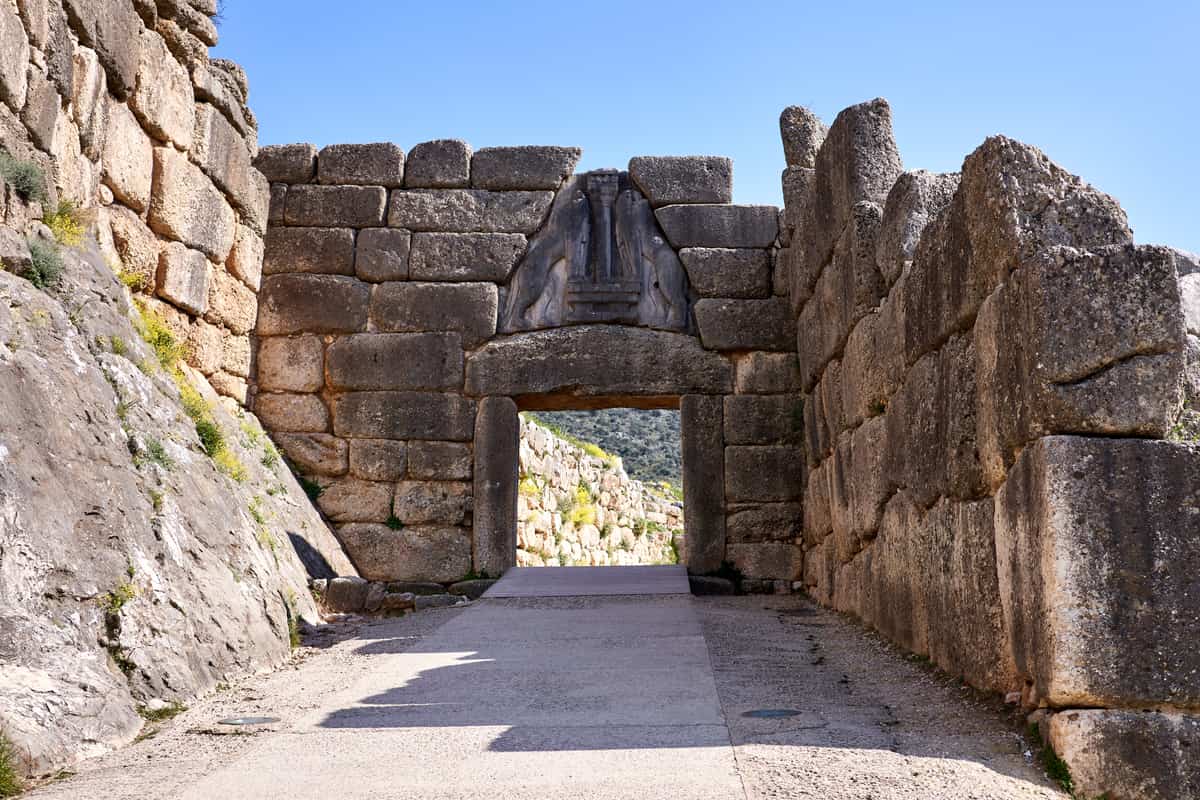
A Mycenae Epidaurus day trip starts with the Lion Gate. It is the main gateway of the old citadel. Above it sits a stone triangle carved with two animals. This relief is the largest sculpture that survives from the Bronze Age Aegean.
The triangular relief block measures 3.60 metres along its base. It stands more than 3 metres high. A relief is a carving that rises from a flat stone surface. It is the only Bronze Age monument in Greece whose carved image was never buried. It has stood in the open since it was made.
On a Mycenae Epidaurus day trip, visitors see a carving with a long written record. It is the only relief of Bronze Age Greece that writers of classical antiquity described. In 1802, Lord Elgin hoped to take it to Britain. The block was too large to lift or carry.
The heads were made of a different material from the bodies. They once looked down at people coming up to the gate. Because the heads were made apart, certain scholars think the animals were sphinxes. A sphinx is a creature with an animal body and a human head.
Between the animals stands a Minoan-type column, in the style of ancient Crete. A row of four discs on top seems to show the ends of roof beams. Other scholars link the lions to the goddess Hera.
A Mycenae Epidaurus day trip shows how the gate was defended. A bastion, a stone tower, guards the west side of the approach. It is 14.80 metres long and 7.23 metres wide. Warriors held shields on the left arm, so attackers had an unprotected right side facing it.
- Narrow court: Between wall and bastion, the path narrows into a court of 15 by 7.23 metres.
- Gateway width: The opening narrows upward and is 2.78 metres wide below the lintel, the top beam.
- Guard room: A small room off a covered court inside the gate seems to be a guard post.
On a Mycenae Epidaurus day trip, the walls around the gate show Cyclopean work. These walls use huge limestone boulders, roughly fitted. Builders used clay mortar or none at all. Smaller chunks of limestone fill the gaps. Scholars have compared the Lion Gate with the gates of Hattusa, the Hittite capital in Asia Minor.
What are the shaft graves on a Mycenae Epidaurus day trip?
A Mycenae Epidaurus day trip passes the shaft graves of Mycenae. A shaft grave is a deep rectangular pit. It has a pebble floor and walls of rough rubble masonry. A roof of wooden planks once covered it from above.
Grave Circle A is a ring of graves. Its shafts are between 1.0 and 4.0 metres deep. The smallest grave measures 3.0 by 3.5 metres. The largest measures 4.50 by 6.40 metres.
On a Mycenae Epidaurus day trip, the gold masks stand out. Seven gold masks came from Grave Circle A. They were found with six adult men and one boy. No woman there was buried with a mask.
Gold masks like these have not been found anywhere else in Mycenaean culture. The Mask of Agamemnon was hammered from one thick gold sheet against a wooden form. Its details were cut in later with a sharp tool.
It is the only face in Mycenaean art with a full pointed beard and a handlebar moustache. The gold Cup of Nestor came from Shaft IV. It weighs 295.8 grams and has a gold bird on each handle.
A Mycenae Epidaurus day trip can include Grave Circle B, 28 metres across. It lies 117 metres west of the Lion Gate. It holds 26 graves. Of these, 14 are shaft graves and the rest are simple cist graves. A cist grave is a small box-shaped grave lined with stone slabs.
- Grave stelae: At least 21 stone grave markers came from Grave Circle A, and 12 carry carved reliefs.
- Stone and date: The stelae are slabs of oolitic limestone from 1600 to 1500 BCE.
- Family link: DNA showed two people in grave Gamma were brother and sister.
Workmen found Grave Circle B by chance in 1951 while digging at the Tomb of Clytemnestra. It came into use about 50 years before Grave Circle A. It shows the first use of stelae as grave markers in Greek lands. Stelae are upright stone slabs set over graves.
What is the Treasury of Atreus on a Mycenae Epidaurus day trip?
A Mycenae Epidaurus day trip includes the Treasury of Atreus at Mycenae. It is a tholos, a round stone tomb with a dome. Its façade is 10.5 metres high. None of the tholos tombs at Mycenae was found intact.
The tomb has three parts. The dromos is the entry passage, 6 metres wide, running east to west. The stomion is the deep doorway. The thalamos is the round burial chamber.
On a Mycenae Epidaurus day trip, the size of the doorway stands out. Two lintel blocks, or top beams, span it. The inner one is 8 metres long, 5 metres wide and 1.2 metres thick. A relieving triangle is an open gap above a lintel that takes weight off the beam.
Builders first dug a cylindrical hole into the hillside. Then they built the corbelled dome inside it, with each stone ring stepping inward. Building the tomb took at least 20,000 worker-days of labour.
Green marble half-columns with zig-zag patterns stood on each side of the door. The façade had red marble called rosso antico. It was later named lapis Taenarius, after Cape Taenarum.
A Mycenae Epidaurus day trip shows a rare side chamber here. A doorway 2.5 metres high leads to it from the main chamber. The side room is 6 metres square. Only the Treasury of Minyas at Orchomenos in Boeotia shares this feature.
- Shepherds: Shepherds once sheltered inside, and smoke from their fires blackened the dome.
- Lord Elgin: He crawled into the tomb through its relieving triangle in 1802.
- Date debate: Arthur Evans and Alan Wace argued over its date in a debate called the “Helladic Heresy”.
A Mycenae Epidaurus day trip visits a site with nine tholos tombs. Five lie west and four lie east of the Panagia ridge. The four eastern tombs are larger and lie closer to the citadel. They are named Aegisthus, Lion, Atreus and Clytemnestra.
What stood inside the palace of Mycenae on a Mycenae Epidaurus day trip?
A Mycenae Epidaurus day trip reaches a palace on the highest point of the citadel. It spreads over man-made terraces. The main building held a large courtyard and a guesthouse. At its centre stood the megaron, the great royal hall.
The megaron had three parts. First came a columned porch, then a front room called the prodomos. The main room was the domos, where the ruler’s throne stood. The throne sat against the middle of a wall beside the hearth.
The open hearth burned in the middle of the hall. Its smoke left through an opening in the roof, called an oculus. On a Mycenae Epidaurus day trip, visitors climb toward this hall. A grand staircase rose from a lower terrace to a courtyard with a columned porch.
The palaces of Mycenae, Pylos and Tiryns share one plan. A large court lined by colonnades sits right in front of the main megaron. A colonnade is a row of columns holding up a roof. The ruins seen today belong to the last of a series of palaces. Earlier ones were cleared away or built over.
Archaeologist Hugh Plommer studied a carved block from the megaron. It had broken into more than forty fragments. The block appeared to be a reddish sandstone. Its blackened edges show that a fire swept through the building. He saw it as part of an abacus, the square top of a porch column.
A Mycenae Epidaurus day trip also shows that the palace was a centre of trade. Workshops and storerooms stood inside the complex, because the palace controlled the supply of goods. In the last building phase, the north storerooms rose against the inner side of the north wall.
- Second hall: Mycenae, Pylos and Tiryns each held a second, smaller megaron.
- Column top: The abacus from the porch measured about 80 cm long and 80 cm wide.
- Linear B: Mycenae has given archaeologists 88 documents in this early Greek script.
Clay tablets from the House of the Oil Merchant, outside the walls, mention workers, oil and perfumes. Archaeologists widely see these buildings as the palace production quarter. A production quarter is an area where goods were made. The House of Columns, explored by Tsountas in 1892, stood on a south-east terrace.
How did Mycenae get water on a Mycenae Epidaurus day trip?
A Mycenae Epidaurus day trip shows how the citadel got water. The main source was the Perseia spring. It still flows today and supplies the modern village. An underground cistern let people reach water during a siege.
Scholars place the Perseia spring 360 m from the acropolis. It sits 13 m higher than the top of the acropolis. The Mycenaeans carried its water in channels to the foot of the hill.
The cistern entrance lies inside the walls, in the north-east corner. A cistern is a tank that stores water. Builders used a natural opening in the rock there. Through it, they reached a cistern built outside the wall. The way down begins under a tall pointed arch.
On a Mycenae Epidaurus day trip, the way down passes a doorway. This doorway has stone side posts and a lintel. A lintel is the flat stone beam across the top. Sixteen steps survive in the first flight, leading to a gate in Cyclopean style. Cyclopean means walls of huge, rough stones.
The passage cuts slantwise through the whole wall to a covered square landing. There it turns west. A second flight of 20 steps leads to another landing. Then the stair turns east and runs beside the wall.
The third flight has 54 steep steps over the last 12 m. This flight, the cistern and the shaft had a double coat of waterproof lime plaster. So the stair also stored water. The vaulted cistern is 5 m deep. Vaulted means it has a curved stone roof.
- Filter shaft: A vertical shaft in the roof, lined with loosely set stones, filtered water from the springs.
- Torch: Visitors can go down into the cistern with the help of a torch.
- Small gates: One guarded the fountain, and one led to a lookout post outside.
A Mycenae Epidaurus day trip also explains the place name. Pausanias wrote that Perseus possibly named Mycenae after the Perseia spring. He found it under the root of a mushroom, called mykes in Greek.
Who was Agamemnon on a Mycenae Epidaurus day trip?
A Mycenae Epidaurus day trip brings visitors to the kingdom of Agamemnon. He is a mythical king first sung by Homer. The Greek culture ministry calls Mycenae “Rich in Gold”. Legends make him king of Mycenae or Argos.
In the myth, the family of Perseus ruled Mycenae for three generations. The last of them died childless. Then the people chose Atreus, son of Pelops, as king. Atreus fathered Agamemnon and Menelaus, called the Atreidae, or sons of Atreus.
One reading of the name Agamemnon is “very steadfast” or “resolute”. Homer’s Catalogue of Ships gives his Mycenaean force 100 ships. That is the biggest number in the list. In the Iliad, he takes the captive Briseis from Achilles. Achilles then refuses to fight.
Visitors on a Mycenae Epidaurus day trip hear different stories of his death. In the oldest versions, Aegisthus, lover of Clytemnestra, killed him. In Homer’s Odyssey, this happens during a feast for his return from Troy. In Aeschylus, Clytemnestra kills him in a bath, trapped in a net.
Aegisthus then ruled Mycenae for seven years. In his twentieth year, Agamemnon’s son Orestes came back. His sister Electra urged him on, and his cousin Pylades joined him. Orestes killed Aegisthus and Clytemnestra.
Hittite texts mention a land to the west called Ahhiyawa. A widely held view now links it to the Mycenaean world. Mycenae is one possible capital, with Thebes and Rhodes as other options.
- Sparta: People there worshipped Zeus under the title Zeus Agamemnon.
- Tomb: Ancient Greeks pointed out a tomb of Agamemnon at Mycenae and at Amyclae.
- Son: Heinrich Schliemann named his own son Agamemnon after the legendary king.
Historian Moses Finley found no evidence for a war leader named Agamemnon. Even Schliemann later accepted doubts about the mask named after the king. He is quoted as saying, “All right, let’s call him Schulze.”
How did Mycenae fall on a Mycenae Epidaurus day trip?
A Mycenae Epidaurus day trip leads to a citadel that fell in stages. Around 1250 BC, buildings near the citadel were attacked and burned. An earthquake hit the same year. A series of major fires then destroyed the rebuilt town in 1190 BC.
Crushed bodies were later found in the buildings that fell in the earthquake. After these first blows, new walls almost doubled the fortified area of the citadel. The hilltop grew stronger, but the danger was not over.
The causes of the final fall are still unknown. Robert Drews thought an attack started the fires. Eric Cline points out that no archaeological evidence of an attack has been found.
Pottery shows that the later town won back part of its wealth before it burned again. Unlike other sites, Mycenae was partly rebuilt. Yet it was no longer the centre of a palace that kept written records.
This destruction ended the time of Mycenae as a major power. Up to 90% of the small sites in the Peloponnese were abandoned. The Argolis lost a large part of its people, and refugees moved to Cyprus and the Levant coast.
A Mycenae Epidaurus day trip also shows later layers on the hill. In the Archaic period, a temple to Hera or Athena stood on the top. In the Hellenistic period, people from Argos set up a village there. They repaired the old walls and the temple.
- Persian wars: Soldiers from Mycenae fought against the Persians at Thermopylae and Plataea.
- Small theatre: Hellenistic settlers built a small theatre over the entrance passage of the Tomb of Clytemnestra.
- Roman visitors: By the time of Roman rule, the ruins had become a tourist sight.
A Roman map, the Tabula Peutingeriana, still put Mycenae in the right place in the 5th century AD. In the Middle Ages, the location was forgotten. Cyriac of Ancona believed he visited in 1447 or 1448, but he saw the fort of Katsingri.
Who dug up Mycenae on a Mycenae Epidaurus day trip?
A Mycenae Epidaurus day trip visits a site dug by Greek and British teams. Heinrich Schliemann first visited Mycenae in 1868. Panagiotis Stamatakis, Christos Tsountas and Alan Wace followed with major finds. George Mylonas and Spyros Iakovidis led later work on the citadel.
French troops surveyed and mapped the site in 1834. In 1841 Kyriakos Pittakis cleared the approach to the Lion Gate.
In March 1874 Schliemann dug 34 test trenches without a permit. The police stopped him. The permit to dig belonged to the Archaeological Society of Athens. So Schliemann was in effect working for the society.
The Greek state sent Stamatakis to watch over the dig. He was a self-taught archaeologist from Varvitsa in Laconia. In November 1877 he dug a sixth shaft grave with two burials.
Tsountas took over the site in 1886 and worked there until 1910. He found seven faience plaques, small glazed pieces, naming the pharaoh Amenhotep III. They gave the first firm proof that the site belonged to the Late Bronze Age.
On a Mycenae Epidaurus day trip, the tombs show the work of Tsountas. Between 1887 and 1898 he dug 103 chamber tombs. He also found three tholos tombs, round stone tombs that nobody had known before.
- Wace: Alan Wace showed that the Tomb of Aegisthus was older than the Treasury of Atreus.
- Linear B: In 1952 his team found the first Linear B tablets from Mycenae. These are clay records in an early Greek script.
- Mylonas: George Mylonas led citadel digs from 1957 until 1985 and named the Cult Center.
Lord William Taylour led the British dig from 1958 to 1969. His team worked mainly on the west slope of the citadel. Spyros Iakovidis took over the excavation in 1985.
What does the museum of Mycenae show on a Mycenae Epidaurus day trip?
A Mycenae Epidaurus day trip can include the museum on the slope of the ancient hill. The building steps down the hillside like a staircase. Its galleries sit on two levels. Ramps join the two levels and make a loop.
Local leaders wanted the museum in the nearby village. Building work started in 1984 and ended in 1997. Work stopped in 1985 for a dig after ancient remains turned up under the south wing.
The European Union and the Greek state shared the cost. Ephor Elisavet Spathari, the head of the local antiquities office, led the project. Between 1998 and 2003, about 35,000 finds moved into the storerooms.
The entrance hall shows how travellers drew Mycenae from the 16th to the 19th century. The first room shows pottery from the end of the Stone Age to the fall of Mycenaean power.
On a Mycenae Epidaurus day trip, the clay idols from the religious centre stand out. Displays rebuild the spots where they and the large Cult Centre fresco, a wall painting, were found. Schliemann believed similar figurines showed the goddess Hera.
The lower level is given to the dead. It holds finds from Grave Circle B and the chamber-tomb cemeteries. The last room covers Geometric, Archaic and Hellenistic grave goods. It also shows finds from the shrines of Enyalios, or Ares, and the Agamemnoneion.
- Figurine names: Psi, phi and tau figurines are named after the Greek letters they look like.
- Warrior Vase: This wine-mixing bowl with marching soldiers is in the National Archaeological Museum in Athens.
- Ivory Triad: Wace found this carving of two seated women and a child in 1939. It is there too.
In Athens, the Mycenaean finds fill Room 4 on the ground floor of the national museum. Stamatakis set up the first public show of the Mycenae finds at the Polytechneion in Athens. He grouped them by the burial they came from.
What is the Sanctuary of Asklepios on a Mycenae Epidaurus day trip?
A Mycenae Epidaurus day trip reaches the Sanctuary of Asklepios, a large ancient healing place. It lies in quiet inland country with a mild climate. The area has plenty of mineral springs. The Greek culture ministry says it had over two hundred dependent spas around the eastern Mediterranean.
A Mycenaean sanctuary of a healing goddess stood on Kynortion hill. It lasted from the sixteenth century BC until the eleventh century BC. Around 800 BC a sanctuary of Apollo replaced it. People worshipped him here as Apollo Maleatas.
The sanctuary in the plain lies about one kilometre north-west of that hill. Pilgrims first entered from the north. They passed through the Propylaia, a large Doric gate of the third century BC.
The temple of Asklepios was built in 380-370 BC. Its building started the great construction programme of the sanctuary. The east pediment, the carved triangle above the front, showed the fall of Troy. The west pediment showed Greeks fighting Amazons.
The painter Pausias decorated the Tholos. His picture showed Eros laying down his bow and arrows to pick up a lyre.
- Tholos columns: An outer ring of 26 Doric columns circled an inner ring of 14 marble Corinthian columns.
- Artemis temple: This small temple dates from the end of the 4th century BC. It had six Doric columns across its front.
- Water spouts: The Artemis temple had spouts carved as boar and dog heads, not the usual lions.
During a plague in 293 BC, Rome sent envoys here. A sacred snake they took home led to a temple on Tiber Island. Worship continued after an official ban in 426 AD. Earthquakes in 522 and 551 AD left the sanctuary abandoned.
Why is the theatre of Epidaurus special on a Mycenae Epidaurus day trip?
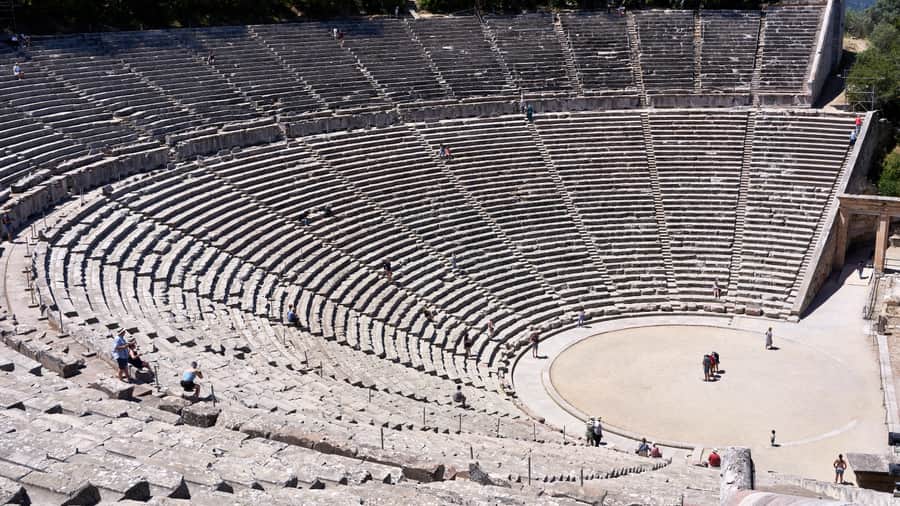
A Mycenae Epidaurus day trip includes the ancient theatre, built around 340-330 BC. The Greek culture ministry gives that date. Building happened during a general rebuilding of the sanctuary. The theatre stayed in use until at least the 3rd century AD.
The first auditorium, or seating area, held about eight thousand people. It was enlarged in the middle of the 2nd century BC. Retaining walls built of poros stone hold up the seating.
Thirteen stairways climb the lower seating, and 23 climb the upper seating. Seats with backrests line the first and last rows below. They also line the first row of the upper part. Each side entrance had a monumental gate with two doors.
The front of the raised stage, the proskenion, had Ionic half-columns. Five openings were later cut in the upper floor of the stage building. They led onto the logeion, the platform where actors played. Painted panels between pillars changed the scenery for each play.
Visitors on a Mycenae Epidaurus day trip find a careful plan. It is based on a regular pentagon, a five-sided shape, with the orchestra drawn inside it. One claim concerns the upper and lower row numbers, two Fibonacci numbers. Their ratio is about 1.619, close to the golden ratio.
A 2007 study at the Georgia Institute of Technology looked at the seat rows. They shape the sound mainly when the theatre is not full. Eindhoven University of Technology took over ten thousand sound measurements in three ancient theatres, including Epidaurus.
- Whisper test: In the Eindhoven tests, a stage whisper was clear only from the front row.
- Paper and coins: Tearing paper or a falling coin was heard only about halfway up the seats.
- Restoration work: Conservation teams rebuilt the west entrance gate and the two orchestra rainwater drains.
Pausanias admitted that Roman theatres were more splendid. He said the theatre at Megalopolis in Arcadia was bigger. Still, the round orchestra gives a strong idea of the first theatre shape in Athens. The Olivier Theatre in London copied Epidaurus, with fan-shaped seats for 1,160 people.
What is the Epidaurus Festival on a Mycenae Epidaurus day trip?
A Mycenae Epidaurus day trip passes the home of the Epidaurus Festival. World War II had stopped all shows in the ancient theatre. Organised theatre shows began there again in 1954. Katerina Evangelatos became the festival’s artistic director in 2019.
In its first years, the Hellenic Tourism Organisation managed it with the Athens Festival. For about twenty years, the National Theatre of Greece took the plays. Actors included Anna Synodinou and Mary Aroni.
Director Spiros Evangelatos staged plays there for the National Theatre from 1971 to 1977. In 1980 his Amphi-Theatre company brought Menander’s comedy Epitrepontes. That year the Theatrical Organization of Cyprus played Euripides’ Suppliants. Nikos Charalampous directed it.
Greek festival artists include painter Yiannis Moralis and composers Mikis Theodorakis, Yannis Markopoulos and Iannis Xenakis. Foreign artists include Tadashi Suzuki, Pina Bausch, Fiona Shaw and Gérard Depardieu.
Fans on a Mycenae Epidaurus day trip hear stories of famous nights. Irene Papas played Electra here in 1985. In 1988 Peter Hall brought Cymbeline, The Winter’s Tale and The Tempest by Shakespeare. In 1996 his masked Oedipus premiered here before moving to London.
Peter Stein directed Sophocles’ Elektra for the festival in 2007. On 25 July 2020, Aeschylus’ The Persians streamed live on YouTube. That date marked the 2,500th anniversary of the Battle of Salamis.
- Music for Eumenides: Nikos Xanthoulis wrote the music for Aeschylus’ Eumenides in August 2004.
- Rock for Bacchae: In 2021 the band Thrax Punks scored Euripides’ The Bacchae, directed by Nikaiti Kontouri.
- Stage sets: Kleovoulos Klonis made sets for Epidaurus and worked on over 500 productions with Antonis Fokas.
Singers have stood on this stage too. José Carreras gave a recital at the theatre in 1993. As a student, Nana Mouskouri was barred from singing here. The reason was that she also sang light music.
How did healing work at Epidaurus on a Mycenae Epidaurus day trip?
A Mycenae Epidaurus day trip reaches a sanctuary where the god Asklepios was thought to heal. Sick people washed with water from a Sacred Well. Then they slept on the bare ground inside a hall. They hoped for a cure from the god in a dream.
The sanctuary grew up around that Sacred Well. Builders later placed the well inside the portico of the Abaton. A portico is a long porch with columns. The Abaton was the hall where patients slept, in touch with the god’s underground home.
The healing sleep was called enkoimesis. It copied the death and rebirth of divine powers. These powers went back inside the earth. During the sleep, the god or a sacred animal appeared to heal or show a cure.
Asclepius was thought to visit sleepers as a dog, a rooster or a snake. The Aesculapian snake takes its name from the healing god. It is a harmless constrictor, a snake that squeezes its prey. It grows up to 2 m long.
An inscription names Perillos as the architect of the Abaton. Builders raised it in two phases in the 4th century BC. The second phase doubled its length as the cult grew more famous. Its front had 31 Ionic columns.
Ionic columns are slim columns with curled, scroll-like tops. A cult means the worship of one god at one holy place. More pilgrims meant the hall needed more room.
Stone tablets called iamata told the god’s miracles and hung inside the Abaton. One tells of Hermon of Thasos, healed of blindness. He failed to bring his thank-offering, so he went blind again.
A thank-offering was a gift to the god after a cure.
- Apellas: A stone tells how Marcus Julius Apellas had nine days of baths, exercise and a special diet.
- Headaches: For his headaches, Apellas ate celery with lettuce, honey with milk and dill with oil.
- Illnesses: Healing inscriptions mention pregnancy problems, arthritis, blindness, paralysis and wounds.
Emperor Hadrian made the priesthood at Epidaurus a yearly post chosen by lot, not a job for life. A Mycenae Epidaurus day trip shows the ground where this system ran.
What other buildings stand at Epidaurus on a Mycenae Epidaurus day trip?
A Mycenae Epidaurus day trip shows more than the theatre. The sanctuary also holds a grand gateway and a huge guest house. A stadium, a dining hall and a small temple stand nearby. A round building called the Tholos completes the group.
Visitors entered from the north through the Propylaia, a grand Doric gateway of the third century BC. Doric columns are plain and sturdy. Panagiotis Kavvadias dug up this gateway in 1884, along with the Temple of Artemis.
The Katagogion was the guest house for pilgrims and the largest building of the sanctuary. It formed a square about 76 metres on each side. Four equal squares filled it, each around a courtyard with Doric columns.
Pilgrims were people who travelled to a holy place for worship or a cure. They needed a place to stay near the god.
On a Mycenae Epidaurus day trip, the stadium shows ancient sport. Low posts split its track into 6 equal parts. Together they made about 181 metres, the length of one stadion. Stone seats came from the 3rd century BC, over older seats of clay and small stones.
A building called the Gymnasium was really a hall for ritual meals. Couches in its rooms and remains of fires and food prove this. Later, an Odeion, a small concert hall, rose in its courtyard. It had 9 rows of seats and a mosaic floor.
The Tholos went up between 365 and 335 BC. Its building inscription calls it the Thymele. It measured 22 metres across. Under its floor, ring-shaped corridors with blocking walls forced anyone inside along a winding, maze-like path.
- Tholos columns: An outer ring held 26 Doric columns, and an inner ring held 14 marble Corinthian ones.
- Paintings: Pausanias saw paintings by Pausias, including Eros putting down his bow to pick up a lyre.
- Baths: The Roman senator Pythodorus paid for the north-east baths in the 160s and 170s AD.
The small Temple of Artemis rose at the end of the 4th century BC. Six Doric columns lined its front. Its rain spouts showed wild boars and dogs instead of lions. These animals suited the hunting goddess.
What does the museum of Epidaurus show on a Mycenae Epidaurus day trip?
A Mycenae Epidaurus day trip leads past the site museum, founded in 1897 by the Archaeological Society. Its finds run from the Archaic period to Roman times. They include inscriptions, medical tools, reliefs, large statues and small offerings.
The Society built it between 1898 and 1900. The long building stands between the ancient theatre and the sanctuary. It sits on the south side of a small stream. Inside are an entrance hall and two long, narrow rooms.
Panagiotis Kavvadias set up the display. He packed objects in close rows, as museums did in the early 20th century. Large parts of the Propylaia, the Temple of Asclepius, the Temple of Artemis and the Tholos stand rebuilt.
The only Tholos piece still on show is a Corinthian capital, the carved top of a column. It was found carefully buried near the building. Experts think it was a model for stonemasons.
On a Mycenae Epidaurus day trip, two marble slabs reveal building costs. One, 182 cm tall, lists the contracts and pay for the Temple of Asclepius. The other, 212 cm tall, does the same for the Tholos.
A headless statue of Hygieia stands 159 cm tall and dates from around 160 AD. A snake winds up beside her. Her right hand once held a bowl of food for the snake, experts believe.
- Messalina: A 163 cm statue copies a type from about 420 BC and is thought to show Messalina.
- Casts: Plaster casts replace statues of Hygieia, Aphrodite and Asclepius kept in the National Archaeological Museum in Athens.
- Nike: Timotheos carved the 85 cm Nike of Epidaurus around 380 BC, and it holds a partridge.
The Nike once stood at the top of the west pediment of the Temple of Asclepius. A pediment is the triangle above a temple front. That west side showed Greeks battling Amazons.
What are the walls of Tiryns on a Mycenae Epidaurus day trip?
A Mycenae Epidaurus day trip can pass the walls of Tiryns, a Bronze Age fortress in the Argolid. Its Cyclopean walls run for about 750 m in all. Cyclopean means built from huge rough stones.
In the Early Bronze Age, 2500-2000 BC, a huge round building stood on the summit. It measured 28 m across. Apsidal houses, meaning houses with one rounded end, ringed it.
The walls went up in three main building phases. The first phase dates from the early 14th century BC. Builders used red and grey limestone from the hill itself. They took stone from the Profitis Ilias hill to the east.
The gates show how the walls changed. The first gate turned up in a 1909 dig, below the later great gateway. Around the middle of the 13th century BC, a new outer gate went up. It matched the Lion Gate of Mycenae in size and in its conglomerate stone.
Conglomerate is a rock made of small pebbles stuck together.
The last phase came in the second half of the 13th century BC. Then galleries joined the south and east walls. Corbelled stones, each set a little further in, met in pointed arches. The outer gate moved to a spot between two arms of the east wall.
Inside the walls stood a palace with painted walls. Cyclopean tunnels led to storerooms and workshops. UNESCO’s first criterion, or test, names these walls as outstanding examples of human creative genius. The Lion Gate and the Treasury of Atreus share that praise.
- Myth of the twins: Proetus lost Argos to his twin Acrisius, then won Tiryns with a Lycian army.
- Heracles: In one myth, Heracles went mad and threw Iphitus from the walls of Tiryns.
- Earthquakes: Digs in the Lower Citadel tied the decline of Tiryns to 12th century BC earthquakes, not invaders.
The Lower Citadel wall holds 28 rooms with square plans and pointed ends. An earthquake at the end of the 13th century BC damaged the larger part of them. They were closed after it. These rooms add depth to a Mycenae Epidaurus day trip.
What does Argos add to a Mycenae Epidaurus day trip?
A Mycenae Epidaurus day trip can add Argos, a living city. It had 21,891 residents in the 2021 census. Its sights include an ancient theatre, an agora, a market square, and a museum. A castle tops the Larisa hill.
At least 5,000 people lived in Argos in 700 BC. Up to 30,000 lived there in the fourth century BC. The name links to the old Greek word argós, meaning “white” or “shining”.
Legend gives another story. Argus, the third king, gave the city his name. Before him it was Phoronikon Asty, the “Citadel of Phoroneus”. Strabo wrote that the Larisa hill took its name from a group of Pelasgians. The Pelasgians were a people the ancient Greeks placed in Greece before themselves.
The theatre is a high point of a Mycenae Epidaurus day trip stop in Argos. Its central section has 83 rows of seats cut into the rock. Stairways cut the seating into four wedges, one for each tribe of Argos.
The orchestra, the round floor for the chorus, was first a full circle 26 m across. A carved circle and lines helped the chorus keep its place. The Charonian stairway, an underground passage, let actors playing the dead appear there.
The stairway took its name from Charon. In Greek myth, Charon ferried the dead to the underworld.
In the fourth century AD the orchestra became an artificial lake. It held water sports and mock sea battles. On 15 July 1829 the theatre hosted the 4th National Assembly of the new Greek state.
- Agora: The market square grew where roads from the Heraion, Corinth and Tegea met.
- Square hall: A hall 32.75 by 32.75 m, roofed on 16 Ionic columns, rose about 460 BC.
- Museum: Its Lerna Room shows a tiny clay figure, one of Europe’s oldest sculptures of the human body.
Argos holds modern history too. Demetrios Ypsilantis captured the castle on Larisa in 1821. A monastery on the hill briefly struck coins as the national mint. A mint is the place where a state makes its money. These layers make Argos a strong stop on a Mycenae Epidaurus day trip.
What is the Heraion of Argos near a Mycenae Epidaurus day trip?
A Mycenae Epidaurus day trip can reach the Heraion of Argos, a sanctuary of the goddess Hera. It was founded in the middle of the 8th century BC. It sits on the slopes of a hill called Aetovouno.
In Homer’s Iliad, Hera names three towns she loves best. They are Argos, Sparta and Mycenae. A built Mycenaean road about 5 km long linked the sanctuary area with Mycenae.
The paved upper terrace measures 55.80 m by 34.40 m. The old terrace wall copies Cyclopean masonry from Mycenae. In 1903 E. L. Tilton noted that the Argives used bigger stones than the Mycenaeans did. The Argives were simply the people of Argos.
The archaic Doric temple had columns all round. There were 14 on each long side and 6 on each short side. It had no back porch. A separate room served as its inner shrine instead.
Doric is a plain Greek building style. Its columns have simple tops with no carved scrolls.
On a Mycenae Epidaurus day trip, the Heraion shows early building types. Two Doric stoas, or long roofed walkways, rose on the middle terrace in the early 6th century BC. They are the oldest of their type. The West Building, used for feasts, had three dining halls.
The new Doric temple was the work of the architect Eupolemos. Only its foundations can be seen today. Polykleitos made its gold-and-ivory cult statue. Hera sat holding a pomegranate and a sceptre topped by a cuckoo. A cult statue was the main holy image that people worshipped.
- Other images: The temple held a small Hera image of wild pear wood from Tiryns.
- Dating: Argos counted years by the list of the Heraion’s priesthoods.
- Discovery: General Thomas Gordon found the Heraion in 1831 and dug there in 1836.
Later, Charles Waldstein led four excavation campaigns across the whole sanctuary. He published The Argive Heraeum in 1902. His work helps explain the Heraion on a Mycenae Epidaurus day trip.
What nature lies along a Mycenae Epidaurus day trip?
A Mycenae Epidaurus day trip crosses the Argolis, a land of mountains, springs and wetlands. Oligyrtos rises in the north-west. Lyrkeio and Ktenia stand in the west, and Arachnaio and Didymo close the east. Each area holds its own plants and animals.
Mount Arachnaio covers the larger part of the central Argolis. Its south side is bare, but its north side still holds pine forests. Mount Didymo wears low plants, led by a juniper called “venio” in the Peloponnese. Plane trees line its northern stream beds.
Artemisio rises to 1,771 m in the west. Lyrkeio reaches 1,648 m. Scrub grows lower down, with meadows and conifer woods higher up. The Natura site GR2510004, a European nature protection area, covers 11,477.38 hectares here. Golden eagles, short-toed eagles and common eagle owls hunt over it.
At Kefalari, about 6 km from Argos, a large karst spring flows between plane trees. Karst means water-worn limestone. The Lerna spring near Myloi is a 16.70-hectare lake-spring. Part of its water runs to the sea among reeds. Pumps send the rest to the plain of Argos.
In the Early Bronze Age, Lake Lerna was a freshwater lagoon behind sand dunes, about 4.7 km across. The Tolo Bay wetlands cover 676.89 hectares. One holds fresh water and one holds brackish, or slightly salty, water. European pond turtles and migrating birds shelter there.
- Palamidi rock: Natura site GR2510003 protects 366.16 hectares of Akronafplia and Palamidi, home to Campanula andrewsii.
- Lizards: The Peloponnese wall lizard lives nowhere else and grows to about 8.5 cm long.
- Kantia marsh: This spring-fed marsh holds great reed warblers, moorhens and penduline tits.
- Trimpa hill: This limestone hill near Nea Epidavros wears tree spurge scrub beside an Aleppo pine forest.
Farms add to the scene on a Mycenae Epidaurus day trip. Argos is famous for its own melon, the Argitiko. The Nafpliou olive grows in the valley of Argos as a table olive. At Epidaurus, channels once carried spring water from Mount Kynortion to the sanctuary.
When is the best time of year for a Mycenae Epidaurus day trip?
A Mycenae Epidaurus day trip works best in March or December, when days in Argos stay mild. Summer heat in the Argolis can reach extreme levels. Winter brings cold nights and heavy rain. Mild months suit walking among the ruins.
The Greek weather service keeps its Argos climate averages at the Pyrgela station. The figures cover the years 1980 to 2010. March days average 17.4 °C, with nights at 4.3 °C. December days average 15.5 °C, and December nights 4.8 °C.
Summer is the hot season for a Mycenae Epidaurus day trip. Across a whole day and night, Argos averages 25.1 °C in June and 26.8 °C in August. Argos hit 46.3 °C on 3 August 2021.
Winter nights turn cold. January nights average 3.0 °C, and February nights drop to 2.9 °C. Below-zero readings come mainly at night in winter. Snow is rare. The last big snowfall came in early January 2017.
Rain follows the cold months. December brings 69.7 mm of rain. January averages 66.5 mm over 10.3 rainy days. February averages 52.5 mm over 10.1 rainy days. Yearly totals swing between 300 and 800 mm.
- March rain: March still gets 52.2 mm of rain over 9.7 rainy days.
- Humidity: Air humidity in Argos averages 52.5% in July and 77.3% in December.
- Nea Epidavros: The landscape near Epidaurus has weak winds, strong sunshine and dry spells.
Summer nights stay mild, with July at 16.7 °C and August at 16.8 °C. A Mycenae Epidaurus day trip in March or December avoids the summer heat and the deepest winter cold.
What do travelers want to know about a Mycenae Epidaurus day trip?
A Mycenae Epidaurus day trip raises questions about names, ages, tombs, walls, myths and protection. Mycenae carries an old pre-Greek name. Its hill holds round tombs and huge walls. Epidaurus is tied to Asklepios, and both sites enjoy strict legal protection.
What does the name Mycenae mean on a Mycenae Epidaurus day trip?
Experts think the name Mukanai is not Greek. It is a pre-Greek place name that later Greek speakers kept. Homer linked the name to the nymph Mycene. She was a daughter of Inachos, the river god of Argos. In the Iliad, the city is spelled Mykene.
How old are the sites on a Mycenae Epidaurus day trip?
People first lived on the Mycenae hill in the seventh millennium BC. At Epidaurus, a sanctuary of a healing goddess rose on Kynortion hill in the sixteenth century BC. It sat on a village of 2800 to 1800 BC.
What is a tholos tomb seen on a Mycenae Epidaurus day trip?
A tholos, or beehive tomb, has three parts. These are a stone-built round chamber, a doorway called the stomion and a passage called the dromos. After about 1500 BCE, builders cut these tombs into hillsides. Nine have been found at Mycenae, four near Grave Circle B.
What are the Cyclopean walls of a Mycenae Epidaurus day trip?
Cyclopean walls are made of huge, rough limestone boulders fitted loosely. Small chunks of limestone fill the gaps. The walls stand on very shallow beds carved into the bedrock. Pliny’s Natural History repeats an old story credited to Aristotle. It says the Cyclopes, mythical giants, invented stone towers.
Who was Asklepios at the heart of a Mycenae Epidaurus day trip?
The local story made his mother Koronis a granddaughter of Malos, a king of Epidaurus. In one myth, Koronis left her baby on Tittheion, a mountain near Epidaurus. A goat fed him, and the herd’s dog watched over him. The original Hippocratic Oath of doctors swore by Asclepius, Apollo, Hygieia and Panacea.
How are the sites of a Mycenae Epidaurus day trip protected?
The UNESCO World Heritage property at Epidaurus covers 1,393.8 hectares. A buffer zone of 3,386.4 hectares surrounds it. No building is allowed in the fully protected zone, so the view stays almost whole. At Mycenae and Tiryns, the law bans building inside the site borders and keeps the farmland around them.