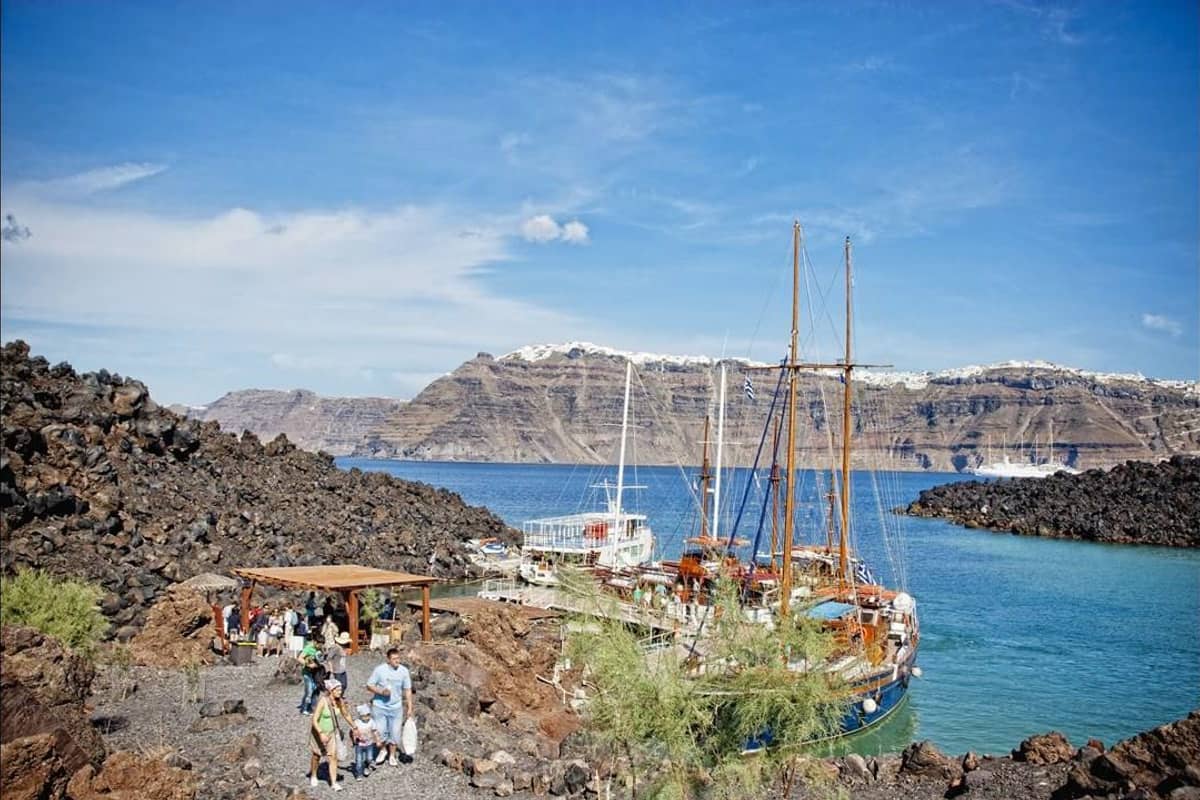
A Santorini volcano tour is a trip to the volcanic islands in the flooded caldera of Santorini. The islands hold black lava, a crater and hot springs. It is one of the Greece Tours on Greece Ville.
This post covers what a Santorini volcano tour is, how Nea Kameni was built and what the hot springs show. It also covers monitoring, the underwater volcano Kolumbo and the gases and minerals. Life on the islands, the hazard plan and common questions come last.
The sections include Santorini volcano tours and related boat trips that can be booked online.
What is a Santorini volcano tour?
A Santorini volcano tour visits a continental arc caldera, a huge sunken volcano flooded by the sea. The flooded caldera covers 84.9 km² and holds about 27 km³ of seawater. Its islands keep remains of old lava shields, domes and cone volcanoes.
Santorini grew mostly from lava outpourings and dome-building eruptions. Now and then, huge blasts laid down ignimbrite, a rock made from hot ash flows. Geologists call the layers from these major explosive eruptions the Thera Pyroclastics.
A Santorini volcano tour helps visitors read these layers. The Lower Pumice 1 eruption took place about 184 thousand years ago. At Cape Balos West, a large volcanic bomb from it survives. This lump of thrown lava is still pressed into the layers below.
A reservoir more than 10 km below the surface feeds magma into a shallower chamber. One study estimates this chamber holds about 122 km³ of magma. If it is a flat, sill-like body, it is about 4 km in radius and 2 km thick.
Magma is melted rock that stays underground. Once it reaches the surface, people call it lava. A sill is a flat sheet of magma squeezed between rock layers.
A typical single eruption on the Kameni islands brings up only about 0.06 km³ of magma. Rare eruptions top 30 km³. For these, about one quarter of the chamber’s magma must be squeezed out. The caldera floor then sinks like a piston.
The northern caldera wall of Thera shows at least 63 dykes, sheets of frozen magma. The thickest is about 5 m wide. Roughly 130 m of sediment covers the caldera floor. Kameni lava and ash make up the bulk of it.
- Chemistry: Kameni lava has kept a steady chemical make-up for about the last 2,000 years.
- Sea level: A 2021 study linked eruptions to a sea-level fall to 40 m below today’s.
- Reason: Less water then pressed down on the magma chamber.
A Santorini volcano tour links cliffs, deep chamber and sea floor into one living system. Each layer records a past eruption. The young Kameni islands show the newest chapter of that long history.


How is Nea Kameni built on a Santorini volcano tour?
A Santorini volcano tour lands on Nea Kameni, about 1,430 metres west of Thira. The Kameni islands are the tops of a mostly underwater lava shield. It rises almost 470 m and covers about 21 km². Domes, flows and craters shape its surface.
The Kameni eruptions poured out dacite, a thick, sticky lava. It formed domes, blocky lava and channels with raised banks called levees. Lava that reached the sea cooled into round pillow lavas.
Each lava flow has a name. The Niki lava flowed east and the Fouqué lava north. The Ktenas, Reck and Smith lavas moved west and south-west. They filled the old Agios Georgios Bay. A Santorini volcano tour crosses this rough ground.
The Theran doctor Iosif Dekigalas named the Georgios cone, still the island’s highest landform. The Ktenas dome honours geologist Konstantinos Ktenas. He watched the eruptions and later founded the Geological Service of Greece.
The Smith dome honours an American volcanologist, and the Reck dome German geologist Hans Reck. The Nautilos dome formed east of the Dafni cone. Lava from later eruptions now buries it.
Two steam-driven explosions opened the twin crater below the Georgios dome summit. Gases leaving its upper part are 75 to 95 °C. Sulphur-laden fumes have turned the nearby ground into a “yellow desert”. Sulphur is a yellow mineral carried up in volcanic gas.
- Mikri Kameni crater: This north-east crater is about 102 by 95 m and 31 m deep.
- Crater walls: Its steep dacite walls have no fumaroles, or gas vents.
- Protected land: Both Kameni islands and Profitis Ilias form NATURA site GR4220003, covering 1264.25 hectares.
- Plant records: Botanists on seven trips since 1911 recorded 156 species of ferns and seed plants.
Life returns slowly on a Santorini volcano tour landscape. The barren lava holds pioneer plants. Fig trees survived the 20th-century eruptions. Hyparrhenia hirta grass and blue lupin give a steppe look. Atriplex halimus shrubs spread from the mid-1980s. The first mastic seedlings have appeared.
Pioneer plants are the first plants to grow on bare ground. A steppe is open land covered mainly by grass.
What do the hot springs show on a Santorini volcano tour?
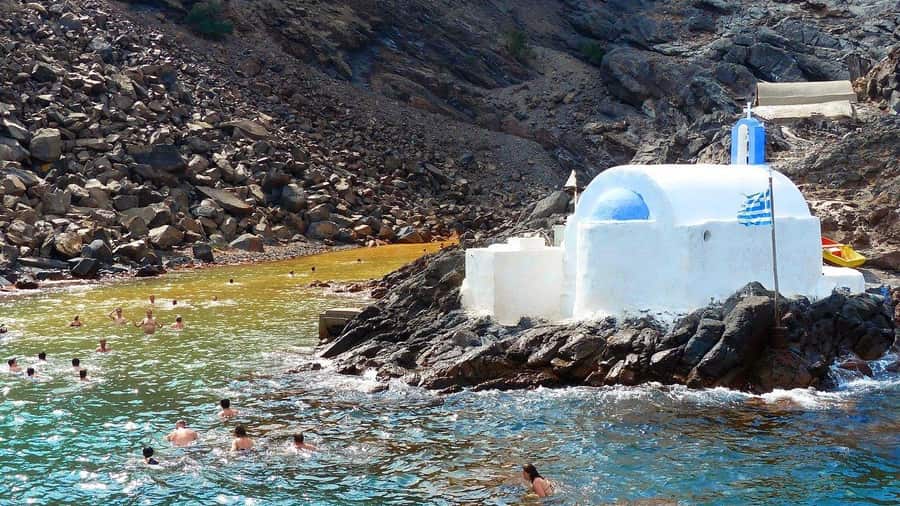
A Santorini volcano tour ends at warm bays where hot water seeps into the sea. This water stays below 35 °C. It is acidic, with a pH below 6. The springs show that heat and minerals still rise from the volcano.
Spring water sampled between 1982 and 1997 kept a stable average chemical make-up. Among South Aegean Volcanic Arc hot-water centres, the Kameni springs carry the highest manganese and iron. These metals reach about a thousand times their level in seawater.
Iron explains the water’s colour. When oxygen-poor water meets oxygen, iron bacteria turn dissolved iron into reddish-brown slime. This slime can stain clothing. Microbes play an essential part in cycling iron in these shallow bays.
The mud holds 927 ppm of arsenic and 3.21 ppm of antimony. Ppm means parts per million, a measure of tiny amounts. Microbes here have become resistant to these toxic metals.
Scientists isolated Marinobacter santoriniensis from iron-rich sediment here. That sediment was full of stalk-shaped cells and iron-eating Zetaproteobacteria. The bacterium carries genes to detoxify arsenate and mercury. Researchers also found 101 heat-loving bacterial strains near the volcano.
Fat-digesting enzymes from the best strains worked best at 70 or 80 °C. The sea around both Kameni islands has a hard floor with hot springs and vapour columns. Known seafloor vents sit around the caldera ring faults or the Kameni volcano.
Enzymes are natural helpers that speed up chemical changes in living things. Ring faults are cracks around the caldera edge where the ground slipped down.
- Older system: Seabed cores show a stronger hot-water system lasting about 1,100 years between two major eruptions.
- Metal levels: In that system, arsenic and mercury reached about 200 times background levels.
- Yearly output: It released about 9 tonnes of arsenic and 2.5 tonnes of copper a year.
- Comparison: That output matched Taupo Volcanic Zone geothermal fields today.
A 1988 drill hole on Palea Kameni passed through 200 m of oxidised lava and volcanic sediment. It never reached rock changed by hot fluids. On a Santorini volcano tour, the warm bays reveal a quieter system. The past one was far stronger.
How do scientists watch the volcano on a Santorini volcano tour?
A Santorini volcano tour crosses a caldera that scientists watch closely. An institute called ISMOSAV runs the observatory and its sensor networks. Land sensors watch quakes, ground movement and gases. Robots and seafloor gauges add data from under the sea.
ISMOSAV stands for the Institute for the Study and Monitoring of the Santorini Volcano. It was set up as a non-profit body in the summer of 1995. Its networks were first installed in 1993 under a European research programme.
The networks cover four kinds of measurement: seismological, geodetic, geophysical and geochemical. In plain words, sensors track quakes, ground height, ground heat and gas chemistry. Greece has no public body for volcanic hazard, so ISMOSAV fills that gap.
The caldera went through unrest in 2011–2012 after a long quiet. Unrest means signs of movement inside a volcano. GPS and satellite radar measured parts of the Kameni islands rising nearly one centimetre a month. Experts placed the Kameni centre at the first stage of the yellow advisory level.
Models put the source of the swelling 1.5 km north of Nea Kameni. It sat 4 km below the northern basin. A magma chamber is a large pocket of molten rock underground. New magma raised the chamber volume by only about 0.02%. Yet pressure rose by about 1.1 MPa, bringing the chamber roof close to breaking.
Gas from Nea Kameni and Palea Kameni showed a helium isotope ratio rising from 3.6 to 4.0 Ra. This ratio compares two forms of helium gas. This signalled fresh magma below. A national scientific committee saw two possible paths. One was a quiet fade without eruption. The other was renewed activity at Kameni.
- Robot submarine: On 21 July 2012, an experimental robot submarine surveyed the northern basin of the caldera.
- Seafloor gauge: A pressure gauge from the French institute IPGP measured the up-and-down movement of the seabed.
- Gas pools: Scientists suggest tracking carbon dioxide pools on the caldera slope as an extra warning tool.
Kolumbo, a nearby undersea volcano, has its main earthquake sources 6 to 9 km deep. Land seismographs on Santorini locate these quakes without sensors inside the cone. Every Santorini volcano tour crosses waters watched from land and sea.
What is Kolumbo near a Santorini volcano tour?
A Santorini volcano tour passes near Kolumbo, an undersea volcano. Kolumbo erupted in 1650 with deadly gas and a tsunami. Today its crater holds hot vents and orange microbial mats. Scientists study it with research ships and deep-sea robots.
From March 1650, people on nearby islands felt damaging earthquakes and underground roaring. The shaking peaked around 14 September. By 27 September, plumes rose above the sea. Rafts of pumice, a light rock full of air holes, floated on the water.
Explosions began on 28 September. The ash cloud made lightning and threw out glowing rocks. Ash piled on roofs until houses collapsed. Victims at sea or on the north-east coast of Santorini choked on acidic gases.
The blast was heard at least 400 km away, at the Dardanelles. A tsunami ran up to 20 m high on the south coast of Ios. On Santorini, the sea flooded up to 2 km² of the east coast. It badly damaged Kamari and Perissa.
Seismic scans show about 1.2 km³ of Kolumbo’s north-west flank slid 500 to 1000 m downhill. A flank is the side slope of a volcano. Scientists think this slide set off the main explosion. The eruption ended on 6 December 1650, when the water cleared.
The research ship E/V Nautilus studied the crater in 2010. Its robots Hercules and Argus made the first detailed survey. Vents were intense in 2010 but had almost stopped in 2011. Scientists compare this to the volcano breathing.
- Vent names: Scientists named the main vents Politeia, Champagne, Diffuser II and Poet’s Candle.
- Clear fluids: The spires are not black smokers, since they give off clear, shimmering fluids.
- Microbial mats: Orange to brown iron-rich mats cover a crater area of about 600 by 1200 m.
Life thrives in the crater. The hottest sediments reach 99 °C, home to heat-tolerant Firmicutes bacteria. Pseudomonas bacteria from 430 m and 495 m deep cope with acid and heavy metals. A Santorini volcano tour floats above this deep, hot world.
What gases and minerals mark a Santorini volcano tour?
A Santorini volcano tour crosses waters shaped by carbon dioxide, sulphur gases and metal-rich minerals below the surface. Kolumbo’s vents release strong gases. Its chimneys hold pyrite and even gold. Old pumice and rock layers record past eruptions.
Gas bubbling from Kolumbo’s vents is more than 99% carbon dioxide. It carries traces of hydrogen sulphide, methane, hydrogen and carbon monoxide, plus striking mercury. The dissolved gas turns the deepest crater water acidic, down to pH 5.0. This acidic layer is about 15 m thick.
In 2012, survey dives found carbon dioxide pools called Kallisti Limnes. They are 1 to 5 m wide and lie 235 to 250 m deep. They sit within 1 km of Oia. Their water measured 21.5 °C, about 5.5 °C warmer than the sea around them.
The pool fluid held about 100 times more carbon dioxide than nearby seawater. Its pH was 5.93, which is mildly acidic. The pH scale shows how acidic water is. Lower numbers mean stronger acid. The pools shine iridescent white because their mats hold about 10% amorphous opal.
In historic Kameni eruptions, sulphur dioxide was the main harmful gas at first. Hydrogen sulphide took over later. It smells strongly at first, then quickly deadens the sense of smell. People then stop noticing it.
The main minerals in Kolumbo’s chimneys are barite, galena, sphalerite and pyrite. Pyrite is nicknamed fool’s gold. Its name comes from the Greek for a stone that strikes fire. Arsenic sulphides paint red, orange and yellow patches on the chimneys.
- Precious metals: Chimney samples hold up to 32 mg of gold and 1,910 mg of silver per kilogram.
- 1650 pumice: Pumice from the Kolumbo eruption is rhyolite with 73.7 to 74.2% silica.
- Caldera dykes: The dykes in the northern caldera wall range from andesite to trachydacite.
On a Santorini volcano tour, these light stones and warm gases tell the story of a living volcano.
What lives on and around the islands of a Santorini volcano tour?
A Santorini volcano tour crosses young islands born from the sea. Botanists rank them among the world’s best examples of such land, with Anak Krakatau in Indonesia. Scientists study how life takes over new ground there. Plants, lichens, lizards, rabbits and gulls all live on them.
Botanists found slightly more kinds of ferns and flowering plants on young Nea Kameni. Older Palea Kameni has slightly fewer. Short-lived annual plants make up the bulk of plant kinds there and on Aspronisi. Annuals live for one season only.
The last eruption covered part of Nea Kameni’s older lava with fresh pumice ash. Pumice ash is light, holey volcanic rock broken into small grains. That ash became key ground for the first plants. Their spread also depends on lava age, recent ash fall and soil richness.
On a Santorini volcano tour, the lava itself carries life too. Lichens, tiny crusts on rock, are more common here than on nearby Paros. Pioneer lava lichens grow only on young lava fields. Stereocaulon vesuvianum is common, and in places abundant.
Rabbits live on Nea Kameni, with two colonies of the seagull Larus cachinnans. The Aegean wall lizard, Podarcis erhardii, rests on black lava rock. These lizards are darker than those on other islands studied. Their color hides them from hunting birds.
- Plant communities: Botanists sorted the cover into seven groups, four on Palea Kameni and three on Nea Kameni.
- Older island: Palea Kameni has low evergreen scrub, and livestock grazing presses it hard.
- Sea plants: Cymodocea nodosa and Ruppia cirrhosa grow at Palea Kameni but remain unrecorded on the main island.
Five kinds of hunting birds live on Nea Kameni. They come from the buzzard, falcon, barn owl and crow groups. People from Thira once farmed there between eruptions. Both islands belong to the Natura 2000 site GR4220003, a protected nature area.
What does the hazard plan say about a Santorini volcano tour?
A Santorini volcano tour takes place inside an area with hazard plans. Maps mark zones for thrown rocks, earthquakes, explosions, lava flows and ash fall. Planners expect a new vent on Nea Kameni or the sea between the Kameni islands. Authorities can limit access there during a crisis.
Greece’s civil protection service lists the dangers of an eruption. They include thrown rock, mudflows, landslides, earthquakes, toxic gases, ash fall and tsunami. Mudflows are fast streams of wet ash and mud. A tsunami is a large sea wave. Pyroclastic flows, fast clouds of hot gas and rock, are listed too.
Hazard maps by Vougioukalakis, Papazachos, Lekkas and Antonakos show an expected case and a worst case. A worst case shows the strongest event that planners prepare for. They serve the public, civil authorities and land-use planners. No towns lie close to the expected vent. Large ships passing near Nea Kameni risk thrown rocks.
A fast ash and gas study was made during the 2011-2012 unrest. Its expected eruption is slow lava growth over one to two years. Steady weak explosions send ash up to 3 km. Its largest case is a strong sub-Plinian blast with a 12 km column lasting 4 hours.
Ash and gas hazard is higher to the south and east, near key tourist and transport hubs. Ash falls are far more expected at the port than at Oia. On a Santorini volcano tour, sea vents matter too. Waters around them need closing to boats because of blasts and gas.
- On land: Anyone near an eruption leaves at once for higher ground and follows evacuation orders.
- On the coast: Visitors move to higher ground, as caldera cliff landslides can send small tsunamis to Athinios.
Geothira, a town council body, manages the National Geological Park of Nea Kameni and its volcanic trail. A volcanic trail is a marked footpath across the volcano. Low hazard in the north and north-west suits emergency response centres. Local families keep evacuation plans that follow official instructions.
What do travelers want to know about a Santorini volcano tour?
A Santorini volcano tour raises common questions about how active the volcano is and its past eruptions. Visitors also ask whether warning signs come before a new eruption. They wonder what terms like caldera, dacite and pumice mean. Volcanologists, geologists and civil protection experts give clear answers.
Is the volcano on a Santorini volcano tour still active?
Volcanologists call a volcano active if it erupted in the Holocene. That epoch began about 11,700 years ago. Greece’s civil protection service names Santorini and Nisyros as active volcanoes. A hazard study says Santorini is in an effusive phase, meaning lava flows out calmly. Dacite lava activity centres on the Kameni islands.
What were recent eruptions like near a Santorini volcano tour?
Nea Kameni took its present shape in its last eruption, after seven eruptive phases. Its historic explosions were small and weak compared with other volcanoes of its kind. Certain eruptions began with weeks of quiet lava growth. Others had explosions in their first weeks.
What is the caldera seen on a Santorini volcano tour?
The word caldera comes from Spanish caldera and Latin caldaria, meaning “cooking pot”. German geologist Leopold von Buch brought it into geology after his 1815 visit to the Canary Islands. Calderas form rarely. Only nine caldera-forming collapses are known between 1911 and 2022.
What is the dacite rock of a Santorini volcano tour?
Austrian geologist Franz von Hauer and a colleague first used the name dacite. It appeared in their book on the geology of Transylvania. The reference site for this rock is the Gizella quarry near Poieni, in Romania. Mount St. Helens in the United States holds dacite domes from earlier eruptions.
What is the pumice found on a Santorini volcano tour?
Pumice forms when very hot, high-pressure rock blasts out of a volcano. It cools and loses pressure so fast that its gas bubbles freeze in place. The name comes from Latin pumex, related to spuma, meaning “foam”. People once called it spuma maris, “froth of the sea”.
Do warning signs come before an eruption on a Santorini volcano tour?
Every historic Kameni eruption had warning signs, such as felt earthquakes and slow sinking of the vent area. Hot fluids changed too. Crystals in lava from the 1925-28 eruption show fresh magma arrived 3 to 10 weeks before. Volcanologists Pyle and Elliott expected discoloured sea and a rise of the volcano days to weeks ahead.