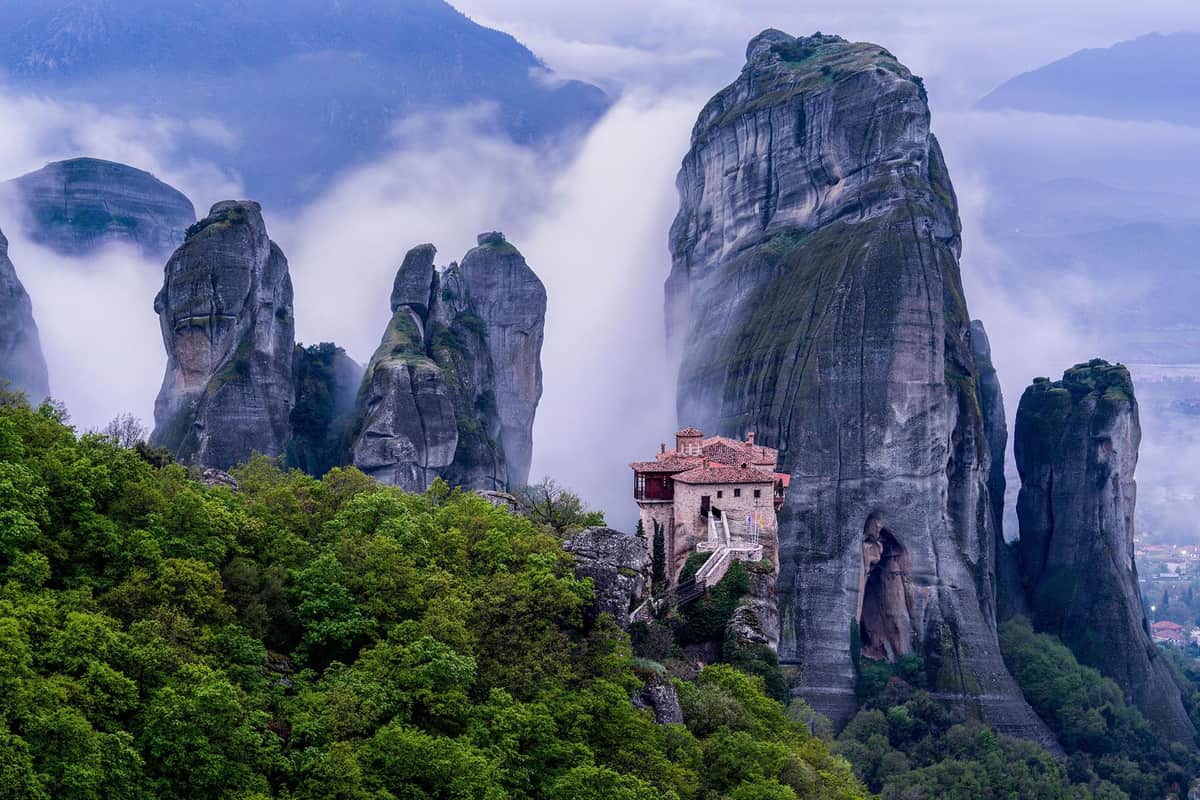
A Meteora day trip from Athens takes visitors from the capital to the rock monasteries of Meteora in Thessaly. The monasteries stand on tall rock pillars above the town of Kalambaka. It is one of the Greece Tours on Greece Ville.
This post covers what a Meteora day trip from Athens is, how the route works and how the rocks formed. It also covers the six monasteries, the first monks, the history and the art. Nature, nearby places, the best season, films, protection and common questions come last.
The sections include Meteora day trips and related Greece tours that can be booked online.
What is a Meteora day trip from Athens?
A Meteora day trip from Athens is a same-day journey to the rock towers near Kalambaka. The towers belong to Antichasia, a range covered in forest. Antichasia lies in the eastern foothills of the Pindus mountains. Every rock there carries its own name.
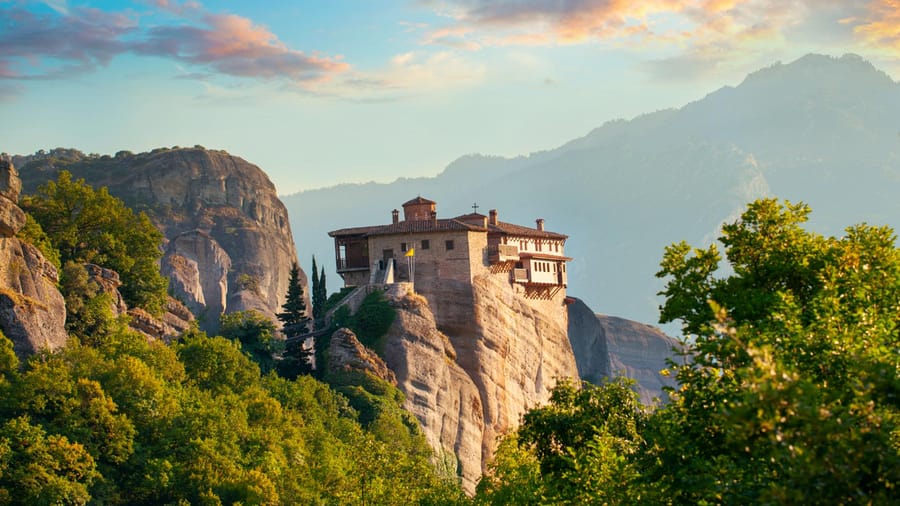
The Antichasia range runs about 45 km from east to west. Its highest point reaches a height of 1,424 m. A Meteora day trip from Athens brings visitors into these wooded hills.
Meteora is one of only three World Heritage Sites in Greece listed as mixed. Mixed means it is honoured for nature and culture. UNESCO listed Meteora under five criteria. One of them, criterion (vii), is a nature criterion. It was given because the area has exceptional natural beauty.
UNESCO calls the goal of a Meteora day trip from Athens a place where nature and culture meet. Together they create “a natural work of art on a monumental, yet human scale”. Meteora was added to the list at the 12th session of the World Heritage Committee. Its file carries the number 455.
The rock of Megali Agia, meaning “Large Aya”, rises to 630 m above sea level. The Agio Pneuma and Surloti rocks both reach 600 m. Ypsilotera Rock stands next to the Devil’s Tower and rises to 585.7 m.
A Meteora day trip from Athens also enters a municipality of the same name. It had 19,274 residents at the 2021 census. It covers 1,658 square kilometres. It was formed in 2011 by merging eight former municipalities.
- Toichos: The four Toichos rocks range from 480 m at Toichos Alpha to 540 m at Toichos Gamma.
- Dupiani Rock: This lower rock rises to 390 m above sea level.
- Psaropetra: This rock name means “Fish Rock”.
- Marmaro: This rock, whose name means “marble”, is crossed by the paved road from Kastraki to Kalabaka.
The Trikala regional unit is split into four municipalities, and Meteora is one of them. The goal of a Meteora day trip from Athens therefore lies in this regional unit.


How does the route work on a Meteora day trip from Athens?
A Meteora day trip from Athens runs north by road or by rail. Drivers follow the A1 motorway, then switch to the A3 towards Trikala. Trains use the Athens to Thessaloniki line. Both routes pass old towns, mountains and wide plains.
Thebes lies about 100 km south-east of Lamia. By the middle of the 12th century, it was the biggest silk producer in the Byzantine Empire. It was ahead even of Constantinople. A Meteora day trip from Athens passes this old silk town.
The A1 motorway crosses the border between Boeotia and Phthiotis. North of that border, it runs close to the Aegean coast. A Meteora day trip from Athens by road then reaches Lamia. In the Middle Ages, Lamia was called Zetounion, a name first recorded in 869.
From Lamia, the southern A3 section runs 32.5 km to Xyniada. The next A3 section, from Xyniada to Trikala, is 80 km long. It opened to traffic on 22 December 2017. A Meteora day trip from Athens by car uses both sections.
Between Lamia and Xyniada, the Othrys road tunnel passes under the mountain. It is 2.9 km long, the longest road tunnel of the A3. Mount Othrys peaks at Gerakovouni, 1,726 m above sea level. In Greek myth, it was the Titans’ base in their ten-year war with the Olympians.
On the Athens to Thessaloniki railway, the Tithorea to Domokos section was rebuilt. The work cut its length from 121.60 km to 107.33 km. The new line runs through the 9.3 km Kallidromo Tunnel. It is the longest tunnel in the Balkans.
- Opening: The first railway stretch north, from Athens to Demerli, today’s Palaiofarsalos, opened in 1908.
- Palaiofarsalos: The station, whose name means “Ancient Pharsalus”, stands in Stavros village, 12 km west of Farsala.
- Metre-gauge line: The old narrow line from Velestino to Kalambaka was 142 km long.
Farsala lies 44 km north of Lamia and 41 km east of Karditsa. In 48 BC, the Roman generals Julius Caesar and Pompey fought a major battle there. A Meteora day trip from Athens by rail passes close to this battlefield.
How were the rocks formed on a Meteora day trip from Athens?
A Meteora day trip from Athens shows rock towers made from old layers of stone. A study in the journal Geoheritage explains how the spires began. Erosion in the Pleistocene, a period of Earth’s past, cut down into a flat, worn land surface.
The International Union of Geological Sciences calls Meteora one of the world’s finest molasse deposits. Molasse is the name for sandstones, shales and conglomerates, or pebble rocks. Molasse is laid down on land or in shallow seas in front of rising mountain chains.
The sand and stones of Meteora collected in the Mesohellenic Trough, a basin inside the Greek mountain chain. This basin stretches about 300 km, with 150 km of it in Greece. In the Miocene period, its southern edge reached past Meteora, under today’s Trikala plain.
In the Miocene, an area called the Pelagonian zone rose sharply. It sent down the coarse material that became the conglomerates seen on a Meteora day trip from Athens. The Meteora rocks belong to the Pentalophos Formation, which dates from the Upper Oligocene to the Lower Miocene.
The Pentalophos Formation is up to about 4,000 metres thick. It is mostly thick beds of sandstone. Its conglomerates come in all sizes and grow very large at Meteora. The Lower Meteora Conglomerates formed as fan-deltas, where streams spread gravel into water.
The Upper Meteora Conglomerates are mostly river deposits. The conglomerates were laid down in a Gilbert-type delta, a steep delta at a river mouth. Large channels cut through this delta.
- Size: The Meteora pinnacles are about 200 metres high and up to 300 metres wide.
- Göreme: An IUCN review contrasts Meteora with Göreme in Turkey, where volcanic lava and tuff form the cones.
- Cave: St George of Mandila cave, on Holy Spirit Rock, sits about 30 m above the ground.
The Geoheritage study links the spires to ten key geological events over nearly a billion years. Pieces of blueschist, a rock from the deep layers of Mount Olympus, sit in the deposits. A Meteora day trip from Athens therefore reveals a very long story in stone.
What is the Great Meteoron on a Meteora day trip from Athens?
A Meteora day trip from Athens leads to the Great Meteoron, a monastery on a rock. The rock was once known as the Broad Rock. Athanasios gave it the new name Meteoro. The Orthodox Church honours Athanasios as a saint on 20 April.
Athanasios was born in New Patras, today the village of Ypati, in 1302 or 1303. He gave the community on the rock a strict shared rule. That rule followed the Typikon, the rule book of the Mount Athos monasteries.
His pupil John Uroš, a former Serbian ruler, became the monk Joasaph. In 1387/88 Joasaph built a new church on the spot of the first one. In 1544/5 a new and larger church went up. The old church became its sanctuary, the area by the altar.
The main church that visitors see on a Meteora day trip from Athens follows the Athos plan. It is shaped like a cross and stands on four columns. Rounded side wings, called choroi, flank it, and an entrance hall sits on the west.
Abbot Symeon had the main church painted in 1552. He built the dining hall in 1557. So he counts as the third founder of the monastery. The painters of 1552 left no names. Experts mainly credit the Cretan painter Tzortzis, thought to be a pupil of Theophanes.
Only one painting from the 14th century survives at this stop of a Meteora day trip from Athens. It is a Last Judgement on the outer north wall of the old church. The old church was painted in 1483.
- Net tower: It held the net machine that once lifted monks up.
- Museum: The old cellar, called the vagenareio, now shows objects from daily life.
- Small chapel: The vaulted chapel of St John the Baptist has wall paintings from 1682.
On a Meteora day trip from Athens, the Great Meteoron shows the work of three founders. Athanasios started the community. Joasaph built a new church, and Symeon had the main church painted.
What are Varlaam and Roussanou on a Meteora day trip from Athens?
A Meteora day trip from Athens can include Varlaam and Roussanou, two monasteries of Meteora. Roussanou stands by the road from Kastraki to Meteora. It sits between St Nicholas Anapausas and Varlaam. Its buildings cover the whole flat top of its rock.
Varlaam on a Meteora day trip from Athens tells the story of the Apsarades brothers. In 1518 they rebuilt the chapel of the Three Hierarchs from the ground up. It rose on the spot of the first church of Varlaam.
Before Meteora, the brothers founded the monastery of St John the Baptist on the Island of Ioannina. In 1536 they built the tower that holds the winch, a turning drum, for the lifting net.
On a Meteora day trip from Athens, Varlaam’s present main church is dedicated to All Saints. It was built in 1541. In 1548 the famous painter Frangos Katelanos painted its sanctuary and nave. In 1566 Georgios Kontaris and his brother Frangos, both from Thebes, painted the entrance hall.
The chapel of the Three Hierarchs was rebuilt in 1627. In 1637 the priest Ioannis and his children, a team from Kalambaka, painted it. Varlaam’s last paintings date from 1780 and 1782. Around then it ran a book-copying workshop and received rich gifts from the princes of Wallachia.
Visitors on a Meteora day trip from Athens reach Roussanou over two solid bridges from 1930. They replaced a wooden bridge from 1868. In the mid-16th century, the brothers Ioasaph and Maximos from Epirus rebuilt its ruined church. Bessarion, the Metropolitan or chief bishop of Larissa, gave his consent.
- Archive: In the 18th century the monk Christoforos sorted Varlaam’s valuable archive and copied historical texts.
- Church date: The two brothers from Ioannina built the present church of Roussanou in 1545.
- Paintings: The culture ministry ranks them among the top mature works of the Cretan School at its peak.
In the 19th century Roussanou declined. It became a hermitage, a quiet retreat, for the monks of Varlaam. The Archaeological Service restored it in the 1980s. In 2015 more than 10 nuns lived at Roussanou, a stop on a Meteora day trip from Athens.
What are Holy Trinity, St Stephen and St Nicholas Anapausas on a Meteora day trip from Athens?
A Meteora day trip from Athens can reach Holy Trinity, St Stephen and St Nicholas Anapausas. Written records show that Holy Trinity existed in 1362. At St Nicholas, the wall paintings are the oldest known signed work of Theophanes.
Holy Trinity owns 124 manuscripts, or handwritten books, kept at St Stephen since 1953. They include the old books of the Anapausas and Roussanou monasteries. Behind the church, a balcony sits at the highest point of the rock. It gives a rare view of the other monasteries and rocks.
St Stephen is another stop on a Meteora day trip from Athens. Unconfirmed accounts name the hermit Jeremias as its first founder, in 1191/2. The first builder was the monk Antonios Kantakouzinos, who later became its abbot.
Later the monk Philotheos of Sklataina rebuilt St Stephen from its foundations. In 1545 it gained the special rank of a stavropegic monastery and kept it until 1743. Its new church is dedicated to St Charalambos.
At St Nicholas Anapausas, the tiny chapel of St Antonios dates from the 14th century. It keeps traces of wall paintings. In the first decade of the 16th century, two church leaders rebuilt St Nicholas and its present church. They were Metropolitan Dionysios of Larissa and Nikanor, exarch of Stagoi.
On a Meteora day trip from Athens, St Nicholas shows the work of the Cretan painter Theophanes Strelitzas. He painted its church in 1527. His signature sits over the door into the nave. It reads “by the hand of Theophanes the monk, Strelitzas of Crete”.
- Feast days: The old church of St Stephen opens to pilgrims only on 27 December and 10 February.
- Modern art: Bare until the 1980s, the new church walls now show works by the icon painter Tsotsonis.
- Rotunda: At Holy Trinity, the chapel of St John the Baptist is round and cut into the rock.
At St Nicholas, a Meteora day trip from Athens reveals a rare scene of Adam naming the animals. The monastery was abandoned in the first decade of the 20th century and began to fall into ruin.
Who were the first hermits and monks of a Meteora day trip from Athens?
A Meteora day trip from Athens reaches rocks where hermits and monks lived for centuries. Certain Greek accounts name a hermit called Varnavas as the first settler. He founded the Skete of the Holy Spirit in 950-970. A skete is a small settlement of monks.
The monks behind a Meteora day trip from Athens belong to a wider story. UNESCO says that in the fourteenth and fifteenth centuries, monks revived the hermit ideals of early Christianity. It happened in the Orthodox Church and the West, as in Tuscany.
Athanasios the Meteorite was baptised with the name Andronikos. Around 1319, Catalan troops took his home town. Mount Athos first turned him away, because he was too young to become a monk.
In Constantinople he met Gregory of Sinai and Isidore Buchiras, who urged him on towards the monastic life. He became a monk at 30 in a remote skete on Mount Athos and took the name Athanasios.
Turkish pirates kept raiding Mount Athos, so Athanasios left with the monks Gregory and Moses. A bishop, once a pupil of Gregory of Sinai, advised them to go to Meteora. They first lived on top of a rock called Stylos, or Pillar. A Meteora day trip from Athens enters the land where the three settled.
Hesychasm is a monks’ prayer tradition that took its final form at Mount Athos in the 14th century. It seeks inner stillness through the Jesus Prayer, said without a break. The prayer runs: “Lord Jesus Christ, son of God, have mercy on me, the sinner.”
- Semantron: St Stephen keeps a fixed wooden block that is struck to call the monastics to prayer.
- Prayer rope: A standard Orthodox rope has 33 knots, one for each year of Christ’s life.
- Leaders: A hegumen heads an Orthodox monastery, and a hegumenia heads a convent of nuns.
The Swiss photographer Frédéric Boissonnas photographed the net lift at Meteora in 1908. Varlaam still used its old basket and windlass, a hand-turned winch, for renovation work in 1961-1963. Such old lifts belong to the history of a Meteora day trip from Athens.
What history does a Meteora day trip from Athens pass?
A Meteora day trip from Athens passes a long history of rulers, rebels and wars. A ruler named Simeon Uroš backed the first Meteora monasteries. He was born around 1326 and was nicknamed Siniša. He also used his mother’s family name, Palaiologos.
In 1356, Nikephoros II Orsini forced Simeon to flee to Kastoria. There Simeon declared himself Emperor of Serbs and Greeks. His son, John Uroš, was the last emperor with that title. He was also the last Serbian ruler of Thessaly.
Later, Manuel Angelos Philanthropenos lost Thessaly to the Ottoman sultan Bayezid. The Ottoman border lord Turahan Bey led the conquest of Thessaly. Greek sources tie a decline in monastic life at Meteora to this conquest.
Yet the monasteries saved monuments through the centuries of Ottoman rule. They also saved works of post-Byzantine art, made after the Byzantine era. A Meteora day trip from Athens reaches the monasteries that did this work.
The rocks of a Meteora day trip from Athens later gave shelter. In the eighteenth and nineteenth centuries, they were a refuge from harsh Ottoman officials. Members of the Greek independence movement hid there too. The Greek culture ministry says Rousanou sheltered persecuted people and families in hard times.
Thymios Vlachavas was a leader of klephts, or Greek rebels, born in Vlachava around 1760. He planned a large uprising against Ali Pasha in 1808, but it was betrayed. Ali Pasha caught him by a trick and had him executed and quartered. Vlachavas died in 1809.
- St Dimitrios: In 1809 Ali Pasha destroyed this monastery, because Greek rebels led by Vlachavas hid there.
- Memorials: A statue of Vlachavas stands near the former Ypapantis Monastery, and a bust stands in Kalambaka.
- St Stephen: Easier to reach than the others, it was damaged and abandoned during the Second World War.
In the Greek Civil War that followed, communist rebels destroyed a great number of St Stephen’s wall paintings. In 1976, Abbot Alexios left Great Meteoron for Xenophontos Monastery on Mount Athos, with 17 of its monks. This is the history a Meteora day trip from Athens passes.
What art does a Meteora day trip from Athens show?
A Meteora day trip from Athens shows frescoes, or wall paintings, of great weight in art history. UNESCO calls Theophanes the Cretan the founder of the Cretan School of painting. His frescoes at Meteora became the basic reference for post-Byzantine painting. Their influence was wide and lasting.
Theophanes was born in Heraklion on Crete and died there on 24 February 1559. In 1730, Dionysius of Fourna wrote a painting manual. It names Theophanes as the model for painters to copy.
The Cretan school grew up while Crete was under Venetian rule. It led Greek painting in the 15th, 16th and 17th centuries. A large number of Cretan painters signed their works, which was not a Byzantine custom. The work of this school is part of a Meteora day trip from Athens.
Frangos Katelanos and Theophanes knew the Palaiologan models, a late style of Byzantine art. Despite strong Italian influence, they laid the foundations of post-Byzantine wall painting. Katelanos was born in Thebes and ran a workshop based in Ioannina.
Older art also survives along a Meteora day trip from Athens. The church of Ypapanti holds frescoes from 1366/67. The hieromonk, or priest-monk, Neilos paid for them with the monk Kyprianos. They rank among the leading wall paintings of the second half of the fourteenth century.
St Stephen is a monastery on a Meteora day trip from Athens. In the 17th century, the priest and painter Nikolaos Kastrisios worked there. At the wish of Abbot Gregorios, he added a second layer of frescoes to its old church.
- St Nicholas Anapausas: A large Last Judgement covers the north wall of its entrance hall.
- Varlaam: Its museum shows carved wooden crosses, icons and embroidered church cloths called epitaphia.
- Great Meteoron: One of its icons shows the Hagia Sophia of Constantinople in the background.
Ypsilotera was also called the Monastery of the Calligraphers, or experts in fine handwriting. It was famous for its manuscripts, or hand-written books. Varlaam owns over 300 manuscripts. Books join paintings in the art of a Meteora day trip from Athens.
What nature surrounds a Meteora day trip from Athens?
A Meteora day trip from Athens reaches a large protected nature zone. The Meteora rocks count as part of Antichasia, a forested mountain range. Birds of prey, tortoises, bats and rare plants live across the wider area.
A Meteora day trip from Athens enters the Natura 2000 site GR1440003, a protected nature area. It covers 61,837 hectares. A second Natura 2000 area, GR1440005, protects birds over 71,859 hectares. It was set up in 1997.
Antichasia starts at the Mourgkani valley and ends at the Titarisios valley. Both valleys feed the Pineios river. North-west of Antichasia rises the Chasia range. Its highest peak, Kratsovo, reaches 1,564 m.
The protected area is an Important Bird Area. It holds the largest population of Egyptian vultures in Greece. Birds of prey around a Meteora day trip from Athens include black kites and booted eagles. Lesser spotted eagles, lanner falcons and long-legged buzzards are found here too.
Short-toed eagles breed here, with 7 to 10 pairs. Peregrine falcons, with 4 to 5 pairs, live in the area all year. Levant sparrowhawks arrive to breed, with 14 to 30 pairs. A breeding colony of little egrets holds 20 to 50 pairs.
Centaurea kalambakensis is a knapweed that grows only at Meteora. The plant numbers between 600 and 2,500. Anthemis meteorica, a local chamomile, was listed as “Rare” on the IUCN Red List of 1993. A Meteora day trip from Athens also crosses the home of at least 1,000 Hermann’s tortoises.
- Oak forests: Turkey oak and sessile oak cover 33,611 hectares, the largest habitat in the site.
- River woods: Oriental plane woods cover 773 hectares, and willow and white poplar line the rivers.
- Reptiles: Marginated tortoises and leopard snakes also live in the site.
The same Natura site that frames a Meteora day trip from Athens includes Melissotrypa Cave. It is the largest known bat colony in Greece, with at least six bat species. Counts there reached 3,400 Myotis bats and 2,300 Schreibers’ bent-winged bats.
What else is near a Meteora day trip from Athens?
A Meteora day trip from Athens sits in a region rich in history and mountain life. Old churches, a Stone Age cave and an Ottoman mosque stand in the wider area. Aromanian villages, also called Vlach villages, dot the nearby mountains.
The Kalambaka cathedral of the Dormition holds late 16th-century frescoes. A donor inscription names the painters as Neophytos, son of Theofanes Strelitzas-Bathas, and Kyriazes. The marble pulpit is the only one of its kind still standing. It was rebuilt from pieces of an Early Christian basilica’s pulpit.
Vlachava is an Aromanian village 910 m above sea level. Its hill overlooks Kalambaka and the monasteries seen on a Meteora day trip from Athens. The village counted 169 residents in 2021.
Theopetra Cave opens about 100 metres above the plain, at 280 metres above sea level. Digging there began in 1987 under the archaeologist Nina Kyparissi-Apostolika. In 2016, scientists read the DNA of two Stone Age people buried there. Their remains date to 7605–7529 BCE and 7288–6771 BCE.
Trikala adds an Ottoman chapter to a Meteora day trip from Athens. Its Osman Shah Mosque was completed in 1570. It is the only building in modern Greece by Mimar Sinan, the great Ottoman architect. Its prayer hall sits under a dome 18 m across.
Pyli lies 18 km west of Trikala. Its church of Porta Panagia was founded in 1283 by John Doukas, ruler of Thessaly. The Portaikos bridge at Pyli was built in 1514 and is 67 m long. Until 1936, it was the only link between the plain and the Pindus villages.
- Varousi: Trikala’s old Christian quarter below the castle is a protected area of 17th to 19th-century houses.
- Matsopoulos Mill: Built in 1884, this Trikala museum turns into the “Mill of Elves” at Christmas.
- Metsovo: Called Aminciu in Aromanian, Metsovo is the largest centre of Aromanian life in Greece.
Theopetra Cave Museum stands in Theopetra village, a short walk from the cave. People kept using the cave from time to time right up to 1955. Both sites add deep history to a Meteora day trip from Athens.
When is the best time of year for a Meteora day trip from Athens?
A Meteora day trip from Athens works best in spring or autumn. Regional weather records show mild days in April and October. Summer brings strong heat and little rain. Winter brings cold nights, wet days and much less sunshine.
Weather records from the Trikala Castle station show a clear yearly pattern. April averages a high of 20.5 °C and a low of 8.7 °C. A Meteora day trip from Athens in April meets fresh, mild air.
July in Trikala averages a high of 33.5 °C and a low of 20.3 °C. It is also the driest month, with only 17.0 mm of rain. The hottest reading at Larissa, the capital of Thessaly, is 45.5 °C, reached in July.
July is the sunniest month there, with 334.8 hours. December gets only 97.2 hours. Humidity at Larissa falls to 46% in July and rises to 82% in December. A Meteora day trip from Athens in July meets long, bright and dry days.
A Meteora day trip from Athens in September still meets summer warmth. Trikala then averages 30.6 °C highs and 17.3 °C lows. October averages 24.6 °C highs and 12.1 °C lows. Rain returns in autumn, with 73.1 mm in October and 75.6 mm in November.
A Meteora day trip from Athens in winter meets cold air. January in Trikala averages a high of 10.7 °C and a low of 1.8 °C. February is the wettest month, with 80.2 mm of rain. The coldest reading at Larissa is −21.6 °C, reached in January.
- Rainy days: Larissa averages 10.4 rainy days in December and 3.5 in July.
- Wind: Larissa winds blow mostly from the east, but from the north in December and January.
- Winter snow: Pyli, at the foot of the Pindus, gets snowfalls averaging 30–40 cm each year.
Spring and autumn sit between the hot, dry summer and the cold, wet winter. Both seasons suit long walks among the Meteora rocks. Mild air makes them the best time for a Meteora day trip from Athens.
What films and writers link to a Meteora day trip from Athens?
A Meteora day trip from Athens visits rocks that film crews, musicians and writers know. Film makers came here to shoot scenes on the cliffs. A band and a TV series took ideas from the place. Travelers and historians wrote about the monks and their rocks.
A Bond film was shot from September 1980 to February 1981. The crew moved to Meteora in October. In the story, the villain hides in “St Cyril’s”, an abandoned monastery on a mountaintop. A Meteora day trip from Athens passes the same cliffs seen on screen.
A Greek Supreme Court case found the monks owned only the monastery interiors. The outside and the landscape belonged to the local government. In protest, the monks hung washing out of the windows to spoil the shots. They covered the main monastery in plastic bunting and flags.
The film crew fought back with back lighting and painted backdrops called matte paintings. They built a copy of the monastery on a nearby empty rock and a studio set. In the climax, Bond climbs the rock to reach Kristatos. Roger Moore feared heights and drank a little to calm his nerves.
Other films used the rocks seen on a Meteora day trip from Athens. In Boy on a Dolphin, Clifton Webb’s character goes up to Holy Trinity monastery for library research. The rescue scenes of the 1976 film Sky Riders were filmed here. James Coburn, Susannah York and Robert Culp starred in it.
- Tintin: The French film Tintin and the Golden Fleece, from 6 December 1961, visits San Stefano monastery.
- Music: Linkin Park named its second album, released on March 25, 2003, after the Meteora monasteries.
- Television: Meteora inspired the Eyrie in the Game of Thrones TV series.
French consul François Pouqueville said that the old name Stagoi meant “to the saints”. The name came from the hermits in the rock caves. Historian Donald Nicol first saw the monasteries in 1944–1945. He later wrote the book Meteora: The Rock Monasteries of Thessaly.
What protects the site seen on a Meteora day trip from Athens?
A Meteora day trip from Athens enters a site with strong protection. World Heritage status, Greek laws and building zones all guard the rocks. State offices care for the monuments and nature areas. Crowds of visitors still put pressure on the site.
Meteora shares its mixed status with two other Greek sites. They are Mount Athos and Mount Olympus.
Criterion v covers a traditional way of using the land. Such land use has become exposed to change that cannot be undone. The site seen on a Meteora day trip from Athens meets this test.
Greek law 2351/1995 declared Meteora a “Sacred, Holy and Immutable Site”. Immutable means it must not change. The law protects its monuments and its spiritual character. Law 4858/2021, the Greek code for antiquities and cultural heritage, also covers the site.
A 2005 Ministry of Culture and Sports decision, number 70206/3687, marked out the archaeological site. It holds the rock pillars. In Zone A, new building is banned around the monastery complex. In Zone B, building in Kastraki and Kalambaka must follow rules that protect the setting of the rocks.
- Ephorate of Antiquities of Trikala: This office of the Ministry of Culture and Sports manages the cultural heritage.
- NECCA: This national agency, created in 2020, runs the Thessaly unit that manages nature areas overlapping Meteora.
- Geopark: Meteora lies inside the Meteora-Pyli UNESCO Global Geopark, which covers 2,409.5 km² of western Thessaly.
- Visitor centre: The local municipality runs one centre for all the monasteries.
A 2007 study by Lyratzaki, cited by IUCN, counted around two million visitors a year. IUCN calls the large crowds the gravest threat, through disturbance and waste. Visitors on a Meteora day trip from Athens can help by taking their waste away.
What do travelers want to know about a Meteora day trip from Athens?
A Meteora day trip from Athens raises common questions. Travelers ask about the height of the rocks and the number of monks. They ask about climbing, natural risks and new building. They also ask who pays to keep the monasteries in good repair.
How high is the tallest rock on a Meteora day trip from Athens?
On a Meteora day trip from Athens, the tallest named rock is Agia, at 630 m. Its other names are Megali Agia and “Large Aya”. Agio Pneuma and Surloti come next, at 600 m each. Dupiani is the lowest named rock, at 390 m. It held the first skete, a small monk community.
What number of monks live at the monasteries seen on a Meteora day trip from Athens?
Monk numbers have changed over time. In 1614, the Holy Monastery near Ypsilotera had more than 20 monks. It is now in ruins. In 1911, the Britannica said no more than four monasteries held more than two or three monks. Saint Nicholas Anapafsas has had just one monk living there since 2015.
Can visitors go rock climbing on a Meteora day trip from Athens?
More than 100 rock formations at Meteora carry climbing routes, with and without bolts. In the 1970s, German climber Dietrich Hasse agreed terms with the government. Climbers were free to use every formation except six monastery towers. Since the area was declared sacred, climbing and hang-gliding are allowed only on certain cliffs.
Is the site of a Meteora day trip from Athens at risk from earthquakes or fire?
Earthquakes in the last four centuries were frequent but caused no serious damage. Old faults show quakes of 6.3 to 6.5 magnitude, from ancient times up to the 15th century. The Greek fire risk map rates the area class C, a moderate risk. Fires tend to start lower down in summer.
Will new building spoil the views on a Meteora day trip from Athens?
Solar parks have been refused inside protected zones because they spoil the view. A 400-megawatt solar park on 600 hectares is planned at Ellinokastro, 12 to 14 km away. If built, it will be visible from the site. Requests to build in Kastraki and Kalambaka have grown. Recent building has frequently harmed the landscape.
Who pays for the monasteries seen on a Meteora day trip from Athens?
The monasteries spend the entrance fees of their museums on restoration and conservation. European Union support programmes also bring money. Tourism income keeps the monasteries going and pays for the care of their heritage. A museum ticket on a Meteora day trip from Athens helps this work.