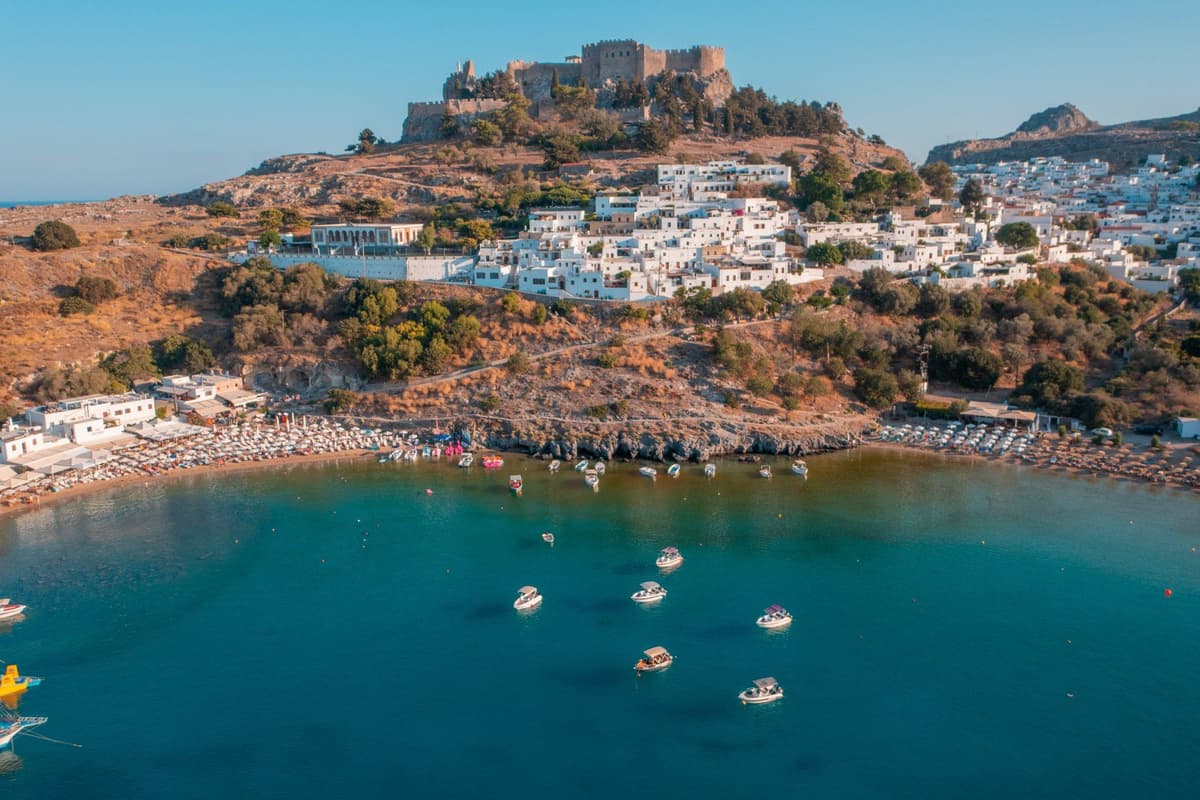
A Lindos tour visits the white village and the ancient acropolis of Lindos on the island of Rhodes. The acropolis stands on a hill above the sea. It is one of the Greece Tours on Greece Ville.
This post covers what a Lindos tour is, the ancient acropolis and the Knights. It also covers the ancient history, the houses and churches and the sea. Places nearby, the best time of year and common questions come last.
The sections include Lindos tours and related Rhodes trips that can be booked online.
What is a Lindos tour?
A Lindos tour is a visit to the main archaeological site of Rhodes. The village is an official traditional settlement of the island. It stands where the ancient city once stood. Visitors walk narrow lanes and climb toward an old acropolis on a great rock.
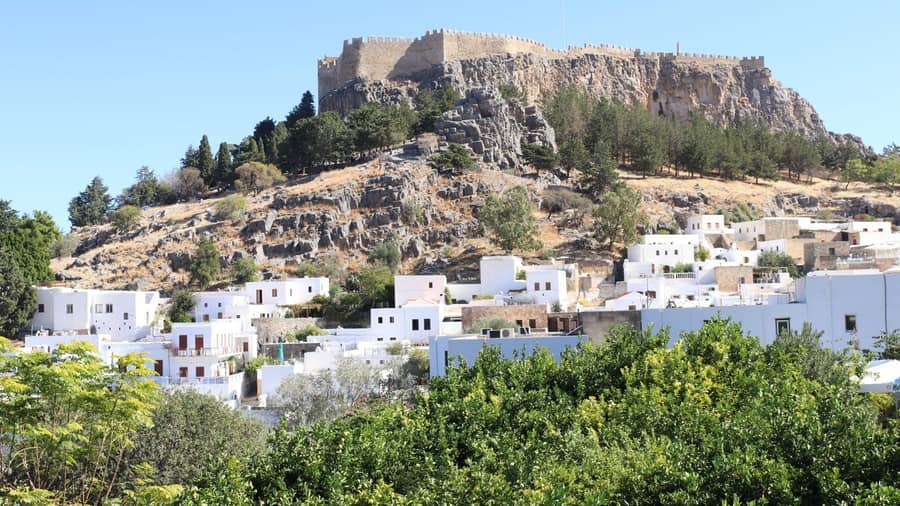
The Greek Ministry of Culture says the old village is in a very good state of preservation. The ancient city lay between the acropolis rock and Cape Krana. Two natural harbours surround the great rock.
An acropolis is a high, strong place above a city. Its name means “top city” in Greek. People built temples and defences there.
A Lindos tour starts at the north side of the village. Visitors enter there, where the only square stands. Donkeys carry visitors through the streets and up toward the acropolis. They are one of the best-known sights of the place.
Rhodes had three ancient cities. Lindos is the only one with people living there without a break since ancient times. It also had the richest seafaring tradition of the three. In ancient Greek, the whole island of Rhodes was also called Lindos.
- Old writer: The Greek writer Strabo said Lindos was built on a hillside facing south toward Alexandria.
- Residents: The village had 810 residents at the 2001 census.
- Local rule: Lindos was the seat of the Municipality of Lindians from 1999 to 2010.
A Lindos tour also touches modern history. Kalathos Airfield lies north of the village. The Italians built it in the Second World War. Today the airfield is no longer in use.


What is the Acropolis of Lindos on a Lindos tour?
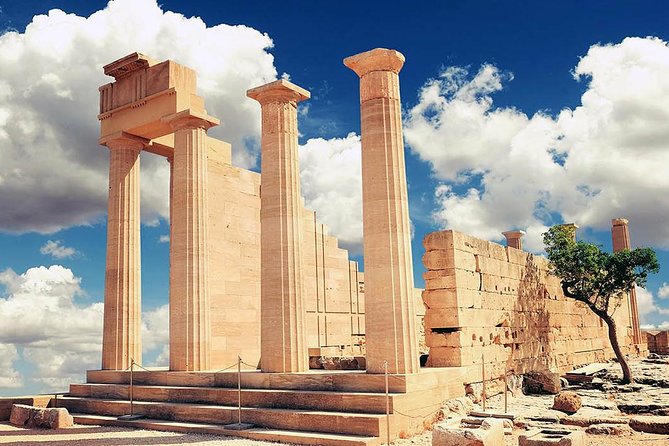
A Lindos tour reaches its high point at the Acropolis of Lindos. This rock rises 116 m high. Only two archaeological sites in Greece get more visitors. People climb up on foot or by mule, since there is no access for disabled visitors.
The worship of Athena began on the rock in the 9th century BC. Experts call this time the Geometric period. Scholars think an older local goddess of nature, called Lindia, was worshipped there first. The temple stands above a natural cave in the cliff.
The ancient writer Diogenes Laertius says the early temple rose in the time of the ruler Kleoboulos. A stone record, the Lindian Chronicle, tells of a fire in 392 BC that damaged the old temple. Its Doric temple had four columns at the front and back.
Doric is a plain style of Greek building. Its columns have simple tops with no carved scrolls.
A Lindos tour shows how builders worked. They used local poros, a soft sandstone, and coated it with stucco. Stucco is a smooth plaster that hides rough stone. Under one terrace, ten cisterns stored rainwater from the roofs, about 300 cubic metres in all.
- Stoa of Psithyros: This Ionic covered walkway of the second century AD honoured an oracle spirit called Psithyros.
- Exedra: A half-round rock bench held a statue and gave pilgrims a seat to rest.
- Olive trees: A verse on the exedra praises the priest Aglochartos for planting olive trees on the rock.
Danish experts dug here long ago. The artist Helvig Amsinck joined them in 1902 and drew the finds. A museum in Copenhagen now shows their finds. Greece began a full restoration in 1985.
How did the Knights shape a Lindos tour?
A Lindos tour also shows the work of the Knights, a Christian military order. They held Lindos by October 1307. They built a strong castle on the acropolis rock. After the castle in the city of Rhodes, it was their strongest castle.
In 1317, knights tried to kill their own leader, Grand Master Foulques de Villaret. His chamberlain helped him escape to the castle of Lindos. His own Order then besieged him there. The rebels chose Maurice of Pagnac as the new Grand Master.
A Grand Master was the top leader of the Order. A chamberlain was a trusted servant who ran his rooms. To besiege means to surround a place and cut it off.
Work on the fortress began in the fourteenth century. It ended in the fifteenth, under Antoine Fluvian and Pierre d’Aubusson. Around 1474, a rule of Grand Master Orsini made the walls stronger.
On a Lindos tour, visitors pass through the ground floor of the Knights’ Administrative Building. It leads to the large square of the acropolis. The commander once lived in this building.
- Church of St John: The church has three aisles that end in three rounded walls called apses.
- Village fountain: The square at the north entrance has a fountain with features from the Knights’ time.
- Frangokklisia: A rock-cut tomb later took this name, which suggests it served as a church.
In 1522 the castle passed to the Ottoman Turks. They added bastions, or strong corner walls, against cannon fire. The church became a mosque, and traces of its prayer niche remain. A small Turkish garrison stayed until 1844.
What ancient history does a Lindos tour pass?
A Lindos tour passes a town with very deep roots. Homer named Lindus among the Rhodian cities in the war against Troy. Ancient Lindos had land that gave rich wine and figs. The rest of the land was barren.
In the 6th century BC, Cleobulus led the town. Under him, Lindian ships traded across the whole Mediterranean. They led the way in setting up colonies. Lindian boys sang a poem credited to him in spring. They collected money for the return of the swallows.
A colony was a new town built by settlers far from home. It kept close ties with the mother city.
Settlers from Rhodes and Crete founded Gela in Sicily around 688 BC. The Rhodians came mainly from Lindos, led by the Lindian Antiphemus. Gela took Athena Lindia as its protector. It built her a temple on its acropolis.
- Coins: The Lindians struck their first coins in the 5th century BC.
- Sea law: A Rhodian rule called “avaria” made owners of saved cargo share storm losses.
- War in Sicily: In 415–413 BC, Rhodians fought their own colonists from Gela.
At old games, the Dorian cities gave bronze tripods as prizes. A tripod was a bowl on three legs. One citizen of Halicarnassus took his tripod home instead of giving it to Apollo’s temple. His city was thrown out of the league. A Lindos tour brings such old tales back to life.
What houses and churches stand in the village on a Lindos tour?
A Lindos tour enters a village of old stone captains’ houses. Rich sea captains built them between the 16th and 18th centuries. The village also keeps a Gothic church with rich wall paintings. The village centre is closed to vehicles.
In the 18th century, Lindos had its own shipyard. Wealth from shipping paid for the houses. Locals call them kapetanospita, meaning captains’ houses. Their style mixes island, Byzantine, Frankish and Arabic features, found only in Lindos.
The Papakonstantis house is dated 1626. The Lefteris Makris, Krikis and Marietta Markoulitsa houses all date from 1700. Each house opened through an arched street gate called the “pylionas”. Ropes or chains on it showed the number of the owner’s ships. So the gate told passers-by how rich the family was.
The yard floor was paved with sea pebbles called “hohlaki”. They form coloured patterns like a carpet. The main house was one large hall, the “spitakla”. A stone arch split it in two.
A Lindos tour also shows the “pataros”, a raised wooden platform in the hall. The food store sat inside it, and the parents’ bed lay on top. A rare embroidered curtain, the “sperveri”, closed off the bed.
- Captain’s room: The “ontas” sat above the entrance, with its own door.
- Children’s beds: Children slept on tall chest-shaped benches that also stored grain.
- Odd painting: One church painting shows Saint Christopher with the head of a dog.
Grand Master Pierre d’Aubusson had the older Church of the Virgin rebuilt in Gothic style in 1489/90. Gothic style uses pointed arches and tall shapes. Its paintings show the Creation and twenty great feasts. The Ecclesiastical Museum opened at the Church of the Dormition in 1998.
What sea and beaches meet a Lindos tour?
A Lindos tour meets the sea at St Paul’s Bay, just south of the acropolis. The bay is almost round and ringed by high rocks. It lies on the east side of Rhodes. So its water belongs to the Levantine Sea.
The beach in the bay is 100 m long. It is about 25 m wide on average. The mouth of the bay is only about 30 m wide. A small chapel stands on the south side.
The chapel recalls a legend that Paul landed there. Local tradition says his ship came into the bay in AD 58. A Lindos tour links this old story to the quiet, closed bay.
Ancient Lindos stood on the east coast, a little north of a cape with the same name. It had two natural harbours. They helped it stay a strong trading town for centuries. A natural harbour is a bay where ships shelter from waves without built walls.
- Spring sea: In the fifth month of the year, the sea off Rhodes averages 20.1 °C.
- Winter sea: February is coolest at 17.0 °C, and December averages 18.8 °C.
Old sea-floor layers full of fossils show along the east coast. Experts call them the Lindos Bay Formation. Earth movements pushed them up. Rhodes rose by up to about 700 m over 1.40 million years. A Lindos tour sees this deep past in the cliffs.
What lies near a Lindos tour on the east coast of Rhodes?
A Lindos tour sits on the east coast of Rhodes, close to villages, bays and castles. Kalathos lies only 5 km from Lindos. Lardos stands about 8 km to the west. Feraklos Castle rises above the fishing village of Charaki.
Kalathos is a lowland village 60 m above sea level. Its beach of sand and fine gravel runs for 4 km. Vlicha Bay lies between Kalathos and Lindos. In ancient times it was called Thermidro.
The Knights of St John took Feraklos on 20 September 1306. It was their first foothold on Rhodes. A foothold is a first safe base from which to take more land. One gate, two round towers and a cistern, or water tank, still stand there.
A Lindos tour also passes near Pefkos, named after the pine trees on the hill behind it. Farmers from inland villages once spent summers there in small basic houses.
- Kalathos Airfield: Work began in 1937, and the Italians named it Airport 308.
- Seven Springs: An Italian dam made a lake about 200 m long.
- Archangelos: Its castle stands on a 216 m hill near the sea.
Tsambika has an old hilltop church of 17 by 8 m with a pebble mosaic floor. A pebble mosaic is a picture made from small stones set in the ground. Wild mountain sheep and mouflon roam the hills around Charaki. They gather in the castle ruins at dusk.
When is the best time of year for a Lindos tour?
A Lindos tour suits late spring, June, September and October best. In the fifth month, highs average 26.8 °C and rain only 12.4 mm. September nights average 24.8 °C, and rain is only 5.8 mm.
Warm katabatic winds, which blow downhill, reach Lindos for much of the year. They are the main reason for its warmth. Air warms up as it sinks down the slopes. The yearly mean beats Cairo, Tel Aviv and the Canary Islands, far to the south.
In August 2021, the Lindos station recorded Europe’s highest mean monthly temperature. The station stands 65 m above sea level. August nights average 27.8 °C, and the record high is 43.1 °C.
A Lindos tour in spring needs sun care. The average UV index, a measure of sun strength, reaches 8 in the fifth month. A high UV index means skin burns fast. Heat can still come early, with 32.4 °C in April and 36.2 °C one month later.
- Midsummer: The day and night mean is 31.5 °C in July and 31.4 °C in August.
- June: Nights average 24.2 °C, and rain averages just 2.3 mm.
- October: Nights average 20.6 °C, and the month’s mean is 23.6 °C.
Winter is mild but wetter. January nights average 11.3 °C, and December highs average 18.3 °C. Rain reaches 74.5 mm in February.
What do travelers want to know about a Lindos tour?
A Lindos tour raises questions about names, myths, castles and films. Visitors ask about the town’s long past. The great peak of the ancient town came in the 7th to 6th century BC. Famous people and an old chronicle add to the story.
Where does the name on a Lindos tour come from?
The Greek culture ministry calls Lindos a pre-Greek name. A small number of prehistoric remains show people lived there from the Neolithic era, the late Stone Age. In myth, Lindus and his brothers Camirus and Ialysos split Rhodes. Each founded a city named after himself.
How old is the sanctuary seen on a Lindos tour?
At Vigli, 38 inscriptions on the rocks mark a place of sacrifice. A small shrine there held clay and bronze ox figures from the 10th to 9th century BC. Famous kings such as Ptolemy Soter, Pyrrhus and Philip V sent gifts to Athena Lindia.
Who held the castle seen on a Lindos tour?
In Byzantine times the acropolis walls stayed in good repair, because the rock served as a fortress. Around 1248, the general John Kantakouzenos took the forts of Lindos and Filerimos. He used them as bases against the Genoese. After 1470, the Knights kept only Feraklos, Lindos and the city of Rhodes.
Which famous people link to a Lindos tour?
The Stoic philosopher Panaetius was born in Lindos and lived from 185 to 109 BC. He is said to have brought Stoic thought to Rome. Cleobulus is said to have lived to seventy. The asteroid 4503 Cleobulus, found in 1989, carries his name.
What does the Lindos Chronicle add to a Lindos tour?
The Lindos Chronicle holds four miracle stories about Athena, but only one can be read in full. It says the Persians laid siege to Lindos in 490 BC. A miracle of Athena saved the town. Christian Blinkenberg first published it in 1912.
Which films link to a Lindos tour?
Scenes of The Guns of Navarone were shot at Lindos. The film crew was based on Rhodes from April to July 1960. The 1954 film They Who Dare starred Dirk Bogarde. It is based on the 1942 commando raid on Kalathos Airfield.