A Delos tour is a boat trip from Mykonos to the sacred island of Delos and its archaeological site. The island holds temples, houses and mosaics of an ancient trading town. It is one of the Greece Tours on Greece Ville.
This post covers what a Delos tour is, the sea crossing and why the island was sacred. It also covers the lions, the temples, the houses, the mosaics and the theatre quarter. Trade, foreign cults, war, the purifications, the excavations and the museum follow. Nature, the best time of year and common questions come last.
The sections include Delos tours and related Mykonos boat trips that can be booked online.
What is a Delos tour?
A Delos tour is a visit to a low island near the middle of the Aegean Sea. No village or town was ever built over its ruins. UNESCO lists Delos under four criteria: (ii), (iii), (iv) and (vi).
Delos lies at about 37°23′ north and 25°16′ east. It barely rises above the sea. Other Aegean islands have high and rugged shapes. A Delos tour reaches low, open ground instead.
From north to south, the island splits into three parts. Rocky peninsulas of gneiss, a hard banded rock, come first. A central plain held the religious centre. The hills of Mount Kynthos rise beyond it.
Mount Kynthos is lower than hills on neighbouring islands. Yet it stands out clearly from the sea around Delos. South of it rise the Kato Vardhia hills. Kherroniso, a small island, lies off the southern tip.
The Cave of Kynthos is thought to have been a shrine of Heracles. Parts of a Hellenistic statue were found inside. They include feet, a tree trunk and a lion skin.
Granite and gneiss surface on Delos, Rheneia and Mykonos. Researchers have found ancient granite quarries on Delos. It is the only Greek city whose whole territory was abandoned. So all its quarry sites can still be studied.
- Lagia: This old name of Delos meant “island of hares”.
- Pyrpile: Pliny, a Roman writer, said this name meant “gate of fire”, because fire was first found there.
- Early science: Members of the French scientific expedition to the Morea took rock samples here in 1829.
Ancient people built farming terraces and basins to catch rainwater. Today the only modern buildings are the museum, a refectory and small staff houses. Strong north winds and the nearby sea threaten the monuments seen on a Delos tour.


How does the sea crossing work on a Delos tour?
A Delos tour crosses open water to an island with only a small number of anchorages. The harbour has always been open to the winds. Once they rise, the island cannot be reached. The best landing place faces the channel to the west.
The 1911 Britannica says an ancient mole, a stone sea wall, protects that landing place. It lies opposite the northern Rhevmatiari islet. Underwater harbour remains show Skardana bay was also an anchorage. Skippers there avoided crossing in bad weather.
Rheneia, the larger island just west of Delos, is known as “Great Delos”. Until 1940, Delos was officially called “Little Delos”. The name Delos then belonged to Rheneia. Both islands face each other across a narrow channel.
The channel is about half a mile wide. Strabo, an ancient geographer, put Rheneia within four stadia of Delos. A stadion was an old Greek unit of length. Rheneia hides Delos from ships coming from Syros.
Two islets called the Rhevmatiari sit in the channel seen on a Delos tour. The name means “the channel isles”. Only Greater Rhevmatiari, the southern one, has given up ancient remains. Once called the island of Hecate, it received cakes from Delian women.
UNESCO treats Delos, Rheneia and Greater and Lesser Rematiaris as one huge archaeological site. Until late Roman times, the channel was a main Aegean waterway. It linked the eastern and western Mediterranean.
- Chain: Thucydides reports that Polycrates of Samos tied Delos to Rheneia with a chain.
- Bridge of boats: Nicias, an Athenian general, paid for a garlanded bridge of boats for a chorus.
- Farms: The Sanctuary of Apollo on Delos ran farms on Rheneia, which had its own sanctuary of Artemis.
The 1911 Britannica noted a small group of shepherds crossing with their flocks in the summer months. They came from Mykonos or Rheneia. Their crossings used the same narrow waters around the island.
Why was Delos sacred on a Delos tour?
A Delos tour visits an island the poet Callimachus called the holiest of all islands. He wrote in the 3rd century BC. Myth placed the birth of Apollo here. Apollo Delios was the patron god of the Ionian Greeks.
One myth says Poseidon acted at the request of Zeus. He struck the sea with his trident, a three-pointed spear. Two flat rocks rose: Delos and Rheneia. Another legend tied floating Delos fast to Gyaros and Mykonos.
The Delians said Leto travelled twelve days and twelve nights to reach the island. She came from the land of the Hyperboreans. In the Homeric Hymn, Delos feared the newborn god kicking it into the deep sea.
In the UNESCO retelling, newborn Apollo threw off his swaddling clothes. He filled the world with light. He walked with his bow and his cither, a kind of lyre. The hymn names the Deliades, a chorus of Delian maidens who sang to Apollo, Leto and Artemis.
Ancient sources name Cynaethus of Chios as author of the Hymn to Apollo. A probable date is 522 BC. The Iliad never mentions Delos. In the Odyssey, Odysseus compares Nausicaa to a young palm by Apollo’s altar on Delos.
A Delos tour recalls the birth feast of Apollo. It fell on the 7th of Thargelion, an old Greek month. The great festival had contests in sport, riding and music. Dances, plays and banquets followed. Athens added horse races when it restored the Delia.
- Eleodytai: The Delians cooked for festival visitors, which earned them this name.
- Sacred ship: Athens sent a yearly ship, said to be the one Theseus sent after Crete.
- Crane dance: On his way home, Theseus danced the “Crane” on Delos, copying the labyrinth paths.
While the ship was away, Athens executed no criminals, and one voyage lasted thirty days. The trial of Socrates fell during one voyage, so his execution was delayed. The Delians once asked the Delphi oracle how to end a plague from Apollo. They were told to double his cube-shaped altar.
What can you see at the Terrace of the Lions on a Delos tour?
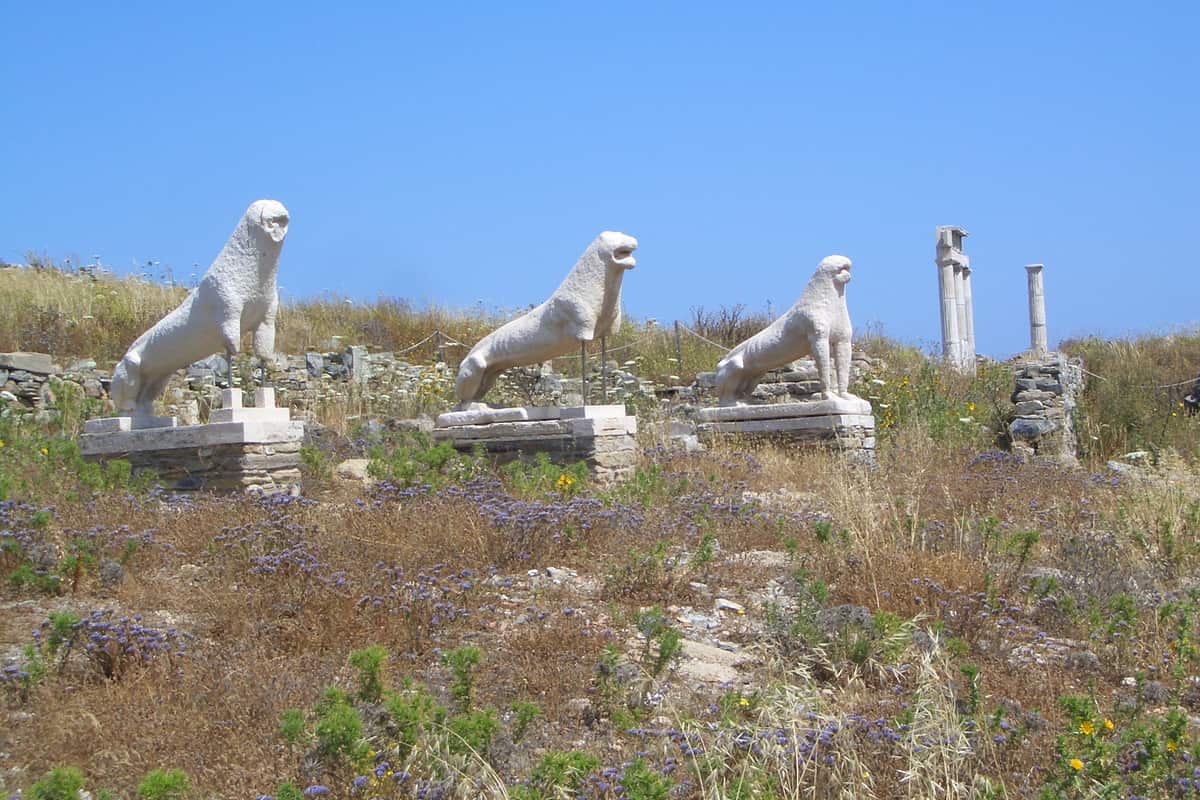
A Delos tour reaches the Terrace of the Lions, a row of marble beasts near the old lake. Naxos gave this terrace to Delos in the archaic age. The lions kept watch for thousands of years. Experts call them sleepless sentinels.
Experts think the lions are in fact lionesses. They have thin, very long bodies and small heads. This carving style is unusual. On a Delos tour, the odd shape of the animals stands out at once.
The lions lead to the old archaic entrance of the Letoon, the shrine of Leto. For this reason, certain scholars see them as guards. In their view, the lions watched over the sacred land of Leto.
Yet the sanctuary of Leto did not exist when the terrace was built. So the lions possibly first led to the shrine of Apollo or of Artemis. Artemis had a closer link with lions than her mother Leto had.
In the archaic period, the area around the lake was the sacred precinct of Leto. The lion terrace is one of its surviving parts. One estimate says up to 16 lions once lined the avenue.
The original lions moved indoors in 2000, safe from the harsh island weather. They now stand in Room IV of the Archaeological Museum of Delos. A Delos tour there shows old photos and a special soundscape of recorded sounds.
- Paros: In the sixth century BC, Paros briefly replaced Naxos as the main artistic power on Delos.
- Venice: One Delos lioness joins three other ancient Greek animal statues at the Arsenal’s Land Gate.
- Wealth: Historians rank the terrace with the Siphnian Treasury and the Naxian column at Delphi as Cycladic showpieces.
French archaeologist Hubert Gallet de Santerre joined the French School at Athens in 1945. He defended a Sorbonne thesis on early Delos in 1956. His 1959 study of the terrace, the Letoon and the Granite Monument is volume 24 of the series.
What does the Sanctuary of Apollo hold on a Delos tour?
A Delos tour enters the Sanctuary of Apollo, the holy heart of the island. Three temples of Apollo stand side by side there. All three face west. Altars, statue bases, gates and long halls fill the ground around them.
The Porinos Naos is the northernmost of the three temples. It dates from about 550 to 525 BC. It measures about 15.5 by 10 metres. The money of the Delian League was first kept here.
The Temple of the Athenians rose around 425 to 417 BC. It measured 17 by 11 metres, with six Doric columns at each end. Inside, a horseshoe-shaped base held statues of seven gods. Nobody knows for sure which gods.
The Great Temple was the only temple on Delos with a full ring of columns. It stood unfinished under a temporary roof until Delos became independent. On a Delos tour, its story includes a statue of Apollo holding the three Graces.
Plutarch called the Altar of Horn one of the Seven Wonders of the World. Its horns held together without glue or any binding. Legend says the young Apollo built it from horns of goats hunted by Artemis.
The poet Callimachus described a strange rite at this altar. The nymphs of Delos ran around it and beat it. Then, with hands tied behind their backs, they bit an olive branch. Passing sailors later copied the custom.
- Oikos of the Naxians: Its roof frame and roof were marble, possibly the island’s first marble roof.
- Colossus base: The 3.48 by 5.08 metre base says statue and base are one single stone.
- Fallen palm: A bronze palm tree from Nicias or the Naxians blew down and knocked the colossus over.
A Delos tour also passes the Stoa of the Naxians, an L-shaped portico at the southwest corner. The Propylon, the south gate, came from the Athenians around 150 BC. It replaced an older gateway.
What are the Sacred Lake and the Sacred Way on a Delos tour?
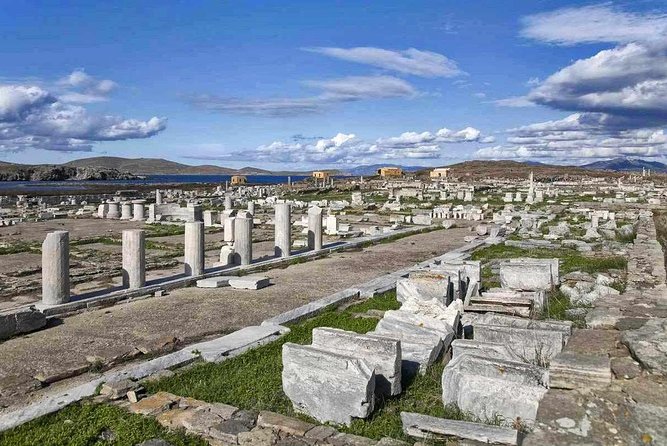
A Delos tour passes the Sacred Lake and walks the Sacred Way, the old processional road. The lake was a natural basin that once held fresh water. The road leads into the sanctuary. Long stoas, or covered halls, line its sides.
Ancient writers knew the lake well. Herodotus and the poet Theognis called it the “wheel-shaped lake”. Callimachus called it Trochoessa. Herodotus compared it to a round sacred lake at Sais in Egypt.
The lake held the water for the service of Apollo’s temple. Smith’s Dictionary of Greek and Roman Geography describes an oval basin about 100 yards long. It lay a little inland, east of the ancient harbour.
Tournefort and other early writers took the basin for a naumachia, a pool for staged sea battles. They were wrong. On a Delos tour, the natural lake explains where later buildings stood. Strabo placed it in the domain of Leto.
Until the 2nd century BC, large gardens covered the lake area. Only a small number of buildings stood there, such as the Dodekatheon. The chief buildings lay between the basin and the harbour on the west side.
The palm tree does not grow in mainland Greece, but Delos held it in special reverence. In the time of Cicero, the Delians still showed visitors a palm. They said Leto had held this very tree.
- Name: The Sacred Way was also known as the Dromos.
- Route: Pilgrims entered the sanctuary by the same route that visitors on a Delos tour still follow.
- Stoa of Philip: King Philip V of Macedon built a stoa beside the road around 210 BC.
Its architrave is the stone beam above the columns. It reads “Offering of Philip, king of Macedon, son of king Demetrius, to Apollo”. The eastern hall is 71.08 metres long, with 16 Doric columns. Each end wall had 4 windows.
What do the houses of Delos show on a Delos tour?
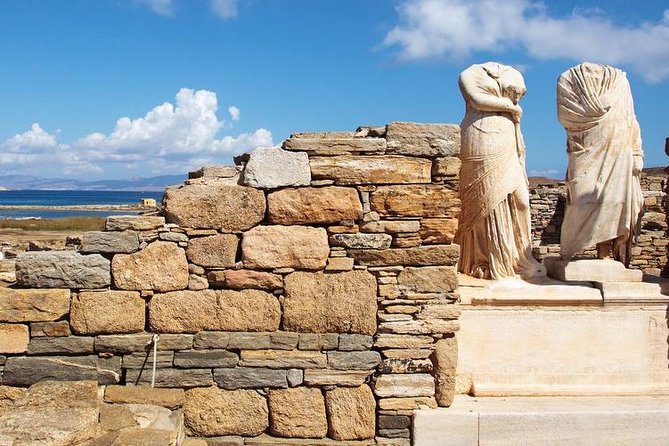
A Delos tour shows private houses from the 2nd and 1st centuries BC. These homes make up the great majority of buildings dug up on the island. They reveal how families lived, stored water and painted their walls.
One block of the old town held one house, fifteen houses or even twenty-four. A Delos house had anywhere from two to seventeen rooms. Builders used gneiss, a kind of hard rock, for the bulk of the walls.
Granite was used in the south of the town. Marble appears where builders found a seam of it. At street level, houses showed only blank walls. The archaeologist Philippe Bruneau even called them fortresses. The House of the Lake was lived in from about 300 to 100 BC.
The largest known home is the House of the Diadumenos. It covered 958 square metres. Its courtyard alone measured 266 square metres. Courtyard columns were fluted, or grooved, only on their upper part.
On a Delos tour, water storage stands out. Rainwater ran from roof gutters down lead pipes into a cistern, an underground tank. The tank sat under the courtyard floor. The deepest known cistern holds 270 cubic metres.
Each house stored enough water for about ten people through months of summer drought. The House of the Dolphins covers about 450 square metres. Its south entrance leads down a corridor straight into the courtyard.
- Oikos: The main living room sat on the north side and opened south onto the courtyard.
- Wall paint: Painted plaster made walls look like stone rows, with a blue sky zone up top.
- Water supply: Besides the Minoan Fountain, Delos had no public fountain, so homes relied on their own water.
A Delos tour also passes the House of the Trident. It has an irregular plan, with its main door on the west. This door opens onto a large courtyard ringed by Doric columns, a layout called a Rhodian peristyle.
What do the mosaics of Delos show on a Delos tour?
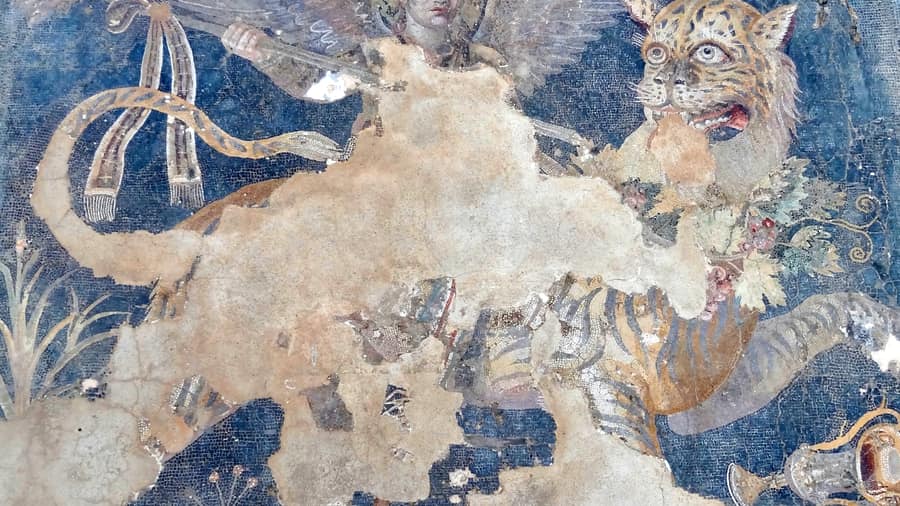
A Delos tour reveals house floors covered in mosaics, which are pictures made from small cut pieces. They range from plain white floors to fine scenes of gods and myths. The French archaeologist Jacques Albert Lebègue first described them in 1876.
Chip pavement of broken white marble is the commonest floor on Delos. It appears in 55 homes, mainly on the ground floor. Kitchen and latrine floors used broken pottery, brick and tile. These rough floors kept water out.
The simpler style, opus tessellatum, used tesserae, or small cubes, of about eight by eight millimetres. The finer opus vermiculatum used tesserae smaller than four by four millimetres. Delos makers used coloured grout in these fine floors.
On a Delos tour, thin strips of lead show up in the cement. They outline geometric mosaics. They are missing from the finer figured scenes. Fine figured mosaics turn up more in upstairs rooms than on ground floors.
Makers used white, black, yellow, red, blue and green. These colours made figures look three-dimensional. A white Triton figure on a black background keeps the look of red-figure vase painting.
In the House of the Masks, a Dionysos panel sits between two smaller panels. Each smaller panel shows a centaur. Another floor there shows a flute player and a dancing figure, thought to be Silenus.
- Lycurgus scene: An upstairs mosaic in the Northern Quarter shows King Lycurgus of Thrace killing Ambrosia.
- Gods scene: A main-room mosaic in the Northern Quarter shows Athena and Hermes beside a seated woman.
- Borders: The single wave pattern is the commonest border around Delos mosaics.
On a Delos tour, the House of the Trident holds more mosaics than any other courtyard house. The bulk of them show geometric patterns. Its courtyard is covered in white mosaic. One room shows a vase decorated with a horse race.
What is the Theatre Quarter on a Delos tour?
A Delos tour through the Theatre Quarter covers an old district of houses, shops and streets. The quarter took shape during the 3rd century BC. People kept rebuilding it. Its finest houses date from the 2nd or 1st century BC.
When the quarter grew in the 2nd century BC, new streets were laid out straight. They ran north to south and east to west. Theatre Street and Street 5 are the only paved streets. Both were lined with shops.
Waste water drained into a shared sewer network along the streets. This network ran down to the sea. The theatre is first mentioned in 305 BC. It was completed in 246 BC. Joseph Chamonard helped clear the theatre in 1892 and 1893.
On a Delos tour, the seating shows two sections of 26 and 17 rows. The theatre held about 6,500 spectators. The front-row seats were kept for honoured guests. They are the only ones with backrests.
The stage building measured 15.26 by 6.64 metres on the outside. It had three doors on its east side and one on the west. Two underground passages let performers reach the orchestra unseen.
In front stood the proskenion, a colonnade 2.67 metres high with Doric half-columns. Movable painted panels filled the gaps. Actors performed on top of it. The chorus moved in the half-round orchestra below.
- Great cistern: A channel around the orchestra carried rainwater from the seats into the theatre’s great cistern.
- Cistern roof: The roof rested on eight granite arches and had well-mouths for drawing water.
- Shrines: Remains of altars to Artemis-Hecate, Apollo, Dionysus, Hermes and Pan lie southwest of the theatre.
A Delos tour reaches only the orchestra and the ground around the theatre. Walking on the seats is dangerous. Southeast of the theatre, the House of the Masks is thought to have lodged visiting troupes of performers.
What trade shaped a Delos tour?
A Delos tour walks through a former trade hub of the ancient world. Rome made Delos a free port, so merchants no longer paid the 2 percent customs tax. Slaves and banking filled the town. The writer Festus called it the greatest commercial centre of the whole world.
The free port hurt rival Rhodes badly. In one year, its harbour tax income fell from 1 million drachmas to 150,000 drachmas. Strabo, an ancient Greek writer, said Delos sat well for ships sailing from Italy and Greece to Asia.
A free port is a harbour where traders pay no tax on goods. Ships chose Delos because trade there cost less. That is why other harbours lost business so fast.
Italian traders began setting up business on Delos in the later 3rd century BC. A Delos tour passes the squares they used. Strabo called the general festival of Apollo a kind of commercial affair. Romans attended it more than any other people.
Slaves became the number one product traded there. Strabo gave a figure of 10,000 slaves sold each day. Historians warn this number was just his way of saying “a huge amount”. Kidnap victims also landed, and their ransom was paid on arrival.
Syrian and Cilician slaves from Delos went on to large farm estates in Sicily, historians think. There they led slave revolts in 135 and 104 BC. Delos also became a leading banking centre in the late 3rd and 2nd centuries BC.
In the 2nd century BC, the town had at least three banks. It also had one temple depository, a safe store for money. A “bank of Apollo” lent money mainly to the cities of the Cyclades. Temples were trusted places, so people felt their money was safe there.
- League treasury: The yearly payments of the Delian League allies, first fixed at 460 talents, stayed on Delos.
- Treasurers: Ten Athenian officials called the Hellenotamiai were first named in 477 BC to guard that money.
- Pirate fees: In 298 BC, Delos paid at least 5,000 drachmae to Rhodes for protection against pirates.
The Agora of the Competaliasts dates to the last quarter of the 2nd century BC. A Delos tour passes it. In a 2008 book, archaeologist Monika Trümper made a bold claim. She argued the so-called Agora of the Italians was really a garden.
What foreign cults stood on the island of a Delos tour?
A Delos tour reveals temples to gods from far beyond Greece. Egyptian, Syrian and Phoenician cults all found a home here. Foreign merchants brought their gods with them. Their shrines still stand among the ruins near the slopes of Mount Kynthos.
A cult here means a group that worshipped one god with its own rites. Traders far from home kept praying to their own gods. So each group built its own shrine on the island.
Sarapeion A, built in 220 BC, is the oldest Egyptian sanctuary on Delos. The grandson of a priest from Memphis built it after a dream. A long inscription on a small column tells the story.
In Sarapeion C, a path lined with porticoes and small sphinxes leads to a large paved courtyard. Square altars stand along the way. A Delos tour reaches a small temple of Serapis there, made of bluish marble. A portico is a covered walkway held up by columns.
The Temple of Isis has a rebuilt front. Its inner room still holds a large statue of the goddess. In Roman times, a central basin supplied water for her rites. Women carrying lamps also performed rituals for Isis.
The Sanctuary of the Syrian Gods honoured Atargatis and Hadad. It fills the north half of a terrace below Mount Kynthos. Priests from Hierapolis ran it at first. Later, Athenian priests took over the sanctuary.
Worshippers sat in a small theatre with no stage. A portico around the seats hid the rites from outsiders. Syrian merchants spread the cult of Atargatis. Inscriptions across a Delos tour show how important she was.
- Samothrakeion: This shrine honoured the Great Gods of Samothrace, the Dioskouroi-Kabeiroi.
- Astarte altar: Philostratos of Ascalon set up an altar to “Astarte the Palestinian Aphrodite”.
- Jewish residents: Two Jewish women, Heraclea and Marthina, are recorded on the island.
The Delos Synagogue was first named from an inscription to Theos Hypsistos, meaning the highest God. Experts later found the stone came from a house about 90 m away. A Delos tour still raises this open question.
How did war end the glory of a Delos tour?
A Delos tour tells of a rich island ruined by war. In 88 BC, Athens sided with King Mithridates. Delos stayed loyal to Rome under its Italian traders. Two brutal attacks followed, and the island never regained its wealth.
Athens sent the philosopher Apellicon of Teos to retake the island. He was known for owning the library of Aristotle. His men camped without watchtowers. A Roman squadron under the prefect Orbius attacked them at night.
Orbius set up a trophy on the beach and an altar for his victory. Then the Pontic general Archelaus sent his lieutenant Menophanes. Pausanias wrote that Delos had no walls, and its people carried no weapons.
A trophy in ancient war was a marker set up where enemies were beaten. Without walls or weapons, the island had no way to defend itself. That made it an easy target.
Up to 20,000 Italians were slaughtered on Delos. Menophanes killed the Delians too. He carried off women and children as slaves. A wooden statue of Apollo was thrown into the sea and washed ashore in Laconia.
The temple treasure of Apollo went to Aristion. He took it to Athens with 2,000 men and became tyrant. A tyrant was a ruler who took power alone. Merchants who escaped lay in wait in ships. They sank Menophanes as he put to sea.
A second attack came in 69 BC from the pirates of Athenodoros, an ally of Mithridates. UNESCO names the island’s wealth and its ties with Rome as the main cause of its fall. A Delos tour shows that cost.
- Sulla’s choice: In 84 BC Sulla let Athens keep Delos, but its economy never recovered.
- Pirates cleared: In 67 BC Pompey cleared the pirates and put Marcus Terentius Varro Lucullus over the Cyclades.
- Later rule: An Athenian official called an epimelete, meaning a manager, ran the island.
Strabo wrote that the retaken island was desolate and stayed poor. The Basilica of St Cyriacus is its only well-preserved Early Christian monument. A Delos tour ends among quiet stones of that lost glory.
How was Delos purified before a Delos tour?
A Delos tour crosses ground that Athens cleaned for religious reasons. The first purification took place between 540 and 528 BC. A bigger one came in 426 BC. An oracle said the whole island must belong to Apollo alone.
The Athenian tyrant Pisistratus ordered the first cleaning. A tyrant was a ruler who took full power alone. During the Peloponnesian War, Athenians blamed a plague on Apollo’s anger. A plague is a deadly disease that spreads fast. So they decided to purify all of Delos.
When the graves were opened, more than half of the dead were Carians. Experts knew them by their buried weapons and burial style. A Delos tour walks over this cleared ground.
Two tombs were spared, against a direct order from the Delphic oracle. The tomb of Opis and Arge was called the theke. It was a Mycenaean-style chamber tomb behind the temple of Artemis. A chamber tomb is a burial room built for the dead. Human remains lay inside.
The tomb of Hyperoche and Laodice was called the sema. It lay at the foot of an olive tree, left of the temple entrance. Excavators found two spindles there. Spindles are sticks used to spin wool into thread. Before marriage, Delian girls left a lock of hair there.
Thucydides says Polycrates of Samos chained Delos to the neighbouring island of Rheneia. Midwives, herbalists and doctors worked there. Women gave birth there, and the sick got care. Delos owned part of it and lived mainly from farming that land.
- Festival: After the purge, Athens revived the Delian festival and added its first horse races.
- Expulsion: Thucydides says Athens later expelled the Delians over an old offence the cleaning missed.
- Exile: In 422 BC Pharnaces, a Persian governor, gave the exiles a home in Adramyttium.
- Return: The Delians came back in 421/420 BC, after Athenian defeats and commands from Delphi.
Arsaces, an officer of the Persian satrap Tissaphernes, invited the Delian leaders to dinner. A satrap was a Persian regional ruler. His soldiers shot them down. A Delos tour shows the island the survivors regained.
Who dug up the island seen on a Delos tour?
A Delos tour shows ruins uncovered mainly by the French School. Théophile Homolle began large digs in 1877. Maurice Holleaux carried on until the First World War. A committee now plans and supervises all restoration work on the site.
Almost a hundred old books of island maps describe visits long before the digs. In the fifteenth century, Cyriacus of Ancona copied the words “The Naxians to Apollo”. They stood on the base of the Colossus of the Naxians. A colossus is a giant statue, much bigger than a person.
Before the digs, scrub hid the ruins. Only the Colossus, the Stoa of Philip and the theatre had known names. A French Morea expedition map marked a ruin field called Marmara, meaning “the marbles”.
The Greek archaeologist Panagiotis Stamatakis drew the first archaeological maps of Delos and Mykonos. Archaeological maps show where old ruins lie on the ground. From 1872 to 1873, he lived on Delos. He oversaw a French dig at the sanctuary of Heracles, led by Albert Lebègue.
In 1873 Lebègue dug the western slope of Mount Kynthos. He hoped to find the first temple of Delian Apollo. A Delos tour still crosses ground these early diggers studied.
When Homolle scouted Delos in 1876, it had no trees and no people. His team crossed to Rheneia every evening. In 1877 he cleared the south and west sides of the Great Temple of Apollo.
- Leader: Maurice Holleaux led the French School from 1904 to 1912.
- Patron: The Duc de Loubat, a rich patron, paid for the digs of 1903 to 1908.
- Courby: In 1906 Fernand Courby found Minoan and Mycenaean remains in the sanctuary.
- Hoard: A dig in the House of the Seals found bronze fittings for doors, beds and chests.
Two trenches toward the west shore uncovered the Oikos of the Naxians and the Porinos Naos. In 1878 Homolle found the Temple of the Athenians. On a Delos tour, monuments stay as found, kept with reversible methods. Reversible methods are repairs that experts can undo later without harm.
What does the museum show on a Delos tour?
A Delos tour includes the island museum among the ancient ruins. It keeps around 30,000 vessels, statuettes and small objects, whole or in parts. The culture ministry calls its statues and reliefs one of the world’s best collections.
The museum, the refectory and a small number of staff houses are the only modern buildings on Delos. A refectory is a dining hall for workers. The museum grew in 1931 and 1972. The ministry calls those outside changes great but unfortunate.
Fragile marble sculptures such as the Naxian Lions were moved inside, away from the north wind. The left hand of the Colossus of the Naxians has a hole. It once let the statue hold a bow.
Two life-sized marble kouroi from the seventh century BC stand in the museum. A kouros is a statue of a standing young man. These two are possibly the earliest that survive.
A Delos tour also shows archaic statues of the twelve gods. Archaic means from the early period of Greek art. They come from the Dodekatheon, a temple of the 3rd century BC. A marble group of Boreas carrying off Oreithyia once topped the Athenians’ temple of Apollo.
A Melian amphora, a tall jar from 620-600 BC, came from the sanctuary of Zeus on Mount Kynthos. An Attic oil flask shows Herakles fighting the three-bodied giant Geryon. A clay stove comes from Roman times.
- Nikandre: The statue Nikandre of Naxos dedicated around 650 BC is item number 1 in Athens.
- Nike: The winged Nike of Delos is kept in the National Archaeological Museum in Athens.
- Aphrodite: The group of Aphrodite, Pan and Eros, found in 1904, is also in Athens.
- Gaul: The head of the Wounded Gaul stayed on Delos until 1973, then joined its statue.
The museum holds funerary statues and grave stelae, or carved grave stones. They date from the 7th to the 1st century BC. The ministry says the exhibition is not yet complete. UNESCO notes the museum needs renovation for a better Delos tour.
What lives on the island of a Delos tour?
A Delos tour reaches a dry island full of wild life. Rock lizards, sea birds and thorny shrubs live among the ruins. The sea around Delos and Rineia forms a protected area for birds. The sea there is shallow, never deeper than 100 m.
The animal that best marks a Delos tour is the starred agama. This spiny rock lizard counts as a rare, protected species. Delos is its type locality. That means a reference specimen named in 2006 ties the species to this island.
In the Cyclades, the starred agama also lives on Rhineia, Mykonos and the tiny islet of Mikro Rhematiaris. It is found on Paros, Antiparos and Naxos. Erhard’s wall lizard (Podarcis erhardii) is also common on Delos.
The sea around Delos and Rineia is an EU Special Protection Area for birds. Greece listed it in October 2002. The site covers 18,508.59 hectares, and water makes up 91.44% of it. A Delos tour crosses part of this protected sea.
Eleonora’s falcon breeds here with 282 pairs. A mixed colony holds 100-250 pairs of yelkouan shearwaters, a kind of sea bird. This colony is the second largest in the Cyclades. It ranks fourth in importance in Greece. Cory’s shearwaters add 150-250 pairs.
- Gulls: Audouin’s gulls first bred here in 1998, a rare case of nesting on a larger island.
- Dolphins: Common bottlenose and striped dolphins appear here, and Risso’s dolphins and sperm whales have washed ashore.
- Plants: Low, thorny shrubs called phrygana cover Delos, among them the spiny spurge Euphorbia acanthothamnos.
Delos has no springs and no rivers. Its stream beds carry rainwater only in winter. Its small herbs live mainly on the morning dew. Strong north winds and high waves wear away its north and north-east coasts. A Delos tour shows this dry land.
When is the best time of year for a Delos tour?
A Delos tour works best in spring or autumn, when days are mild. April and November both average highs of 17.8 °C on nearby Mykonos. Summer is dry, hot and windy. Winter is the wettest season of the year.
The weather figures for a Delos tour come from the HNMS station on Mykonos. They are 1991-2020 normals, or long-term averages. In January the average high is 12.9 °C, and the average low is 8.7 °C. March reaches highs of 14.9 °C and lows of 10.3 °C.
April nights average a low of 12.6 °C. In the fifth month of the year, nights stay warmer, with lows of 16.4 °C. Rain drops from 16.5 mm in April to 6.4 mm in that month. Humidity, the amount of water in the air, then averages 65%.
June averages a high of 26.8 °C and a low of 20.5 °C. July gets only 0.07 mm of rain on Mykonos. Delos has a long dry season, from the end of spring to the middle of autumn. A summer Delos tour meets hot, dry days.
Etesian winds are strong Aegean summer winds. They can blow from late spring to October, and they peak in July and August. The north side of Mykonos and its islets faces strong north-north-east winds. These come off the open central Aegean and the Tsiknias Strait.
- Sunshine: Sunshine on Delos counts among the highest in Greece.
- Clear views: The north winds over Delos give a clear view that can reach 30 nautical miles.
- Winter rain: January is the wettest month on Mykonos with 73.1 mm, and February gets 60.6 mm.
December averages highs of 14.2 °C and lows of 10.3 °C. Humidity drops to 63% in August. For a Delos tour, spring and autumn mix mild heat with lighter rain.
What do travelers want to know about a Delos tour?
A Delos tour raises questions about the island’s name, size and age. Travelers also ask about the rising sea and UNESCO status. The island of Rinia next door draws questions too. Short facts on each topic help travelers plan the visit.
Where does the name on a Delos tour come from?
In myth, the floating island was “adelos”, or unseen. It became “delos”, or visible, when Leto found shelter there. Ancient Athenians wrote Dêlos, while Doric Greek speakers said Dâlos. An old name was Chlamydia, because the island looks like a hanging Greek cloak.
How big is the island on a Delos tour?
UNESCO lists the World Heritage property of Delos at 350.13 hectares. The archaeological ground covers 95 hectares. Only 25 hectares of it have been uncovered. That is roughly a quarter. In the south, the hill of Kato Vardia rises to 83 m.
Is the sea flooding the ruins on a Delos tour?
The rising sea has already flooded part of ancient Delos. The Late Neolithic was the late Stone Age. Since then, the sea here has risen 0.76 mm a year on average. The rise keeps speeding up. Geologist Phokion Negris built a theory of a rising Mediterranean on Delos.
Why is a Delos tour a visit to a UNESCO site?
UNESCO lists Delos as World Heritage site number 530. UNESCO says the island survived so well because no one settled there after the 7th century AD. It also lies far from other places. Its theatre joined a bid of 15 ancient Greek theatres on Greece’s tentative list in 2014.
What is the oldest village seen on a Delos tour?
An Early Bronze Age village stood on Mount Kynthos. It belonged to the Kastri culture. Its houses had oval plans on the granite hilltop. Later use of the hilltop left little of those walls standing. People left around 2200 BC and came back around 1400 BC.
What is Rinia, the island beside a Delos tour?
The name Rinia is said to come from eirini, the Greek word for peace. The island has two parts, each rising to 136 m. A narrow neck of land about 60 m wide joins them. Each Pentecost Sunday, people from Mykonos, Syros and Tinos sail there for the Holy Trinity feast.