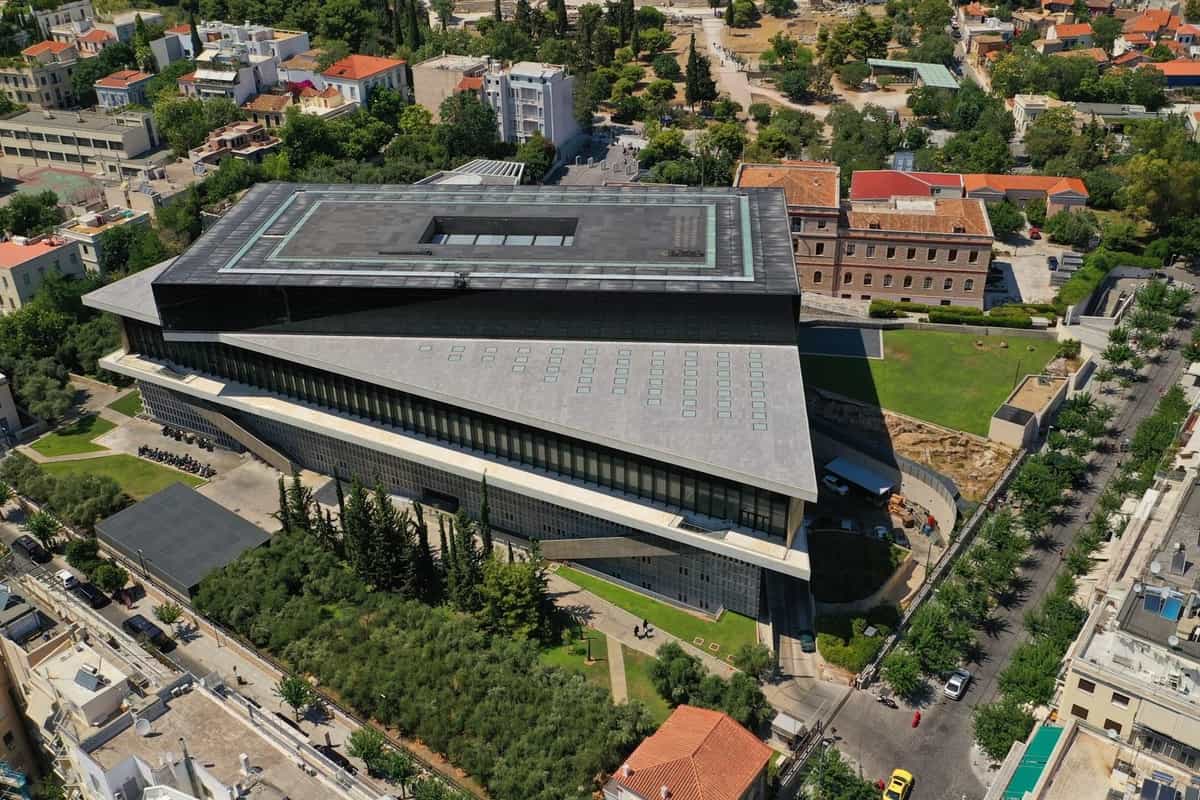
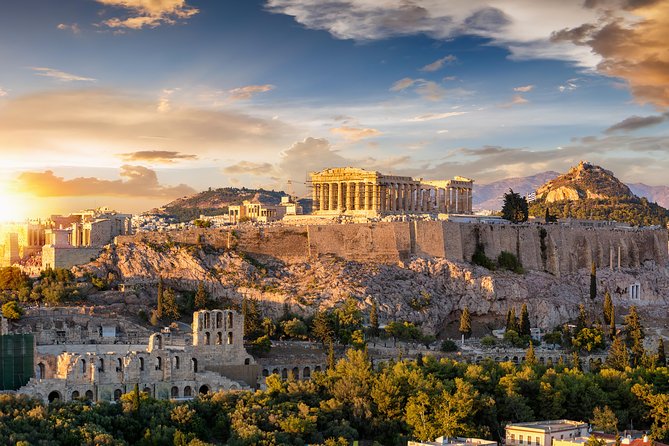
Acropolis Museum tickets give entry to the museum in Athens that holds the finds of the Acropolis hill. The building stands at the foot of the rock, a short walk from the Parthenon. It is one of the Greece Tours on Greece Ville.
This post covers what Acropolis Museum tickets are for, how the building was made and what the old museum on the rock held. It also covers marble work, the Panathenaic Festival, the myths of the pediments and the sculptors. How the hill changed, conservation, the rock itself, the best time of year and common questions come last.
The sections include Acropolis Museum tickets and related Athens tours that can be booked online.
What are Acropolis Museum tickets for?
Acropolis Museum tickets give entry to the museum of the Sacred Rock of the Acropolis. By law, it gathers, protects, studies and shows the rock’s monuments. The Greek Ministry of Culture owns the museum. Its whole site covers 23,000 square metres.
Greek Law 3711/2008 set the museum up as a legal body under public law. In plain words, it stands as its own public organisation. Pieces taken down from the Acropolis monuments, now or later, are kept there.
The museum behind Acropolis Museum tickets has a board. Professor Dimitrios Pantermalis led that board from 2009 to September 2022. One department looks after finds from the Acropolis slopes and the Makryianni plot.
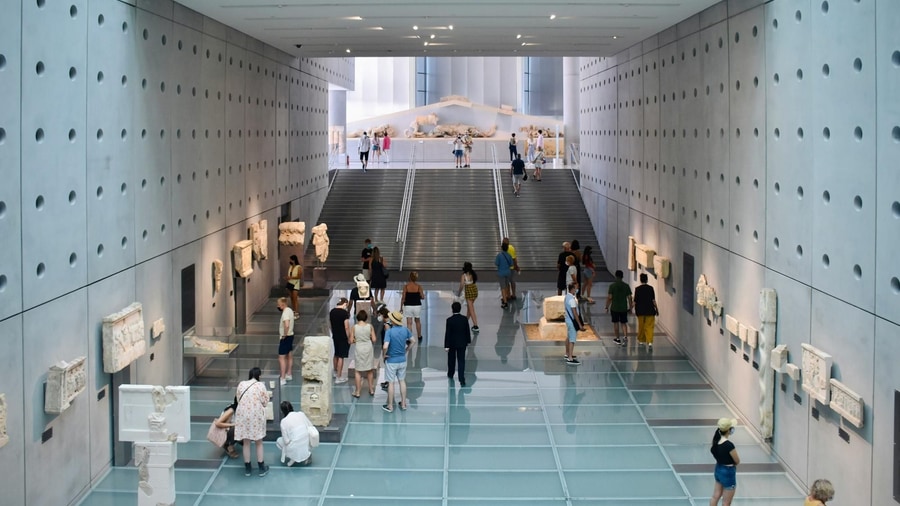
The building behind Acropolis Museum tickets has three main levels and two in-between levels. On the first floor, a circular route tells the story of the rock. The story starts in the 2nd millennium BC and ends with the close of antiquity.
Left of the wide staircase to the first floor, finds show how the rock changed. A ruler’s fortress became a holy place for Athena. The last gallery, on the north side, covers the 5th century BC to the end of antiquity.
Acropolis Museum tickets also show the museum plot’s past. Human activity there first appears between 3,500 and 3,000 BC. In the mid-5th century AD, a rich house called Building Z stood there. It had mosaic floors and a private bath.
- Last residents: The ancient neighbourhood under the museum was left empty in the early 13th century AD.
- Weiler Building: Bavarian engineer Von Weiler built Athens’ first military hospital here in 1836.
- Dekemvriana, 1944: These December events brought a violent battle to the gendarmerie headquarters in Makrygianni.
The name Makrygianni honours General Ioannis Makrygiannis, a hero of the Greek War of Independence. The museum behind Acropolis Museum tickets won fast notice. In its first two months, its website drew 409,000 different visitors from 180 countries.



How was the building behind Acropolis Museum tickets made?
Acropolis Museum tickets lead into a building born from design contests. A 1976 contest was open only to architects from Greece. The final one, announced in 2000, invited 12 architecture firms. Design work ended in August 2002, and building work in September 2007.
In that final round, Daniel Libeskind, working with D. and L. Potiropoulou, won second prize. The office of A. N. Tombazis won third prize. An engineering firm in New York advised on construction. Its London office advised on the lighting.
Acropolis Museum tickets lead to a building shaped by the Parthenon sculptures. Showing them called for a hall of at least 3,200 square metres. The outer glass is extra-clear low-iron glass. It has a UV coating against sun rays and tiny ceramic dots.
Acropolis Museum tickets open a building made to cope with earthquakes. It sits on 94 friction pendulum bearings, a kind of sliding support. They also push it back to centre after an earthquake.
The project also met anger. In 2007 a plan to pull down two old houses caused protests. They stood at 17 and 19 Dionysiou Areopagitou Street. One was Neo-Classical and one was Art Deco.
The building behind Acropolis Museum tickets has won praise. In 2010 the museum won the International Association of Lighting Designers Award of Excellence and Sustainability. The British Guild of Travel Writers’ award for Best Worldwide Tourism Project followed on 8 November 2010.
- Parthenon Gallery: This hall measures 39 by 84 metres.
- Columns: 43 columns stand in the excavation area, and 28 in the Archaic Gallery.
- Floors: The galleries have beige marble floors, while the walkways use dark marble.
Praise also came from the press. In 2013 a newspaper list ranked it 3rd among the 50 best museums in the world. That puts the home of Acropolis Museum tickets near the top.
What did the old museum on the rock hold before Acropolis Museum tickets?
Acropolis Museum tickets lead to a new building, but an older museum once stood on the rock. Its core collection came from digs on the hill. They gave sculptures, vases, figurines and inscriptions, plus thousands of fragments of Archaic art.
Before the museum, Kyriakos Pittakis kept finds locked away on the rock. He used storerooms, cellars and water cisterns. Only he had the keys. In 1863 the Greek state chose a hollow southeast of the Parthenon for a museum.
Long before Acropolis Museum tickets, the first museum’s foundation stone was laid on 30 December 1865. Workers digging its foundations found the torso of the Kritios Boy. The architect Panagis Kalkos designed the building. In 1875 he led the move of antiquities inside.
Panagiotis Kavvadias and the German architect Georg Kawerau led the digs from 1885 to 1890. They dug the whole Acropolis down to bedrock. The Archaeological Society of Athens funded them. No dig had ever turned up more Archaic, or early Greek, art.
In 1888 Kavvadias dug around the museum. He uncovered the Parthenon’s platform to its full depth of 14 m. In 1887 and 1888 Kawerau built a second, smaller museum to the east. Its nickname was “the little one”.
During the Second World War, exhibits hid in National Archaeological Museum basements. Others went into caves on nearby hills. Work to enlarge the museum began in 1953, to plans by Patroklos Karantinos. The small building was torn down.
- Reopening: The first new rooms opened in 1956, and the new display was finished in 1964.
- Blond Kouros: The head of this statue was found in 1923, northeast of the museum.
- New plan: In 1974 Prime Minister Konstantinos Karamanlis proposed building a new museum.
Drainage pipes from the old museum have been blamed for much of the decay on the Acropolis. The old museum closed in June 2007. Its contents moved to the new building that Acropolis Museum tickets open.
How was marble worked in the sculptures seen with Acropolis Museum tickets?
Acropolis Museum tickets lead to statues cut from Pentelic marble. This stone is made mostly of calcite, with a little quartz. Carvers shaped it with hammers, chisels, drills and rasps. Then they polished skin, added metal details and painted parts in colour.
The pediment marble seen with Acropolis Museum tickets came from Mount Pentelikon. Workers first cut it there in 439–438 BC, and carving began the next year. The Parthenon used 22,000 tons of this marble, more than any Greek temple before it.
Pentelic marble holds traces of iron. Over time the iron rusts and gives the stone a soft honey colour. In the 2nd century BC, Pentelic became the first white marble used in large amounts in Rome.
Greek sculptors broke away stone with the hammer and the pointed chisel from about 650 BC. On the pediment figures linked to Acropolis Museum tickets, point-chisel marks from the first rough shaping survive underneath.
For deep folds of cloth, carvers drilled rows of large holes, straight and slanting. Then a point chisel knocked out the stone between them. They used drills of at least three sizes, from 3 to 10 mm wide.
On statues seen with Acropolis Museum tickets, light linen tunics got fine rasp work. A rasp is a rough file. Heavy wool mantles were carved with more bulk. The neck of Helios was polished to set his skin apart from cloth.
- Size: The pediment statues are the largest made in classical Greece, nearly all from one piece.
- Metal: Drill holes on figure M of the east pediment held an added bracelet and necklace.
- Paint: Egyptian blue was found on 11 pediment sculptures and one figure of the frieze.
On the metopes, or carved panels, the background was painted red. The triglyphs between them were blue. Egyptian blue also coloured the sea water from which Helios rises on the east pediment.
What is the Panathenaic Festival shown with Acropolis Museum tickets?
Acropolis Museum tickets open the story of the Panathenaia, a festival held every year in Athens. It lasted more than one day and always ended on 28 Hekatombaion. A large procession carried a new robe for Athena. Athletes also competed in races and contests.
The festival shown with Acropolis Museum tickets has very old roots. The Iliad holds its earliest mention and says King Erechtheus founded it. Hekatombaion, the first month of the Athenian year, fell in July or August.
The festival opened with a banquet on the first night in the Agora, the market square. Meat was cut with a ceremonial blade called a kopis. On the night before the procession, young Athenians danced on the Acropolis. This all-night vigil was called a pannychis.
Acropolis Museum tickets also tell the story of the sacred peplos, a robe for Athena. Girls called Ergastinai spent about nine months weaving it, starting at the Chalkeia festival. The robe showed the battle of the gods and the Giants.
The procession had over 1,000 people. The high priestess and the temple treasurers led it. From the late fourth century BC, the peplos hung as the sail of a large cart. The cart was shaped like a wooden ship.
Foreign residents joined in too. Their women carried water jars called hydriai, and their men carried bread on trays called skaphai. The procession ended with more than one hundred cows and sheep sacrificed on the altar of Athena.
- Route: The Panathenaic Way ran 1.5 km from the Dipylon Gate to the Acropolis, climbing 94 m.
- Apobates: Men in armour jumped off a moving chariot and back onto it.
- Age groups: Athletes competed as boys 12–16, beardless youths 16–20 and men over 20.
After about 350 BC, at least 1,450 prize vases were handed out at each Great Panathenaia. They held olive oil from the sacred grove of Athena at the Academy. Acropolis Museum tickets connect visitors to this festival.
Which gods and myths appear on the pediments seen with Acropolis Museum tickets?
Acropolis Museum tickets lead to the gods of the two Parthenon pediments. Together they held about fifty statues. The Parthenon was the first to carve the birth of Athena in sculpture. On the west pediment, Athena and Poseidon stood either side of the centre.
Only one ancient text names the subjects of the Parthenon sculpture. It is a single sentence by Pausanias. Each pediment gave a space 28.35 m long. It rose up to 3.47 m high and went 0.90 m deep.
In the myth, Zeus swallowed Metis while she was pregnant with Athena. Later, someone split his aching head with a labrys, a double axe. Sources name Prometheus, Hephaestus and others for the blow. Athena then sprang fully armed from his head.
The east pediment linked to Acropolis Museum tickets put Zeus at the centre. His eagle was at his feet. A reclining figure read as Dionysus is the only pediment statue that kept its head.
Two goddesses seated on chests, figures E and F, are read as Demeter and her daughter Persephone. The leading view credits the group of three women K, L and M to the sculptor Agoracritus.
On the west pediment tied to Acropolis Museum tickets, Athena stood left of centre and Poseidon right. The object between them is read as her olive tree or a thunderbolt of Zeus. Nike drove Athena’s chariot, and Amphitrite drove Poseidon’s.
- Troy: On north metopes XXIV and XXV, Menelaus chases Helen during the fall of Troy.
- Aeneas: North metope XXVIII is read as Aeneas carrying his father Anchises on his shoulders.
- Centaurs: The south metopes show Centaurs trying to seize women at the wedding of King Pirithoos and Hippodamia.
The battles on the metopes are read as a symbol of the Persian Wars. They stand for order against chaos. Acropolis Museum tickets open a window on these gods and heroes.
Which sculptors made the works seen with Acropolis Museum tickets?
Acropolis Museum tickets lead to works by sculptors whose names still survive. Inscribed bases from the rock record who carved a statue and who gave it. Ancient writers such as Pausanias add more names. These sources tie artists to the Acropolis.
An inscribed base found on the Acropolis names “Antenor son of Eumares” as sculptor of a marble kore. A kore is a statue of a young woman. It is 201 cm high without its base, in Parian marble.
The base also names the donor, Nearchos, who was thought to be a potter. Antenor also made the first bronze statues of the tyrant-killers Harmodius and Aristogeiton. The Persian king Xerxes carried them off to Susa.
Kritios and Nesiotes made a new tyrant-killer group to replace the stolen one, set up in 477/476 BC. For Acropolis Museum tickets holders, Kritios is a key link. He is thought to have been Antenor’s pupil and Myron’s teacher.
The Kritios Boy stands out among works linked to Acropolis Museum tickets. Its torso was found in 1865, as workers dug the foundation of the old museum on the Acropolis. It is the first known ancient statue to use contrapposto, a relaxed pose with weight on one leg.
Among names linked to Acropolis Museum tickets, Kallimachos made a golden lamp for the Erechtheion. It needed new oil only once a year, as its asbestos wick did not burn away. A bronze palm branch above it caught the rising smoke.
- Endoios: Callias dedicated his statue of Athena in Athens about 564 BC.
- Kresilas: His bronze Pericles wore a Corinthian helmet, and its base was found on the Acropolis.
- Phidias: Pausanias called his Lemnian Athena, made for Lemnos, the finest sight of all his works.
Not every maker on the rock left a name. The architect of the Erechtheion is unknown, an open puzzle for Acropolis Museum tickets holders. Scholars have put forward Mnesikles, Kallikrates and Iktinos as candidates.
How did the Acropolis change over the centuries for Acropolis Museum tickets holders?
Acropolis Museum tickets point to a rock with a long, busy past. The oldest finds there date to the Middle Neolithic era. Over the centuries, the hill held walls, temples, churches and a fort. Old buildings took on new roles.
For Acropolis Museum tickets holders, the old walls come first. The gate of the Mycenaean wall faced south and was set at an angle. Thucydides and Aristophanes called the old wall at the rock’s western foot the “Pelargikon”, or stork wall.
In the 7th and 6th centuries BC, Kylon once and Peisistratos twice seized the Acropolis for power. The Hekatompedon temple adds a twist for Acropolis Museum tickets holders. Its name means “one hundred feet long”, yet it measured 46 metres.
After the battle of Marathon in 490 BC, builders of the Older Parthenon switched from limestone to marble. Work stopped in 485 BC, when Xerxes became king of Persia and war looked near.
Before the battle of Plataea in 479 BC, Greek allies vowed not to rebuild shrines the Persians destroyed. Only the Peace of Callias in 450 BC freed Athens from that vow. That is one possible reason the site stayed a ruin for 33 years.
The round Temple of Roma and Augustus was built about 19 BC. It stood 23 m east of the Parthenon’s entrance. It had nine columns, no inner wall and a cone-shaped marble roof.
- Church: In the late sixth or seventh century, the Erechtheion became a church with three aisles.
- Palace: The Acciaioli family used the Propylaea as their ducal palace.
- Frankish Tower: It stood 85 ft high, built partly with stones from ancient Acropolis buildings.
In 1835 the Acropolis became the first archaeological site in the world to charge an entrance fee. Acropolis Museum tickets carry on that tradition. In 1875, Heinrich Schliemann paid £465 to pull down the Frankish Tower.
What conservation work links to Acropolis Museum tickets?
Acropolis Museum tickets connect to a long effort to save the monuments. In 1975 the Greek state set up the Committee for the Conservation of the Acropolis Monuments. This panel of top specialists dealt with rusting iron, pollution and wear from visitors’ feet.
Charalambos Bouras chaired the committee from 1985. He worked on the Acropolis monuments for over 40 years. The Erechtheion was the first monument the committee finished, with work running from 1979 to 1987.
Restorers took down 720 blocks of the Erechtheion. They replaced the rusted iron clamps and dowels with titanium. Copies in artificial stone now replace the column and beam Lord Elgin took from the north-east corner.
The Caryatids give the clearest link to Acropolis Museum tickets. These statues were moved from the Erechtheion into the protection of the museum in 1979. A laser institute in Heraklion, Crete, custom-built the laser that cleaned them.
The laser used on the Caryatids seen with Acropolis Museum tickets fires infrared light at 1064 nm. It also fires ultraviolet light at 355 nm at the same time. Using both beams together stops the marble from changing colour.
The Parthenon’s west frieze went under a shelter in 1978. Soot and a black crust then built up on its carved surface. Experts compared four ways of cleaning it, and the laser worked best on every kind of dirt.
- Nike temple: Between October 2000 and 2002, all 319 of its blocks came down for restoration.
- Stainless steel grate: In 2004 it replaced Balanos’s iron girders and concrete slab under the Nike temple.
- Titanium rods: They are used sparingly and fail before the ancient marble under extreme stress.
The conservation work linked to Acropolis Museum tickets needs a large team. The Acropolis works employ 161 people, from engineers and archaeologists to marble technicians. Even the lion heads on the Nike temple’s new gutter pieces were carved by hand.
What is the Acropolis hill made of for Acropolis Museum tickets holders?
Acropolis Museum tickets holders learn that the hill is a rock of limestone. This stone is unstable. Retaining walls, drainage systems and rock bolts guard against rock slides. The slopes also hold a natural spring, old walls and caves that served as shrines.
Acropolis Museum tickets holders can trace water on the hill too. The Klepsydra is a natural spring on the north-west slope. The ancient writer Hesychius said its fountain was once called Empedo. Empedo was also thought to be the name of its nymph.
The spring house was set into a natural cave, which collapsed in ancient times. Pottery finds date the first Greek fountain house there to 475–470 BCE or later. In the 1822 siege, the Ottoman garrison on the rock surrendered for lack of water. The well had fallen out of use.
The old Pelasgic wall was also called the Enneapylon, meaning nine-gated. Herodotus wrote that the Pelasgians got land below Mount Hymettus for building it. The Peripatos, a path around the hill, is believed to follow the line of the vanished wall.
The middle cave on the north-west slope is linked with Zeus Olympios or Zeus Keraunios. The cave of Apollo honoured him as Hypoakraios, Apollo under the High Rocks. Part of the cave of Pan later became a chapel of Saint Athanasius.
- Aphrodite and Eros: Their open-air sanctuary sits on a terrace 30 m by 14 m.
- Aglaureion: This east-slope cave is the largest on the Acropolis, 14 m across at the mouth.
- East side: Herodotus records that the Persians climbed onto the Acropolis from here in 480 BCE.
A Mycenaean spring lies on a terrace west of the Asklepieion. A spring house enclosed it from the Archaic period, the early era of Greek art. For Acropolis Museum tickets holders, the hill holds water as well as stone.
When is the best time of year for Acropolis Museum tickets?
Acropolis Museum tickets fit a city of hot, dry summers and cooler, wetter winters. Mountains around Athens cause a temperature inversion. Warm air sits above cooler air and traps it. This makes the city’s weather complex by world standards.
From 1955 to 1997, the Athens suburb of Nea Filadelfeia had the highest average summer highs in Greece. The Hellenic National Meteorological Service, or HNMS, reports this. An automatic station there gives July an average high of 35.5 °C.
In summer, Acropolis Museum tickets holders face dry air. At the HNMS station in Nea Filadelfeia, rain falls on only 1.9 days in July on average. In July, relative humidity at Elefsina averages just 41.8%. A heat wave in July 1987 counts among Greece’s notable heat waves.
Heat lingers into autumn for Acropolis Museum tickets holders. The highest October reading at Nea Filadelfeia is 38.2 °C. Winds there blow mostly from the north-east. From April to June, they blow from the south-west instead.
At the HNMS station in Nea Filadelfeia, December is the wettest month. It brings 71.2 mm of rain over 12.5 days. Relative humidity there averages 76.2% in December. The automatic station gives January an average low of 5.2 °C.
- Smog: Athenians called their smog “nefos”, and it grew less common after anti-pollution steps in the 1990s.
- Parnitha: Fires in late June 2007 burned much of this forested park, key to cleaner Athens air.
- Tatoi: This HNMS station sits 225 m above sea level and gets 79.7 mm of rain in December.
At Tatoi, the January mean minimum is 3.4 °C. Summer brings dry heat, while winter brings cold and rain. Acropolis Museum tickets holders can weigh one season against the other.
What do travelers want to know about Acropolis Museum tickets?
Acropolis Museum tickets raise practical questions about the area, transport, money and access. The Odeon of Herodes Atticus and the Theatre of Dionysus stand only hundreds of metres apart. Ermou Street, from Syntagma Square to Aiolou Street, has been a pedestrian zone since 1997.
What is Acropolis metro station like for Acropolis Museum tickets holders?
On metro Line 2, Acropolis station lies between Syntagma and Syngrou–Fix. Ancient pottery found while it was built is on show on its concourse. Archaeologists worked for six years before and alongside the metro engineers. They recorded streets, houses, cemeteries, kilns and aqueducts.
What ruins lie under the floor for Acropolis Museum tickets holders?
The ruins under the museum show through its glass floor and from its balconies. Until the early 5th century BC, the site lay outside the old city walls. By the early 1st century BC, dense streets held small courtyard houses, shops and workshops.
What daily life do Acropolis Museum tickets reveal?
From the mid-2nd century AD, houses there had colonnaded courtyards, or yards ringed by columns. They also had colourful frescoes and private latrines, or toilets. A selection of 1,150 objects, picked from the thousands found in the dig, tells the neighbourhood’s story.
What language and time do Acropolis Museum tickets holders meet in Greece?
Greek is the official language of Greece and one of the 24 official languages of the European Union. The Greek alphabet has been in use for about 2,800 years. Before Greece adopted Eastern European Time, it kept Athens mean time. That ran 1 hour, 34 minutes and 52 seconds ahead of GMT.
What currency do Acropolis Museum tickets holders need in Greece?
Greece uses the euro. The drachma was the currency of modern Greece from 1832 until the euro arrived in 2002. The Greek €1 coin shows a 5th-century BC Athenian coin called a tetradrachm. That old design on a modern coin makes it a coin within a coin.
What access help exists for Acropolis Museum tickets holders with disabilities?
On the Acropolis summit, one wheelchair route runs south along the east side of the Parthenon. It ends at the southern Kimoneion wall. The Athens bus company runs a fleet of 10 special vehicles. They give door-to-door rides to people with disabilities.