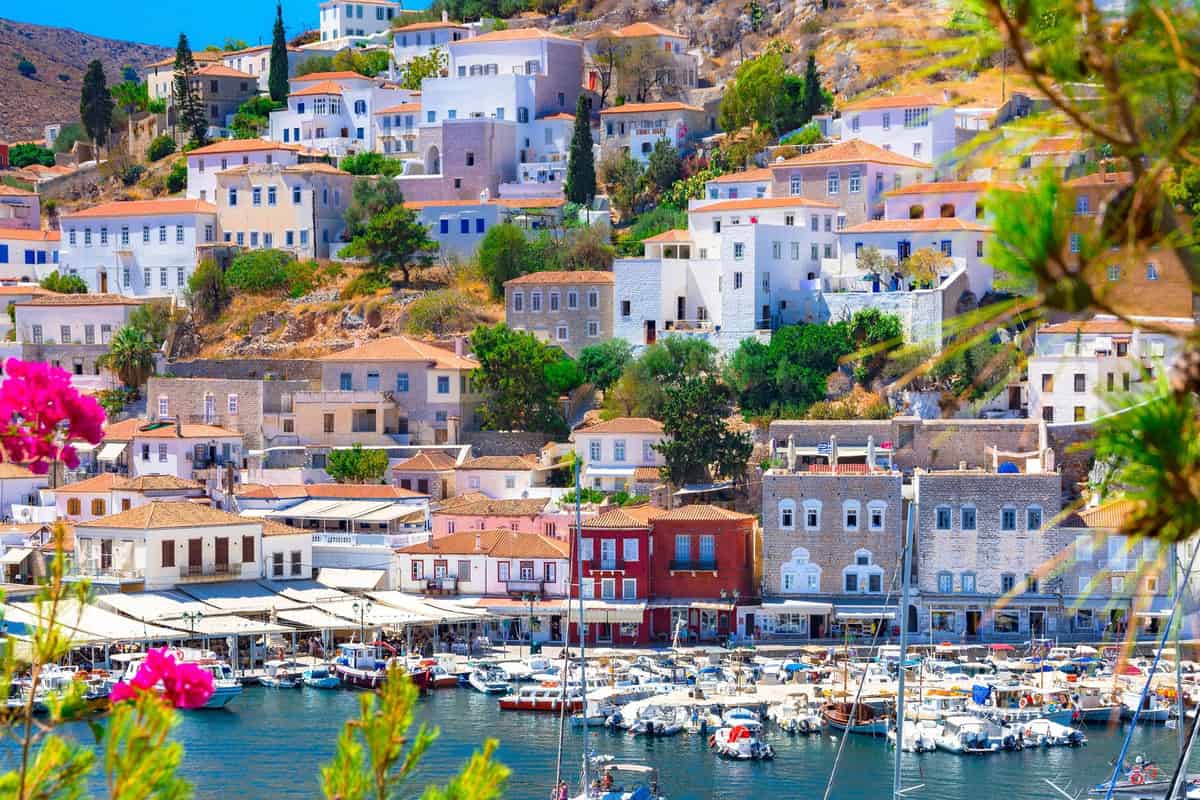
A Hydra Poros Aegina cruise is a day at sea from Athens to three islands of the Saronic Gulf. Each island has its own harbour town, hills and history. It is one of the Greece Tours on Greece Ville.
This post covers what a Hydra Poros Aegina cruise is, how the route works and what the Saronic Gulf is. It also covers what each island shows, the history the three share, the sea life and the winds. The port of Piraeus, the best time of year and common questions come last.
The sections include Hydra Poros Aegina cruises and related Saronic trips that can be booked online.
What is a Hydra Poros Aegina cruise?
A Hydra Poros Aegina cruise is a sea trip that links three islands. All three belong to the Islands regional unit, and its seat is the town of Aegina. The island of Hydra lies about 65 km south-west of Athens.
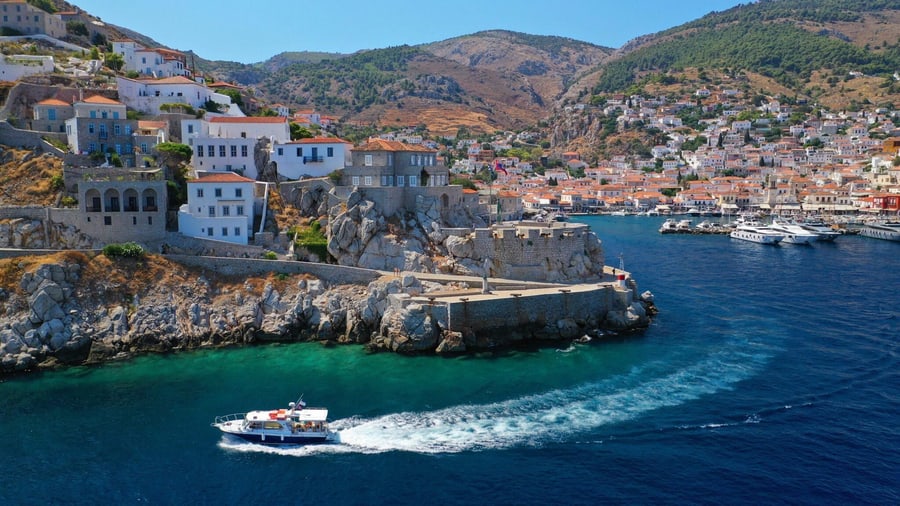
On the map, the three islands of a Hydra Poros Aegina cruise form a near north-south line. Aegina sits at 37°43′48″N 23°29′24″E. Poros sits at 37°31′N 23°29′E. Hydra sits at 37°20′06″N 23°28′21″E.
The Islands regional unit covers 897.6 square kilometres. It had 70,005 residents in 2021. The unit was created in the 2011 Kallikratis reform. It is split into 8 municipalities.
The unit takes in the Saronic Islands and a small part of the Peloponnese. From 1833 to 1942, the province of Hydra belonged to the Argolis and Corinthia Prefecture.
Aegina is the second largest island of the Argo-Saronic group. Its coastline is 57 km long. The island has no rivers and no running water. A ridge of trachyte, a light volcanic rock, runs along its east coast.
On a Hydra Poros Aegina cruise, Poros is the middle island of the three. The town of Poros had 2,806 residents in 2021. It is built on top of a small, dome-shaped volcanic crater.
- Aegina hills: Low Cretaceous limestone hills run south-west to north-east, from Moni islet to Mount Parliagos.
- Hydra size: The island is about 20 km long and 4 km wide.
- Hydra rock: Hydra is built mostly from Triassic, Jurassic and Cretaceous sea-floor sediments, later folded and pushed.
Hydra shows two faces on a Hydra Poros Aegina cruise. Its north side faces the Peloponnese and is partly built up. The east and the south are almost empty of people.



How does the route work on a Hydra Poros Aegina cruise?
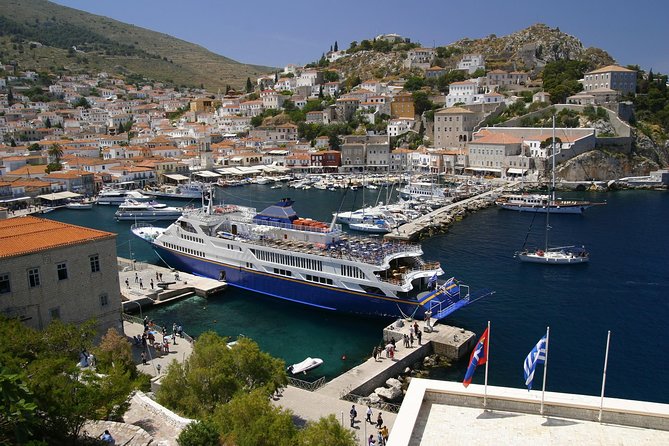
A Hydra Poros Aegina cruise moves between islands that lie close together. The north-east tip of Aegina is 10.5 nautical miles from the mouth of Piraeus harbour. The southern tip of Aegina is 9 nautical miles from the northern entrance of Poros.
The north-west tip of Aegina is 12 nautical miles from Trachili, on the Epidaurus coast of the Peloponnese. On a Hydra Poros Aegina cruise, Aegina sits between Piraeus and that coast.
The Methana peninsula lies about 50 km south-west of Athens. The Methana municipal unit covers 50.161 square kilometres and had 1,352 residents in 2021. The town of Methana lies about 22 km north-west of Galatas.
On a Hydra Poros Aegina cruise, Galatas is the town that faces Poros across the strait. It is the seat of the Troizinia-Methana municipality. The community of Galatas had 2,244 residents in 2021.
The writer Pausanias said the strait off Sphaeria was very narrow and shallow. People were able to cross it on foot. The strait has sunk since ancient times. A marsh that Pausanias waded through now lies up to four metres under the sea.
On a Hydra Poros Aegina cruise, the Poros strait is part of the Epidaurus graben. A graben is a sinking strip of land where the earth’s crust is still active.
- Poros name: The name comes from the narrow channel, or poros, between the island and the mainland.
- Modi (Liontari): It lies 1 nautical mile east of Poros and looks like a resting lion.
- Cape Skyllaion: The farthest east point of the Peloponnese belongs to the municipality of Poros.
One old story adds a legend to a Hydra Poros Aegina cruise. It says Cape Skyllaion is named after Scylla. She was the daughter of King Nisus of Megara. Her body washed ashore at the cape.
What is the Saronic Gulf on a Hydra Poros Aegina cruise?
A Hydra Poros Aegina cruise crosses the Saronic Gulf. The gulf lies between the Corinth Canal and the Myrtoan Sea. At its widest point, three islands split it: Salamis, Aegina and Poros. Its deepest point is 416 metres, west of the Methana volcano.
A line from Cape Sounion to Cape Skyllaion is about 27 nautical miles long. From that line, the gulf reaches 44 nautical miles inland. Weather forecasts of the Hellenic National Meteorological Service report it with the South Euboean Gulf.
The gulf has a western and an eastern basin. Lines from Methana to Aegina and from Aegina to Salamis close off the western one. A line from Aegina to the Fleves islets splits the eastern one in two.
The gulf is a tectonic trough, a long dip in the earth’s crust. It formed as the African plate sinks under the Aegean plate and stretches the crust.
Deep under a Hydra Poros Aegina cruise, the western gulf has a crust only about 20 km thick. Magma, or melted rock, has been found 12 km down.
Volcanic activity on Methana began about 1.5 million years ago. Its oldest dated rocks are about 900,000 years old. The last eruption built the Kameno Vouno lava dome. Its lava ran 500 metres into the sea.
- Pausanias volcano: Found in 1987, this undersea volcano lies 1.5 to 2 km north-west of Methana.
- Poros volcano: One small lava dome formed 3.1 to 2.6 million years ago and covers 1 square kilometre.
- Sousaki vents: Near Agioi Theodoroi, vents still release carbon dioxide and hydrogen sulphide at 30-40 °C.
An old myth adds a story to a Hydra Poros Aegina cruise. Saron, the third king of Troezen, drowned while chasing a doe that swam out to sea. He built a sanctuary of Artemis Saronia beside the Phoebaean Lagoon, a shallow, marshy sea.
What does a Hydra Poros Aegina cruise show on Hydra?
A Hydra Poros Aegina cruise shows a town spread over two rocky hills on Hydra. The town has been declared a protected settlement. Its traditional houses have tiled roofs and bright blue doors and windows. Mount Eros, the highest peak, rises to 598 metres.
The present town of Hydra first grew around the hill of Kiafa. People picked the spot for safety from pirate raids. In Arvanite, the local language, the island is called Nidhra.
A Hydra Poros Aegina cruise reaches an island with a long past. Certain old Permian limestone layers are rich in well-preserved fossils. Traces of Mycenaean-era aqueducts, or water channels, have been found. They once supplied ships with water.
Hydra has no airport, and its mountainous ground makes one unlikely ever to come. There is no heliport on the island either. Helicopters land on a flat area near the town instead.
In the early 18th century, Hydra built sachtouri, small ships of 15 to 20 tons. Bigger latinadiko ships weighed 40 to 50 tons. Wars between Venice and the Ottomans held back this shipping until the Treaty of Passarowitz in 1718.
From 1785 Hydra’s captains traded goods themselves. Before, they only carried them. Each ship became a small business. When the 1821 revolution began, Hydra’s fleet counted 186 ships. Spetses had only 64.
- Andreas Miaoulis: He made his money shipping wheat during the Napoleonic Wars.
- Old mansion: The Lazaros Kountouriotis mansion, built in the late 18th century, has two floors and a basement.
- Iakovos Tombazis: The first admiral of the Hellenic Navy also built the first greenhouses in Greece.
The bones of Admiral Miaoulis were moved to Hydra in 1993. They lie under his bronze statue above the port. This sea history sits at the heart of a Hydra Poros Aegina cruise.
What does a Hydra Poros Aegina cruise show on Poros?
A Hydra Poros Aegina cruise shows on Poros two hilly peninsulas joined by a narrow sandbank. The scholar William Martin Leake judged the sandbank to be recent. The rocks include limestone, flysch-type sandstone and ophiolites, or old sea-floor rock.
The central limestone mass of Poros holds sinkholes, or sunken pits. It also has caves with stalactites, or hanging stone spikes. At Kavos Vasili, archaeologists found an Early Bronze Age settlement. It is the oldest in the wider Troezen area.
On Poros, a Hydra Poros Aegina cruise reaches ancient Kalaureia. Strabo wrote that its shore measured one hundred and thirty stadia, an old Greek unit. Kalaureia was once called Eirene, which means peace.
An old myth says Poseidon got Kalaureia from Apollo. In exchange, Poseidon gave up his share of Delphi. The sanctuary had a league, or union of members. Argos paid the dues for Nauplia, and Sparta paid them for Prasiae.
A Hydra Poros Aegina cruise also recalls Demosthenes. Archias, a man trusted by the Macedonian ruler Antipater, found him at the sanctuary. Demosthenes pretended to write a letter to his family. Meanwhile, he took poison from a reed.
Russia built a naval supply station at the edge of Poros town. Its stores held coal and food. The carved stone ruins of the later Russian base were listed as protected monuments in 1989.
- Hiera: Sphairia became Hiera, the sacred island, after Aethra built a temple of Athena Apaturia.
- Troezen: Euripides set his tragedy Hippolytus in this town across the strait.
- Lemonodasos: This forest of lemon trees lies about 3 km outside Galatas at Artimos.
Myth says Theseus was born at Troezen. There his father Aegeus hid his sandals and sword under a large rock. These tales add depth to a Hydra Poros Aegina cruise.
What does a Hydra Poros Aegina cruise show on Aegina?
A Hydra Poros Aegina cruise shows on Aegina a volcanic island. Eruptions built it between about 4 and 1 million years ago. The main rock is dacite, with smaller amounts of andesite. Both come from eruption centres that overlap.
The first and largest eruptions built the Skotini volcano. Soon after, the whole structure collapsed. During the Pleistocene, an ice-age period, the island tilted west. The sea laid down a layer known as Poros limestone.
On a Hydra Poros Aegina cruise, Aegina tells the story of early coins. The earliest known stamped stater, a type of coin, was struck here. This electrum turtle coin now sits in the Bibliothèque Nationale in Paris.
The turtle was an animal sacred to Aphrodite. The back of the early turtle coins carries a punch mark. By 456 BC a land tortoise had replaced the sea turtle.
A Hydra Poros Aegina cruise reaches the island of the first museum in Greece. The Archaeological Museum of Aegina now stands at Kolona. Bavarian friends of the museum gave the building in 1980.
Charles Robert Cockerell found that the Aphaia pediment figures had once been painted. These marbles are finished even on their backs. The backs faced the pediment wall, the temple’s top triangle, and stayed out of sight.
- Munich: The Aphaia sculptures shaped the Neoclassical style of Munich, seen in the buildings of Leo von Klenze.
- Venice: In 1462 Venice took Aegina’s relic, the head of St George.
- Kemal Reis: In 1502–03 this Ottoman admiral briefly took the castle and carried off 2000 inhabitants.
Francesco Morosini left Aegina desolate in 1654 during the Cretan War. A plague in Attica in 1688 sent large numbers of Athenians south. The greater part settled on Aegina. Such events shaped the island a Hydra Poros Aegina cruise visits.
What history do the islands of a Hydra Poros Aegina cruise share?
A Hydra Poros Aegina cruise links islands with a long shared past. Early farmers and foreign rulers left their mark first. Later, the islands played key roles as Greece fought for its freedom. Their ships and leaders helped shape modern Greece.
People first farmed and herded animals on Hydra in the second half of the third millennium BCE. Nearby lies the Dokos wreck from about 2200 BC, the oldest known shipwreck under the sea.
Foreign powers ruled the islands of a Hydra Poros Aegina cruise at different times. After Alexander the Great died in 323 BC, the Ptolemies of Egypt took over Calauria. That was the northern part of Poros.
The Catalan Company seized Aegina, another island of a Hydra Poros Aegina cruise, in 1317. An Ottoman fleet took it in the war of 1714–1718. Apart from a short Russian occupation, the Ottomans held it until 1821.
Sea power came next for the islands of a Hydra Poros Aegina cruise. Greek fireships, burning boats sent into enemy ships, worked well. Small boats moved fast among the Aegean islands, reefs and straits, while big Ottoman warships turned slowly.
At the Battle of Samos in August 1824, the Ottomans lost three ships. They also lost 100 cannons and at least 1,000 men. The Greeks lost only three men and six fireships.
- Leader: Georgios Kountouriotis of Hydra led the executive of the Greek Revolution from 1823 to 1826.
- Captain: Hydra’s Georgios Sachtouris fought at Patras, Spetses, Samos and Gerontas.
- Poros: Kapodistrias took over the Russian navy’s supply base at Poros for the Greek navy.
In 1831, a crisis hit two islands of a Hydra Poros Aegina cruise. The people of Hydra refused to hand their customs money to Kapodistrias. After the fight at Poros, government troops under Kallergis looted the town.
Which nature and sea life does a Hydra Poros Aegina cruise pass?
A Hydra Poros Aegina cruise passes islets and sea areas under nature protection. Wild animals and birds live on the small islands. Trees, scrub and wildflowers cover their slopes. Dolphins, seals and gulls belong to Mediterranean sea life.
A Hydra Poros Aegina cruise crosses the Saronic Gulf, whose islets and sea form Natura 2000 site GR3000020. The sea off Methana, with its underwater volcanoes in the Pausanias area, is site GR2510005.
Moni, an islet off Aegina, has no residents. It is a refuge for deer, wild goats, kri-kri goats and peacocks. Plenty of these animals are tame and walk up to visitors. Its highest point is 179 metres.
Turtle doves, hares, wild rabbits and foxes live on Aegina, an island of a Hydra Poros Aegina cruise. Its wild plants include wild olives, kermes oaks, buckthorn, phillyrea and low phrygana scrub.
Hydra, also on a Hydra Poros Aegina cruise, has rare cyclamen, called spentzes, and poppies. Besides pines, the island has cypress and olive trees. Its birds include partridges, quails and migrating birds, which local hunters target.
Short-beaked common dolphins favour shelf edges and steep sea floors, such as underwater mountains. In the western Mediterranean, common dolphins were plentiful until the 1960s. Sightings there have dropped fast, with human activity the main suspect.
- Dokos: This rocky island next to Hydra rises 308 metres.
- Psyttaleia: This islet between Piraeus and Salamis cleans Attica’s wastewater in Europe’s largest such plant.
- Monk seal: The Mediterranean monk seal is believed to have the shortest hair of any seal.
The breeding range of the yellow-legged gull is centred on the Mediterranean Sea. Adults have yellow legs, a grey back and a red spot on the bill. A red ring also circles each eye.
How do the winds shape a Hydra Poros Aegina cruise?
A Hydra Poros Aegina cruise sails in a gulf where summer winds follow a daily rhythm. A north-east wind and a sea breeze take turns through the day. Calm patches, sudden squalls and clear skies all come from these winds.
On a Hydra Poros Aegina cruise in summer, the Saronic Gulf has two main wind patterns. The etesian, a seasonal wind, blows from the north-east, and the sea breeze from the south-west.
On etesian days, the morning wind on the Athens coast tends to start weak from the north-north-west. Warm land air over the cooler sea forms a thin, very stable layer near the water. That layer explains patches of calm close to the coast.
When the etesian is weak, the south-west sea breeze pushes its front onto the south-west coast of Attica. In the late afternoon, the air cools and the etesian grows stronger. It pushes the sea-breeze front back out to sea.
On sea-breeze days near Athens, a light morning wind blows from the north-west. It shifts to the west around midday and to the south-west by mid-afternoon. The hilly peninsula south-east of Athens channels the sea breeze.
For a Hydra Poros Aegina cruise, the greatest etesian danger is a sudden squall with violent thunderstorms. These squalls come when cold air arrives high up while hot air keeps flowing near the surface.
- Prodromoi: These forerunners, the first light northerly winds, last two to three weeks.
- Meltemi: After a pause in June, this strong wind averages force 6 to 7.
- Graigolia: Greek sailors call the last strong meltemi winds, around 29 August, the graigolia of St John.
Ovid and Hyginus wrote that Aeolus calmed the winds for seven days before and after the shortest day. That let Alcyone nest, and it gave rise to the phrase halcyon days.
What is the port of Piraeus on a Hydra Poros Aegina cruise?
A Hydra Poros Aegina cruise links three islands with Piraeus. The port covers 3,900 hectares. It is the first European port that ships reach after the Suez Canal. Ancient Athens charged a 2 percent duty on goods passing through it.
When the low land joining Piraeus to the mainland dried out, people used it as a salt field. Its ancient name, Halipedon, means “salt field”. The historian Thucydides records that Themistocles began to fortify Piraeus in 493 BC.
Piraeus, the port of a Hydra Poros Aegina cruise, was laid out by Hippodamus of Miletus. He planned it for Pericles, with wide streets running out from a central agora, or main square. That square was called the Hippodameia, after its planner.
The Roman general Sulla captured and destroyed Piraeus in 86 BC. Venetians called the port Porto Leone, after a giant ancient lion at its entrance. The Ottomans took it in 1456 and named it Aslan Liman, “Lion Harbour”.
On a Hydra Poros Aegina cruise, the port and Hydra share an old tie. The modern municipality of Piraeus was founded in 1835 with about 300 people. Its first mayor, Kyriakos Serfiotis, came from Hydra.
- Ship sheds: The Zea war harbour sheds were about 40 m long and 6 m wide.
- Trireme crews: Each Athenian trireme, a rowed warship, carried about 200 crew, including 170 rowers.
- Station: The Line 1 port station opened on 30 June 1928 and houses the Electric Railways Museum.
In 2018, Greek owners controlled the largest merchant fleet in the world, with 5,626 ships. The majority of Greek shipowners keep offices in Piraeus. A Hydra Poros Aegina cruise sets sail from this shipping center.
When is the best time of year for a Hydra Poros Aegina cruise?
A Hydra Poros Aegina cruise meets warm, dry weather in summer. Piraeus gets just 3.07 mm of rain in August, its driest month. In June, the average high there is 29.9 °C. Hydra nights stay warm, with an average August low of 26.4 °C.
A Hydra Poros Aegina cruise in winter meets cool air. At the Piraeus weather station, February is the coldest month, with an average low of 7.9 °C. Hydra’s lowest recorded temperature is 2.4 °C, set in January.
November and December are the wettest months at Piraeus, with 58.87 mm and 58.84 mm of rain. Yet the sea off Athens still averages 19 °C in November and 18 °C in December.
Spring days grow sunnier for a Hydra Poros Aegina cruise. The coastal Elliniko station in Athens logs 182.9 hours of sunshine in March. Two months later, the total climbs to 291.4 hours.
Greece’s weather office, the Hellenic National Meteorological Service, sets the test for a heat wave. Highs must reach 39 °C or more for three days in a row. Lows must also stay at 26 °C or more.
- Hot nights: In the 2007 heat wave, night temperatures ran up to 8 °C above average.
- Health toll: More than 200 people in Greece went to hospital, and 18 died from heat exhaustion.
- Hydra forest: A 2007 heat wave fire destroyed much of the pine forest east of Hydra Port.
Downtown Athens averaged 107 tropical nights a year in 1991-2020. On these nights, the air does not fall below 20 °C. A Hydra Poros Aegina cruise in summer meets heat by night as well as by day.
What do travelers want to know about a Hydra Poros Aegina cruise?
A Hydra Poros Aegina cruise raises questions about pack animals, tides, sun, money, language and island life. Greece moves to summer time, UTC+03:00, on the last Sunday in March. It moves back on the last Sunday in October.
What are the pack mules seen on a Hydra Poros Aegina cruise?
A mule is the offspring of a male donkey and a female horse. It gets sure feet, toughness and caution from donkeys, and speed and agility from horses. Mules carry loads of up to about 90 kg as a rule. A small number can carry up to 160 kg.
How strong are the tides on a Hydra Poros Aegina cruise?
The Mediterranean has very small tides. The sea’s natural sloshing does not match the timing of the pull of the Moon and Sun. In the Euripus Strait at Chalcis, the current reverses about four times a day. At its peak, it runs at about 12 km/h.
How strong is the sun on a Hydra Poros Aegina cruise?
The UV index is a linear, or straight-line, scale. A reading of 12 is twice as strong as 6. A burn that takes 30 minutes at 6 takes about 15 minutes at 12. A low UV index does not mean low UVA.
What money is used on a Hydra Poros Aegina cruise?
Greece fixed its old money, the drachma, at 340.750 drachmas to one euro. Euro coins and notes arrived in Greece on 1 January 2002. The euro sign is based on the Greek letter epsilon. Its two parallel lines stand for stability.
What language is heard on a Hydra Poros Aegina cruise?
Greek has one of the longest written records of any living language. Written evidence comes from a Linear B clay tablet from Messenia, dated 1450 to 1350 BC. In the 19th century, the majority of people on Aegina spoke a form of Greek called Old Athenian. It was also heard in Megara and Athens.
What past shaped the islands of a Hydra Poros Aegina cruise?
After Greek independence, sponge fishing became the main business on Hydra. It stayed that way until 1932, when Egypt banned fishing along its own coast. Poros has been the setting of a number of Greek films. One is the Thanasis Vengos comedy “Tyfla na ‘hei o Marlon Brando”.