
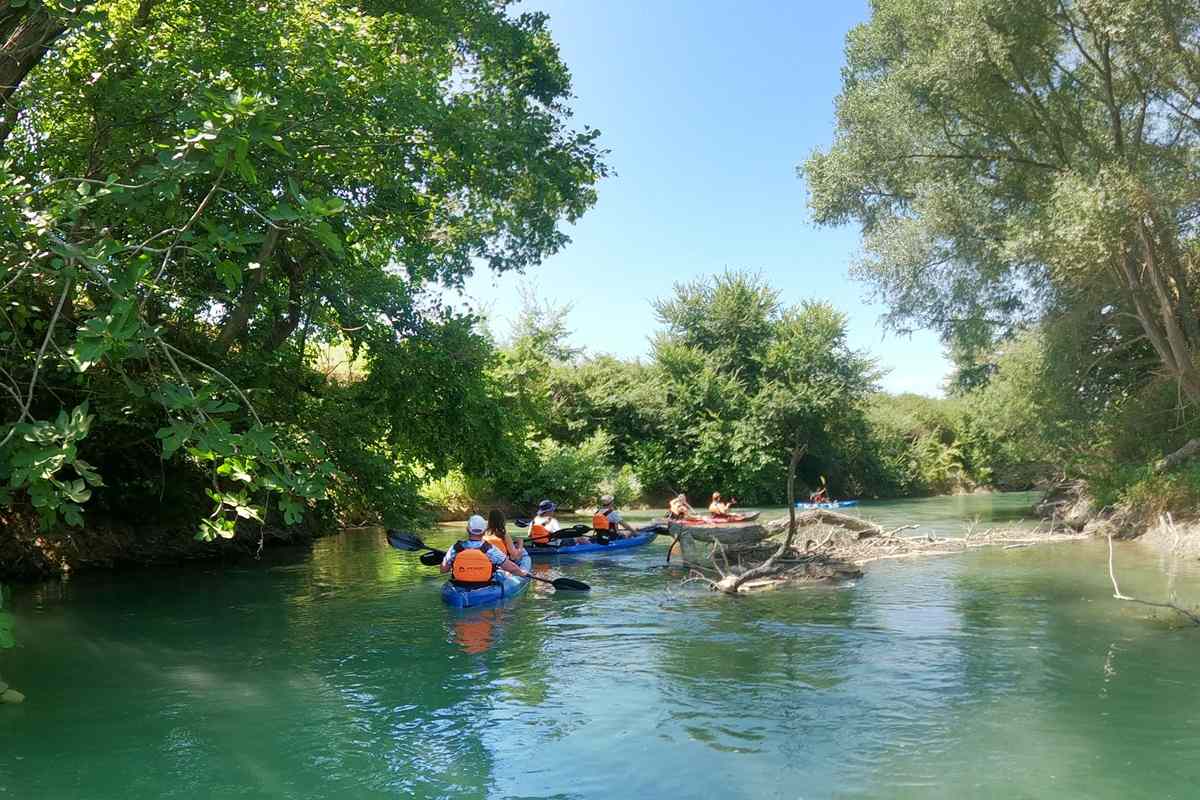
An Acheron river tour follows the river of Epirus that Greek myth tied to the underworld, from its springs and gorge to the Necromanteion near its mouth, with Souli above and Nicopolis to the south. The tour is one of the Greece Tours on Greece Ville, listed with the other Epirus tours and day trips from Corfu.
This post covers the formats on sale, the river, the springs and gorge, the river in myth, Charon, the Necromanteion and Ephyra, Souli and the Souliotes, Nicopolis and the questions that come up before booking.
What does an Acheron river tour visit in north-west Greece?
An Acheron river tour visits a river in the Epirus region of north-west Greece. Formats cover its springs, its gorge and its lower course. In Greek myth, the same river served as an entrance to the underworld of the dead.
The Acheron is a river in the Epirus region of north-west Greece. Ancient Greek writers called it Acheron or Acherousios. The modern Greek name is Acherontas, which also names a municipal unit of Souli.
Epirus has four regional units: Thesprotia, Ioannina, Arta and Preveza. The Acheron runs through Thesprotia and enters the Ionian Sea in Preveza. An Acheron river tour moves along this western edge of Epirus.
In Greek myth, the Acheron served as the entrance to the underworld. Ancient writers describe Charon ferrying the souls of the dead across its water. Later Roman poets gave that role to the Styx.
The ruins of the Necromanteion, an oracle of the dead, stand near the river on the mainland opposite Corfu. An Acheron river tour links the springs, the myth sites and, in one format, Roman Nicopolis.
- Region: The river belongs to Epirus in north-west Greece.
- Greek name: The modern Greek form of the name is Acherontas.
- Sea: The river reaches the Ionian Sea on the west coast of Epirus.
- Myth: Ancient sources call the Acheron the river of woe.
Each stop on the route connects to one of these themes. The sections below follow the formats, the course of the river, the myths and the ancient sites in turn.

Which formats does an Acheron river tour come in?
An Acheron river tour comes in formats that start from Parga, from the Epirus mainland or from Corfu. They range from a river visit with transport to private tours, a kayaking trip and an evening format that ends with dinner.
The first format is a river visit from Parga with transport included. A tour leader accompanies the group to the Acheron and explains the river, its springs and its place in the old stories.
A private Acheron river tour from Parga combines the springs, the Necromanteion and Souli. It joins the river, the oracle site and the Souliote mountain country in a single outing for one party.
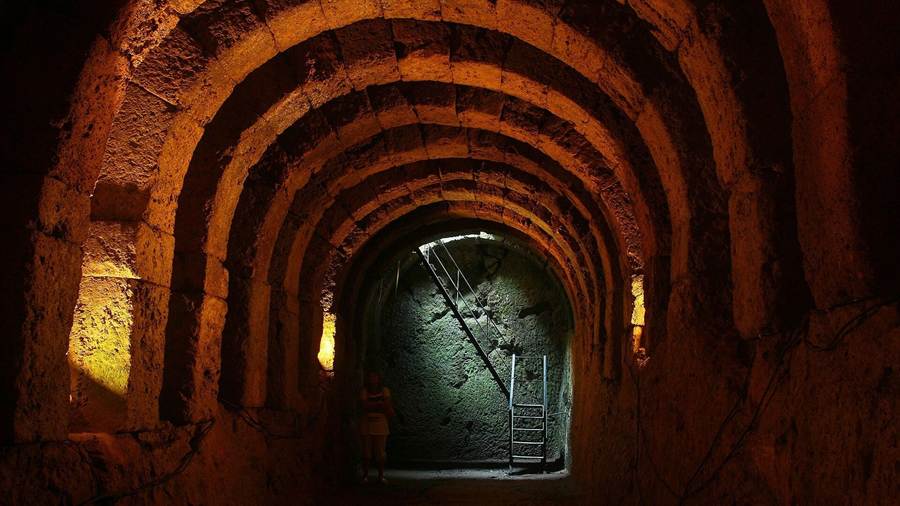
A kayaking trip from Parga follows a stretch of the Acheron by paddle. A separate format visits an underground crypt, the springs and the river, and closes the outing with a river dinner.
An Epirus format pairs imperial Nikopolis with the Acheron as a private tour. From Corfu, a private visit covers Parga and the Acherontas river. Another listing offers a plain tour in the Acheron river.
- Transport: The Parga river visit includes transport for the group.
- Private: Three listings run as private tours for a single party.
- Active: The kayaking format puts visitors on the river in a kayak.
- Evening: The crypt, springs and river format includes a dinner.
Visitors based in Parga also book a Parga boat trip on the open sea along the coast. The tour cards and availability boxes on this page list live dates for each format.
Where does an Acheron river tour follow the river on its way to the sea?
An Acheron river tour follows a river that rises near the village of Zotiko, runs through Thesprotia and reaches the Ionian Sea at Ammoudia in the Preveza regional unit. Reedbeds and plane trees line its banks in Thesprotia.
The source of the Acheron lies near Zotiko. Zotiko also appears among the partly abandoned or sparsely populated villages of the Souli area, so the upper river begins in the old Souliote country.
Thesprotia, the regional unit that the river crosses, borders Albania to the north, Ioannina to the east and Preveza to the south. The Ionian Sea lies to the west. Much of the unit is mountainous.
In antiquity, the river estuary was known as the sweet port. By the 11th century, that name had passed to the river itself. The name of nearby Glyki appears to derive from the river.
Until 1937, official Greek documents called the area above the river Tsamouria. In that year the separate prefecture of Thesprotia was formed. The mouth lies in Ammoudia, a small fishing village in Preveza.
- Source: The river rises near the village of Zotiko.
- Middle course: The Acheron crosses Thesprotia between reedbeds and plane trees.
- Mouth: The river meets the Ionian Sea inside the village of Ammoudia.
- Catchment: The drainage area of the river covers 705 square kilometres.
An Acheron river tour reaches the river at different points along this course. The springs lie upstream, while the oracle site and the mouth lie downstream near the coast.
What does an Acheron river tour show at the springs and the gorge?
An Acheron river tour at the springs takes visitors into the water of a narrow gorge. The river runs between rock walls there, and visitors walk upstream through the current, past the plane trees that grow along the banks.
The springs formats reach the upper river near Glyki, a village in Thesprotia. The site of Glyki is identified with the ancient city of Euroea, abandoned in the early 7th century after Slavic attacks.
Inside the gorge, the cold water fills the space between steep rock walls. Visitors wade upstream in the river bed itself, and the depth of the water changes from one bend to the next.
Glyki has a long church history. The ruins of a three-aisled middle Byzantine cathedral survive next to the Church of St. Donatus. The cathedral rose over the remains of an earlier church.
The Treaty of Glyki between the Souliotes and the Ottoman Albanian beys of the area was concluded in the village. This took place in the early months of the Greek War of Independence.
- Water: Visitors walk in the river itself rather than on a path.
- Banks: Reedbeds and plane trees line the Acheron in Thesprotia.
- Village: Glyki grew from 238 inhabitants in 1928 to 481 in 1971.
- Farming: Local families raised livestock and grew crops, with rice to the fore.
An Acheron river tour at the springs suits visitors who enjoy walking in water. Further inland, the mountains of Epirus are the setting for Zagori tours.
Why does an Acheron river tour tell the myth of the underworld?
An Acheron river tour tells the underworld myth because Greek myth placed the Acheron at the entrance to the realm of Hades. Ancient sources counted it among the five rivers of the underworld and called it the river of woe.
In Greek religion, Hades was the god of the dead and the king of the underworld. His brothers Zeus and Poseidon received the sky and the sea, while Hades received the realm below.
The five rivers of that realm were the Acheron, Cocytus, Phlegethon, Lethe and Styx. Ancient writers link them with woe, lamentation, fire, oblivion and hate. The Homeric poems describe Cocytus and Phlegethon flowing into the Acheron.
Plato, in his Phaedo, called the Acheron the second greatest river in the world after Oceanus. The Roman poet Virgil named it the principal river of Tartarus. The Suda described it as a place of healing.
The Acherusian lake belongs to the same story. The belief first seems to have attached to a lake in Thesprotia through which the Acheron flowed. In Plato’s Phaedo, neutral souls are cleansed in the Acherusian Lake.
- Hades: Greek myth makes Hades the eldest son of Cronus and Rhea.
- Five rivers: The Styx, Phlegethon, Lethe, Acheron and Cocytus encircle the underworld.
- Lake: Greeks in Italy identified the Acherusian lake with Lake Avernus.
- Literature: Virgil, Dante and Shakespeare all refer to the Acheron.
An Acheron river tour presents these stories as ancient belief. The river in Epirus gave the myth a fixed place on the map of Greece.
Who is the ferryman an Acheron river tour talks about?
An Acheron river tour talks about Charon, the ferryman of the Greek underworld. In Greek myth, he carried the souls of the dead across the river that bordered the underworld, which ancient sources name as the Acheron or the Styx.
Charon carried only souls that had received funeral rites. Archaeology confirms that in certain burials low-value coins, known as Charon’s obols, were placed in or near the mouth of the dead, or beside the cremation urn.
In the Aeneid, Virgil wrote that the dead who lacked the fee or funeral rites wandered the near shore for one hundred years. Only after that wait were they allowed to cross the river.
Charon first appears in the Minyas, a fragmentary Greek epic that possibly dates back to the 6th century BC. Attic funerary vases of the 5th and 4th centuries BC show the dead boarding his boat.
Pausanias placed Charon on the Acheron, and Pindar, Aeschylus, Euripides, Plato and Callimachus did the same. Roman poets such as Propertius, Ovid and Statius named the river as the Styx instead.
- Living passengers: Charon ferried Heracles and Aeneas to the underworld and back.
- Vase art: Early vases show him as an Athenian seaman dressed in reddish-brown.
- Dante: Charon is the first named mythological character Dante meets in the Inferno.
- Astronomy: The largest moon of the dwarf planet Pluto carries the name Charon.
An Acheron river tour on the lower river passes the waters that ancient writers linked with Charon. The story explains the long association of the Acheron with the dead.
What is the Necromanteion that an Acheron river tour visits?
An Acheron river tour visits the Necromanteion, the oracle of the dead linked with ancient Ephyra. Tradition places this temple of Hades and Persephone on the banks of the Acheron, where the faithful came to speak with their dead ancestors.
Necromanteion means Oracle of the Dead. It belonged to the Thesprotians, the local Epirot Greek tribe. Tradition set it where the Acheron, Pyriphlegethon and Cocytus met, names read as joyless, burning coals and lament.
Herodotus wrote that Periander, the 6th century BC tyrant of Corinth, sent envoys here to question his dead wife, Melissa. Homer’s Odyssey describes it as the entrance for the descent of Odysseus to the underworld.
Sotirios Dakaris identified a site near Mesopotamo, found in 1958, as the Necromanteion. Later study dates the ruins to no earlier than the later 4th century BC and questions the identification.
Ancient Ephyra, also called Cichyrus, was the capital of ancient Thesprotia. It stood about 800 m north of the junction of the Kokytos with the Acheron, near the outlet of the Acherusian Lake.
- Ritual meal: Celebrants at the oracle ate broad beans, pork, barley bread and oysters.
- Destruction: The Romans burned the site down in 167 BC.
- Finds: Excavators found 21 bronze washers from at least seven catapults.
- Bronze Age: Ephyra holds the only confirmed Mycenaean acropolis in Epirus.
An Acheron river tour in the crypt format enters the underground chamber of the site. A conference paper has examined the acoustic properties of this crypt below the ruins.
How does an Acheron river tour connect with Souli and the Souliotes?
An Acheron river tour connects with Souli through a private format from Parga. Souli is a mountain area of Epirus above the river, and the Souliotes who lived there resisted Ottoman rule until their armistice in December 1803.
Souli is today a municipality in Epirus, with its seat in the town of Paramythia. The 2011 reform formed it from three former municipalities: Acherontas, Paramythia and Souli. It covers 502.8 square kilometres.
The Souliotes were an Orthodox Christian community of Albanian origin. They lived in Souli from the 16th century to the beginning of the 19th century and later came to identify with the Greek nation.
The core of Souli had four villages: Souli, Avariko, Kiafa and Samoniva. At its height, in the second half of the 18th century, the confederacy held an estimated population of up to 4,500.
Ali Pasha became the local Ottoman ruler in 1789 and sent repeated expeditions against Souli. After the 1803 armistice the Souliotes left their homeland, and the majority went into exile in the Ionian Islands.
- Name: One theory derives Souli from the Albanian word sul, meaning mountain peak.
- Leaders: Markos Botsaris and Kitsos Tzavelas led Souliotes in the Greek War of Independence.
- Kiafa: The Kiafa castle, built by Ali Pasha, stands abandoned and in ruin.
- Zalongo: The Dance of Zalongo recalls Souliote women at Mount Zalongo after the fall of Souli in 1803.
An Acheron river tour that adds Souli climbs from the river valley to these mountain villages. The private format from Parga combines Souli with the springs and the Necromanteion.
Why does one Acheron river tour add Nicopolis?
An Acheron river tour adds Nicopolis in a private Epirus format. Octavian founded this Roman city in 29 BC to mark his victory over Antony and Cleopatra at the Battle of Actium, a sea battle fought nearby in 31 BC.
Nicopolis means City of Victory. Its ruins lie 7 kilometres north of Preveza. The city became the capital of the Roman province of Epirus when Trajan created that province in the early second century AD.
The Battle of Actium took place on 2 September 31 BC in the Ionian Sea. Marcus Agrippa led the fleet of Octavian against the combined fleets of Mark Antony and Cleopatra.
Antony brought 500 ships and 70,000 infantry and made his camp at Actium. Octavian had 400 ships and 80,000 infantry. In 27 BC, the Roman Senate gave Octavian the title of Augustus.
On a hill north of the city, where his own tent had stood, Octavian built a monument and sanctuary to Apollo. He also founded the Actian games, held every four years in honour of Apollo Actius.
- Buildings: Early works included the theatre, stadium, gymnasium, odeion and aqueduct.
- Size: The city occupied a site of around 375 acres.
- Paul: The Apostle Paul spent the winter of 65 to 66 at Nicopolis.
- Epictetus: The Stoic philosopher Epictetus founded his own school at Nicopolis.
An Acheron river tour with Nicopolis joins myth and Roman history in one route across southern Epirus. Another Ionian outing, the Paxos Antipaxos cruise, sails to the islands off this coast.
What do travellers ask about an Acheron river tour?
An Acheron river tour raises a short set of recurring questions. Travellers ask about departure points, the kayaking format, the oracle of the dead and the link between the river and the underworld. The answers below draw on the sections above.
Does an Acheron river tour leave from Parga or from Corfu?
Formats leave from both. Listings from Parga include the river visit with transport, the private springs, Necromanteion and Souli tour, and the kayaking trip. From Corfu, a private visit covers Parga and the Acherontas river, with a crossing to the mainland opposite the island.
Is there a kayaking Acheron river tour?
Yes. One listing from Parga runs as a kayaking trip on the Acheron. Participants paddle a stretch of the river instead of walking through the gorge. The listing appears beside the other formats in the tour cards on this page, with live dates for booking.
What was the Necromanteion seen on an Acheron river tour?
The Necromanteion was an ancient Greek temple of necromancy devoted to Hades and Persephone. Its name means Oracle of the Dead. The faithful came to it to talk with their dead ancestors. Tradition places it on the banks of the Acheron, near the ancient city of Ephyra.
Why does an Acheron river tour link the river to the underworld?
Greek myth depicted the Acheron as the entrance to the underworld. Charon ferried the souls of the dead across it. Ancient sources counted it among the five rivers of the underworld, and writers also used its name as a figure for Hades itself.