

A Paxos Antipaxos cruise is a boat trip from Corfu to two small islands south of it in the Ionian Sea. The islands have white cliffs, olive groves and clear water. It is one of the Greece Tours on Greece Ville, listed with the other Ionian Islands tours.
This post covers what a Paxos Antipaxos cruise is, the sea route from Corfu and how the islands formed. It also covers the west cliffs, the harbours, the olive groves and the rulers of the islands. Myths, sea life, winds, the best time of year and common questions come last.
The sections include Paxos Antipaxos cruises and related Corfu boat trips that can be booked online.
What is a Paxos Antipaxos cruise?
A Paxos Antipaxos cruise is a boat trip from Corfu to two small islands in the Ionian Sea. Paxos lies just south of Corfu. Antipaxos sits to its southeast. Together with nearby islets, the group carries the plural name Paxi or Paxoi.

A Paxos Antipaxos cruise reaches a main island stretching northwest to southeast. Its highest point is Agios Isavros, at 231 m. The Ionian Sea is the stretch of the Mediterranean west of mainland Greece.
Paxos sits in the Corfu regional unit, a local government area. Its municipality covers 30.121 square kilometres. A regional unit is a district that groups a number of municipalities. Besides Paxos, it takes in Antipaxos and a couple of tiny islets.
A Paxos Antipaxos cruise also covers the smaller island, known in Greek as Antipaxoi or Propaxos. It measures 2 miles long and 1 mile wide. The 1951 census counted 96 people there. A census is an official count of the people living in a place.
Both islands share a lizard-like shape, long and narrow. Paxos was named Cultural Village of Europe for the year 2004. The Paxos group lies between Corfu and Lefkada.
A Paxos Antipaxos cruise visits islands whose name has competing explanations. Strabo was an ancient Greek geographer who described the known world. According to him, Phoenicians named Paxos from paks, their word for trapezoid. That shape appears from the air. Another story links the name to settlers from Paxountos in Sicily.
Athinagoras, the Metropolitan or senior bishop of Paramythia, linked the name to plaka, the Greek word for flagstone. Such slabs were cut on Paxos and exported. Giannis Doikas preferred pax, a word meaning peace.
- Parga link: In summer, boats bring visitors from Paxos, Antipaxos and Corfu to Parga.
- Mainland nickname: Parga is known as the Bride of Epirus.
- Early visitor: Archduke Ludwig Salvator of Austria spent six months on Paxos in 1884-1885.
- His book: In 1887 he published about 500 pages on Paxos and Antipaxos.
A Paxos Antipaxos cruise visits islands with a long history at sea. Their small size and steep coasts set them apart from Corfu to the north.


How does the sea route of a Paxos Antipaxos cruise run from Corfu?
A Paxos Antipaxos cruise runs south from Corfu towards the smaller islands. Corfu narrows towards the south, where its land turns low. Its southeast side faces Thesprotia, a coastal district of Epirus. Beyond the southern tip, open sea leads to Paxos.
A Paxos Antipaxos cruise passes Asprokavos, a cape on the southeast side. A cape is a point of land that juts into the sea. Kavos, with 643 residents, is the southernmost seaside village on the island.
Kavos lies within Lefkimmi, the southernmost district of Corfu, covering 50.819 square kilometres. Its main town, also known as Alefkimmo, has a canal through its eastern part. A small port on Cape Kavos runs a ferry to the mainland.
A Paxos Antipaxos cruise follows waters with a violent past. The Ottomans ran a Turkish empire that ruled southeastern Europe for centuries. In August 1571, Ottoman forces first seized towns on the mainland. They then attacked Paxos and Antipaxos. Next they landed on the southeast shore of Corfu.
The northern harbour of Lakka lies about 9 nautical miles south of Corfu. A nautical mile is the standard unit of distance at sea. Paxos itself sits 8 miles from the mainland coast.
In the wartime occupation, traders rowed this gap by night. An occupation is the rule of a land by a foreign army. They swapped olive oil for wheat, maize and barley.
A Paxos Antipaxos cruise shares its sea with Syvota, a mainland coastal village. It was called Volia until 1927, then Mourtos until 1940. Its beaches lie on islets just offshore.
- Igoumenitsa: This chief port of Epirus sits at the eastern end of its own gulf.
- River mouths: The Thyamis runs 115 km and the Acheron 52 km before reaching the Ionian Sea.
- Sea charts: The Greek chart ΧΕΕ-212 covers Corfu, Paxos and the facing mainland coast.
Near the islands, a Paxos Antipaxos cruise enters protected water. Natura 2000 is the European network of protected nature sites. The site around these islands reaches out to the 50 m depth line.
How did the islands of a Paxos Antipaxos cruise form?
A Paxos Antipaxos cruise visits islands made of limestone, a rock formed from calcium carbonate. Both islands lie in the Pre-Apulian Zone, the westernmost rock belt of Greece. Rain and waves keep wearing this rock away. Over time they shape cliffs and caves.
Limestone is made chiefly of calcite and aragonite, two crystal forms of calcium carbonate. Antipaxos is completely covered by pelagic limestone, meaning limestone laid down in the open sea. Paxos is largely the same rock. Its southeast also holds patches of micritic limestone, a very fine-grained type.
A Paxos Antipaxos cruise crosses a boundary between rock belts. These belts follow a scheme by the geologist Aubouin. Corfu lies in the Ionian Zone, east of the Pre-Apulian belt. That belt holds limestone dating from the Cretaceous to the Miocene periods.
Greece sits where the European and African plates meet, so its geology is complex. A plate is a giant slab of the outer shell of the Earth. The Ionian Zone has been pushed westward over the Pre-Apulian Zone. Geologists call this push a thrust. The Ionian Sea ranks among the world’s busiest earthquake areas.
Karst is a landscape formed when water dissolves rocks such as limestone. Rain picks up carbon dioxide and turns into weak carbonic acid. A Paxos Antipaxos cruise passes limestone that splits into slabs.
Sea caves form mainly through the wave action of the sea. The rock first needs a weak zone, such as a gap between layers. Waves squeeze air into cracks and force them wider. A collapsed cave tunnel can leave a lone pillar called a sea stack.
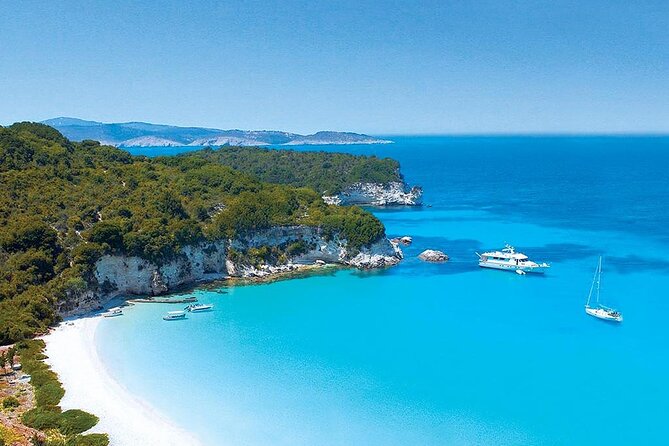
A Paxos Antipaxos cruise shows the contrast between the coasts of Paxos. The east coast is smooth. The west coast is abrupt, with arches, dome-shaped forms and sheer cliffs.
- Antipaxos ridge: Agrilida, the northern peak of the Antipaxos ridge, reaches 117 m.
- Sulphur springs: Paxos holds sulphur springs as well as caves.
- Corfu rock: Corfu is widely covered by marine marls from the Miocene and Pliocene periods.
A Paxos Antipaxos cruise passes calcareous, or lime-rich, islands with rocky and eroded coasts. Waves keep cutting into these shores, so the coastline changes slowly over time.
What does a Paxos Antipaxos cruise show along the west cliffs of Paxos?
A Paxos Antipaxos cruise shows steep white cliffs along the whole west side. The sea has cut caves, arches and lone rocks into them. The east coast is smooth by contrast. Small rock islets rise just offshore.
A Paxos Antipaxos cruise passes cliffs of Pre-Apulian zone limestone, a rock belt of western Greece. The rock holds fossil corals, sponges and rudists, extinct reef-building clams. At sea level, erosion has cut blue caves into the chalky base.
The 1911 Encyclopaedia Britannica called the island a hilly mass of limestone. That limestone meets the sea in sheer walls on the west side. Erosion is the slow wearing away of rock by water and wind.
A Paxos Antipaxos cruise passes roughly forty graves. Graves is the term used here for sea caves with vaulted ceilings. Dozens of marine caves line the west side, linked in places underground. Achai is a cave system with maze-like passages.
Ortholithos, or upright stone, is a single rock over 20 metres high. It rises close to the west coast. Trypitos is a natural stone arch like a bridge. Its other name is Kamara, the Greek word for vault.
A Paxos Antipaxos cruise also passes Katergo, a rock islet off Grammatikeika. Its second name is Erimitis, meaning hermit. A cliff landslide formed a beach of that name. The church of Agioi Apostoloi, the Holy Apostles, overlooks this cliff.
Opposite the islet lies a huge cave. Locals call it Ypapanti, a Greek word for the Presentation of Christ. Tradition says the submarine Papanikolis hid there during the Second World War. It joined the Hellenic Navy on 21 December 1927.
- Seal cave: Kalogiris cave on Antipaxos, where seals nest, is under Coast Guard watch.
- Rock islets: Marmaro is a group of three rock islets off the northwest tip.
- Wind warning: The cave route calls for caution and experienced handling in westerly winds.
A Paxos Antipaxos cruise along this coast passes cave after cave in the white rock. The arch, the rock pillars and the islets break up the long line of cliffs.
What do the harbours of Paxos show on a Paxos Antipaxos cruise?
A Paxos Antipaxos cruise shows a capital harbour sheltered by green islets. A fortress crowns the larger islet, and a monastery the smaller. Northern bays hold stone villages and an old lighthouse. Their stories run from pirate raids to a British takeover.
On a Paxos Antipaxos cruise, the capital’s harbour opens between two islets. They lie just fifty metres from shore and shield the harbour. The channel forms a meniscus, or crescent, so the port’s northern end is called Maneskos.
Agios Nikolaos islet covers 0.180 square kilometres. Baron Adam II San Ippolito began its castle in 1423 against pirates. He paid for it himself, with permission from the Venetian Senate. The fortress became a listed monument in 1976. A listed monument is a building protected by law.
A Paxos Antipaxos cruise passes a castle rebuilt in 1510. Legend says Leonardo da Vinci drew the plans. A gunpowder store and stone cisterns survive inside. The walls still stand sturdy above the water.
Panagia islet, also called Madonna, covers 0.100 square kilometres. It lies 200 metres off the east coast. In 1720 monks began living there as a community. A monastery is a home where monks live and pray together. On the 15 August feast, small boats carry the monastery icon from the town.
A Paxos Antipaxos cruise also shows Lakka, about 8 km northwest of the capital. It is the island’s second-largest harbour. Headlands on each side enclose its almost circular natural bay. The bay is fairly sheltered from northwest winds.
Loggos sits at the head of a bay on the east coast. Its stone houses have tiled roofs. Mansions follow the building style of the Ionian Islands.
- Kolokotronis: He served as a major in the British force that took the castle in 1814.
- Lighthouse: A stone lighthouse built in 1932 stands west of the northern village.
- Old press: A traditional olive press in Magazia is now an Olive Press Museum.
The capital takes its name from Gaios, a pupil of Paul the Apostle. He brought Christianity to the island. Since 1996, the Paxos Museum has used a school building of 1905. Andreas Syngros, a banker, bequeathed the building.
What grows on the islands of a Paxos Antipaxos cruise?
A Paxos Antipaxos cruise shows hills covered in olive groves from Venetian times. Antipaxos grows grapes for wine that families make at home. Cypress, pine and evergreen shrubs cover the uncultivated land. Fresh water has always been scarce.
On a Paxos Antipaxos cruise, olive groves cover much of the hilly land. They run from the northern harbour down to the capital. The Venetians encouraged olive growing to give the island an income.
Archduke Ludwig Salvator’s book on the islands records about 440,000 cultivated olive trees. It adds 100,000 uncultivated trees among rocks. The Republic of Venice paid owners one taler, a silver coin, per planted tree. Antipaxos then had only a dozen cultivated olive trees.
On a Paxos Antipaxos cruise, Antipaxos stands out for its strong dark wine. Families still make almost all of it at home. The same book records 150-200 barrels of wine made there. Black wine, the Greek term for red, made up the bulk.
An old encyclopaedia rated the island’s olive oil of the very highest quality. That oil carried the island’s trade for centuries, long before visitors arrived by boat.
On a Paxos Antipaxos cruise, the wild plants are mainly Mediterranean in type. About 65% of the plant taxa are typical Mediterranean elements. Taxa means plant species and subspecies.
Evergreen shrubs like carob, olive, mastic and kermes oak cover wild ground. Clusters of Italian cypress remain from a former cypress forest. Phoenician juniper grows in the northwest. Aleppo pine grows on Mogonisi, an islet in the southeast.
- Scarce water: The island has only a single stream and a handful of springs.
- Eleousa cisterns: Above a church in Vlachopoulatika, old water tanks also stored olive oil.
- Saracen cisterns: Near Boikatika, carved stone tanks look like small huts.
Below the waterline, meadows of Posidonia seagrass grow off Antipaxos. Coral reefs lie there at depths of more than 30 metres. Posidonia is a seagrass, a flowering plant that grows underwater. Cisterns are tanks that store rainwater for dry months.
Who ruled the islands of a Paxos Antipaxos cruise?
A Paxos Antipaxos cruise crosses waters ruled by a long chain of foreign powers. Illyrians, Romans and Byzantines came first. Normans, Angevins and Venetian lords followed in the Middle Ages. French, Russian-Ottoman and British rule came last before modern Greece.
The waters of a Paxos Antipaxos cruise saw a naval battle in the spring of 229 BC. An Illyrian fleet sent by Queen Teuta met 10 Achaean ships. The historian Polybius recorded the fight. A historian is a writer who records past events.
The Illyrians lashed their ships together and boarded the enemy decks. They captured four quadriremes, large ancient warships with oars. Corcyra, now Corfu, then took an Illyrian garrison, a force of soldiers, under Demetrius of Pharos.
Romans ruled the islands of a Paxos Antipaxos cruise from the 2nd century BC. In 31 BC Octavian used nearby Corfu as a base against Mark Antony. Their fleets then met at Actium, in the Ionian Sea.
Pirates held Paxos during the Byzantine era and the Middle Ages. By the early 9th century, the islands belonged to the Byzantine theme of Cephallenia, a military province. Normans from southern Italy occupied Corfu from 1081 to 1084.
The islands of a Paxos Antipaxos cruise passed to the House of Anjou with Corfu in 1267. Paxos was a fief, land granted to a lord. The San Ippolito barons held it from 1357 to 1484, and the Gotti family until 1527.
Venice took over Paxos in the late 1300s. Under Venice, the island passed to Venetian princes and barons as a fief for decades.
- French rule: In 1797 Paxos joined the French department of Corcyre, a unit of local government.
- Septinsular Republic: This state of seven islands lasted from 1800 to 1807 under Russian and Ottoman protection.
- British arrival: On February 13, 1814, Paxos surrendered to the frigate HMS Apollo and 160 troops.
Under British protection, Paxos elected one member to the Legislative Assembly. A protectorate is a land guarded and run by a stronger state. A second seat rotated with Cythera and Ithaca. Its deputies Ioannis Vellianitis and Dimitrios Makris voted for union with Greece.
Which myths surround a Paxos Antipaxos cruise?
A Paxos Antipaxos cruise sails past the island where an ancient voice announced the death of a god. A Greek writer told this story about the god Pan. The Ionian Sea also carries a myth in its name. Local tradition adds a Christian saint.
A famous legend of a Paxos Antipaxos cruise comes from Plutarch’s essay The Obsolescence of Oracles. An oracle was a place where people asked the gods for advice. In it, Pan, the goat-legged god of the wild, is the only Greek god who dies. The story is set in the reign of Tiberius, AD 14–37.
Epitherses, a teacher of grammar, was sailing to Italy on a crowded cargo ship. One evening, near the Echinades Islands, the wind dropped. The ship drifted close to Paxi, another name for Paxos.
A voice from the island called the name Thamus. He was the ship’s Egyptian pilot, the sailor who steers. He stayed silent twice and answered the third call. The voice told him to announce, off a place called Palodes, that Great Pan is dead.
At Palodes there was neither wind nor wave. The pilot spoke the message from the stern, the back of the ship. A great cry of grief rose at once from the shore.
Word reached Rome, and the emperor sent for the pilot. His scholars guessed that Pan was the son of Hermes and Penelope. Christian writers such as Eusebius of Caesarea used this Paxos Antipaxos cruise legend. In Greek, pan also means all.
The sea of a Paxos Antipaxos cruise has its own myth. Ancient writers, especially Aeschylus, tied the name Ionian to Io. She was a princess of Argos and a priestess of Hera. Zeus turned her into a heifer, a young cow.
- The gadfly: Hera sent a gadfly, a biting fly, to sting Io without rest.
- The swim: Greeks called the sea Ionios because Io swam across it.
- Goat god: Pan is the god of shepherds and flocks, with the legs and horns of a goat.
Later writers kept the Pan story alive. In the 16th century, Rabelais tied it to the death of Jesus Christ. In 1921 James Van Teslaar argued that sailors misheard a cry for the god Tammuz.
What lives in the sea of a Paxos Antipaxos cruise?
A Paxos Antipaxos cruise crosses a Natura 2000 site, part of a European network of protected areas. Bottlenose, common and striped dolphins all swim in these waters. A small colony of Mediterranean monk seals lives on the steep rocky coasts.
The protected area of a Paxos Antipaxos cruise carries the code GR2230004. Its official name means the Paxoi and Antipaxoi islands and wider sea area. The islands and their waters cover about 1,355 km².
The bulk of the marine area is shallow, less than 200 m deep. West of the islands, the seabed drops away fast. Bottlenose and common dolphins gather around bottom trawlers, fishing boats that drag nets along the seabed.
Striped dolphins travel in groups through the deeper western waters of a Paxos Antipaxos cruise. Greece lists this dolphin as a vulnerable species. In the early 1990s, an epidemic sharply cut their Mediterranean numbers. An epidemic is a disease that spreads fast through a population.
A very small colony of Mediterranean monk seals uses the steep rocky coasts. The seals favour the western shores of both islands. The Greek Red Data Book, a list of threatened wildlife, rates the species as endangered.
Fewer than 700 Mediterranean monk seals survive worldwide. Females give birth on beaches or in underwater caves.
Threats to the seal colony include persecution by fishermen and illegal fishing. Pollution of the coasts adds to the danger. Tourists now reach rocky shores that once stayed out of reach.
- Neptune grass: This seagrass, Posidonia oceanica, lives only in the Mediterranean and grows leaves about 1.5 m long.
- Seabirds: The islets hold seabird colonies and lie on the main bird migration route of western Greece.
- Loggerhead turtles: Greece leads Mediterranean nesting, with more than 3,000 loggerhead nests per year.
Clean water suits Posidonia best, so healthy meadows signal a sea free of pollution. In Greek seas it covers the seabed from the shoreline down to 25–30 m. A Paxos Antipaxos cruise passes over these meadows near the shore.
How do winds and weather shape a Paxos Antipaxos cruise?
A Paxos Antipaxos cruise depends on wind and sea state. Summer brings a mild northwest breeze that Greeks call the maïstros. Spring and autumn bring the sirocco, while the cold bora blows from the north. These winds decide how smooth each crossing feels.
On a Paxos Antipaxos cruise, the summer maïstros acts as a sea breeze. A sea breeze is a wind that blows from the water onto warm land. It blows when the coast grows warmer than the sea. It is a mild wind that moves from the sea toward the coast.
In the Aegean, the strong, dry north winds are called etesians or meltemia. They blow from late spring until mid-September. Similar winds reach the Ionian and Adriatic regions. Their force builds through the afternoon and fades after dark.
The Beaufort scale rates wind by its visible effect on the sea. Aegean etesians can reach force 7–8 on this scale. Because of them, the Aegean stays cooler than the Ionian. A Paxos Antipaxos cruise therefore runs through warmer summer air.
The sirocco, called sorókos in Greek, is a Mediterranean wind that comes from the Sahara. It can blow at up to 100 km/h. The Sahara is the great desert of North Africa. March and November see it at its strongest. Crossing the sea, it gathers moisture and brings warm, wet weather to southern Europe.
The bora, called mpóra in Greek, is a cold wind from the north or north-east. It is katabatic, meaning it pours down from high ground. It raises short, high waves with white crests. Such seas make navigation difficult on a Paxos Antipaxos cruise.
- Force 3: Winds of 7–10 knots, a gentle breeze, lift waves 0.6–1.2 m high.
- Force 6: At 22–27 knots, a strong breeze, waves reach 3–4 m.
- Rain contrast: Corfu averages 189.9 mm of December rain, against 69.0 mm in Aegean Naxos.
- Off-season links: Hydrofoils to Paxos outside the tourist season are infrequent and weather dependent.
The Paxos coast offers shelter on a Paxos Antipaxos cruise. Lakka, in the north, sits on a natural, nearly circular harbour. Two headlands shield that bay from the open sea. Olive groves and cypress trees flank the village.
When is the best time of year for a Paxos Antipaxos cruise?
A Paxos Antipaxos cruise fits best between late spring and early autumn. Corfu has a hot-summer Mediterranean climate, marked Csa on the Köppen climate map. Summers are hot and dry. Winters are mild to cool, and much wetter than on other Greek islands.
Spring brings a fast rise in sunshine for a Paxos Antipaxos cruise. Corfu records 116.0 hours in March but 206.5 hours in April. Late spring sees mean highs of 24.0 °C and lows of 13.3 °C. June’s mean high reaches 28.2 °C, with only 4.8 rain days. A rain day is a day with measurable rain.
July and August are hottest, with Corfu mean highs of 31.2 °C and 31.5 °C. July sees just 8.7 mm of rain over 3.3 days. That month also logs 364.5 sunshine hours.
Longos, a harbour village on Paxos, keeps its own climate record. Such a record lists average weather over long periods. August highs there average 31.4 °C. Rain falls to just 7 mm in July but climbs to 181 mm in November. So a Paxos Antipaxos cruise in July meets almost no rain.
September stays warm, with mean highs of 27.5 °C and lows of 16.8 °C. October’s mean high falls to 23.2 °C, but rain jumps to 140.4 mm. November is wetter still, at 187.1 mm. Corfu’s yearly rain totals 1111.3 mm.
A Paxos Antipaxos cruise in January meets a mean Corfu high of just 13.9 °C. The 39th parallel north crosses the Ionian Sea. There, the summer solstice, the longest day, brings 14 hours, 54 minutes of daylight. The shortest day, the winter solstice, brings 9 hours, 26 minutes.
- Humidity: Corfu’s air moisture averages 61.7% in July and 77.5% in November.
- Record heat: Corfu reached 42.8 °C on 24 July 2007, its highest reading.
- Air traffic: Flights at Corfu airport peak between April and October.
The municipality of Paxos counts more than 200,000 visitors each summer. A Paxos Antipaxos cruise in June or September still enjoys hot, dry weather. Those months fall on each side of the July and August peak.
What do travelers want to know about a Paxos Antipaxos cruise?
A Paxos Antipaxos cruise raises practical questions about access and surroundings. Travelers ask about the nearest airport and the depth of the sea. They also ask who lives on the islands. Olive oil, wildlife and harbours draw questions too.
Which airport serves a Paxos Antipaxos cruise from Corfu?
Corfu International Airport “Ioannis Kapodistrias” serves a Paxos Antipaxos cruise. It is named after Ioannis Kapodistrias, the first governor of Greece. Its codes are CFU and LGKR. The airport lies around 2 kilometres south of Corfu Town. It was founded in 1937. Its runway reached its full 2,373 m in 1959.
How deep is the sea under a Paxos Antipaxos cruise?
The Ionian Sea covers 169,000 km². It holds the Calypso Deep, the deepest point of the Mediterranean, at 5,109 m. The deep lies in the Hellenic Trench, a long undersea valley, 62.6 km south-west of Pylos. Water at that depth stays at 13.2 °C. The Mediterranean averages 1,500 m deep.
Who lives on the islands of a Paxos Antipaxos cruise?
The islands of a Paxos Antipaxos cruise hold small communities. The municipality of Paxos had 2,466 residents at the 2021 census. Gaios, the main port, counted 1,396 people. Lakka had 487 residents. Longos, the smallest island port, counted 267 in its community. Antipaxos had only 21 permanent residents.
Why does olive oil matter on a Paxos Antipaxos cruise?
Paxos olive oil also goes into soap and shampoo. At Longos, a tall chimney stands from an abandoned soap factory. Tourism replaced olive oil, soap and fishing as the main trade in the mid-1960s.
Which plants and animals live along a Paxos Antipaxos cruise?
Paxos and Antipaxos form a protected zone within Natura 2000, the European network of nature sites. The islands hold around 450 plant species. Two are endemic, meaning they grow nowhere else: Limonium antipaxorum and Centaurea paxorum. No amphibians have been reported on the islands. Natura 2000 sites protect rare habitats and species across Europe.
Where do larger ships dock on a Paxos Antipaxos cruise?
The new port of Gaios lies about one kilometre from the town centre. Larger ships from Igoumenitsa and Corfu dock at this port. The old harbour in the town centre is narrow and sheltered by islets.