
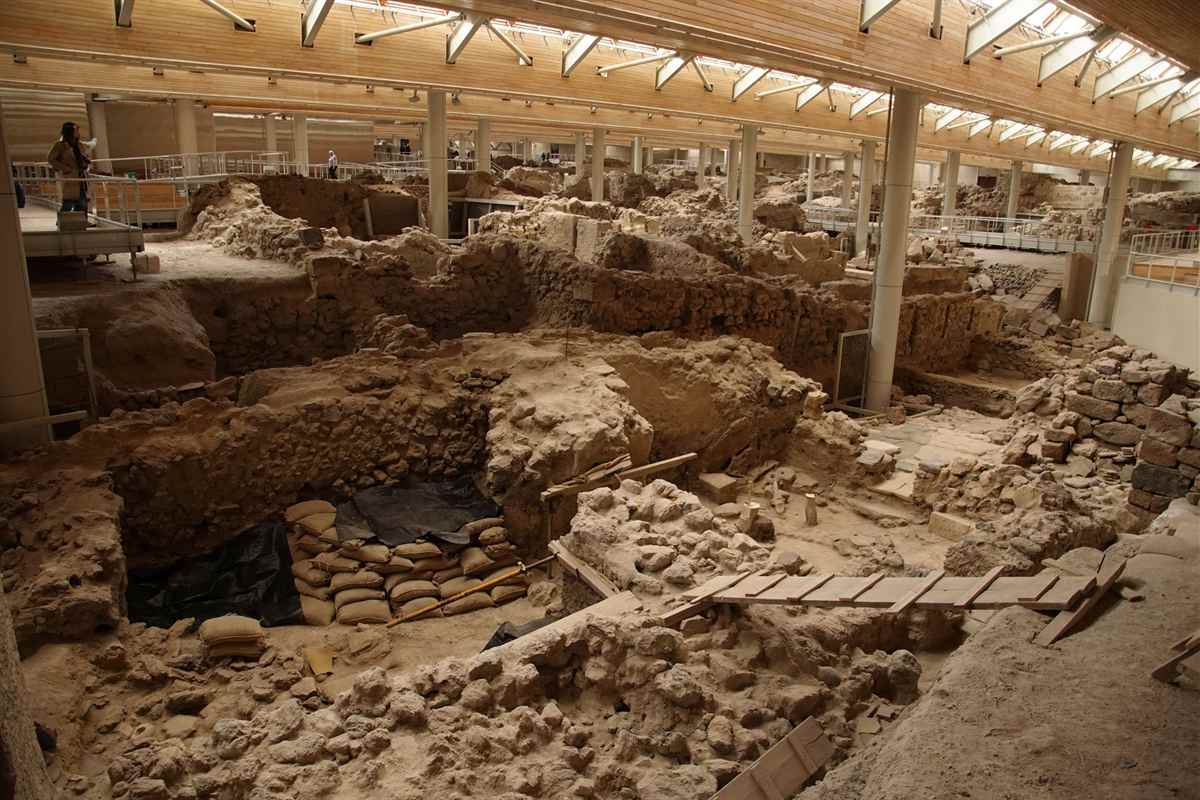
Akrotiri tickets open the Bronze Age town of Akrotiri in south-west Santorini, a settlement buried by a volcanic eruption whose streets and houses are now shown under a roof. The ticket is one of the Greece Tours on Greece Ville, listed with the other Santorini tours.
This post covers the tickets and formats on sale, where the site lies, the town it opens, the eruption, the excavators, the frescoes and finds and the questions that come up before booking.
What are Akrotiri tickets?
Akrotiri tickets open the excavated remains of a Bronze Age settlement in the Cyclades, on the island of Santorini. The site takes its name from the nearby village of Akrotiri, because the name of the town in antiquity is unknown.
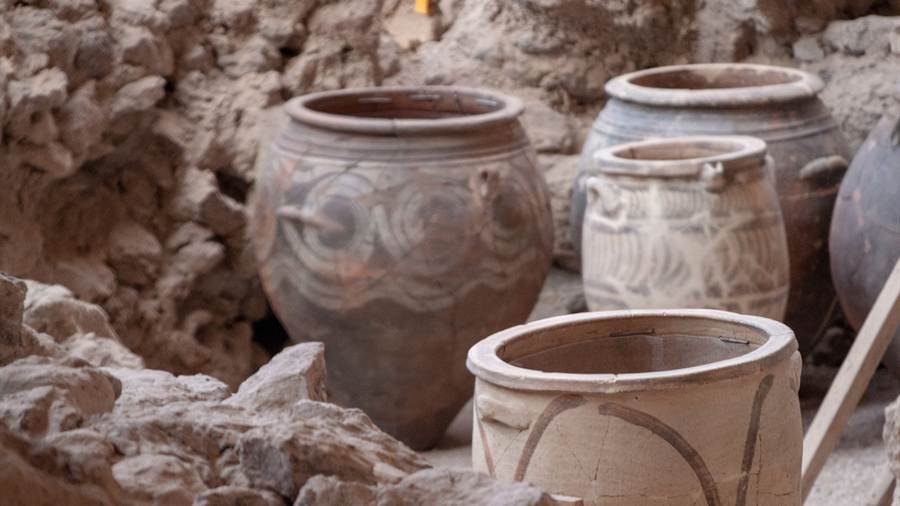
The settlement lay entombed under pumice and ash, and that cover kept its houses, furniture and wall paintings in rare condition. Scholars compare the site with the Roman ruins of Pompeii for this reason.
The British archaeologist Reynold Higgins noted that the Akrotiri digs had been called the foremost classical excavation since Pompeii. Press reports on the work reached Europe, the United States, Australia, Iran, Japan and China.
National Geographic magazine gave the excavation a special edition in 1978. The site counts among the best-preserved settlements of the ancient world and holds a central place in the study of Minoan wall painting.
The town belongs to the Cyclades, yet scholars tie it to the Minoan civilisation of Crete. Inscriptions in Linear A and close parallels in artefact and fresco styles support that connection.
Akrotiri tickets therefore lead into streets and houses left behind after a sudden evacuation. The excavated finds went to a museum away from the site, the Museum of Prehistoric Thera, where the artworks are shown.
- Site type: Akrotiri is a Cycladic settlement of the Bronze Age on Santorini.
- Name: The modern name comes from the nearby village, since the ancient one is lost.
- Minoan link: Linear A inscriptions and shared fresco styles connect the town with Crete.
- Finds: Artefacts from the dig sit in the Museum of Prehistoric Thera.
Akrotiri tickets thus serve as an entry point to Aegean prehistory. The sections below cover the formats on sale, the setting, the town, the eruption, the excavators and the frescoes.


Which Akrotiri tickets and formats are on sale?
Akrotiri tickets on sale come in eight listed formats. Two pair site entry with an audio tour, one adds the Venetian castle, one runs with a local expert, two add Red Beach and two fold the site into wider island tours.
The first listing joins an entry ticket for the Akrotiri site on Santorini with an audio tour. Entry and commentary arrive together, so the recorded narration accompanies the walk through the excavated town.
A second format sells Akrotiri tickets with a self-led audio option. The audio part is optional in this listing, so the ticket also stands on its own for visitors who prefer to explore unaided.
A third listing is a combined pass for the archaeological site and the Venetian castle in Akrotiri village. The pass joins the Bronze Age town with the later fortress that crowns the village hill.
A fourth format is a tour of the city frozen by a volcano, led by a local expert. Its title echoes the fate of the town under the eruption that sealed its streets and houses.
Two formats link the excavations with Red Beach, one as an archaeological bus tour and one with a lost Atlantis theme. A second catalogue adds a day tour with villages, wine and an Oia sunset.
- Entry with audio: Two listings sell site entry with an audio tour, one of them optional.
- Castle pass: One pass covers the site and the Venetian castle in Akrotiri village.
- Expert-led: One format visits the city frozen by a volcano with a local expert.
- Private option: One listing is a private Santorini island tour with Akrotiri and wine tasting.
The tour cards and availability boxes on this page list live dates for each format of Akrotiri tickets, from the plain entry ticket to the private island tour.
Where is the site on Akrotiri tickets?
Akrotiri tickets lead to the south-west part of Santorini, where the site lies on a peninsula. The modern village of Akrotiri stands to the north of the ancient settlement, and a roof structure was built to protect the excavated town.
The Museum of Prehistoric Thera places the site of Akrotiri tickets in the south-west of the island, on a peninsula. A second excavated site, Potamos, lies nearby, and both have supplied finds to the museum.
R. Zahn dug at Potamos, close to Akrotiri, under the auspices of the German Archaeological Institute at Athens. That work took place long before the modern campaign at the main Bronze Age site began.
The village of Akrotiri is built on the slopes of a hill. Remains of a Venetian castle, called Goulas, crown the hilltop, and much of the village grew around the ruins of a 13th-century fortress.
A new roof structure, meant to shelter the excavation, collapsed in 2005 just before its completion. One visitor died in the collapse, while the antiquities themselves suffered no damage at all.
The site then stayed closed to visitors from 2005 until April 2012. Digging also stopped in 2005 for lack of funds, and work resumed with sponsor support after a pause that lasted until 2016.
- Position: The site lies in the south-west of Santorini, on a peninsula.
- Village: Modern Akrotiri stands north of the ancient settlement.
- Nearby site: Potamos, dug by R. Zahn, lies close to Akrotiri.
- Landscape: The rocks in the Blue Monkeys fresco mimic volcanic rocks near the site.
Akrotiri tickets therefore place the visitor between a medieval hill village and a Bronze Age town under the ash. The next section turns to that town and its trade.
What town do Akrotiri tickets open?
Akrotiri tickets open a Bronze Age town that began as a small fishing and farming village in the fifth millennium BCE. By the end of the third millennium BCE it had expanded, and later phases added paved streets and an extensive drainage system.
Fragments of foreign pottery found at the site point to trade links with other cultures across the Aegean. Those contacts helped the community to grow during the late third millennium BCE.
The town lay on the main sailing route between Cyprus and Minoan Crete. That position made it a stop in the copper trade, and moulds and crucibles show that copper was processed there.
Prosperity lasted for about another 500 years. Paved streets, an extensive drainage system, high-quality pottery and further craft specialisation show how far the settlement advanced in that period.
The Museum of Prehistoric Thera traces the history of Akrotiri back to 3300 BC. The town flourished in the mature Late Cycladic I period, in the 17th century BC, and that phase is shown in depth.
Akrotiri tickets lead into a Cycladic town with close ties to Crete. Linear A, the script of the Minoans of Crete, appears at Thera on three tablet fragments and on four inscribed vase sherds.
- Origins: A fishing and farming village stood at Akrotiri in the fifth millennium BCE.
- Trade route: The town sat on the main sailing route between Cyprus and Minoan Crete.
- Industry: Moulds and crucibles prove copper processing at the site.
- Culture: Theran paintings count as Minoan art, though the culture of Thera differed from that of Crete.
The Cretan side of the story continues with Knossos tickets, since Spyridon Marinatos met Arthur Evans at the palace in June 1926 while both assessed earthquake damage there.
How did the eruption preserve the town seen with Akrotiri tickets?
Akrotiri tickets show a town sealed by the Minoan eruption, which radiocarbon dating places between 1620 and 1530 BC. Pumice and ash buried the houses with limited damage at first, and the deposit kept walls, paintings and furniture shapes intact.
The first ash layer is thin and shows no erosion from winter rains before the next layer fell. Studies read this as a warning of months, during which the population of the island fled.
Studies also suggest that one or more earthquakes struck Santorini in the months before the eruption and damaged its settlements. The first major phase then laid down up to 7 metres of pumice and ash.
No uninterred human skeletons have come to light at the site, and only a single gold object turned up, hidden beneath a floor. Both points indicate an orderly evacuation with little or no loss of life.
Ash that poured into the houses formed hollow negatives of wooden objects as the wood decayed. Excavators fill these hollows with liquid plaster of Paris to cast beds, tables, chairs and stools.
Pottery survives in abundance at Akrotiri because the inhabitants took only their prized possessions when they left. Evidence at the site also suggests that survivors returned to recover goods and possibly to bury victims.
- Date range: Radiocarbon dating gives 1620 to 1530 BC for the eruption.
- Tree rings: Growth anomalies in 1597, 1560, 1546 and 1544 BC fit a major volcanic event.
- Deposit: A white tephra layer 60 metres thick covers the old ground surface on Santorini.
- Evacuation: The absence of human remains points to an orderly departure.
The volcanic side of Akrotiri tickets extends to a Santorini volcano tour, which takes the story of the eruption out to sea.
Who dug the site behind Akrotiri tickets?
Akrotiri tickets cover a site dug by Spyridon Marinatos until his death in 1974 and then by his deputy Christos Doumas. The site itself was first identified in 1867, the year the French geologist F. Fouque dug on the island.
Marinatos was born in 1901 in Lixouri on Kephallonia and specialised in the Minoan and Mycenaean civilisations. He directed the Heraklion Museum on Crete from 1929 until 1937.
On Crete he formed the theory that the Thera eruption ended Neopalatial Minoan society. Later study of pottery from Crete and Akrotiri placed the eruption generations before the end of that society.
Pumice found in the excavations of Nikolaos Platon at Zakros on Crete, which began in 1961, revived the theory. Marinatos visited Thera in 1962 and 1963 before he opened the dig at Akrotiri.
The town lay under about 46 metres of pumice, so Marinatos tunnelled in from a gully that cut through the deposit. Forty local pumice miners supported the work, and Minoan-style walls appeared within five days.
By 1974 the cleared area reached about one hectare. Marinatos died at the site on 1 October 1974, and his grave was later moved outside the ruins that Akrotiri tickets now open.
- Doumas: Born in 1933, he worked with Marinatos at Akrotiri from 1968 and took charge in 1975.
- Report: Doumas published the first full report of the excavation in 1983.
- Society: The Archaeological Society of Athens directed the main excavations at Akrotiri.
- Method: Tunnelling into the pumice was tried in the early years but later abandoned.
Marinatos directed the Heraklion Museum long before his work behind Akrotiri tickets, and Heraklion Archaeological Museum tickets open the Cretan collection he once ran.
Which frescoes and finds belong to Akrotiri tickets?
Akrotiri tickets lead to the rooms where the Theran wall paintings were found, from the Boxer Fresco to the Spring Fresco. The excavated artefacts now stand in the Museum of Prehistoric Thera, away from the site, with the wall paintings on display.
Fresco fragments found in Sector Alpha in 1968 showed the head of an African, the head of a blue monkey and large flying blue birds. Specialised techniques became necessary once the scale of the paintings emerged.
In 1969 the Blue Monkeys fresco came to light in Room Beta 6. In 1970 the Spring Fresco followed in Room Delta 2, the first painting found intact and still standing in its original position.
The Boxer Fresco came from Room B1 of Building Beta, together with the Antelope Fresco. It shows two young boys in boxing gloves and belts, painted at slightly over life-size.
Room five of the West House holds the Ship Procession, or Flotilla, miniature fresco. In 1979 the archaeologist Peter Warren ranked the West House paintings among the foremost monuments of Aegean art yet found.
The Fisherman and the Lady from the House of Ladies were also found standing, though detached from their walls. In the House of the Benches, a deposit of 300 to 500 horns awaits an explanation.
- Museum site: The museum occupies the site of the old Ypapanti Church, lost in the 1956 Amorgos earthquake.
- Collections: Ceramics, sculptures, jewellery, wall paintings and ritual objects follow a chronological order.
- Bird jugs: Middle Cycladic jugs with swallows from the 20th to 18th century BC include examples from Akrotiri.
- Recent finds: A golden goat turned up near Xeste 3 in 1999, and a shrine with a marble figurine in 2018.
Akrotiri tickets and the Museum of Prehistoric Thera belong to one story, since the walls at the site and the paintings in the museum come from the same buried town.
What do travellers ask about Akrotiri tickets?
Akrotiri tickets raise questions about the frescoes, the Atlantis link, the colours of the paintings and the footpath from the village. The answers below draw on the excavation record and on accounts of the site, without prices or timetables.
Do Akrotiri tickets show the frescoes on their original walls?
Akrotiri tickets show the rooms where the paintings stood, while the paintings themselves left the site. The Spring Fresco had to come off at once because its supporting wall was weak. Tassos Margaritoff, a leading restorer of Byzantine frescoes, supervises the work, and the Museum of Prehistoric Thera holds the larger share of the frescoes.
Why does a format of Akrotiri tickets mention Atlantis?
In 1950 Spyridon Marinatos suggested that the story of Atlantis drew on an oral tradition of myths about the eruption of Thera. The idea lives on in popular culture and in tour titles such as the lost Atlantis format. Current scholarship does not support the link and treats Atlantis as a myth invented by Plato.
Which colours appear in the paintings behind Akrotiri tickets?
The paintings behind Akrotiri tickets use white from lime plaster, red from ferrous earths and haematite, yellow ochre, blue and mineral black. Painters gave women pale white skin and men a red, sun-tanned tone. Yellow served for the fur of lions and stood in for light green in plants such as myrtle.
Is there a footpath for Akrotiri tickets from the village?
A footpath runs down from the first houses of modern Akrotiri to the parking area of the excavations. It was signposted and reopened in September 2012. International volunteers and the local population maintain it, and the route also suits hiking and mountain biking.