
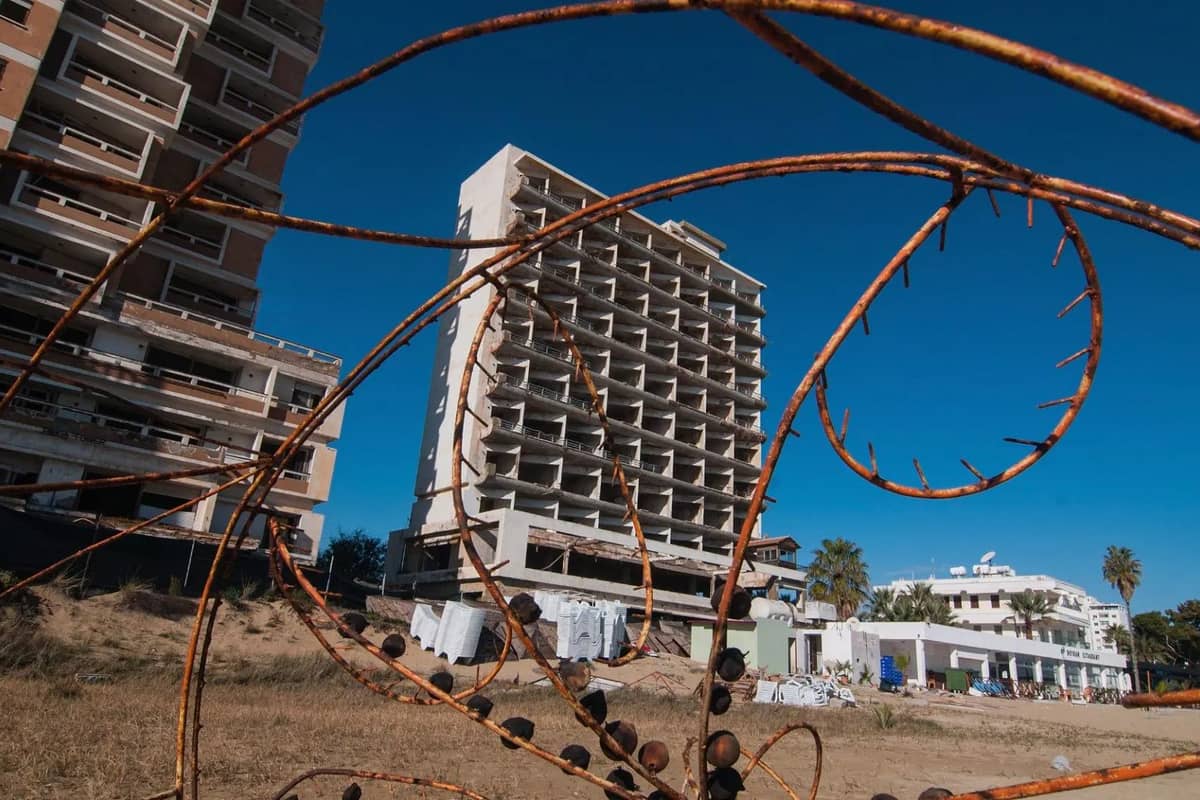
A Famagusta ghost town tour is a visit to Varosha, the fenced-off quarter of Famagusta on the east coast of Cyprus that has stood empty since 1974. Varosha lies just south of the old walled city, along a long sandy beach. The tour is one of the Cyprus tours on Greece Ville, beside the Greece Tours.
This post covers Varosha in numbers, how nature takes over the empty streets, what the United Nations decided about the town, how Famagusta grew rich as a medieval port, Othello’s Tower and the names of the town. It ends with the questions that come up on the day: military zones, the Turkish lira, goods brought back, rental car insurance, asbestos dust and stray cats.
What is a Famagusta ghost town tour?
A Famagusta ghost town tour is about Famagusta and the area called Varosha. In 1974 the town of Famagusta had an estimated 39,000 residents. No census had been held since 1960. The 2011 census of Northern Cyprus counted 226 residents in Varosha.

Behind any Famagusta ghost town tour lies the population of 1974. Famagusta had about 26,500 Greek Cypriots. It also had about 8,500 Turkish Cypriots and 4,000 people from other groups.
About 12,000 to 15,000 people came into Famagusta each day from nearby villages to work. At the summer peak, the number of people staying there was able to reach 90,000 to 100,000.
Older history lies behind a Famagusta ghost town tour. In 1573 to 1574, Greek Cypriots were banished from the walled city. They settled outside it, in the area that later developed into Varosha.
Greek Cypriot figures count 6,082 plots of land in Varosha. Of these, 425 lie on the beach front. Greek Cypriots have filed 281 compensation cases with the Immovable Property Commission of Northern Cyprus.
- Famagusta: By 1960 Greek Cypriots made up 70 percent and Turkish Cypriots had fallen to 17.5 percent.
- Mosque in Varosha: The Bilal Aga Mosque was built in 1821 and taken out of service in 1974.
- Beach: In 2017 Varosha’s beach was opened for exclusive use by Turkish Cypriots and Turkish citizens.
On 10 August 2023 the Northern Cyprus government decided to build a marina and tourist facility in Varosha.


How does nature take over the streets of a Famagusta ghost town tour?
A Famagusta ghost town tour is about a place where buildings decay. Nobody lives there to repair them. In Varosha, metal rusts, windows are broken, and plants push roots into walls and pavement. Without upkeep, roofs wear down and let rain seep in.
On a Famagusta ghost town tour, the question is how nature returns to the streets. Walls that crack let roots in, and open spaces give seeds a place to take root.
A ruderal species is a plant that is first to settle in disturbed land. As a rule, ruderal plants dominate an area for a short time, then lose ground to native species.
Trees take over places beyond a Famagusta ghost town tour. Ta Prohm is a 12th century temple in Cambodia. Fig, banyan and kapok trees have reclaimed it, and their roots wrap its walls.
Primary succession begins after living things first settle in a newly created habitat that had no life. When pioneer plants die, their dead remains break down and turn into new soil.
- Hong Kong: Air roots of over 1,100 banyan trees attach to walls and push through pavements.
- Pollen: Pioneer plants tend to use wind for pollen, as insects rarely live in bare places.
- Salt: A halophyte is a plant that tolerates salty water at its roots or salt spray.
Wildlife has reached the shore too. In 2014, a news report said sea turtles were seen nesting on the city’s beaches.
What did the United Nations decide about the town of a Famagusta ghost town tour?
A Famagusta ghost town tour raises the question of what the UN decided. The Security Council adopted Resolution 550 in the month after April 1984, then Resolution 789 in November 1992. Both resolutions dealt with the situation in Cyprus, and one named Varosha.
On a Famagusta ghost town tour, the UN decisions include Resolution 550. It passed by 13 votes to one. There was also one abstention, a choice to vote neither yes nor no.
Resolution 550 condemned illegal efforts to break away in the occupied part of the Republic of Cyprus. It also called on other states not to recognise the Turkish Republic of Northern Cyprus.
On a Famagusta ghost town tour, Resolution 550 adds context. It confirmed again earlier resolutions 365 from 1974 and 367 from 1975. It did the same for 541 and 544, both from 1983.
Resolution 550 said attempts to interfere with the UN peacekeeping force in Cyprus went against Security Council resolutions. Later, the Security Council adopted Resolution 789, and it passed unanimously on 25 November 1992.
- Varosha: Resolution 789 proposed extending the control of UNFICYP, the UN force, to include Varosha.
- Origin: UNFICYP was set up in 1964 to prevent fighting again between Greek Cypriots and Turkish Cypriots.
- Status: Resolution 789 confirmed Resolution 774 again and said the current situation on Cyprus was not acceptable.
In 2022 the UN said its position on Varosha was unchanged. It said it was monitoring the situation closely.
How did Famagusta grow rich as a medieval port?
A Famagusta ghost town tour is set in a city that was once a rich medieval port. Its turning point came in 1192, when Lusignan rule began. In the 13th century, it became a centre of commerce for the East and the West.
On a Famagusta ghost town tour, the setting is a Lusignan city. The Kingdom of Cyprus existed from 1192 to 1489 under the House of Lusignan. Under them, Famagusta became a fully developed town.
Famagusta had a natural harbour and walls that protected it. These made it more important to the Eastern Mediterranean. Famagusta’s development centred on the Lusignan palace, the cathedral, the square and the harbour.
During a Famagusta ghost town tour, the past includes Famagusta merchants and ship owners who lived in luxury. Italians were concentrated in Famagusta, while Frankish knights lived mainly in the city of Nicosia.
Cyprus served as an entrepôt, which means a trading hub, between Western Europe and the Middle East. Cypriot sugar was the main product sold abroad. Wine, wheat and oil were sold abroad too.
- Cloth: Cypriot samite and camlet cloth were in increasing demand in the West and the East.
- Ships: Famagusta also became a hub for shipbuilding, which is the making of ships.
- Banks: Florentine banking houses, meaning banks from the city of Florence, sent representatives to Cyprus.
King Janus besieged Genoese-held Famagusta for three years in vain, because the sea stayed open to the city.
Why is Othello’s Tower linked to a Famagusta ghost town tour?
A Famagusta ghost town tour is linked to Othello’s Tower through Shakespeare’s play Othello. Shakespeare wrote Othello around 1603, and the play is set in Venice and Cyprus. In the play, Othello commands the Venetian soldiers who defend Cyprus against the Ottomans.
On a Famagusta ghost town tour, the castle was built to guard the port against possible enemy attacks. The Venetians had fortified Famagusta, Nicosia and Kyrenia because they feared the growing Ottoman Empire.
By order of the Duke, Othello leaves Venice to command Venetian armies against invading Turks on Cyprus. Shakespeare’s direct sources had no threat of war. The Turkish invasion threat seems to be his own idea.
On a Famagusta ghost town tour, the story of Cyprus matters. Shakespeare’s first audience knew that the Turks later took Cyprus and kept it. In the play, Montano, a Venetian, governed Cyprus before Othello.
In 1900 the castle’s ditch was drained to reduce the risk of malaria, a disease. Restoration of the castle began in 2014. It reopened to the public on 3 July 2015.
- Opera: Verdi’s 1887 opera Otello is considered a masterpiece with power equal to the play.
- Printing: Othello was not published in Shakespeare’s lifetime; one quarto, a printed book, from 1622 survives.
- Renewal: Leonardo da Vinci apparently advised the castle’s refurbishment, or renewal work, in 1481.
At Kyrenia Castle, the Venetians replaced three of four thin Frankish towers with thick round towers. They did this to withstand cannon fire.
Where do the names Famagusta and Varosha come from?
A Famagusta ghost town tour brings two place names to mind, Famagusta and Varosha. In the medieval period, the Latin name of the city was Fama Augusta. The name Varosha comes from the Turkish word varoş, which means suburb.
On a Famagusta ghost town tour, the city’s name has other medieval forms. The French form was Famagouste, and the Italian form was Famagosta. The English form Famagusta also appeared in the medieval period.
In American English, the name Famagusta is pronounced FAH-mə-GOO-stə. In the early medieval period, the city was called New Justiniana, after Emperor Justinian. Justinian’s wife Theodora was born in the city.
On a Famagusta ghost town tour, the second place name is Varosha. Turkish speakers call Varosha Maraş, or Kapalı Maraş. The place where Varosha stands was once fields where animals grazed.
Strabo described the ancient port town as a fishing town in the first century BC. A coin of Ptolemy II shows head-and-shoulder portraits of him and his sister Arsinoe II.
- Spelling: In Ottoman times, the word varoş, source of the name Varosha, was written in Arabic script.
- Egyptian use: Arsinoe was among only a small number of Greek names taken up as Egyptian personal names.
- Sanctuaries: Ptolemaic port cities, including Citium in Cyprus, worshipped Arsinoe II as Aphrodite Euploia in holy places.
The city had Latin, French, Italian and English name forms in the medieval period. Varosha comes from a Turkish word for suburb.
What do visitors ask about a Famagusta ghost town tour?
A Famagusta ghost town tour comes with practical rules for visitors. Photos near military buildings can lead to arrest. The north has its own rules on money, goods and car insurance. Asbestos dust and cat scratches also carry health risks.
Can visitors take photos on a Famagusta ghost town tour?
Visitors need to avoid taking photographs near sensitive areas. Military buildings are one example of such areas. The authorities can arrest anyone who takes such photographs. The safe choice is to keep the camera away.
What money is used in the north on a Famagusta ghost town tour?
Northern Cyprus uses the Turkish lira. This links its economy to that of Turkey. The Republic of Cyprus joined the Eurozone, where countries share the euro. Since then, the euro is also widely used in the north.
What limits apply to goods on a Famagusta ghost town tour?
Controls limit the quantities and types of goods bought in the north and taken across the Green Line. The authorities can take goods away at the checkpoint. EU Regulation 866/2004 ended the crossing restrictions for EU citizens.
What car insurance applies to a Famagusta ghost town tour in the north?
Hire cars from the Republic of Cyprus commonly have no insurance in the north. Drivers need the correct insurance papers to pass a crossing. Insurance for the north is sold at certain crossings, including Agios Dometios.
Why does WHO warn about asbestos dust during a Famagusta ghost town tour?
WHO, the World Health Organization, found all six main forms of asbestos cause cancer in humans. Asbestos exposure causes cancer of the lung, larynx and ovaries, and mesothelioma. Fibres are released when asbestos products break down.
Are stray cats a risk on a Famagusta ghost town tour?
Bartonella henselae is spread by the scratch of domestic or feral cats infected by fleas. Feral means wild. Symptoms include a painless bump or blister at the injury and painful, swollen glands called lymph nodes.