
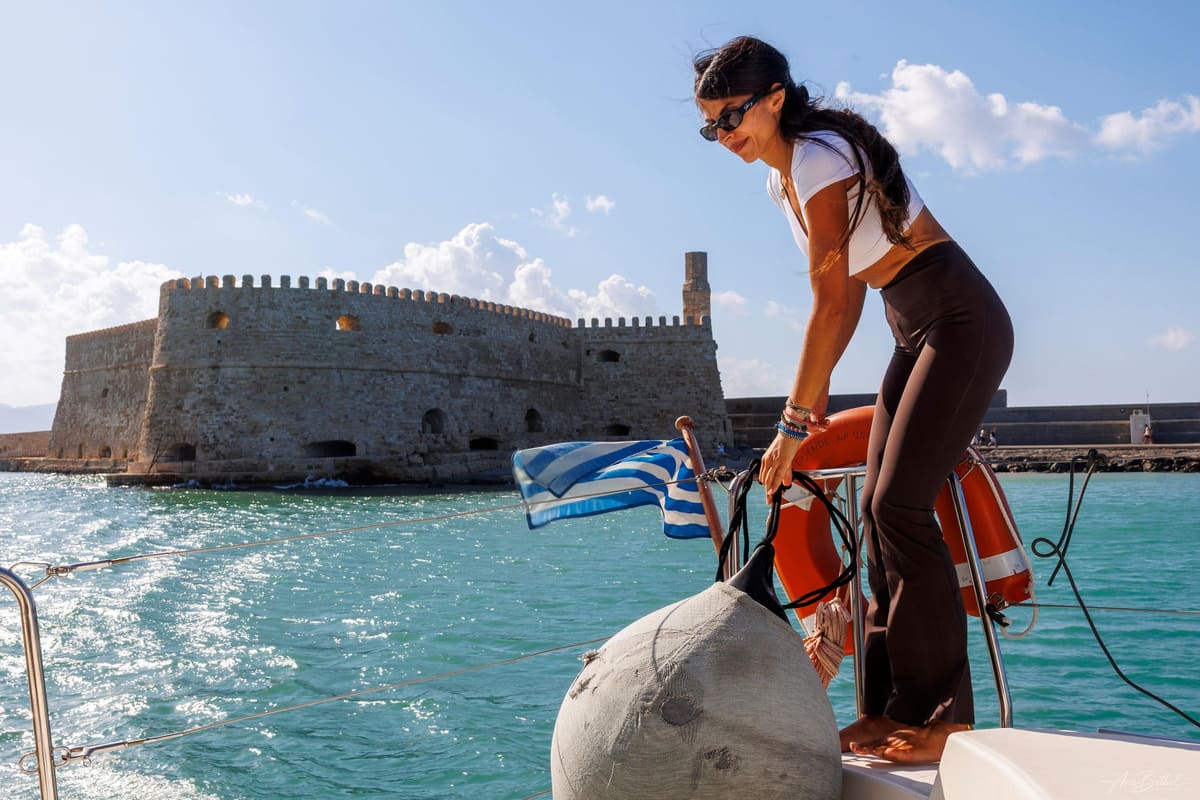
A Heraklion sailing tour leaves the harbour of the Cretan capital under sail and heads towards the island of Dia. The tour is one of the Greece Tours on Greece Ville, listed with the other Crete tours.
This post covers how a sailing yacht works, the words sailors use, the rules on board and the old ways of finding a course.
Sea myths, Venetian trade, the sea floor, anchoring, seabirds, forecasts, safety, food on board, the best months and common questions follow. The sections include Heraklion sailing tours that can be booked online.
What is a Heraklion sailing tour?
A Heraklion sailing tour is a trip on a sailing yacht from Heraklion, on Crete. The city’s Venetian harbour was the largest artificial harbour built in the eastern Mediterranean up to that time. That history makes Heraklion an old base for ships.
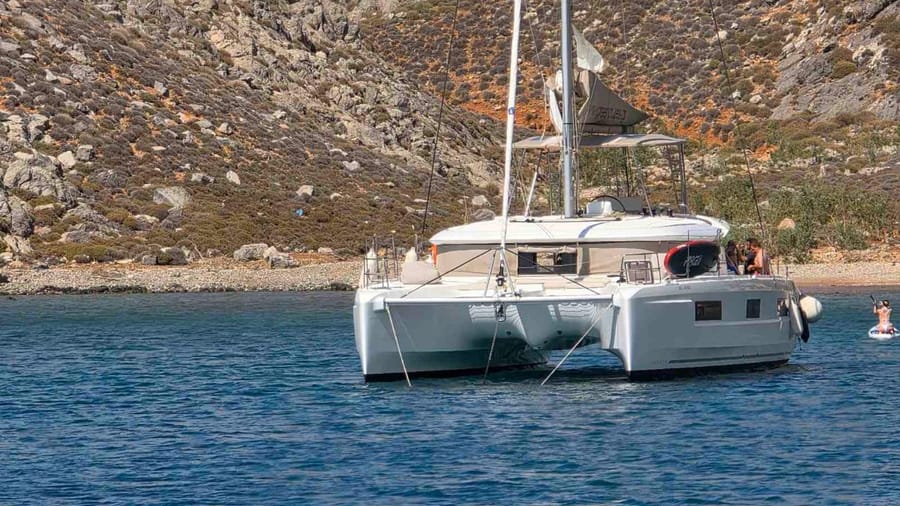
The Venetians built 12 shipsheds at the inner end of Heraklion harbour. The sheds had three jobs. The Venetians used the sheds to build, repair and store their ships.
On a Heraklion sailing tour, the summer heat is worth a thought. At the port weather station, 10 m above sea level, July and August highs both average 28.3 °C.
The port of Heraklion counted 307,043 cruise passengers in 2019. During the pandemic, numbers fell to 19,998 in 2020, then rose to 119,930 in 2021. In 2022, 304,257 arrived, close to the 2019 level.
On a Heraklion sailing tour, it helps to know Fraskia bay. It is a small inlet on the north coast of Crete. The bay lies 10 km northwest of Heraklion.
Before the modern port was built in the 1920s, ships used Fraskia as a safe anchorage. Two things made it safe. The bay had deep water and shelter from north winds.
On a Heraklion sailing tour, Fraskia has a trade story. Heraklion’s shallow harbour forced merchant ships, time and again, to split their cargo. They loaded only part of it there and the rest at Fraskia.
- Name: The bay of Fraskia takes its name from the fraski, a type of clay beehive.
- Thyme: The hills by the shore at Fraskia bay are rich in thyme.
- Railway: An old harbour railway in Heraklion also carried oil to the old power station.
- Museum: That old power station building is now the Natural History Museum of Crete.
Dia, the island off Heraklion, became a Special Area of Conservation in 2011. That status comes under the EU Habitats Directive.


How does a sailing yacht work on a Heraklion sailing tour?
A Heraklion sailing tour depends on wind, sails and a keel. Sailing yachts reach their highest speeds on a reach, because lift is stronger than drag there. Designers place a monohull’s centre of gravity well below its centre of buoyancy, chiefly by adding ballast.
The no-go zone spans between 30 and 50 degrees from the wind. Its size depends on the sails and the keel. Pinching means steering so close to it that speed falls off sharply.
On a Heraklion sailing tour, a tack turns the yacht through the no-go zone. If it stalls there, the yacht has “missed stays”. It must then fall back and build speed again.
As a rule, a jibe is quicker than a tack. A large share of yachts go faster on a broad reach than straight downwind. So a zig-zag of jibes can beat a straight course.
On a Heraklion sailing tour, hull speed matters. In knots, it is roughly 1.34 times the square root of waterline length in feet. A 10 m waterline gives 7.7 knots, and 15 m gives 9.4.
A genoa is a large headsail reaching past the mast. From the side, it overlaps the mainsail. A modern number 1 genoa measures about 155% of the foretriangle, and a number 2 genoa 125–140%.
On a Heraklion sailing tour, sail names can tell a story. The genoa is named after Genoa. There, Swedish sailor Sven Salén first used one in the 1926 Coppa del Tirreno.
- Inventor: James Brown Herreshoff, who lived from 1834 to 1930, invented the fin keel.
- Less drag: A fin keel has less wetted surface than a full keel, cutting drag and leeway.
- Bulb keel: This keel’s teardrop-shaped ballast bulb puts weight as low as possible for the greatest righting moment.
- Canting keel: This keel swings its bulb to the windward side to reduce heel in strong winds.
The Kyrenia ship is an ancient Greek merchant wreck. Its remains show that keels were in use by at least 315 BC.
Which sailing words does a Heraklion sailing tour use?
A Heraklion sailing tour uses old words. In Old English, the left side was bæcbord, or back-board, since the steersman’s back faced it. The Oxford English Dictionary records port for it since 1543. The United States Navy switched from larboard to port in 1846.
Halyards were once natural fibre, such as manila or hemp. In certain places, the main halyard is tied on the mast’s starboard side. The jib halyard goes on the port side.
On a Heraklion sailing tour, the boom is a pole along a sail’s bottom edge. The gooseneck pivot joins it to the mast. A German study found boom strikes the commonest cause of sailing injury.
The ISO symbol for the knot is kn, while aviation prefers kt. The United States adopted the international nautical mile in 1954. The United Kingdom adopted it in 1970.
On a Heraklion sailing tour, the word sheet is linked to shoot. The sheet-anchor shows this link. It was kept in reserve, to be shot in an emergency.
In 1853, the First International Meteorological Conference met in Brussels. It accepted the Beaufort scale there. Extra forces 13 to 17 were added in 1946, for tropical storms.
On a Heraklion sailing tour, the word logbook first meant a book for chip log speed readings. The chip log first appeared in print in 1574, in William Bourne’s A Regiment for the Sea.
- Ladebord: From around 1300, English sailors used this left-side name, from lade, load, and bord, side.
- Kybernetes: This ancient Greek word for a ship’s steersman is the root of governor.
- Pilot, pirate: Pilot comes from Greek pēdón, an oar blade, and pirate from peiratēs, anyone who attempts something.
- Pharos: It became modern Greek for lighthouse, and French phare and Italian faro come from it.
Astronaut comes from Greek astron, star, and nautes, sailor. The oldest form of navy is Mycenaean Greek na-u-do-mo, shipbuilders, on a Linear B tablet from Knossos.
Which rules and licences cover a Heraklion sailing tour?
A Heraklion sailing tour sits among EU, United Nations and Greek rules. EU Directive 2013/53/EU on recreational craft replaced Directive 94/25/EC, the first EU-wide law for the boating industry. The EU rules cover boats from 2.5 to 24 metres long.
Design category A is built for winds above force 8 and significant waves of 4 metres and more. Category B means winds to force 8 and waves to 4 metres.
On a Heraklion sailing tour, category C means winds to force 6 and waves to 2 metres. Category D means winds to force 4 and waves to 0.3 metres, with occasional 0.5-metre waves.
Since 18 January 2017, design categories no longer use place names such as ocean or coast. Commercial vessels carrying passengers fall outside the recreational craft directive, under separate laws.
The international collision rules at sea hold 41 rules and four annexes. On a Heraklion sailing tour, Rule 2 lets a skipper depart from the rules to avoid immediate danger.
Rule 13 says an overtaking sailing yacht must keep clear of the other vessel. Rule 9 says boats under 20 metres and sailing boats must not block larger ships in narrow channels.
On a Heraklion sailing tour, Greek law also counts. New coast guard officers study for four years at the Hellenic Naval Academy.
- Resolution 14: The United Nations adopted it on 29 January 1979, creating the first international boating certificate.
- Resolution 40: It replaced Resolution 14 on 16 October 1998, naming bareboat charter vessels among covered craft.
- Rivers: The certificate grew from Rhine and Danube boat traffic, as crews crossed between countries.
- Mediterranean: The certificate is widely required on coastal waters there, but not in Northern Europe.
Newer EU rules make sailing yachts give the helmsman a clear view. Only multihulls that can turn upside down need a way of escape after capsizing.
Which stars and instruments steered ships before a Heraklion sailing tour?
A Heraklion sailing tour crosses waters where sailors once steered by stars. The Odyssey says the Bear alone never sinks below the horizon. Sailors used it as a fixed mark. Later came the compass, charts and the astrolabe, or “star-taker” in Greek.
Homer’s Iliad calls the Great Bear “the Bear, which men also call the Wain”. The Greek poet Aratus called it Helike, meaning “turning”, because it wheels around the sky’s pole.
On a Heraklion sailing tour, the height of Polaris above the horizon gives the observer’s rough latitude. The ancient Greek name of the Little Bear was Cynosura, meaning “dog’s tail”.
Thales of Miletus measured the Little Bear, “the stars of the Wagon by which the Phoenicians sail”. Strabo says Thales suggested it to Greek sailors, who until then steered by the Great Bear.
On a Heraklion sailing tour, the Pleiades’ name is thought to come from the Greek for “to sail”. That is because the sailing season began with their dawn rising.
Mediterranean sailors kept off the sea from October to April. In 1190, Alexander Neckam wrote of sailors steered by a magnetized needle. It is Europe’s first record of a compass.
On a Heraklion sailing tour, the astrolabe has a local link. The painter Ieremias Palladas was born in Chandaka, today’s Heraklion. His 1612 painting of Saint Catherine of Alexandria shows a detailed astrolabe.
- Baylak al-Qibjaqi: In 1242, a needle floating in a bowl led his ship from Syria to Alexandria.
- Carta Pisana: Made about 1275–1300, this is the oldest nautical chart that survives today.
- Longer season: By around 1290, the compass and better charts stretched the season from late January to December.
- Portolan charts: Their lines showed 16 compass directions, which became 32 from around 1450.
In 1417, the Florentine priest Cristoforo Buondelmonti wrote a description of Crete, the Descriptio insulae Cretae. Benedetto Bordone’s Isolario, or Book of Islands, was printed in Venice in 1528.
Which sea myths surround a Heraklion sailing tour?
A Heraklion sailing tour moves through waters linked to the old sea myths of Crete. Talos was a man of bronze who protected Crete from pirates and invaders. One account says he ran around the island three times a day.
Talos had a single vein from neck to ankles, closed with a bronze nail. As the Argo neared Crete, he hurled great boulders at the ship to keep the heroes away.
On a Heraklion sailing tour, the tale of Talos ends with Medea. She used magic to make him graze his ankle. Then the ichor drained out of his body.
In the Argonautica, the Argo lands at Dicte, a haven thought to be in north-eastern Crete. After leaving Crete, the Argonauts were trapped in “the shroud”, a starless night that terrified sailors.
On a Heraklion sailing tour, Europa’s story has a sea crossing. In John Tzetzes’s version, a “bull-shaped” ship took her from Phoenicia to Crete. In another, a Cretan general, Taurus, meaning “Bull”, carried her off.
Hellenistic writers said Daedalus fled Crete by boat, inventing the first sails to outrun Minos’s galleys. In that version, Icarus fell overboard on the way to Sicily and drowned. Heracles built his tomb.
On a Heraklion sailing tour, Idomeneus links Crete to Troy. He led Crete’s armies there in eighty black ships. In a storm on the way home, he promised Poseidon the first living thing he saw.
- Exile: The first living thing he saw was his own son, and the Cretans exiled Idomeneus.
- Catalogue of Ships: It lists Knossos, Gortys, Lyktos, Phaistos and Rhytium among Cretan towns that sent ships.
- Mozart: His 1781 opera Idomeneo is based on the story of Idomeneus’s return to Crete.
- Icarian Sea: Strabo says it meets the Cretan Sea on the west, the Carpathian on the south.
Disguised as an old beggar, Odysseus tells the swineherd he comes “from broad Crete”. He says he is a wealthy man’s son.
How did Venetian Candia trade by sea before a Heraklion sailing tour?
A Heraklion sailing tour makes more sense with the story of Candia, Heraklion’s Venetian name. Crete lay about a month’s journey by galley from Venice. In principle, every Cretan export had to go to Venice. Imports had to pass through Venice too.
Venice ran its state merchant convoys, called mude, without a break from 1315 to 1533. For each voyage, the state supplied 2 to 5 galleys. It auctioned them to private merchant companies.
On a Heraklion sailing tour, Crete’s waters mark where convoys parted. The Syria and Egypt convoys left Venice together in late August. Four or five galleys went to Egypt, four to Cyprus and Syria.
A convoy held a two-month monopoly on agreed goods after sailing. Its 2-3% freight tax was halved. Venice’s Senate named a Captain to lead each convoy and report everything he learned.
On a Heraklion sailing tour, Candia’s cargo records are worth knowing. On 20 October 1336, a Venetian merchant received 16 casks of wine and 3,415 cheeses from Candia. Two ships carried them.
In 1333, Crete’s Venetian landholders offered Venice 80,000 measures of grain yearly for five years. The Senate refused. At times, the landholders sold grain on the free Aegean market, not cheaply to Venice.
On a Heraklion sailing tour, it helps to know Candia held one of Venice’s strongest arsenals. Even so, in August 1429 Turkish pirates swarmed Cretan waters, and sea trade stopped.
- Fair: After about a month in port, Levant convoys rushed to Venice’s winter fair before Christmas.
- Consul: In 1522, Henry VIII made Lucca merchant Censio de Balthasari England’s consul in Crete for life.
- Corsairs: Venice took the Cretan wine convoy against Genoese corsairs, then repaid Rethymno’s ruined wine merchants.
- Duke: The Duke of Crete was elected from the Venetian nobility for a two-year term.
In 1317-1318, private traders were allowed to use Venice’s state galleys for free. They carried Cretan wine, silks and spices to Flanders.
How does the sea floor shape a Heraklion sailing tour?
A Heraklion sailing tour sits above a deep, layered sea. In the western Cretan Sea, deep troughs drop below 1000 m. The shelf floor of Heraklion Bay is chiefly mud. It faces wave action and is little touched by large rivers.
East of Crete, the Kassos Strait has a sill 1000 m deep and is 67 km wide. The Karpathos Strait is 43 km wide.
On a Heraklion sailing tour, the sea below holds salty Levantine Surface Water. It enters the Cretan Sea through the eastern straits of the Cretan Arc. Its salinity is 39.15 to 39.20.
Water of Atlantic origin forms a less salty band near 200 m deep. Its salinity there is 38.68 to 38.90. At 1000 m, salinity stayed nearly steady at about 38.95.
On a Heraklion sailing tour, the central Cretan Sea shows a seasonal thermocline. This sharp step from warm to cool water starts forming in April. It peaks at summer’s end.
In March 2008, winter mixing stirred the central Cretan Sea’s top 250 m. It did not reach 400 m. At peak mixing, the layer held 14.9 to 15.1 °C, with salinity 39 to 39.06.
On a Heraklion sailing tour, the sea off Heraklion holds rich seabed life. Samples taken 10 to 200 m deep held 231 kinds of seabed animals. Polychaete worms were the commonest group.
- Antikithira: West of Crete, this strait is 31 km wide, with a 700 m deep sill.
- Naming: Scientists call the winter-made water Cretan Intermediate Water, a little denser than Levantine Intermediate Water.
- Shallows: Seabed life on Heraklion Bay’s shelf was richest between 10 and 30 m deep.
- Crust: Cretan Sea crust thins to 16 km, against over 30 km below central Crete.
The Hellenic arc curves around a centre in the north Aegean, with Crete at its tip. It regularly produced magnitude 7 earthquakes in a century of instrument records.
How does anchoring work on a Heraklion sailing tour?
A Heraklion sailing tour obeys basic anchoring rules. A boat approaches its spot from downwind or down-current, whichever is stronger. Chain can outweigh the anchor and is critical to good holding. Hanging in a catenary curve, it lifts and settles to absorb sudden pulls.
A snubber line between the chain and a deck cleat softens shock loads. The boat then lies more quietly. Nylon is the best anchor rope because it is strong and elastic.
On a Heraklion sailing tour, scope compares line length with depth. Light modern burying anchors commonly use 5:1 to 7:1. The British Admiralty uses a square root formula, because chain hangs in a curve.
Plough anchors tend to dig in, then break back out to the surface. Certain ones skip across the seafloor. Patented in 1992, the Delta is a hingeless plough anchor with a rigid, arched shank.
On a Heraklion sailing tour, a grapnel’s four or more tines rarely hold in sand, clay or mud. A mushroom anchor suits silt or mud. Once buried, it holds up to ten times its weight.
A field test in the Ustica Island marine protected area, Italy, compared Hall, Danforth and folding grapnel anchors. On the Posidonia seagrass meadows there, the Hall anchor did the least damage.
On a Heraklion sailing tour, weighing anchor means hauling it back up. This stage did the worst damage to the meadow. Chain or rope made no difference to the number of damaged shoots.
- Kellet: This heavy weight, lowered down the line, lowers the anchor’s angle of pull.
- Danforth: In strong current, its broad flukes can act like a wing, so it can kite.
- Claw: Charter fleets like them because they set first try in a large share of drops.
- Rocna: This New Zealand design, made since 2004, has a roll-bar. Its sharp toe pierces weed and grass.
France banned anchoring in Posidonia meadows for boats longer than 24 m in 2019. Ship-tracking data then showed large ships anchoring there fell sharply.
Which seabirds follow a Heraklion sailing tour?
A Heraklion sailing tour shares the sea with seabirds. Dia is EU Natura 2000 site GR4310003. Its data form records 150 to 200 breeding pairs of Eleonora’s falcon. Greece classified Dia as an EU Special Protection Area for birds in October 2001.
Alpine swifts both breed on Dia and gather there in numbers. The great crested grebe, a diving water bird, is also listed as a gathering species at Dia.
On a Heraklion sailing tour, Eleonora’s falcon has two morphs. Dark ones are all sooty brown, and light ones have buff underparts. It catches and eats large insects such as dragonflies in flight.
Eleonora’s falcons have been seen stripping the flight feathers from live small birds. The falcons then feed those birds to their young. At times, this feeding comes days later.
On a Heraklion sailing tour, Scopoli’s shearwater has a pale yellow bill. A dark patch sits near the tip. The Italian naturalist Giovanni Antonio Scopoli formally described this bird in 1769.
Scopoli’s shearwaters also scavenge discards from fishing vessels. They show more white under the wingtip than Cory’s shearwater, chiefly on the outermost long feather. Shearwaters lay a single white egg in a burrow.
On a Heraklion sailing tour, shearwaters are tubenoses. This group is named after the tube-shaped nostrils on their bills. They are monogamous, with long-term pair bonds that can last for life.
- Night: Shearwaters visit colonies at night, preferring moonless nights for safety from predators.
- Smell: Burrow-nesting tubenoses can smell dimethyl sulfide from plankton, helping them find prey.
- Salt gland: It lets tubenoses drink seawater and drips a 5 percent salt solution from their nostrils.
- AEWA: Audouin’s gull is covered by AEWA, the agreement for African-Eurasian migratory waterbirds.
Yellow-legged gulls lay three eggs as a rule, from mid-March into spring. The eggs hatch after 27 to 31 days. The young fly after 35 to 40 days.
How do sea forecasts work for a Heraklion sailing tour?
A Heraklion sailing tour depends on Greek marine forecasts. These go out at 0400, 1000, 1600 and 2200 UTC. In them, “later” means the forecast’s last 12 hours. Storm warnings are issued for winds of Beaufort force 10 or higher.
Greece became the “Issuing Service” for METAREA III on 1 February 1999, when the IMO’s GMDSS system began. Greek sea bulletins cover the eastern Mediterranean and Black Sea. Météo-France handles the western Mediterranean.
On a Heraklion sailing tour, each sub-area forecast uses Douglas scale terms. A “moderate” sea has waves of 1.25 to 2.50 metres. A “rough” sea has waves of 2.50 to 4.00 metres.
In a Greek sea bulletin, “very poor” visibility means less than 0.5 nautical miles. “Poor” means 0.5 to less than 2, and “moderate” means 2 to 5 nautical miles.
On a Heraklion sailing tour, Greece’s three NAVTEX stations send sea warnings to ships. They are at Heraklion, Kerkyra and Limnos. Heraklion serves the South Aegean as station H in English and Q in Greek.
The English NAVTEX slots at Heraklion fall at 01:10, 05:10, 09:10, 13:10, 17:10 and 21:10 UTC. Four of these six slots carry weather bulletins. These English broadcasts use 518 kHz.
On a Heraklion sailing tour, urgent Greek NAVTEX messages carry serial number 00, so every receiver prints them. Letter B marks weather warnings and E marks weather forecasts. Receivers cannot reject B messages.
- Greek service: A Greek-language NAVTEX service on 490 kHz started on 1 February 2012.
- Receiver timing: Greek hydrographers want receivers on at least 12 hours before departure, or left on.
- Advisory: American small craft advisories cover 22 to 33 knot winds, Beaufort forces 6 and 7.
- Buoys: POSEIDON has one buoy type for waters shallower than 300 m and another for deep basins.
Sea areas 30, Southwest Kritiko, and 31, Southeast Kritiko Ierapetra, cover waters south of Crete. The Greek weather service posts spot forecasts for Heraklio, Agios Nikolaos and Chania.
How do sailors stay safe on a Heraklion sailing tour?
A Heraklion sailing tour can bring on seasickness, a form of motion sickness. About one-third of people are highly susceptible to it. The rest get sick only in extreme conditions. Poor visibility, such as fog, can make seasickness worse.
In a survey of 20,029 ferry passengers on 114 voyages, 7% vomited at least once. Of these passengers, 21% felt “slightly unwell”, 4% “quite ill” and 4% “absolutely dreadful”.
On a Heraklion sailing tour, holding the head still and lying on one’s back can reduce motion sickness. In that survey, vomiting was linked to anti-seasickness tablets and alcohol.
Sopite syndrome is the drowsiness of motion sickness. It can appear before nausea, or with no nausea. People who regularly get it can raise their sleep hours by fifty percent.
On a Heraklion sailing tour, UV peaks in the four hours around solar noon. Solar noon falls between noon and 2 p.m. Shade can cut how hot people feel by over 10 °C.
UV values in weather reports are computer predictions, within ±1 index unit of measured values as a rule. The WHO and WMO standardised the UV index in 1994.
On a Heraklion sailing tour, a fall overboard gives at least one person a single job. That person stands and points at the casualty, keeping them in constant sight.
- UV types: About 95% of ground-level ultraviolet light is UVA, and about 5% is UVB.
- Cool rest: In hot weather, the WHO advises 2–3 hours a day in a cool place.
- WBGT: This heat index weights wet-bulb by 0.7, black-globe by 0.2 and dry air temperature by 0.1.
- Man-overboard button: On a large share of marine GPS chart plotters, it records the casualty’s last known position.
An adult life jacket for offshore use needs at least 150 newtons of buoyancy. A water-pressure inflation trigger can fail if a wearer in waterproof clothing falls in face-down.
Which Cretan foods are served on board a Heraklion sailing tour?
A Heraklion sailing tour fits an old Greek link between food and the sea. Barley paximadia, staka cream, Graviera Kritis cheese, tsikoudia and Cretan olive oil each have research behind them. The studies cover history, food safety and quality.
Barley paximadia were food for sailors, travellers and poor islanders. A paper at the 1996 Oxford Symposium on Food and Cookery says so. Their barley biscuit was first recorded in the second century.
On a Heraklion sailing tour, staka means a traditional Greek sour cream. Its other name, anthogalo, means milk flower. This cream rises on sheep’s milk left to ferment alone.
A study in the journal Foods first mapped staka microbes, using five samples from Chania and Sitia. Lactococcus or Leuconostoc bacteria dominated, and lactic acid led the organic acids.
On a Heraklion sailing tour, staka cooked with wholemeal flour has a clean record. Heating left no tested microbe group detectable. Hafnia paralvei and other staka bacteria fought harmful streptococci in tests.
A Cretan dairy trial checked 42 traditional Graviera Kritis cheeses. All tested negative for Salmonella and E. coli O157:H7. After ripening, measured bacteria fell to safe levels or vanished in raw-milk and pasteurised cheese.
On a Heraklion sailing tour, Cretan olive oil shines in a pilot study. One organic oil held about 60% more polyphenols and 15% more antioxidant power than commercial oils. Authors credit millstones and cold pressing.
- Tsikoudia: This marc spirit held more acetaldehyde than tsipouro in 23 Greek samples, within official limits.
- Safety: The bulk of samples held little estragole, lead or copper, posing no health risk.
- Alcohols: Higher alcohols passed the official minimum of 140 g per hectolitre of pure alcohol.
- Fermentation: High ethyl acetate in a handful of samples showed unwanted grape pomace fermentation must be limited.
The joint name Tsipouro/Tsikoudia was registered as geographical indication GI-1231 under WIPO’s Lisbon system on 22 June 2021. Its EU file, PGI-GR-02079, dates from 13 February 2008.
Which months suit a Heraklion sailing tour?
A Heraklion sailing tour depends on wind and waves, and both shift from season to season. Mediterranean tropical-like storms, or medicanes, are least common in June and July. Those months form the peak dry season, with stable air.
From December to March, Mediterranean waves come mainly from the Mistral and travel east and south-east. From June to September, Etesian winds raise high waves that run southward through the Aegean.
On a Heraklion sailing tour, spring and autumn waves differ. In April and the month after, waves come chiefly from the Libeccio and Sirocco winds. The same holds in October and November.
At Heraklion, the key winds for waves blow from the north in winter, amid a series of storms. For north winds, the effective fetch, or open sea crossed, is 150.6 km.
On a Heraklion sailing tour, nearby waves have been measured. A buoy about a mile off Heraklion logged them from 1 October 1992 to 22 September 1993. Researchers processed 5014 records.
On 1 December 1992, 31 January 1993 and 8 February 1993, squalls hit the sea off Heraklion. They built fully grown waves there in just 3 to 6 hours.
On a Heraklion sailing tour, the Cretan Sea holds the Aegean’s warmest water. Averaged over 2008 to 2021, coastal water topped 20 °C along Crete. Northern and central Aegean coasts stayed below 20 °C.
- Speed: Land around the Aegean channels Etesian winds, at times above 15 metres per second.
- Index: Carapiperis began an index in 1951 counting Etesian days at Athens from 1892 to 2006.
- Basin: The South Aegean spans about 130 km north to south, 300 km west to east.
- Buoys: POSEIDON records show Aegean winds and waves come mainly from the north, then the north-east.
From 2008 to 2021, the Cretan Sea warmed about 0.045 °C yearly. This was the slowest of seven Greek sea areas. In August 2021, it had no marine heatwave.
What do visitors ask about a Heraklion sailing tour?
A Heraklion sailing tour raises questions about seasickness, child safety and the coastal sea water. Visitors also ask about berths in the Venetian harbour and Greek charter rules. Dia island and the public body that manages it come up as well.
What predicts seasickness on a Heraklion sailing tour?
Researchers predict seasickness from slow up-and-down boat motion below 0.5 Hz. They also look at how strong that motion is and how long it lasts. One study followed 239 ship passengers bound for Antarctica. Those with cabins farther from the ship’s centre of gravity got sicker.
What life jacket advice covers children on a Heraklion sailing tour?
Greek child-safety advice says jackets must not ride up to the chin. Smaller children need a crotch strap. In Greece, Type 1 open-sea jackets come in classes up to 15 kg, 15–30 kg and 30–40 kg. Puddle-jumper vests are steadier than plain armbands yet cannot replace open-sea jackets.
What do satellite studies show about sea water on a Heraklion sailing tour?
Satellite studies have looked at the sea along Heraklion’s coast. They read chlorophyll levels in the water from space. The studies find chlorophyll hotspots near river mouths. Port waters show hotspots as well. Readings come out higher in winter than in other seasons.
What limits apply in the Venetian harbour on a Heraklion sailing tour?
Heraklion’s Venetian harbour holds about 210 boats of all kinds, says the port fund head. Since one catamaran takes two berths, boats over 15.5 m long or 5.5 m wide are now banned. Archaeologists warned that big boats entering the harbour harm its walls and endanger the fortress.
What does Greek Law 4256/2014 mean for a Heraklion sailing tour?
Crewed charters need a departure permit within 48 hours before sailing. Charters without master and crew need no permit or arrival declaration. A hired person or skilled, experienced passenger can skipper them. Masters and skippers must report accidents, injuries, illness or missing crew to the next port authority.
What protection covers Dia island on a Heraklion sailing tour?
The World Database on Protected Areas lists the Dia site as a protected area on land. A national ministry or agency governs it. NECCA has a Management Unit of Eastern Crete Protected Areas. This unit is based in Heraklion. It manages Dia’s Natura 2000 site.