

A Lasithi Plateau tour climbs to the high, flat plain inside the Dikti mountains of eastern Crete. The tour is one of the Greece Tours on Greece Ville, listed with the other Crete tours.
This post covers what the plateau is, the rocks that shaped it, the peaks around it, its caves, Minoan sites and wildlife.
Churches, revolts, village museums, the roads up, the best months and common questions come last. The sections include Lasithi Plateau tours that can be booked online.
What is a Lasithi Plateau tour?
A Lasithi Plateau tour visits the municipality of Oropedio Lasithiou, home to 2,258 residents at the 2021 census. The whole municipality lies higher than 800 m above sea level. Its low-lying plain covers about 45 km².
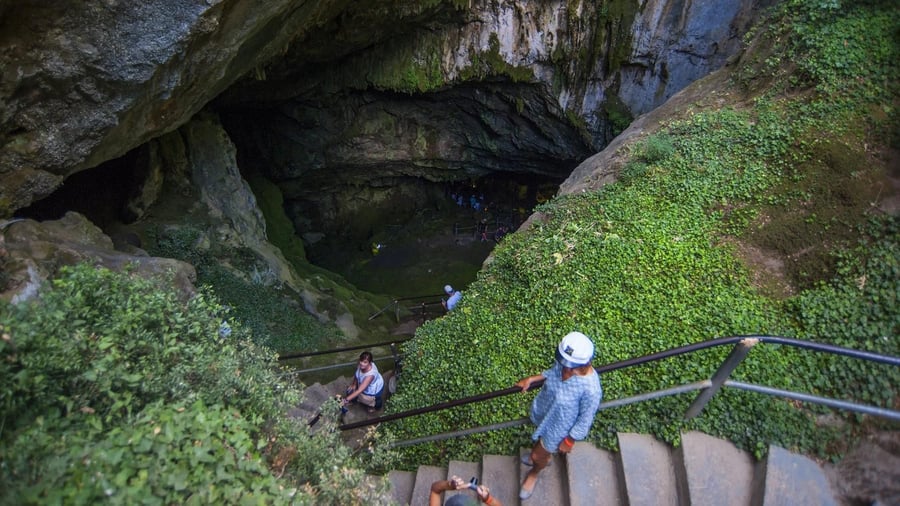
The municipality had 2,387 residents in 2011, and it is made up of 11 communities. It kept its borders unchanged under the Kallikratis reform of local government.
On a Lasithi Plateau tour, no part of the municipality touches the sea. The nearest coast, at Malia, is about 8 km away in a straight line. The municipality takes up the bulk of the western side of the Dikti mountains.
It borders Agios Nikolaos and Ierapetra to the east, Viannos to the south and Chersonisos to the north. Tzermiado, the seat of the municipality, lies 49 km west of Agios Nikolaos.
Before 1879, under Ottoman rule, Mesa Lasithi was the capital of the plateau. In 1879 the Lasithi province was split into two municipalities, Tzermiado and Psychro. That layout lasted through the Cretan State.
On a Lasithi Plateau tour, the plain is not one flat field. A limestone hill called Kephala splits it in two. The larger Kampos lies west, and the drier, rocky Xerokampos east. Lasithi is the only area of Crete above 800 m where people live all year.
- Tzermiado: The largest community had 609 residents in 2021.
- Marmaketo: The smallest community had only 45.
- Psychro: Its community counted 202 residents.
- Old path: A pass at Tsouli to Mnema, in the north-west corner, leads to central Crete on paving.


Which rocks shaped a Lasithi Plateau tour?
A Lasithi Plateau tour crosses a polje, the karst researchers’ term for a large closed basin in limestone. The plain shows clear signs of sinking along faults. Borings show its red-brown alluvium is 30 to 70 m deep.
Researchers think Cretan poljes began forming in the Early Quaternary or even the Late Pliocene. Tripolitza limestone and Talea Ori Plattenkalk form the rocky rim around the plain. The Tripolitza limestone was laid down from about 220 to 45 million years ago.
On a Lasithi Plateau tour, the edges tell how the plain formed. On the south edge, old flysch rock lies just above the floor, a low spot only faulting explains. North of the central hill, a stream cuts into phyllite-quartzite. That part of the plain came from erosion, not sinking.
The central hill in the east of the plain is a hum. It is a leftover knob of Mesozoic Tripolitza limestone. The land around the Katharo plateau was pushed up along a fault, compared with Lasithi to its west.
The floor slopes gently from 870 m at the Havgas gorge to 814 m. During two winters of field observations, a small lake formed on the plain.
On a Lasithi Plateau tour, the springs explain where villages stand. The mountains are limestone, called sideropetra locally, resting on schist. Where this schist shows, as between Tzermiado and Marmaketo, rainwater seeps out as springs. Villages grew up there.
- Vidiani: Besides Chonos, the plateau’s water drains into a second sinkhole at Vidiani, at about 800 m.
- Nisimos: This small plateau at 930 m never floods, because sinkholes in a number of spots drain it.
- Dikti layers: Plattenkalk lies at the base, then phyllite-quartzite, then the Tripolis and Pindos zones on top.
- Springs: The phyllite-quartzite layer blocks water, so springs rise where it meets the limestone above.
Which mountains frame a Lasithi Plateau tour?
A Lasithi Plateau tour sits inside a ring of more than 20 heights. They run from Louloudaki at 1,163 m up to the high Spathi summit. Dikti has a prominence of 1,798 m. That places it among the ultra-prominent peaks of Europe.
Two Dikti summits share the name Afentis Christos, and the smaller one rises to 1,571 m. The name refers to the Transfiguration of Christ, and a chapel stands on the higher summit. From there, walkers can see both the Cretan Sea and the Libyan Sea.
On a Lasithi Plateau tour in summer, 6 August is the day of Afentis Christos. Hundreds of visitors then climb to Dikti’s mountain chapels for a feast of the mountains and herding. Psari Madara, the eastern spur of Afentis Christos, reaches 2,094 m.
The Selena massif, north-east of the plateau, runs east to the Machairas peak at 1,487 m. Toumpa Moutsouna, at 1,538 m, and Virgiomeno Oros, at 1,414 m, rise to the south-west.
Climbers start from Katharo for Lazaros and Spathi, and from Limnakaro for Spathi and Afentis Christos. From the south, the Omalos Viannou plateau is the start for Afentis Christos and Psari Madara. The north-west face of Spathi is one of Dikti’s great sheer walls.
On a Lasithi Plateau tour, the Havgas gorge is the only large gorge on the plateau. It runs about 4 km, and the E4 long-distance path climbs its side to reach the Katharo plateau. From Limnakaro, the marked E4 heads south-west toward Afentis Christos.
- Name: Dikti possibly comes from Dios and tikto, meaning the place where Zeus was born.
- Dittany: Cretan dittany, a herb of Dikti’s rocks and cliffs, takes its name from the mountain.
- Snow: Lasithi gets an average of 0.38 m of snow a year.
- Cover: That snow can lie on the plain for up to a week.
Which other caves does a Lasithi Plateau tour pass?
A Lasithi Plateau tour can pass the Trapeza cave, just north-east of Tzermiado. Today it also goes by the name Kronio cave. Arthur Evans discovered it in 1896, but little work followed for decades. He found chiefly Hellenistic objects there.
Evans also found a faience figure of the god Bes and fragments of gold leaf. John and Hilda Pendlebury dug Trapeza with Mercy Money-Coutts in 1936. Treasure hunters had disturbed the deposits, and only one spot was still intact.
On a Lasithi Plateau tour, Trapeza shows how old life on the plain is. People lived in the cave in the Late Neolithic. From Early Minoan II to the end of Early Minoan III, it held communal burials. Metal was rare, but gold, silver, bronze or copper, and lead all turned up.
Pendlebury’s pottery study suggested people used Trapeza even before the Diktaean Cave across the plain. Trapeza is one of only three Cretan sacred caves with clay human figurines. The other two are the Idaean and Psychro caves.
The Hagios Charalambos cave lies on the western side of the plain. Its entrance sits 834.95 m above sea level. Dynamite blasting for road work rediscovered it in 1976.
On a Lasithi Plateau tour, Hagios Charalambos holds a striking burial record. It has seven small linked chambers, and five served as an ossuary in Middle Minoan IIB. Its bones belong to hundreds of people of all ages, from infants to adults.
- Grave goods: Seals, figurines, jewellery and fragments of six clay sistra, or rattles, lay there.
- Closed: A stone and concrete wall now closes Hagios Charalambos to visitors.
- Dikti caves: The Dikti Natura site around the plateau holds a great number of caves.
- Cave fauna: A number of those caves hold animals found nowhere else.
What did Minoans leave on a Lasithi Plateau tour?
A Lasithi Plateau tour can climb to Karfi, high above the plain. It is one of the best-preserved sites of the period around 1200 BC. The Minoan town there had a shrine with an altar, single-storey houses and paved streets.
Pendlebury had noted Karphi on an earlier trip, but nobody had excavated it before. Its pottery mixed Minoan and Proto-Geometric styles. Its architecture mixed Minoan and Achaean elements. Karfi means the nail, the local name for the limestone knob on its peak. Certain house complexes resemble megaron-type buildings with a central hearth.
On a Lasithi Plateau tour, the Karfi path has a curious detail. Pendlebury asked the sculptor Eric Gill for a lettered stone surround. It frames the Vitzelovrysis spring on the ascent. In 2023 a Polish team began new excavations at Karfi.
The peak first served as a Minoan peak sanctuary from about 1900 to 1800 BC. Finds from Karfi are shown in Room 11 of the Heraklion Archaeological Museum.
The Polish digs run for the Polish Archaeological Institute at Athens. They work under one of the first Greek permits given to a Polish academic institution.
The year after the Trapeza dig, Pendlebury ran trial digs around Tzermiado with Mercy Money-Coutts and Marion Pascoe. That season they also probed caves and a group of tombs called Ta Mnimata.
On a Lasithi Plateau tour, Kastellos near Tzermiado is a debated site. Its rock crevices hold remains from the Final Neolithic and the first Early Minoan phase. Pendlebury found burials there and called it a burial site. The archaeologist K. Nowicki reads it instead as a defensible site.
- Report: Pendlebury’s report called Karphi a City of Refuge of the Early Iron Age in Crete.
- Plati: A hill east of Plati village holds a Minoan and Archaic site.
- Papoura: Agios Georgios Papoura was lived in from Late Minoan IIIC until the Iron Age.
- Dattala: L. V. Watrous identified Agios Georgios Papoura with ancient Dattala.
Which wildlife lives on a Lasithi Plateau tour?
A Lasithi Plateau tour crosses the Dikti mountains. A Natura site protects them from 280 m up to 2,146 m. Dikti holds a holm oak forest of about 700 ha. It is the only large forest of this oak on Crete.
Next door, Natura site GR4320010, Lazaros Koryfi – Madara Diktis, covers 13,157.93 hectares. It is an important site for passage and breeding raptors and for alpine species. A third site, GR4310006, covers the Omalos Viannou area of Dikti, from Symi to Omalos.
On a Lasithi Plateau tour, the trees are worth a look. Kermes oak grows here in tree form, which is unusual outside Crete and the Peloponnese. Alyssum lasithicum, Tragopogon lassithicus and Cirsium creticum dictaeum are plants endemic to the site.
Presidential Decree 67/81 protects Cretan mountain endemics here, such as Tulipa cretica and Ranunculus cupreus. The snail Oxychilus amalthae lives only in the Diktaion Andron cave and is in danger of extinction.
Dikti holds a narrow endemic tree frog, Hyla arborea cretensis. The wood mouse Apodemus sylvaticus creticus, endemic to Crete, lives here too. So does the horseshoe bat subspecies Rhinolophus ferrumequinum creticum.
On a Lasithi Plateau tour, look up for vultures. Griffon vultures form colonies on the bulk of Dikti’s mountains and gorges. The gorge of Gonion holds the classic colony. The bird list also names the bearded vulture, Bonelli’s eagle and the booted eagle.
- Small birds: The European roller, ortolan bunting and nightjar appear on the site’s bird list.
- Falcons: The peregrine falcon is listed too.
- Mammals: Stone martens and lesser horseshoe bats are among the site’s notable mammals.
- Threats: Overgrazing, fires and heavy tourist traffic threaten these mountain ecosystems.
NECCA’s Management Unit of Eastern Crete Protected Areas, based in Heraklion, looks after the Dikti sites.
Which churches does a Lasithi Plateau tour see?
A Lasithi Plateau tour reaches Kroustallenia monastery, the religious centre of the plateau. In 1543 plateau fields went to Peloponnesian refugees. The sisters Theokliti and Palantia Ntanasi then agreed to found two monasteries there. Palantia is thought to have founded Kroustallenia.
Theokliti founded the monastery of Agia Pelagia, of which only the church survives. That places the start of Kroustallenia in the middle of the 16th century. A carved stone window from its sanctuary matches one at the Pantanassa church in Avdou, built in 1600.
On a Lasithi Plateau tour, the main church sits on the highest point of the monastery grounds. It is a barrel-vaulted, single-nave building from Venetian times. A school ran inside Kroustallenia from the mid-19th century until 1926.
In 1817 old monks told the visitor Siber something striking. No European had climbed up to Lasithi for 27 years.
The twin-naved Holy Spirit church stands on Limnakaro, at 1,130 m. It is the only plateau church with Venetian-era wall paintings. The paintings possibly date from the first half of the 14th century. They came to light during restoration at the end of the 20th century.
On a Lasithi Plateau tour, the north nave there tells a later story. Dedicated to the Holy Spirit, it was added in 1875 to the older church of the Transfiguration. One painting shows the donors holding a small model of the church.
- Avgousti: The single-nave church of Agios Georgios Avgousti is a rare Byzantine monument on the plateau.
- Plague: Avgousti village lasted until 1798. Tradition says a plague left one father and son from 72 households.
- Nitadoroi: Woodcarvers from Mesa Lasithi made about 200 carved iconostases for churches on and beyond the plateau.
- Magoulas: Tradition says villagers formed a human chain to pass stones and finish the church of Agios Spyridon.
The woodcarvers’ informal school worked in Mesa Lasithi from 1850 to 1940. At Agios Charalambos, part of an old Byzantine church survives opposite the cemetery. It was the church of Saints Sergius and Bacchus.
How did revolts reach a Lasithi Plateau tour?
A Lasithi Plateau tour recalls Kapetan Kazanis, born Emmanouil Rovithis in Marmaketo in 1793. He led the Lasithi fighters in a long run of battles against the Ottomans. His statue stands in the main square of Marmaketo.
Kazanis died a poor labourer on Naxos in 1846. In 1822 his men and other chiefs drove back the first Ottoman attempt to take the plateau.
On a Lasithi Plateau tour, one life story stands out. Ismail Selim Pasha was born Emmanouil Papadakis in Psychro around 1809, the son of the village priest. Captured in 1823 and sold as a slave, he became an Egyptian major general. In 1867 he marched on his home plateau.
His brother Antonios, living in Athens, sent supplies and money to the Cretan rebels.
The first battle of 1867 came near Plati, where 50 rebels died, among them their leader Petroulakis. Ottoman troops surrounded the rebel chief Michail Korakas at Tzermiado, and the village was destroyed in the fight.
On a Lasithi Plateau tour, Kroustallenia played a war role. In the Battle of Lasithi of 1867, it held the rebels’ ammunition stores and a gunpowder workshop. Civilians hid in the Aloida heights, where the chapel of Agios Ioannis served as a hospital.
- 1897: On 19 January, a general assembly of plateau residents declared the union of Crete with Greece.
- Italians: They held Lasithi, with a strong outpost at Mesa Lasithi, until the Germans took over in 1943.
- 1943: In February the occupiers turned Kroustallenia into a concentration camp.
- Krasanakis: Adam Krasanakis of Agios Georgios was a resistance captain alongside Kapetan Bandouvas.
Guerrillas based near Avrakontes fought the occupiers with sabotage, arson and kidnappings. Villagers from Avrakontes and Koudoumalia helped them. After 1898, large numbers of plateau families bought olive groves in Pediada, Monofatsi and Viannos and settled there.
Which museums does a Lasithi Plateau tour visit?
A Lasithi Plateau tour visits the Folklore and Historical Museum of Agios Georgios. It is a group of four separate spaces that tell the history and traditions of the whole plateau. A local association, ELSOL, founded it and still runs it.
A traditional Lasithi house with its side rooms stands right next to a neoclassical house. The traditional house is the only surviving example of the area’s old arched houses, called kamarospita. Inside, visitors see the cellar, the oven and the barn with its stable.
On a Lasithi Plateau tour, another room shows tools from the traditional trades of the plateau. The neoclassical house holds the municipal art gallery, with works by painters and woodcarvers. It also shows Cretan weavings, traditional furniture and material from the wartime battles in Lasithi.
A short way higher, the Eleftherios Venizelos museum fills a stone building of 1871. It displays photographs, personal objects of the Cretan politician and newspaper reports about him. The building was the first primary school of Plathianos.
On a Lasithi Plateau tour, the church of Agios Dimitrios next door is a museum too. It serves as the Ecclesiastical Museum, with icons and church heirlooms. It displays iconostases made by the nitadoroi, the church woodcarvers of Lasithi.
- Plathianos: Agios Dimitrios is the church of Plathianos, the upper quarter of Agios Georgios.
- School: The Plathianos school closed in 1937 because it had grown too small for its pupils.
- 1903: Venizelos toured the plateau that year during his election campaign and stayed at Kroustallenia.
- Prince George: The High Commissioner had stayed at Kroustallenia in February 1903, a little before Venizelos.
Its July 2023 reopening showed a windmill clip from Signs of Life, Werner Herzog’s first film.
How do roads climb to a Lasithi Plateau tour?
A Lasithi Plateau tour arrives by one of three road entrances. The best-known road enters at the Seli Ambelou pass, on the north-north-west side. A second paved road passes Mesa and Exo Potamoi, and a third runs through Kaminaki.
From Avdou, the climb to the Ambelou pass runs 12.6 km. It gains 670 m at an average of 5.3%. It follows the Hersonissos to Tzermiado road, with 5 hairpin bends. Its steepest 100 metres rise at 10.7%.
On a Lasithi Plateau tour by bike, the Spathi pass road is harder. From Emparos it climbs 825 m in 12.9 km to a top at 1,250 m. It has 15 hairpin bends, and its steepest 100 metres rise at 16.7%.
Kera, at 680 m, is the last mountain village of Hersonissos municipality before the plateau. Below Kera, 35 watermills once ran on spring water. They ground the grain of the Lasithi province.
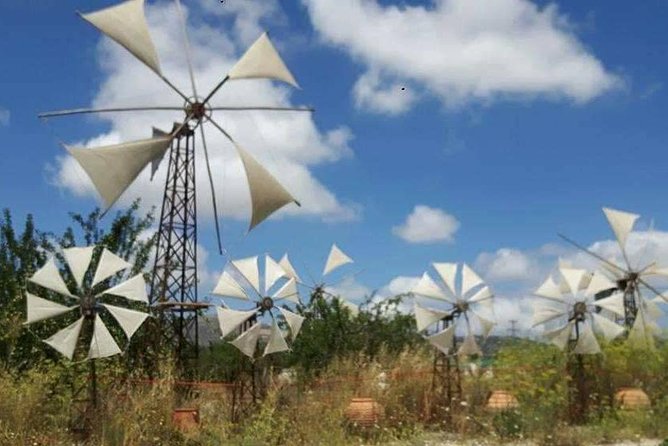
At Seli Ambelou, the northern entrance, 26 flour mills once stood. Seven stood right of the road and 19 to the left. Ruins of 23 single-sail windmills stand on the Asfentami saddle, one of the largest mill sites of Crete.
On a Lasithi Plateau tour, Pinakiano is the first village after Seli Ambelou. It sits at 850 m, where the road descends and turns left. After the revolt of 1866 to 1869, the Asfentami mill site moved west to Seli Ambelou.
- Kaminaki: Beyond the village the road splits in two, and both branches end at Embaros.
- Ergano: One branch crosses the small Ergano plateau and Katofygi village.
- Neapoli: Once called Kainourgio Chorio, it grew on the Ottoman route between Heraklion and Lasithi.
- Zenia: It sits at 750 m on the Neapoli road, 14 km from Neapoli.
Exo Potamoi lies at 850 m on the same road. It is 20 km from Neapoli and 25 km from Agios Nikolaos. Under the Cretan State, Kroustallenia was a halfway stop between Viannos and Neapoli.
Which months suit a Lasithi Plateau tour?
A Lasithi Plateau tour suits the dry half of the year. On Crete, over about 85% of the yearly rain falls from November to April. Around Dikti, evaporation exceeds rainfall from April to October. February is the coldest month on Crete.
July is the hottest month on Crete. Groundwater around Dikti refills mainly from November to April. Tzermiado has a Mediterranean climate, with moderate rain in winter.
On a Lasithi Plateau tour in autumn, Tzermiado stays mild and sunny. From September to November, days pass 18 °C. From mid-November, temperatures drop noticeably and rain becomes more frequent. At Psychro, December turns gradually wetter and colder.
In certain years, snow stays on the surrounding peaks until early summer. Winter visitors can join snow activities on the plateau. In January 2020, the storm Hephaestion postponed the reopening of all schools in Oropedio Lasithiou.
On a Lasithi Plateau tour in late spring, farmers plant potatoes, from late April to early June. The Diktaia Games, also called Run Zeus, are held on the last Sunday of August. They include runs through Psychro village and a half marathon across the plateau.
In summer, concerts are held in the churchyard of St John Kampitis, in the middle of the plain.
- Harvest: The potato harvest runs from mid-to-late August until mid-September.
- Cycling: In July, the municipality held its first inter-club road cycling race through the plateau villages.
- Sails: Restored windmills now carry sails of perforated polyester.
- All seasons: Those sails let the mills work in every season and all weather.
What do visitors ask about a Lasithi Plateau tour?
A Lasithi Plateau tour raises questions about winter floods, cold, festivals, old censuses, local food and art. The Chonos sinkhole drains no more than 10 to 12 cubic metres of surface water per second. Heavy rain can outrun it.
Why does the plain flood on a Lasithi Plateau tour?
In January 2020, heavy rain, sleet and melting snow flooded the bulk of the plain. A news report on 1 April 2019 showed the plateau turned into a lake after heavy rain.
How cold does it get on a Lasithi Plateau tour?
The whole municipality lies above 800 m. Compared with the rest of Crete, the Tzermiado area has lower temperatures. Snow covers the plateau every winter, and thousands of Cretans drive up to see the white landscape.
Which festivals run on a Lasithi Plateau tour?
On the feast of St John the Theologian, Marmaketo recalls a miracle. Dried Easter violets bloom again during the Gospel. St John Kampitis is the largest pilgrimage church of the old province. It celebrates on 29 August, with a big festival on the eve. An anniversary ceremony at Kroustallenia marks the Battle of Lasithi of 1867.
What did old censuses count on a Lasithi Plateau tour?
In the Ottoman census of 1671, Tzermiado had 112 families and Agios Georgios 55, the second largest. The 1881 census counted 894 Christians in Tzermiado and 4 Turks, the tax collectors. Agios Georgios peaked at 1,312 residents in 1951. It stayed the largest settlement of the province until 1981.
What food comes from a Lasithi Plateau tour?
Plateau dairies and shepherds make feta, graviera, kefalotyri, anthotyros, tirozouli and Dikti yogurt from sheep and goat milk. Around Psychro, farmers also grow pulses and pears and keep livestock. Growers sell carrots and cucumbers straight from the farm.
Which artists praised a Lasithi Plateau tour?
Odysseas Elytis praised the windmill-filled plain in his 1968 art collage The Message. The poet won the Nobel Prize in Literature in 1979.