

A Mount Athos cruise sails along the coast of the Athos peninsula in Halkidiki, past monasteries that women cannot visit by land. The cruise is one of the Greece Tours on Greece Ville, listed with the other Northern Greece tours and day trips from Thessaloniki.
This post covers the peninsula in numbers, its marble peak, its plants and animals, the monastery harbours, their treasures and old storms.
Athos time, the best months and common questions come last. The sections include Mount Athos cruises that can be booked online.
What is a Mount Athos cruise?
A Mount Athos cruise follows a peninsula where the 2021 census counted 1,746 people in the monastic community. In 1971, the monks had fallen to a low of 1,145, the bulk of them elderly. By 2000, they numbered 1,610 again.
Article 105 of the Greek constitution places the Athos region beyond Megali Vigla. Men admitted as novices or monks gain Greek citizenship without further formalities. Heterodox or schismatic persons cannot live there under the constitution.
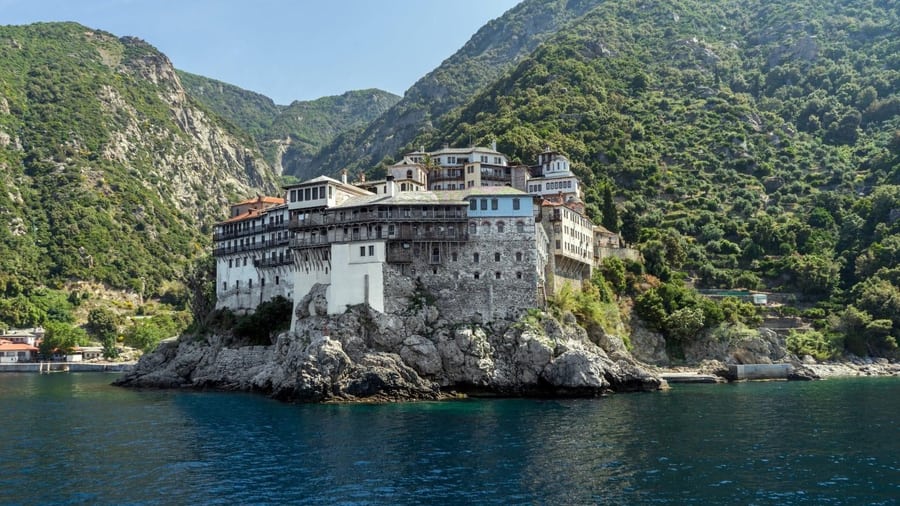
On a Mount Athos cruise, every slope belongs to a monastery. The twenty monasteries divide the whole peninsula, and its land is exempt from expropriation. The Constitutional Charter of Athos dates from 1924 and took effect in 1926.
The twenty representatives of the Holy Community in Karyes are elected for one year. The monasteries form five groups of four. Each group runs the Holy Epistasia for a year in turn.
On a Mount Athos cruise, the summit dominates the view. Its topographic prominence of 2,012 metres makes it an ultra-prominent peak. The 1997 Amsterdam Treaty carried a Greek declaration renewing the 1979 joint declaration on Athos.
- Assembly: The Holy Assembly of all twenty abbots meets fifteen days after Easter and on 20 August.
- Charter: The twenty monasteries vote the Charter, then the Patriarchate and the Greek Parliament ratify it.
- Customs: Mount Athos belongs to the EU customs union.
- Schengen: Greece’s Schengen accession treaty says the special status of Athos must be taken into account.


Which rocks form the mountain on a Mount Athos cruise?
A Mount Athos cruise passes rocks of the Serbo-Macedonian Massif, a large block of old basement rock. Geologists place the mountain and the southern tip in the Chortiatis Unit. The south-eastern part is banded gneiss and migmatite that form a dome.
The north and the bulk of the western shore are a tectonic mélange, the Athos-Volvi Suture Zone. A mélange is a jumble of rock blocks mixed by tectonic forces. Its rocks range from marbles and gneisses to amphibolites, eclogites and peridotites.
On a Mount Athos cruise, granite marks the coast. Three granites, called Ierissos, Ouranoupolis and Gregoriou, cut through the mélange. Zircon crystals date the Ouranoupoli magma to about 52.1 million years ago.
The granite magma that built the eastern gneiss dome dates from the Late Jurassic. On Ammouliani, an orthogneiss comes from rock that crystallised about 458.8 million years ago.
On a Mount Athos cruise, earthquakes are part of the story. On 8 November 1905, an earthquake of about magnitude 7.2 hit the mountain. Landslides at the southern tip raised a local tsunami with a run-up of about 3 metres.
- Boundary: The boundary between the Serbo-Macedonian and Rhodope massifs lies inside the Athos-Volvi Zone.
- Kerdyllion: In northern Athos, marbles and biotite gneisses belong to the Kerdyllion Unit.
- Vertiskos: Two-mica gneisses make up the Vertiskos Unit, with almost no partial melting.
- Stretching: Since the Late Miocene, the crust of southern Athos has been pulled apart.
Which plants and animals live on a Mount Athos cruise?
A Mount Athos cruise skirts Natura site GR1270003, Chersonisos Athos, which covers 33,567.81 hectares. Beech grows in its broadleaved forests beside chestnut and oak. The monks have favoured chestnut wood for over a thousand years.
In the maquis, the heath Erica manipuliflora and the kermes oak are the main shrubs. Athos holds 22 Greek endemic plant taxa, and 14 of them are local endemics. The Natura record names the Athos fir as Abies pseudocilicica.
On a Mount Athos cruise, the plant names honour the mountain. The woad Isatis tinctoria ssp. athoa and the violet Viola athois carry its name. So do Hypericum athoum and the flax Linum olympicum ssp. athoum.
About 350 species of mushrooms grow on the peninsula. Chestnut blight is caused by the fungus Cryphonectria parasitica. On Athos, an introduced weaker strain of the fungus has almost defeated it.
On a Mount Athos cruise, wildlife fills the forests. Mammals include the red fox, badger, beech marten, stoat and hedgehog. Roe deer, hares and red squirrels also live there.
- Birds: The western capercaillie, eagle-owl, short-toed snake eagle and lesser kestrel live on Athos.
- Tortoises: Spur-thighed and Hermann’s tortoises live there, with the yellow-bellied toad and alpine newt.
- Balkan endemics: Six grow on Athos, among them Allium chamaespathum and Colchicum doerfleri.
- Protected: Ten taxa, such as lily of the valley and bearberry, are protected by Decree 67/1981.
Which harbours serve the monasteries on a Mount Athos cruise?
A Mount Athos cruise passes the arsanades, the sea landings of the coastal monasteries. People commonly call them skales. Greek took the word arsanas from Turkish tersane, itself from Venetian tersanà. Its root is Arabic dār aṣ-ṣināʿa, house of craft.
In Greek sea talk, an arsanas is a small boatyard for hauling out boats. Hilandar stands about five kilometres from its arsanas, in a green valley.
On a Mount Athos cruise, towers guard the landings. Milutin Tower, or the Tower of the Horseman, stands near Hilandar’s harbour on the north coast. It went up around the mid-13th century, and King Stefan Milutin added its top floor in 1302.
After a fire in 1497, Wallachian princes gave Koutloumousiou a walled harbour. Konstamonitou lies one hour uphill from its arsanas, through olives and chestnuts.
On a Mount Athos cruise, Dafni is the main port. The 2001 census counted 38 inhabitants there. Local boats link it with other landings, such as Kafsokalyvia. On 2 November 1912, the Greek flagship Averof anchored in Dafni bay as monastery bells rang.
- 1912: A Greek landing party made the Ottoman governor and his small force prisoners without a fight.
- Great Lavra: The monastery lies about 20 minutes from its arsanas on the coast.
- Mylopotamos: This Great Lavra dependency, known for its winery, lies just north-west of Filotheou’s arsanas.
Which treasures hide behind a Mount Athos cruise?
A Mount Athos cruise passes Iviron, home of the Panagia Portaitissa icon. Tradition holds it has been there since 999 and that Luke the Evangelist painted it. The Georgian monk Gabriel the Iberian drew it from the sea.
Tradition says the scar on the Virgin’s face came from a soldier’s blow in Nicaea. The icon kept turning up on the monastery gates. So it got a chapel by the gate and the name Gate-Keeper.
On a Mount Athos cruise, Great Lavra’s library holds rarities. The Codex Athous Laurae is an 8th- or 9th-century New Testament. It is one of the oldest manuscripts with musical notes. In 1842, a manuscript hunter found 123 fables of Babrius there.
Zograf’s library holds 388 manuscripts in Church Slavonic and 126 in Greek. The Codex Zographensis, a Gospel book of 304 parchment leaves, was found there in 1843. It went to Tsar Alexander II in 1860.
On a Mount Athos cruise, relics shape the monasteries’ fame. St Paul’s keeps a 15th-century golden case said to hold the Gifts of the Magi. Xeropotamou holds what is thought to be the largest surviving piece of the True Cross.
- Moscow copy: An exact copy reached Moscow in 1648. A chapel was built for it in 1669.
- Lost charter: Hilandar’s founding chrysobull was destroyed by German bombs on Belgrade on 6 April 1941.
- Microforms: Ohio State University holds microform copies of Hilandar’s entire Slavic manuscript collection.
- 1941 photos: In June 1941, a German mission took 1,900 photographs of Athos manuscripts and icons.
Which storms and shipwrecks mark a Mount Athos cruise?
A Mount Athos cruise rounds a cape feared since antiquity. Herodotus wrote that the fleet of Mardonius crossed from Thasos and hugged the coast to Acanthus. It then tried to round Athos and was wrecked. The peninsula ends at Cape Nymphaio, or Akrothoon.
Herodotus said the coasts were full of wild beasts, which carried off shipwrecked Persians. Others were dashed against the rocks, drowned or died of cold. Darius relieved Mardonius of his command.
On a Mount Athos cruise, the wind explains the danger. A katabatic wind blows down from high peaks or coasts, driven by heavier, cooler air. The worst in Greece blow at Cape Athos and Cape Maleas.
Such winds can raise heavy seas near the shore, dangerous for small boats. Diodorus wrote that a storm off Athos sank fifty Spartan triremes under Epicles. Only twelve men survived.
On a Mount Athos cruise, naval history adds a Russian chapter. In the Battle of Athos, in July 1807, Admiral Dmitry Senyavin beat the Ottoman squadron of Seydi Ali. Only 12 of the 20 Ottoman ships returned home.
- Burned ships: The Turks ran two battleships and a sloop aground west of Athos. They then burned them.
- No losses: The Russians lost no ship in the battle.
- Coroneia: A temple dedication at Coroneia remembered the twelve Spartan survivors.
- 2004: A Chinook helicopter flying to Athos crashed into the Aegean, killing 17, among them Patriarch Peter VII.
Which clocks and calendars run on a Mount Athos cruise?
A Mount Athos cruise passes monasteries that keep Byzantine time, where the day starts at sunset. Mar Saba monastery in the West Bank keeps it too. The monks also follow the Julian calendar, 13 days behind the civil one.
The Julian calendar gains one day on the solar year every 128 years. The 13-day gap lasts until 28 February 2100, then grows to 14 days.
On a Mount Athos cruise, the calendar split has a history. Greece switched its civil calendar in 1923, when 15 February was followed by 1 March. The Church of Greece adopted the Revised Julian calendar in March 1924.
The Serbian scientist Milutin Milanković proposed that revised calendar in 1923. An all-night vigil joins Vespers, Matins and the First Hour into one service. Feasts that call for a vigil carry a red cross in a semicircle in church calendars.
On a Mount Athos cruise, the services run long. A vigil elsewhere can last two hours, but on Athos it can run 18 hours. Before each service, a monk strikes the wooden semantron three hard blows.
On a Mount Athos cruise, each monastery keeps its own feast. Vatopedi and Philotheou honour the Annunciation, Hilandar the Presentation of Mary and Iviron the Dormition. Agiou Pavlou celebrates the Presentation of Christ on 2 February, or 15 February civil.
- Founder: St Athanasius the Athonite, founder of the Athos community, has his feast on 5 July.
- Docheiariou: Its feast of the Archangels on 8 November falls on 21 November in the civil calendar.
- Zografou: It honours its icon of the Virgin of the Akathist on 10 October, or 23 October civil.
- Napoleon’s tent: At the Ascension, Esphigmenou hangs part of Napoleon’s tent over its church entrance.
Which months suit a Mount Athos cruise?
A Mount Athos cruise in winter meets cold, wet weather from November to March. North winds then lash the east coast. The west coast stays sheltered and warmer. North-easterly winds prevail across the region. At Karyes, the yearly mean is 14 °C.
About 925 mm of rain falls at Karyes in a year. Athos differs from Kassandra and Sithonia, which have a typical Mediterranean climate.
On a Mount Athos cruise, the climate changes with height. A pure Mediterranean climate covers only the north and the coastline. The inner parts are transitional. Above about 1,600 m, the climate turns continental, with alpine plants.
The mountain itself sets up rising and falling air currents over the peninsula.
On a Mount Athos cruise, a monastery tracks the weather. The National Observatory of Athens runs a station at Simonopetra, 278 m above sea level. A monk supervises it.
- Warmest: July averages 26 °C at Karyes.
- Coldest: January averages 4 °C.
- Wettest: December brings 136 mm of rain.
- Driest: August brings only 29 mm.
What do visitors ask about a Mount Athos cruise?
A Mount Athos cruise raises questions about the flag, the charter, the 1932 quake, travel, permits and Ierissos. Monasteries fly the yellow flag of the Greek Orthodox Church, with a black double-headed eagle. The eagle holds a sword and an orb topped by a cross.
Where does the eagle flag come from on a Mount Athos cruise?
The double-headed eagle became a Byzantine imperial emblem only in the last century of the Palaiologos dynasty. A crown sits between its heads.
When was the first charter signed on a Mount Athos cruise?
Emperor John Tzimiskes, Athanasius the Athonite and 46 abbots signed it in 972. It is called the Tragos, or goat, because it was written on goatskin. It is kept at the Protaton in Karyes.
What did the 1932 earthquake do near a Mount Athos cruise?
The Ierissos earthquake of 26 September 1932 measured 7.0, at a depth of 40 km. It left 10,000 people homeless. The new Ierissos was built a little north-west of the ancient city.
How do people move around on a Mount Athos cruise?
Domestic ferries link Dafni with Kafsokalyvia and single monasteries. Visitors’ cars are not permitted on Athos.
Which permits apply on a Mount Athos cruise?
A monastery can issue its own permit, the idikon diamonitirion, valid from 4 days to 1 year. Visits were suspended from 19 March 2020 until spring 2021 because of COVID-19.
Until 2000, the monks barred Catalans because of the Catalan Company’s raids in the 14th century. In the 1920s, Maryse Choisy broke the ban on women by entering disguised as a sailor.
What is Ierissos near a Mount Athos cruise?
Ierissos counted 3,208 residents in 2021. Its name comes from the Latin Ericius, a translation of Akanthos, the ancient city 0.6 km away. In 942, it disputed its border with the Athos monks. A large commission settled it the following year.