
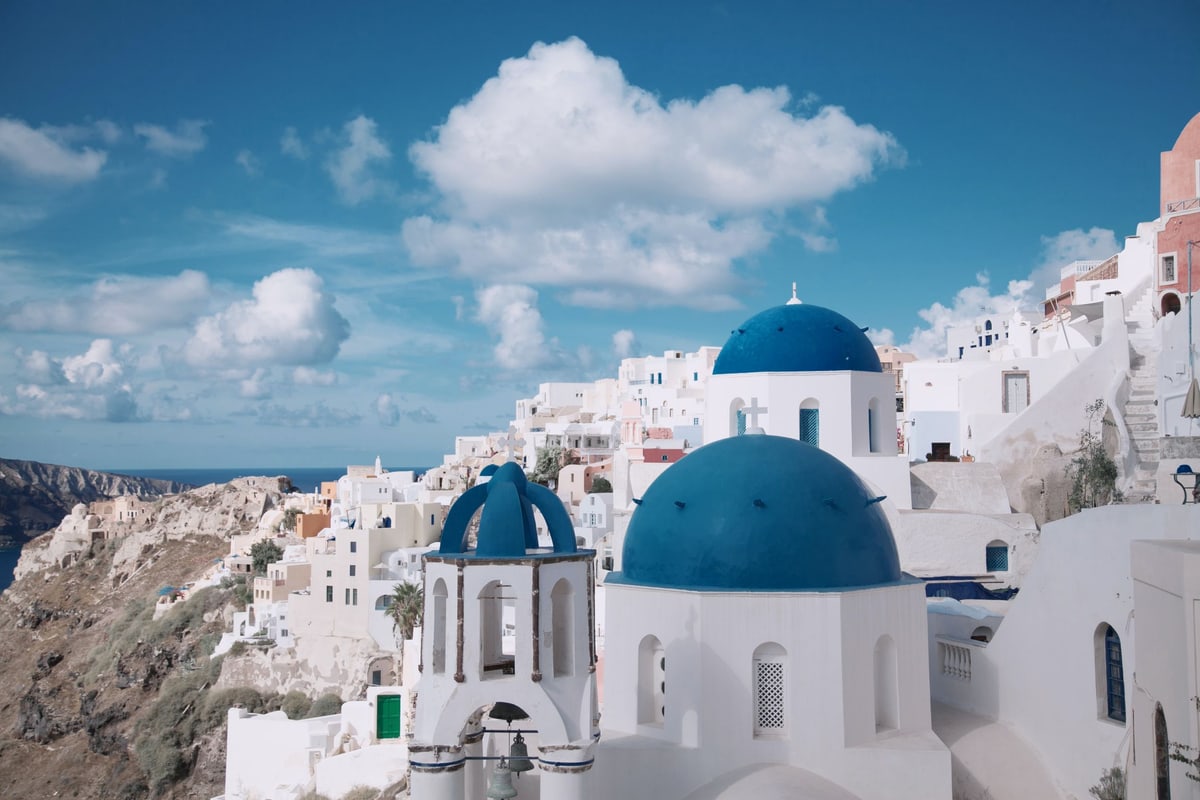
A Santorini private tour is a tour of the island of Santorini for one party, with its own driver or local host. The trip is one of the Greece Tours on Greece Ville.
This post covers the island in numbers, Santorini earth in the Suez Canal, how the Minoan eruption is dated, the first volcano scientists, the colony of Cyrene, population change, village protection rules, birds, the lighthouse, beach sand, climate, village names, neighbour islands, the cable car, tsunamis, carsickness, sun through car windows, drinking water for walkers, child seat rules and common questions. Each section answers one question in plain words and uses facts from public sources. The first part looks at the island itself: its villages and population, and the volcanic earth that went into the cement of the Suez Canal. It then covers the dating of the Minoan eruption, the first scientists who studied the volcano and the colony that islanders founded in Libya. The middle part covers village protection rules, birds, the lighthouse, beach sand, climate, village names, neighbour islands, the cable car and tsunamis. The last part turns to the day by car: carsickness, sun through the car window, drinking water for walkers and child seat rules.
What is a Santorini private tour?
A Santorini private tour takes place on the island of Santorini. The Thira municipality says its coastline is 69 kilometres long. The main island, Thira, is 17.4 kilometres long. It runs from Cape Mavropetra in the north to Cape Exomytis in the south.

On a Santorini private tour, Thira is a crescent, the curved shape of a thin moon. It is about 1.2 kilometres wide in the north and about 6 kilometres wide in the south.
Fira town had 1,346 permanent residents in the 2021 count. It ranks only fourth among the settlements of Santorini. Ahead of it are Emporeio with 1,785, Messaria with 1,742 and Karterados with 1,428.
Every Santorini private tour happens on an island of varied villages. The village of Oia itself had 478 permanent residents in 2021. Phinikia had 137 residents and Tholos 134, in the Oia community.
The village of Pyrgos Kallistis itself had 1,029 permanent residents at the 2021 count. The Greek statistics service lists the Profitis Ilias monastery as its own settlement, with 43 residents in 2021.
- Messaria: It is the second biggest community on Santorini, with 2,008 residents, and Monolithos has 266.
- Episkopi Gonia: The community had 1,252 residents in 2021, but the old village itself had only 187.
- Exo Gonia: It is the smallest community of the Thira municipal unit, with 302 residents in 2021.
Akrotiri village had 432 residents and Imerovigli village 421 in 2021. On Thirasia, Potamos has 74 residents, Agia Eirini 28 and Agrilia 5.


How did Santorini earth reach the Suez Canal near a Santorini private tour?
A Santorini private tour is a trip on an island with earth mines. The Oia earth mine, founded in 1928, loaded its ships from a stair in Ammoudi Bay. Big harbour works at Alexandria and Constanța also used the earth from Santorini.
Before a Santorini private tour, a reader can learn how the island’s earth was dug. Mining began with simple tools in the tunnels. Later on, machines made the digging of the earth much faster.
Demand for the earth opened mines at Oia, Fira, Akrotiri and Thirasia. Near Fira, the mines dug a vertical wall up to 70 metres deep. Dust storms sometimes made work impossible for a while.
After a Santorini private tour, a reader can read about the plant in Fira. The plant started work in 1929. It dried the earth, ground it to fine powder and packed it in sacks.
The plant’s rotating iron kiln, an oven that turns, was 16 metres long. The plant was able to process 10 tonnes of earth in an hour. The plant stands 162 metres above sea level.
- Mine crew: In 1932 the Oia earth mine used 25 to 30 workers a day.
- Ramp: A sloping ramp 300 metres long carried ground earth from the plant down to the shore.
- Closing years: The Oia earth mine stopped work in 1974 and moved to Akrotiri.
In 1932 the workers loaded 500 to 600 tonnes of Santorini earth. The loading stair of the Oia mine stood until 1985.
How do scientists date the Minoan eruption seen on a Santorini private tour?
A Santorini private tour raises one big question: when did the Minoan eruption happen? Scientists use tree rings, ice cores and radiocarbon dating, which measures carbon-14, to look for the answer. Each method gives clues, but the exact year is still open.
Anyone on a Santorini private tour is near a hard dating puzzle. In the 1970s, early radiocarbon dates for the eruption clashed badly with archaeology. Archaeologists first dismissed those dates as unreliable.
From about 1600 to 1530 BCE, the radiocarbon calibration curve, which turns readings into years, goes flat. This flat stretch is called a plateau, so a single measurement cannot give a precise year.
Trees give another clue to anyone on a Santorini private tour. Researchers measured carbon-14 in 285 single tree rings. They found an offset, a shift, from the old curve between 1660 and 1540 BCE.
Dragging two electrodes along an ice core records how well it carries electricity. The graph shows yearly cycles and major volcanic eruptions. Scientists matched Antarctic and Greenland cores by a shared sulfate layer.
- Trees: Oak in Ireland and pine in California, about 7,900 km apart, showed the same carbon-14 offset.
- Nile ash: Santorini ash was once reported in the Nile Delta, but that was a misidentification.
- Turkey: Nine radiocarbon ages from a Turkish tsunami layer place the eruption no earlier than 1612 BCE.
Ice-core sulfur spikes at 1611, 1561, 1558, 1555 and about 1538 BCE remain possible dates for the eruption.
Who first studied the volcano before a Santorini private tour?
A Santorini private tour raises a simple question about the volcano: who studied it first? Ferdinand Fouqué, a French geologist, which means a rock scientist, made the first detailed geological study of Santorini. He told three layers apart in the volcanic deposits.
Before a Santorini private tour, it helps to know about Fouqué, the French geologist. He taught at a college in France from 1877. In 1881, he joined an academy of sciences.
Fouqué argued that the centre of the island sank into the sea. That was one of the earliest modern ways to explain a caldera. A caldera is a hollow left when a volcano collapses.
On a Santorini private tour, the 1866 eruption is a key part of the story. The German geologist Karl von Seebach saw it. He published a study of the Santorini volcano in 1867.
Julius Schmidt was the director of the observatory in Athens. He watched the 1866 eruption too. In 1874, he published his study with studies of Etna, Vesuvius and Stromboli, three other volcanoes.
- Mountains: In 1871, Fritsch published a geological description of the ring of mountains around the Santorini bay.
- Volcano growth: In 1936, Hans Reck and colleagues made a major study of how the Santorini volcano developed.
- Map: In 1980, Pichler and Kussmaul published a detailed geological map of the Santorini islands.
Santorini’s eruption during World War II was studied only by Greek scientists and local residents. The war largely kept foreign scientists away from Santorini.
Which colony did the island of a Santorini private tour found in Libya?
A Santorini private tour is set on the island that Herodotus calls Thera. In his story, the people of Thera sent men to settle in Libya. Their colony there was the city of Cyrene. Herodotus names Battus as the founder of that city.
Behind a Santorini private tour lies an old tale from Herodotus. In his story, the drought on Thera killed every tree except one. The Therans sent men from each of their seven districts.
Brothers in every family drew lots to decide who went. Therans asking in Crete found Corobius at Itanus. The dealer in purple had once been blown to the island of Platea off Libya.
Beyond a Santorini private tour, the story moves to Libya. The settlers spent two years on Platea and six years at Aziris. Then Libyans offered to lead them to a better place further west.
Herodotus says Battus stammered and had a lisp. At Delphi, he asked about his voice and was told to found a city in Libya. In the Libyan language, “Battus” means “a king”.
- Harvest: Crops around Cyrene ripened at three heights, one after another, giving eight months of harvest.
- Export: Silphium, a medicinal herb, was the chief export of Cyrene and was harvested to extinction.
- Science: Eratosthenes of Cyrene was the first known person to calculate the distance around the Earth.
An earthquake destroyed Cyrene on 21 July 365, yet a lot of buildings were rebuilt. Temples there stayed open until the decrees of 395.
How did the population of a Santorini private tour island change?
A Santorini private tour is a trip to an island with a changing population. The Thira municipal unit had 7,751 residents in 1961 and 6,196 in 1971. It counted 14,005 residents in 2011. The 2011 census gave the Thira municipality 15,550 permanent residents.
On a Santorini private tour, the Thira municipal unit is the main part of the island. It grew to 7,083 residents in 1981 and 8,771 in 1991. It then counted 12,440 residents in 2001.
The Oia municipal unit includes Therasia, a small island west of Santorini. It counted 882 residents in 1991, 1,230 in 2001 and 1,545 in 2011. Thira and Oia together had 13,670 residents in 2001.
Older records cover a Santorini private tour island too. A 1911 encyclopedia gave the Santorin province, then divided into nine communes, 19,597 people in 1907. A 1913 Catholic encyclopedia said Thera numbered 15,000 inhabitants.
Vothonas grew from 415 residents in 1991 to 609 in 2001, 699 in 2011 and 834 in 2021. Megalochori grew from 329 residents in 1991 to 457 in 2001 and 594 in 2011.
- Therasia: The island had 319 residents in 1834, 855 in 1896 and 679 in 1907.
- Akrotiri: It counted 248 people in 1961, 224 in 1971, 207 in 1981 and 333 in 1991.
- Agios Georgios: The coastal settlement had 54 permanent residents in 1991, 65 in 2001 and 343 in 2011.
Large numbers of islanders left after the 1956 earthquake but returned in later decades. Settlers came from other parts of Greece and from European countries.
Which rules protect the villages of a Santorini private tour?
A Santorini private tour happens on an island with strict building rules for villages. A presidential decree of 16 February 1990 set building limits on Thira and Thirasia. In Zone One, the decree bans building and any change to the shape of the landscape.
On a Santorini private tour, Fira, the island capital, is a traditional settlement. It has held that status since 1988. The village of Emporio has been classed as a traditional settlement since 1978.
Finikia has also been a traditional settlement since 1988, and cars do not drive through its centre. The 1990 decree set building limits outside town plans and outside settlements older than 1923.
On a Santorini private tour, Zone One covers the slopes facing the caldera, the volcano’s crater. The zone reaches the slopes of these places: Thira, Akrotiri, Megalochori, Pyrgos, Messaria, Imerovigli, Oia and Thirasia.
In Zone One, the decree allows small works on legal buildings. These are repairs, facade painting, roof repairs and new frames in the same openings. A facade is a building’s front wall.
- Harbours: Zone One allows harbour installations at Athinios, Gialos of Fira, Armeni, Korfos, Riva and Thirasia.
- Permits: Zone One issues no building permits for new buildings, extensions, pools or other water surfaces.
- Later change: A 2012 decree in the official Government Gazette, issue 144, amended and extended the 1990 decree.
Beyond the villages, the EU lists twelve habitat types in one Natura site. That site covers Nea Kameni, Palia Kameni and Profitis Ilias.
Which birds nest on the cliffs of a Santorini private tour?
A Santorini private tour question about cliff birds has more than one answer. Eleonora’s falcon breeds mainly on Aegean islands and islets. Peregrine falcons nest in a shallow hollow on a cliff edge. Blue rock thrushes nest in rock cavities and walls.
On a Santorini private tour, Eleonora’s falcon nests from Cyprus show a cliff pattern. Almost all sat on near-vertical sea cliffs, 1 to 100 metres up, and mostly faced south.
In Cyprus, 67 percent of Eleonora’s falcon nests were on exposed ledges. Another 19.3% were in holes and 8.4% in deep ledges. In the Aegean, a lot of pairs lay eggs in exposed nests.
For a Santorini private tour, note that Scopoli’s shearwaters reach colonies in late February or early March. Chicks hatch in mid to late July and fledge, or leave the nest, in late October.
One in every 2500 to 5000 migrants crossing the Mediterranean in autumn ends up as Eleonora’s falcon prey. Eleonora’s falcons tagged in Cyprus reached Madagascar between 8 and 28 November.
- Hatching: Peregrine eggs, normally three or four, are kept warm for 29 to 33 days before hatching.
- Gull nests: Yellow-legged gulls build a mound of plants on the ground or on cliff ledges.
- Larders: Food stores for leftover prey sit in caves and bushes around the Eleonora’s falcon nest site.
The Central Aegean protected-areas unit oversees 41 Natura 2000 sites, protected nature areas mostly in the Cyclades. Its bird zones protect 133 bird species.
Which lighthouse marks the south coast of a Santorini private tour?
A Santorini private tour of the south coast has the Akrotiri lighthouse as its marker. Its light shows one white flash every 10 seconds. The light has a range of 24 nautical miles, which is a distance unit used at sea.
On a Santorini private tour, the Akrotiri tower has a lantern and a gallery. The lantern is the room on top that holds the lamp. The gallery is a balcony on the tower.
The tower joins a one-storey stone keeper’s house, the home of the person who tends the light. The lantern on top is painted white with a green dome, which is a round roof.
The Akrotiri light, seen on a Santorini private tour, burned oil in the past. The oil beam reached about 23 nautical miles. The lighthouse is listed with a third-order Fresnel lens, a lens that focuses light.
The Ios lighthouse on Akra Fanari dates from 1892. It flashes white every 4 seconds from 33 metres above the sea. The Aspropunta light on Folegandros shows three white flashes every 30 seconds.
- Gaidouronisi: Near Syros, a 29 meters tower built in 1834 is called the tallest Greek lighthouse.
- Agios Nikolaos: The 1831 lighthouse on Kea was among the first built by the Greek government after independence.
- Navy command: The Navy’s Lighthouse Command is called Υπηρεσία Φάρων in Greek and is based in Piraeus.
Stylianos Lykoudis pioneered the first automatic lighting installation in 1915. The Navy named a lighthouse tender ship Lykoudis (A-481) after him.
What colours the sand on the beaches of a Santorini private tour?
A Santorini private tour is a good moment to ask what gives volcanic sand its colour. Minerals such as augite, magnetite and sometimes hornblende make volcanic sand look black. Their iron can give the sand a rusty hue once the grains have weathered.
On a Santorini private tour, basalt is a volcanic rock that is worth knowing by name. It is dark grey to black when it holds a lot of augite or other dark pyroxene minerals.
More than 90% of all the volcanic rock on Earth is basalt. Basaltic cinders are frequently red in colour. Oxidised, or rusted, iron from weathered iron-rich minerals such as pyroxene gives them this hue.
On a Santorini private tour, Kamari beach has an average grain size of roughly 3 mm. A studied stretch of Kamari beach is about 1500 m long and up to 55 m wide.
Volcanic sand is immature, as its grains weather easily. It tends to be made of rock fragments, not single crystals. In volcanic ash, pumice grains weigh between 700 and 1,200 kg per cubic metre.
- Magnetite: Magnetite is more magnetic than any other natural mineral, except very rare native iron.
- Augite: This mineral takes its name from the Greek word augites, which means “brightness”.
- Pyroxene: The name comes from two Ancient Greek words that mean “fire” and “stranger”.
Red Beach is about 300 m long and 4 to 10 m wide. Sea erosion, which wears the shore away, strongly affects this beach.
How hot and dry does the island of a Santorini private tour get?
A Santorini private tour takes place on an island with hot, dry summers. From June to September, Santorini has hardly more than one rain day a month. From December to February, the island averages up to nine rain days a month.
On a Santorini private tour, the mean August temperature is 26.8 °C for 1991-2020. The Greek weather service measures this at its Santorini station. For 1971-2000, the same station gave 25.3 °C for August.
The mean January temperature at the station rose from 11.4 °C in 1971-2000 to 12.2 °C in 1991-2020. The mean January night low rose from 9.1 °C to 9.9 °C over the same periods.
During a Santorini private tour, the mean July daytime high is 29.7 °C for 1991-2020. For 1971-2000, the figure was 28.6 °C. Both numbers come from the same Greek weather service station on Santorini.
Average relative humidity on Santorini, which shows how much water the air holds, is 61.1% in June. The same station on the island records 61.4% in August, 70.4% in January and 71.4% in December.
- Summer lows: The station’s lowest July reading is 19.6 °C, and its lowest August reading is 19.2 °C.
- February high: The warmest February day on record at the island’s weather station reached 23.7 °C.
- September low: The lowest September reading at the island’s weather station is 15.1 °C.
The warm sea period ends between 27 October and 19 November at eight Aegean navy stations. Thira is among them.
Where do the village names on a Santorini private tour come from?
A Santorini private tour raises one simple question: where do the village names on the island come from? The names come from Greek, Latin and French words. Santorini itself comes from Santa Irina, the name Frankish crusaders gave to the place.
On a Santorini private tour, the name Imerovigli joins imera, which means “day”, with vigla, a lookout post. The word vigla comes from the Latin verb vigilare, which means “to keep watch”.
Imerovigli is thought to come from an imeroviglio, a small daytime lookout tower. Watchers were able to warn islanders in good time when pirates appeared. They came from the side of Exo Gialos.
On a Santorini private tour, Emporio has two theories. The best accepted theory links it to emporio, the Greek word for trade. Another theory joins Greek neo, “new”, with French bourg, a fortified village.
After Greek independence, Thira became the official name. Foreign maps kept Santa Irina, which Greeks shortened to Santorini. Pyrgos Kallistis was once also called Kainourgiomburgo. People from Oia are still called Apanomerites.
- Karterados: The name comes from karteri, Greek for ambush, thought to refer to ambushes set for pirates.
- Vourvoulos: Its name is thought to come from Greek vourvoula, “blister”, maybe from its blistered volcanic ground.
- Monolithos: The name comes from the big rock that carries the church of Agios Ioannis.
Skala is the name of Fira’s old port. The Greek word means stairs, ladder or pier and comes from Latin scala.
Which islands can be seen from a Santorini private tour?
A Santorini private tour is set in the Santorini island group. Ios lies about 19 km north of the group and is one of the two nearest neighbours. Folegandros lies about 40 km north-west of Santorini. Sikinos lies about 31 km north-west of Santorini.
On a Santorini private tour, Crete can be seen far to the south on a clear day. The uninhabited Christiana islets mark the southernmost point of the Cyclades prefecture, an official regional area.
On Thirasia, rocks drop steeply into the sea along the east coast. The west coast, in contrast, is low and gently spread out. Mount Viglos is the highest point of Thirasia, at 295 m.
On a Santorini private tour, Sikinos has Mount Troulos as its highest peak. It rises to 552 m in the middle of the island. Chora, the main village, sits at about 270 m.
In 1537 the Ottoman admiral Barbarossa raided Anafi and carried off all its people as slaves. From 1770 until the war ended, a Russian fleet under Alexei Orlov used Anafi as a base.
- Thirasia: Growing wine grapes and vegetables is the main work there, together with day tourism in summer.
- Folegandros: From 1936 to 1941, the island was a place of exile, where political prisoners were sent.
- Sikinos: Sikinos is said to be named after Sicinos, a son of Thoas and Oenoe.
Amorgos is the seventh-largest island of the Cyclades. The highest point of Amorgos is Mount Krikellos, which rises to 823 m.
How does the cable car climb the cliff near a Santorini private tour?
A Santorini private tour near a cliff cable car raises one question: what lifts the cabin? A gondola lift is held up and pulled by a loop of steel wire rope between two stations. Hauling by cable can overcome large differences in height.
On a Santorini private tour, a big wheel called a bullwheel turns the cable. The bullwheel joined to the motor is the drive bullwheel. The wheel at the other end is the return bullwheel.
On a pulse gondola system, the cable slows from time to time for boarding. More than one cabin loads at once. Cabins on a gondola lift can hold between two and fifteen people.
On a Santorini private tour, a gondola lift can have spring-loaded grips on its cabins. These grips let each cabin detach from the moving cable and slow down in the station.
An aerial tramway has only one or two cabins. They shuttle back and forth instead of circling on a loop. Fixed cables carry the weight, while a separate moving rope pulls it.
- Fixed grip: The grip of a tramway cabin is fixed to the pulling rope and cannot let go.
- Jig-back system: On a two-cabin tramway, the weight of the cabin going down helps pull the other up.
- Funicular: Two cars joined to opposite ends of one cable balance: one rises as the other falls.
Bicable and tricable lifts, with two or three cables, are steadier from side to side than single-cable ones. They can run in stronger cross-winds.
Which tsunamis have hit the island of a Santorini private tour?
A Santorini private tour happens on an island linked to more than one tsunami. The Minoan wave flooded the coast of Crete. The Kolumbo wave struck the island of Santorini itself. A wave in 1956 reached the coasts of Amorgos and Astypalaea.
On a Santorini private tour, the Kolumbo wave is one that hit the island. It destroyed five churches on Santorini. It uncovered old ruins from the Hellenistic and Byzantine eras at Kamari and Perissa.
At Kamari and Perissa, the sea drew back before the 1650 flood. Modellers first tested their method for explosion waves on a 1996 lake tsunami in Kamchatka. Then they applied it to Kolumbo.
On a Santorini private tour, the 1956 wave is one more to note. Water climbed up to 20 m on Amorgos’s south coast. On Astypalaea’s north coast, it also climbed up to 10 m.
The Minoan wave flooded up to 400 m inland at Malia on Crete. The water climbed no more than 8 m. Researchers largely reject older reports of Minoan tsunami deposits at Gouves on Crete.
- Wave timing: Santorini ash in the Palaikastro deposit fell first, pointing to the third or fourth eruption phase.
- Palaikastro layer: Unsorted coastal gravel, sand, shell bits, building stones and pottery pieces are read as tsunami debris.
- Minoan cause: Researchers now blame pyroclastic flows, fast clouds of hot ash and rock that entered the sea.
Together, the findings point to waves that reached Malia, Palaikastro, Kamari, Perissa, Amorgos and Astypalaea.
How does carsickness work on a Santorini private tour?
A Santorini private tour by car raises the question of how car sickness works. Car sickness depends mainly on how well the driver drives and on the road itself. The road matters, such as a curvy country road compared with a highway.
On a Santorini private tour, looking out of a moving vehicle’s window makes the eyes follow the scenery. Then the eyes snap back, and this reflex is called the optokinetic response.
A clash can also start inside the ear itself. The clash is between the canals that sense turning and the otolith organs. The otolith organs sense speeding up, slowing down and gravity.
On a Santorini private tour, drivers rarely get motion sick, possibly because they can predict the sideways pushes. They also frequently tilt their heads along with the force of each turn.
On roads, the main triggers of sickness are slow horizontal sways. These sways run both forward-backward and sideways. Active suspension, which controls up-and-down movement, was shown not to play a decisive role.
- Stomach: During motion sickness, the stomach’s electrical rhythm climbs from three cycles per minute up to nine.
- Balance: People with no working balance organs in both ears are essentially immune to motion sickness.
- Head tilt: In one study, passengers who tilted like a driver felt significantly less sickness than upright ones.
A full stomach, stuffy air and tobacco smoke can all make nausea worse. Bad smells and the sight of someone vomiting can do the same.
What does the sun do through a car window on a Santorini private tour?
A Santorini private tour inside a car does not shut out all sun rays. The windscreen blocks nearly all UVA, one kind of ultraviolet light from the sun. Side windows block less UVA than the windscreen. The amount changes from car to car.
On a Santorini private tour, the car windscreen is laminated safety glass. It has two curved sheets of glass with a layer of plastic between them. The middle plastic layer is called PVB.
In a windscreen, the glass itself absorbs the larger part of UVB, another kind of ultraviolet light. The PVB layer then takes up the leftover UVB, and also the larger part of UVA.
A test of 29 cars from 15 makers gives numbers for any Santorini private tour by car. The front windscreen blocked 96% of UVA on average, in a range of 95% to 98%.
In the same 29 cars, the driver’s side window blocked only 71% of UVA on average. The range was 44% to 96%. Only 4 of 29 cars (13.8%) blocked over 90% at that window.
- Windows shut: In German tests, dummies’ arms got 3 to 4% of outside UV with windows shut.
- Windows open: The same German tests gave dummies’ arms 25 to 31% of outside UV with windows open.
- Open convertible: In an open convertible, the dummies’ UV doses reached 62% of the outside UV.
Across sixty car models, the windscreen let through 0.9% of UVA. The driver’s and front passenger windows let through 16%.
How much water does a walker need on a Santorini private tour?
A Santorini private tour walker counts total water, meaning every drink plus the moisture in food. EFSA sets its daily water figures on that total basis, not on drinks alone. Those figures only apply to moderate temperatures and moderate physical activity.
On a Santorini private tour, the body loses water when a person is not active. The skin can lose about 0.3 L of water an hour through sweat and unnoticed evaporation.
The brain signals thirst once the water in the body falls below a set level. Early research finds signals from the mouth, throat and gut quench thirst minutes before drunk water is absorbed.
On a Santorini private tour, drinking when thirsty keeps hydration within about 2% of what the body needs. During exercise, people who drink only according to thirst can fail to hydrate enough.
After the age of 50, the thirst sensation weakens and keeps weakening with age. EFSA gives older adults the same water intake as other adults, because ageing kidneys concentrate urine less well.
- Urine colour: Urine gets its yellow mainly from urobilin, a waste product of old blood cells breaking down.
- Colourless urine: Urine that is completely colourless indicates over-hydration, which means drinking more water than the body needs.
- Dehydration sign: Peeing less frequently than usual is one NHS sign of dehydration in adults and children.
The majority of people cope with a 3 to 4% drop in total body water. Losing over 10% brings physical and mental decline.
Which child seat rules apply on a Santorini private tour?
A Santorini private tour with children starts with one Greek rule for the front seat. Greek law bars children under 12 from the seat beside the driver. The only exception is an approved child seat. The seat must fit the child’s age, height and weight.
On a Santorini private tour, a rear-facing seat faces the back of the car. The European Commission says it cannot go on the front passenger seat unless the airbag is off.
UN Regulation 129 began in July 2013. It gives rear-facing travel to 15 months, not 9 to 12 months. Since February 2013, UN rules have required ISOFIX anchors in all new vehicles.
On a Santorini private tour, Group 0+ seats face backwards and take babies up to 13 kg. Group 1 seats take children of 9 to 18 kg, in a harness with five belt points.
Group 2 seats cover 15 to 25 kg. Group 3 booster seats cover 22 to 36 kg. A booster seat lifts the child so the belt crosses the collarbone and chest.
- Head support: In a sudden stop, a rear-facing seat supports a child’s head better than a forward-facing seat.
- Adult belts: Small children in adult seat belts can suffer injuries to the intestines, diaphragm and spine.
- Infant deaths: The World Health Organization says child restraints can cut deaths among infants by 71%.
Child seats are tested for just one crash. A seat that was damaged in any way needs to be replaced.
What do visitors ask about a Santorini private tour?
A Santorini private tour visitor can ask about electric plugs, national holidays, pharmacies, smoking, alcohol and tax. Greek law covers smoking, alcohol sales and pharmacy duty shifts. Greece also sets its own sales tax rates and its own national holidays.
Which plugs fit Greek sockets for visitors on a Santorini private tour?
The Type C Europlug suits low-power devices up to 2.5 amps. It fits every round-pin household socket in Europe except Italy’s 16-amp socket. A Type F socket has earthing clips that connect earth before the live pins touch.
What do visitors on a Santorini private tour need to know about Greek holidays and Ohi Day?
Fixed-date Greek national holidays include 1 January, 25 March and 15 August. Others fall on 25 December and 26 December. Ohi Day marks Greece’s refusal of an Italian ultimatum, a final demand, on 28 October 1940.
How do pharmacies work for visitors on a Santorini private tour?
Greek law requires pharmacies to take daytime and overnight duty shifts. Only the Regional Governor can excuse one, for serious reasons. A 2011 law made each local pharmacists’ association draw up yearly duty tables for holidays and nights.
What are the smoking rules for visitors on a Santorini private tour?
Smoking is banned in any car carrying a child under 12. Greek airports ban smoking except in areas set aside for smokers. A royal decree of 1856 brought modern Greece’s first smoking ban, for state buildings only.
What are the alcohol rules for visitors on a Santorini private tour?
Greek law bans selling, offering or supplying alcohol to minors. Sellers must check age. Minors cannot enter or work in nightclubs and licensed pure bars. The exception is private events reported 48 hours ahead. Vending machines cannot sell alcohol.
How do VAT and tax-free refunds work for visitors on a Santorini private tour?
Greece’s VAT, a sales tax, is 24 percent. Only visitors who live outside the EU can claim a tax-free refund. A claim needs the receipts, an export within three months of buying, and a Customs export stamp.