

A Skiathos island tour circles the green island at the western edge of the Northern Sporades. The tour is one of the Greece Tours on Greece Ville.
This post covers the rocks and shores, the plants, birds and sea life, the old paths and the churches of the island.
History, ships, food, the airport, the best months and common questions follow. The sections include Skiathos island tours that can be booked online.
What is a Skiathos island tour?
A Skiathos island tour is a trip around the Greek island of Skiathos. The whole island has been protected as an aesthetic forest since 1977. About 30 km² of woodland is declared an Aesthetic Forest. Aleppo pine, stone pine and evergreen broadleaf trees grow there.
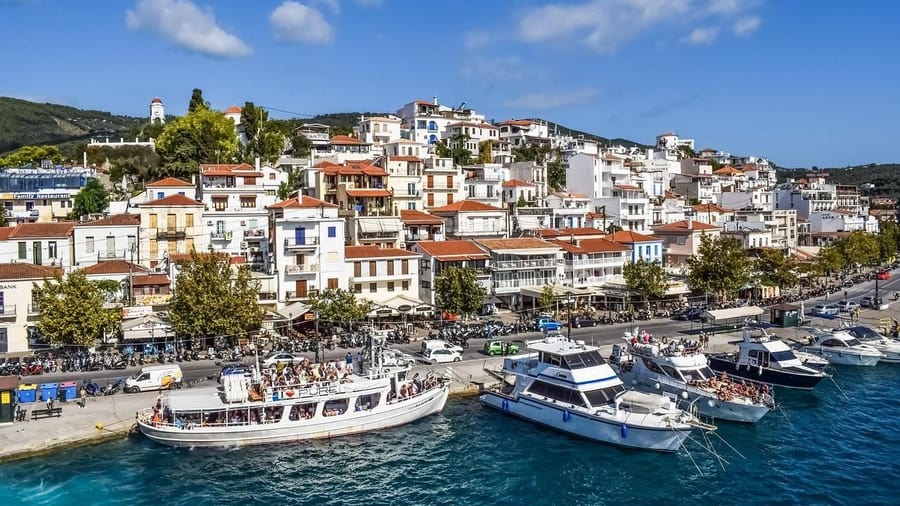
Skiathos town counted 4,897 residents at the 2021 census. The settlement of Koukounaries is far smaller. It had only 44 residents in 2021. That number was down from 119 in 2011.
On a Skiathos island tour, the island is wooded, with a handful of small wetlands. Greece’s CORINE biotope survey logged this in 1986. The survey gives 3,600 ha of land and a 47.9 km perimeter.
On a Skiathos island tour, the island holds two Natura 2000 sites. GR1430003 lies at Koukounaries, GR1430009 along the coast and islets. Only 38.77 ha of the Koukounaries site is land. Its perimeter measures 4.4 km.
Skiathos has two Landscapes of Outstanding Natural Beauty. Koukounaries Bay covers 135.33 ha and is no higher than 5 m. The Evangelistria Monastery area covers 365.46 ha and rises up to 429 m.
- Site edges: Roads bound the Koukounaries site on the north, east and west.
- EU status: Koukounaries is a Site of Community Importance under EU decision 613/2006.
- Law 3937/2011: Under this law, Koukounaries also counts as a Special Protection Area.
- Wildlife refuges: Two refuges protect Kechria, at 172 ha, and Koukounaries, at 16 ha.
Platanias, at 3 ha, and Vromolimnos, at 1.9 ha, are small island wetlands under absolute protection. Skiathos island is also protected under the Barcelona Convention.


Which rocks and shores shape a Skiathos island tour?
A Skiathos island tour crosses an island that geologists place in the Pelagonian isopic zone. Its eastern part is made of strongly metamorphosed rocks: schists, gneiss and schistose gneiss. Its western part has lightly metamorphosed marbles, dolomites, slates and phyllites.
The Evangelistria area in the north mixes limestone and schist. A limestone ridge at Kakorema, in the east, holds karst sinkholes at Kambia, Katavothra and Mygdalia. Springs are common, chiefly where limestone meets schist.
On a Skiathos island tour, valleys run north to south along tectonic faults. Running water cut gorges across the island. The Lechouni and Kakorema streams narrow at their mouths, forming open gorges on the north side.
In the Holocene, the sea flooded the valleys, turning them into lagoons. As the sea pulled back, two small lakes stayed linked to it by channels. Strofylia lies in the southwest, Agios Georgios in the southeast.
On a Skiathos island tour, the two lakes are no deeper than 2 m. Agios Georgios covers 12 ha. Gneiss surrounds Strofylia, so its shores are sandy. Flysch surrounds Agios Georgios, leaving sandy clay and silt.
Back-dune brackish ponds once lay at Platanias, Kolios and Vromolimnos. Only Vromolimnos still holds water. Strofylia’s canal on the forest’s east side is natural, but people widened it. It runs dry at times.
- Low ground: The Koukounaries site lies almost at sea level, rising to only 1.50 m.
- Koukounaries beach: It is open and gently sloping, with strong water movement and a sandy seabed.
- Dunes: The embryonic shifting dunes of Koukounaries are listed as a highly degraded habitat.
- Aspronisi: This islet is strongly calcareous, with steep slopes and strong wind exposure.
Tsougria, too, has two brackish back-dune ponds. It is thought to be a piece of land that once broke away from Skiathos.
Which plants grow on a Skiathos island tour?
A Skiathos island tour explores an island with one endemic plant, the bellflower Campanula sciathia. The botanist Phitos named it in 1964. The latest survey found it only on Kastro’s rocks. Dense kermes oak scrub covers the highest ground around Mitikas and Karaflitzanaka.
Orchis × sciathia, an orchid cross of Orchis boryi and Orchis morio, was named from Skiathos in 2003. Its type plant came from 140 m, just west of the town centre, on 5 April 2002.
On a Skiathos island tour, the Koukounaries Natura site holds two rare orchids, Serapias cordigera and Serapias lingua. CORINE lists Orchis boryi, Serapias orientalis, Helleborus cyclophyllus and Daphne gnidioides as notable plants.
The Koukounaries stone pine stand, between the lake and the beach, is only 200 to 250 m wide. The botanist Rechinger saw these pines as a relic of planting in Venetian times.
On a Skiathos island tour, the pine wood grew by secondary succession, replacing cover dominated by holm oak. Holm oak grows beneath the pines, unlike in the stone pine forests of Strofylia and Schinias.
Thick evergreen undergrowth, deep litter, little light and trampling make natural stone pine regrowth almost impossible. Large fires in 1999 and 2000 caused over half the area burned on Skiathos in 40 years.
- Stone pine: Large Greek populations grow only at Strofylia and Kaiafa, while Skiathos has a small isolated one.
- Beyond the pines: Heaths of heather, strawberry tree and Cretan rockrose spread, as at Koumarorachi behind Troulos.
- Strawberry trees: Between Katsarou and Plagia, both species grow together and form the hybrid Arbutus × andrachnoides.
- New records: An August 2013 survey added 62 new plant taxa and logged 26 introduced ones.
Cretan maple is abundant around Evangelistria and acts more like a deciduous tree than an evergreen. Old tree-sized maples grow near the monastery.
Which birds and sea life meet a Skiathos island tour?
A Skiathos island tour visits an island where Lake Strofilia, at Koukounaries, is vital for migrating birds. They stop and breed there. Heavy tourist pressure, though, has caused a big drop in the migrating water birds at this site.
A Greek biotope survey says small Skiathos wetlands draw a wide range of water birds on spring migration. The islet of Tsougria has small wetlands, an important bird refuge in the Sporades.
On a Skiathos island tour, two lakes stand out in the GBIF records: Agios Georgios lake and Strofilia. Records from these lakes include grey heron, little egret, squacco heron and purple heron.
Notable Skiathos birds include Eleonora’s falcon, peregrine falcon, hobby and sparrowhawk. Little bittern and wood sandpiper, two wetland birds, are listed too. So are chukar partridge, nightjar, tawny pipit and short-toed lark.
On a Skiathos island tour, the bird zone around Skiathos holds 26 breeding pairs of Mediterranean shag. After nesting, 186 to 307 shags gather there, thought to be from around Alonnisos.
The shags fish along the Skiathos shore, off west Skopelos and in the Strait of Skopelos. Shags ringed in the marine park have turned up as far as 200 km from their nests.
- Kingfishers: They are logged at Strofilia and Agios Georgios lake from late summer into winter.
- GBIF: Records also show honey buzzard, short-toed eagle, long-legged buzzard and lesser kestrel on Skiathos.
- Audouin’s gull: In recent years, a colony has settled on an uninhabited Skiathos islet.
- Monk seals: Surveyors judged it highly possible that they use, or even breed in, north coast sea caves.
GBIF holds records of the fan mussel Pinna nobilis off Skiathos. The pillow coral Cladocora caespitosa is on record there too.
Which old paths cross a Skiathos island tour?
A Skiathos island tour unfolds on an island with about 197 km of trails and dirt tracks. They thread the wooded interior past springs, creeks, watermills and old oil presses. Skiathos is a declared “Landscape of National Value” in Greece.
Pine, stone pine, strawberry tree, oak and olive line the paths. Another 700 plant types grow among them. The network follows European Ramblers Association and Green Flag Trails standards where possible.
On a Skiathos island tour, the spring at Profitis Elias still gives locals drinking water. It lies below the island’s highest peak. Agios Athanasios stands at about 400 m, near this plane-shaded spring.
Agios Dimitrios sits beside the old path to Kastro. It is about 2 km north of town, at about 300 m. The renewed network includes a trail for people with disabilities.
On a Skiathos island tour, the old road to Kastro passes Three Crosses. Papadiamantis placed it half an hour short of Kastro. He wrote that the soil there was red and fragrant.
The way to Panagia Kechria climbs Agios Konstantinos hill, then drops to the Kechria stream. The Taxiarches spring at Agalianou, on the road to Evangelistria, is known for crystal-clear water.
- The Poor Saint: In this Papadiamantis story, a shepherd runs a rough shortcut to warn Kastro of pirates.
- Christ at Kastro (1892): 16 people sail through a storm, then climb the snowy path for Christmas.
- Kastro watermill: Its remains stand near the bay where the Doman stream meets the sea.
- Kastro gate: Above it stood a roof with battlements and a box machicolation.
Tradition says Kastro families built a small settlement at Pyrgi to escape pirate raids. It lies 200 m up, on the way to Kastro.
Which churches and chapels mark a Skiathos island tour?
A Skiathos island tour crosses an island with over fifty churches and chapels beyond Kastro. The bulk are post-Byzantine. Only Agia Triada and Hagia Sophia at Troulos are older. In Kastro, only three churches still stand: Christos, Agios Nikolaos and Agia Marina.
Agia Triada in town keeps ruins of an Early Christian basilica. They are thought to date from the 4th to 6th centuries AD. Until 1725, Skiathos was the seat of the Bishop of the Sporades.
On a Skiathos island tour, Three Hierarchs has been the town cathedral for over 150 years. Its marble iconostasis is a rare example of Gothic Revival style in Greece.
Hieromonk Symeon found the icon of Panagia Kounistra in 1650, dangling from a pine branch. She is the island’s patron saint, honoured on 21 November. For safety, her icon is kept in the Three Hierarchs cathedral.
On a Skiathos island tour, Panagia Limnia keeps the skull of writer Alexandros Papadiamantis. It grew around an icon of the Nativity of Mary. Settlers from Limni on Euboea brought it in 1784.
Kechria monastery dates from the 17th century. Its church was renovated in 1738 and painted in 1745. The dome sits on a tall drum with 14 windows. The west wall holds glazed plates from Nicaea.
- Panagia Megalomata: It is named after an old icon of the Virgin with very large eyes.
- Agia Kyriaki: It lies below Barberaki, the peak of Kastro, where the Anagkia cannon still sits.
- Tsougria chapel: Saints Florus and Laurus rose from the islet’s own stone in the early 1960s.
The Kechria monastery stands at 100 m, on a slope of olive and plane trees. Each year, it celebrates on 23 August.
What history shaped a Skiathos island tour?
A Skiathos island tour takes place where Chalcidians, Ionian Greeks, settled around the 8th or 7th century BC. Their town stood on today’s town site, high above the double harbour. Its wall of big rough square marble blocks had two gates.
One old theory joins skia, meaning shadow, with Athos. It pictures the island in the shadow of Mount Athos. The municipality favours another theory, linking the name to the rich shade of thick trees.
On a Skiathos island tour, the island’s coins date from around 350 BC. They showed the head of Apollo or Hermes, or a Gorgon’s face. The back carried a caduceus and the letters ΣΚΙΑΘΙ or ΣΚ.
In 480 BC, Skiathians at Pyrgi used torches to warn Greeks in Euboea of the Persian fleet. The ten fastest Persian ships caught a Troezenian guard ship near Skiathos. They sacrificed its finest fighter, Leon, on the prow.
On a Skiathos island tour, the courage of Pytheas of Aegina stands out. He fought on until hacked with wounds. So the Persians nursed him with ointments and linen bandages.
In 200 BC, after Philip V’s raid, fleets of Rome and Attalus the First looted everything left standing. The Ghisi family and their heirs held the Northern Sporades. A Byzantine fleet drove them out in 1276.
- Kastro: The walled town at Kastro covered roughly 25,000 square metres.
- Bourtzi: The fort had two round gate towers, a water tank and a Saint George chapel.
- 1823: Islanders and refugees used the Bourtzi’s crumbling battlements to drive back the Pasha.
- Mountain fighters: Armatoloi and klephts from Mount Olympus were active on Skiathos and Skopelos from 1806 until 1816.
At the end of World War II, the Germans bombed the whole town. It was rebuilt quickly in its old style.
Which ships and shipyards shaped a Skiathos island tour?
A Skiathos island tour takes place where shipyards already stood by the end of the 18th century. From 1843 to 1858, the yards of Skiathos built 153 vessels. That put the island among the nine busiest boatbuilding places in Greece.
In those years, Skiathos, Spetses and Skopelos built ships averaging between 59.5 and 78.8 tons. Phaneromeni, a sailing boat of the perama type, was built on Skiathos in 1939.
On a Skiathos island tour, the Bourtzi is home to the Maritime and Cultural Tradition Museum. It shows more than 600 exhibits. They trace two centuries of shipbuilding on Skiathos.
In 1770, Skiathos joined the naval battle of Çeşme on the side of Russian admiral Alexei Orlov. The island later gave men and ships to Lambros Katsonis. He raided Turkish coasts and ships.
On a Skiathos island tour, the Greek submarine Katsonis lies offshore. She sank on 14 September 1943, hit by the German submarine chaser UJ-2101. Commander Vasileios Laskos was among 32 crewmen lost with her.
Three crewmen swam for 9 hours to reach Skiathos. They hid there and got back to Egypt. In July 2016, the navy ship Naftilos found the wreck 170 m down.
- Maria: This Norwegian ship was wrecked on Skiathos on 20 November 1853; five crew were rescued.
- Eleftheria: This Greek troopship caught fire and was beached off Skiathos on 11 August 1916, killing 40.
- HMS Devonshire: On 26 July 1929 a gun explosion aboard this British warship off Skiathos killed 18 men.
- Pontikonisi: This lighthouse of 1907, off Cape Artemision, leads ships into the Skiathos strait.
On the mainland, the Cape Sepia light shines 105 m above the sea. It marks the entrance to the Skiathos strait.
Which foods and drinks come from a Skiathos island tour?
A Skiathos island tour takes place where seafood and chorta, the edible wild greens, rule the kitchen. In the past, Skiathos fishermen swapped their catch for the vegetables and oil of the farmers. That old trade shaped the island cuisine.
The local catch includes squid, langoustines, shrimps, lobsters, limpets and oysters. Skiathians call crustaceans and lobsters tsoflia, meaning shells, as they hold little meat. Cooks prepare tsoflia with courgettes and mountain greens.
On a Skiathos island tour, fish stifado is the local stew. It uses common dentex, white or dusky grouper, or angler fish. Local fishing grounds lie off Lalaria, around the small islets, at Tsougrias and off Kastro.
Chard, sow thistle and chervil are among the wild greens paired with seafood. Cuttlefish with wild greens is a classic Skiathos dish. Kalapodia is the traditional Skiathos pie, filled with wild greens.
On a Skiathos island tour, fava with sardines is another local dish. White grouper boiled with tomato is a Skiathos dish too. Lamb, wild goat or rabbit are cooked with home-grown vegetables, like the fish dishes.
Aspro, meaning white, is the classic Skiathos sweet. Cooks make it from finely chopped almonds, stirred until pale. Skiathos weddings serve chamalia: walnuts and pine honey wrapped in filo pastry.
- Quince: Kydonopasta, a quince paste, is one of the island’s traditional sweets.
- Liqueurs: The Women’s Association leaves fruit and herbs, like rose geranium, in sunlight for 40 days.
- Marinade: On the island, local olives are marinated with plenty of fennel.
- Vegetables: Papadiamantis praised the strength and beauty of Skiathos vegetables in his works.
On a Skiathos island tour, the local menu pairs the sea with the land. Seafood meets wild greens, and meat meets home-grown vegetables.
How does the airport shape a Skiathos island tour?
A Skiathos island tour shares the island with an airport that counted 552,844 passengers in 2023. Of these, 494,023 took international flights. The airport also recorded 5,159 aircraft movements that year. Its runway, numbered 01/19, points almost due north and south.
A mechanic who lived in Volos chose the airport site. Lazareta, the small island beside the airport, was once a leper colony. Skiathos has only two roundabouts, and one sits at the airport.
On a Skiathos island tour, the airport buildings carry history. A passenger terminal and a new control tower were built in 1988. A minor earthquake closed the terminal in 2001, and a new one opened in 2002.
Certain airlines make their captains take extra training for Skiathos. They require the captain to fly every landing. Pilots landing southward face a downslope, so the runway’s southern end stays out of sight at touchdown.
On a Skiathos island tour, planes landing northward pass east of Skiathos Town. Jets must take off light here. Certain types cannot carry enough fuel to fly direct to northern Europe, so they stop to refuel.
The airport handled 235,071 passengers in 2009. By 2019 the yearly total reached 446,219. In 2020, traffic fell to 88,916. Then it rose again to 511,611 passengers in 2022.
- Capacity: The runway takes aircraft up to the size of a Boeing 757-200.
- Record: An Air Italy Boeing 767-200 from Milan is the largest type to use the airport.
- Upgrade: In 2016 the apron gained six airliner parking stands and an extra taxiway.
- Spotters: A 2020 poll of over 6,000 voters ranked Skiathos third among airports for plane spotting.
On a Skiathos island tour, the airport also serves another island. Foreign visitors to Alonissos arrive mainly through Skiathos airport, and secondly through the airport at Anchialos.
Which months suit a Skiathos island tour?
A Skiathos island tour takes place in a temperate Mediterranean climate, with about 600 mm of rain yearly. Mild and hot days run from April well into November. In summer, the sea around Skiathos stays between 20 and 26 °C.
Spring warms step by step. April averages 17.7 °C by day and 10.8 °C at night. The month after April is warmer still. It averages 22.4 °C by day and 15.4 °C at night.
On a Skiathos island tour, June days average 27.2 °C and nights 20 °C. Greek weather service (HNMS) figures for the Skiathos station make July the hottest month by day. Its average high is 29.4 °C.
The air is driest in July, with humidity at just 60.6%. Heat holds after dark in high summer. August has the warmest nights of the year, with lows averaging 23 °C.
On a Skiathos island tour, the heat eases after summer. September averages 25.7 °C by day and 19.5 °C at night. October averages 21.4 °C by day and 15.5 °C at night.
Records show the extremes. The National Observatory of Athens station on Skiathos peaked at 41 °C on 25 July 2023. That station logged no rain in July and August 2023.
- November: The month still averages 16.5 °C by day and 10.7 °C at night.
- December air: The island air turns dampest in December, with humidity at 77.4%.
- December rain: The observatory station logged 183.2 mm in December, its wettest month of 2023.
- January: The coldest month averages 11.5 °C by day and 5.8 °C at night.
At the Skiathos-Xanemos station, September 2023 brought 435.4 mm of rain. During Storm Daniel that month, police banned travel to Skiathos, Volos and nearby Pelion villages.
What do visitors ask about a Skiathos island tour?
A Skiathos island tour raises questions about ports, beaches and sea life. Dive photographs from Skiathos show sponge-covered rocks and red, golden and, more rarely, black corals. The port authorities of Skiathos, Skopelos and Alonissos help protect the Alonissos marine park against illegal activities.
Where does a Skiathos island tour sit on the map?
Skiathos lies 16 nautical miles from Evia and 95 from Thessaloniki. On Evia, Mantoudi uses the port of Kymasi, which runs a ferry line to the Sporades. Agios Konstantinos port has ferry links to Agios Georgios Lichadas on Evia and to Volos.
How busy is the port in Skiathos island tour season?
Eurostat counted 146 thousand sea passengers at Skiathos port from July to September 2023. Cruise guests are excluded. January to March 2023 brought only 25 thousand passengers through the port. In July to September 2019, the port handled 243 thousand passengers.
Which Blue Flag beaches matter for a Skiathos island tour?
In 2023, 13 beaches on Skiathos won a Blue Flag. The whole Sporades regional unit had 15 Blue Flag beaches in total. Achladies, Vasilias and Vromolimnos were among the 2023 winners. Kanapitsa, Tzaneria, Troulos and Megali Ammos won flags too.
How big are the islets around a Skiathos island tour?
Tsougria is the largest of the main islets, at 1,225 stremmata. A stremma is 1,000 m². Arkos covers 450 stremmata, and Aspronisi covers 190 stremmata. Maragos and little Tsougriaki cover 85 each. Tsougria rises to 90 m above the sea.
What grows on the seabed near a Skiathos island tour?
Neptune grass, or Posidonia, grows on sandy seabeds 1 to 60 m deep around Skiathos. Its leaves reach up to a metre tall. Its deep roots hold the sand, slow coastal erosion and soften waves before they reach the shore.
What rules protect nature on a Skiathos island tour?
The Koukounaries Natura site is a Controlled Housing Zone and an “area of total protection of nature”. Building there is banned, with three exceptions. The exceptions are the existing golf course, research and a handful of small tourist units outside the forest.