
Day trips from Mykonos set out from the island by boat and ferry to Delos, Rhenia, Tinos, Syros, Paros, Naxos and Santorini, with cruises under sail and food and wine days on Mykonos itself. The page is part of the Greece Tours on Greece Ville.
This page covers what day trips from Mykonos are, Delos and Rhenia, catamaran, yacht and sunset cruises, ferry trips to the neighbouring Cyclades and Santorini, then the island’s dishes and wine. Common questions come last. Each section links to the Greece Ville posts on single tours.
What are day trips from Mykonos?
Day trips from Mykonos are single-day journeys from the Cycladic island by sea or road that return to Mykonos in the evening. Boats serve Delos and the south coast, while ferries link Mykonos with the neighbouring islands of the central Aegean.
The island holds nearly 12,500 inhabitants, and the majority live in the main town of Chora. The harbour of that town sets the pattern for day trips from Mykonos, because boats start from its waterfront.
Hydrofoils explain the speed of island routes. As a craft gains speed, the foils lift the hull out of the water, which decreases drag and brings a corresponding gain in speed and fuel efficiency.
Fast ferries shape the routes. The first high-speed craft were frequently hydrofoils or hovercraft, but catamaran and monohull designs became more popular in the 1990s, and the majority of high-speed craft serve as passenger ferries.
This page sorts the trips by kind. It begins with Delos and the islets beside it, moves to sea days by catamaran, yacht and sunset cruise, then covers ferry trips and days spent on Mykonos itself.
- Sea: Boats leave the harbour for Delos, the islets and the beaches of the south coast.
- Ferry: Fast routes link Mykonos with Tinos, Syros, Paros, Naxos and Santorini.
- Island: Chora, its windmills and the village churches fill a day on land.
- Table: Cheese, almond sweets and wine give a day of tasting without any crossing.
Each kind of journey suits a different mood and a different weather window, so the sections below describe what each of the day trips from Mykonos offers and which post on this site covers it in detail.
Which day trips from Mykonos go to Delos?
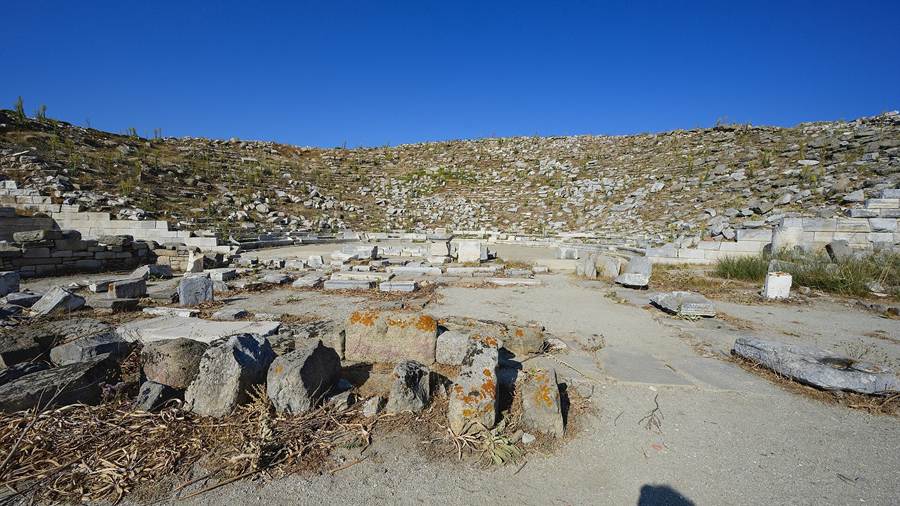
Day trips from Mykonos reach Delos, the sacred island of Apollo, by boat across the strait. The island is an archaeological site of temples, houses and mosaics, and a small museum keeps the best finds from its soil.
In Greek myth, Leto sought a place to bear Apollo and Artemis, but Hera ordered all lands to shun her. Asteria had turned into a wandering island, later named Delos, and that island gave shelter.
The Doric Great Temple of Apollo went up around 475 BC, with six columns by thirteen and a base of 13.72 by 29.78 metres. The temple anchors the visit on day trips from Mykonos.
A temple to Artemis rose on Delos between 700 and 550 BC, on the site of an earlier Mycenaean building. In the classical age she was worshipped in the Delian Triad with Apollo and Leto.
The Delos tour post covers the crossing, the Terrace of the Lions, the sanctuary of Apollo, the houses and mosaics, the theatre quarter and the museum, so this page leaves those details to it.
- Museum: Built in 1904 with five rooms, it grew to nine rooms by 1972.
- Fresco: A fresco from the Skardana Quarter shows Heracles, two boxers and a man playing a flute.
- Kouros: A colossal statue of Apollo once stood beside the Temple of the Delians, and a foot of it is in the British Museum.
- Alabastron: A Corinthian oil flask from the Heraion dates to the end of the seventh century BC.
Delos suits a visitor who likes ancient history, and it pairs well with a sea day. The crossing and the site together form the central item among day trips from Mykonos.
Why do boats stop at Rhenia on day trips from Mykonos?
Day trips from Mykonos stop at Rhenia, the uninhabited island lying just west of Delos, for swimming and a view of the strait. The island also carries a long past as a gift to Apollo and as a place of burial.
Rhenia is also spelled Rineia and belongs to the municipality of Mykonos. In the sixth century BC the tyrant Polycrates of Samos subdued it and dedicated it to the Delian Apollo.
Finds from the island rest in the Archaeological Museum of Mykonos. The architect Alexandros Lykakis designed the building, and the Ministry of Education and the Archaeological Society of Athens paid for it.
The Municipality of Mykonos donated the land for that building. It is one of the oldest museums in Greece, and its Rhenia finds include Cycladic pottery dated to the ninth and eighth centuries BC.
The museum also keeps a large storage jar made on Tinos, which shows the Trojan Horse with warriors in its portholes. Beneath the horse run three lines of metopes with battle scenes.
The Mykonos boat tour post covers the stops at Delos and Rhenia, the south coast beaches, the snorkelling spots, the lighthouses and the effect of the wind on day trips from Mykonos.
- Name: The island appears as Rineia, Rhenea and Rheneia in different sources.
- Gift: Polycrates dedicated it to the Delian Apollo in the sixth century BC.
- Museum: The Archaeological Museum of Mykonos keeps its finds.
- Vessel: A storage jar shows warriors in the wooden horse.
Rhenia gives the boat day a quiet end point after the busy ruins of Delos. It remains one of the shortest hops among day trips from Mykonos.
How do catamaran cruises work among day trips from Mykonos?
Day trips from Mykonos by catamaran follow the coast of an island that rises to 341 metres, and the two-hulled boat gives a wide deck for swimming stops. The design grew from twin-hulled canoes that carried Polynesian sailors across the Pacific.
Catamarans took over from the hovercraft on fast ferry routes, since they are nearly as fast and less affected by sea and weather conditions. The largest hovercraft carried cars between England and France.
The catamaran began in the Pacific. Twin-hulled canoes there developed into the asymmetric double canoe, where one hull is smaller than the other, and the smaller hull became the prototype of the outrigger.
Seafaring Polynesians used such canoes to voyage to distant Pacific islands. The same principle of two hulls set far apart now carries passengers on day trips from Mykonos, with a broad deck between the hulls.
The Mykonos catamaran cruise post covers the rocks along the coast, the films shot there, the arrival of tourism, seasickness, the strength of the sun and the meaning of the beach names.
- Canoes: The Pacific double canoe had one hull smaller than the other, and Polynesians sailed it far.
- Outrigger: The smaller hull became the prototype of the single outrigger canoe.
- Fast ferries: Catamaran designs grew popular for high-speed craft in the 1990s.
- Hovercraft: Catamarans replaced hovercraft on fast ferry routes, being nearly as fast and less affected by weather.
The catamaran suits a visitor who wants swimming stops and open air along the coast. It is the commonest boat among sea day trips from Mykonos.
What do yacht cruises add to day trips from Mykonos?
Day trips from Mykonos by yacht add a vessel with a cabin, a crew and a flexible route among the islets. The history of such pleasure boats reaches back to ancient Egypt, and they grew from rowed craft to sail and steam.
The history of pleasure boats begins with rowed craft in Pharaonic Egyptian times. In the eighth century, Anglo-Saxon royal play ships carried ornamented bows and sterns and had room for cooking on board.
Fast yachts of the early nineteenth century were fore-and-aft luggers, schooners and sloops. Steam later changed the craft, and large steam yachts needed a captain, an engineer, stewards and deck hands.
All superyachts have crew areas below deck, made up of a crew mess, crew cabins and a laundry. Depending on the season, superyachts are found in the Mediterranean or the Caribbean.
The Mykonos yacht cruise post covers yacht days on day trips from Mykonos around the islets off the island, with the same coast seen from a higher deck and a different kind of boat.
- Sail: Early yachts relied on wind and canvas alone, as luggers, schooners and sloops.
- Steam: Steam engines made yachts efficient enough for leisure travel on the water by the late nineteenth century.
- Crew: A captain, an engineer and stewards ran the large steam yachts.
- Egypt: The first pleasure boats were rowed craft of Pharaonic Egypt.
The yacht suits a group that wants a set route and a crew on deck, with room to move about. It sits between the catamaran and a private charter among day trips from Mykonos.
Why take a sunset cruise on day trips from Mykonos?
Day trips from Mykonos end well on a sunset cruise, because the open sea shows how the atmosphere colours the setting sun and the sky above it. Sunset cruises turn the last light of the day into a quiet voyage.
At sunrise and sunset the path of sunlight through the atmosphere is longer. Blue and green light is then removed almost completely, which leaves the orange and red hues seen over the water.
Air molecules and particles much smaller than the wavelength of light scatter shorter wavelengths more strongly. Clouds then scatter the reddened light across the horizon, so a sky with clouds glows more than a clear one.
Modern yachts carry electronics for communication, measurement and navigation, including GPS units that fix the vessel’s location and radar that shows other vessels and the nearby shore after dusk.
The Mykonos sunset cruise post covers the glitter path on the water, the way twilight fades after the sun has gone and the questions that visitors ask about day trips from Mykonos at dusk.
- Colour: Orange and red remain because the longer path removes the blue and green.
- Clouds: Cloud droplets scatter reddened light across the horizon.
- Hour angle: Dividing the sunset hour angle in degrees by 15 gives the hours after solar noon.
- Radar: Radar shows other vessels and the nearby shore after dusk.
An evening on the water closes a day of swimming or ruins in one calm scene. It is the gentlest of the sea day trips from Mykonos, and the light does the work.
Can day trips from Mykonos reach Tinos and Syros by ferry?
Day trips from Mykonos reach Tinos and Syros by ferry, two neighbouring islands in the same chain of the central Aegean. Tinos is a pilgrimage and marble island with terraced hills, while Syros holds the neoclassical capital of the Cyclades.
Tinos joined the Delian League and paid a yearly tribute of 3600 drachmae. A Tenian trireme deserted the Persian fleet before the battle of Salamis, and the Tenians’ name was inscribed on the tripod at Delphi.
The hills of Tinos are terraced with stone walls, and each village connects to its neighbour by stone walkways set between parallel walls. In Greek myth, Heracles slew the sons of Boreas on the island.
Cycladic frying pans, shallow circular vessels with a decorated base, emerged on Syros in the Early Cycladic II phase. Piraeus later eclipsed Ermoupoli, yet the town kept its role as the administrative centre of the Cyclades.
Day trips from Mykonos to Syros meet an island that played a prominent role in the Greek Constitution of 1831 and changed almost overnight into a vigorous centre of crafts, industry and production.
- Tinos: A tribute of 3600 drachmae a year shows the island’s wealth in the Delian League.
- Stone: Terraces, walls and walkways of stone shape the whole landscape of Tinos.
- Frying pans: Shallow decorated vessels of Early Cycladic II emerged on Syros.
- Constitution: Syros played a prominent role in the Greek Constitution of 1831.
Both islands reward a slow walk through harbour streets and old stone lanes. The ferry makes them the nearest destinations among day trips from Mykonos that lead to another island. The Tinos day trip post covers Chora, Volax, Kardiani and the pilgrimage church.
Can day trips from Mykonos reach Paros and Naxos by ferry?
Day trips from Mykonos reach Paros and Naxos by ferry across the central Cyclades, and the two islands lie close together in the middle of the chain. Paros is the marble island and Naxos holds a long Cycladic past.
Paros paid the highest tribute of the island members of the Delian League, 30 talents each year. That figure implies that Paros was one of the wealthiest islands of the Aegean in its day.
Naoussa Bay served as the home base of the Russian Archipelago Squadron of Count Alexey Orlov from 1770 to 1775, during the Russo-Turkish War. Paros later joined the newly independent Greek kingdom.
Marble marks Paros among day trips from Mykonos. Sculptors carved the Venus de Milo and the Winged Victory of Samothrace from its fine-grained, pure white Parian stone, which ancient workers cut from open-pit quarries and shafts.
In Byzantine times Naxos suffered Saracen raids, especially while the Emirate of Crete existed from 824 to 961. Frescoes of the tenth century show traces of Muslim artistic influence.
- Paros: The island paid 30 talents a year, the highest tribute among the island members.
- Naoussa: The bay sheltered a Russian squadron during the Russo-Turkish War.
- Marble: Sculptors carved the Venus de Milo from Parian marble, a fine-grained stone.
- Naxos: Saracen raids hit the island while the Emirate of Crete lasted, from 824 to 961.
Paros and Naxos can share one outing, since the channel between them is narrow. The pair forms a natural middle stage among ferry day trips from Mykonos, between Tinos and Santorini.
Can day trips from Mykonos reach Santorini by sea?
Day trips from Mykonos reach Santorini by sea along the Cyclades chain, and the island rewards the journey with a story of eruptions, revolt and vines. Viticulture is the leading sector of its farming, which suits a day of tasting.
Santorini has erupted repeatedly, with varying degrees of explosivity. The Minoan eruption has been considered possible inspiration for stories including Atlantis and the Exodus, though archaeological research does not support their content.
Evangelis Matzarakis, the governor named for Santorini by the Provisional Administration of Greece, soon had to hire bodyguards as the island descended into open revolt against him. Tax collectors had resigned in protest.
By 1810 Santorini owned 32 ships, the seventh largest fleet in Greece. As tourism grew, rainwater harvesting methods proved incapable of supplying the increased demand, and historic cisterns fell into disrepair.
Santorini lies at the far end of the chain, so day trips from Mykonos to the island rest on a long sea route. A separate hub on this site covers the volcano, wine and villages.
- Stories: The Minoan eruption is a possible inspiration for tales of Atlantis and the Exodus, though the tales lack support.
- Revolt: The island rose in open revolt against its governor, Matzarakis.
- Fleet: Santorini owned the seventh largest fleet in Greece in 1810, behind Hydra and Kefalonia.
- Cisterns: Historic cisterns fell into disrepair as tourism grew and rain harvesting fell short.
The sea route to Santorini suits a traveller who accepts a longer outing for one view of the volcano. It is the farthest of the sea day trips from Mykonos.
What does the island itself offer on day trips from Mykonos?
Day trips from Mykonos on the island itself cover Chora, Little Venice, the windmills and the village churches. The old streets hold monuments from the Venetian and Ottoman centuries, and they reward a day on foot rather than at sea.
Panagia Paraportiani consists of five separate churches joined together: four at ground level, honouring Saint Eustathios, Saint Sozon, the Saints Anargyroi and Saint Anastasia, with a fifth built above them.
Mill sails carry signals. Blades stopped in a plus sign mean the windmill is open for business, and an X means it is closed. A slight tilt of the sails signals joy.
Earlier multiple-sailed mills are found in Spain, Portugal, Greece, parts of Romania, Bulgaria and Russia. Medieval mills wound the sailcloth in and out of a ladder-type arrangement of sails.
A statue of Manto Mavrogenous sits in the square that bears her name, a stop on day trips from Mykonos on foot. The Catalans ravaged the island at the end of the thirteenth century.
The Mykonos island tour post covers the growth of the town, the windmills, Little Venice, the churches, the harbour front, the museums, Ano Mera, the north of the island and the beaches.
- Chapels: Four churches form the base of Paraportiani and a fifth stands above them.
- Saints: The four lower churches honour Eustathios, Sozon, the Anargyroi and Anastasia.
- Signals: Blades in a plus sign show that a windmill is open for business.
- Sails: Medieval mills wound sailcloth through a ladder-type arrangement of sails.
A day on land costs no crossing and suits any weather. It is the easiest of all day trips from Mykonos to fit around a late start.
Which dishes shape food days among day trips from Mykonos?
Day trips from Mykonos that follow food centre on kopanisti, almond sweets and the meze table. Cheese is more compact than milk and keeps longer, and island kitchens also turn that craft into local sweets and savoury dishes.
As a cheese ages, microbes and enzymes transform its texture and intensify its flavour. Herbs, spices or wood smoke can flavour it as well, and rennet completes the curdling of acidified milk.
Cycladic sweets differ by island. Syros is the home of kouvanezes, sponge cake rolls with chocolate cream, and Sifnos is traditionally linked with melopita, a honey cheesecake, so ferry days and food days overlap.
Cooks call amygdalota Greek macaroons, although they contain no coconut. The cookies can be sweetened with honey and flavoured with orange flower water or rose water, and they are shaped like pears, balls or other forms.
The Mykonos food tour post covers kopanisti, louza, almond sweets, pies and seafood, while the Mykonos cooking class post covers dishes, olive oil, dough and stuffed vegetables on day trips from Mykonos.
- Ageing: Microbes and enzymes transform texture and intensify flavour as a cheese ages.
- Syros: Kouvanezes are sponge cake rolls with chocolate cream from the island of Syros.
- Sifnos: Melopita is a honey cheesecake traditionally associated with the island of Sifnos.
- Flavours: Honey, orange flower water and rose water sweeten the cookies of the Cyclades.
Tasting days need no boat and no early start. They link the farms and dairies of the island with the town table among day trips from Mykonos, and they pair well with a ferry day.
What does Cycladic wine add to day trips from Mykonos?
Day trips from Mykonos with wine draw on a Cycladic tradition that reaches back to the myth of Dionysus, the god of the grapevine. Pherecydes of Syros, the philosopher of a neighbouring island, wrote about the nursing of the infant god.
In Greek myth, the infant Dionysus, god of the grapevine, was nursed by the rain-nymphs, the Hyades, at Nysa. Pherecydes of Syros suggested that nysa was an archaic word for tree.
Recent evidence shows that Dionysus was one of the earliest gods attested in mainland Greek culture. His cult was closely associated with trees, in particular the fig tree.
His religion included rituals with the sacrifice of goats or bulls, and dancers wore wooden masks associated with the god. The Lenaia was an annual Athenian festival with a dramatic competition.
The Santorini sweet wine Vinsanto shares its name with the Tuscan Vin Santo, and Venetian influence on the island explains the link. It follows a passito style, from grapes dried in the sun after harvest.
The Mykonos wine tour post covers Cycladic grapes, wine words, old customs, vine pests and the glasses and temperatures that suit tasting, and the months that suit a wine outing among day trips from Mykonos.
- Hyades: Rain-nymphs nursed the infant Dionysus at Nysa in Greek myth.
- Fig: The cult of Dionysus was closely associated with the fig tree.
- Lenaia: An annual Athenian festival with a dramatic competition.
- Style: Vinsanto follows the passito method of sun-dried grapes.
Tasting rooms and cellars suit a slow afternoon. They add a calm counterpart to the sea routes that fill the larger share of day trips from Mykonos.
What do travellers ask about day trips from Mykonos?
Day trips from Mykonos prompt steady questions about the nearest island, the route to Santorini, the boats and the food days. The replies below stay short and point back to the sections above on this page, with one answer each.
Which island is the nearest of the day trips from Mykonos?
Delos is the nearest of the day trips from Mykonos, set in the strait beside the island and joined to the same municipality. Rhenia lies just west of Delos, so a boat day can include both islands without a long sail between them.
Can day trips from Mykonos include Santorini?
The sea route to Santorini runs along the Cyclades chain, and the island rewards the journey with a story of eruptions, revolt and vines. Viticulture is the leading sector of its farming, which suits travellers who value tasting. A separate hub covers the island.
Which boats serve day trips from Mykonos?
Catamarans give a wide deck for swimming stops along the coast, yachts add a cabin and a crew, and fast ferries link the neighbouring islands. Hydrofoils lift the hull out of the water as they gain speed, which decreases drag.
Are food and wine part of day trips from Mykonos?
Food and wine give a land-based option for a calm afternoon of tasting among day trips from Mykonos. Cheese keeps longer than milk, Syros is the home of kouvanezes, and the myth of Dionysus links the vine to the Greek islands.