
Tinos day trip visits the Cycladic island of the Panagia Evangelistria, with Chora, Pyrgos and its marble, Volax, the rock of Exomvourgo, the dovecotes and the harbour of Panormos. The trip is one of the Greece Tours on Greece Ville, listed with the other Cyclades tours and day trips from Mykonos.
This post covers what the trip is, Chora, the Panagia Evangelistria, Pyrgos and the marble, Volax, Exomvourgo, the sanctuary of Poseidon and Amphitrite, dovecotes, artists and the formats on sale. Common questions come last.
What is a Tinos day trip?
A Tinos day trip visits an island in the middle of the Cyclades, where a pilgrimage church, marble villages, Venetian ruins and dovecotes share one landscape, and where Orthodox and Catholic communities live side by side in the same villages.
Tinos is a Greek island in the Aegean Sea and forms part of the Cyclades archipelago. Its closest island neighbours are Andros, Delos and Mykonos, so the Tinos day trip fits into a wider island route.
The island lies near the geographical centre of the Cyclades. That position helps explain why the Tinos day trip draws pilgrims, artists and walkers to the same harbours, roads and stone paths.
Administratively, Tinos forms its own regional unit within the South Aegean region and holds a single municipality. The 2011 Kallikratis reform created that municipality from three older ones: Exomvourgo, Panormos and Tinos town.
Three ports serve the island. One handles passenger speed boats, and two handle ferries and high-speed boats that sail to Mykonos, Piraeus, Rafina, Andros and Syros, so each Tinos day trip starts at one of them.
A heliport lies near Aghios Fokas beach, 2 kilometres from Tinos town, and regular buses link the town with the villages. A Tinos day trip by road follows those village links.
- Setting: Tinos belongs to the Cyclades and lies close to Andros, Delos and Mykonos.
- Faiths: Both Greek Orthodox and Catholic populations live on the island.
- Art: The island is known for sculptors and painters, among them Gysis, Chalepas and Lytras.
- Climate: Tinos has warm dry summers and mild wet winters.
The Syros day trip post covers the neighbouring island that shares ferry lines with Tinos. Both posts suit one island route.
What does a Tinos day trip see in Chora?
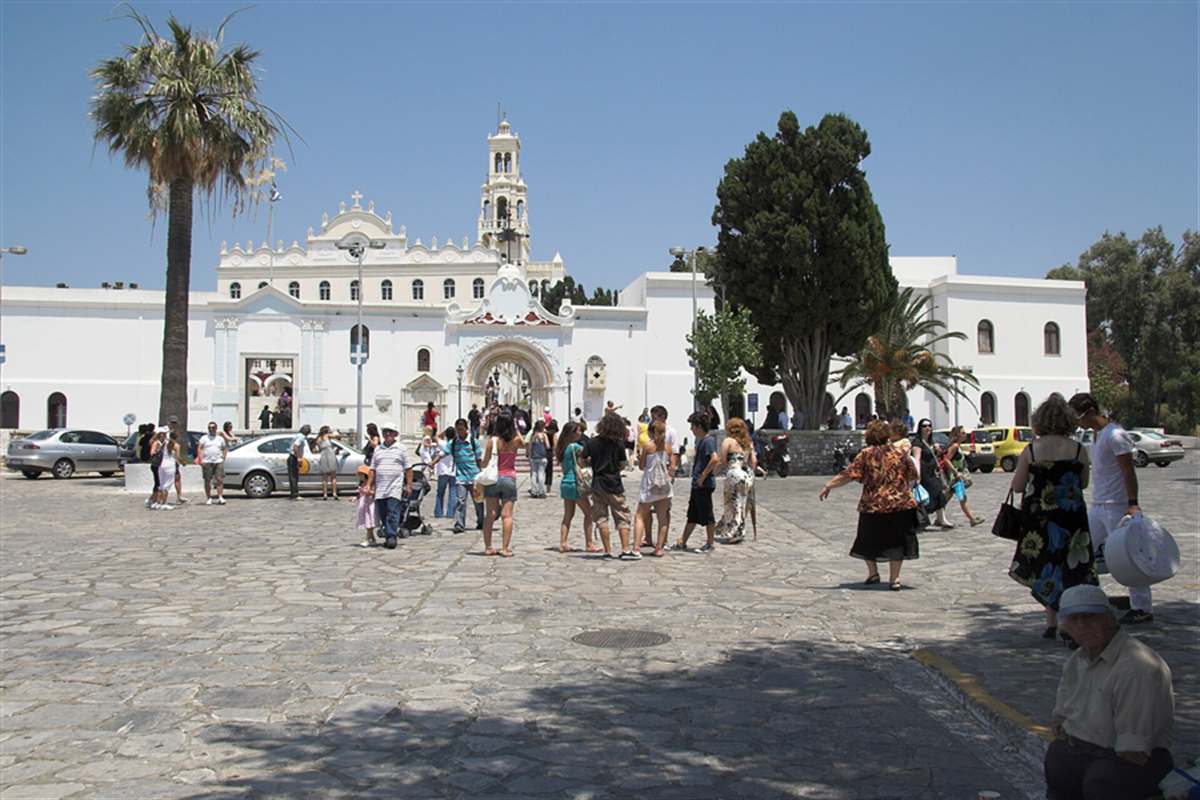
A Tinos day trip sees Chora, the largest town on the island, which is also called Tinos town, serves as its administrative capital and is built around the Church of Panagia Evangelistria and the businesses that serve arriving pilgrims.
Chora is the common Cycladic name for a main island town, and on Tinos it means the town of Tinos itself. The Tinos day trip therefore treats Chora and Tinos town as the same place.
The town became the administrative capital after the older town and fortress of Tinos on the mountain Exomvourgo were destroyed. Since then Chora has been the seat of local government on the island.
Venetian rulers knew the mountain town as Tinos, Tine or Tino, and they called the present coastal town San Nicolò. A Tinos day trip in Chora therefore stands on a settlement that once carried another name.
The municipal unit of Tinos town covers 22.873 square kilometres. It shares the island with the units of Exomvourgo and Panormos, which the Tinos day trip reaches along the village roads.
Chora also links to the island’s oldest crafts. A large vase produced on Tinos, with scenes from the fall of Troy, is the best-known exhibit in the museum of neighbouring Mykonos.
- Name: Locals call the town Chora, as on other Cycladic islands.
- Old name: Venetians called the present town San Nicolò.
- Area: The municipal unit of Tinos town covers 22.873 square kilometres.
- Trade: Businesses in the town revolve around the needs of pilgrims.
Chora is the base for the rest of the Tinos day trip. The next sections follow the church and then move out to the villages.
Why does a Tinos day trip centre on the Panagia Evangelistria?
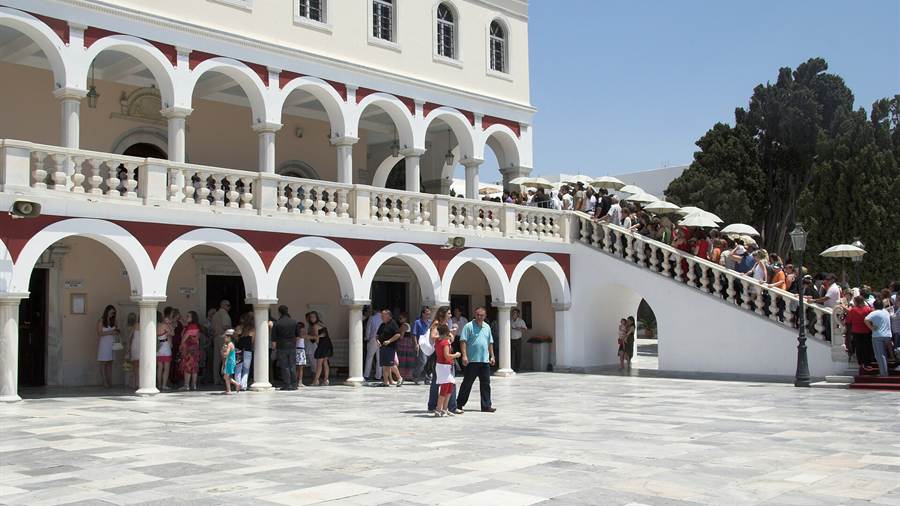
The Tinos day trip centres on the Church of Panagia Evangelistria in Chora, which holds a reputedly miraculous icon of the Virgin Mary and makes the island the centre of a yearly pilgrimage that draws visitors from across Greece.
Tinos is famous among Greeks above all for the Church of Panagia Evangelistria. The Tinos day trip therefore treats the church as the reason for the island’s wider reputation, not as one stop among equals.
The church holds an icon of the Virgin Mary that tradition calls miraculous. Pilgrims travel to Tinos town for that icon, and the town has grown a trade around their needs.
The church also funded learning. A scholarship from the Panhellenic Holy Foundation of the Evangelistria of Tinos sent the sculptor Yannoulis Chalepas to Munich in 1873, which links the building to the island’s artists.
Other Aegean churches measure themselves against it. The Panagia Ekatontapiliani on Paros is described as a renowned Marian pilgrimage church, second only to the Megalochare church on nearby Tinos.
- Name: The full title is the Church of Panagia Evangelistria.
- Icon: The church holds a reputedly miraculous icon of the Virgin Mary.
- Pilgrimage: The island is the centre of a yearly pilgrimage.
- Scholarship: The foundation named after the church paid for the studies of Chalepas in Munich.
The church sets the rhythm of the Tinos day trip. The next section explains the date on which the island receives its largest pilgrim crowds, and why the feast matters to both faiths.
What happens on a Tinos day trip on 15 August?
A Tinos day trip on 15 August meets the yearly pilgrimage for the Dormition of the Virgin Mary, called Dekapentavgoustos in Greek, when pilgrims make their way to the church and the devout cross the last stretch on hands and knees.
The Dormition is a Great Feast of the Eastern Orthodox and Eastern Catholic churches. It marks the falling asleep of Mary and her being taken up into heaven, and Tinos keeps it on 15 August.
The word dormition expresses the belief that Mary died in a state of spiritual peace. The Greek word for falling asleep, koimesis, is also the root of the word cemetery, a place of sleeping.
Western churches know the same feast as the Assumption of Mary. Pope Pius XII declared the bodily Assumption a dogma of the Catholic Church in 1950, which shows how the two traditions differ in detail.
Tinos holds both traditions at once. Greek Orthodox and Catholic populations coexist on the island, and Catholic villages and parishes survive from the Venetian period, so the feast crosses community lines.
- Greek name: The Greek name of the date is Dekapentavgoustos.
- Feast: The Dormition is a Great Feast of the Orthodox Church.
- Western name: Western churches call the feast the Assumption of Mary.
- Julian calendar: Churches that follow the Julian calendar keep the feast on 28 August by the Gregorian count.
The Tinos day trip on this date follows the pilgrims, not a fixed route. The remaining sections leave the church and describe the villages, ruins, sanctuaries and artists of the wider island.
Why does a Tinos day trip stop at Pyrgos and its marble?
A Tinos day trip stops at Pyrgos because the mountains west of the village contain green marble, the island has long worked stone, and the village produced the sculptor Yannoulis Chalepas, who was born there in 1851 into a family of marble hewers.
Pyrgos is also named Panormos in the Greek municipal lists. The Tinos day trip uses the name Pyrgos for the marble village and keeps Panormos for the fishing harbour described later.
The island’s mineral resources include marble, verde antico, asbestos and a granite mine near Volax. A Tinos day trip therefore passes a landscape that stone workers have shaped for a long time.
Verde antico is a dark green serpentinite breccia with white veins, and it takes a high polish. It is sometimes classed wrongly as a marble, which explains why the green stone of Tinos draws attention.
Stone work shaped careers beyond the village. Chalepas studied at the School of Arts in Athens from 1869, Nikiforos Lytras was the son of a marble sculptor, and Lazaros Sochos was another Tinian sculptor.
- Birthplace: Chalepas was born in Pyrgos in 1851 into a family of marble hewers.
- Stone: The mountains around Pyrgos contain green marble.
- Resources: Marble, verde antico, asbestos and granite are listed among the island’s minerals.
- Workshop: Chalepas opened his own workshop in Athens in 1876 after returning from Munich.
Pyrgos shows the craft side of the Tinos day trip. Villages of stone walls and boulders follow, and the next section describes Volax, where the stone sits in the open.
What does a Tinos day trip find at Volax?
A Tinos day trip finds at Volax a small village on a plateau in the centre of the island, ringed by giant, almost spherical grey boulders, the largest the size of multi-storey buildings, which give the whole landscape a lunar look.
Volax, also called Volakas, had a population of 51 at the 2011 census. It was founded in the 14th century or earlier and lies at an average altitude of 284 metres.
The village rests in a gorge that looks as if boulders had been thrown into it. Houses stand above and between the rocks, close to each other, and follow the rules of traditional Cycladic architecture.
Venetian documents of 1618 registered the village as Volacus. Volax has traditionally been a home of basket weavers, and it keeps a small folklore museum that opens in the summer period.
The village also holds an amphitheatre with 380 seats. Musical and theatrical performances take place there, so a Tinos day trip in the warm season can coincide with a local event in the village.
- Boulders: Large grey rocks dot the plateau and the slopes around the village.
- Craft: Volax has traditionally been a home of basket weavers.
- Sport: Athletes from across the world gather in the rocks to boulder in the Easter period.
- Feast: The village honours the birth of the Virgin Mary on 8 September.
The nearby chapel of Panagia Kalaman hosts the second local festival, held at Easter. After Volax the Tinos day trip turns to Exomvourgo, the jagged mountain that dominates the middle of the island.
Why does a Tinos day trip climb Exomvourgo?
A Tinos day trip climbs Exomvourgo because the rugged mountain carries the ruins of a Venetian fortress and town that served as the island’s capital, and because its shape differs from the rounder mountains elsewhere in the Cyclades.
Exomvourgo is not the highest mountain on Tinos, which is Tsiknias, but it stands in a central place ringed by villages such as Tripotamos and Falatados. Walkers can climb it from different villages.
A Byzantine fortress, later called Castello di Santa Elena by the Venetians after a chapel on the summit, stood here. The Ghisi brothers received the island in 1207 after the Fourth Crusade.
Ottoman admiral Hayreddin Barbarossa took the island in 1537, and Venice recaptured it in 1538. The expanded fortress then had ramparts 600 metres long and a town of 677 houses and 5 churches.
A force of 8,000 Ottoman troops besieged the mountain in 1570 and failed. Further attempts failed in 1655, 1658, 1661 and 1684, but the commander surrendered in 1715 and the Ottomans dismantled the fortress.
- Name: Exomvourgo comes from a Greek phrase meaning outside the burg.
- Ancient remains: Excavations at the southern foot found a temple of Demeter.
- Church: The Sacred Heart of Jesus church on the slope is now a Catholic monastery.
- Pilgrimage: The Jesuits finished the church in 1725, and it was restored in 1895.
Exomvourgo is the longest stop of the Tinos day trip for walkers. The next section moves from the mountain fortress to an ancient sanctuary on the south shore of the island.
What was the Poseidon and Amphitrite sanctuary on a Tinos day trip?
The Tinos day trip includes the ancient sanctuary of Poseidon and Amphitrite, a Doric temple built near the shore at Kionia in the fourth century BC, where a great festival called the Poseidonia honoured the sea god with feasting.
The temple of Poseidon and Amphitrite rose near a beach of the island in the Hellenistic period. It was a peripteral Doric building, which means that a row of columns surrounded the whole structure.
Builders reconstructed the temple in the third century BC and used local marble for it. The decoration included the symbols of the god, such as dolphins and the trident, which suit a sea cult.
The complex had great banquet halls, a sign that large numbers of people took part in the Poseidonia festival. In the ancient cult on Tinos the sea god was also worshipped as a healer.
Amphitrite was the sea goddess and the consort of Poseidon. Her children included seals and dolphins, and Triton was her son, so the marine images on the temple belong to a family of sea figures.
- Place: Kionia lies on the southern shore of Tinos, where beaches line the coast.
- Style: The temple was a peripteral Doric building.
- Festival: The Poseidonia was a great festival for Poseidon on Tinos.
- Cave: The Gastria Cave lies near Kionia, close to the site of the temple.
The Delos tour post covers the sacred island that sits among the closest neighbours of Tinos. The Tinos day trip then returns inland to the stone buildings of the villages.
Why do dovecotes shape a Tinos day trip?
Dovecotes shape a Tinos day trip because the island is known for its artistic dovecotes, stone towers that stand among terraces and walkways built by the islanders, and because the structure has a long history beyond the Cyclades.
A dovecote houses pigeons or doves. Pigeon droppings served in leather tanning and in making gunpowder, so the towers supplied workshops as well as farms, while the Tinos day trip sees them as farm buildings.
On Tinos the islanders worked stone into terraces on the hills, and stone walkways between parallel walls connect every village to its nearest neighbours. The Tinos day trip follows these paths through a built landscape.
The island also keeps about 80 windmills, another feature of its farming past. Windmills and dovecotes together show how the villages worked with wind, grain and birds on the hills.
In Isfahan, the largest dovecotes held 14,000 birds and carried red bands that let the pigeons recognise them. Builders there raised the towers to supply organic fertiliser to the rich market gardens.
- Rome: Roman columbaria were round and coated inside with marble powder.
- France: The French word for a dovecote is pigeonnier or colombier.
- Isfahan: A European traveller counted up to 3000 dovecotes around the Persian city.
- Cappadocia: Dovecotes there were carved into the rock like rooms, near water sources.
The dovecotes round off the farming side of the Tinos day trip. The next section turns from the farm towers to the painters and sculptors born in the island’s villages.
Which artists does a Tinos day trip recall?
A Tinos day trip recalls the painters Nikolaos Gysis and Nikiforos Lytras and the sculptor Yannoulis Chalepas, all born on the island, which has a long artistic history and sent its sons to the schools of Athens and Munich.
Nikolaos Gysis was born in the village of Sklavochori on Tinos. His family settled in Athens in 1850, and in 1865 he won a scholarship to the Academy of Fine Arts in Munich.
Gysis remained in Munich and became a professor there from 1886. His painting The Secret School appeared on the Greek 200 drachma banknote, which carried the work to a wide public.
Nikiforos Lytras was born on Tinos in 1832 and became a professor at the Athens School of Fine Arts in 1866. His best-known portrait showed the royal couple Otto and Amalia.
Chalepas worked in two phases. His early period, from 1870 to 1878, was neoclassical, and the later period from 1918 opened a spontaneous style that critics compare with Expressionism.
- Gysis: His best-known early work is Eros and the Painter.
- Lytras: He taught at the Athens School of Fine Arts for the rest of his life.
- Chalepas: His tomb sculpture Sleeping Female Figure of 1877 stands in the First Cemetery of Athens.
- Return: Chalepas lived on Tinos after 1902 and received an Academy award in 1927.
The artists tie the Tinos day trip to Athens as well as to the island. The next section goes to the north-western coast, where Panormos serves as a fishing harbour for the island.
What does a Tinos day trip offer at Panormos?
A Tinos day trip offers at Panormos a small fishing village on the north-western tip of the island, with a population of 566 at the 2021 census, a beach on the north shore and a municipal unit of 33.378 square kilometres.
Panormos is a former community and now a municipal unit within the municipality of Tinos since the 2011 reform. The village stands on the north-western tip, far from the harbour of Chora on the southern side.
The unit covers 33.378 square kilometres, which is larger than the unit of Tinos town. The Tinos day trip therefore crosses a wide rural area when it reaches this corner of the island.
Beaches line the coast. The shores of Panormos and Kolimbithra lie on the north shore, while Kionia, Agios Yannis O Portos and Agios Sostis lie on the south shore.
The Two Caves lie near Panormos. The north also meets the meltemi, the strong dry wind that blows over the Aegean until mid-September and is strongest in the afternoon, when it dies down at night.
- Population: Panormos had 566 inhabitants at the 2021 census.
- Livelihood: It is a small fishing village at the tip of the island.
- Notable people: Chalepas and Lytras are listed among its notable people.
- Wind: The meltemi is dangerous to sailors because it rises in clear weather without warning.
The Andros tour post covers the island that lies just north of Tinos across the water. After Panormos, the Tinos day trip ends with the formats on sale.
Which formats of a Tinos day trip are on sale?
A Tinos day trip is on sale in seven formats, from a fast ferry between Piraeus port and Tinos to a full-day trip from Mykonos and a set of walking and climbing experiences around the hill of Exomvourgo.
The first format is a fast ferry between the port of Piraeus and Tinos. It suits a Tinos day trip that starts in Athens and keeps the whole programme on the island itself.
The second format is a full-day trip to Tinos from Mykonos. Mykonos is one of the closest neighbours of Tinos, so this Tinos day trip starts from a neighbouring island rather than from the mainland.
Two formats focus on Exomvourgo. One is a rock climbing experience on the hill, and the other is a circular hiking tour around it, which the listing spells Exobourgo, the same mountain.
The remaining formats are walks across the island. One is a three-day hiking adventure, one is an expert-led via ferrata hike, and one is an expert-led hike from Tarampados to Komi on the island’s paths.
Each Tinos day trip format keeps to the island’s own landmarks, such as Chora, the pilgrimage church, Volax and Exomvourgo, which the earlier sections of this post describe in turn.
- Ferry: A fast ferry links Piraeus port and Tinos.
- Mykonos: A full-day trip leaves from Mykonos.
- Climbing: A rock climbing experience uses the Exomvourgo hill.
- Hiking: The hiking formats include a three-day adventure and a circular tour.
The tour cards and availability boxes on this page list live dates for each Tinos day trip format. They show which departures are open before a choice is made.
What do travellers ask about a Tinos day trip?
A Tinos day trip raises questions about the pilgrimage date, the fortress, the villages and the island’s faiths, and the answers below use facts about the Cyclades island, its municipal units, its ports and its high mountains.
Which villages does a Tinos day trip reach?
A Tinos day trip reaches Chora, the main town, and the villages of Volax and Pyrgos, which stand for boulders and marble. It also reaches Panormos on the north-western tip and the villages around Exomvourgo, such as Tripotamos and Falatados, so the route covers the island centre as well as its coasts.
Why is 15 August important on a Tinos day trip?
The date marks the Dormition of the Virgin Mary, called Dekapentavgoustos in Greek, and the island is the centre of a yearly pilgrimage on that day. A Tinos day trip on 15 August therefore meets the pilgrims who come to the Church of Panagia Evangelistria. Western churches keep the same feast as the Assumption.
What does a Tinos day trip say about the island’s faiths?
Both Greek Orthodox and Catholic populations coexist on Tinos. Syros and Tinos have entirely Catholic villages and parishes, a legacy of Venetian rule, and a Tinos day trip meets Orthodox pilgrimage and Catholic churches such as the Sacred Heart of Jesus on Exomvourgo, where the feast unites both communities.
Which ruins does a Tinos day trip include?
A Tinos day trip includes the Venetian fortress and town on Exomvourgo, which fell to the Ottomans in 1715 after a long period of Venetian rule. It also includes the sanctuary of Poseidon and Amphitrite near Kionia, built in the fourth century BC and rebuilt in the third century BC.
Featured photo: Zde, CC BY-SA 4.0, via Wikimedia Commons.