
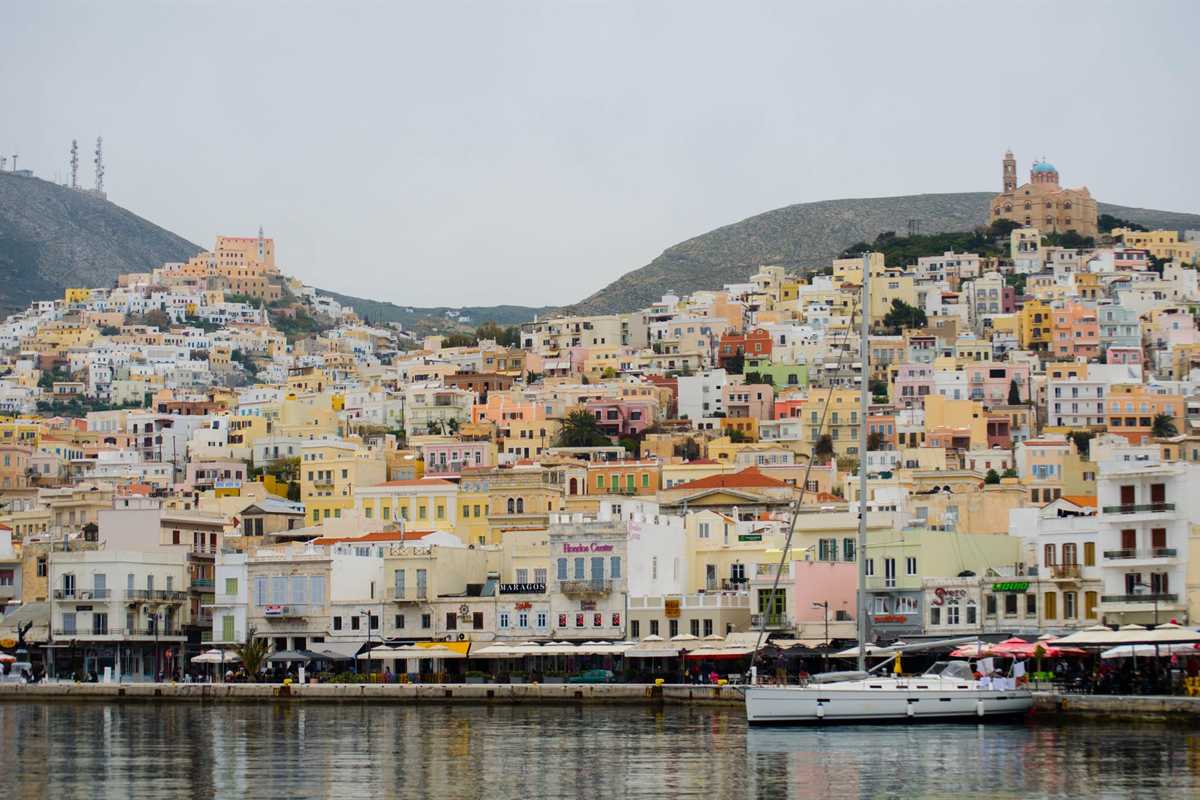
A Syros day trip reaches the Cycladic island of Syros and its capital Ermoupoli, with its neoclassical squares, the old shipyard and the Catholic hill town of Ano Syros, and Early Cycladic sites in the north. The trip is one of the Greece Tours on Greece Ville.
This post covers the formats on sale, Ermoupoli then and now, the Neorion shipyard, Ano Syros and the two churches, Chalandriani and Kastri, Pherecydes, loukoumi, the beaches and the questions that come up before booking.
What does a Syros day trip cover?
A Syros day trip covers an island in the Cyclades, in the Aegean Sea, and its capital Ermoupoli. Visitors reach it by fast ferry from Mykonos or on a day trip from Andros, then explore the port, the shipyard and the hill town.
Syros also goes by the names Siros and Syra. The island covers 83.6 km2, and Ermoupoli serves as the capital of both the island and the South Aegean region of Greece.
The largest towns are Ermoupoli, Ano Syros and Vari. Other villages include Galissas, Foinikas and Poseidonia. A Syros day trip centres on the first two, since Ano Syros stands on a hill north-west of Ermoupoli.
Ermoupoli has always been a significant port town. During the 19th century it even outranked Piraeus, and it still sits on a naturally amphitheatrical site, with white houses running down to the harbour.
On a Syros day trip by sea, the fast ferry from Mykonos ends at the Ermoupoli harbour. A frequent passenger boat system helps draw domestic and foreign tourists to the island all year round.
- Airport: Dimitrios Vikelas Airport lies 3.5 kilometres south-east of Ermoupoli and opened in 1991.
- Municipality: The 2011 reform merged Ermoupoli, Ano Syros and Poseidonia into Syros-Ermoupoli.
- Gyaros: The municipality also takes in the uninhabited island of Gyaros.
- Homer: In the Odyssey, Syros was the homeland of the swineherd Eumaeus.
The sections below follow a Syros day trip from the formats on sale to Ermoupoli, the Neorion shipyard, Ano Syros and the two Christian communities of the island.
Which formats does a Syros day trip take?
A Syros day trip comes in eight formats: a cultural walk past the old Ermoupoli shipyards, a food walk, an Early Cycladic hike, a boat and hike day, two beach hikes, the Mykonos fast ferry and a day trip from Andros.
The cultural walk, a Syros day trip on foot, crosses Ermoupoli to the historic shipyards. Thousands of ships came out of the Syros shipyards, and Neorion holds the title of the first shipyard of Greece.
The food walk stops at local shops for tastings. The island list of specialities includes tomatokeftedes, the fried tomato balls, stuffed grilled squid, and desserts such as loukoumi, halvadopita and pastelaria, made from dried figs.
The Early Cycladic hike links Chalandriani with Kastri. Chalandriani holds more than 600 tombs, the largest Early Cycladic cemetery yet found, while Kastri, dated to 2800-2300 BC, had stone walls with rounded bastions.
A boat and hike Syros day trip reaches secluded beaches by sea and on foot. Two other hikes reach the Saint Stefanos chapel with Galissas beach, and the beaches of Apano Meria.
The fast ferry runs between Mykonos and Syros, and a separate day trip crosses from Andros to Syros with lunch included. Both Andros and Mykonos lie in view of the cathedral in Ano Syros.
- Archaeology: Christos Tsountas, the father of Cycladic research, first excavated Kastri in 1898.
- Protection: The area of Chalandriani and Kastri became a protected archaeological zone in 1992.
- Galissas: In antiquity a second city, Galessus, stood where Galissas lies today.
- Cemetery: Its tombs date mostly to the Early Cycladic II period.
Travellers based on Mykonos can pair the fast ferry with a Mykonos boat tour on another day. The tour cards and availability boxes on this page list live dates for each format.
How did Ermoupoli, the hub of a Syros day trip, grow into a port?
A Syros day trip starts in Ermoupoli, a town founded in the 1820s during the Greek War of Independence. Refugees from other Greek islands and Asia Minor built it as an extension of Ano Syros, and it soon became the main Greek port.
Syros held a crucial position on sea routes. Its special social, religious and institutional conditions kept its people neutral at the start of the Greek Revolution in 1821, so the island became a secure shelter.
Refugees arrived from Asia Minor, Chios, Spetses, Psara, Aivali, Smyrna, Kydonia and Kassos. These newcomers, mainly mariners and tradesmen, founded the new town, and its Greek name means the Town of Hermes.
Syros joined the First Hellenic Republic in 1827 and the Greek Kingdom in 1834. In 1831, under Governor Ioannis Kapodistrias, the population of Ermoupolis reached 13,805, and the city became a seat of government.
Trade in fabrics, silk, leather and iron grew from 1830, alongside ship building and a strong banking system. Until 1860, Syros held the place of the leading commercial harbour in Greece.
Decline followed when steam replaced sail, Piraeus took the lead and Patras also competed. The neoclassical town that a Syros day trip explores dates from the boom years before that decline.
- Firsts: The town had a Commercial Court of Law, an early post office and the first public school.
- Shipping: The Greek Steamship Company was founded in the city in 1856.
- Earlier rule: In 1522 the corsair Barbarossa took possession of the island.
- Recovery: Services, industry, education and tourism lifted the economy from the late 20th century.
A Syros day trip through Ermoupoli follows streets that these refugees laid out, and the next section turns to the square at their centre.
What does Ermoupoli show on a Syros day trip today?
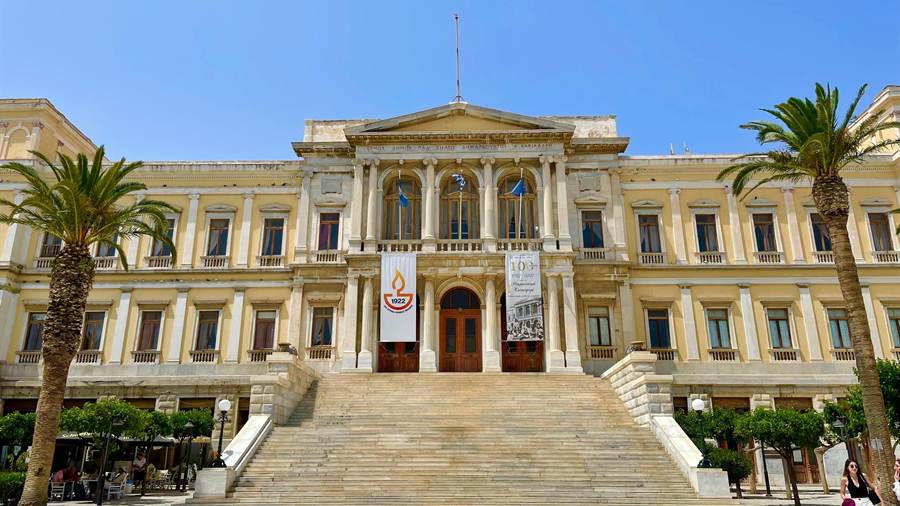
A Syros day trip in Ermoupoli today centres on Miaouli Square, the main square of the town, where the City Hall by Ernst Ziller and the municipal library stand among neoclassical buildings and mansions rebuilt between 1822 and 1865.
The Bavarian architect Wilhelm von Weiler drew up the square. It first honoured Otto of Greece as Othonos Square and took its present name in 1889, when a statue of admiral Andreas Miaoulis was unveiled.
In 1847 the municipality bought the Salaha family orchard on the site. Marble tiles covered the middle in 1868, the rest was paved in 1870, and the town hall was founded in 1876.
Today the square holds the City Hall, the Historical Archive of Syros and the Municipal Library. On a Syros day trip, the church of Agios Nikolaos and the port lie within a short walk.
The Apollo Theatre, by the Italian architect Pietro Campo, was built as a miniature version of La Scala in Milan. The main Library and the General Hospital of Syros date from the same period.
The Vaporia quarter is where sea captains traditionally lived, and neoclassical mansions line its narrow streets. On 6 April 1864, the English artist Edward Lear called the town the old sparkly pile in his diary.
- Style: The rebuilding merged Greek Classicism with elements of the Renaissance.
- Architects: Mainly German and Italian architects, along with Greeks, planned the town.
- Churches: Metamorphosis, Koimisis, Three Hierarchs, Anastasis and Evangelistria stand among its churches.
- University: The Aegean University runs a department of Fine Arts and system design here.
A Syros day trip on foot links Miaouli Square, the Apollo Theatre and the captains’ mansions of Vaporia within the same harbour town.
Why does the Neorion shipyard feature on a Syros day trip?
A Syros day trip passes Neorion in Ermoupoli, the first shipyard of Greece and one of its oldest heavy industries. Its roots lie in a traditional local yard that built ships and boats for the Greek revolution of the 1820s.
The company was officially founded in 1861 to give technical support to the Greek Steamship Company. Its first staff combined Greek technical workers with mechanics from Western Europe.
During the 1860s the works produced steam engines, boilers, pumps and heavy cannons alongside ships. A heavy steam engine of its own design went on show at the International Exhibition in Paris in 1878.
The name Neorion, an Ancient Greek word for a port facility where ships were repaired and built, came into use in 1898. At times the yard ranked second only to the Basileiades works in Piraeus.
On a Syros day trip, the shipyard recalls the industrial era. Ermoupoli saw its first industrial units in the 1860s, and from the late 19th century a textile industry brought a temporary recovery.
From 1972 the firm also built electric cars on Syros through Enfield-Neorion. A little more than 100 vehicles left the plant, all of them exported, mostly to the UK, before the venture ended in 1976.
- Jeep model: The E 8000 Bicini, designed by Georgios Michael, appeared in 1973.
- Limousine: The Neorion Chicago appeared in 1974, and only two complete cars were built.
- Expansion: In 1997 Neorion acquired Elefsis Shipyards.
- New fields: The group added luxury mega-yachts and subcontracting work for aerospace companies.
The re-opening of the Neorion shipyards marked an upturn for Syros, and a Syros day trip on the cultural walk reaches the yards where ships are still serviced and refitted.
What does Ano Syros add to a Syros day trip?
A Syros day trip climbs to Ano Syros, the medieval town that the Venetians built at the start of the 13th century on the hill of San Giorgio, north-west of Ermoupoli. Catholic Greeks live there, and a cathedral crowns the top.
The name means Upper Syros. The town is densely built with narrow roads, a circular order and a radial street plan, so its whole layout resembles a fortified citadel.
Cars reach the settlement, but inside it a network of marble steps serves as the streets. On a Syros day trip, the climb from the harbour to the main entry point covers about 1000 metres.
The Catholic cathedral of Saint George dominates the hill. First built in 1208, it has been destroyed three times and rebuilt. From the cathedral the view takes in Tinos, Delos, Mykonos, Paros, Andros and Naxos.
Ano Syros ceased to be the administrative centre after the founding of Ermoupoli. It remained a religious centre as the seat of the Roman Catholic Diocese of Syros and Milos, established in 1400.
A Capuchin monastery founded in 1637 stands in the town. A museum honours Markos Vamvakaris, the rebetiko musician who lived from 1905 to 1972 and whose name the town lists among its people.
- Population: The municipal unit counted 3,611 people at the 2021 census.
- Islands: Its area includes the uninhabited islands of Gyaros and Varvarousa.
- Twin towns: Ano Syros has been twinned with Grillon in France since 1994 and Gołdap in Poland since 2000.
- Land: The municipal unit covers 67.014 square kilometres.
Naxos lies in view of the cathedral, and travellers continuing across the Cyclades can follow a Syros day trip with a Naxos tour.
How do Catholics and Orthodox share the island on a Syros day trip?
A Syros day trip crosses an island where Catholics and Orthodox live side by side. Catholics make up about 47% of the population, the majority is Greek Orthodox, and Syros keeps an equal number of Catholic and Orthodox church buildings.
The split goes back to 1204, when the Venetians under Marco Sanudo conquered the island after the Fourth Crusade. During the Latin period, the majority of locals were Roman Catholics who kept the Greek language.
Syros stayed under Venetian rule as part of the Duchy of the Archipelago until 1566. When that era ended, the Catholics of Syros came under French protection, and Catholicism survived on the island.
From the Ottoman occupation in the 16th century, the Greeks set up an Orthodox metropolitan on Syros. Joseph is the earliest known holder, followed by Symeon, who died in 1594, and Ignatius in 1596.
On a Syros day trip, Metamorphosis stands out as the leading Orthodox church on the island. Kimisis tis Theotokou is also significant, as it holds a work by the painter El Greco.
Immigration from other islands turned the Catholic majority into a minority. Intermarriage between the Churches is very common, and both communities celebrate Easter on a common date, the Orthodox one.
- Diocese: The Catholic diocese numbers 9000 worshippers, 7 parishes and 57 chapels.
- Orders: The Capuchins and Jesuits each keep an establishment on Syros.
- Eastern rite: A single parish belongs to the Byzantine Greek Catholic Church.
- Bishop Kargas: In 1617 the Turks strangled Ioannis Andreas Kargas, who refused to convert to Islam.
A Syros day trip that takes in both Ermoupoli and Ano Syros passes the main churches of the two communities, from Metamorphosis below to Saint George on the hill.
Why does a Syros day trip include the Early Cycladic cemetery of Chalandriani?
A Syros day trip to the north reaches Chalandriani, the largest Early Cycladic cemetery found so far. More than 600 tombs lie there, mostly from the Early Cycladic II period, between about 2700 and 2200 BCE, on the northeastern coast.
The graves spread along the Chalandra plateau, a short way south of the walled hill settlement of Kastri. The bulk of them predate the first residents of Kastri, so the cemetery is older than the fort.
Each tomb is small, roughly 1.5 metres across, with a corbelled dome of flat stones laid without mortar. A capstone closed the top, and upright slabs framed a doorway. Such tombs occur only on Syros.
Almost every grave held one body, laid crouched, with the head on a flat stone like a pillow. Only nine held two or three people. Every tomb faced between northwest and northeast.
Grave goods included painted and plain pottery, marble vases, metal tools, pins and obsidian blades. Clay objects known as frying pans also turned up, and their use is still unclear. Marble figurines were rare here.
A local historian, P. Zolontas, first noted tombs here in a booklet of 1842. Grigorios Papadopoulos dug about 100 graves in 1861 but wrongly placed them in the Roman period.
- Population: Cyprian Broodbank puts the group using the cemetery at 75 to 100 people at its peak.
- Layout: The cemetery splits into a western and an eastern part, each made of grave clusters.
- Doorways: Green schist served for lintels, while grey limestone formed the bulk of each tomb.
- Protection: The Chalandriani-Kastri area became a protected archaeological zone in 1992.
Cycladic remains of the same age also survive on Delos, where the Mount Kynthos site resembles Kastri, so a Delos tour extends a Syros day trip into that era.
Which Early Cycladic settlements does a Syros day trip reach on the Kastri hike?
A Syros day trip on the hike from Chalandriani to Kastri reaches a fortified hilltop settlement that gave its name to the Kastri culture. Stone walls with rounded bastions ringed it, making it one of the earliest walled settlements in Greece.
Christos Tsountas found and dug Kastri in 1898 for the Archaeological Society of Athens. In the same campaign he opened 540 graves at nearby Chalandriani within a single year.
From this work Tsountas coined the term Cycladic culture, and he is called the father of Cycladic research. A Syros day trip to the site therefore visits the place where the term was born.
Inside the fortification, houses stood packed close together and shared party walls between them. Estimates put the number of people living in the fortified town at up to 300.
Kastri yielded a large body of metal objects and ranks among the first places in the region to use metalwork and the potter’s wheel. Its tin bronzes closely resemble Anatolian ones.
The pottery points east as well. Depas vessels, bell-shaped cups and incised pyxides from the site are fully Anatolian in character, and the fort resembles larger walls at Liman Tepe near Izmir.
- Name: Colin Renfrew named the Kastri culture after the fort near Chalandriani.
- Sequence: In the Renfrew scheme, the Kastri culture follows the Keros-Syros culture of Early Cycladic II.
- Keros-Syros: That earlier culture takes part of its name from Syros and counts Chalandriani among its key sites.
- Trade: The fort marks the reach of an Anatolian Trade Network into the Cyclades.
A hike between Chalandriani and Kastri is on sale as a Syros day trip format, and the tour cards and availability boxes on this page list live dates for each format.
Who was Pherecydes of Syros, and why does a Syros day trip recall him?
A Syros day trip recalls Pherecydes, a mythographer and early philosopher from the island who lived in the 6th century BCE. He wrote a book on the origin of the world and was considered the first writer to set out philosophical ideas in prose.
Ancient sources disagree on his dates. The Suda places his birth in the reign of King Alyattes of Lydia, while Apollodorus sets his prime in the 59th Olympiad, a generation later.
Ancient testimony at times listed him among the Seven Sages of Greece, though he is thought to have lived in the generation after them. His father was Babys, a name tied to southern Anatolia.
His own teacher is unclear. Diogenes Laertius names Pittacus, but the Suda says he taught himself from secret Phoenician books, a claim scholars treat as almost certainly fiction.
Tradition holds that he foretold an earthquake on Syros after drinking from a well. Another story has him predict the sinking of a ship seen off the coast of the island, which then went down.
Diogenes Laertius also reports a sundial said to be his work and kept on Syros. A Syros day trip therefore touches an island tied to one of the first prose writers in Greek thought.
- Titles: His book went by the names Heptamychos, Pentemychos and Theokrasia.
- Survival: The book is lost, apart from short quotations and a long fragment on an Egyptian papyrus.
- Namesake: A second Pherecydes, from Athens, also wrote on myth, which blurred his identity in antiquity.
- Death: Conflicting legends describe his death, and the historicity of each is open to debate.
The Odyssey also names Syros as the home of the swineherd Eumaeus, so a Syros day trip meets two ancient literary links on one island.
What did Pherecydes teach, and how does a Syros day trip link him with Pythagoras?
A Syros day trip recalls a thinker whom ancient writers credit with the first teaching of the transmigration of souls. His cosmogony rests on three eternal gods, Zas, Chthonie and Chronos, who always existed before the ordering of the world.
In his account, Chronos places his seed in five niches inside the earth, and further gods arise from it. Zas then weds Chthonie and gives her a robe showing the earth and Ogenos, the ocean.
Before the world takes order, Kronos fights the serpent Ophion for rule of the sky. The side that falls into Ogenos loses, and Zas later assigns each god a domain.
Cicero and Augustine both credited him with the first teaching of the immortality of the soul. Themistius reported that he counted killing a great sin, and Numenius mentioned a river in his underworld.
Orphic texts share his primordial serpents, his woven cosmic robe and his eternal Time that creates from its own seed. Martin West traces these myths and related Eastern cosmogonies to a common source in the Levant.
Aristotle placed him between the theologians and the philosophers, since his writing was no longer fully mythical. Later writers also named him a teacher of Pythagoras, who grew up on Samos.
- Prose: He, Anaximander and Anaximenes rank among the first Greek writers to use prose in place of hexameter verse.
- Creation: His account allows no creation out of nothing, since the three first gods were always there.
- Mixing: Chronos mixes fire, air and water in the niches, and this krasis returns in Anaxagoras and Plato.
- Winged oak: Zas hangs the robe of the world on a winged oak, an image without precedent in Greek tradition.
A Samos boat trip covers the island tied to the pupil, while a Syros day trip covers the home of his reputed teacher.
Which sweets and dishes define a Syros day trip, starting with loukoumi?
A Syros day trip leads to loukoumi, the Greek name for Turkish delight, a sweet famously produced on the island as well as in Patras, Thessaloniki, Serres and Komotini. It has been popular in Greece since the 19th century or earlier.
Rosewater and bergamot are the common flavours, and mastic loukoumi is also available and very popular. Another sweet close to loukoumi, called akanes, is made only in the town of Serres.
In Greek homes loukoumi comes with coffee in place of biscuits. It stands for hospitality and refinement, and hosts offer it to guests with tea or coffee as a sign of warmth.
The Greek word loukoumi shares its roots with Turkish lokum, which goes back to an Arabic word for a morsel or mouthful. The product is also marketed under the name Greek Delight.
The savoury side of the island includes frisoura, an appetiser, along with ladopita, marathopita and sfougato. Tomatokeftedes are fried tomato balls, and kalamari gemisto is squid stuffed and then grilled.
- Halvadopita: This dessert appears on the list of local specialities of Syros.
- Pastelaria: This local dessert is made from dried figs.
- San Michali: The island lists this cheese among its specialities.
- Ancestor: The Byzantine Empire knew a similar starch sweet, paloudakin, made with sugar dissolved in rosewater.
Cyprus holds the only protected geographical indication for loukoumi, granted to the version made in Yeroskipou, so loukoumi from a Syros day trip carries no such label.
Which beaches and villages does a Syros day trip reach, from Galissas to Apano Meria?
A Syros day trip beyond Ermoupoli reaches Galissas, Kini and the Apano Meria area. The village of Galissas stands where the ancient city of Galessus lay on the western coast, one of the two leading cities of the island in antiquity.
Galissas and Kini sit on the list of Syros villages together with Foinikas, Pagos, Manna, Azolimnos and Poseidonia. None of them ranks among the three largest towns, which are Ermoupoli, Ano Syros and Vari.
Two hiking formats on sale shape a Syros day trip outside the capital. One pairs the chapel of Saint Stefanos with Galissas beach, and another crosses Apano Meria toward remote beaches.
A combined boat and hike format heads for the less known beaches of Syros. Another format starts on Andros and crosses to Syros, with lunch included in the plan.
Northern Syros holds the Chalandriani site on its northeastern coast. Off the northwest of the island lies uninhabited Gyaros, which belongs with Varvarousa to the Ano Syros municipal unit.
- Ano Syros: The Venetians built this medieval town on the hill of San Giorgio, north-west of Ermoupoli.
- View: From the Catholic cathedral of Saint George, the view takes in Tinos, Delos, Mykonos, Paros, Andros and Naxos.
- Size: Syros covers 83.6 square kilometres of the Cyclades.
- Unit: The Ano Syros municipal unit covers 67.014 square kilometres and had 3,611 residents in 2021.
The tour cards and availability boxes on this page list live dates for the hikes and the boat format that turn a Syros day trip toward these beaches.
What do travellers ask about a Syros day trip?
A Syros day trip raises four common questions: whether a fast ferry from Mykonos is on sale, whether a food walk exists, what the Chalandriani site is, and what loukoumi is. The answers below cover each point in turn.
Is a ferry from Mykonos on sale for a Syros day trip?
Yes. A fast ferry format between Mykonos and Syros appears among the formats on sale, so a Syros day trip can start from Mykonos. Crossing details and live dates sit in the tour cards and availability boxes on this page. The ferry format links two islands of the Cyclades.
Does a Syros day trip include a food walk?
A food walking format with tastings at local shops is on sale. It fits a Syros day trip built around loukoumi, halvadopita, pastelaria and San Michali cheese, which appear among the local specialities of the island. Live dates for the walk appear in the tour cards on this page.
What is Chalandriani, the site seen on a Syros day trip?
Chalandriani is an Early Bronze Age cemetery on northern Syros, a short way south of the prehistoric fort of Kastri. With more than 600 known tombs, it is the largest Early Cycladic cemetery found so far. The area became a protected archaeological zone in 1992.
What is loukoumi, the sweet bought on a Syros day trip?
Loukoumi is the Greek name for Turkish delight, a family of sweets based on a gel of starch and sugar. Pieces are packaged in small cubes dusted with icing sugar, copra or cream of tartar to stop them clinging. Premium kinds hold chopped dates, pistachios, hazelnuts or walnuts.