

A Chios tour crosses the island of Chios in the north-east Aegean, from Chios town and its castle to the mastic villages of the south, the painted facades of Pyrgi, the walled lanes of Mesta and the monastery of Nea Moni. The tour is one of the Greece Tours on Greece Ville.
This post covers the formats on sale, Chios town, mastic and the mastic villages, Pyrgi and Mesta, Nea Moni and Anavatos, the events of 1822 and the questions that come up before booking.
What does a Chios tour visit on the island?
A Chios tour visits the fifth largest Greek island, which sits in the northern Aegean and faces the Anatolian mainland across the Chios Strait. Stops cover Chios town and its castle, the mastic villages and the 11th-century monastery of Nea Moni.
At its closest, Chios lies only 6.7 kilometres from the Anatolian mainland. Chios town, on the eastern coast, faces the Turkish coastal town of Çeşme across the strait.
The island carries the nickname the Mastic Island, after its exports of mastic gum. Medieval villages and the monastery of Nea Moni, a UNESCO World Heritage Site, rank among its listed tourist attractions.
A ridge of mountains runs the length of the island. The two highest, Pelineon at 1,297 m and Epos at 1,188 m, stand in the north, while the smaller Provatas peaks split the centre.
Locals call the main town Chora, a name for the capital of a Greek island. A Chios tour treats it as the hub, since it is the seat of the municipality and the main port.
- Size: The crescent-shaped island runs 50 km north to south and 29 km at its widest.
- Old names: In antiquity the island went by Ophioussa, snake island, and Pityoussa, pine-tree island.
- Homer: The northern suburb of Vrontados claims to be the birthplace of Homer.
- Airport: Chios Island National Airport takes its name from the poet Homer.
A Chios tour links these places in one loop: the harbour town, the mastic south and the interior around Nea Moni.


Which Chios tour formats are on sale?
A Chios tour on sale comes as a mastic and food tasting trip, a compact sightseeing loop, a town food walk, a mastic shore excursion, Kampos walks, a boat cruise, a castle walk, hikes, a private island tour or an artisan visit.
The mastiha tasting format pairs the resin with local food and includes a seaside lunch. A second mastic option runs as a shore excursion for cruise passengers in port.
A compact sightseeing tour suits a first visit. In Chios town, a foodie walking tour eats like a local and closes with lunch, while a private castle walk runs with a licensed tour leader.
Two formats explore Kampos, a district of orchards on the east coast beside the main town. One is a discovery experience, and the other is a private walking tour with a local.
At sea, a Chios tour by boat mixes sailing and swimming with a meal. On land, one hike explores quieter corners of the island, and a private sunset hike ends at Lithi beach.
Further listings add a private sightseeing tour across the island, a mastiha and food tour through the medieval villages, an authentic foodie tour in Chios town and a meeting with artisans and their living traditions.
- Mastic: Tasting trips and a shore excursion both centre on mastiha, the resin of the island.
- Town: Food walks and a private castle walk stay inside Chios town.
- Outdoors: Hikes, Kampos walks and a sailing cruise head into the countryside and out to sea.
- Private: Private formats cover the castle, Kampos, a sunset hike and an island-wide sightseeing tour.
The tour cards and availability boxes on this page list live dates for each Chios tour format. Travellers combining islands can set them beside a Samos boat trip.
What does a Chios tour see in Chios town and its castle?
A Chios tour in the main town follows the harbour to the Kastro, the medieval castle that the Genoese built up around an older Byzantine walled town. Museums, the municipal gardens and the Aplotaria shopping street lie between port and castle.
Chios town had 27,015 residents in 2021 and serves as the capital and main port of the island. Locals also call it Kastro, the castle, to tell the town apart from the island.
The first town rose on the north side of a natural harbour. By the 16th century the Genoese rulers had turned the Byzantine walled town into a large medieval castle.
The castle has a perimeter of 1,400 m. Its current form comes mainly from Genoese and Ottoman rule, yet remains on the site show settlement there as far back as 2000 BC.
After the 1881 earthquake the town was largely rebuilt in neoclassical style. On a Chios tour the promenade shows the pull of nearby Smyrna, on the Asia Minor coast.
Greek refugees from Asia Minor settled in the Kastro after the population exchange between Greece and Turkey. Before that, the walled quarter inside the castle had been a Turkish neighbourhood.
- Byzantine Museum: The museum occupies the former Mecidiye Mosque.
- Palace of Giustiniani: The palace recalls the Giustiniani family, who controlled the Genoese company that ruled the island.
- Columbus: Christopher Columbus lived on Chios in the 1470s, before his voyages to the Americas.
- Maritime Museum: The museum recalls an island that became the motherland of modern Greek shipping in the later 19th century.
A Chios tour of the town covers a compact centre, since the administration, museums and shops sit between the port and the castle.
What does a Chios tour teach about mastic and its protected status?
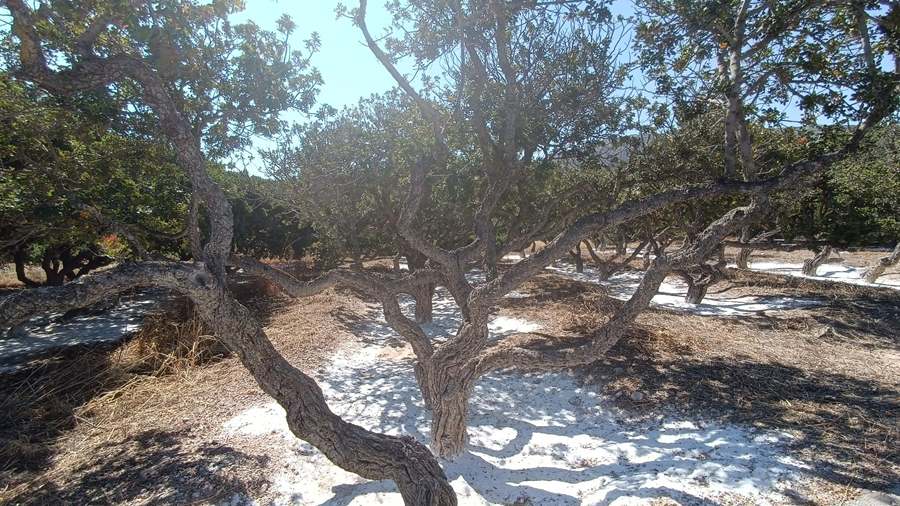
A Chios tour explains mastic as a resin from the mastic tree, Pistacia lentiscus, that dries into brittle, translucent drops called the tears of Chios. Its trade name, Masticha Chiou, now holds a European Union protected designation of origin.
The resin comes from the glands of an evergreen shrub. Chewed, it softens and turns bright white and opaque, with a bitter first taste that gives way to a fresh note of pine and cedar.
The harvest, called kentos, runs from early July to early October. Growers clear the ground under each tree, sprinkle it with inert calcium carbonate and then cut the bark to release the resin.
Every 4 to 5 days each tree takes 5 to 10 incisions. The clear drops hang and catch the light, and they need about 15 to 20 days to harden and drop to the ground.
Farmers wash the dry pieces in natural spring water and spend the winter cleaning tears from sand by hand. A Chios tour in the south shows this slow, year-round work in the villages.
Mastic was worth its weight in gold under Ottoman rule. The Turkish name for the island, Sakız Adası, means gum island, and the Sultan claimed the finest part of each crop.
- Word: The name mastic comes indirectly from Ancient Greek and is possibly linked to a verb meaning to chew.
- Byzantine era: The mastic trade became a monopoly of the emperor.
- Church use: Mastic is an essential ingredient of chrism, the holy oil of the Eastern Orthodox Churches.
- Kitchen: In Greece, mastic goes into chewing gum, breads, cheese and a spoon sweet known as the submarine.
A Chios tour treats mastic as a food tradition, and a Thessaloniki food tour follows other Greek flavours on the northern mainland.
How does a Chios tour cover the mastic villages and Pyrgi?
A Chios tour of the south enters the Mastichochoria, the mastic villages, with Pyrgi as their traditional seat. Pyrgi is known as the painted village for the black and white patterns, called xista, worked into the facades of its houses.
The Mastichochoria municipal unit covers the south-west and far south of the island. At 211.687 km2 it is the largest unit by land area on Chios, with 3,384 residents at the 2021 census.
Pirate raids shaped the plan. The villages stand out of sight from the sea behind high walls, with no doors at street level, so people entered by ladder to protect the resin.
The Chios Gum Mastic Growers Association, founded in 1938, unites twenty primary co-operatives with nearly 5000 members across twenty-four villages of southern Chios. A Chios tour passes through a handful of them.
Pyrgi lies 25 km south of the capital and had 1,063 residents in 2021. Its narrow roads run under arches and vaults, and an 18-metre tower rises in the middle of the village.
Walls with four corner towers surround that central tower. The 1881 earthquake left Pyrgi undamaged, so the medieval layout survives, along with three old churches, among them Agioi Apostoloi, thought to date from the 15th century.
- UNESCO: The mastic villages appear on the UNESCO Representative List of the Intangible Cultural Heritage of Humanity.
- Museum: The Chios Mastic Museum opened at Rachi, in the Mastichochoria, on 11 June 2016.
- Chian earth: A white earth dug near Pyrgi was prized as a cosmetic from antiquity.
- Other villages: Kalamoti, Armolia, Mesta and Lithi rank next to Pyrgi in size.
A Chios tour in the south links these villages by road, and the facades of Pyrgi stand out from those of its neighbours.
Why does a Chios tour stop at the fortified village of Mesta?
A Chios tour stops at Mesta because the southern mastic village survives as a village-castle with fully preserved medieval architecture. Narrow, maze-like streets sit inside a pentagonal fortified perimeter that once kept pirate raids out of the settlement.
Mesta lies 35 km south-west of Chios town and 4 km from the coast. The village stands at an elevation of 120 m, and the small port of Limenas belongs to the same municipal unit.
The village dates back, by best estimate, to the 12th century and the Byzantine era. Its defences were later strengthened under Genoese rule on Chios, between 1346 and 1566.
The church of the Older Taxiarchi stands in the centre of the village and was built in 1794. A Chios tour reaches it through the lanes that wind in from the old gates.
The 1822 massacre struck Mesta hard, and villagers were killed or captured. A share of the captives later went free, since mastic farming mattered greatly to the Ottoman rulers.
- Region: Mesta sits in the south-west of Chios, inside the former Mastichochoria municipality.
- Seven villages: Mesta, Pyrgi, Olympi, Kalamoti, Vessa, Lithi and Elata have controlled mastic production since the Roman period.
- Research: Ohio State University has published a study titled The Greeks of Mestá, Chios, in Greek and English.
- Work: Mesta belongs to the Mastic Villages of South Chios, where the main activity is mastic production.
A Chios tour that pairs Mesta with Pyrgi sees two answers to the same pirate threat: a sealed castle plan in one and patterned houses inside walls in the other.
What does a Chios tour see at Nea Moni and Anavatos?
A Chios tour inland reaches Nea Moni, an 11th-century monastery complex known for its mosaics and listed by UNESCO in 1990, then continues to Anavatos, a medieval village left largely abandoned after the 1822 massacre and the 1881 earthquake.
Nea Moni, the New Monastery, stands on Provateio Oros in the interior between Avgonyma and Karyes, about 15 km from Chios town. Today it serves as a convent and history museum.
Tradition holds that three monks, Nikitas, Ioannes and Iosif, found an icon of the Virgin Mary hanging from a myrtle branch. They visited Constantine, then in exile on Lesbos, and foretold his rise to the throne.
Constantine IX Monomachos took the throne in 1042 and began the monastery with Empress Zoe. The main church opened in 1049, and the complex was finished in 1055, after his death.
At its peak around 1300 the estates covered one third of Chios. In April 1822 Ottoman troops stormed the monastery, where 2,000 people had sought refuge, and set the church furnishings on fire.
The 1881 earthquake brought down the dome of the main church. In 1952 a shortage of monks turned Nea Moni into a convent, and a Chios tour now finds a small museum in a renovated cell.
- Katholikon: The main church follows an octagonal plan of the insular type, found on Chios and Cyprus.
- Anavatos: The village lies 16 km from Chios town and had 10 inhabitants at the 2021 census.
- Origins: Workers of Nea Moni are thought to have founded Anavatos in the Byzantine era.
- Fortress: A medieval fortress stands above the village of Anavatos.
A Chios tour to these inland sites sits alongside a Patmos day trip for travellers who follow monasteries from island to island.
What does a Chios tour tell about the Chios massacre of 1822?
A Chios tour recalls the 1822 massacre as the catastrophe in which Ottoman troops killed, enslaved or drove out about four-fifths of the Greek population of Chios during the Greek War of Independence, an event that drew outrage across the Western world.
Before the war, the Ottoman Empire left Chios almost full control of its own affairs, since Chian trade and mastic held great value. The island’s leading families hesitated to join the revolt.
A Chios tour sets the scene in March 1822, when armed Greeks from a neighbouring island landed and attacked the Turks, who withdrew to the citadel. Islanders at large had not joined the revolt.
A Turkish fleet under Kapudan Pasha Nasuhzade Ali Pasha arrived on 22 March. On 12 April orders went out to burn the town, and an estimated 30,000 troops landed over the next four months.
Estimates give at least 25,000 killed, 45,000 enslaved and 10,000 to 20,000 who fled, out of a population of 100,000 to 120,000 before the catastrophe.
Tens of thousands of survivors scattered across Europe and became part of the Chian diaspora. Following the massacre, the island never again reached the commercial prominence it had held before.
- Delacroix: A copy of Scenes from the Massacres of Chios by Eugène Delacroix is on display in the Byzantine Museum on Chios.
- Poetry: Victor Hugo wrote L’Enfant on the massacre, and William Cullen Bryant published The Massacre at Scio in 1824.
- Greek response: On the night of 18 June 1822, fire ships under Konstantinos Kanaris and Andreas Pipinos burned the Ottoman flagship.
- Commemoration: In 2021 the Holy Synod of the Church of Greece glorified Metropolitan Plato of Chios and 43 others martyred in 1822.
A Chios tour treats this history with care, since the events of 1822 left their mark on Nea Moni, Mesta and Anavatos alike.
What do travellers ask about a Chios tour?
A Chios tour raises four common questions from travellers: whether a mastic tour is on sale, whether cruise passengers have a shore excursion, what Nea Moni is, and which villages of the island make mastic. Short answers follow below.
Is a Chios tour focused on mastic on sale?
Yes. Listings include a mastiha tasting trip with local food and a seaside lunch, a mastiha shore excursion, and a mastiha and food tour through the medieval villages. The tour cards on this page show live dates for every mastic Chios tour.
Does a Chios tour exist as a shore excursion?
Yes. A mastiha shore excursion is on sale for cruise passengers in port at Chios town. It centres on mastiha, the resin of the island, and its listing sits with the other Chios tour cards on this page, beside the mastic tasting trip.
What is Nea Moni on a Chios tour?
Nea Moni is an 11th-century monastery complex in the interior of the island, now a convent and history museum. Constantine IX Monomachos began it after taking the throne in 1042. The complex, inscribed by UNESCO in 1990, is known for its mosaics.
Which villages make mastic on a Chios tour?
Twenty-four villages in southern Chios grow mastic, among them Mesta, Olympi, Pyrgi, Armolia, Kalamoti, Vessa, Elata and Lithi. Their growers belong to twenty primary co-operatives under the Chios Gum Mastic Growers Association, and Pyrgi is the traditional seat of the group.