

A Thessaloniki food tour is a walking and tasting tour through Kapani market, the Modiano Market, the tavernas of Ladadika and the bakeries of the second-largest city in Greece. The tour is one of the Greece Tours on Greece Ville, listed with the other Northern Greece tours and day trips from Thessaloniki.
This post covers the formats on sale, the markets and Ladadika, bougatsa and its name, breads and sweets, loukoumades, Byzantine, Ottoman and Jewish Thessaloniki, the local spirits, Aristotelous Square, the roots of Greek food and the questions that come up before booking.
What is a Thessaloniki food tour?
A Thessaloniki food tour is a walking and tasting tour through the markets, bakeries and tavernas of Thessaloniki, the second-largest city in Greece. The city kept a strong Eastern character in its food, with spices playing a larger role than in southern Greece.
Thessaloniki is the capital and largest city of the region of Central Macedonia. The historic municipality had 319,045 residents in 2021, and the metropolitan area had 1,006,112.
The city stayed under Ottoman rule for about 100 years longer than southern Greece. As a result it kept a strong Eastern character, including its culinary tastes, which a Thessaloniki food tour meets at each stop.
Spices play an important role in the cuisine of the city, to a degree not found in the southern regions of Greece. Bougatsa, the local breakfast pastry, has spread from the city across Greece and the Balkans.
Greek cuisine rests on the Mediterranean triad of wheat, olive oil and wine. It continues traditions from Ancient Greek and Byzantine cuisine, with Middle Eastern, Balkan and Italian influences added over time.
- City: The second-largest in Greece and capital of Central Macedonia.
- Population: 319,045 in the municipality and 1,006,112 in the metropolitan area.
- Food character: Eastern, with a strong role for spices.
- Signature dish: Bougatsa, a breakfast pastry.
The sections below cover the formats, the markets, Ladadika, bougatsa, breads and sweets, spirits and the history behind each Thessaloniki food tour stop.


Which Thessaloniki food tour formats are on sale?
A Thessaloniki food tour comes as a walking food tour of the open market district, a small-group tour in Ladadika, a culinary backstreets tour built around bougatsa, a tasting and drinks tour with a chef, or a private food tour of the city.
The open market format walks through the market district with tastings along the way. A small-group format focuses on local food in Ladadika, the old harbour quarter of the city.
A backstreets format starts from bougatsa and moves on to further local dishes. Chef-led formats pair food tastings with drinks, and one listing adds rooftop views to the walk.
Private formats run for one group only. Related listings in the city include a Greek cooking class with a market visit and lunch, a cooking and wine tasting session by the docks and an olive oil tasting.
A street art walk with tastings mixes food and city art. A Thessaloniki food tour can also sit alongside a small-group wine tasting with appetizers in the centre.
- Open market walk: Tastings in the market district.
- Ladadika tour: Small groups in the old harbour quarter.
- Bougatsa and beyond: A backstreets tour that starts with the city pastry.
- Chef-led tastings: Food and drinks with a chef, one with rooftop views.
The tour cards and availability boxes on this page list live dates for each Thessaloniki food tour format, and food walks in the capital are covered in the Athens food tour post.
What does Kapani market show on a Thessaloniki food tour?
A Thessaloniki food tour starts in Kapani, also called Agora Vlali, the oldest central market of the city. Its shops sell fish, meat, vegetables, fruit, drinks, olives, sweets, nuts and spices, and the Modiano Market stands nearby in the same district.
Kapani is one of the districts around Aristotelous Square, the central point of Thessaloniki. The central Modiano Market lies within the Kapani district.
The range of goods at Kapani covers both raw food and ready-made treats. Olives, nuts and spices sit next to fish, meat and fresh produce, so a Thessaloniki food tour can taste and shop in the same lanes.
The districts around Aristotelous Square include Ladadika, Kapani, Diagonios, Navarinou, Rotonda, Agia Sofia and Hippodromio. All of them lie around the square, the central point of the city.
The American Farm School is an important contributor to local food production. The Italian-Jewish Allatini brothers once led Jewish business in the city with milling and other food industries.
- Names: Kapani, or Agora Vlali.
- Status: The oldest central market of Thessaloniki.
- Goods: Fish, meat, vegetables, fruit, olives, sweets, nuts and spices.
- Neighbour: The Modiano Market.
Kapani and the Modiano Market sit side by side, so a Thessaloniki food tour covers both markets in one walk.
What does the Modiano Market show on a Thessaloniki food tour?
A Thessaloniki food tour enters the Modiano Market, an enclosed market built between 1922 and 1925 after the great fire, on the site of the old Talmud Tora synagogue. Inside are fish markets, butcher shops, tavernas and bars.
The market forms the central point of the market area of the city, which spreads over more than one block. It takes its name from the architect Eli Modiano, of the Italo-Jewish Modiano family of the city.
Eli Modiano owned the area and later the market itself. His architectural office was also inside the building, beside the stalls.
The market is a place of social meeting and of historical significance for Thessaloniki. A Thessaloniki food tour walks through it as a living market rather than a museum.
The building was restored and reopened on 5 December 2022, after the Hellenic Republic Asset Development Fund bought it.
- Built: 1922 to 1925, after the great fire.
- Site: The old Talmud Tora synagogue.
- Name: From the architect Eli Modiano.
- Reopened: 5 December 2022, after restoration.
The Modiano story ties the market to the Jewish past of the city, a thread that runs through a Thessaloniki food tour from stall to stall.
What does Ladadika add to a Thessaloniki food tour?
A Thessaloniki food tour reaches Ladadika, the historic district near the port named after its olive oil shops. Listed as a heritage site in 1985, it is now the entertainment district of the city, with tavernas serving traditional meze.
For centuries Ladadika was one of the leading marketplaces of the city. Its name comes from the olive oil shops that filled the area.
Jews of the city lived in Ladadika, and the “Frankish district”, Frankomahala, with French and Italian merchants, lay beside it. Before the First World War the area became the red-light district.
The Ministry of Culture listed Ladadika as a heritage site in 1985, and its 19th-century buildings are protected. After gentrification in the 1980s, the old oil stores and warehouses became bars, restaurants and clubs.
Pedestrian streets and small squares such as Morichovou Square link the venues. Ladadika is a busy area for Thessalonian cuisine, with tavernas serving meze and other local dishes.
- Name: From the olive oil shops of the quarter.
- Heritage listing: 1985, by the Ministry of Culture.
- Today: The entertainment district, with tavernas and bars.
- Square: Morichovou Square.
A small-group Thessaloniki food tour in Ladadika moves among these tavernas, near the port of the city, and sea outings south of the city are covered in the Halkidiki boat tour post.
Why does bougatsa lead a Thessaloniki food tour?
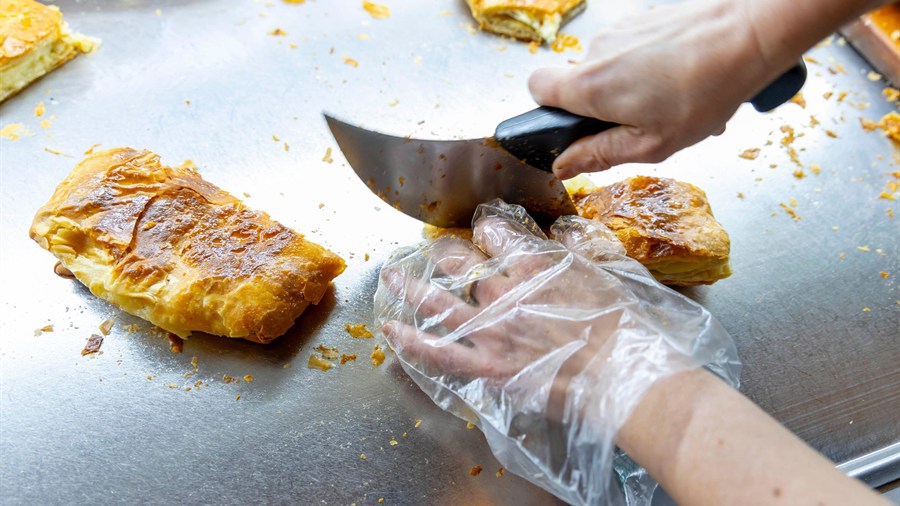
A Thessaloniki food tour starts with bougatsa, the breakfast pastry of the city, sweet with a semolina custard cream or savoury. In Thessaloniki the cream version is crunchy and not that sweet, unlike the sweeter, creamier bougatsa of Veria and Athens.
Bougatsa is a Greek breakfast food, mid-morning snack or midday snack. It comes in versions with their own filling, and the best known is bougatsa krema, with a semolina custard filling.
The modern version of bougatsa came from Northern Greece, in particular the cities of Serres and Thessaloniki. Specialty shops called bougatsadika or bougatsopolia sell bougatsa and nothing else.
The taste changes from region to region. In Chania on Crete, the cheese bougatsa uses local mizithra cheese, which is not sweet, with sugar and cinnamon sprinkled on top.
Bougatsa is also a popular breakfast dish among Greek Jews. A Thessaloniki food tour that starts with bougatsa therefore starts with a dish shared across the communities of the city.
- Type: A breakfast pastry, sweet or savoury.
- Best known: Bougatsa krema, with semolina custard.
- Thessaloniki style: Crunchy and not that sweet.
- Shops: Bougatsadika or bougatsopolia, which sell only bougatsa.
The pastry has spread from Thessaloniki across Greece and the Balkans, and the morning stop of a Thessaloniki food tour shows it at the source.
Where does the name of bougatsa come from on a Thessaloniki food tour?
A Thessaloniki food tour tastes a pastry whose name comes from the Byzantine Greek pogátsa, from the Roman pānis focācius, “hearth bread”, the same root as the Italian focaccia. It was a staple of the Cappadocian Greeks in the Byzantine Empire.
The name traces back through Byzantine Greek to Latin. The Roman pānis focācius meant “hearth bread”, a sense shared with the Italian word focaccia.
A classical origin for bougatsa is traced to the Ancient Greek and Roman placenta cake. A similar dessert is still known as placenta on the island of Lesbos.
The placenta of Lesbos is a type of pancake made from two layers of dough and filled with cottage cheese, or with chocolate or apples. It is covered with honey before baking.
Bougatsa was a staple of the Cappadocian Greeks in the Byzantine Empire. A Thessaloniki food tour thus tastes a pastry with a history that runs from Rome through Byzantium to Macedonia.
- Byzantine word: Pogátsa.
- Latin root: Pānis focācius, “hearth bread”.
- Relative: The Italian focaccia.
- Older cousin: The placenta cake, still made on Lesbos.
The story of the word gives each bite of bougatsa on a Thessaloniki food tour a link to the bread ovens of Rome.
Which breads and sweets fill a Thessaloniki food tour?
A Thessaloniki food tour tastes koulouri, a sesame bread ring with Byzantine roots, and the sweets of the city: Trigona Panoramatos, Roxakia, Kourkoubinia and Armenonville. Tsoureki, a sweet holiday bread with mastic or mahleb, joins them in the bakeries.
Koulouri, also called simit, is a circular bread encrusted with sesame seeds. It is found across the cuisines of the former Ottoman Empire and the Middle East, and in Greece it is still eaten regularly.
Constantine VII Porphyrogennitos first mentioned the kollikion in the 9th century as a small ring-shaped bread sold in Constantinople. Byzantine writers describe it as popular among the army.
Tsoureki is a sweet bread made with flour, milk, butter, eggs and sugar. It is seasoned with lemon and orange zest, mastic resin or mahleb.
Lampropsomo, the Greek Easter bread, is a braided tsoureki with dyed eggs pressed into the dough. Christopsomo is a round Christmas loaf with a cross on top.
- Koulouri: A sesame bread ring, first recorded in the 9th century.
- City sweets: Trigona Panoramatos, Roxakia, Kourkoubinia and Armenonville.
- Tsoureki: A sweet bread with mastic or mahleb.
- Holiday loaves: Lampropsomo at Easter and Christopsomo at Christmas.
The record of the city lists Trigona Panoramatos, Roxakia, Kourkoubinia and Armenonville as its notable sweets, four local names for a Thessaloniki food tour to look out for.
How do loukoumades reach a Thessaloniki food tour?
A Thessaloniki food tour can include loukoumades, fried dough balls soaked in syrup or honey. The dish links to the medieval Arab luqmat al-qadi and to enkrides, honeyed fried dough eaten in Ancient Greece and named by Aristophanes and Aeschylus.
Lokma, as the dish is called across the region, is made of leavened, deep-fried dough balls. They are soaked in syrup or honey and coated with cinnamon or other toppings.
The recipe for luqmat al-qadi, yeast dough fried in oil and doused in honey or syrup with rosewater, dates back at least to the 13th-century Abbasid Caliphate. Cookery books of the time mention it.
Ancient Greek texts mention enkrides, dough fried in oil and eaten with honey. Archestratus, Aeschylus, Epicharmus, Aristophanes and Pherecrates all refer to them.
In Greece, loukoumades are a popular street food served with honey, cinnamon, walnuts or chocolate sauce. A Thessaloniki food tour meets them as a sweet stop between savoury tastings.
- Dish: Fried dough balls with honey or syrup.
- Medieval link: Luqmat al-qadi of the 13th-century Abbasid Caliphate.
- Ancient link: Enkrides, named by Aristophanes and Aeschylus.
- Toppings: Honey, cinnamon, walnuts or chocolate sauce.
The two lines of descent, Arab and Ancient Greek, meet on the plate of a Thessaloniki food tour.
How did Byzantine Thessaloniki shape a Thessaloniki food tour?
A Thessaloniki food tour walks through a city that was the second-largest of the Eastern Roman Empire by 476 and, under Byzantium, the second city after Constantinople in wealth and size. Its Paleochristian and Byzantine monuments form a World Heritage Site.
By the fall of Rome in 476, Thessaloniki was the second-largest city of the Eastern Roman Empire. From the first years of the Byzantine Empire it ranked second only to Constantinople.
In the middle of the 12th century the city had about 150,000 people. In the 14th century its population passed 100,000 to 150,000, which made it larger than London at the time.
The Paleochristian and Byzantine monuments of the city form a World Heritage Site. Roman, Ottoman and Sephardic Jewish buildings stand among them along the streets of the centre.
The kollikion, ancestor of the koulouri, was sold as a small ring-shaped bread in Byzantine Constantinople. A Thessaloniki food tour tastes the same ring of bread in the second city of that empire.
- Roman rank: Second-largest city of the Eastern Roman Empire by 476.
- Byzantine rank: Second only to Constantinople.
- Population: About 150,000 in the 12th century.
- Heritage: Paleochristian and Byzantine monuments on the World Heritage List.
Royal tombs of ancient Macedonia are covered in the Vergina day trip post, a day out from the same city as a Thessaloniki food tour.
How did the Ottoman centuries shape a Thessaloniki food tour?
A Thessaloniki food tour tastes the legacy of nearly five centuries of Ottoman rule, from 1430 to 1912. The city was a multi-ethnic seaport where churches, mosques and synagogues stood side by side, and its food kept an Eastern character.
The Ottomans conquered Thessaloniki in 1430. For nearly five centuries the city stayed an important seaport and a multi-ethnic metropolis under Turkish rule.
Thessaloniki passed from the Ottoman Empire to the Kingdom of Greece in 1912, during the Balkan Wars. The name Thessaloniki was revived as the official name of the city in the same year.
Ottoman cuisine grew through long contact among the food traditions of Central Asia, the Persian and Arab world, Byzantium and the Balkan and Anatolian lands of the empire.
The Ottoman palace kitchen registers record the ingredients and names of dishes cooked for the palace. These registers are key sources for the study of Ottoman food in the early modern period.
- Ottoman rule: From 1430 to 1912.
- City life: Churches, mosques and synagogues side by side.
- Cuisine roots: Central Asia, the Persian and Arab world, Byzantium and the Balkans.
- Sources: The palace kitchen registers.
The spices that mark the cuisine of the city are part of this inheritance, and a Thessaloniki food tour finds them in the spice stalls of Kapani.
How did the Jewish city shape a Thessaloniki food tour?
A Thessaloniki food tour walks through the only Jewish-majority city in Europe from the 16th to the 20th centuries. Jewish families built the Modiano Market and led milling and food industries, and Jews lived in Ladadika by the port.
From the 16th to the 20th centuries Thessaloniki was the only city in Europe with a Jewish majority. Its name in Judeo-Spanish was Saloniko, one of the names the city carried in other languages.
The Italian-Jewish Allatini brothers led Jewish business in the city. They set up milling and other food industries, along with brickmaking and tobacco processing plants.
The Modiano Market stands on the site of the old Talmud Tora synagogue and carries the name of the Italo-Jewish Modiano family. A Thessaloniki food tour in the market therefore walks over a Jewish site.
Jews of the city lived in Ladadika, the olive oil quarter by the port. Bougatsa, the breakfast pastry of the city, is also a popular breakfast among Greek Jews.
- Jewish majority: From the 16th to the 20th centuries.
- Judeo-Spanish name: Saloniko.
- Food industry: Milling led by the Allatini brothers.
- Market: Modiano, on the site of the Talmud Tora synagogue.
The city is also known for its Sephardic Jewish structures, which stand among the Roman, Byzantine and Ottoman buildings on the routes of a Thessaloniki food tour.
Which spirits pour on a Thessaloniki food tour?
A Thessaloniki food tour can pour tsipouro, an un-aged brandy of Thessaly, Epirus and Macedonia with 40 to 45 percent alcohol, and ouzo, a dry anise aperitif served with a small plate of meze. Tradition credits Mount Athos monks with the first tsipouro.
Tsipouro is a strong distilled spirit with 40 to 45 percent alcohol by volume. It comes in two kinds: pure, the default, and an anise-flavoured kind introduced during the 1900s.
Unlike tsikoudia of Crete, which is distilled once and has no added flavour, tsipouro is double-distilled and at times includes spices such as anise.
According to tradition, Greek Orthodox monks on Mount Athos in Macedonia made the first tsipouro in the 14th century. A Thessaloniki food tour pours it close to that birthplace.
Ouzo is a dry anise-flavoured aperitif drunk in Cyprus and Greece. Its taste is close to other anise drinks such as pastis, sambuca, mastika, rakı and arak, and it comes with meze of small fish, fries and olives.
- Tsipouro: Un-aged brandy, 40 to 45 percent alcohol.
- Varieties: Pure, and anise-flavoured since the 1900s.
- Origin story: Monks on Mount Athos in the 14th century.
- Ouzo: A dry anise aperitif served with meze.
The monastic peninsula behind the tsipouro story is covered in the Mount Athos cruise post, a day out from the same region as a Thessaloniki food tour.
How did Aristotelous Square become the hub of a Thessaloniki food tour?
A Thessaloniki food tour circles Aristotelous Square, the main square of the city on the waterfront, designed by the French architect Ernest Hébrard in 1918 after the Great Fire of 1917 destroyed two thirds of Thessaloniki. The markets lie around it.
Aristotelous Square stands on Nikis avenue, on the waterfront of the city centre. Hébrard designed it in 1918, but the greater part of the square was built in the 1950s.
The Great Fire of 1917 destroyed two thirds of Thessaloniki. Before the fire the city lacked large squares, and Hébrard proposed a number of them, among them the present Aristotelous Square.
Hébrard planned a monumental axis that ran from the square on the seafront to Dikastirion Square and the Roman Forum. Imposing façades were part of his plan for the new centre.
Kapani, Ladadika, Diagonios, Navarinou, Rotonda, Agia Sofia and Hippodromio all lie around the square. A Thessaloniki food tour moves between the markets and tavernas of these districts from this central point.
- Location: Nikis avenue, on the waterfront.
- Designer: Ernest Hébrard, in 1918.
- Built: Mainly in the 1950s.
- Axis: From the seafront to the Roman Forum.
Day trips that leave the city from the same centre are covered in the Meteora day trip from Thessaloniki post.
What older roots of Greek food does a Thessaloniki food tour taste?
A Thessaloniki food tour tastes a cuisine built on the Mediterranean triad of wheat, olive oil and wine. Ancient Greek cooking was frugal, with meat eaten rarely and fish more common, and the spread of vines and olives followed Greek colonization.
Greek cuisine uses vegetables, olive oil, grains, fish and meat, including pork, poultry, veal, beef, lamb, rabbit and goat. Cheeses, herbs, lemon juice, olives and yogurt complete the larder.
Pasta such as hilopites also belongs to the Greek kitchen. The cuisine continues Ancient Greek and Byzantine traditions and adds Middle Eastern, Balkan and Italian influences.
Wine and olive oil have always stood at the centre of Greek food. The ancient spread of grapes and olive trees in the Mediterranean is linked with Greek colonization.
Ancient Greek cuisine was known for its frugality. One notorious staple was melas zomos, a black soup of pork, blood, olive oil, bay leaf, onion, salt, water and vinegar.
- Triad: Wheat, olive oil and wine.
- Ancient habit: Little meat and more fish.
- Influences: Middle Eastern, Balkan and Italian.
- Black soup: Melas zomos, an ancient staple.
The Greek kitchen spread its influence to ancient Rome and on across Europe, a long reach that a Thessaloniki food tour sums up in one walk.
What do travellers ask about a Thessaloniki food tour?
A Thessaloniki food tour raises the same questions before booking: which market it starts in, how the local bougatsa tastes, which sweets belong to the city and whether drinks are part of the walk. The answers draw on the markets and formats.
Which market does a Thessaloniki food tour start in?
Open market formats walk through Kapani, also called Agora Vlali, the oldest central market of the city, and the Modiano Market next to it. Kapani sells fish, meat, fruit, vegetables, olives, nuts, sweets and spices, and Modiano holds fish markets, butchers, tavernas and bars.
How does bougatsa taste on a Thessaloniki food tour?
In Thessaloniki the bougatsa cream is crunchy and not that sweet. In Veria and Athens the cream version is very sweet and full of cream, so the city style differs from both.
Which sweets belong to a Thessaloniki food tour?
The notable sweets of the city are Trigona Panoramatos, Roxakia, Kourkoubinia and Armenonville. Loukoumades with honey and the koulouri, a sesame bread ring, join them on the streets.
Does a Thessaloniki food tour include drinks?
Chef-led formats do. These listings pair food tastings with drinks, and a related small-group wine tasting with appetizers runs in the centre. Tsipouro and ouzo with meze are the local spirits of the table.