

A Thessaloniki walking tour follows the streets of the city from the Roman Arch of Galerius and the Rotunda to the Byzantine churches, the walls and the upper town of Ano Poli. The tour is one of the Greece Tours on Greece Ville.
This post covers the formats on sale, the founding of the city, Roman Thessaloniki, the UNESCO churches, Saint Demetrius, the walls and the Heptapyrgion, the Ottoman baths and mosques, the Atatürk Museum, the museums, Jewish Thessaloniki, the university, the metro and the questions that come up before booking.
What does a Thessaloniki walking tour cover?
A Thessaloniki walking tour traces the city from its founding in 315 BC through Roman, Byzantine and Ottoman times, passing the Arch of Galerius, the Rotunda, Byzantine churches, the stone lanes of the Upper Town and the old city walls.
For centuries Thessaloniki ranked as the second city of the Byzantine Empire in importance. In Greek it carries the name Symprotévousa, the co-capital, a nod to its rank beside Constantinople.
In 1988, fifteen monuments of the city joined the UNESCO World Heritage List. A Thessaloniki walking tour reaches the Rotunda, the Church of Panagia Chalkeon and the city walls from that list.
Ano Poli, the Upper Town, is the old town of Thessaloniki and the highest part of the city. It keeps small stone-paved streets, old squares and houses in Greek and Ottoman styles.
The walls ran for 4 kilometres around the medieval city. The present circuit dates from the early Byzantine period, around 390, and joins the acropolis, where the Heptapyrgion, or Seven Towers, stands.
During the Ottoman period, the Upper Town formed the main district for the Turks of the city. Greeks, western Europeans and Jews lived lower down, around the port on the Thermaic Gulf.
- Roman layer: The Arch of Galerius, the Rotunda and the Roman Forum.
- Byzantine layer: Churches such as Panagia Chalkeon, from the 11th century.
- Ottoman layer: The Alaca Imaret Mosque and the old houses of Ano Poli.
- Walls: A 4-kilometre circuit, on the UNESCO list since 1988.
The sections below follow a Thessaloniki walking tour stop by stop, and the Thessaloniki food tour post covers the tasting walks.


Which Thessaloniki walking tour formats are on sale?
A Thessaloniki walking tour comes as a group or private highlights walk, a walk with a local, a Jewish heritage tour, an Apostle Paul story walk, a myths and legends walk with a market visit, or a highlights walk ending at sunset.
Highlights walks run for private or group bookings, and one adds lesser-known corners to the main sights. Private walks with a local keep the group to one party.
A Jewish heritage format runs as a private tour and covers the monuments of the Jewish community. The Apostle Paul story walk follows the early Christian chapter of the city on foot.
A myths and legends format pairs the old stories of the city with a market visit along the route. Another Thessaloniki walking tour covers the city highlights and ends with the sunset.
Wheeled formats cover more ground. They include a Segway tour, a four-wheel scooter tour, a bike tour past the Rotunda, a panoramic city tour with stops and a hop-on hop-off bus.
A private walk covers the UNESCO monuments of the city. Museum formats include an e-ticket to the Byzantine Culture Museum with an audio tour, and a city tour with the Archaeological Museum.
- On foot: Highlights, sunset, myths and legends, Jewish heritage and Apostle Paul walks.
- Private: Walks with a local and a walk through the UNESCO monuments.
- On wheels: Segway, four-wheel scooter, bike and hop-on hop-off bus tours.
- With museums: The Byzantine Culture Museum and the Archaeological Museum.
Each Thessaloniki walking tour format above is on sale. The tour cards and availability boxes on this page list live dates for each format.
Who founded the city seen on a Thessaloniki walking tour?
A Thessaloniki walking tour starts its story in 315 BC, when King Cassander of Macedon founded the city on or near the site of ancient Therma and named it after his wife Thessalonike, a half-sister of Alexander the Great.
Cassander was king of Macedonia from 305 BC until 297 BC. A son of Antipater, he studied under the philosopher Aristotle in his youth, alongside Alexander the Great and Hephaestion.
After the fall of Pydna, Cassander married Thessalonike and so tied himself to the Argead dynasty. He then founded Thessalonica and Cassandreia and rebuilt Thebes, a city Alexander had destroyed.
Thessalonike was a daughter of Philip II of Macedon by Nicesipolis. Her name joins Thessaly and nike, the Greek word for victory, and honours the Macedonian win at the Battle of Crocus Field.
A Thessaloniki walking tour explains that the city grew from ancient Therma and 26 other local villages on the Thermaic Gulf, 40 km southeast of Pella, the royal capital of Macedonia.
A popular Greek legend holds that Thessalonike became a mermaid who lived in the Aegean after the death of Alexander the Great. She asks passing sailors whether King Alexander is still alive.
- Founder: Cassander, king of Macedonia from 305 BC to 297 BC.
- Founded: Around 315 BC, on or near ancient Therma.
- Namesake: Thessalonike, half-sister of Alexander the Great and wife of Cassander.
- Meaning: The name means Thessalian victory, from Thessaly and nike.
A Thessaloniki walking tour keeps to the city itself, while the Vergina day trip post follows the royal story of the Macedonian kings beyond its walls.
What did Roman rule leave on a Thessaloniki walking tour?
A Thessaloniki walking tour shows Roman Thessalonica, capital of the Roman province of Macedonia from 128 BC and a free city under Mark Antony from 41 BC, which grew into an important trade hub on the Via Egnatia between Dyrrhachium and Byzantium.
The Roman conquest of 167 BC brought Roman peace to the city. Its walls grew weak, and by about the middle of the 1st century they already lay in ruins.
The Pax Romana and the strategic position of the city made it a major economic hub in the Balkans. Goods moved between Rome and Byzantium through Thessaloniki along the Via Egnatia.
Under the Tetrarchy, the city became the administrative capital of one of four portions of the empire. Galerius commissioned a palace, a new hippodrome, a triumphal arch and a mausoleum there.
A Thessaloniki walking tour also passes the palace complex at Navarinou Square. Its large octagonal hall, which survives in large part, is believed to have served as an imperial throne room.
- Provincial capital: Capital of the Roman province of Macedonia from 128 BC.
- Free city: Granted free status under Mark Antony in 41 BC.
- Trade role: A hub on the Via Egnatia between Rome and Byzantium.
- Imperial seat: The palace of Galerius, with its octagonal throne room.
In 379 the city became capital of the new Prefecture of Illyricum, and a Thessaloniki walking tour ends this Roman chapter with the Edict of Thessalonica, which made Christianity the state religion a year later.
How does the Via Egnatia fit into a Thessaloniki walking tour?
A Thessaloniki walking tour meets the Via Egnatia, a road the Romans built in the 2nd century BC. It ran from Dyrrachium on the Adriatic Sea through Thessalonica to the city of Byzantium, about 1,120 km in total.
Bilingual inscriptions on milestones name Gnaeus Egnatius, proconsul of Macedonia, as the man who ordered the work. The road presumably took its name from him, though the exact date stays uncertain.
The road was about six metres wide, like other major Roman roads. Builders paved it with large polygonal stone slabs or covered it with a hard layer of sand.
The route linked a chain of Roman colonies from the Adriatic Sea to the Bosphorus. Its western end lay almost opposite the end of the Via Appia, which led from Rome itself.
Inside the city, the road served as the decumanus maximus, the main east to west street. A Thessaloniki walking tour sees where the central arch of the Arch of Galerius once spanned it.
Armies used the road in Roman civil wars. Julius Caesar and Pompey marched along it, and Mark Antony and Octavian pursued Cassius and Brutus on it to the Battle of Philippi.
- Built: In the 2nd century BC, on the order of Gnaeus Egnatius.
- Length: About 1,120 km, or 746 Roman miles.
- Width: About six metres, like other major Roman roads.
- Later repairs: Under Trajan and, in the 6th century, Justinian I.
By the 5th century AD the road had largely fallen into disuse, yet a Thessaloniki walking tour still crosses Egnatia Street at the Arch of Galerius.
What does the Roman Forum show on a Thessaloniki walking tour?
A Thessaloniki walking tour visits the ancient Roman Forum of the city, a large two-terraced complex with two-storey stoas, two Roman baths and a small theatre that also hosted gladiatorial games, found by accident during excavation in the 1960s.
The Church of Panagia Chalkeon stands at Dikastirion Square, just north of the Via Egnatia. The archaeological site of the Roman forum lies to the northeast of the church.
The site was planned for the Thessaloniki Municipal Courthouse. Once the ruins came to light during the excavation, the project was scrapped and the courthouse building moved to another site.
The square around the forum still carries its intended name, Dikastirion or Courthouse Square, in popular use. Its official name is the Square of the Ancient Agora, Archaias Agoras in Greek.
The first complex predates Roman rule, but builders refurbished it on a large scale in the 2nd century. The forum and theatre are believed to have stayed in use until at least the 6th century.
A Thessaloniki walking tour sees one of the two Roman baths of the complex, the one that has been excavated. The second bath still lies buried beneath the modern city.
- Layout: A large two-terraced forum with two-storey stoas.
- Found: By accident in the 1960s, on the planned courthouse site.
- Extras: Two Roman baths and a small theatre used for gladiatorial games.
- In use: Until at least the 6th century, after a 2nd-century refurbishment.
The forum lies near the Church of Panagia Chalkeon, so a Thessaloniki walking tour takes in the Roman square and the Byzantine church in one stop.
Who was Galerius on a Thessaloniki walking tour?
A Thessaloniki walking tour meets the emperor Galerius, who ruled from 305 to 311. He served first as caesar under Diocletian in the Tetrarchy and defeated Narseh of the Persian Sasanian Empire at the Battle of Satala in 298.
His full name was Gaius Galerius Valerius Maximianus. He was of Dacian origin, born in the Danube provinces, and as a young man he followed his father as a herdsman, earning the nickname Armentarius.
He served as a soldier under the emperors Aurelian and Probus. He married Valeria, the daughter of Diocletian, and in 293 he became caesar at the founding of the Tetrarchy.
In the war with Persia, Roman forces under Galerius seized the camp, treasury and wife of Narseh at Satala. The Peace of Nisibis made the Tigris the boundary between the two empires.
Galerius became augustus in 305, when Diocletian abdicated. A staunch opponent of Christianity, he pressed for the persecution edicts from 303, then ended them with the Edict of Serdica in 311.
A Thessaloniki walking tour links Galerius to the city through his palace, his arch and the Rotunda. Born around 258, he died in 311 after a painful and fatal illness.
- Full name: Gaius Galerius Valerius Maximianus.
- Reign: Caesar from 293 and augustus from 305 to 311.
- Victory: Over Narseh at the Battle of Satala in 298.
- Edict: The Edict of Serdica of 311 ended the Diocletianic Persecution.
Galerius Peak in Antarctica also carries his name, but a Thessaloniki walking tour finds his main traces in the arch and the Rotunda.
What does the Arch of Galerius show on a Thessaloniki walking tour?
A Thessaloniki walking tour stops at the Arch of Galerius, known as Kamara, a triumphal arch built in 298 and 299 AD and dedicated in 303 AD to mark the victory of Galerius over the Sassanids at the Battle of Satala.
The arch once formed an octopylon, an eight-pillared gateway with a triple arch. Its rubble masonry core was faced first with brick and then with marble panels carved in relief.
The central opening was 9.7 m wide and 12.5 m high. The side openings were 4.8 m wide and 6.5 m high, and a road to the palace ran through it.
Only three of the eight pillars survive, all on the northwest side. The two pillars beside the central passage keep their marble slabs, which show the wars of Galerius against the Sassanids.
A Thessaloniki walking tour picks out one panel where a mounted Galerius attacks Narses with a lance. An eagle carrying a victory wreath flies towards him, though the two rulers never met in battle.
Over time, the purpose of the arch was forgotten, since its reliefs never directly name Galerius. Karl Frederik Kinch studied it in the 1880s and identified Galerius in an 1890 monograph.
- Local name: Kamara, the colloquial name of the arch.
- Built: 298 to 299 AD, dedicated in 303 AD.
- Preserved: About two-thirds of the arch survives today.
- UNESCO: Inscribed in 1988 with the Paleochristian and Byzantine monuments.
From the arch, a Thessaloniki walking tour follows the old road 125 m northeast to the Rotunda, the next stop in the imperial precinct.
What does the Rotunda add to a Thessaloniki walking tour?
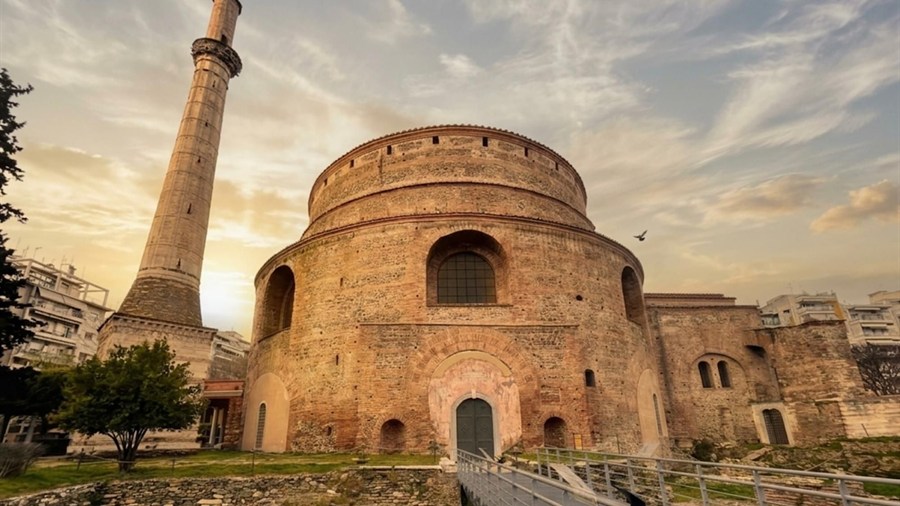
A Thessaloniki walking tour visits the Rotunda, a cylindrical building raised around 306 AD on the orders of Galerius, who was thought to have planned it as his mausoleum. It later served as a church, a mosque and a church again.
The Rotunda is also called the Rotunda of Saint George and the Church of Agios Georgios. It stands 125 m northeast of the arch, at the end of the old road.
The building measures 24.5 metres across, and its walls, more than 6 metres thick, have helped it withstand earthquakes. A flat brick dome rises 30 metres at the peak.
Theodosius I made it a church in the late 4th century. It served as a church of the Archangels for over 1,200 years, until the city fell to the Ottomans.
In 1590 it became the Mosque of Suleyman Hortaji Effendi, and a minaret was added. After the Greeks took the city in 1912, it was reconsecrated as a church, and the minaret stayed.
A Thessaloniki walking tour looks up at the surviving mosaics, including an evergreen wreath of twenty-five sections with lilies, laurels, pears, grapes and pomegranates. A band of saints with raised hands also survives.
- Built: Around 306 AD, on the orders of Galerius.
- Size: 24.5 metres across, with walls over 6 metres thick.
- Mosque years: 1590 to 1912, with a minaret that is still preserved.
- Status: The oldest of the churches of Thessaloniki.
Today the Ephorate of Byzantine Antiquities looks after the building, and a Thessaloniki walking tour sees in it both the Roman and the Christian city.
How does Saint Paul feature on a Thessaloniki walking tour?
A Thessaloniki walking tour recalls the visit of Paul the Apostle around 50 AD, on his second missionary journey, when he preached in the chief synagogue of the city on three Sabbaths and laid the ground for its first Christian church.
Paul, born Saul of Tarsus, left on his second missionary journey from Jerusalem in late autumn 49 AD. Silas joined him, and in Lystra the two met Timothy, who travelled on with them.
A vision of a man of Macedonia drew the group to Macedonia. After a spell in jail at Philippi, Paul took the Via Egnatia from Philippi to Thessalonica.
From Thessalonica, Paul travelled on by Berea to Athens, where he preached in the Agora and at the Areopagus. He then moved on to Corinth and stayed there for 18 months.
From Corinth, Paul wrote 1 Thessalonians to the church, a letter a majority of scholars date to 49 to 51 AD. A Thessaloniki walking tour counts it among the earliest surviving Christian texts.
In the letter, Paul thanks the Thessalonians for their faith and love. He reminds them that he worked to earn his keep and notes that they had turned from idols.
- Visit: About 50 AD, on the second missionary journey.
- Companions: Silas and Timothy, who joined him on the journey.
- Road: The Via Egnatia, from Philippi to Thessalonica.
- Letters: First and Second Thessalonians, in the Biblical canon.
Papyrus 46, from around AD 200, holds one of the oldest surviving copies, and a Thessaloniki walking tour on the Apostle Paul theme brings the story back to the city.
Which UNESCO monuments does a Thessaloniki walking tour cover?
A Thessaloniki walking tour follows the Paleochristian and Byzantine monuments of Thessaloniki, a group listed by UNESCO in 1988. The listing covers fifteen monuments in the city. They range from the 4th-century Rotunda of Saint George to the 14th-century Byzantine Bath.
For centuries, Thessaloniki stood as the second city of the Byzantine Empire in importance. Its Paleochristian monuments shaped the growth of Byzantine art and architecture across the empire and in Serbia as well.
A Thessaloniki walking tour reads this past in brick, marble and mosaic. The Ottoman Empire captured the city in 1430. The Christian monuments survived that conquest and were not destroyed by the new rulers.
The oldest entries on the list are the City Walls, dated to the 4th and 5th centuries, and the Rotunda of Saint George. The Church of the Acheiropoietos follows in the 5th century.
Seven of the fifteen entries date to the 14th century. They include the Church of Saint Panteleimon, the Church of Saint Nicholas Orphanos, the Church of Christ Saviour and the Church of Prophet Elijah.
- Latomou Monastery: The UNESCO list dates this monastery to the 6th century.
- Saint Demetrios: The list gives the main church of the patron saint a 7th-century date.
- Panagia Chalkeon: Its entry on the list carries an 11th-century date.
- Byzantine Bath: A 14th-century bath appears on the list beside the churches.
Each church on the route is one of fifteen structures inscribed under a single UNESCO name. A Thessaloniki walking tour links these sites through the historic centre and the upper town.
Why does a Thessaloniki walking tour stop at the Church of Saint Demetrius?
A Thessaloniki walking tour stops at Hagios Demetrios, the main sanctuary of Saint Demetrius, patron saint of the city. The church joined the UNESCO World Heritage List in 1988. Its five-aisled basilica dates from a rebuilding in 629 to 634.
The first church here replaced a Roman bath in the early 4th century AD. A century later, the prefect Leontios swapped the small oratory for a larger, three-aisled basilica on the same spot.
Repeated fires gutted the church. The five-aisled rebuilding gave it the form that a Thessaloniki walking tour sees today, with six mosaic panels from that era still in place.
The six panels predate Byzantine Iconoclasm of 730 and show Saint Demetrius with founders and children. An inscription below one thanks heaven for saving the city from a pagan Slavic raid in 615.
Under Bayezid II, about 60 years after 1430, the church became a mosque named Kasımiye Camii after the local mayor, Cezeri Kasım Pasha. It served as a mosque from 1493 to 1912.
- Crypt: Tradition and excavation place the imprisonment and martyrdom of Demetrios in an old bathhouse below the church.
- Holy water: In the 5th century, the fountain of that bathhouse became a source of holy water.
- Museum: The crypt opened as an exhibition space in 1988 and displays finds across seven rooms.
- Reconsecration: After decades of restoration work, the church was reconsecrated in 1949.
Hagios Demetrios sits at the heart of a Thessaloniki walking tour. Beyond the old town, the city also serves as the starting point for a Meteora day trip from Thessaloniki.
Who was Saint Demetrius, the patron saint at the centre of a Thessaloniki walking tour?
A Thessaloniki walking tour meets Saint Demetrius in the churches of the city. He was a Greek Christian martyr of the early 4th century AD and is the patron saint of Thessaloniki. His epithet, the Myroblyte, means the Myrrh-Gusher.
Early accounts say Demetrius was born to pious Christian parents in Thessalonica in 270. He came from a senatorial family and served as proconsul of the Thessalonica district while still a young man.
He was run through with spears in around 306, during the Christian persecutions under the emperor Galerius. The 7th-century mosaics in his church match this account of his death.
A Thessaloniki walking tour also meets the later legend. The city faced repeated Slavic attacks and sieges, and Demetrius received credit for miraculous defence. Later traditions turned him into a soldier of the Roman army.
Scholars hold that the saint had no physical relics for four centuries after his death. An empty shrine, the ciborium, stood in their place. Later remains won acceptance once they emitted a strong-scented myrrh.
- Feast day: The Orthodox feast of the saint falls on 26 October.
- Military saint: In the Middle Ages, he became a leading Orthodox military saint.
- Sinai icon: A 12th-century icon at Sinai shows him bearded on a red horse beside George on a white horse.
- Lyaeus: Icons show him spearing the gladiator Lyaeus.
A Thessaloniki walking tour meets his name beyond the churches too. Dimitris in Greek and Dimitar in Bulgarian derive from Demetrius and remain in common use.
What does a Thessaloniki walking tour reveal inside Hagia Sophia?
A Thessaloniki walking tour reaches Hagia Sophia, a church whose current structure dates from the 7th century. It ranks among the oldest churches still standing in the city. UNESCO listed it in 1988 with the other Byzantine monuments of Thessaloniki.
A church has stood here since the 3rd century. That earlier church collapsed in 620, and an earthquake is the suspected cause. The present building followed later in the 7th century.
Its builders based it on the Hagia Sophia in Constantinople. The ground plan is a domed Greek cross basilica, typical of the Byzantine middle period. Its peers include the Gül and Kalenderhane Mosques in Istanbul.
A Thessaloniki walking tour looks up to the dome mosaic of the Ascension, with an inscription from Acts 1:11. All Twelve Apostles, Mary and two angels ring the dome.
In the Iconoclastic era, the apse held plain gold mosaics with one great cross. After the victory of the Iconodules, an image of the Theotokos replaced the cross in 787 to 797.
- Crusader cathedral: The Fourth Crusade made the church the cathedral of Thessaloniki in 1205, a role that lasted until 1224.
- Mosque: After Murad II took the city on 29 March 1430, the church became the Ayasofya Camii.
- Restoration: Charles Diehl restored the building between 1907 and 1909, after a fire in 1890.
- Dome: The dome itself was not restored until 1980.
The building returned to use as a church upon the liberation of Thessaloniki in 1912. A Thessaloniki walking tour therefore finds a church, not a mosque, on this site.
How old is the Church of the Acheiropoietos on a Thessaloniki walking tour?
A Thessaloniki walking tour finds the Acheiropoietos at Agias Sofias street, opposite Makedonomachon square. Its bricks and mosaics date it to between about 450 and 470. That dating makes it a candidate for the earliest surviving church in the city.
In Byzantine times the church was known as the Panagia Theotokos, and it is dedicated to Mary. Its current name, first attested in 1320, is thought to come from an icon not made by hands.
The building is a three-aisled basilica, 28 metres wide and 36.5 metres long. A Thessaloniki walking tour enters through the tribelon, a triple-arched opening between the narthex and the main nave.
Early 13th-century frescoes on the southern side depict the Forty Martyrs of Sebaste. Beneath the north aisle, three layers of floor mosaics from an earlier Roman-era bath have come to light.
After the Ottoman conquest of 1430, Sultan Murad II made the Acheiropoietos the first church in the city to become a mosque. It served as the principal mosque under the name Eski Camii.
- Saint Irene: A middle Byzantine chapel of Saint Irene adjoins the northern aisle.
- Baptistery: A small building on the south side has been identified as the baptistery.
- Galleries: Galleries rise above the two side aisles.
- Inscription: A text of Murad on the eighth column from the east records 833 AH.
Byzantine sources say the cult of Saint Demetrius was also practised here. A Thessaloniki walking tour therefore links this basilica with the cult at Hagios Demetrios.
Why is Panagia Chalkeon on a Thessaloniki walking tour called the Red Church?
A Thessaloniki walking tour reaches Panagia Chalkeon at Dikastirion Square. The church is built entirely of bricks, which gave it the popular nickname Red Church. Its name means the Virgin of the Copper-smiths, after the traditional area of the coppersmiths nearby.
A founder’s inscription above the west entrance dates the church to 1028. The founder was Christopher, a protospatharios and katepano of Longobardia, who acted with his wife, his son and two daughters.
A Thessaloniki walking tour sees a cross-in-square plan with four columns and three domes, one central and two over the narthex. A marble cornice divides the walls into upper and lower sections.
The central dome is octagonal, 3.8 metres wide and 5.3 metres high, with sixteen windows in two rows. A painting of the Ascension takes the place of the usual Pantocrator.
Bordered by an inscription on the eastern arch, the Last Supper here is the earliest extant depiction of that scene in the bema of a Byzantine church. The narthex walls show the Last Judgment.
- Mosque name: After 1430, the church became the Kazancilar Camii, the Mosque of the Cauldron-Merchants.
- Mosque years: It served as a mosque until 1912.
- Earthquake: A restoration in 1934 followed the Chalkidiki earthquakes of 1932.
- Founder’s tomb: The tomb believed to be Christopher’s lies in an arcosolium in the north wall.
A Thessaloniki walking tour also notes small anomalies here. The north wall is slightly longer than the south wall, and the four central columns do not form an exact square.
What does a Thessaloniki walking tour see at the Church of the Holy Apostles?
A Thessaloniki walking tour finds the Church of the Holy Apostles at the start of Olympou Street, near the western medieval walls. This 14th-century church holds late examples of Byzantine mosaic, the last of their kind in Thessaloniki.
A column fragment to the south and a cistern to the northwest show that the church belonged to a larger complex. It appears to have been the katholikon of a monastery.
Inscriptions name Nephon, Patriarch of Constantinople in 1310 to 1314, as the ktetor, or founder. A text on the eastern wall adds his pupil, the hegumenos Paul, as second ktetor.
Carbon-14 analysis points to a later date for the whole structure, around 1329. A Thessaloniki walking tour sees a composite, five-domed cross-in-square church with four supporting columns and walls of patterned brick.
Between about 1520 and 1530, the Ottomans turned the church into a mosque. They removed the gold tesserae and covered the mosaics and frescoes with plaster. A minaret rose at the southwest corner.
- Mosque name: In the 19th century, the building took the name Soğuksu Camii, the Mosque of the Cold Water.
- Reconsecration: The structure became a church again in 1912.
- Frescoes revealed: Restoration and the gradual uncovering of the frescoes began in 1926.
- Mosaics restored: After the 1978 earthquake, the building was strengthened, and its mosaics were restored in 2002.
A series of Marian scenes and an image of the hegumenos Paul kneeling before Mary point to a dedication to Mary. A Thessaloniki walking tour reads that history on the walls.
What mosaic does a Thessaloniki walking tour find at Hosios David?
A Thessaloniki walking tour reaches Hosios David, a late 5th-century church that served as the katholikon of the Latomos Monastery. Its apse holds a 5th-century mosaic, the Icon of Christ of Latomos. The church is dedicated to David the Dendrite.
Tradition traces the icon to the late third century AD, when Maximian and Diocletian ruled the Roman Empire together. It is also known as the Miracle of Latomos and counts among the acheiropoieta.
According to tradition, Princess Flavia Maximiana Theodora, the Christian daughter of Emperor Maximian, found the icon. She hid it from the pagan Roman authorities. A Thessaloniki walking tour sees an image with this layered past.
The icon survived Byzantine iconoclasm in the eighth century. A monk from Lower Egypt rediscovered it before the twelfth century. It came to light again in 1921, when the building was reconsecrated to Saint David.
Under Ottoman rule, the church became a mosque called Suluca Mosque or Murad Mosque. Its walls and art disappeared under plaster. A minaret stood at the southwest corner bay, and its base still remains.
- Ezekiel: The icon depicts an apocalyptic scene with imagery from the Book of Ezekiel, the first of its type.
- Frescoes: Middle Byzantine murals from around 1160 to 1170 were found under the plaster.
- Palaeologan work: The entry into Jerusalem and two other frescoes belong to the Palaeologan period, around 1300.
- Marble: Marble decoration shows crosses, vines and leaves in swirling detail.
The church stands further from the heart of Thessaloniki, closer to the mountains, behind a simple exterior. A Thessaloniki walking tour finds the mosaic in the apse.
What does a Thessaloniki walking tour find in the upper town at Vlatades and Saint Catherine?
A Thessaloniki walking tour climbs into Ano Poli, the upper town, for two listed sites. Vlatades Monastery dates from the 14th century. The Church of Saint Catherine stands in the northwestern corner of Ano Poli and dates from the Palaiologan period.
Vlatades Monastery rose in the 14th century, in the late era of the Byzantine Empire. Tradition holds that it stands on the former site of the house of Jason. UNESCO lists it with 14 other monuments.
During the siege of Thessalonica from 1422 to 1430, the monks cooperated with the Ottoman troops. The monastery escaped pillage as a result. Sultan Murad II later granted it privileged status under Ottoman rule.
A Thessaloniki walking tour then moves to the Church of Saint Catherine. Its exact date and original dedication are unknown. Its interior decoration survives only in fragments dated to around 1315.
One suggestion holds that the church was the katholikon of the Monastery of the Almighty. Yakup Pasha made it a mosque in the reign of Bayezid II, who ruled from 1481 to 1512.
- Galen: In 2005, a manuscript of Galen’s Peri Alypias came to light in the library of Vlatades.
- Mosque name: As a mosque, Saint Catherine bore the name Yakup Paşa Camii.
- UNESCO spelling: The 1988 list names the monastery Blatades Monastery.
- Listing: Saint Catherine was one of fifteen structures inscribed on the UNESCO list in 1988.
Vlatades still stands as a monastery in Ano Poli. A Thessaloniki walking tour ends its monastic theme here, while a Mount Athos cruise carries that theme further.
Why does a Thessaloniki walking tour recall the massacre of Thessalonica in 390?
A Thessaloniki walking tour recalls the massacre of Thessalonica, in which Roman troops killed local civilians around 390. The killing followed the lynching of Butheric, a Roman general, in a riot. Scholars hold that Theodosius the Great either ordered or permitted it.
In 390, Butheric commanded the garrison of Illyricum, which included Thessalonica. A mob lynched him after he jailed a popular charioteer and refused to release him. Sozomen is the only source for this story.
A Thessaloniki walking tour places the killing in the hippodrome, where the citizens had gathered. One account puts the dead at 7,000 men, women and children. The exact date remains unknown and disputed.
Theodosius was not in Thessalonica at the time, since the court sat in Milan. Ambrose, bishop of Milan, wrote to the emperor and refused him the Eucharist until he showed repentance.
Theodosius accepted the terms of the bishop. Ambrose readmitted him to communion on Christmas Day in 390, after an eight-month penance. The earliest record of these events comes from fifth-century church historians.
- Sozomen: His Historia ecclesiastica dates from around 442.
- Theodoret: The bishop of Cyrrhus wrote the lengthiest account, but it ranks as the least reliable.
- Law: In August 390, Theodosius is said to have ordered a 30-day wait before executions.
- Church door: McLynn calls the encounter at the church door in Milan a pious fiction.
Since Edward Gibbon wrote The Decline and Fall of the Roman Empire, the response of Ambrose has served as an example of church dominance over the state. A Thessaloniki walking tour ends with this episode.
What does a Thessaloniki walking tour reveal about the city walls?
A Thessaloniki walking tour along the walls follows a 4 kilometre circuit that once enclosed the medieval city. The present walls date from the early Byzantine period, around 390, and mix ashlar masonry with bands of brick in the late Roman manner.
Thessaloniki was fortified from its establishment in the late 4th century BC. The Roman conquest of 167 BC brought peace and left the walls weak. By the middle of the 1st century, they lay in ruins.
In the 3rd century, defences rose against the Goths, built with material from older buildings. These works repelled two Gothic attacks, in 254 and 268. The Roman wall was 1.65 m wide, with square towers.
Galerius and Constantine the Great strengthened the walls in the early 4th century. The wall visible today rose between the end of the 4th century and the middle of the 5th century.
A Thessaloniki walking tour also reads later threats in the walls. A 7th-century programme supported defence against the Avars and the Slavs. In 904, the Saracens captured the city from the sea.
- Sea walls: The sea walls were strengthened after the Saracens departed.
- Seaward side: Ottoman authorities demolished the entire seaward section in the late 19th century.
- Main street: The main street, Leoforos or Mesi, ran from the Golden Gate in the west to the Cassandreot Gate in the east.
- World Heritage: UNESCO listed the walls in 1988 for their Byzantine architecture.
The northern stretch joins the acropolis, a separate fortified enceinte. A Thessaloniki walking tour climbs from there towards the Heptapyrgion, known by its Ottoman name, Yedi Kule.
Why does a Thessaloniki walking tour stop at the Heptapyrgion fortress?
A Thessaloniki walking tour reaches the Heptapyrgion, or Yedi Kule, on the north-eastern corner of the acropolis. Its name means Fortress of Seven Towers, yet it has ten. It served as a Byzantine and Ottoman fortress, then as a prison until 1989.
A Thessaloniki walking tour finds two building phases here. The five northern towers form the northern corner of the acropolis. One view dates them to Theodosius I, another to the 9th century.
The southern five towers and wall are dated to the 12th century, though the dating remains disputed. They formed a fortified redoubt inside the citadel. The fort was maintained and rebuilt in the Palaiologan period.
An inscription over the gate records a rebuilding by Çavuş Bey, the first Ottoman governor of the city, in 1431. Archaeology has disproved the idea of a wholly new construction at that date.
A 1591 account calls the fort the Iç Kale, or Inner Castle. It was then the residence of the military governor of the city and held a 300-strong garrison.
- Prison: The fortress became a prison during the 1890s and appears as one on an 1899 map of the city.
- Name: The name is thought to follow the Yedikule Fortress in Constantinople.
- Rebetiko: The colloquial name of the prison, Yedi Kule, recurs in rebetiko songs.
- Restoration: Systematic study and restoration of the fortress began in 1990.
After the prison closed in 1989, the fort opened a new chapter for a Thessaloniki walking tour. The 9th Ephorate of Byzantine and Modern Antiquities moved offices there, and excavations revealed an early Christian basilica.
What does a Thessaloniki walking tour find in Ano Poli, the upper town?
A Thessaloniki walking tour climbs into Ano Poli, the old town around the acropolis north of the centre. It is the highest part of the city and keeps its Byzantine and Ottoman street plan, with stone-paved lanes and old squares.
Ano Poli preserves much of the Byzantine and Ottoman city design. Houses there follow traditional Greek and Ottoman architecture. The district is also known as a centre for poets, intellectuals and bohemians.
The Eptapyrgio, a Byzantine and Ottoman fort, dominates the district from the acropolis. A Thessaloniki walking tour also traces what remains of the old city walls, which still surround Ano Poli.
Ottoman and Byzantine structures still stand here, including the Church of Prophet Elijah, the Church of St. Nicholas Orphanos, the Taxiarches church, the Church of Saint Catherine and the Vlatades Monastery.
Other landmarks include the Karipio Melathro and Villa Varvara. People linked with the district include the writer Dinos Christianopoulos, the Turkish poet Nâzım Hikmet and Konstantinos Zervas, a mayor of Thessaloniki.
- Byzantine bath: The district holds the Byzantine bath, the next stop on the route.
- Atatürk Museum: The house museum of Mustafa Kemal Atatürk stands in the upper town.
- Alaca Imaret: The Alaca Imaret Mosque also stands among the Ottoman structures of the district.
- Writers: Kostis Moskof, Antonis Sourounis and Georgios Vafopoulos appear among the writers linked with Ano Poli.
On clear days, Mount Olympus, about 80 km away across the gulf, shows on the horizon from a Thessaloniki walking tour of Ano Poli. A Mount Olympus day trip reaches the mountain itself.
Which Byzantine bath does a Thessaloniki walking tour pass in the upper town?
A Thessaloniki walking tour passes the Byzantine Bath of the Upper City on Theotokopoulou Street. The bath dates to the late 12th or early 13th century, worked continuously until 1940 and is the only Byzantine bath surviving in Thessaloniki.
Byzantine sources never mention the bath, so it is thought to have belonged to a monastery complex. In Ottoman times it was known as Kule Hammam, the bath of the tower.
A Thessaloniki walking tour finds a plan that follows Roman bath conventions. A south entrance leads to frigidarium dressing rooms, then two vaulted tepidarium rooms and two square caldarium rooms with hypocausts.
One caldarium was covered by a dome on an octagonal base with eight windows. A cistern to the north provided the water, and a hearth beneath the cistern warmed it.
Men and women used the building in turn during Byzantine times. In the Ottoman period, blocking off each pair of rooms from the other split it into male and female sections.
- Choumnos: The 14th-century writer Nikephoros Choumnos claimed that the city had more baths than inhabitants.
- Size: It is the largest of the Byzantine baths that survive in Greece.
- Other baths: Ruined Byzantine public baths survive in Corinth, Sparta, Paramythia and Ioannina Castle.
- Earthquake: After the 1978 earthquakes, heavy propping by the 9th Ephorate of Byzantine Antiquities kept the bath standing.
After four years of restoration, the bath re-opened to the public in June 2015 as a museum and cultural space, now a stop on a Thessaloniki walking tour of Ano Poli.
Why does a Thessaloniki walking tour include Bey Hamam?
A Thessaloniki walking tour reaches Bey Hamam on Egnatia Street, east of Panagia Chalkeon. Sultan Murad II built it in 1444 as the first Ottoman bath in Thessaloniki, and it ranks as the foremost Ottoman bath still standing in Greece.
The building also carries the name Baths of Paradise. It is a double bath, with separate parts for men and women. Each part follows the same plan of cold, tepid and hot rooms.
The male quarters are the larger and more luxurious side. A large octagonal cold room has a gallery resting on columns, arcades around the windows and a painted cupola.
The tepid room, also octagonal, has a cupola with oculi and painted plants. A Thessaloniki walking tour then reaches the hot rooms, set around a large cruciform room with the massage table at its centre.
Eight small hot and tepid rooms open off this space, with basins and marble benches. A large rectangular cistern on the east side secured the water supply for both baths.
- Use: The baths stayed in use under the name Baths of Paradise until 1968.
- Lease: The Greek archaeological service then leased the building for four years.
- Restoration: Restoration followed the 1978 earthquake, which shook the city especially hard.
- Today: The baths host cultural events and short exhibitions, and the eastern annex holds the main shop of the Foundation of Archaeological Receipts.
Bey Hamam stands among the remaining traces of Ottoman culture in Thessaloniki. A Thessaloniki walking tour covers its rooms, while a Thessaloniki food tour turns to the kitchens of the city.
What does a Thessaloniki walking tour show at the Alaca Imaret Mosque?
A Thessaloniki walking tour reaches the Alaca Imaret Mosque, also called the Ishak Pasha Mosque. Its Turkish name means Colourful Mosque. Ishak Pasha ordered its construction in 1484 or 1487, and the complex joined a mosque with an imaret.
The imaret served as a public charity kitchen joined to the mosque. The mosque was completed in the 1480s, during the Ottoman era, under the direction of Ishak Pasha.
The plan is a reverse T, a form common to early Ottoman architecture. A Thessaloniki walking tour sees two large domes over the prayer hall and five smaller domes on the portico.
The mosque had one minaret. It was destroyed after 1912, once the Greek Army had taken Thessaloniki and the city had become part of the modern Greek state.
The mosque counts among the Ottoman and Byzantine structures that still stand in Ano Poli, as do the Byzantine bath and the Atatürk Museum on the same Thessaloniki walking tour.
- Name: Alaca İmaret Camii translates as Colourful Mosque.
- Use: Neither the mosque nor the imaret is in use any more.
- Restoration: The mosque is under restoration.
- Plan: The reverse T layout links the building to early Ottoman architecture.
The domes and portico still show the early Ottoman form that Ishak Pasha commissioned, while the lost minaret marks the change of rule in 1912.
What history does a Thessaloniki walking tour find at the Hamza Bey Mosque?
A Thessaloniki walking tour reaches the Hamza Bey Mosque, built between 1467 and 1468 in the Ottoman era. Thessalonians know it as Alkazar, after a cinema that operated in the building for decades. The mosque was abandoned in the 1820s.
A Thessaloniki walking tour tells a founding story with two names. Hafsa Hatun, daughter of Isa Bey Evrenosoğlu, ordered the building, yet it took the name of Hamza Bey, the Beylerbey of Rumeli.
Later earthquakes and fires damaged the mosque. It was rebuilt in 1620, and a madrasa was added at that time. The building is covered by a dome, and its minaret was removed after 1923.
After the population exchange between Greece and Turkey, the mosque ceased to serve as a religious building. It passed to the National Bank of Greece and first housed military services.
It was declared a protected monument in 1926, yet it was sold to private owners in 1928. Decades of use as a cinema brought extensive modifications to the structure.
- Cinema name: The name Alkazar comes from the cinema that ran in the premises.
- Madrasa: The rebuilding of 1620 added a madrasa to the mosque.
- Owner: The National Bank of Greece held the building after the population exchange.
- Dome: A dome covers the building, though the minaret is gone.
The mosque was handed to the Greek Ministry of Culture in 2006, and restoration work began. A Thessaloniki walking tour reads its layers of mosque, military use and cinema in one building.
Why does a Thessaloniki walking tour visit the Yeni Mosque of the Dönmeh?
A Thessaloniki walking tour reaches the Yeni Mosque, whose Turkish name means new mosque. Italian architect Vitaliano Poselli built it in 1902 for the Dönmeh, crypto-Jewish converts to Islam. It was the last mosque built in Ottoman Thessaloniki.
A Thessaloniki walking tour finds the mosque in the Hamidiye district, in the south-eastern part of the city. It was the only mosque in its immediate district. The Dönmeh kept elements of Judaism.
The 1923 population exchange counted the Dönmeh among the Muslim community, and they left the city. The empty mosque then sheltered Greek refugees from Asia Minor before it was shut down.
From 1925 to 1962, the building housed the Archaeological Museum of Thessaloniki. Its minaret and fountain were demolished after its 1938 listing as a preservable monument, to free space for the museum.
A Thessaloniki walking tour notes the mix of styles. The design is eclectic, with Baroque and Renaissance elements, traditional Islamic forms and neoclassical influences. The building measures 23.3 by 14.9 metres externally.
- Prayer hall: The square prayer hall measures 13.7 metres a side and holds the mihrab.
- Inscriptions: An Ottoman and Italian inscription with the name of Poselli survives beside a sundial and the mihrab inscription.
- Courtyard: Ancient Greek, Roman and early Christian artefacts, such as marble sarcophagi and stelae, lie in the courtyard.
- Orientation: The mosque faces Mecca and sits at an angle to the surrounding urban fabric.
The municipality of Thessaloniki acquired the building in 1986. In 2012, mayor Yiannis Boutaris reopened it for worship during Ramadan, the first such use in 90 years.
How does a Thessaloniki walking tour present the Atatürk Museum?
A Thessaloniki walking tour reaches the Atatürk Museum at 17 Apostolou Pavlou Street, next to the Turkish Consulate. Mustafa Kemal Atatürk was born in this three-floor house in 1881, when Salonika was still part of the Ottoman Empire.
His father, Ali Rıza Efendi, was a military officer, title deed clerk and lumber trader. His mother, Zübeyde Hanım, came from a farming family in Langaza, west of Salonica. One sister, Makbule, survived childhood.
His mother encouraged him to attend a religious school, which he did only briefly. His father then directed him to the Şemsi Efendi School, a private school with a more secular curriculum.
His father died when he was seven. His mother wanted him to learn a trade, yet he sat the entrance exam for the Salonica Military School in 1893.
On a Thessaloniki walking tour, the house reveals the 2nd-floor room of his birth, with a banquette, his desk and a large brazier. Documents from his schooldays hang on the walls.
- First floor: A reception room, a sitting-room, his mother’s room and a kitchen fill this level.
- Courtyard: A pomegranate tree planted by his father still grows in the courtyard.
- Colour: Repairs in 1981 returned the house to its original pink.
- Gift: The Thessaloniki City Council gave the house to the Turkish State in 1935, and the state turned it into a museum.
A Thessaloniki walking tour notes that the house predates 1870 and stood in the Ottoman Koca Kasım Paşa district. In 1981, a replica of the house was built in Ankara.
How does a Thessaloniki walking tour trace the Ottoman layer of the city?
A Thessaloniki walking tour traces the Ottoman layer through Hagia Sophia and the upper town. After Sultan Murad II captured the city on 29 March 1430, the church became a mosque called Ayasofya Camii and kept its old name.
Hagia Sophia’s present structure dates from the 7th century, modelled on the Hagia Sophia in Constantinople. A church had stood on the site since the 3rd century, until its collapse in 620.
Before the Ottoman era, the Fourth Crusade made the church the cathedral of Thessaloniki in 1205. The Despotate of Epirus, under Theodore Komnenos Doukas, freed the city in 1224.
A Thessaloniki walking tour then climbs to Ano Poli. In the Ottoman period, it was the main district for the Turks of the city, while Greeks, western Europeans and Jews lived below around the port.
The building was reconverted to a church upon the liberation of Thessaloniki in 1912. Ano Poli kept its Byzantine and Ottoman street plan, with small stone-paved streets and houses in Greek and Ottoman styles.
- Plan: Hagia Sophia follows the plan of a domed Greek cross basilica.
- Dome mosaic: The dome shows the Ascension, ringed by the Twelve Apostles, Mary and two angels.
- Apse: An image of the Theotokos replaced the apse cross in 787-797.
- Restoration: Charles Diehl restored the building between 1907 and 1909 after a fire in 1890.
The mosque phase of Hagia Sophia ran from 1430 to 1912. A Thessaloniki walking tour pairs that span with the Ottoman houses and lanes of Ano Poli above the centre.
What does a Thessaloniki walking tour show at the Museum of Byzantine Culture?
A Thessaloniki walking tour that stops at the Museum of Byzantine Culture reaches a building by architect Kyriakos Krokos, opened on 11 September 1994. Its eleven permanent exhibitions trace early Christian, Byzantine and post-Byzantine life, mainly from the wider region of Macedonia.
A nationwide architectural competition for the museum was announced in 1977, and the entry of Kyriakos Krokos won it. Building work started in March 1989 and ended in October 1993, ahead of the opening.
Antiquities held at the Byzantine and Christian Museum in Athens came north in June 1994. The first show carried the title Byzantine Treasures of Thessaloniki: The Return Journey, and it marked their homecoming.
Room 1 covers the early Christian church, with finds from the 4th to the 7th century. Room 3, From the Elysian Fields to the Christian Paradise, deals with graves, gravestone inscriptions and tomb paintings.
A Thessaloniki walking tour meets a collection that spans the 2nd to the 20th century. It includes about 30,000 coins found in Thessaloniki and wider Macedonia, plus 100 seals and 70 mosaics.
- Award: The museum won the Council of Europe’s Museum Prize in 2005.
- Prints: Room 8 shows more than 200 prints from the Dori Papastratos Collection.
- Workshops: Seven laboratories and workshops fill 2750 square metres of the building.
- Final room: Room 11, Discovering the Past, traces an object from excavation to display.
A Thessaloniki walking tour treats this museum as the Byzantine chapter of the day. The eastern side of the centre also holds the archaeological museum, the next stop on the route.
Which finds does a Thessaloniki walking tour reach at the Archaeological Museum?
A Thessaloniki walking tour that enters the Archaeological Museum of Thessaloniki meets artefacts from the prehistoric to the Roman periods. The building, by architect Patroklos Karantinos, dates from 1962 and holds finds from the city and from the wider region of Macedonia.
A new wing was added in 1980, and the finds from Vergina were shown there until 1997. Two rounds of renovation, in 2001 and 2004, reorganised the permanent displays before the Athens Olympics.
The new wing hosts The Gold of Macedon. It follows gold from the 6th century BC to 148 BC, with finds from cemeteries at Sindos, Agia Paraskevi, Derveni, Serres and other sites.
A second exhibition, The Thessaloniki Area in Prehistory, covers the Neolithic to the Late Bronze Age. It presents the first excavations, carried out by British and French troops during the First World War.
A Thessaloniki walking tour then crosses the central rooms. These hold architectural members from an Ionic temple of the 6th century BC and finds from the palace complex that Galerius built in the city centre.
- Derveni Papyrus: The papyrus dates from the end of the 5th century BC.
- Sindos finds: A bronze helmet and a gold mask come from the Sindos cemetery.
- Agia Paraskevi: A marble door and a rebuilt tomb façade come from this Macedonian tomb.
- Las Incantadas: Plaster casts of the figures are on show, while the originals are in the Louvre.
The Vergina finds were shown in the new wing until 1997. A Vergina day trip extends a Thessaloniki walking tour from these halls to the site that produced them.
Where does a Thessaloniki walking tour find the Jewish Museum of Thessaloniki?
A Thessaloniki walking tour finds the Jewish Museum of Thessaloniki at 13 Agiou Mina Street. Run by the city’s Jewish community, it tells the history of Sephardic Jews and Jewish life in Thessaloniki, and its Ladino name is Museo Djudio de Salonik.
The museum dates from 2001. Evangelos Venizelos, then Minister of Culture, inaugurated it with Andreas Sefiha, president of the Jewish Community of Thessaloniki, who had worked toward the project since 1994.
The building went up in 1904 to a design by the Italian architect Vitaliano Poselli. It housed the Bank of Athens from 1906 to 1925 and later the Jewish newspaper L’Independent.
On the ground level stand tombstones and inscriptions from the great Jewish necropolis that lay east of the city walls. Photographs from 1914 show the cemetery and its visitors at that time.
A Thessaloniki walking tour then climbs to the first floor. There, a narrative runs from the third century BCE to the Second World War, and a separate exhibit covers the Shoah in the city.
- Restoration: Work on the building ran from 1998 to 2003.
- New wing: A wing opened in 2019 added four spaces and a shop.
- Collections: Holdings include ketoubot, rare Hebrew books and building members from demolished synagogues.
- Network: The museum belongs to the Association of European Jewish Museums.
The Shoah exhibit records that 49,000 people from the community were deported to Auschwitz and Bergen-Belsen. A Thessaloniki walking tour that stops here gives that loss a fixed place.
Why does a Thessaloniki walking tour stop at the Monastir Synagogue?
A Thessaloniki walking tour stops at the Monastir Synagogue because it survived the Second World War. Known in Judaeo-Spanish as Kal de los Monastirlis, it is an Orthodox congregation and synagogue built between 1925 and 1927 for Jews from Monastir.
Funding came from Jews of Monastir, then in the Kingdom of Yugoslavia. Ida Aroesti gave the main share in memory of her late husband Isaac, joined by the Camhi, Massot and Calderon families.
Ernst Loewy, born in Buchau in Austria-Hungary, drew up the design. He worked as engineer for the Austrian company that built the railway between Thessaloniki and Vienna, and he settled in the city in 1938.
Haim Raphael Habib, acting Chief Rabbi of Thessaloniki, consecrated the building on 24 September 1927. Families had fled Monastir during the Balkan Wars of 1912 to 1913 and the First World War.
A Thessaloniki walking tour hears how the Red Cross requisitioned the synagogue during the war, which saved it. An earthquake in June 1978 damaged the structure badly, and the Greek government restored it.
- Restoration: Architect Elias Messinas and KARD Architects completed a historic restoration in 2016.
- Worship: Shabbat prayers and services on Jewish holidays still take place inside.
- High holidays: Services mark the Days of Awe from Rosh Hashanah to Yom Kippur.
- Nearby: A newer synagogue and the community offices stand on Tsimiski Street downtown.
The Jewish Museum of Thessaloniki sits near the Tsimiski Street location, so both sites fit into one Thessaloniki walking tour of Jewish heritage.
What Jewish history does a Thessaloniki walking tour explain?
A Thessaloniki walking tour explains a Jewish story that runs from the third century BCE to the Second World War. Sephardic Jews from Spain arrived during the Ottoman period, and the city became the largest centre of Sephardic Jews in Europe.
Paul the Apostle taught in the area now called the Upper City. Later, Sephardic Jews named the city la madre de Israel, or Israel’s mother, and Jerusalem of the Balkans.
The ancient Greek-speaking Romaniote community lived alongside them. Judeo-Spanish, the Romance language of the Sephardic Jews, was the speech of a large part of the community, and Jewish merchants were prominent in commerce.
The Germans occupied Greece in 1941. In 1943 the Nazis forced the Jewish population into a ghetto near the railway lines and began deportations to concentration and labour camps.
A Thessaloniki walking tour marks 15 March 1943, when the first train left the city. Later trains took about 50,000 people to Auschwitz-Birkenau, and around 94% of the remaining Jews were killed.
- Census: The Ottoman Census of 1902 counted the Sephardic community as half of the population.
- Cemetery: The Nazis bulldozed the ancient Jewish Cemetery, which held around 500,000 tombs.
- Memorial: A Holocaust memorial in Eleftherias Square went up in 1997 where Jews were rounded up.
- Today: A community of around 1,200 remains in the city.
Descendants of Thessaloniki Jews, Sephardic and Romaniote, live mainly in the United States and Israel. A Thessaloniki walking tour of this history can end at Eleftherias Square.
What does a Thessaloniki walking tour see at Aristotle University of Thessaloniki?
A Thessaloniki walking tour that crosses Aristotle University of Thessaloniki enters the largest university in Greece. Its campus covers 230,000 square metres in the city centre, and in 1925 it became the first Greek university founded outside Athens.
The university takes its name from the philosopher Aristotle, born in Stageira, about 55 kilometres east of Thessaloniki. It ranks as the fifth oldest tertiary institution in Greece and took its present name in 1954.
The campus rose on the remains of the old Jewish cemetery, destroyed during the Nazi occupation. Gravestones from that cemetery served as building material in the construction of the university.
A monument to the cemetery was unveiled on campus in 2014. It sets gravestones in a bed of grass beside a broken menorah, and a new Faculty of Jewish Studies began work in October 2015.
A Thessaloniki walking tour also passes the Teloglion Fine Arts Foundation on the northern side of the campus. Founded in 1972, it shows works by Greek artists of the 19th and 20th centuries.
- Library: Founded in 1927, it is the second largest library in Greece after the National Library.
- Emblem: The university emblem shows St. Demetrius of Thessaloniki.
- Seismology: The Seismological Station, founded in 1978, records earthquakes in Greece and worldwide.
- Byzantine studies: The Centre for Byzantine Research dates from 1966.
Panepistimio station on the metro serves the campus, so a Thessaloniki walking tour can move from the lecture halls to the station displays of the line.
How does a Thessaloniki walking tour use the Thessaloniki Metro and its finds?
A Thessaloniki walking tour can use the Thessaloniki Metro, a fully automated, driverless system of two lines and 18 stations. Its construction set off the largest archaeological dig in northern Greek history, and finds now sit in permanent displays inside the stations.
Work on the main line began in 2006, and the Kalamaria extension followed in 2013. Line 1 runs within the municipality of Thessaloniki and calls at 13 stations between New Railway Station and Nea Elvetia.
Line 2, the Kalamaria Extension, adds five stations on a 4.78 km route between 25 Martiou and Mikra. Its works met no major archaeological finds, so it avoided long delays.
Between New Railway Station and Sintrivani, the line runs beneath the Decumanus Maximus, the main road, buried 5.4 metres down. At Venizelou station, 75 metres of marble-paved, column-lined road came to light.
One scholar called the Venizelou find, with its shops and plumbing, the Byzantine Pompeii. A tetrapylon marked the crossroads where the main road met a cardo, and 22 more metres appeared at Agias Sofias.
- Statue: A headless statue of Aphrodite came out of the ground during the works.
- Mosaics: Fourth-century AD mosaics and a golden wreath joined the finds.
- Coins: The dig produced 50,000 coins, plus a bath complex and urban villas.
- Scale: Over 300,000 artefacts have been unearthed across a 20 square kilometre area.
Attiko Metro redesigned the line and sank the tunnels to between 14 and 31 metres. A Thessaloniki walking tour that rides between stations sees the mini-museums this redesign produced.
Which festivals and venues fit into a Thessaloniki walking tour?
A Thessaloniki walking tour passes venues for the Thessaloniki International Film Festival, the Dimitria festival and the Thessaloniki Concert Hall. The film festival dates from 1960, and the Dimitria festival, founded in 1966, takes its name from Saint Demetrius.
The film festival counts as one of the leading film festivals in Southern Europe. Francis Ford Coppola, Catherine Deneuve, Irene Papas and Fatih Akın have taken part, and the Olympion Theater serves as its site.
A Documentary Festival, founded in 1999, focuses on films about global social and cultural developments. The Dimitria festival covers music, theatre, dance, local happenings and exhibitions in honour of the patron saint.
The Thessaloniki Concert Hall opened in 2000 on land the Greek state donated. Its M1 building has an auditorium of 1400 seats, while M2, by Japanese architect Arata Isozaki, holds smaller performance spaces.
A Thessaloniki walking tour also meets the city’s opera, born in 1997 when Thessaloniki was European Capital of Culture. The opera is based at the Concert Hall, within the National Theatre of Northern Greece.
- International Fair: The Thessaloniki International Fair was first established in 1926.
- Photography: The International Festival of Photography places exhibitions in museums, galleries, bookshops and cafés.
- Open-air theatres: The Earth Theater and the Forest Theater are open-air amphitheatres overlooking the city.
- Books: Thessaloniki also holds an annual International Book Fair.
The Nea Paralia parks run 3 km along the coast to the concert hall. The beaches of Chalkidiki lie close to the city, and a Halkidiki boat tour extends the trip beyond town.
Which names for the city does a Thessaloniki walking tour explain?
A Thessaloniki walking tour explains a name that honours Thessalonike, half-sister of Alexander the Great. Cassander founded the city in 315 BC and named it after his wife, whose name means Thessalian victory, a nod to the Battle of Crocus Field.
The form Saloníki first appears in Greek in the Chronicle of the Morea, from the 14th century. The short form is older still, since al-Idrisi already called the city Salunik in the 12th century.
That short form shaped names across the region: Solunŭ in Old Church Slavonic, Saloniko in Judeo-Spanish, Saloniki in Hebrew, Selânik in Ottoman Turkish, and Selanik in modern Turkish and Albanian.
Italian has Salonicco, the local South Slavic languages have Solun, and Russian has Saloníki. Aromanian gives Sãrunã and Megleno-Romanian gives Săruna, both built on the same short Greek form.
A Thessaloniki walking tour in English meets more spellings. Thessalonica led in print until the early 20th century, Salonika then took over for much of that century, and Thessaloniki became the common name by about 1985.
- Official name: Thessaloniki returned as the official name in 1912, when the city joined the Kingdom of Greece.
- Co-capital: Greeks also call it Symprotévousa, the co-capital, after its Byzantine rank beside Constantinople.
- Legend: A Greek legend says Thessalonike became a mermaid in the Aegean after Alexander died.
- Ottoman era: The city was the capital of the Sanjak of Selanik until 1826.
Local speech gives the name a dark, deep L, typical of the modern Macedonian dialect of Greek, and its written short form is Θεσ/νίκη.
What do travellers ask about a Thessaloniki walking tour?
A Thessaloniki walking tour raises four common questions: which UNESCO monuments lie on the route, whether the walk climbs to the Upper Town and walls, which museums suit wet weather, and whether a Jewish heritage walk is on offer in the city.
Which UNESCO monuments does a Thessaloniki walking tour pass?
In 1988, fifteen monuments of Thessaloniki joined the UNESCO World Heritage list. A Thessaloniki walking tour passes the 4th-century Rotunda of Saint George, the 5th-century Church of Acheiropoietos, the 7th-century Church of St. Demetrios, the 8th-century Church of St. Sophia and the 11th-century Church of Panagia Chalkeon. The list also covers the Byzantine Bath.
Does a Thessaloniki walking tour reach the Upper Town and the walls?
Yes, when the route climbs to Ano Poli, the old town around the acropolis north of the centre. Its stone-paved streets lead to the Eptapyrgio fort and Vlatades Monastery. The walls, once 4 kilometres long, date from about 390 and joined the UNESCO list in 1988. On clear days Mount Olympus shows on the horizon.
Which museums suit a rainy day on a Thessaloniki walking tour?
The Museum of Byzantine Culture, with eleven permanent exhibitions, the Archaeological Museum of Thessaloniki, with The Gold of Macedon, and the Jewish Museum on Agiou Mina Street all keep a rainy Thessaloniki walking tour indoors. Metro stations with permanent in-station exhibitions add further covered stops.
Is there a Jewish heritage Thessaloniki walking tour?
Yes. Tour listings include a private Jewish heritage tour of Thessaloniki and a route titled Jewish Heritage and Monuments at Thessaloniki. The same theme covers the Jewish Museum on Agiou Mina Street, the Monastir Synagogue and the Holocaust memorial in Eleftherias Square.