

A Mount Olympus day trip visits the highest mountain in Greece, on the border of Macedonia and Thessaly, in a single day. The trip is one of the Greece Tours on Greece Ville.
This post covers the protected park, its rocks, plants and animals, the first climbers, the monasteries, old wars and castles.
The villages round the mountain, its weather, its foods and common questions come last. The sections include Mount Olympus day trips that can be booked online.
What is a Mount Olympus day trip?
A Mount Olympus day trip enters Olympus National Park, founded by Royal Decree 20 of 1938. Olympus is the second-highest mountain of the Balkan Peninsula. The park spans four municipalities: Dion-Olympos and Katerini in Pieria, Tempi and Elassona in Larissa.
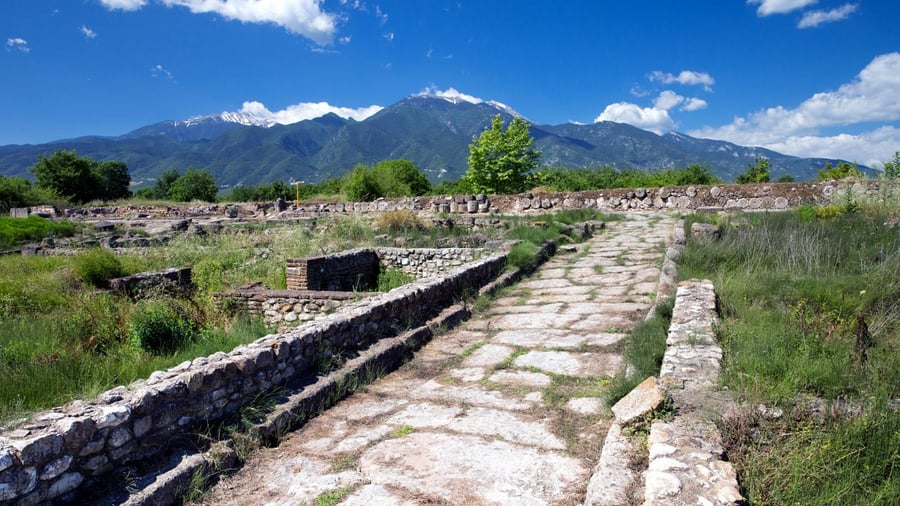
The decree appeared in Government Gazette issue 248. A ministerial decision in 1985 approved the park’s operating rules. A presidential decree in 2021 drew its protection zones and set the allowed land uses and activities.
On a Mount Olympus day trip, the protection comes in layers. The Natura 2000 site GR1250001 serves two roles. It is a Special Area of Conservation and a Special Protection Area for birds.
Lower Olympus has its own Natura 2000 site, GR1420001, named Kato Olympos – Kallipefki. A second site, GR1420008, joins southern Lower Olympus with Mount Godamani and the Rodia valley.
On a Mount Olympus day trip, two UNESCO titles apply. The biosphere reserve covers 37,371 hectares, with no settlements inside. Dion, Litochoro, Karitsa and Kokkinopilos lie around it. The World Heritage property, The wider area of Mount Olympus, covers 18,938 hectares.
UNESCO lists that property as serial and mixed, under criteria (vi) and (x). The park’s management unit, based in Litochoro, looks after nine Natura 2000 sites. They run from the Pieria Mountains to the Pineios delta.
On a Mount Olympus day trip, the Ziliana gorge marks a border. The gorge, 13 km long, divides Mount Olympus from Lower Olympus. Kallipefki village sits on a plateau on the west side of Lower Olympus, at about 1,040 metres.
- Category: The IUCN places Olympus National Park in protected-area category II.
- Survey: A satellite survey in autumn 2022 put Mytikas at 2,918.390 metres.
- Kurz: The result matched the 1921 height of the Swiss surveyor M. Kurz to within 12.8 cm.
- Old figures: Before 2022, published heights for Mytikas ranged from 2,917 to 2,919 metres.


Which rocks built a Mount Olympus day trip?
A Mount Olympus day trip crosses a tectonic window in the earth’s crust. There, erosion and warping have exposed old rock layers that are normally hidden. Mildly altered limestones of an old carbonate platform show through the Pelagonian rock units above them.
These limestones date from the Triassic and from the Early Cretaceous to the Eocene. They end in flysch. The geologist Godfriaux spotted the window after finding Eocene nummulite fossils near the top of the limestone.
On a Mount Olympus day trip, the upper rocks tell a separate story. The highest unit is a broken-up ophiolite unit, covered by Cretaceous limestone. Between the Pelagonian units and the window lies the Ambelakia unit, which holds blueschist.
Near Kallipefki on Lower Olympus, the Ossa rock unit was pushed on top of the Olympos unit. Normal faults border the window on its eastern side, against younger Neogene and Quaternary deposits.
On a Mount Olympus day trip, the slopes change with height. The eastern slopes are Upper Triassic dolomitic limestone, between 200 and 2,000 metres. The Mytikas summit rocks are Jurassic and span 2,000 to 2,918 metres. Eocene flysch lies on the north-western slopes between 600 and 1,200 metres.
The rocks went through high-pressure metamorphism between 34 and 26 million years ago. Plate movement still pushes Olympus up by one to four millimetres a year, so the mountain keeps growing.
On a Mount Olympus day trip, ice left its mark. At least three sets of glacial deposits have been recorded on the mountain. Chlorine-36 dating of moraine boulders shows that cirque glaciers lasted in Megala Kazania into the Holocene.
- Homeric Minimum: A glacier grew on Olympus during a weak-sun period between about 800 and 600 BC.
- Fossils: Fossil sea animals turn up at 1,000 to 1,500 metres. An ammonite was found at about 1,100 metres.
- Landforms: UNESCO lists glacial cirques, limestone cliffs, karst sinkholes and olistolith fields on the mountain.
- Lower Olympus: The lower massif is made of serpentine rock, gneiss and other rocks.
Which plants grow on a Mount Olympus day trip?
A Mount Olympus day trip meets 26 plants found on Olympus and nowhere else on earth. Endemics cluster in the alpine meadows and rock habitats of the high zone. The park’s management unit keeps the full list of these species.
Olympus-only plants include the bellflower Campanula oreadum and the cinquefoil Potentilla deorum. Two dandelions, Taraxacum deorum and Taraxacum thessalicum, are on the list. So are Centaurea litochorea, Silene oligantha and Viola striis-notata.
On a Mount Olympus day trip, Jankaea heldreichii, a violet-flowered rock plant, is the botanical star. It was long treated as the only member of its own genus. It grows in damp limestone cracks from 400 to 2,400 metres, chiefly between 700 and 1,400 metres.
Its violet flowers make no nectar, yet bumblebees of more than one kind still visit them. The IUCN rates the plant Near Threatened, and the Bern Convention protects it.
On a Mount Olympus day trip, the Bosnian pine has a local link. It was first described in 1863 from specimens Theodor von Heldreich collected on Olympus. Old trees have bark broken into small plates like crocodile skin.
Its cones are dark blue-purple and turn brown when ripe, about 16 to 18 months after pollination. Above 2,500 metres, the pines grow in a low, crawling form.
On a Mount Olympus day trip, the forest belts follow height. Mediterranean pine forest with endemic black pine covers almost 40% of the Natura site. Beech and silver fir forests grow between 600 and 1,400 metres.
- Protected flora: More than 160 plant taxa on Olympus are protected, rare or endemic.
- Downy oak: A high forest of about 120 hectares grows on the north slopes of Xirolakos valley. It sits at 600 to 700 metres.
- First botanist: Botanical study of Olympus began in 1836 with the French botanist Aucher-Éloy.
- Orchids: About 30 orchid species grow on the mountain.
Which animals live on a Mount Olympus day trip?
A Mount Olympus day trip enters a home for 157 bird, 40 mammal and 23 reptile species. UNESCO’s World Heritage listing for Olympus gives these counts. Of the birds, 36 are protected under the first annex of the EU Birds Directive.
The Balkan chamois herd on Olympus numbers about 426 to 469 animals, the largest in Greece. It makes up about one third of all Balkan chamois in the country. Olympus is one of only seven Greek areas where the animal lives.
On a Mount Olympus day trip, the chamois stand apart. Olympus chamois have a pink tongue, a feature seen in no other population. Their genes differ strongly from chamois on other Greek mountains. They form a separate gene pool.
The brown bear has reappeared on Olympus in recent years. Of the mammals, 20 species are protected by the EU Habitats Directive, and 16 of them are bats.
On a Mount Olympus day trip, raptors are scarcer than before. Golden eagles number only 1 to 2 pairs on the mountain. Short-toed snake eagles raise 6 to 7 breeding pairs each summer and hunt mainly snakes.
The bearded vulture has been gone from Olympus since the 1990s. Griffon and Egyptian vultures still pass through, but they no longer nest on the mountain.
On a Mount Olympus day trip to the high zone, alpine birds take over. Wallcreepers, alpine accentors, horned larks and alpine choughs live in the high meadows and rocks.
- Black storks: One to two pairs breed on Olympus in summer.
- Tortoises: Hermann’s and marginated tortoises live on the low and middle slopes.
- Amphibians: The Macedonian crested newt and the Greek stream frog are strictly protected here.
- Butterflies: Olympus counts 155 of the 239 butterfly species recorded in Greece.
Who first reached the summit on a Mount Olympus day trip?
A Mount Olympus day trip recalls the 1913 first ascent. On 28 July, Frédéric Boissonnas and Daniel Baud-Bovy reached Litochoro. They hired the lumberjacks Christos Kakkalos and Nikos Bistikos. The party’s first night on the mountain was at Petrostrouga.
In 1862, the German geographer Heinrich Barth drew a detailed map of Olympus. The German engineer Eduard Richter tried to climb Mytikas in 1909, 1910 and 1911, but failed each time.
On a Mount Olympus day trip, Richter’s story reads like an adventure novel. In 1911, klephts abducted him and killed the Ottoman gendarmes who escorted him. He spent three months as a captive of the band of Liolios.
On 30 July 1913, the climbers reached the Muses Plateau and climbed Profitis Elias and Toumba. They first topped a lower peak and named it Victory Peak, after the Battle of Sarantaporo. They left a card in a bottle there.
On a Mount Olympus day trip, the summit day sounds hard. It rained, and it was cold and foggy. Two shepherds came along to carry the heavy camera gear. Kakkalos took the gear for the final climb. The trio stood on Mytikas at 10.25 in the morning.
The climbers first named the summit Venizelos Peak, and it was later called Mytikas. The card from Victory Peak was found in 1927. The Hellenic Federation of Mountaineering and Climbing now keeps it.
On a Mount Olympus day trip, Stefani has its own first. In 1921, Kakkalos led the Swiss topographer Marcel Kurz, the first climber of Stefani. Kurz’s 1923 book Le Mont Olympe held the first detailed map of the summits.
- Map: The map was drawn at 1:20,000, and the book added four panoramas and three plans.
- Book: The 1913 climb became widely known through La Grèce immortelle, published in 1919.
- Painter: In 1928, Vasilis Ithakisios climbed with Kakkalos and named a cave the Shelter of the Muses.
- Last climb: Kakkalos last stood on the summit in 1973, at the age of 91.
Which monasteries stand on a Mount Olympus day trip?
A Mount Olympus day trip can reach the monastery of Saint Dionysios of Olympus. The saint was born around 1500 in Sklataina, today’s Drakotrypa, near Karditsa. At about 18, he became a monk at the Great Meteoron, under the name Daniel.
Saint Dionysios is the patron saint of Litochoro, and his feast day is 23 January. A letter from the Russian tsars, dated 13 June 1692, let the monks carry his skull around Russia.
On a Mount Olympus day trip, the old monastery shows its wounds. German bombing and explosives in 1943 left only the abbot’s building standing. Years before, on 15 June 1936, the monastery had hosted the first Panhellenic Mountaineering Congress.
In the new monastery, the inner part follows the abaton rule, so women cannot enter it. Patriarch Bartholomew opened the sacristy museum in late spring 1999, in a restored building from 1860.
On a Mount Olympus day trip, the museum holds rare items. It keeps the 1542 Ottoman permit for the monastery. A gold-thread epitaph, made in 1578-79 by Arsenius, a Meteora monk, survives there too. In the cave chapel, a tiny prayer room marks where the saint said liturgy.
Kanalon takes its name from four wild brooks, the kanalia or channels. They join to form the Ziliana river. Its oldest written record is a 1638 inscription on the frescoes of the All Saints chapel.
On a Mount Olympus day trip to the Thessalian side, Petra monastery has a long past. A founding slab dates it to 1151, under Bishop Nikitas and Emperor Manuel Komnenos. It was a sanatorium for poor tuberculosis patients from 1939 to 1969.
- Kanalon rebuild: The katholikon collapsed in 1881 and was rebuilt in 1883 to plans by Efthymios Milios.
- Petra clinic: After 1969, Petra served as a psychiatric clinic until 2004.
- Sparmos: Records show monks at Sparmos since at least 1386. Its chandeliers carry porcelain bowls and ostrich eggs.
- Frescoes: The painter Georgios and the priest Ioannis frescoed the Sparmos church in 1633.
Which wars reached a Mount Olympus day trip?
A Mount Olympus day trip crosses old armatolik ground. Under Ottoman rule, Olympus was one of the main armatolik districts, policed by Greek militia. Its seats stood at Katerini, Elassona and Servia. Tolios Lazos, born around 1710, led the Pieria captains from Milia.
In April 1813, Veli, son of Ali Pasha, raided Milia by night. He captured the women and children of the Lazaioi, the clan of Tolios Lazos.
On a Mount Olympus day trip, the 1822 revolt is close at hand. In March 1822, Grigoris Salas, named leader by Ypsilantis, reached Eleftherochori. On 8 March, Diamantis Nikolaou attacked Kolindros. The scholar Theophilos Kairis fought in the revolt and was wounded.
In 1823, Anastasios Karatasos and Angelis Gatsos led their bands across the mountain to fight in southern Greece. Kosmas Doumpiotis later led the 1878 Olympus revolt.
On a Mount Olympus day trip to Litochoro, 1878 left scars. On 20 February, Bishop Nikolaos Lousis declared the revolt in Kolindros. There, 300 men attacked the Turkish garrison. On 4 March, Ottoman troops retook Litochoro and burned 9 churches and 320 houses.
The revolt ended with an armistice signed at Smokovo on 19 April 1878. From 14 to 16 April 1941, the New Zealand 5th Infantry Brigade held the Olympus Pass. Brigadier James Hargest led it.
On a Mount Olympus day trip past Platamon, the ridge recalls 1941. The New Zealand 21st Battalion dug in there near a ruined castle. On 15 April, the Maori Battalion saw German vehicles stretching 22.5 km back to Katerini.
- Losses: New Zealand lost 40 men killed, 50 wounded and 130 captured in the Battle of Olympus.
- Tempe: On 18 April 1941, Brigadier Arthur Allen’s Anzac Force fought a day-long rearguard at the Tempe Gorge.
- 1943: On 19 April, a battle above Tachnista, today’s Milia, left 40 Germans and 18 Greeks dead.
- 1946: On 30 March, ELAS veterans blew up Litochoro’s gendarmerie station. The act is seen as the start of the Civil War.
Which castles guard a Mount Olympus day trip?
A Mount Olympus day trip along the coast passes Platamon, the best-preserved castle of north-central Greece. The culture ministry counts eight four-sided towers on its outer wall. The wall also carries battlements and a wall-walk. The inner enclosure wall rises 6 to 7 metres.
The battlements date from the Ottoman phase. Craftsmen who knew the old Byzantine methods added them. The gate has a Byzantine round vault on its inner side and an Islamic pointed arch outside.
On a Mount Olympus day trip, Platamon’s towers stand out. Free-standing towers like these appear mainly in Serbia and Romania. The closest Greek parallel stands at Methoni. Under Ottoman rule, the castle church of Agia Paraskevi served as a mosque.
Around 1224, Theodore Komnenos Doukas captured Platamon as he ended the Frankish Kingdom of Thessalonica. After the Battle of Pelagonia in 1259, Michael VIII Palaiologos took the castle. He held Frankish prisoners there.
On a Mount Olympus day trip, the Ottoman story of the castle runs long. The Ottomans first took Platamon around 1385. On 9 August 1470, the Venetian captain Angiolello wrote that the Sultan camped near a castle called Platimonia.
Greeks held the castle briefly in 1770, 1825 and 1878. Captain Sachtouris shelled it in 1897, and the Ottomans then abandoned it.
On a Mount Olympus day trip, Platamon also serves as a stage. The Olympus Festival uses the castle as a venue. OR.FE.O, a non-profit based in Katerini, runs the festival.
- Servia: The town of Servia, in the Kozani unit, has a 6th-century Byzantine castle.
- Wedding gift: In October 1256, Servia passed to Emperor Theodore II Laskaris as a wedding gift.
- Leivithra: Pieria’s list of forts places the acropolis of ancient Leivithra at a site called Kastri.
- Louloudies: Near Korinos, a fortified bishop’s seat of the late 5th century measures 80 by 90 metres.
Which villages ring a Mount Olympus day trip?
A Mount Olympus day trip can climb to Palaios Panteleimonas, at 440 metres on its foothills. Its founding is placed in the late 14th century. In the early 1980s, Theo Angelopoulos filmed scenes of his film Megalexandros there.
Palaioi Poroi, once called Pourlia, is a traditional settlement on the south-eastern side of Olympus. It has 4 permanent residents. Christoforos Perraivos, a fighter of 1821 and author of war memoirs, came from there.
On a Mount Olympus day trip, Skotina shows how villages moved downhill. Old Skotina, at about 750 metres, was abandoned for good in 1972. The community counted 857 inhabitants in 2021. Its name comes from woollen cloth made there for cloaks and ship sails.
Rapsani grew from 31 households in 1466 to 154 in 1570. In 1767, Bishop Dionysios of Platamon founded its school. Its rich libraries burned in 1878, during the Olympus revolution.
On a Mount Olympus day trip to the Thessalian side, Karya stands at 900 metres. Myth says Zeus imprisoned the Titans here after the last phase of the Titanomachy.
Kokkinopilos was called Kokkinoplos until 1940. The old name seems to come from the red clay soil of the area. Local tradition says Vlach farmers and herders founded the village around the 12th century.
On a Mount Olympus day trip past Livadi, a revolutionary birthplace appears. Giorgakis Olympios, a leading figure of the Greek Revolution, was born there in 1772. The Agia Triada monastery south of the village is seen as the starting point of the 1878 revolution.
- Vrontou: The village stands at 120 metres and had 1,762 inhabitants in the 2021 census.
- Name: Vrontou takes its name from the roar of the Agia Triada stream rushing down from Olympus.
- Caravan stop: The village began in the early 17th century as Karavan Serai at Platydromos.
- Move: Around 1700, the village moved 2 km south to its present site.
What weather meets a Mount Olympus day trip?
A Mount Olympus day trip passes weather stations run by Aristotle University of Thessaloniki. Its Department of Meteorology and Climatology runs two of them. The alpine station on the Agios Antonios peak has run since 1963, though only in the summer months.
Storms and thunder can stop the summit station from working normally. A second university station stands at 1,850 m, where the weather is milder. It sits at the Army’s mountain combat and ski training centre.
On a Mount Olympus day trip, lightning is a real force. In winter 1964-1965, lightning cut two of the three cables holding the university’s weather mast on Agios Antonios. Ice and strong winds later brought the damaged mast down.
Scientists caught summer clouds at 1,800 m and 2,817 m to measure how radioactive they were. A 1968 University of Thessaloniki report from the Olympus Cumulus Project studied the artificial draining of summer ground-clouds.
On a Mount Olympus day trip, snow sets the calendar. Snow starts to build up in late October or early November and can last until July. Snowfields and ice still survive all year in the Megala Kazania cirque, between about 2,300 and 2,400 m.
They last because the cirque lies only about 18 km from the Aegean Sea. The sea shapes its climate. Aerial photos show the snow and ice covered a much larger area between 1960 and 1980. That was a time of more winter precipitation.
On a Mount Olympus day trip, ice hides underground too. A lasting ice cave holds glacial ice 30 m deep. Under the lasting snowfields, scientists found a permafrost layer 15 m thick. There, the average yearly air temperature of the last 10 years is above 0 °C.
- Grant: The summit station building was raised for the Olympus Cumulus Project. NATO paid for it under Grant no. 131.
- Glacier line: Today the snowline needed for a glacier lies above the summit, at about 2,918 m.
- Melting: Warming and early-summer storm rain have nearly wiped out the lasting snowfields in the past 10 years.
- Snowy winters: The loss went on even after very snowy winters on the mountain.
Which foods come from a Mount Olympus day trip?
A Mount Olympus day trip on the Thessalian side reaches the wine village of Rapsani. In 1932, the Greek state recognised Rapsani wine as an appellation of origin. At that time, 53% of the income of its people came from vine growing.
In 1836, the writer L. Leonardos described Rapsani as ringed by tended vineyards with excellent grapes. The Wine and Vine Museum of Rapsani has been open since 2012. It traces local vine growing and winemaking from the 17th and 18th centuries to today.
On a Mount Olympus day trip, mountain tea grows wild. Greek mountain tea, Sideritis scardica, is native to Greece, especially the Olympus area. It also grows wild in four other Balkan countries. Botanists first described it in 1844, and the IUCN lists it as Near Threatened.
EU herbal experts accept Sideritis tea for coughs with a cold and mild stomach upset. The basis is long traditional use.
On a Mount Olympus day trip, the cheese counter is full. Cheeses made around Katerini include feta, kasseri, manouri, anthotyros, kefalotyri and mizithra. Kasseri, a PDO cheese, must be made in Thessaly, Macedonia, Lesbos or Xanthi. It must age at least three months.
Manouri, a PDO whey cheese made mainly in Thessaly and Macedonia, has only about 0.8% salt. Batzos, a PDO brined cheese, comes from Western Macedonia, Central Macedonia and Thessaly.
On a Mount Olympus day trip, Skotina offers a sweet. The Pierian village grows chestnuts, and its traditional sweet is glyko kastano, chestnuts in syrup.
- Wine label: Wines from Pieria carry the EU’s Protected Geographical Indication.
- Honey: Pierian bee products include propolis, royal jelly, beeswax ointment and bee pollen.
- Cattle: Katerini Steppe cattle, a Podolian breed kept for meat and milk, face a high risk of extinction.
- Feta festival: Elassona holds a feta festival in late September every two years.
What do visitors ask about a Mount Olympus day trip?
A Mount Olympus day trip raises questions about height, the name, rescue, park rules, races and souvenirs. Until the 2022 survey, the last official height of the summit came from the Swiss surveyor M. Kurz. Later campaigns were unofficial.
How was the height measured on a Mount Olympus day trip?
A 1997 study had already used GPS to measure the heights of the Olympus summits. The 2022 survey used satellite readings accurate to 1 to 3 cm. Its triangulation heights were accurate to 5 to 10 cm.
What does the name mean on a Mount Olympus day trip?
NASA notes that the name Olympus means the luminous one in classical Greek. The name seems related to the Mycenaean word u-ru-pi-ja-jo, a term for a group of people. Homer and Hesiod called Olympus polydeiras and polyptychos, meaning ridged and folded.
Who helps in trouble on a Mount Olympus day trip?
The emergency refuge on Agios Antonios, at 2,817 m, holds Hellenic Rescue Team kit and a radio link. The team is a volunteer group based in Thessaloniki, with 34 divisions across Greece. Live data from the summit weather station helps rescue operations on the mountain.
Which park rules apply on a Mount Olympus day trip?
A presidential decree bans free overnight camping in the open on the mountain. It also bans fishing, and walking along or inside flowing stream beds unless the management plan allows it. Drone pilots needing approval notify the civil aviation authority at least 5 working days ahead.
Which races run on a Mount Olympus day trip?
The first mountain marathon on Olympus ran on 6 July 1986, with about 100 Greek runners. The Olympus Mythical Trail climbs 6,410 metres in total and closes after 28 hours. The Olympus Marathon, Ultra and Vertical belong to the Skyrunner World Series.
Which coins and stamps recall a Mount Olympus day trip?
In 2005, Greece issued a silver coin, National Park Olympus, showing the War of the Titans. Only 25,000 were struck, all in the 2005 annual coin set, so none circulate. On 19 July 2013, Greece issued four stamps marking 100 years since the first ascent.