
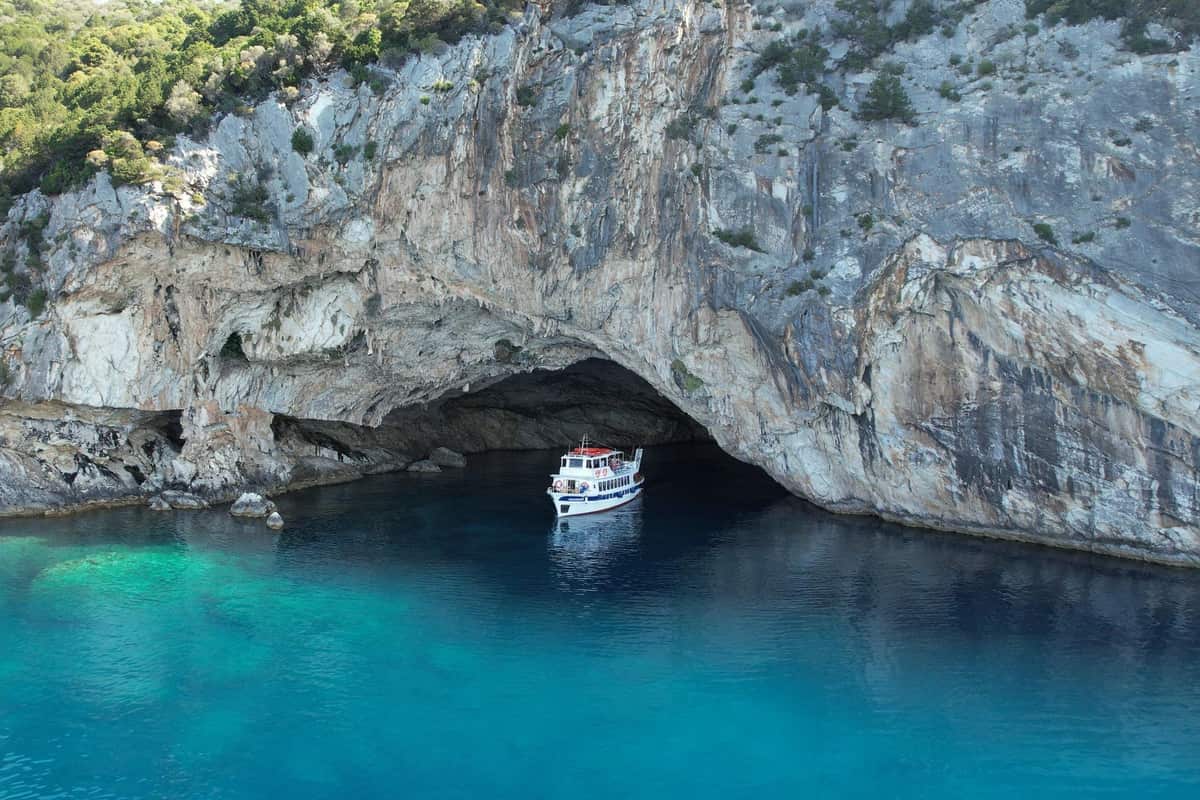
A Lefkada boat tour sails from Lefkada into the sheltered Inland Sea of islets between the island and the Greek mainland. The tour is one of the Greece Tours on Greece Ville, listed with the other Ionian Islands tours and Greece boat tours.
This post covers the sea the boats cross, its small islets, its dolphins, the Homer debate, old sea battles and the island’s fishermen.
Lighthouses, the best months and common questions come last. The sections include Lefkada boat tours that can be booked online.
What is a Lefkada boat tour?
A Lefkada boat tour from the east coast enters the Inner Ionian Sea Archipelago, Natura 2000 site GR2220003. It covers 865 km². Its sea floor lies chiefly 50 to 250 m deep, with rocky coasts and seagrass in the shallows.
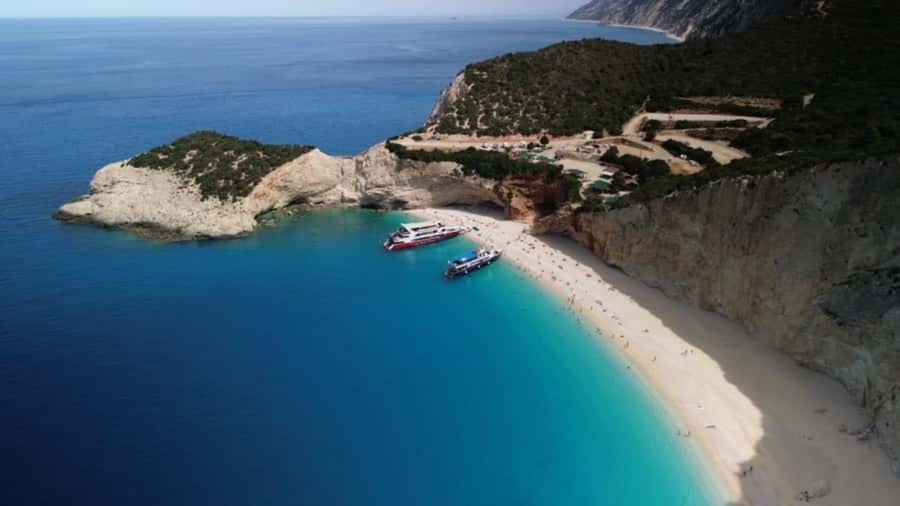
EU nature law names four species with critical habitat here. They are the bottlenose dolphin, monk seal, loggerhead turtle and giant devil ray.
On a Lefkada boat tour, monk seals are part of the picture. The wider Ionian Archipelago is an Important Marine Mammal Area. It holds an estimated 5.7% to 9.2% of the world’s Mediterranean monk seals.
On a Lefkada boat tour, the first sailors here were pirates. The ancient Teleboans lived chiefly by piracy, with Meganisi as their base. Middle Palaeolithic finds show Neanderthal groups in the archipelago about 200,000 to 45,000 years ago.
Wetlands in karst basins on Meganisi, Thilia, Atokos and Arkoudi were landmarks for those hunters. At low sea level, Kythros was joined to the other small islands and the mainland.
- Kalamos strait: From Hellenistic times, the strait between Kalamos and Mytikas gained military importance.
- Kastos: It lies 6 miles from Mytikas, its nearest mainland port.
- Lookout: In the 17th century, a lookout on Kastos warned Ithaca about passing Ottoman ships.
- Names: The islands between east Lefkada and the mainland are the Teleboan, or Taphian, Islands.


Which islets does a Lefkada boat tour pass?
A Lefkada boat tour passes Madouri, also called Moudra, an islet of 0.127 km². Besides the Valaoritis mansion, it has a Gothic-style church owned by the family. Sparti, also called Skasti, covers 0.538 km². It had no permanent residents in 2021.
Skorpidi covers 0.118 km², and half of it belongs to the politician Spilios Livanos.
On a Lefkada boat tour, the smallest islets have two names each. Heloni, also called Cheloni, lies west of Sparti and north of Madouri. Tsokari, or Sokava, is a rocky islet just west of Skorpios.
Thilia is an uninhabited islet of 0.155 km² west of Meganisi. Kythros, also called Kothros, is an uninhabited islet south of Meganisi. Arkoudi lies 7 km south-west of Meganisi and rises to 136 m.
On a Lefkada boat tour past Kythros, the Panther Cave is a surprise. Found on its north coast in 2010, it has been excavated since 2015. Its stone tools were made with the Levallois technique.
Between human stays, a leopard, Panthera pardus, used the cave as its den.
- Tools: The Levallois tools served for hunting and cutting up food.
- Atokos: It has belonged to the municipality of Ithaca since 1952.
- Formikoula: In 2012, 40 monk seals used this islet off Kalamos to rest and breed.
- Record: That was the densest seal group in Greece.
Which dolphins swim on a Lefkada boat tour?
A Lefkada boat tour crosses waters studied by the Tethys Research Institute. Marine ecologist Giuseppe Notarbartolo di Sciara founded it in Milan on 31 January 1986. It ran its Ionian Dolphin Project from Ithaca in 1995.
The project was based on Kalamos from 1996 to 2008. Its field base has been at Vonitsa since 2006.
On a Lefkada boat tour, the project’s work became a record of decline. Boat surveys from 1993 to 2003 covered 24,771 km over 835 survey days. They logged 428 common dolphin sightings and 235 of bottlenose dolphins.
Photo-identification from 1995 to 2015 recorded 205 common dolphins in the archipelago. Of those, 69 were seen only once. Of the other 136, 64 showed fairly strong loyalty to the area.
On a Lefkada boat tour, fishing explains the decline. A 2008 study found that 308 fishing boats removed about 3,571 tonnes a year. Common dolphins ate 17 tonnes. The authors warned of local disappearance without quick fishing rules.
A 2011 ecosystem model found common dolphins clearly increased only if the whole area closed to all fishing. Bottlenose dolphins appear more near fish farms, where the cages make prey easier to catch.
- Calves: Calves are seen regularly in the common dolphin groups, which feed at the surface.
- Range: Later surveys outside the archipelago matched more than 20 dolphins first identified inside it.
- Wanderers: Monitoring from 2008 to 2015 shows a small number of common dolphins still roam a wider area.
- Fish farms: Another model linked the bottlenose dolphin trend to the growing number of fish farm cages.
How did Homer reach a Lefkada boat tour?
A Lefkada boat tour across Vlichos bay passes the tomb of Wilhelm Dörpfeld. From 1900 he tried to prove that Homer’s Ithaca lay on Lefkas. Scholars later judged the effort unsuccessful. He was born in Barmen in 1853 and died on Lefkada in 1940.
His tomb stands on the Vlichos peninsula hill above the church of Agia Kyriaki. Small rented boats reach that church in Vlichos bay, opposite Nydri.
On a Lefkada boat tour, the Homer debate has ancient roots. Strabo appears to place Homer’s Ithaca on Lefkada in one passage, Geography 10.2.12. Dörpfeld won funding for his digs by calling the island Homer’s Ithaca.
A repeated Odyssey joke about coming on foot possibly hinted, for him, at the narrow land link.
On a Lefkada boat tour off Nydri, the plain itself is protected. The Nydri valley, from Mount Skaros to Magemenos at Nikiana, is a declared archaeological site. A double harbour, a ring of mountains and plentiful springs drew settlers from the Early Bronze Age.
- Tumuli: Hammond wrote that dating Dörpfeld’s Leucas tumuli had always been controversial.
- Caskey: J. L. Caskey put the R graves in Early Helladic II.
- Stepping-stone: Hammond called Leucas a stepping-stone on the route from Minoan Cythera to Italy.
- Pig cave: Dörpfeld also dug the pig cave of Evgiros, with Paleolithic and Neolithic finds.
Which sea battles were fought near a Lefkada boat tour?
A Lefkada boat tour sails waters near Actium, scene of a great sea battle. There, Antony’s fleet had 250 larger galleys with towers full of armed men. Octavian lost about 2,500 men. Antony lost over 5,000 men and 250 ships sunk or captured.
Agrippa led Octavian’s left wing, Lucius Arruntius the centre and Marcus Lurius the right. Antony’s flagship was a ten. An eight carried about 200 heavy marines, archers and at least six catapults.
On a Lefkada boat tour, older fights come to mind. In 428 BC the Athenian commander Asopius sailed west with 30 ships and landed on the Leucadian coast. Leucadians and coast guards cut off his retreat, and he died with the bulk of his force.
In October 1500 the Ottoman admiral Kemal Reis appeared with his fleet at Cape Santa Maria. In 1502 Venetians and thirteen papal galleys attacked Santa Maura, which fell on 30 August.
On a Lefkada boat tour, Preveza is the next great name. In 1538 Andrea Doria sent the Holy League fleet south toward Sessola, near Lefkada. A great Venetian galleon was left stranded and surrounded, but never captured.
- Dellius: Before Actium, Antony’s general Quintus Dellius defected to Octavian with the battle plans.
- 1684: Bekir Agha gave up Santa Maura under pressure from his 500 Albanians and 200 Greeks.
- Cost: That conquest cost Venice 127 dead and 128 wounded.
- 1798: About 500 French troops held the castle until a blockade forced them out on 17 November.
How do fishermen work the water on a Lefkada boat tour?
A Lefkada boat tour passes the island’s two lagoons, which locals call Divari or Ivaria. Inside the town lagoon lies the evari, a fish farm with traditional weirs. There, fish live and grow naturally behind fences of reeds and stakes.
Fish come in through the lagoon mouth, called the bouka. Tides and weather steer their movement inside. They are steered into small trap pens called pires or kouzloukia. A dip net or spear takes them out.
On a Lefkada boat tour, mullets and eels are the lagoon classics. In 1982 and 1983, mullets made up almost half of Greek lagoon catches and eels about 30%. Five grey mullet species live in Greek coastal waters.
An FAO study found that all Greek lagoons belonged to the state. They were leased to cooperatives or private investors. Eels from the bulk of Greek lagoons were auctioned in Athens and shipped live.
On a Lefkada boat tour around Meganisi, purse seiners work the open water. About 10 of them, 4% of the active fleet, took 33% of the fish removed there. They landed chiefly horse mackerel, European pilchard and bogue.
- Rules: Independent fishermen in unleased lagoon waters were limited to handlines, longlines and spears.
- No engines: They worked without lights or engines.
- Kastos: The island’s small population works mainly in tourism and fishing.
- Caique names: A caique’s name is painted or carved on a tablet below the bow.
Which lighthouses mark a Lefkada boat tour?
A Lefkada boat tour off Cape Lefkatas passes the Doukato light. It gives one white flash every 10 seconds. Its beam reaches 23 miles out to sea. The light station stands about 350 m back from the south-west tip of the island.
The first Doukato tower was square and stood on the west side of the keepers’ house. German forces destroyed it in 1941. In 1945 it was rebuilt as a 15 m concrete cylinder.
On a Lefkada boat tour through the canal, the fortress light comes first. The British built it in 1861 on one corner of the Santa Maura fortress. It guards the northern entrance, on the mainland side just north of the bridge.
It shows two flashes every 12 seconds, white or red depending on direction. The light shines 17 m above the sea from an unpainted 6 m square stone tower.
On a Lefkada boat tour heading south, the Volios light marks the southern entrance to the strait. Dating from 1913, it stands on a small islet about 6 km south of the bridge. It gives one quick flash every 1.5 seconds.
- Formikoula: A light 17 m above the sea marks the passage between Meganisi and Kalamos.
- Signal: It flashes every 4 seconds, white or red, from a 4 m round white lantern.
- 1915: A lighthouse on the largest Formikoula islet is on record since 1915.
- Aktio: Since 1928, a quick-flashing yellow light has led ships into the Ambracian Gulf.
Which months suit a Lefkada boat tour?
A Lefkada boat tour in August meets little rain, since Lefkada Town averages only 0.8 inches that month. Across the year, the town averages a high of 71 °F and a low of 56 °F. February brings 4.8 inches of rain.
February highs average 60 °F, with lows of 44 °F. April still brings 2.5 inches of rain.
On a Lefkada boat tour in late spring, nights in Lefkada Town average 59 °F. September nights are warmer, at 65 °F, while October nights average 58 °F.
Dolphin surveys around Meganisi, Kalamos and Kastos ran each year from late spring to September. They counted only calm days, at sea state 1, with no swell and clear visibility.
On a Lefkada boat tour in winter, food is hard to find for lagoon herons. They wait over the fish traps to grab a fish. Swans visit chiefly in the hardest winters.
- Late year: November highs average 64 °F, and December highs 59 °F.
- Survey effort: From 1995 to 2007, the surveys covered 34,801 km on 908 survey days.
- Salt season: The old salt pans needed strong summer sun and dry air. Both made sea water evaporate fast.
- Harvest: Salt was piled up and collected at the end of August.
What do visitors ask about a Lefkada boat tour?
A Lefkada boat tour raises questions about the water, the floating bridge, seals, birds and salt. The Ionian Archipelago marine mammal area takes its northern and southern limits from the 200 m depth contour. River and farm runoff into these waters is insignificant.
How clear is the water on a Lefkada boat tour?
Around Meganisi, Kalamos and Kastos, Secchi disk readings range between 10 and 30 m. The reading is the depth at which a lowered white disk vanishes from view.
How long is the floating bridge on a Lefkada boat tour?
With its two 10 m end ramps, the bridge measures 70 m in all. Its roadway measures 9 m. Craft up to 2 m tall pass under the ramps. The ramps lift hydraulically for other small boats.
When did the bridge on a Lefkada boat tour open?
Built at the Elefsina shipyards, it opened to traffic on 4 October 1986. It carries 600 vehicles an hour, against 50 on the old chain-driven rafts.
Which animals are protected on a Lefkada boat tour?
A ministerial decision set a 200 m restricted-access zone around Formikoula to protect monk seals. Presidential Decree 67/1981 protects the bottlenose and common dolphins of the inner archipelago. Seals that once rested on Formikoula’s beach now flee to underwater caves after visitors chased them.
Which birds visit the lagoon on a Lefkada boat tour?
The lagoon site’s bird list includes the common shelduck, black-winged stilt, whooper swan and Mediterranean gull. Herring gulls shelter at the lagoons all year round.
Who worked the salt pans on a Lefkada boat tour?
Under Venice, the salt pans supplied the Venetian market. From there, the salt reached northern Italy and central Europe. Women workers carried 25 to 30 kilos of salt barefoot on their backs to the central pile.