
Greece boat tours are trips on caiques, catamarans, sailing yachts and speedboats around the islands and coasts of Greece, from the Saronic Gulf and the Cyclades to Crete, the Dodecanese and the Ionian Sea. The page is part of the Greece Tours on Greece Ville.
This page covers what Greece boat tours are and the sea trips region by region, from the Saronic Gulf to the Sporades and the north. Common questions come last. Each section links to the Greece Ville posts on single tours.
What are Greece boat tours?
Greece boat tours are organised sea trips on motor craft, catamarans and sailing yachts that leave Greek ports for islands, bays and coasts across the Aegean, Ionian and Cretan seas, each run by a crew rather than by the passengers themselves.

The Aegean Sea lies between the Balkans and Anatolia, and nine of the twelve administrative regions of Greece border it. The Sea of Crete forms its southern part and covers 45,000 square kilometres.
The Ionian Sea washes the western coast of Greece, and its southern limit ends at Cape Passero, the southern point of Sicily. Every major island in that sea lies in the east.
Motorboats on Greece boat tours date from the 1880s. Gottlieb Daimler and Wilhelm Maybach tested a petrol boat on the Neckar River in 1886, and the Priestman Brothers began trials of a kerosene boat in 1888.
The earliest known sail image comes from Egypt and dates to about 3100 BCE. Estimates say a Roman sailing ship carried grain the length of the Mediterranean for less than moving it 15 miles by road.
- Speedboats: High performance speedboats can reach speeds of over 50 knots, set by hull shape and engine.
- Catamarans: Catamarans entered Olympic sailing in 1976, and the Nacra 17 later raced at the Tokyo Olympics.
- Cretan waters: The Sea of Crete is also called the North Cretan Sea.
- Roman cargo: Rome consumed about 150,000 tons of Egyptian grain each year.
Each boat type suits a different sea and stretch of coast, and the sections below follow Greece boat tours island group by island group.


Which Saronic Gulf routes do Greece boat tours cover?
Greece boat tours in the Saronic Gulf link Piraeus with Aegina, Poros and Hydra, islands of a gulf that lies between the peninsulas of Attica and Argolis, forms part of the Aegean Sea and has Athens on its north coast.
Greece boat tours cross water that took its name, in Greek myth, from King Saron, who drowned at the Psiphaea lake, called Psifta today. Cape Lomvardi lies south-west of Vouliagmeni.
Aegina was a trading island from early times. According to Herodotus, it began as a colony of Epidaurus, and Minoan pottery found there belongs to contexts of about 2000 BC.
The Aeginetic standard of weights, developed in the mid-seventh century BC, was one of the two standards in general use in the Greek world. Aegina founded no colonies, unlike Corinth, Chalcis, Eretria and Miletus. The Spetses day trip post covers the island at the mouth of the Argolic Gulf.
Older remains lie on the same island. Kolonna was a stone-built fortified site of the Early Bronze Age, and a Mycenaean refuge at Mount Ellanio dates to the end of the Late Bronze Age.
- Mint: Tradition says Pheidon of Argos established a mint on Aegina.
- Refugees: A Gothic raid on the Eastern Roman empire sent refugees to Spetses.
- Old Port: The Old Port of Spetses became one of the three largest cities of Argolis.
- League: Aegina belonged to the League of Calauria around the eighth century BC.
Day boats on Greece boat tours of the gulf share one stretch of water. The Hydra Poros Aegina cruise post links three islands, the Aegina boat trip post covers Aegina, and the Hydra day trip post covers Hydra.
How do Greece boat tours use the Santorini caldera?
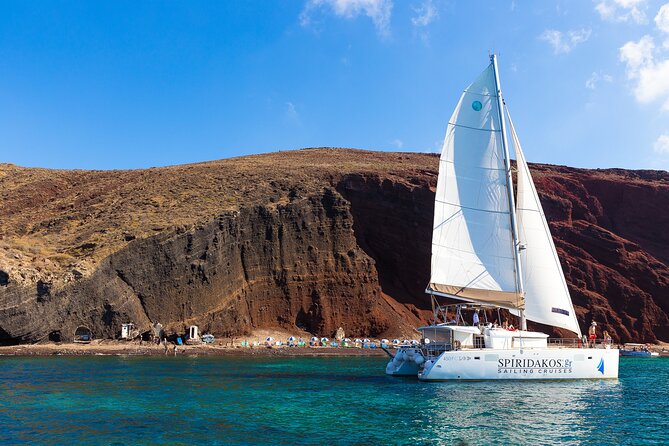
Greece boat tours at Santorini sail on the flooded caldera, a ring of cliffs left by repeated volcanic collapse, past the islets of Nea Kameni and Palea Kameni, and return to the old port at Gialos beneath the cliff-top town of Fira.
The region first became volcanically active 3 to 4 million years ago, and the South Aegean Volcanic Arc runs about 450 kilometres from the Isthmus of Corinth to the Bodrum peninsula.
The caldera that Greece boat tours sail grew in cycles. The volcano erupted violently and collapsed into a seawater-filled ring, then slowly built a new cone as magma refilled the basin.
The Chinese Bamboo Annals report yellow skies and summer frost at the start of the Shang dynasty. Writers on the Minoan eruption cite the report as a possible echo of volcanic winter.
Palea Kameni holds a herd of goats and a single inhabitant, Sostice Arvanitis. The Santorini volcano tour post covers a landing on the islets, and the Santorini boat tour post covers a sailing round the caldera.
- Cable car: Doppelmayr built the lift from the Old Port of Gialos to Fira.
- Lighthouse: A French company built the Akrotiri lighthouse in 1892, and the Greek Navy recommissioned it in 1945.
- Museum: The Archaeological Museum of Thera opened in 1960 after the 1956 Amorgos earthquake collapsed its predecessor.
- Ships: One Attic krater in that museum shows four ships around its rim.
The caldera is the main stage of Greece boat tours at Santorini. The Santorini catamaran cruise post and the Santorini sailing tour post cover two ways to sail it. The Greece sailing tours page covers the trips under sail.
Why do Greece boat tours pair Mykonos with Delos?
Greece boat tours pair Mykonos with Delos because the two islands lie only 2 km apart, and in ancient times Mykonos served as a supply and transit base for the busy sanctuary island, a link that the boats of today follow.
Mykonos, the base for Greece boat tours to Delos, fell to Andrea Ghisi after Constantinople fell in the Fourth Crusade of 1204. In Ottoman times it carried the Turkish name Mukene.
Delos held a Samaritan community in the Hellenistic period. Two marble stelae record gifts from Cretan donors, and the community called itself the Israelites on Delos who make offerings to hallowed Argarizein.
Athens purified the sacred island more than once. In the fifth century BC, on the word of the Delphic Oracle, the island was cleared of dead bodies, but the tombs of the Hyperborean Maidens were spared.
Straight after the clearing, the island held the first Delian games. Semos of Delos later wrote eight books on its history. The Mykonos boat tour post and the Mykonos catamaran cruise post cover sailings from Mykonos.
- Proverb: Greeks said you sing as if sailing into Delos of a light-hearted person.
- Raid: The Greek Sacred Squadron raided the German garrison of Mykonos from 25 to 28 September 1944.
- Liberation: Mykonos was liberated on 30 September 1944.
- Purge: The clearing of Delos took place in the sixth year of the Peloponnesian War.
The Mykonos yacht cruise post and the Mykonos sunset cruise post cover two more ways to join Greece boat tours around Mykonos.
Which islands do Greece boat tours reach from Naxos, Paros and Milos?
Greece boat tours around Naxos, Paros, Milos and the Small Cyclades cover the central and southern Cyclades, from the largest island of the group to the volcanic coves of Milos and the small islets near Koufonisia, where boats find shelter.
Naxos is the largest Cycladic island, and its town of Chora holds 8,897 inhabitants. Mousterian tools from the Stelida quarry show people there in the Middle Paleolithic. The Naxos boat trip post covers its harbour.
Paros covers 196.308 square kilometres and lies 8 km west of Naxos. A car ferry crosses to Antiparos from Pounda, and the strait between them is called Amfigeio. The Paros boat trip post covers its coasts.
The municipality of Milos covers 160.147 square kilometres, including the uninhabited islet of Akradies. At Phylakopi, the first settlers were tuna fishermen. The Milos boat tour post and the Milos sailing tour post cover its coves.
Koufonisia covers 26.025 square kilometres. After the war, a ship called at Heraklia every eight days, and residents crossed to other islands in small caiques. The Koufonisia cruise post covers the islets on Greece boat tours.
- Kimolos: Its ancient name, Echinousa, links to the viper that still lives on the island.
- Old names: Anthony Miliarakis wrote in 1920 that Pano Koufonisi was called Fakousa.
- Epano Mili: Excavations found a fryer-shaped vessel with a nine-ray star, now in the Naxos museum.
- Pirates: In the 17th century pirates sheltered in the channel between Pano and Kato Koufonisi.
Boats on Greece boat tours of these islands anchor in coves where ships have long stopped, so each route here is a short hop between near neighbours. The Milos kayak tour post covers the coast of Milos by sea kayak, with Kleftiko and the sea caves. The Greek island hopping tours post covers trips that link two or more islands by ferry, sailing boat or cruise.
Where do Greece boat tours go around Crete?
Greece boat tours around Crete run along an island that is the 89th largest in the world, with the Sea of Crete to the north and the Libyan Sea to the south, and they leave from ports on both coasts.
The Bible names the island that Greece boat tours circle as Caphtor. Gavdos, south of Crete, was called Gondzo from the 17th to the 19th centuries. The Balos Lagoon cruise post covers the Gramvousa route.
The treaty of 16 September 1669 surrendered Crete to the Ottomans but kept Gramvousa, Souda and Spinalonga for Venice. The Crete catamaran cruise post and the Chania boat trip post cover sailings from the north-west.
In 824, Arab exiles from al-Andalus moved the island capital to a new castle called rabd al-handaq, the Castle of the Moat. The Heraklion boat trip post covers its harbour.
Rethymno, called Resmo in Turkish, was the centre of a sanjak under the Ottomans. In 1551 its Latin diocese absorbed the Diocese of Ario. The Rethymno boat trip post covers its coast.
- Gramvousa: On 9 August 1825, Cretans under Dimitrios Kallergis, disguised as Turks, captured the fort.
- Souda: In 1822 an Egyptian army of about 10,000 under Hassan Pasha landed there.
- Koufonisi: Ancient purple dye from the Murex trunculus snail was worth its weight in silver.
- Pilavas: In April 1823, 28 Cretans killed the janissary Mehmet Pilavas and 27 of his men.
The Chrissi Island boat trip post covers the sea trip to Chrissi, and Greece boat tours around Crete reward a choice of port before a choice of boat.
What do Greece boat tours offer around Rhodes and the Dodecanese?
Greece boat tours around Rhodes and the Dodecanese call at a chain of islands in the south-eastern Aegean, with Rhodes as the largest island and historical capital, and neighbouring Symi and Kos as the other main ports of departure and call.
On Greece boat tours around Rhodes, Kalythies cave on the north-east shows human life since at least the late Neolithic, and Asomatos was the earliest known urban centre. The Rhodes boat trip post covers its coast.
The Colossus stood 70 cubits high, close to two-thirds of the Statue of Liberty from feet to crown. Construction began in 292 BC. The Rhodes catamaran cruise post covers sailings by catamaran.
Under the Ottomans, Symi was called Sombeki. German forces occupied it on 12 October 1943, and ruin prices rose fivefold between 1998 and 2006. The Symi day trip from Rhodes post covers the crossing.
Kos is a base for Greece boat tours, and its five-star hotels almost doubled between 2014 and 2023, with units up by 95.83 per cent. The Kos boat trip post covers its coast.
- Surrender: German forces in the region surrendered to the British on Symi.
- Residents: About 120 non-Greek residents live on Symi, and 50 of them are British.
- Mandeville: The Travels of Sir John Mandeville wrongly says Rhodes was once called Collosus.
- Philo: Philo of Byzantium wrote that Chares cast the Colossus in horizontal courses.
Rhodes and its neighbours give Greece boat tours short hops between large islands, so one base serves routes to Symi, Kos and the open Aegean.
What do Greece boat tours cover around Corfu and Paxos?
Greece boat tours in the north-west Ionian Sea pass the castle city of Corfu, the chapel islet of Pontikonisi, the island of Paxos and the far-western Diapontian group, so a single area offers four quite different sea routes along one coast.
The capital of Corfu is enclosed by two castles, and it is the only city in Greece surrounded in this way. The Greek government has officially declared it a kastropolis, which means castle city.
The Corfu boat trip post covers the sea routes around the island. Greece boat tours also pass the islet of Pontikonisi, which carries a Byzantine chapel of Christ Pantokrator, dated to the eleventh or twelfth century.
The Corfu sailing tour post covers the same coast under sail. In the Diapontian islands, no family is without a sailor, and the islanders own plenty of fishing and speed boats.
The Paxos Antipaxos cruise post covers the two islands south of Corfu. Tradition holds that Phoenicians were the first settlers on Paxos, and that its name comes from the word Pax, meaning trapezoidal.
- Pantokrator: The main mountain range stretches from Cape Falacro to Cape Psaromita.
- Santi Jeca: The second range ends at this peak, named from the Greek Hagioi Deka, the Ten Saints.
- Mathraki: This Diapontian island lies four nautical miles from Cape Arilas.
- Venetians: They gained control of Paxos at the end of the fourteenth century.
These details show how Greece boat tours around Corfu and Paxos pass castle walls, chapel islets and quiet island villages within one stretch of the northern Ionian Sea.
What do Greece boat tours show around Zakynthos?
Greece boat tours around Zakynthos follow a coast of cliffs and bays that has seen alliances, raids and conquests since Homer, and the same shore now leads to a cove, a set of sea caves and a bay of nesting turtles.
The Zakynthos boat trip post covers the coast. Athens valued the island as a source of tar, which was dredged from the bottom of a lake with myrtle branches tied to poles.
The Navagio shipwreck tour post covers the cove on the north-west shore. In 459 the Vandals under their leader Geiseric plundered the island and carried off 500 local aristocrats.
The Zakynthos Blue Caves post covers the sea caves near Cape Skinari. In 880 the Aghlabids raided the island of Zakynthos, but the Byzantine navy under Nasar defeated them.
The Zakynthos turtle boat tour post covers the loggerhead turtles of Laganas Bay. Leonardo III Tocco agreed with Venice to accept 10,000 refugees from the Peloponnese, and the Ottoman Empire captured Zakynthos in 1478.
- Arkesios: Tradition names King Arkesios of Kefalonia as a conqueror of the island before Odysseus of Ithaca.
- Hyrie: The island was said to have carried this name before it became Zakynthos.
- Strofades: The name means Islands of Turning, and legend links it to Zetes and Calais, sons of Boreas.
- Archelaus: In the Mithridatic War this general of Mithridates attacked the island and was repulsed.
Greece boat tours around Zakynthos therefore pass a coast shaped by trade in tar, raids from the sea and the changing fortunes of the powers that held the island, from Athens to the Ottoman Empire.
What do Greece boat tours cover around Kefalonia, Lefkada and Parga?
Greece boat tours around Kefalonia, Lefkada and Parga cover three coasts of the Ionian Sea, from a southern port named after a river crossing to a white cape in the south of Lefkada and a Venetian castle above the bay of Parga.
The Kefalonia boat tour post covers the island’s gulfs and ports. The river Vohinas almost certainly gave Poros its name, which means a ford or crossing in Greek.
The Lefkada boat tour post covers the island and its islets. On Greece boat tours, an ancient cult of Apollo Leucatos marks the south-western cape, where white cliffs rise above the sea.
In 1564, during the reign of Suleiman the Magnificent, an aqueduct of 3 km was built from the interior of Lefkada to the town, after a lack of water.
The Parga boat trip post covers the bay below the castle. During the Epirote rebellion of 1338 and 1339 against Andronikos III Palaiologos, Parga remained loyal to the emperor.
- Gorge: The Poros gorge is an 80-metre deep ravine, and local legend says Heracles cut it.
- Monastery: The Atros monastery near Poros is the oldest on Cephalonia, and a rough track leads to it from the gorge.
- Lichnos: This beach lies 3 km from Parga and covers 2 hectares.
- Gate: The castle gate of Parga bears the name Antonio Bervass and the year 1764.
Greece boat tours across these three areas show a coast where river crossings, ancient cults, Ottoman waterworks and Venetian fortresses lie within sight of the same sea.
What do Greece boat tours show in the Sporades?
Greece boat tours in the Sporades sail among an archipelago of 24 islands, four of them permanently inhabited, and the name Sporades means those scattered; Skiathos is the westernmost island of the group, followed by Skopelos and then Alonnisos.
The Skiathos boat trip post covers the sea around the westernmost island. In 1807 the first flag of Greece was created and hoisted at the Evangelistria Monastery on Skiathos, where Kolokotronis and Miaoulis gathered.
The Skopelos boat trip post covers the island’s harbours and coast. Skopelos has the shape of a saxophone, and with an area of 96 square kilometres it is larger than Mykonos and Santorini.
Skopelos is a matrilineal society, so by custom wealth passes through the female line, and the parents of each bride give the couple at least a house and property. Greece boat tours land in that society.
Alonnisos, the third island of the Northern Sporades, was known as Icus in antiquity, and it took its modern name in 1838, after an identification with ancient Halonnesus that later research judged mistaken.
- Karafiltzanaka: Skiathos reaches its highest point, 433 metres, on this mountain.
- Skantzoura: This island lies 18 km south-east of Alonnisos and 31 km north-west of Skyros.
- Psathoura: The lighthouse of 1895 stands 28.9 metres tall and is one of the tallest in the Aegean.
- Alonnisos: The island covers 64 square kilometres and is mostly limestone.
Greece boat tours in the Sporades therefore join a flag, a saxophone-shaped island, a matrilineal society and a renamed island within a short stretch of the Aegean.
Which coasts do Greece boat tours reach in Northern Greece?
Greece boat tours in Northern Greece follow the three peninsulas of Chalkidiki and the island of Thasos, a coast where Persian canal builders, Spartan admirals and Byzantine monks all left their marks on the waters of the northern Aegean.
The Halkidiki boat tour post covers the three peninsulas. Ammouliani is the only permanently inhabited island of Chalkidiki, and until the early 1900s it was a dependency of the Vatopedi Monastery.
The Mount Athos cruise post covers the monastic coast. Xerxes I ordered a canal through the Athos isthmus before his second invasion, and the engineer Artachaees oversaw the work.
The Thassos boat trip post covers the northern island. In 1887 Theodore and Mabel Bent excavated sites there and uncovered an arch of Caracalla, along with a collapsed portrait statue of the empress Sabina.
Ouranoupoli takes its name from an ancient city founded by Alexarchus, the brother of Cassander. Greece boat tours that start there follow a coast with a long record of sea disasters.
- Canal: It was 2 km long, 30 m wide and 3 m deep, enough for a trireme to pass.
- Spartan fleet: In 411 BC the Spartans lost 50 ships under the admiral Epicleas near Athos.
- Toroni: Excavators found 134 tombs in its cemetery, and 118 of them were cremations.
- Thasos: Under the Axis occupation Bulgaria renamed the island Tasos and closed its schools.
Greece boat tours in Northern Greece therefore cross waters where a Persian canal, an ancient fleet disaster and a monastic peninsula sit within a single gulf-fringed coast.
What do travellers ask about Greece boat tours?
Greece boat tours raise practical questions about small islands, monasteries, wildlife and wind, and the answers below draw on records of the Ionian Islands, the Sporades and the north, covering what the shore offers and what the sea allows.
Which small islands do Greece boat tours pass?
Greece boat tours pass islands of very different size. The 2011 census counted five inhabitants on Skorpios, an island east of Lefkada, and in 2021 the only school on Mathraki, in the Diapontian group, reopened with one pupil after being shut for 21 years.
Which monasteries do Greece boat tours link to?
Greece boat tours link to monasteries on both coasts. The Zygou Monastery near Ouranoupoli was abandoned in 1198 and later held by Crusaders at the start of the thirteenth century, who gave it the name Frangokastro, while monks from Athos built the Evangelistria Monastery on Skiathos in 1704.
Which wildlife do Greece boat tours meet around Corfu?
Greece boat tours around Corfu pass a coast with around 40 mammal species on the island and in the sea. Eurasian otters survive in the lagoons and streams, the golden jackal was very common until the 1960s, and recent sightings suggest that it is returning from the mainland.
How does wind affect Greece boat tours around Skopelos?
Wind affects Greece boat tours around Skopelos because northerly gales can close the main port, which sits in a bay on the north coast. The smaller bays of Staphylos and Agnondas on the south coast, and Panormos on the west, offer better protection from those winds.