
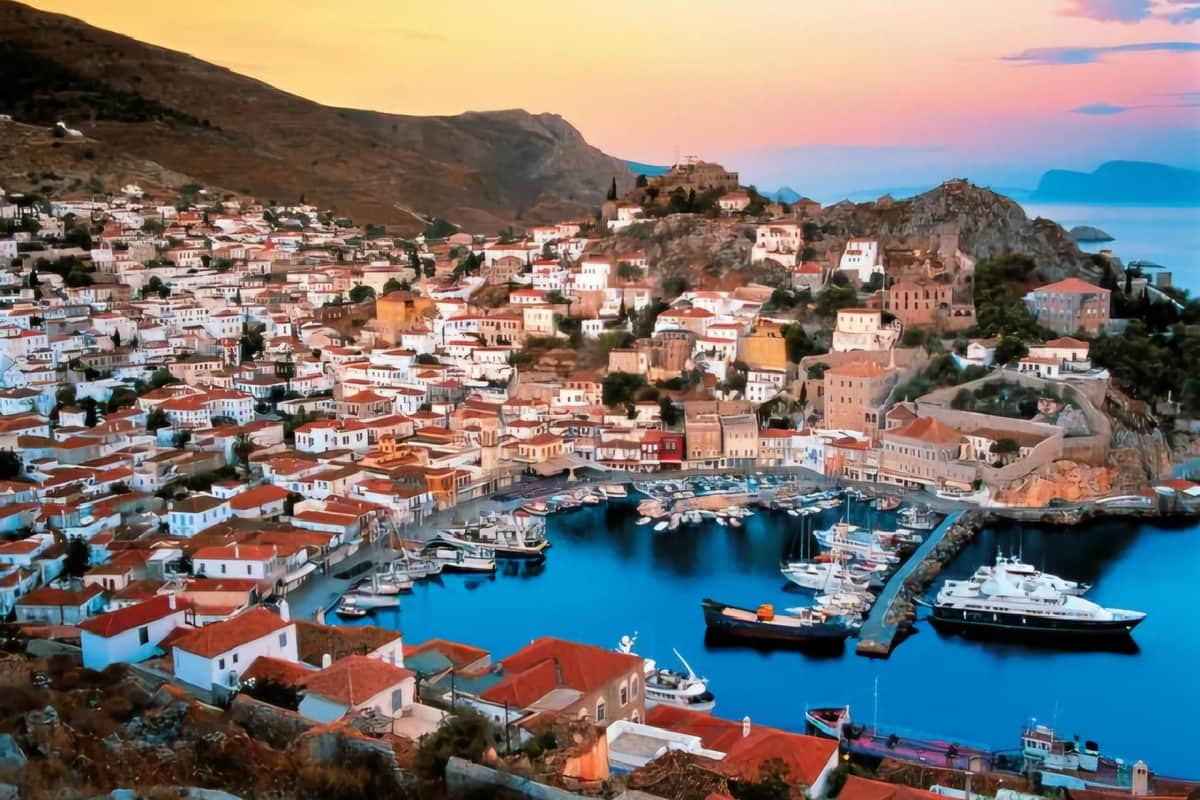
A Hydra day trip spends one day on Hydra, a long rocky island off the eastern Peloponnese. The town climbs from a horseshoe harbour, and no cars run on its lanes. The trip is one of the Greece Tours on Greece Ville.
This post covers what a Hydra day trip includes, how sea trade built the town and the island’s part in 1821. It also covers the harbour, the Kountouriotis mansions, the cathedral, Mount Eros, the mules and the walk to Kamini.
Artists, films, water, beaches, the Arvanite past and nature follow. The merchant marine academy, the best months and common questions come last. The sections include Hydra day trips that can be booked online.
What is a Hydra day trip?
A Hydra day trip spends a single day on a Greek island, mostly on land. Among Greek islands, Hydra ranks 44th by area. Its largely rocky coastline runs for 55 km. Mount Eros is its highest point.
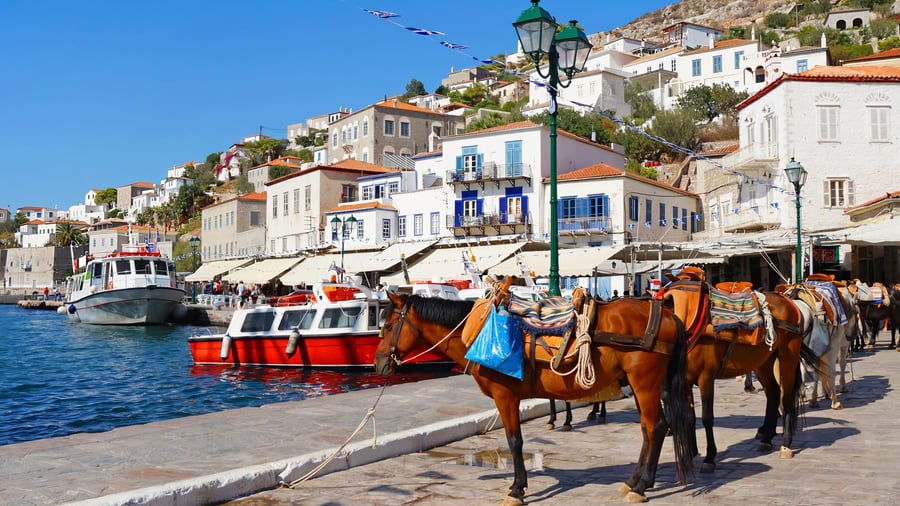
A Hydra day trip reaches an island set apart from the Peloponnese by the narrow Gulf of Hydra. The 2021 census counted 1,988 people in Hydra town. In 1981, it had 2,732 residents.
The island reached its peak of 9,011 people in 1861. Numbers have fallen since then. Newer research shows people lived on Hydra from the Neolithic, the New Stone Age. Its ancient high point came in the Bronze Age.
A Hydra day trip lands in a municipality created by official state notice on 7 June 1834. Its seat was Hydra town from the start. The Kapodistrias plan, a 1997 reform of local councils, left it unchanged.
The Kallikratis plan, a second reform in 2010, also kept it unchanged. The old province of Hydra, a former district, was abolished in 2006. Georgios Koukoudakis has served as mayor since 2014.
In 2019, the mayor was re-elected with all of the first-round votes. Hydra belongs to the Islands regional unit, a district of the Attica region. That unit also takes in Kythira.
A Hydra day trip visits an island whose ancient name, Hydrea, meant “the well-watered one”. Evagis the Hydreate, meaning “of Hydrea”, wrote comic plays in Classical times. He came from the island.
Herodotus, the ancient historian, links Hydrea to Samian exiles who had fought Polycrates of Samos. The exiles forced Siphnos to pay them 100 talents, a large sum. They also fortified the acropolis, or hilltop fort, at Vlychos.
- Date: The Samian exiles’ link with the island dates to around 525 BC.
- Crete: The exiles later settled at Cydonia, a town in Crete.
- Five years: Herodotus says they prospered there for five years.
- Defeat: In the sixth year, Aeginetans and Cretans beat them in a sea fight.
A Hydra day trip explores a long written record. Ancient writers named it. Modern censuses track its people. Its town has served as the council seat since its founding.


How did sea trade build the town on a Hydra day trip?
A Hydra day trip walks through a town built on sea trade. Hydriot crews moved from short local runs to long voyages. A Russian-Ottoman peace treaty freed merchant shipping. By the early 19th century, the island held 27,000 people.
On a Hydra day trip, the story of trade starts inside the Aegean. Early in the 18th century, crews went as far as Constantinople. The boldest reached the Danube mouths, only in summer, for grain, timber and cloth.
A Hydra day trip shows wealth that grew despite Ottoman limits. Heavy taxes and duties slowed growth. Only Ottoman ships were allowed through the Dardanelles and the Bosphorus, the straits to the Black Sea.
After 1770, the leading shipowners held almost all power on Hydra. In February of that year, the Orlov revolt, a Russian-backed Greek uprising, broke out in the Peloponnese. Hydra, unlike Spetses, stayed out of it.
A Hydra day trip passes a town that gained from that choice. The Ottomans took no revenge on the island. In 1778, Hydra won the right to collect the empire’s taxes itself.
During the Russo-Turkish war begun in 1768, island ships raised the Russian flag. The Treaty of Küçük Kaynarca ended it on 21 July 1774. Its Article XI promised free navigation to merchant ships.
Hydriot ships carried Baltic amber, Russian furs and Ukrainian wheat. Other cargoes were Ottoman spices and Italian porcelain. At 14, Lazaros Kountouriotis stood in for his trader father, who was away in Genoa.
In the Napoleonic wars, profits on a Hydra voyage reached up to 400 percent of the sum invested. Owners, captains and sailors shared the gains. Grain sales filled the island with gold coins. Trade slowed after 1810.
- Plague: The plague of 1792 killed a large part of the islanders.
- Governor: In 1802, the new governor, Georgios Voulgaris, fought the pirates.
- Mainland losses: Within nine years, the revolt cost the Peloponnese 20,000 to 30,000 Greeks.
- Rival fleets: On the eve of revolution, Psara had 35 to 40 ships and Kasos 15.
A Hydra day trip walks lanes and quays paid for by these voyages. The same crews learned to fight in clashes with Algerian pirates. That experience mattered once the revolution began.
What part did Hydra play in 1821 on a Hydra day trip?
A Hydra day trip visits an island that joined the revolution after a sailors’ uprising. Captain Antonios Oikonomou led it. Shipowners then put ships and money behind the war. Hydriots also held top posts in the temporary revolutionary government.
On a Hydra day trip, the revolt story starts in late 1820. The revolutionary Papaflessas met island members of the Filiki Etaireia, a secret society. Oikonomou’s camp stood ready to rise. The Kountouriotis camp feared the Ottoman fleet.
Oikonomou rang the church bells and called the people to arms. With the sailors, he seized the ships and removed the governor, Nikolaos Kokovilas. On 31 March, the frightened island leaders handed him power in writing.
On 16 April, a church service blessed the flag of freedom. Bishop Gerasimos raised it where the Turkish flag had flown. It bore a cross, an anchor and the head of Themistocles, an ancient Athenian leader.
The island leaders later turned against Oikonomou. They arrested him while his sailors were at sea. Relatives helped him escape to Kranidi. Kolokotronis, a Peloponnese general, sent 200 men to protect him, too late.
A Hydra day trip recalls how shipowners paid for the war. Lazaros Kountouriotis first thought the revolt came too soon. He backed it once it began. Ioannis Orlandos gave all his ships to the revolutionary government.
The legislature, run by Roumeliotes from central Greece and by Hydriots, removed the executive’s president, Petros Mavromichalis. Georgios Kountouriotis of Hydra took his place on 18 January 1824. His term covered the siege of Missolonghi.
A Hydra day trip also recalls Andreas Miaoulis, whose real surname was Vokos. His nickname came from his first ship, the Miaoul, Turkish for “small boat”. In 1807, he briefly ran the island for its governor.
- Emmanouil Tombazis: He represented Hydra at the Epidaurus and Astros national assemblies.
- Crete: From 1823, Tombazis acted as the government’s commissioner, or envoy, in Crete.
- Naval post: In 1828, Kapodistrias made Tombazis naval minister, but he soon resigned.
- Sea battles: Miaoulis led clashes off Modon, Cape Matapan, Suda and Cape Papas.
In 1827, Miaoulis stepped aside to let Thomas Cochrane, a former Royal Navy officer, take command. In 1832, he helped bring the crown to King Otto. A Hydra day trip ends where his sea life began.
What does Hydra harbour show on a Hydra day trip?
A Hydra day trip shows a harbour town that Greek law guards as a monument. Grey local stone, lime and clay mortar shape the house fronts. A powder house and a statue square line the quay, with windmills on the hill above.
On a Hydra day trip, the town above the quay is legally protected. A ministry decision of 1962 named the whole settlement a historic site. A decree of 19 October 1978 classed it as a traditional settlement.
Later rules protected the whole island. A 1975 decision called all its landscapes places of special natural beauty. In 1996 the island became an archaeological site, with remains from prehistoric to early Christian times.
The Council of State is Greece’s top administrative court. Its decision 978/2012 found that the whole settlement has a monumental character. New building is allowed only where an earlier building is proven by contracts or inspection.
Only part of the town seen on a Hydra day trip has fixed legal limits. A 1966 planning report drew the edge on a sketch without scale. A 1972 decision fixed the central part alone.
Grey stone sets the main colour of the town. Builders took it from Hydra and from the nearby islet of Dokos. Wood and kokkina, a clay-coloured mortar, complete the main building materials.
On a Hydra day trip, white lines of lime frame the walls and break the grey stone. Ordinary houses have eaves of poros, a soft porous stone. Their flat fronts carry symmetrical windows and doors.
The roofs seen on a Hydra day trip tell a story of copying. Whitewashed flat terraces once marked the island. Islanders copied the four-sided roofs of the great mansions, and the town gained its even look.
- Gunpowder store: The Port Authority and a citizens’ service centre use the old stone powder house.
- Statue square: A square named after Pavlos Kountouriotis holds his statue at its centre.
- Windmills: Ruined windmills stand in a row on the hilltop above the western cannon battery.
These laws, stones and roofs explain the even grey town above the quay. A Hydra day trip reads the harbour as one protected whole. Waterfront public buildings add daily life to that old shell.
What do the Kountouriotis mansions show on a Hydra day trip?
A Hydra day trip shows two Kountouriotis houses on the harbour’s west side. One holds family rooms, folk art and paintings. The other, on a pine-covered slope, runs as a state museum. The Tombazis mansion nearby lodges art students.
The mansions seen on a Hydra day trip rise tall, imposing yet plain. They carry features of Genoese architecture. A study by Giorgos Prokopiou says widely travelled shipowners wanted European style at home.
Their bulk makes them look like fortresses from outside. Inside, men and women had separate rooms beside a large hall. A small room held the icon stand, and another served for smoking the nargile, a water pipe.
The Lazaros Kountouriotis mansion is shaped like the Greek letter pi. Natural ochre, a yellow earth pigment, colours its walls. Its best room, the kalos ontas, faces northeast. The house opened as a museum in 2001.
On a Hydra day trip, a wide marble-floored hall runs through its ground floor like a backbone. A full-length portrait of Lazaros hangs there. Andreas Kriezis, a painter from Hydra, made it in 1866.
The first floor shows Greek folk art, mainly from the islands. Large paintings of Hydra by Panagiotis Tetsis hang there too. Tetsis was born on the island in 1925 and donated the works himself.
On a Hydra day trip, the old cellars hold paintings by Periklis Vyzantios and his son Konstantinos. Both were closely tied to the Kountouriotis family. In 1939 Periklis became director of the Hydra art school annex.
A Hydra day trip also takes in the Georgios Kountouriotis mansion, set among pines on the western hillside. It dates from the early 19th century. The Ministry of Culture bought the house in 1991.
- Museum today: The Georgios house shows Kountouriotis heirlooms as a Museum of Post-Byzantine Art and History.
- Pavlos Kountouriotis: Georgios’s grandson, an admiral, inherited the house and became the first president of the Greek Republic.
- Art station: The Tombazis mansion is one of seven art stations of the Athens fine arts school.
Admiral Manolis Tombazis and his wife Xanthi Sachini built this mansion in an Italian style. Its four floors of cut stone cover 1,100 square metres. Students sleep in 20 beds and work on its covered verandas.
What does the Dormition cathedral show on a Hydra day trip?
A Hydra day trip shows the Dormition cathedral, also called the church of Panagia Faneromeni, the Virgin Revealed. Its domed church holds a marble icon screen and relics. Busts stand in the courtyard, and a church museum occupies the old cells.
On a Hydra day trip, the cathedral stands at the centre of the harbour. An earthquake destroyed the monastery church in 1750. Venetian and Genoese architects drew the plans when it was rebuilt years later.
Patriarchs Paisios II, Samuel and Gregory V signed documents for it in 1747, 1764 and 1797. These made the monastery stavropegial, meaning it answered directly to the Patriarch. They also freed it from taxes.
A Hydra day trip meets a monastery that once supported the islanders. Its monks gained land beyond Hydra, because the island’s soil was barren. They founded and ran a school and kept handwritten books called codices.
In 1821 the monastery was a centre for decisions on the uprising. The local diocese calls it the naval headquarters of the Revolution. A monastery building still houses the Town Hall inside the complex.
Inside, a Hydra day trip finds a basilica, a long hall-shaped church, under a dome. Columns split it into three aisles. The middle aisle honours the Dormition, the right Saint Charalambos and the left Saint Nicholas.
On a Hydra day trip, its icon screen, called a templon, is carved from white marble. The monk Gavriil made it while Hierotheos II led the monastery. Its chandeliers and lamps burn candles or oil, not electricity.
The church keeps the icon of the Virgin of Malikis. Relics of Saint Constantine the Hydriot and Saint Eustathios rest there. A cross from Constantinople holds a piece of the True Cross.
- Clock: The large clock on the tall bell tower announces major religious events.
- Courtyard busts: Dimitris Filippotis made busts of Lazaros Kountouriotis, Andreas Miaoulis, King George the First and Antonis Lignos.
- Church museum: The museum named after Saint Makarios Notaras has used the old west cells since 1999.
Its best-known piece is the Virgin icon Rodo Amaranto, the Unfading Rose, from around 1774. Cases hold priests’ robes, music manuscripts and Ottoman firmans, or sultans’ decrees. Archbishop Christodoulos opened it officially on 15 August 2005.
What does Mount Eros show on a Hydra day trip?
A Hydra day trip meets monasteries that monks and nuns still run. They sit on the slopes of the mountain and on ridges further east. Pine woods and ruined shepherd houses stand beside the paths. Each monastery keeps its own feast day.
A Hydra day trip reaches Profitis Ilias, a men’s monastery on the south-east slopes of Eros. It lies about 3 km south-west of the town. Before it, an outpost of the Panagia Faneromeni monastery stood there.
The dome of its church shows Christ as Pantokrator, meaning ruler of all. A Platytera, an image of the Virgin with the infant Christ, also survives. The courtyard holds a drinking-water cistern, a threshing floor and stables.
A Hydra day trip on 20 July meets the monastery’s feast day. In 2000 Father Efthymios Skangos died, the last of its original community. Monks from the Osiou Grigoriou monastery on Mount Athos then staffed it again.
The monastery path starts at the church of Agios Konstantinos the Hydriot. On a Hydra day trip, it passes a spot called Palaies Kalogries, meaning Old Nuns. An old convent once stood there.
Agia Efpraxia, a stone-built monastery, stands among pines and cypresses. Father Ierotheos Dokos built its small church and dedicated the house to the saint. The nuns’ weavings were once renowned.
A Hydra day trip meets Agia Triada above Mandraki, at 170 m. It marks the end of an 18th-century road built by the island’s elders. Its founder left all his property to it in a will of 1736.
In 1825 Tsamis Karatasos fortified the monastery against a possible invasion. A storm in 1915 destroyed its dome and much of its roof. Gikas Koulouras paid for the repairs in 1916.
- Agios Nikolaos: This convent, about 4 km east of the town, has an eight-sided dome.
- Zourva founder: Eleftherios Giannikis founded the monastery on his own estate.
- Zourva manuscript: The convent keeps a 13th-century Gospel commentary by Theophylact on 332 leaves.
- Mount Ompori: This 506 m peak has a local name meaning sheep station.
A Hydra day trip also meets houses that changed roles over time. Agios Nikolaos lay empty until 1983, when it reopened as a convent. Agia Efpraxia once sent nuns to staff three new convents, one on Aegina.
Why does a Hydra day trip move on foot and by mule?
A Hydra day trip moves on foot and by mule because a 1991 decision banned all wheeled vehicles. Only a short list of service vehicles holds permits. Heritage rules guard the whole island as well. Pack animals carry the building loads instead.
The Prefect of Piraeus, the regional governor, issued that ban. It also stopped ferries from landing cars to unload food and drinks. Fire engines and cars for disabled people, with a disabled person aboard, are fully exempt.
A 1993 decision allowed one small loader and one tipper truck for building materials. On a Hydra day trip in July and August, construction machines stay out of the old town.
In 1982 a regional antiquities office became responsible for permits to use machines. A 2002 opinion came from the State Legal Council, the government’s lawyers. It gave the Minister of Culture sole power over vehicles.
A Hydra day trip meets only approved service vehicles, such as an ambulance cleared in 2014. In 2017 the ministry refused a police request for two service motorcycles. A fire engine received a landing permit in 2019.
Short landing permits for vehicles serve urgent public and private works. Their main aim is to spare the island’s horses, mules and donkeys from heavy materials. No permits are issued in the summer months, except for public-benefit works.
On a Hydra day trip, every mule passes with a genetic oddity. Each one has 63 chromosomes, the cell’s gene bundles: 32 from the horse, 31 from the donkey. This odd number makes breeding hard.
On a Hydra day trip, the monastery path becomes a kalderimi, a cobbled mule road with steps. Such roads were built for hoofed traffic. Their standard 2 m width lets two laden mules pass each other.
- Animal care: A municipal department cares for stray animals and the island’s pack animals.
- No vet: Hydra has no resident vet, so yearly dental care is essential for its pack animals.
- Free care: Each year before summer, two animal charities treat working mules, donkeys and horses for free.
- Hinny: This rarer cross comes from a male horse and a female donkey.
A Hydra day trip passes municipal trucks sized to move easily through town. They must also be light enough to spare the paving. Brief exceptions carry artworks for exhibitions and furniture for the Historical Archive.
What does the coastal walk to Kamini show on a Hydra day trip?
A Hydra day trip along the shore meets protected hamlets with deep roots. The route mixes heritage law, church custom and ancient history. Census records show tiny populations beyond the town. Palamidas, further along, sits almost level with the sea.
In 1967 a ministerial decision listed Big Kamini, Small Kamini and Vlychos as historic monuments. It also cited their natural beauty and architecture. Both parts of Kamini now form the western edge of the old town.
On Good Friday evening, Kamini carries its Epitaphios, a stand that represents Christ’s tomb, into the sea. The word means upon the tomb in Greek. The bearers wade in until the water reaches their waists.
On a Hydra day trip, the rite ends with a prayer for sailors. Kamini’s sponge divers first held it in 1923. Their boats left during Lent. They came home near the feast of the Cross on 14 September.
A Hydra day trip walks on to Vlychos, about 2 km from the port. The village sits on the island’s north coast. Official records first name it in 1940, under the community of Hydra.
Vlychos counted 6 residents in 1951 and 46 in 1981. The 2021 census found 32 people living there. Planners drew its limits in 1968 on a sketch without a scale.
On a Hydra day trip, Vlychos also marks an ancient acropolis, or fortified hilltop. It was a major settlement in the Early Helladic, or early Bronze Age, and Mycenaean eras.
A Hydra day trip that goes further reaches Palamidas, the island’s old fortified position. It lies about 5 km from the port. It also absorbed Agios Mamas, a hamlet struck from the records.
- Palamidas census: The 2011 count found no permanent residents there.
- Molos: This very small seaside hamlet lies south-west of Palamidas beach.
- Episkopi: This hamlet stands on a hillside at 266 m.
A Hydra day trip along this shore links faith, heritage law and village history. The Kamini rite also serves as a blessing for those lost at sea. The rite has returned every year since its start.
Which artists shaped the Hydra seen on a Hydra day trip?
A Hydra day trip walks past houses tied to painters, writers and singers. Nikos Hadjikyriakos-Ghika, a Greek painter, hosted famous guests in his family mansion. Henry Miller and Patrick Leigh Fermor were among his guests. Leonard Cohen wrote novels in a house on the island.
The Ghika family came from Albania and settled on Hydra in 1628. On a Hydra day trip, their 18th-century mansion sits on the slope above Kamini. Ghika restored it in 1937. He painted his first decisive works there.
In 1939 the poet George Seferis and the editor George Katsimbalis brought Henry Miller there. Miller wrote that the house had forty rooms. He also played ping-pong with his host.
Travel writer Patrick Leigh Fermor stayed there through the winter of 1954–55. He wrote the bulk of Mani: Travels in the Southern Peloponnese in the house. He called it a Shangri-la, a hidden paradise, for work.
A Hydra day trip still sees the ruin a fire left behind. Flames destroyed the mansion on the night of 5–6 September 1961. A watchman’s dropped cigarette started the blaze. Ghika was away in London.
The painter John Craxton reported that only one Ghika painting burned. Ghika told a newspaper that Hydra was finished for him. He resettled on Corfu. The house was never rebuilt.
Cohen told friends he saw that fire from his terrace. On Hydra he published The Favourite Game in 1963. A Hydra day trip reaches the island where he wrote his second novel in 1964 and 1965.
Charmian Clift and George Johnston arrived in 1955 with their children. Johnston later wrote Clean Straw for Nothing, a novel about a journalist on a Greek island. It won the Miles Franklin Award, an Australian novel prize.
- DESTE grant: The Municipality of Hydra gave the old slaughterhouse to the DESTE Foundation in 2008.
- First show: Matthew Barney and Elizabeth Peyton built it around a glass case first sunk in the sea.
- Jeff Koons: His Apollo Wind Spinner, 9.1 metres wide, stands above the slaughterhouse.
Later shows came from Maurizio Cattelan in 2010, Doug Aitken in 2011 and Kara Walker in 2017. Each show hands the space to a single artist or team. It stands on the town’s outskirts.
Which films were shot along a Hydra day trip route?
A Hydra day trip walks through streets that film crews used. A Greek drama by Michael Cacoyannis won a Golden Globe. Hollywood cast Sophia Loren as a sponge diver here. Jules Dassin set a shipowners’ tragedy here with Melina Mercouri.
A Hydra day trip links to A Girl in Black by Michael Cacoyannis, a Cypriot director. Ellie Lambeti and Dimitris Horn starred. Its plot drops a pair of Athenian visitors into local feuds.
It was among the first Greek films to gain international recognition. It was among six Best Foreign Language Film winners at the 14th Golden Globe Awards. It also competed for the Golden Palm, the top prize at Cannes.
Boy on a Dolphin came from director Jean Negulesco. Sophia Loren played Phaedra, a poor diver who gathers sea sponges on Hydra. She finds an ancient statue of a boy riding a dolphin.
Alan Ladd and Clifton Webb co-starred on the island seen on a Hydra day trip. Hugo Friedhofer’s score earned an Academy Award nomination in 1958. The script grew from a novel by David Divine.
Queen Frederica asked Loren to film on Hydra. The queen watched the shoot herself. The filming started a shift of tourist interest from Loutraki to the Argo-Saronic islands. Loren also sang a Greek song in it.
For a Hydra day trip, Phaedra adds a tragic love story. Jules Dassin directed Melina Mercouri in their fourth film together. Writer Margarita Liberaki turned Euripides’ Hippolytus, an ancient tragedy, into a story of shipowning families.
Anthony Perkins played Alexis. Raf Vallone played Thanos, a shipping tycoon. Mikis Theodorakis wrote the music. Mercouri earned Best Actress nominations from the British Academy, or BAFTA, and from the Golden Globes.
- Incense for the Damned: This British horror film with Peter Cushing places a monastery scene on Hydra.
- The Blue Villa: Alain Robbe-Grillet wrote this crime thriller, entered at the 45th Berlin International Film Festival.
- Fugitive Pieces: Jeremy Podeswa filmed it on Hydra, Kefalonia and Lesvos in 2006.
The Fugitive Pieces film opened the Toronto International Film Festival in 2007. Incense for the Damned was shot in Greece and Cyprus in spring 1969. Each title ties a Hydra day trip to cinema history.
How does water reach the island on a Hydra day trip?
A Hydra day trip lands on an island that drinks treated seawater. A desalination plant at Mandraki, which removes salt from seawater, can make 1,800 cubic metres a day. Pumps lift it to tanks above the town. A borehole, or drilled well, adds more in summer.
Despite its name, Hydra rests mainly on limestone. This karst rock, worn by water into cracks and hollows, lets water move underground. The island once had wells. Three new wells have been found.
Before the plant, the main supply came by tanker ship from Vidi in Troizinia. The tanker brought over 300,000 cubic metres a year. Pumps sent it to the central tank at Kala Pigadia, then to Agios Konstantinos.
That water carried heavy salts. Residents did not drink it. It also damaged the town’s pipe network, laid in the 1960s. Losses from those old pipes topped 40 percent of the water sent.
A survey asked Hydra residents about the tanker years. Over 85% called that water poor. Residents bought bottled water for drinking. About 80% now drink the plant’s water.
A Hydra day trip relies on a plant built by the firm TEMAK. The contract was signed on 20 September 2013 after an international tender, an open bidding contest. The municipality paid nothing beyond the land.
Two reverse osmosis units, which push seawater through a salt-blocking membrane, were built into containers in Athens. A ship landed them at Mandraki. Each unit began at 800 cubic metres a day and later reached 900.
Water on a Hydra day trip is pumped uphill before it reaches taps. Tanks at Mandraki hold 1,200 cubic metres. A plastic PVC pipe about 2.2 kilometres long carries it to Kala Pigadia, 44 metres above the sea.
- Summer borehole: A drilled well at Agios Nikolaos adds up to 400 cubic metres a day.
- Upper tank: The Agios Konstantinos tank sits 124 metres above the sea and feeds the town.
- Water tests: Staff test the water’s pH, or acidity, and its electrical conductivity every day.
Rainfall still serves the fields. Irrigation, the watering of crops, comes from cisterns of rainwater beside the farm plots. Farmland covers just 2.8% of the island seen on a Hydra day trip.
Which beaches can a Hydra day trip reach on foot?
A Hydra day trip reaches five bathing beaches on foot: Avlaki, Spilia, Kamini, Vlychos and Mandraki. Greece tests their water under EU rules. Their seabeds run from bare rock to fine pebbles mixed with sand. None of them holds a Blue Flag, an international beach award.
Avlaki sits on the north coast, west of the harbour, inside a small open bay. A Hydra day trip reaches it along a path from the town. The beach is 70 metres long and faces northwest.
Pebbles and scattered rocks cover both the shore and the seabed at Avlaki. The bottom drops fast. Only 25 metres out, the depth nears 5 metres. Greece listed Avlaki as a bathing beach in 1995.
Mikro Kamini lies between the town and Vlychos. Pebbles and rocky outcrops line its seabed. The beach is about 45 metres long and 15 metres wide. It faces north, and high rocks close it in.
A Hydra day trip finds umbrellas and loungers at Mikro Kamini. A restaurant-café stands on the beach itself. Greece added it to the bathing list in 1991. Its top capacity is about 50 bathers.
Vlychos beach fills a whole open cove in front of the hamlet. Sand mixed with fine pebbles covers its seabed. The beach is 30 metres wide on average and faces north.
A Hydra day trip finds sunbeds, umbrellas, showers and toilets at Vlychos. The chapel of Agios Charalambos stands beside the beach. Southwest of the hamlet, Plakes offers an organised beach with tavernas and rooms.
Mandraki beach sits at the head of a closed bay, 1,200 metres long. Small pebbles cover both its shore and its seabed. The whole shore is man-made, built from brought-in material.
- Water quality: The EU environment agency rated all these beaches Excellent every year from 2019 to 2023.
- Test season: Officials take water samples between 1 June and 31 October in every bathing season.
- Mandraki size: The beach is 200 metres long and 20 metres wide.
A Hydra day trip can choose a beach by the shape of its seabed. Kamini drops steeply, while Mandraki slopes gently. Vlychos and Mandraki each have room for about 150 bathers.
What does Hydra’s Arvanite heritage show on a Hydra day trip?
A Hydra day trip meets the heritage of the Arvanites, a group in Greece of Albanian origin. Their speech, Arvanitika, is a form of Albanian. It was once heard in homes, churches and ships. Traces survive in a chapel name, old letters and a costume.
In Greek lands, Albanian settlers were known as Arvanites. Records first name them in the Peloponnese in the second half of the 14th century. Their main waves into southern Greece began in 1350 and ended around 1600.
An island history of 1946 dates the Arvanite refugees’ arrival to around 1460. They fled the Ottoman conquest of the Peloponnese. A Hydra day trip still meets this community, now fully blended into Greek life.
A last Arvanite wave from nearby areas reached Hydra in the early 18th century. Arvanites grouped families into clans called fara, a word meaning seed or descendants. Women had a say in their fara’s public matters.
A Hydra day trip hears Greek, yet Arvanitika was once spoken by all Hydriots. By the 19th century, men had learned Greek. Women and children commonly knew no Greek. At sea, men spoke and sang in Arvanitika.
The new merchant class spoke and favoured the language, so it lasted. Priests held services in it too, which was rare among Orthodox Albanian speakers.
Arvanitika was rarely written down. In 1824, Ioannis Orlandos sent two letters from London in the Arvanitika of Hydra. He addressed them to Georgios Kountouriotis and used the Greek alphabet.
A Hydra day trip still meets the old speech. Hydriots call the chapel of Agios Kyprianos by an Arvanitika name meaning “the church with wine”. Legend says a captain built it with wine instead of water.
- Costume: Mainland Arvanite men wore the foustanella, a pleated kilt, while island Arvanites wore sailors’ baggy breeches.
- Hydra dress: A Hydriot man’s costume with the typical vraka, or baggy breeches, is kept in Nafplio.
- Noctes Pelasgicae: In this book, fleet officer Karl Reinhold collected songs and words from Hydra’s Arvanitika.
- Today: UNESCO lists Arvanitika as a severely endangered language.
A Hydra day trip also meets settler history in the island’s family names. Families of local magnates, such as the Kountouriotis, spoke it even in the 20th century. Almost all Arvanites now see themselves as Greeks.
What nature lives along a Hydra day trip?
A Hydra day trip crosses rocky hills with pine woods and phrygana, a low, bushy scrub. A rare lily, in its pure form, grows only on Hydra and nearby islets. Birds of prey, geckos and lizards live on the island.
A Hydra day trip crosses land with no site in Natura 2000, the EU network of protected areas. Botanist Kazimierz Browicz listed the island’s wild trees and shrubs. He counted 37 species in 21 plant families.
A Hydra day trip sees Aleppo pine forests only near the tops of the higher hills. Above Mandraki, tree-like Phoenician junipers form woods instead. These junipers reach 8 to 10 metres tall.
Maquis, a dense evergreen scrub, survives in patches on seaside slopes. A Hydra day trip finds it between Kaminia and Vlychos. The low scrub called phrygana is poor in species, led by thorny burnet and Jerusalem sage.
Fritillaria rhodocanakis is a lily that grows from a bulb. Its nodding flowers are purple with yellow tips. It grows on open limestone, in phrygana scrub and in clearings of Aleppo pine woods.
Europe’s Bern Convention and the EU Habitats Directive both protect the lily. Greece’s Red Data Book of rare plants lists it as vulnerable. As of 2020, the species had 500 mature plants, with a stable trend.
A Hydra day trip crosses ground where birds of prey include Bonelli’s eagle and the peregrine falcon. The rare Eleonora’s falcon also appears. Two-thirds of its world population breeds off Greece.
Richard Clark, a reptile expert, recorded Kotschy’s gecko, the Balkan green lizard and Erhard’s wall lizard. Skinks, small smooth lizards, are on record too. His Montpellier snakes from Hydra were well under one metre long.
- Seeds only: The Aleppo pine regrows after fire only from seed.
- Seed store: Unburned trees keep 40 to 80 per cent of each year’s cones closed.
- Heat trigger: Fire heat makes the cones open faster and release winged seeds.
- First year: New pine seedlings appear almost entirely in the first year after a fire.
Tree spurge is common on the slopes near the town and Mandraki. Capers grow on stones and old walls between the town and Vlychos. A reptile survey judged Hydra’s rugged interior unsuited to development.
What does the merchant marine academy add to a Hydra day trip?
A Hydra day trip passes a state school that trains merchant ship captains. The school stands at the island’s port. It claims roots older than the modern Greek state. Its students learn both in class and at sea.
The 1749 date rests on the school of Agios Vasileios, or Saint Basil. It stood beside that saint’s church. Around the turn of the 19th century, the island’s council of elders ran it as a naval school.
A Hydra day trip meets a disputed date. Another account dates the start to just after the 1821 revolution. The claim to be the world’s oldest such school comes from its graduates’ association.
Before the revolution, Italian and Portuguese teachers taught there. They covered naval theory, ship handling, Italian, French and Spanish. Felice Caserta of Palermo taught navigation from 1817 until the uprising. He then fought on a ship from Hydra.
A Hydra day trip passes a school the state shaped step by step. From 1837, the state sent navigation teachers to Hydra, Syros and Nafplio. In 1930, Law 4511 founded the School of Merchant Shipping of Hydra.
The school has used the same building since then. It went up between 1780 and 1810. Athanasios Koulouras, a Hydra sea captain, was one of its owners. The building passed to the state for the school’s use alone.
During the German-Italian occupation, Italian forces made the building their headquarters. Classes moved to Athens, then to Kastella in Piraeus. The first two classes returned to Hydra on 1 November 1949.
The academies answer to the Greek shipping ministry. The Coast Guard’s office for seafarers’ education supervises them. On a Hydra day trip, the island’s academy is for future captains, not ship engineers.
- Courses: Studies run for six semesters in class and two semesters at sea.
- Sea work: Since 1989, students sail on merchant ships between terms and earn a wage.
- Entry: Applicants need Greek citizenship, the national Panhellenic exams and an age under 27.
- Graduates: Leavers receive a third officer’s diploma, the starting rank for ship officers.
Ashore, graduates also work for shipping firms and shipyards. Greek owners control 19.1% of the world fleet by deadweight, the weight ships can carry. More than 98% of that fleet’s capacity carries goods for other countries.
Which months suit a Hydra day trip?
A Hydra day trip suits the warm, dry season from April to October. Greece enjoys long spells of sunshine for the greater part of the year. The cold, rainy months run from mid-October to the end of March. The end of June brings the Miaoulia festival.
Hydra has its own weather station, owned by the National Observatory of Athens. The Municipality of Hydra hosts the station. Its monthly bulletins give the island’s average weather for each month.
April on Hydra averages 17.6 °C, a mild month for a Hydra day trip. In late spring, average daily highs reach 25.0 °C. Rain in late spring totals just 8.1 mm.
June brings an average temperature of 26.3 °C. Nights then cool to an average low of 22.8 °C. June rain totals 12.6 mm. The June record high stands at 37.1 °C.
A Hydra day trip in high summer meets the hottest weeks. Greece’s national weather service puts them in the last ten days of July and first ten of August. August averages 29.6 °C, with 2.4 mm of rain.
In the dry season, the sky stays almost cloudless and the sun bright. Rain then comes only in rare, short showers or thunderstorms. Spring stays short, because winter ends late and summer starts early.
A Hydra day trip in autumn meets long, warm weather. In southern Greece, that warmth can last until mid-December. September nights hold an average low of 23.2 °C. October averages 21.7 °C, with 36.4 mm of rain.
Winter turns cooler and wetter on Hydra. November still averages 18.1 °C. January is the coolest month, averaging 12.5 °C. February averages 13.2 °C. March rain still totals 35.6 mm.
- Miaoulia: Hydra’s chief festival honours Admiral Miaoulis and the island’s sea fighters.
- Harbour finale: A small model of a Turkish frigate, a sailing warship, burns at the harbour entrance.
- Two weeks: The festival programme runs for two weeks, with exhibitions, concerts and art events.
- Carnival: Drums once opened carnival on 17 January, the feast of Saint Anthony the Great.
Winter keeps its own feasts. The carnival procession was held on Cheese Sunday, the Sunday before Lent. Hydra’s carnival ranks among the oldest in Greece, with roots in the 18th century.
What questions come up before a Hydra day trip?
A Hydra day trip prompts first-time visitors to ask about the island’s saint and its Greek name. They also ask which islands belong to the municipality. Medical care, the closest mainland town and twin towns come up too. A New Year custom completes the set.
Which saint’s feast can a Hydra day trip catch?
The saint is Konstantinos the Hydriot, meaning Konstantinos from Hydra. His feast falls on 14 November. He was martyred on Rhodes in 1800. The city of Rhodes also honours him as its patron saint. Orthodox scholars held a conference about him on Hydra in 2007.
How do Greeks spell the island of a Hydra day trip?
The Greek spelling is Ύδρα. Greeks say it EE-dra. In Latin letters it appears as Ýdra, Ydra or Idra. The name goes back to the ancient Greek word ὕδρα. The same word names the Lernaean Hydra, a snake-like lake monster in Greek myth.
Which islands share the municipality on a Hydra day trip?
Beside Hydra, the municipality’s smaller islands include Agios Georgios and Trikeri. Agios Georgios also goes by the name San Giorgi. It has belonged to the Municipality of Hydra since 1834. In 2011, Greece’s statistics office listed it under Lavreotiki, a municipality in Attica.
Where does a Hydra day trip find medical care?
The island’s public clinic is the Multi-purpose Regional Medical Clinic of Hydra. The municipality’s social policy team has run free breast and gynaecological check-ups there. It also organises voluntary blood drives and medical seminars. The municipality lists two pharmacies on the island.
Which mainland town faces the island of a Hydra day trip?
Ermioni is a nearby mainland town across the water. It is a coastal town in Argolis, on the Peloponnese. The 2021 census counted 2,506 people there. Thermisia, a smaller village 7 km east of Ermioni, had 397 residents that year.
Which twin towns does the island of a Hydra day trip have?
Hydra has been twinned with Ereğli, Turkey, since 1996. That Ereğli sits on the Black Sea shore, in Zonguldak Province. In ancient times it was a Greek city called Heraclea Pontica. Hydra has also been twinned with Bayonne, France, since 2008. Bayonne lies near the Spanish border.
Which New Year custom does the island of a Hydra day trip keep?
On New Year’s Day, Hydra homes keep their doors open all day. The family waits for the first visitor who walks in uninvited. The host hangs a New Year gift on a ribbon around the guest’s neck. The guest then joins the family at the festive table.