
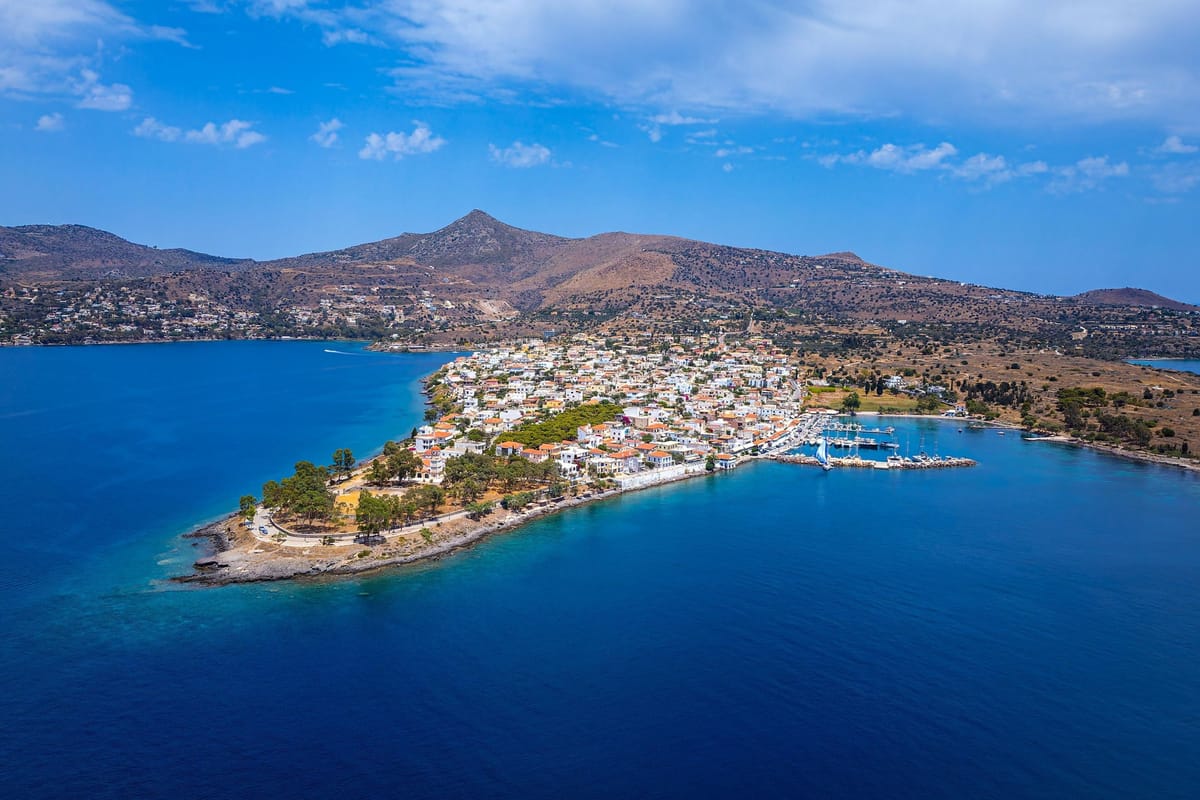
An Aegina day trip spends one day on Aegina, an island of the Saronic Gulf close to Athens. The day runs from the harbour town to temples, monasteries, villages and pistachio farms. The trip is one of the Greece Tours on Greece Ville, listed with the other day trips from Athens and Saronic islands tours.
This post covers what an Aegina day trip includes, Aegina town and the island’s time as the first capital. It also covers Kolona, the Temple of Aphaia, the old coins, Paleochora, Agios Nektarios and the pistachios.
Mount Oros, the villages, the Kapralos museum, the beaches, pottery and nature follow. The old rivalry with Athens, the best months and common questions come last. The sections include Aegina day trips that can be booked online.
What is an Aegina day trip?
An Aegina day trip spends one day on an island in the centre of the Saronic Gulf. A day trip is a form of recreational travel and leisure. In recent decades, tourism has become the main economic activity of the islanders.
An Aegina day trip uses one place as a home base. Budget and active travelers favour this habit, since it avoids new lodging at each stop. Reasons for a day out include sights, museums, cultural events and shopping.
Agistri, the Methana peninsula, Troezen, Poros and the coast of Attica surround the island. It covers a total area of 82.63 square kilometres. Low hills and stretches of flat land make up its ground.
An Aegina day trip on foot meets Oros, the island’s highest mountain. Isolated low hills include Koutalos, Mounti, Fokitsa, Vovos and Agios Dimitrios. Megali Korifi, or Big Peak, reaches 311 metres at the south-eastern end.
Seasonal torrents cross the land, dry in summer and rushing with water in winter. Archaeologists place the ancient Asopos river at the Skotini torrent. Hot springs with hydrogen sulphide, a sulphur gas, rise at Kakoperato in the north.
An Aegina day trip visits an island whose population peaked at the 2011 census. That count reached 13,056 residents, the highest on record. The lowest figure, 6,127, dates from 1879. The sharpest fall, 11.8%, came in 1951.
The municipality was formed in 1997 under a reform called the Kapodistrias plan. It merged the former municipality of Aegina town with four communities. The 2010 Kallikratis reform left it unchanged.
- Paths: Volunteers keep up 45 km of walking paths, with support from the municipality.
- Routes: Nine routes carry signs, eight for hiking and one for cycling.
- Old springs: Ruins show that the northern springs served people in antiquity and the Middle Ages.
- Other visitors: Religious and archaeological tourism also play an important role in the economy.
An Aegina day trip therefore crosses an island of low peaks, seasonal torrents, hot springs and marked paths. Visitors now carry its economy. Walkers, pilgrims and history lovers all find a reason to come.


What does Aegina town show on an Aegina day trip?
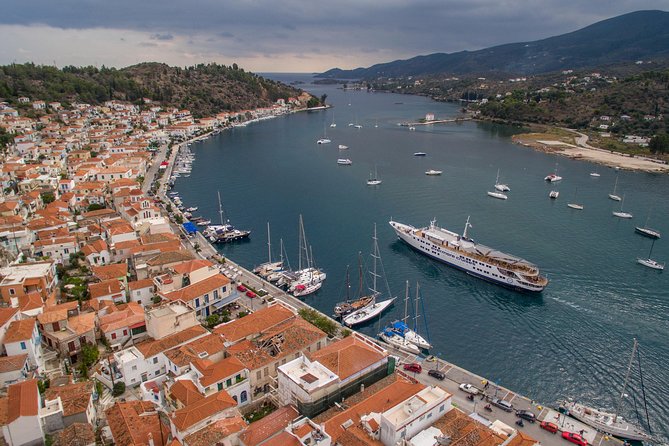
An Aegina day trip finds a town that has been declared a traditional settlement. Blue church domes and yellow or pink house fronts line its coastal road. Narrow streets, lanes with small shops and one-horse carriages complete the scene.
An Aegina day trip meets the community of Aegina town, which covers 40.172 square kilometres. Its 2001 census count was 7,467 permanent residents. Ten years later, the figure stood at 7,253.
The harbour view begins with the chapel of Agios Nikolaos, or Saint Nicholas. It is a small, dazzling-white Byzantine chapel. Fishermen leaving at dawn once stood on deck and prayed to this patron saint of seamen.
An Aegina day trip passes the fish market, a long and narrow gallery. The municipality calls it the core of the island. Crates of fresh fish arrive there morning and night from caiques, small wooden fishing boats.
The waterfront holds a row of neoclassical buildings in soft colours. They herald the town’s growth under the first free Greek state. Sponge-boat owners and sponge traders added more in the late 19th and early 20th centuries.
An Aegina day trip reaches the Mitropoli, the cathedral of the town. An inscription at its entrance dates its opening to 1806. Its right nave, one of three long halls, honours Saint Dionysios, patron saint of Aegina.
The Markellos Tower now houses the Kapodistrian Cultural Center and the Spyros Alexiou Centre for Social Issues. Its rooms also serve as a gallery. Shows of paintings, sculpture and photography take place there.
- Church screen: The marble iconostasis, the screen of icons, dates from 1871 and replaced a wooden one.
- Spyros Markellos: This 1821 fighter belonged to the Filiki Eteria, or Friendly Society, and later sat in parliament.
- Old mansions: The home of Georgios Iriotis-Kontogiorgis, built in 1817, now holds the Historical and Folklore Museum.
- Another mansion: The Kanaris house stands near Ethnegersias, or Revolution, Square.
An Aegina day trip moves from a white chapel to a busy fish market. Neoclassical fronts, a cathedral of the Kapodistrian era and a tower turned arts centre complete the walk.
Why was Aegina the first capital on an Aegina day trip?
An Aegina day trip recalls why the island became the first seat of the new state. The government had already fled there in November 1826. Ibrahim’s armies were still ravaging the Peloponnese. Kapodistrias, the first Governor, therefore came to the island for safety.
An Aegina day trip retraces the landing of Kapodistrias at Perivola beach, aboard the British warship Warspite. On 26 January 1828, he was sworn in at the Mitropoli. The educator and politician Theofilos Kairis introduced him.
The Kyverneio, or Government House, is a two-storey building with a red-tile roof. Built in 1803, it belonged to local dignitary Michail Moiras. Kapodistrias kept two rooms for himself, a bedroom and an office.
Visitors on an Aegina day trip learn that the first mint stood in the Kyverneio courtyard. The building also held the first library of the country. The library of Aegina soon owned 1,078 volumes and 24 ancient manuscripts.
The mint struck the phoenix, named after the mythical bird as a symbol of rebirth. One phoenix was divided into 100 lepta, or hundredth parts. Its presses came from Malta and had belonged to the Knights Hospitaller.
An Aegina day trip recalls the first sample coins, struck on 27 June 1829. A small anchor served as the mark of the Aegina mint. An estimated total of just under twelve thousand coins was minted.
The Eynardeio was designed by architects Stamatis Kleanthis and Eduard Schaubert. Jean-Gabriel Eynard, a Swiss friend of Greece and of the Governor, paid for it. Inside, the Central School trained teachers and state officials over three years.
- First school: The Central School was the first school to run in liberated Greece.
- Orphanage: In its first year, the Orphanage of Aegina housed 495 orphans.
- Old stones: Builders raised the orphanage fast, using stones from the ancient walls and theatre.
An Aegina day trip therefore links the island to the birth of the modern Greek state. A safe refuge became a working capital. Its first schools, library and coins all began in this town.
What does Kolona show on an Aegina day trip?
An Aegina day trip finds at Kolona a headland about 12 m above the sea. Steep cliffs guard three sides, and shallow bays lie north and south. Bronze Age houses, town walls and a Greek temple’s base stand on it.
The first clear village here belongs to the end of the Late Neolithic, the New Stone Age. Its people left clay idols, small human figures, that repeatedly appear in pairs. Male figures outnumber female ones.
An Aegina day trip reaches the “White House”, a large two-storey house of the Early Bronze Age. Houses of this grand type are best known from Lerna, Akovitika and Thebes. Their purpose still provokes debate.
Late in the Early Bronze Age, builders laid out a new planned town. Houses stood joined in blocks behind the site’s first proven city wall, with towers. W.-D. Niemeier called it the first Aegean state outside Crete.
An Aegina day trip also finds signs of a disaster. A large fire, evidently from an enemy attack, destroyed the planned town. Later gates became long, narrow, winding passages that were easier to defend.
The ancient travel writer Pausanias named the temple of Apollo first in his account of the island. Early 19th-century scholars still credited it to Aphrodite. Gabriel Welter proved the Apollo link in work published in 1938.
An Aegina day trip recalls the Aegina Treasure, a hoard of Bronze Age gold. Scholars now think it came from the Chryssolakkos cemetery at Malia on Crete. Its chest pendant shows a god flanked by geese.
- Temple base: The foundation measures 18.75 by 34.28 m, slightly wider than the Aphaia temple’s.
- Harbour stone: The American doctor Samuel Gridley Howe had refugees reuse temple stones in a new harbour pier.
- Sale: The British Museum bought the Aegina Treasure in 1892 from the Cresswell Brothers, London sponge dealers.
The island’s Archaeological Museum was founded under the supervision of A. Moustoxydi. Its rooms hold a torso of the hero Heracles. It comes from an older temple of Apollo and dates to around 570–560 BC.
What does the Temple of Aphaia show on an Aegina day trip?
An Aegina day trip sees at the Temple of Aphaia a sanctuary rebuilt on a grand scale. Its sculptures were cut from marble of Paros, another Greek island. Early visitors recorded red paint on helmet crests and blue on helmets.
The temple stands on a crepis, a base of three steps. A ramp of carefully cut stone climbs it on the east side. Builders coated the columns and walls with plaster and then painted them.
An Aegina day trip enters a sanctuary rebuilt with the new temple. Workers added a stone enclosure wall and a grand propylon, or gateway, on the south side. Marble maidens flanked the central roof ornament.
The west pediment, a triangular gable, shows the older Archaic style, with stiff figures that stand apart. The east pediment already follows the early Classical style. Its dying warriors lose the fixed smile of older statues.
An Aegina day trip meets island heroes in the west gable. Ajax is known by the eagle on his shield. Teukros and Achilles, descendants of Aiakos, the island’s first king, fought there too.
Antiquities of Ionia, a book of 1797, made the temple known in Western Europe. The team that removed the sculptures included Cockerell and Otto Magnus von Stackelberg. Johann Martin von Wagner bought them for Ludwig of Bavaria.
An Aegina day trip links the hill to Munich, where the marbles were installed in 1827. Bertel Thorvaldsen’s added parts were removed completely in 1963–1965. The prince paid for the collection and museum himself.
- Archer’s clothes: Side lighting revealed a diamond pattern on the sleeves of the Trojan archer Paris.
- Colour study: Ernst Fiechter, at the 1901 dig, made the temple’s colour reconstruction still accepted today.
- Older temple: Ernst-Ludwig Schwandner reconstructed it as a temple with four front columns and a back room.
Vinzenz Brinkmann’s colour research, begun in the early 1980s, led to the travelling Gods in Color show. It opened in 2003. In Aegina itself, the sanctuary lay abandoned by the end of the 2nd century BC.
What did Aegina’s turtle coins mean on an Aegina day trip?
An Aegina day trip recalls coins that served as common money across the Peloponnese. People called the silver stater coin chelone, the Greek word for turtle. Its silver came from mines beyond the island. Scholars still debate when the minting began.
The coin expert B. V. Head dated the first Aeginetan coins to about the mid-7th century BC. The scholars Price and Waggoner placed the first silver coins no earlier than 550 BC.
An Aegina day trip meets a coin that changed slowly. Early turtles had a plain shell, later marked with a row of dots. Next, the sunken square on the back took a “mill-sail” pattern.
Later, broad bands divided the square into five parts. One view holds the state kept this old look on purpose. Traders in mainland towns and Aegean ports had known it for over a century.
An Aegina day trip hears of a rare stater with a different back. It shows a triskeles, three human legs around a large central knob. It hints at a money alliance with the town of Phlius.
Later silver shows a land tortoise, Latin name Testudo graeca, with clearly drawn shell plates. Newer issues added the Greek letters ΑΙ for Aegina and a dolphin. Bronze coins then began to replace the smaller silver ones.
An Aegina day trip traces the Aeginetan standard, a system of coin weights. It dominated the Greek world in the second half of the 6th century BC. Athens’ Attic standard overshadowed it in the following century.
- No local silver: Aegina had no known silver sources, so the island gathered metal from elsewhere.
- Old theory: A 1980 study named Lavrion in Attica, the island of Siphnos and an unknown third.
- New view: A 2017 review linked 24 of 45 tested coins to northern Greek mines.
- Later use: Around 200 BC, the Achaean League of cities adopted a reduced Aeginetan standard.
Aeginetan staters regularly turn up in coin hoards in Egypt and the Levant. Both lands were short of silver. Athenians apparently called the Aeginetan drachma, a half-stater coin, the “thick drachma”.
What does Paleochora show on an Aegina day trip?
An Aegina day trip reaches Paleochora, an empty medieval town on a northern peak. A castle crowned the summit at 355 metres. The Taxiarchis church, named for an archangel, dates from the 13th century. Residents left early in the 19th century, as pirate raids faded.
An Aegina day trip finds Paleochora beside the road from Aegina town to Mesagros. Historians and archaeologists place the ancient town of Oie on the same peak. Herodotus and Pausanias both mention Oie.
The Aeginetans once brought wooden statues from Epidaurus to Oie. The statues honoured Auxesia and Damia, goddesses matched with Demeter and Persephone. Remains of ancient and early Christian buildings have also been found on the site.
On an Aegina day trip, the hill explains an old choice. The scholar Moutsopoulos placed the move inland after Saracen, or Arab, pirates ravaged Lygourio and Attica. One possible trigger was a raid of 896 AD.
After the Fourth Crusade of 1204, Aegina passed to Venice. The Duchy of Athens followed. In 1296 the island went to Boniface of Verona as a dowry, or marriage gift. By 1394 the Caopena family held it.
An Aegina day trip climbs toward the castle, begun in the middle of the 15th century. Steep cliffs guarded its south and west sides. Its entrances faced north and east. Wall remains stand up to 1.8 metres.
During Barbarossa’s raid, the attackers pulled down the houses of Paleochora. In 1540 the Ottomans took Aegina. Pirate fears refilled the town. A Venetian siege later lasted eight days. In 1765 records list 400 houses there.
- Cathedral: The Episkopi, the old bishop’s church, carries the name of Saint Dionysios.
- Bishop: Dionysios, born on Zakynthos in 1547, served as archbishop of Aegina.
- Captives: The Venetian force left with 300–600 Albanians and 40 Turkish residents.
- Water: Remains of three cisterns, or water tanks, survive at the castle.
An Aegina day trip walks a town that once packed small houses and churches along two main roads. Hardly any houses survive, even as foundations. The residents moved to today’s Aegina town on the west coast.
What does the monastery of Agios Nektarios add to an Aegina day trip?
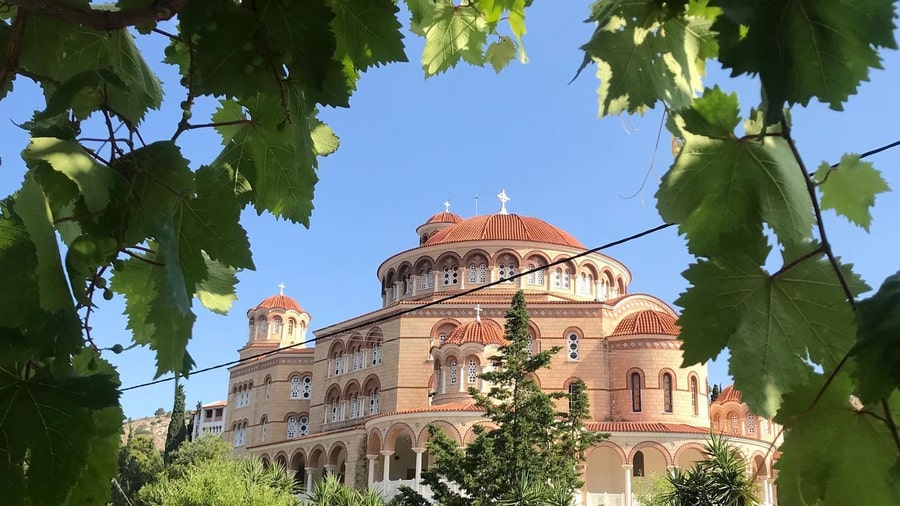
An Aegina day trip at Agios Nektarios meets a modern church built between 1973 and 1994. It stands on the site of an older Byzantine monastery. The saint’s hand is kept inside. Pilgrims treat water from a well on the grounds as holy.
Nektarios was the fifth child of his parents. In Egypt he served the Church of Saint Nicholas in Cairo. He also became secretary of the Patriarchate, the head church office in Alexandria.
An Aegina day trip follows a dream that grew on Mount Athos. Nektarios visited the monk Daniel of Katounakia there. Afterwards he sought a site for an “Ecclesiastical Parthenon,” his name for a monastery.
He found an old, abandoned monastery on Aegina at a spot called Xantos. Four women who wished to become nuns moved there. Other nuns already living on the island joined them.
An Aegina day trip hears stories about his arrival. He healed a young man said to be possessed by a demon. Islanders asked him to pray, since rain had failed for years. Rain fell the same day.
Soon the convent held 15 nuns, thanks to gifts from pilgrims. Yet Metropolitan Theoklitos of Athens, the city’s senior bishop, refused to recognise it. Without legal status, it was unable to accept gifts left in wills.
An Aegina day trip also meets the saint as a writer. He wrote 136 letters to the nuns of the convent. They were published in 1984. He also composed the hymn Agni Parthene, meaning “O Virgin Pure.”
- Deaconesses: In 1911 Nektarios ordained women into this female church office.
- Hospital: His death room at the Aretaieio Hospital in Athens is now a chapel.
- Grave: He was buried outside a small church there, under a pine he planted.
- Diocese: The church belongs to the Metropolis, or church district, of Hydra, Spetses, Aegina, Hermionis and Troizinia.
An Aegina day trip also passes the Agia Aikaterini monastery and the chapel of the Cross. Guest houses serve visitors. Entry to the grounds requires long clothing, as at every Greek Orthodox monastery.
What do Aegina pistachios add to an Aegina day trip?
An Aegina day trip passes orchards of about 240,000 pistachio trees. A Greek agriculture ministry decision of 14 January 1994 protected the name. Only nuts grown on the island carry it. Greece’s list of intangible, or living, cultural heritage also includes the crop.
The arrival date of the tree on Aegina is unknown. Oral accounts say trees were brought from Persia and Syria. The German botanist Heldreich visited Aegina six times from 1848 to 1881 without mentioning the tree.
An Aegina day trip meets a crop with roots beyond the island. Chocolate maker D. Pavlidis planted Greece’s first organised orchard at Psychiko in 1860. In 1869 Orphanidis, head of the state nursery, began raising more trees.
Nikolaos Peroglou wrote the first practical handbook on growing the tree. His Athenian friends with land on Aegina, such as Alexandros Karapanos, were convinced first. Panagiotis Galaris and Nikolis Chaimantas were the first Aeginetan growers on record.
An Aegina day trip passes orchards with a written history. A document of 30 September 1898 in the island’s archives records a deal over 12 okades of pistachio. An oka was an old Ottoman unit of weight.
Georgios Fortounas opened the first commercial pistachio nursery on Aegina in 1925. In 1950 pistachios covered 1,050 stremmata, a Greek unit of 1,000 square metres. Vineyards then covered 13,500 stremmata, but only 4,382 by 1961.
An Aegina day trip meets a craft that changed slowly. Before the 1970s, growers trod the fresh nuts by foot to strip the soft hull. They then washed them in cisterns or in the sea.
- Variety: The rules name the Aeginis variety, also called Koilarati.
- Additives: Only salt and citric acid are allowed, with salt capped at 10%.
- Size: Nuts weighing under 90 grams per 100 nuts are banned from sale.
- Quality: At least 98% of packed nuts must be split open.
Each kernel holds 60–65% oil. Island peddlers carried roasted nuts in baskets and made them famous in Piraeus and Athens. The yearly festival draws 30,000 visitors. Greece leads the EU in pistachio output.
What does Mount Oros show on an Aegina day trip?
An Aegina day trip to Mount Oros climbs a mountain whose name means “mountain”. Its triangular outline is volcanic in origin. The peak shows from every coast of the Saronic Gulf. Ancient sources put a Zeus Hellanios sanctuary on top.
The writer Pausanias called the mountain Panhellenion, meaning “of all the Greeks”. He told of a drought, when no rain fell on either side of the Isthmus of Corinth. The Greeks sent envoys to Delphi.
On an Aegina day trip, this peak recalls the myth. The Delphi priestess said Zeus listened only to Aeacus. Envoys came to Aeacus from each city. He sacrificed and prayed, and rain fell.
Theophrastus, who wrote on weather signs, linked the peak to rain. When a cloud settled on the peak of Zeus Hellanios, rain tended to follow. That reading of summit clouds lasted into modern times.
An Aegina day trip also reaches the lower slopes. In 1905, the archaeologist L. Curtius searched a large cistern there. He found a bronze hydria, a water jar, given to Zeus Hellanios in the 5th century BC.
Its inscription names the givers, Plathon and Ekesthenes, sons of Prokles. The cistern lies about 100 m south of the Taxiarches chapel. Greek Orthodoxy gives that name to the archangels Michael and Gabriel.
On an Aegina day trip, the lower shrine sits at Sfyrichtres. Its polygonal wall of fitted odd-shaped blocks dates to the 6th century BC. H. R. Goette called it a pompeion, where processions to the summit began.
- Ridge: Nikolaki, at 451 m, and Platyvouni, at 442 m, continue the mountain to the north.
- Figurine: A Bronze Age clay figure of 1400-1200 BC from the summit sits in the island museum.
- Vases: One room of 13 m² held over 30 vases of about 1300-1100 BC, chiefly cooking pots.
- Walls: Remains of a prehistoric fortification still show on the western slope.
The Greek antiquities service for Piraeus and the Islands now digs the summit. Its partner is the Swiss School of Archaeology in Greece. The summit view runs from Attica and the Argolid to Kea and Milos.
Which villages does an Aegina day trip pass?
An Aegina day trip passes villages that grew from farming, fishing and summer homes. Kypseli is the largest of them. Souvala, Vagia and Agia Marina mix old churches with holiday homes. Pachia Rachi is a tiny hill village in the south.
On an Aegina day trip, Kypseli lies 3.5 km east of Aegina town. The village stands 60 m above the sea, on a fertile plain. Its people once lived from fishing and sponge fishing.
Until 1950, Kypseli was called Chalasmeni. The old name came from an unfinished church, where work stopped in 1845. The village square and its church, built around 1887, are listed as protected monuments.
At Souvala, an Aegina day trip meets salty springs at Therma. Souvala’s beach counts among the best known on the island. Old farmhouses survive just before Souvala, from a past of vines and olives.
The place name Souvala is thought to be Slavic, and it recurs across Greece. The church of Saint Serafeim there dates from after Byzantine times. Its single vaulted hall later gained an added wing.
On an Aegina day trip, Vagia sits just 15 m above the sea. It is mainly a village of holiday homes. Its first census count was only 41 people. It belonged to the Mesagros community until 1997.
Agia Marina lies 12.5 km east of Aegina town. Until 1960, it was a small village of herders, farmers and fishers. The feast of its church falls on 17 July.
- Census: The 2011 count gave Kypseli 2,124 people, Vagia 291 and Agia Marina 277.
- Pachia Rachi: The village stands at 220 m, north-west of Mount Oros.
- Book: Zoe Sari’s 1969 book The Treasure of Vagia follows children hunting German wartime treasure.
- Television: The Greek broadcaster ERT first showed a series based on the book in 1984.
Pachia Rachi had only 14 residents at the 2021 census, against 25 ten years before. Mesagros and Perdika are two more villages. An Aegina day trip sees fishing villages turned into summer places.
What does the Kapralos museum add to an Aegina day trip?
An Aegina day trip can add the Christos Kapralos Museum in Plakakia. Kapralos ranks among the leading Greek sculptors of the 20th century. He worked on Aegina in summer. Its halls hold his wood, stone and marble works, all made on the island.
An Aegina day trip meets a sculptor who lived from 16 November 1909 to 20 January 1993. Kapralos came from Panaitolio, a village outside Agrinio. His father, a tobacco broker, died when the boy was five.
He studied painting at the Athens School of Fine Arts in 1930-1934. He learned sculpture in Paris under Marcel Gimond. When war was declared, he sailed home, and his work left in France was lost.
An Aegina day trip follows his path to the island. After the war, he settled in Athens in 1946. He later moved to Aegina and set up his own workshop there in 1963.
The Monument to the Battle of Pindos is a frieze, a long band of carved figures. Kapralos cut it in Aegina poros, a porous limestone. He worked on it each summer from 1951 to 1956.
On an Aegina day trip, the frieze’s size stands out. It runs 40 m long and 1.10 m high. Its seven sections, of unequal length, tell seven episodes. The first shows peaceful village life.
The last section, Laterna, centres on a street organ and stands for reconciliation. The first plan called for 61 m. After a show in 1957, the frieze sat crated in a Piraeus warehouse until 1992.
- Parliament: Since 2002, the frieze has lined the upper walls of the Greek Parliament’s Peristyle, a columned hall.
- Plaster cast: The museum shows a plaster cast of the frieze.
- Parody: A work of 1971-1972 parodies the pediment, or gable sculpture, of Olympia in eucalyptus trunks.
- Mother: A full statue of his mother Evgenia stands at the museum and in Karditsa.
The museum opened in 1995 in his six workshop halls. A 1991 decree had set up his foundation to run it. In 2006, the foundation passed to the National Gallery, which runs the museum as an annex.
Which beaches can an Aegina day trip reach?
An Aegina day trip reaches beaches by road at Agia Marina, Souvala and the bay of Marathonas. Agia Marina appears on every Greek list of the Blue Flag, a clean-beach award, from 2019 to 2023. Klima, a sandy beach, lies near Perdika.
Agia Marina’s south beach runs 450 m and averages 10 m wide. Its bottom slopes gently, so the first metres of water stay shallow. The depth reaches 5 m at 230 m from shore.
An Aegina day trip finds sunbeds, showers and toilets on Agia Marina’s south beach. That beach won the Blue Flag for 2014. The state profile estimates room for 800 bathers. Swimming leads there, and sea sports come second.
Agia Marina’s north beach is smaller, at 80 m long. Its shape and orientation shelter it from the prevailing winds, except southeast ones. A stream that flows only part of the year empties onto this beach.
Souvala’s west beach has a sandy shore. Pebbles mix with the sand on its seabed. The beach runs 140 m along a small open bay. That bay stretches for about 500 m.
An Aegina day trip passes Souvala’s east beach. Its whole shore is artificial, filled with sand brought in from elsewhere. The beach runs 120 m and averages 20 m wide. Tamarisk shrubs grow in scattered spots along it.
An Aegina day trip reaches Agios Vasileios beach, 4 km from town, in Marathonas bay. Pebbles and sand cover its shore. It stretches about 650 m and faces southwest. Large pistachio and olive groves lie around it.
- South of Agia Marina: Kyr-Annitsa and Peninta Vrachia, meaning Fifty Rocks, are further beaches.
- Water checks: Samples are taken each year from 1 June to 31 October.
- Legal basis: The beach profiles follow European Directive 2006/7/EC on bathing water quality.
Agia Marina’s two beaches have been official bathing beaches since 1991. Annual state programmes have monitored their water ever since. Agios Vasileios and Souvala’s west beach joined the list that same year.
What does Aegina pottery show on an Aegina day trip?
An Aegina day trip shows an old pottery craft. Bronze Age pots from the island turn up inland as well as on coasts. Later, lime-rich clay made Aegina’s kanatia, or water jugs, prized across Greece. Electric fridges cut demand in the second half of the 20th century.
An Aegina day trip meets a Bronze Age export called Aeginetan pottery. Potters made red-coated bowls and goblets, plus cooking pots. They also made matt-painted tableware, decorated with paint that has no shine.
Plenty of these vessels hold biotite, a mineral flake that shines gold in sunlight. That glint let scholars trace them to Aegina. Such gold-flecked pots first left the island at the very start of the Middle Bronze Age.
An Aegina day trip recalls the reach of this trade. Aeginetan pots travelled 240 km to Mitrou in central Greece. Heavy imports there began around 1500 BC. At a prominent Lerna burial, over half the pottery was Aeginetan.
From around 1350 BC, Aegina exported only cooking pots for 200 years. Near 1200 BC, almost half of Mitrou’s cooking pots were Aeginetan. For nearly 1000 years, potters shaped this ware by hand, never on a wheel.
An Aegina day trip meets an old cooling trick in clay. Bronze Age water jars from Aegina were porous, full of tiny holes. A little water evaporated through their walls, which kept the rest cool.
Later water jugs wear an outer coat of paspara, a local blend of white, charcoal and black clays. Its thin white soil leaves a porous skin. Passing air evaporates water from it, so the jug sweats and cools.
- Clay source: The dark red clay for water jugs comes chiefly from the island’s northeast.
- Workshop map: Research found 11 areas holding the bulk of workshops, including Mesagros, Kypseli and Vathy.
- Decoration: Clay flowers, grapes, female busts and name initials came from wooden or plaster moulds.
Bronze Age potters cut or pressed marks into their vessels, chiefly near the base. Scholars link these marks to specific workshops. In 2010, the village of Mesagros still had one working ceramics workshop.
What nature does an Aegina day trip pass?
An Aegina day trip passes pine-covered hills, dry seasonal streams and old volcanic ground. Twelve inactive volcanic centres lie around Paleochora and Agia Marina. In 2021, crews finished laying an undersea water pipeline. It links the island to EYDAP, the Athens water company.
On an Aegina day trip, pine trees cover the majority of the small hills. At Agia Marina, scattered pines grow out of the shore rocks. Inside Souvala, small hills carry rich pine growth.
The monastery of Agios Minas sits in a pine-covered spot near the Temple of Aphaia. The island’s flora holds 26 Greek endemic taxa, meaning plant kinds found only in Greece. They make up 3.30% of its plants.
For botanists, an Aegina day trip stays inside the Peloponnese plant region. Poros shares that region, while Salamina belongs to central Greece. The flora of nearby Methana is closer to Aegina’s than to Poros or Salamina.
Aegina’s volcanoes started earlier than Methana’s. Aegina and Kos lavas show K-Ar ages, a radioactive clock, of 2 to 3.6 million years. The line of active volcanoes has since moved south about 1 cm a year.
On an Aegina day trip, one andesite lava, a volcanic rock, dates to 3.87 million years. A tuff, or hardened volcanic ash, lies 7 m below it. That tuff dates to about 4.4 million years.
State profiles place Aegina’s beaches in the Attica water district, coded EL06. Off Agia Marina, the outer Saronic water holds a good ecological rating, set in 2017. Off Souvala and Marathonas bay, the rating drops to moderate.
- Length: The undersea pipe runs 14.4 km from Salamis to Aegina.
- Depth: It lies as deep as 95 m below the sea surface.
- Capacity: It was built to deliver 21,500 cubic metres of water a day.
- Rainfall: Monthly totals at the Aegina station ranged from 0 mm to 184.9 mm.
Before the pipeline, water tanker ships supplied the island. Planning for the link began about a decade before its laying. The Attica region called the project the only one of its kind in Greece.
What role did Aegina play against Athens on an Aegina day trip?
An Aegina day trip reaches an island with a long feud against Athens. Herodotus called it the Aeginetans’ long-standing debt of enmity. Thucydides says Aeginetans secretly urged the Spartans to war. Pericles urged Athens to remove Aegina as the eye-sore of the Piraeus.
The feud behind an Aegina day trip began with images of Damia and Auxesia, goddesses of fertility. Apollo’s priestess told Epidaurus to carve them from olive wood. Olives then grew only at Athens, the story says.
The Aeginetans stole the images and set them up at Oea, inland from their city. Only one Athenian survived a raid to take them back. The soldiers’ wives stabbed him with their dress pins.
Athens then dressed its women in Ionian, or East Greek, linen tunics, which needed no pins. Later, the Aeginetans seized the Athenian sacred ship at a festival at Sunium. Leading Athenians on board went to prison.
An Aegina day trip also recalls how Athens hit back. Corinth sold Athens twenty ships at five drachmas, or silver coins, each. Corinthian law banned free gifts. At Salamis, Aegina fought with its thirty best ships.
The Aeginetans kept their other ships at home on guard. They claimed one ship started the battle. It had sailed home to fetch images of the sons of Aeacus, the island’s guardian heroes.
Later, a sea battle broke out off the island of an Aegina day trip. Athens took seventy enemy ships and began a siege under Leocrates. The Peloponnesians, the states of southern Greece, sent three hundred armoured foot soldiers.
- Polycritus: The Aeginetan captain rammed a ship from Sidon and mocked Themistocles over claims Aegina sided with Persia.
- Gold stars: After the battle, the Aeginetans set three gold stars on a bronze mast at Delphi.
- Pottery ban: Argos and Aegina banned Athenian goods, even pottery, from the shrine of the goddesses.
- Peace terms: In 445 BC, Athens promised Aegina self-rule, but the promise had no effect.
The Spartans later gave Aeginetans a home at Thyrea, on the border of Argolis and Laconia. An Athenian force under Nicias landed there in 424 BC. Athens burnt Thyrea and killed its Aeginetan captives over the old feud.
Which months suit an Aegina day trip?
An Aegina day trip finds the mildest air in spring and autumn. The island averages 17.3 °C in April and 21.0 °C in October. Summer brings long, dry, sunny weeks. Winter brings cooler days and far more rain days.
An Aegina day trip in January meets the coolest month, with a mean of 11.5 °C. Nights then average 9.0 °C on the island. The lowest December reading on record there is 2.7 °C.
The Elliniko weather station, on the Athens coast, logs 231.0 hours of April sunshine. It counts 6.4 rain days in late spring. Aegina gets only 8.0 mm of late spring rain.
An Aegina day trip in late spring meets average highs of 25.9 °C on the island. June rain there totals 17.6 mm. The June record high on Aegina reached 40.2 °C.
Elliniko logs 362.7 hours of sunshine in July, its sunniest month. August brings just 1.6 rain days there. Humidity, the dampness of the air, falls to 46.6 percent in July. Aegina’s July record high is 42.5 °C.
An Aegina day trip in September meets a mean of 25.5 °C on the island. October rain there totals 27.1 mm. Elliniko logs 207.7 hours of October sunshine and 8.6 rain days.
Winter turns damp and dark. December brings 13.5 rain days at Elliniko and only 127.1 hours of sunshine. Humidity there climbs to 70.4 percent in that month. On Aegina, February rain totals 25.9 mm.
- Easter: Good Friday and Easter Monday are national holidays across Greece.
- Epitaphios: On Good Friday morning, churches cover this symbolic tomb of Christ with white, red and purple flowers.
- Holy Spirit Monday: Greece keeps the day after Orthodox Pentecost as a national holiday.
- Saint Nektarios: The Church marks the lifting of his remains from the grave on 3 September.
The same saint is honoured again on 12 October, with the saints of Athens. Local patron saint days in Greece can close schools by custom. Both autumn dates suit the mild season of an Aegina day trip.
What do Athens visitors ask about an Aegina day trip?
An Aegina day trip raises practical questions about size, clocks, coins, food labels, cars, local rule and names. Spoken Greek uses the 12-hour clock for the time. Greek euro coins show their value in Greek letters on the national side.
How far apart are places on an Aegina day trip?
The Chrysoleontissa convent stands at 338 metres, 9 km southeast of the main town. The Agios Nektarios shrine lies about 1 km to its north. The convent became a women's monastery in 1935. An Aegina day trip can pair the two sites in one stop.
Which clock and money apply on an Aegina day trip?
Greece adopted its current time zone in 1916. Written Greek also uses the 24-hour format. Minutes normally take two digits; hours appear with or without a zero in front. The time zone database names the zone Europe/Athens. Greeks call a euro cent a lepto. The 20-cent coin shows Ioannis Kapodistrias.
What does PDO mean on food from an Aegina day trip?
The letters PDO mean Protected Designation of Origin, an EU label. A PDO product must be produced, processed and prepared only in its home region. Its qualities must come mainly from that region. The EU rules first came into force in 1992. Greek feta also holds PDO status.
Can a car come along on an Aegina day trip?
Yes, car ferries sail between Piraeus and Aegina. One ferry, the Phivos, carries 1,200 passengers and 120 cars. It loads vehicles over ramps at its stern, or back end. On the island, KTEL buses, the Greek regional bus network, leave from Ethnergesia Square, opposite the port.
Who runs local affairs on an Aegina day trip?
Ioannis Zormpas has been mayor of the Municipality of Aegina since 2019. Local post uses the code 180 10, and phones use the area code 2297. In 1964, the island joined the new Piraeus Prefecture, a regional district. In 1972, it went back under Attica Prefecture.
Where does the Greek name heard on an Aegina day trip come from?
Greeks say the name as EH-yee-na. In myth, Aegina was a nymph, or nature spirit. Her parents were the river god Asopus and Metope. The name suggests a goat-nymph. In Ovid’s telling, Zeus carried her off in the form of a flame. Sisyphus, king of Corinth, told Asopus where she went.