
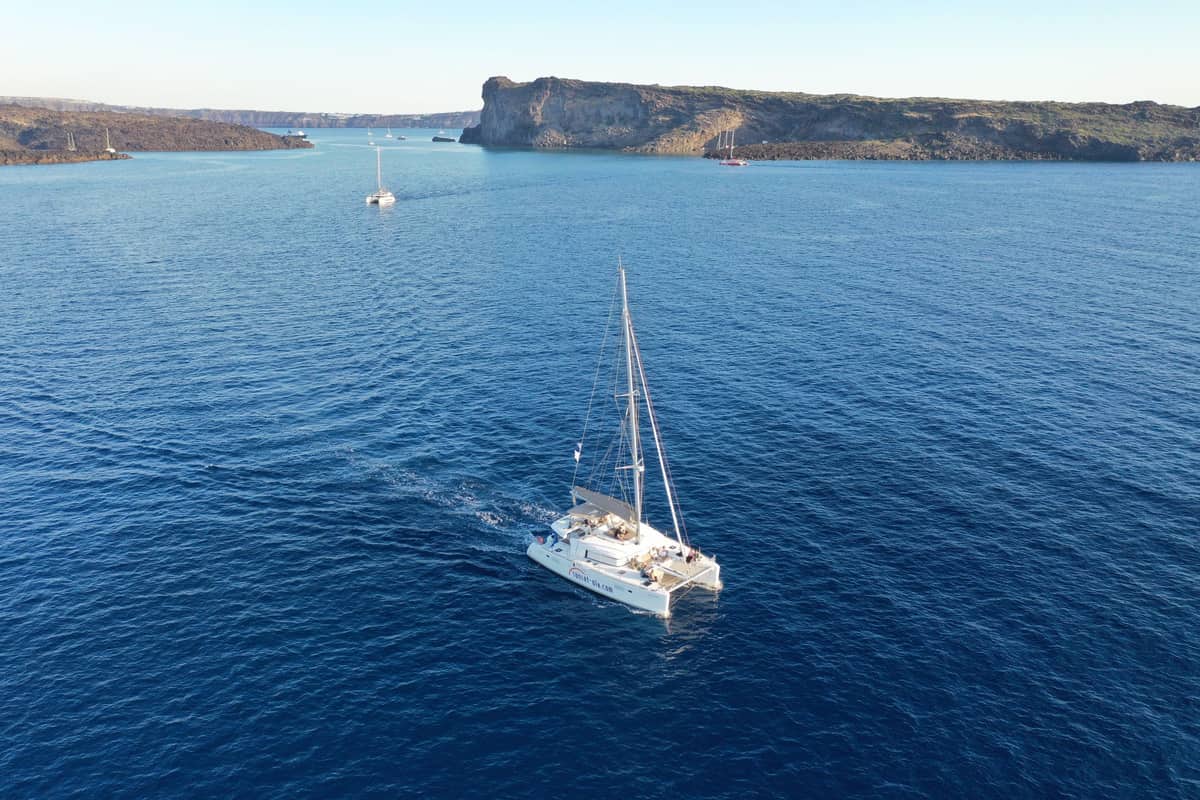
A Santorini sailing tour takes visitors under sail around the caldera of Santorini and its smaller islands. The tour is one of the Greece Tours on Greece Ville, listed with the other Santorini tours and Greece boat tours.
This post covers what the tour is, the marinas it uses, Oia’s sea captains, how a sail moves a boat, why catamarans stay steady and the wind a sailing trip needs.
The coves where boats anchor, the best months and common questions come last. The sections include Santorini sailing tours that can be booked online.
What is a Santorini sailing tour?
A Santorini sailing tour crosses waters on Greek navy chart 4235, Thira Island. It maps the island at 1:50,000, and its last edition dates from 1989. Chart 423/8 shows the harbours of Thira and Athinios at 1:5,000.
Greek chart 44, also INT 3714, covers the sea from Thira to Kasos at 1:250,000. The Greek Pilot comes in four volumes; volume 2 holds detailed notes for Santorini.
On 10 March 1866, an islet rose near Aphroessa. It took the name Reka from an Austrian warship. Lava from the Ktenas dome, formed in September 1939, later filled Agios Georgios bay on Nea Kameni.
On a Santorini sailing tour, the whole caldera is protected. A 1972 decision protected Thira, its gulf, the Kameni islands, Thirasia and Aspronisi. It named them a Landscape of Particular Natural Beauty.
- Monolithos: On the east coast, the shoreline turns from a 180° heading to 310°.
- Port series: Chart 423/8 belongs to the navy’s series for ports and bays.
- Chart 44: Its last edition dates from 1995.
- Approach chart: The navy files chart 4235 among its approach charts.


Which marinas does a Santorini sailing tour use?
A Santorini sailing tour can leave Vlychada, a fishing shelter on the south coast. Boats moor only on the north side of its connecting section, which covers 18,878.62 m². Part of it is only 0.80 m deep. Its deepest water reaches 4.50 m.
From the Old Port of Fira, 587 steps climb to the town. The port had no permanent residents in 2021. At Ammoudi, a 200 m wall lines the bay beside a boat ramp.
At Athinios, the Kamares quay runs 116.40 m and the Poseidon quay 101.30 m. On a Santorini sailing tour, Riva’s concrete pier on Thirasia covers 952.9 m².
- Riva pier: Its head is about 24.5 m wide, and the pier is about 35 m long.
- Breakwater: An 85 m boulder breakwater stands 500 m north of Riva’s pier.
- Exo Gialos: This east-coast port has breakwaters of 145 m and 77 m and an 11 m pier.
- Monolithos: Its harbour has two stone arms, about 220 m and 200 m long.
How did Oia’s captains shape a Santorini sailing tour?
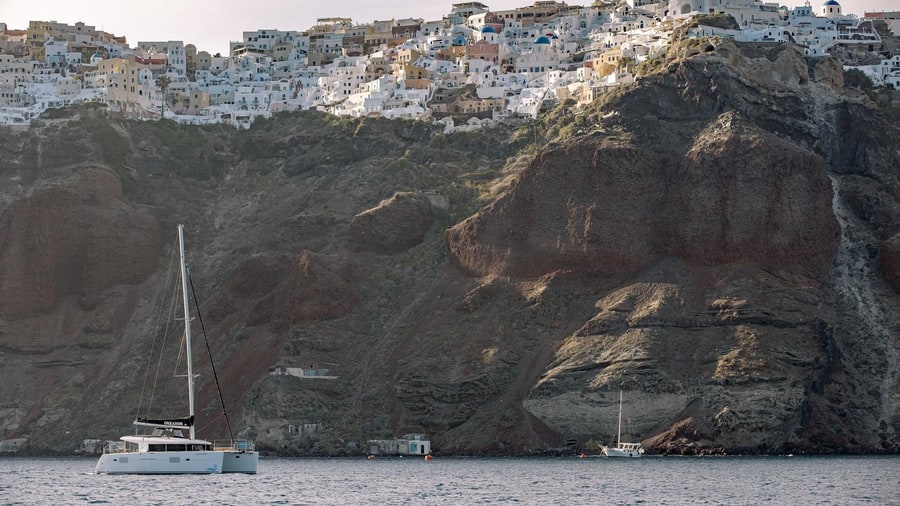
A Santorini sailing tour passes Oia, home of island sea captains. On the eve of the 1821 revolution, Santorini had the third largest fleet in the Aegean. Only Hydra and Psara had more ships. Ship crews once lived in its deep, narrow cave houses.
A number of Oia’s restored churches were built in memory of sailors. After the 1956 earthquake halted it, the town’s maritime collection found a temporary home in 1980.
Shipowner Aristeidis Alafouzos was born in Oia on 9 March 1924, into a shipping family. A volcanic eruption a year later led the family to move to Piraeus.
On a Santorini sailing tour, his story shows how Oia’s sea trade lived on. In 1965 he bought a secondhand ship, and by 1967 he ran five tramp steamers and bulk carriers.
By the mid-1980s, his firms owned 42 new cargo ships, chiefly built in Japan. In 2000 his fleet counted 35 ships, always under the Greek flag.
- Naval Academy: He planned to enter it, but it closed during the German occupation.
- Son: Giannis Alafouzos, born on 2 July 1957, is a sailor with major international distinctions.
- Ermis: Giannis Alafouzos founded the Ermis Maritime Corporation.
- Cave houses: Two windows flank the door, with a fanlight above.
How does a sail move the boat on a Santorini sailing tour?
A Santorini sailing tour moves on lift. The wind’s force on a sail splits into two parts: lift and drag. Lift acts at 90 degrees to the apparent wind. It comes from higher air pressure on the windward side.
Sailboats draw their power from lift between about 40° and 135° off the wind. Both lift and drag grow with the square of the wind speed.
Past a critical angle, the airflow separates and the sail stalls. Running before the wind, lift falls to one-fifth and drag almost quadruples.
On a Santorini sailing tour, heeling weakens a boat’s ability to point into the wind. A keel makes lift and drag, and that drag grows as the boat heels.
- Close-hauled: The sideways force is highest and the forward force lowest.
- Broad reach: A stalled sail still gives about 80% of its upwind lift, with double the drag.
- Apparent wind: Wind from the bow adds to it on deck, and wind from the stern reduces it.
- Weatherly: A boat that points higher or sails faster upwind earns this name.
Why are catamarans steady on a Santorini sailing tour?
A Santorini sailing tour by catamaran rides on two hulls. A multihull can weigh little more than half a monohull of the same length. It also needs less crew effort to sail. Light hulls meet water resistance roughly in step with speed.
SWATH catamarans carry their buoyancy in two submarine-like hulls below the waterline. Waves barely affect those hulls, so pitching and heaving drop sharply.
Wave-piercing catamarans have low-buoyancy bows that cut through waves. Sport catamarans carry trapezes, so the crew can hike out against capsize forces.
On a Santorini sailing tour, the twin hull has ancient Greek roots. Greek sources describe large catamarans of the third century BC, among them the Syracusia, built under Archimedes.
- Righting: A crew rights a capsized catamaran by standing on the lower hull and pulling a line.
- Speed: Extreme 40 and C-class catamarans can sail at up to twice the wind speed.
- 1882: The catamaran Nip and Tuck beat the fastest sloop by over five minutes on Lake Pontchartrain.
- Hobie: Over 100,000 Hobie 16 catamarans had been built by 2016.
Westermoen Hydrofoil of Norway launched the Westamaran catamaran ferry design in 1973.
What wind does a Santorini sailing tour need?
A Santorini sailing tour needs wind, but not too much. In light air under 8 knots, a sail is set at its fullest. Its draft depth is then 13 to 16% of the chord. In 8 to 15 knots, the mainsail keeps little twist.
Gusts run about 1.5 times the steady wind, so a 10-knot wind can gust to 15 knots.
A 5 m/s wind 3 m above the water blows at about 6 m/s at 15 m. That raises the sail’s centre of effort and the heeling moment.
On a Santorini sailing tour, sea breeze strength follows the temperature gap between land and sea. Shifts that improve the course are lifts, and shifts that worsen it are headers.
- Windward shore: It has lower waves and slower winds, so sailors follow one in bad weather.
- Clean air: A boat to windward sails in undisturbed air and leaves disturbed air behind.
- Beaufort: Francis Beaufort devised his scale while serving on HMS Woolwich.
- Sails to sea: In 1916, the Beaufort descriptions switched from sail behaviour to sea behaviour.
Beaufort’s first scale gave no wind speeds; it rated wind by its effect on a frigate’s sails.
Which coves does a Santorini sailing tour anchor in?
A Santorini sailing tour can anchor south-west of Aspronisi. British sailing directions of 1918 gave a fine-weather anchorage there, 3 cables off. It had 9 or 10 fathoms of water over sand and weed. A cable is about 185 m, and a fathom 6 feet.
Rocky shoal ground surrounds Aspronisi, 2 cables to the north and 3 to the south. The bank from Aspronisi to Cape Akrotiri carries 6 to 12 fathoms over sand.
On a Santorini sailing tour past Thirasia, the rock of Kimina lies close off its south-western point. Mansell shoal lies three-quarters of a mile further south. Just east of it, the water plunges to 125 fathoms.
- Copper hulls: Sulphurous spring water at Port Megalo cleaned the growth off ships’ copper hulls within days.
- Cape Riva: A shoal under 3 feet deep lies 3 cables east of Thirasia’s northern tip.
- Anchorage Bank: East of Mikri Kameni, it was only about 340 yards across in 1918.
- Poor hold: Its rock bottom held anchors badly, so crews anchored well in on the bank.
Which months suit a Santorini sailing tour?
A Santorini sailing tour suits summer, when 1918 sailing directions gave strong north-east winds as the rule. Southerly winds ruled in winter. Gales were commonest from early November to the end of March. Greece’s bathing season runs from 1 June to 31 October.
A southerly gale strikes a little before the March equinox, and Greeks call it the forty saints’ storm. In March and April, Etesian winds take turns with strong southerlies.
On a Santorini sailing tour in late spring and June, the sky is clear and the sea smooth. Land and sea breezes take turns.
- Summer gales: They almost always follow a calm, with a dark look to the sea on the horizon.
- Cloud sign: Grey layered clouds that suddenly break off island summits signal a gale.
- Sunshine: The Santorini station averages 8.4 hours of sunshine a day in April.
- Wind peak: February brings the station’s highest average wind speed, slightly above July.
What do visitors ask about a Santorini sailing tour?
A Santorini sailing tour raises questions about knots, capsizing, charter rules, man-overboard turns, sailors’ knots and sea forecasts. A boat at 1 knot along a meridian covers about one minute of latitude an hour. Greek law bars pleasure yachts from carrying ticketed passengers.
What is a knot on a Santorini sailing tour?
Earth’s polar circumference is close to 21,600 nautical miles, 60 minutes times 360 degrees. One knot is one nautical mile an hour. Knots per hour means a change in speed, not a speed.
Can a sailing boat tip over on a Santorini sailing tour?
A dinghy knocked down to about 90 degrees has capsized, and one fully upside down is called turtled. Yachts can carry lift bags that add buoyancy.
What paperwork does a Santorini sailing tour need?
A chartered professional yacht must carry the charter contract and an updated passenger list before leaving port. The skipper countersigns the list. False contracts or lists bring at least three years in prison.
What happens if someone falls overboard on a Santorini sailing tour?
In the quick turn, the boat holds a beam reach for 15 seconds, then tacks. The rescuers approach from downwind, moving upwind. Merchant ships drill such turns, as SOLAS requires.
Which knots do sailors tie on a Santorini sailing tour?
The figure-eight is the common stopper knot, tied in rope ends so they cannot run out. The reef knot serves for reefing sails, never for joining two ropes.
How do sailors read sea forecasts on a Santorini sailing tour?
Each Greek weather service sea forecast gives wind direction and Beaufort force, sea state, visibility and weather. Very soon means the first 6 hours, and soon the next 6. A gale warning covers force 8 and 9.