
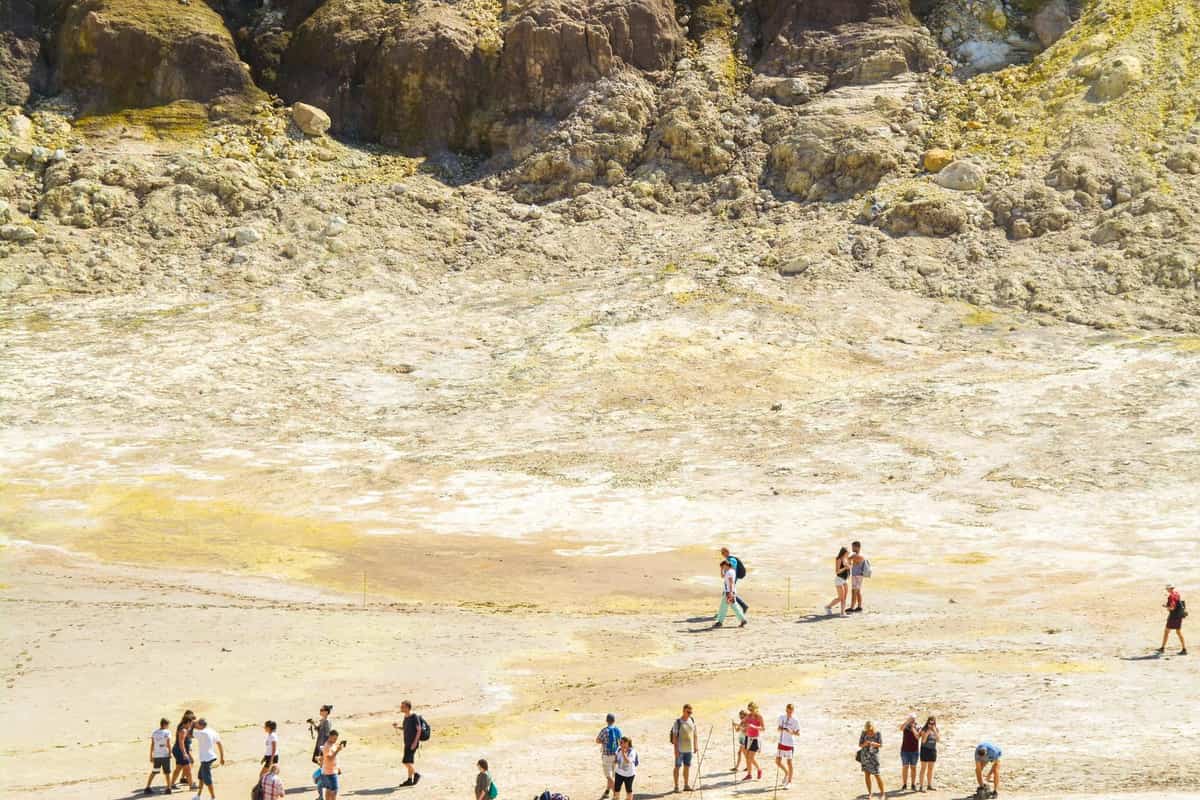
A Nisyros volcano tour crosses by boat to the volcanic island of Nisyros and walks into the craters of its caldera. The tour is one of the Greece Tours on Greece Ville, listed with the other Dodecanese tours.
This post covers what the tour is, how boats reach the island, how the volcano formed, what the caldera floor shows, the gases that rise from it and the unrest of the late 1990s.
The villages on the caldera rim, the monastery of Panagia Spiliani, the old walls, the pumice of Gyali, the best months and common questions come last. The sections include Nisyros volcano tours that can be booked online.
What is a Nisyros volcano tour?
A Nisyros volcano tour visits the easternmost volcanic centre of the Aegean arc. Scientists have called the Nisyros and Yali centre the Aegean’s youngest large volcano. Nisyros is a stratovolcano with a caldera. It is much younger than its neighbour Kos.

The Kos-Nisyros magma system produced the largest eruptions of the South Aegean Arc in the Quaternary. At least two magma chambers lie in the upper crust, one under Nisyros and one under Yali.
The caldera rim rises above 250 m and reaches 588 m at its highest. Outside the caldera, the Karaviotis lava dome in the south-west reaches 539 m. Strabo called the island round, lofty and rocky, 80 stadia around.
On a Nisyros volcano tour, the land is surprisingly green. The volcanic soil is very fertile and favours trees. Its trees earn Nisyros the name of the only green active volcano in the Aegean.
About 450 plant species have been recorded on the island. It has 85 recorded bird species, and the Mediterranean monk seal lives on its coast. The Nisyros bellflower, Campanula nisyria, is its only endemic species.
Nisyros had 2,516 residents in 1950 and 948 at the 2001 census. That year, Mandraki counted 708 residents and Emporeios 192. Four islets to the west and north are known as the Nisyria.
- Water: Nisyros has no real groundwater and little rain, so fresh water is scarce.
- Desalination: A seawater plant opened in 2002 with a capacity of 340 m³ a day.
- Land: With its islets, the municipality covers 50.055 km².
- Chart: Greek nautical chart 4513 covers Nisyros together with Tilos.


How do boats reach Nisyros on a Nisyros volcano tour?
A Nisyros volcano tour crosses about 16.5 km of sea from Kos, which lies to the north. Tilos lies about 17 km south-east. Nisyros lies about 17.5 km west of the Datça peninsula in Turkey. Ships heading for Mandraki pass the islet of Gyali.
Mandraki, the main port, lies in the north-west, 20 m above sea level. Ships from Piraeus call twice a week in summer and once a week in winter. Winter weather can stop passenger and freight transport.
The municipality lists the ships Panagia Evangelistria, Blue Star and Stavros, plus a Dodekanisos Seaways catamaran. That company, founded in Rhodes in 1999, serves 17 island destinations.
On a Nisyros volcano tour, the islet of Agios Antonios lies about 2 nautical miles from Mandraki. In summer, a boat from Pali runs to Gyali or around it.
Strabo placed Nisyros about 60 stadia north of Tilos. In his day it had a city of the same name, a harbour and hot springs. A temple of Neptune stood there too. Pliny placed it twelve miles from Cnidos.
Sulphur dug in the caldera’s mud craters left from a small harbour near Agia Irini. That trade ran in the 19th and 20th centuries. Pumice quarried in the north was shipped from a loading station near Pali.
- Avlaki: Until the 1950s, the people of Nikia used the small harbour at this now abandoned hamlet.
- Spa: Work on the stone Hippocratic Baths at Pali began in 1895, but the spa never opened.
- Flights: From Athens, daily flights reach Kos or Rhodes, with onward boats to Nisyros.
- Catamaran: The first one, Dodekanisos Express, was built in Norway and carries 337 passengers.
How did the volcano form on a Nisyros volcano tour?
A Nisyros volcano tour walks on young rock. Drill cores in the caldera found the Kos Plateau Tuff resting directly on non-volcanic bedrock. So Nisyros above sea is younger than that eruption. Its last magma eruption came about 20,000 years ago.
The oldest rocks are the Holaki pillow lavas, possibly older than the Kos Plateau Tuff. The oldest lavas, near Mandraki, formed under the sea and were later lifted up. Nisyros began on the rim of the Kos caldera as an underwater basaltic andesite volcano.
After the Kos Plateau Tuff, the magma took almost 40,000 years to evolve into water-rich rhyolite. Above sea, a small cone of lava flows grew first. Its layers show in the caldera wall.
Lake sediments between those lava layers point to small caldera collapses, each followed by quiet periods. Side vents then produced lava flows and explosions, among them the Lies tuff cone on the east side.
The first rhyolite erupted about 118,700 years ago, forming the Avlaki lava flow. The Nikia lava flow followed about 73,300 years ago. It holds roughly one cubic kilometre of sticky rhyodacite lava.
The Lower Pumice, the first caldera-forming eruption, came about 63,100 years ago. The Upper Pumice followed about 58,400 years ago. Explosive eruptions came after short rests of 5,000 to 10,000 years.
- Skarn: Eruptions threw out limestone chunks baked into skarn at 600 to 800 °C.
- Pumice layers: Pumice from both eruptions shows only within 5 km of the vent. Its layers are 1 to 8 m thick.
- Ash at sea: Every distant Nisyros ash layer belongs to the Upper Pumice, at least 47,000 years old.
- Olive fossils: Wild olive leaves in ash show the tree grew there 60,000 years ago.
After the Upper Pumice, six dacite domes partly filled the new caldera, and one spilled over the rim. Both magma chambers now sit in a window that favours lava eruptions over explosions.
What does the caldera floor show on a Nisyros volcano tour?
A Nisyros volcano tour crosses a caldera floor dotted with hydrothermal craters. Megalos Polyvotis is an oval crater 180 by 350 m. It came from the earliest and strongest explosion cycle of the Lofos area. The craters line up along the faults of the Lakki plain.
Its ejected rock lies 3 to 5 m thick, partly buried under later debris from Flegethron. Lava blocks inside carry brown-red oxide coatings and veins of anhydrite. After severe rainstorms, its western floor can turn into a lake.
Yellow and purple clay layers, 1.5 m thick, show that a lake stood there before. Mikros Polyvotis, the youngest crater of the Lofos area, has a floor only 30 m across. It cuts into the eastern rim of its larger neighbour.
The geopark dates Flegethron and Megalos Polyvotis to 1871-73 and Mikros Polyvotis to 1887. Flegethron is a large oval crater in the south-east of the Lofos area. Logothetis is the fourth crater on the same rhyodacite hill.
On a Nisyros volcano tour, Kaminakia are two crescent-shaped craters cut into the south-east caldera wall. Each measures about 150 m across. They are the only hydrothermal craters on those slopes.
Andreas, also called Mikros Stefanos, is a small round crater on the south-west rim of Stefanos. Two active faults running north-east shaped Stefanos, and a line of fumaroles marks them.
- Mudpots: Stefanos is the only place on Nisyros with mudpots, hot pools of acidic mud.
- Acid: Its mudpot water has a pH of 2.4 and 1375 mg of sulphate per litre.
- Ropes: Local authorities have roped off the boiling pools in the centre of Stefanos.
- Hot soil: In June 2015, crater soils reached 98 °C.
Those soils released up to 208 g of carbon dioxide per square metre a day.
Which gases rise on a Nisyros volcano tour?
A Nisyros volcano tour smells the gases of 32 fumaroles that scientists sampled between 2018 and 2021. All vent at the boiling point of water. Besides steam, they release mainly carbon dioxide, then hydrogen sulphide. Strong acid gases are absent.
Nitrogen, hydrogen, methane, carbon monoxide, argon and helium appear only in small amounts. Sulphur dioxide, hydrogen chloride and hydrogen fluoride are missing.
In October 2018, about 1,400 soil measurements found 92 tonnes of carbon dioxide leaving the Lakki plain daily. The same method gave 74 tonnes a day in 1999-2001. Soil life adds only about 4 g per square metre a day.
The total carbon dioxide output of Nisyros is close to the world median for volcanoes. Steam condensing just below the ground releases about 60 MW of heat. Where the flux is high, the soil is hot.
Gas models show no carbon dioxide or hydrogen sulphide hazard outside the Stefanos crater today. Future earthquakes can boost the heat flow and set off new steam explosions. That happened more than once in past centuries.
On a Nisyros volcano tour, the southern Lakki plain hides old geothermal wells. Test drilling took place there in 1982 and 1983. Tests of the first well, N.1, recorded 450 °C and a flow of 10 tonnes an hour.
- N.2: The second well, drilled in 1983, reached a depth of 1,545 m.
- Reservoir: Tests put the N.2 reservoir at 250 °C, with 200 °C at the wellhead.
- Brine: The N.2 brine held 56.5 g of salts and 0.4 g of hydrogen sulphide per litre.
- Plant size: The latest plan was a 20 to 25 MW plant. Nisyros needs only 1 to 2 MW.
What did the 1995-1998 unrest change on a Nisyros volcano tour?
A Nisyros volcano tour visits a caldera that stirred in the 1990s. Radar images from 1995-1996 show the ground deforming before the earthquakes began. Intense seismic activity followed in 1996-1998, with ground movement and changing fumarole gases.
Earthquakes during the crisis damaged houses across Mandraki. Gas data show the hydrothermal system heated by about 50 °C, up to 325 °C. Magmatic fluid was pushed up into it, but no steam eruption followed.
Carbon dioxide and helium rose compared with methane in the fumarole gas, a sign of magma gases. A GPS network set up in June 1997 was measured every year until 2002.
Every GPS station rose, by 14 to 140 mm. Sideways shifts of 13 to 53 mm showed the island stretching east, west and south. The best model puts two sources at 5,500 and 6,500 m deep.
On a Nisyros volcano tour, the Mandraki Fault also moved, according to that model. Later records showed ground height and gravity swinging every 40 to 60 minutes, linked to unsteady degassing.
A seismic survey in June 2001 found local earthquakes under the caldera, chiefly shallower than 6 km.
- Fissure: Between November 2001 and December 2002, a fissure 600 m long opened in the central Lakki plain.
- Size: The fissure was 1 to 5 m wide and up to 15 to 20 m deep.
- Cause: It came from the collapse of soft sediment under 50 m thick. It released no gas.
- Threat score: A United States scoring system ranks Nisyros among very high threat volcanoes, with Mount Rainier.
Seismicity and fumarole gases later returned to their values from before the crisis. A volcanological observatory now sits in the old school of Emporeios, looking down on the craters.
Which villages line the caldera on a Nisyros volcano tour?
A Nisyros volcano tour passes villages on the caldera rim such as Nikia. Local craftsman Paschalis Paschalakis laid the pebble mosaic of Porta, its main square, in 1923. Nikia had 443 residents in 1951 and only 40 in 2021.
The Volcanological Museum in Nikia grew out of a municipal programme called Emergence of the Volcano of Nisyros. It keeps rocks from all over the island and from other active volcanoes, with microscopes for visitors.
On a Nisyros volcano tour, Emporeios hides from the sea. That helped it grow strong in the age of pirates. It was built like a castle, with packed houses, narrow lanes and arches.
Its flat roofs send rainwater into cisterns, and courtyards sit open to the sky inside the houses. Emporeios had 376 residents in 1951. Emigration after the 1933 earthquake left it largely empty.
Pali takes its name from the Latin palus, the posts where ships were tied up. It was once the harbour of Emporeios and lies only 15 m above the sea. The Thermiani spring there flows at 33 degrees.
- Thermiani chapel: It sits wedged into rock inside the ruins of Roman baths at Pali.
- Mandraki: It has been a protected traditional settlement since 1978.
- Town hall: Craftsmen from Symi built the Mandraki town hall in 1931.
- Loutra: The Mandraki Municipal Baths have used this hot spring, reaching 46 degrees, since 1872.
Mandraki began as the harbour of the hill town. People moved down to it from the late 18th century. Its busiest square, Ilikiomeni, is named after the elderly people who sat there.
What is Panagia Spiliani on a Nisyros volcano tour?
A Nisyros volcano tour climbs to Panagia Spiliani, a monastery about 35 m above Mandraki. It stands on a sheer, porous rock face. Monasteries tend to hide in remote places, but this one sits above the village and harbour.
Tradition says a Nisyrian found an icon of the Virgin Mary at Vretou, near the Municipal Baths. He carried it to the church of Panagia Potamitissa. The next day, it turned up in a rock crevice. The islanders built the monastery on that spot.
An old ledger note shows the monastery existed before 1424. Its two-sided icon shows the Virgin on one face and St Nicholas on the other. It dates to the late 14th century.
The icon is thought to be a gift from Dragonino Clavelli. This lord from Rhodes held Nisyros as a tenant. The large Hodegetria icon received a silver cover in 1798. Hundreds of votive offerings hang below it.
On a Nisyros volcano tour, the church entrance shows parts of an 11th-century marble altar screen. In 1725 a carved wooden screen replaced it.
The main church honours the Dormition of the Virgin on 15 August. The Enniameritisses, women from Nisyros and Kos, vow nine days and nights of prayer in the cells.
- Fasting supper: On the eve, pilgrims share boiled chickpeas and tomato without olive oil, plus loukoumades.
- Free meal: After the festival liturgy, everyone eats free in the monastery dining hall.
- Coats of arms: Knights’ arms from about 1310 to 1522 are set into the fort-like walls.
- 2001: Patriarch Bartholomew visited from 4 to 6 August to mark 600 years since the founding.
The Knights of St John built their 14th-century castle high on the rock, around the monastery. The cathedral of Panagia Potamitissa, built in 1837, stands beside its narrow entrance.
Which old walls stand on a Nisyros volcano tour?
A Nisyros volcano tour can climb to Palaiokastro, an ancient wall on a low hill above Mandraki. It is built of huge blocks of black volcanic stone. Its walls average 3.50 to 3.80 m thick. Single stones weigh up to 3.5 tons.
On the south side, 230 m of wall survive, and on the east side 80 m. Six rectangular towers survive on the south and two on the east. Rough stones fill the space between the two faces.
The only surviving gate hides in a C-shaped bend at the south-east corner. It is 2.10 m wide and still roofed by stone blocks over 3 m long. The corner tower facing it is 8.50 m long and 9 m wide.
An inscription north of the gate ordered a strip five feet wide outside the wall kept clear. It dates from the third quarter of the 4th century BC and helps to date the wall.
Two stairways on the east side keep 15 and 18 steps, 40 m apart. The fifth south tower was rebuilt with wooden beams between stone courses around 300 BC. With the cliff, the wall encloses an area with a perimeter of almost 2 km.
The ancient city inside the wall has never been excavated. Nisyros peaked in the 4th century BC as an independent city-state that minted its own coins. On a Nisyros volcano tour, a 5th-century basilica lies in ruins inside the walls.
- Cemetery: A cemetery in the valley east of the walls was used from Archaic to Roman times.
- Four forts: Besides the Mandraki castle, the Knights built four more forts on Nisyros.
- Emporeios castle: It holds the 13th-century church of Taxiarchis Michael, with a carved screen and wall paintings.
- Nikia castle: Its remains crown the village’s highest point, looking over the volcano.
How is pumice mined on Gyali on a Nisyros volcano tour?
A Nisyros volcano tour sails past Gyali, where Lava Mining and Quarrying digs pumice. The company is part of Heracles General Cement, a LafargeHolcim subsidiary. Its quarry has a yearly capacity of 1 million tonnes.
In 2017, Greece was the world’s third-ranked pumice producer. Greek output grew from 429,870 tonnes in 2014 to 842,000 tonnes in 2018. Greece supplied 93% of United States pumice imports. In 2011, Greece mined at least a million tonnes of pumice. Iran, Chile and Syria did the same.
Pumice is mined in open pits without blasting, because the rock lies loose. Bulldozers and power shovels dig it. Crushers sort it into lump, coarse, intermediate, fine and extra fine grades.
Pumice goes into lightweight concrete and low-density cinder blocks, because its air-filled holes keep heat in. It also scrubs in polishes, pencil erasers and stone-washed jeans. Demand is high for water filtration, spill clean-up, cement, gardening and pet products.
Perlite, another volcanic glass, goes into lightweight plasters, concrete, mortar, insulation and ceiling tiles. In 2017, Greece was the second-ranked perlite producer, with 20% of world output. Its reserves are put at 120 million tonnes.
On a Nisyros volcano tour, the scars of quarrying show on Gyali. The Municipality of Nisyros has developed intense quarrying there over recent decades. Parts under strip mining are bare of plants.
- Priority: The Greek NatureBank survey rates Gyali’s protection priority as very urgent.
- Trend: It rates the islet’s trend as rapid degradation, from quarrying and fire.
- Plants: About 300 plant species grow on Gyali, one of them endemic.
- World perlite: World output reached 4.6 million tonnes in 2018, with Greece among the leaders.
The survey warns that quarrying spreading into the south can degrade the islet completely.
Which months suit a Nisyros volcano tour?
Tourists visit Stefanos crater on a Nisyros volcano tour almost every day of the year. The National Observatory of Athens keeps a weather station on Nisyros, 5 m above sea level. It stands at the Polyvotis community hostel.
The station logged no July rain in any year from 2017 to 2023. August rain never passed 1.8 mm, and September rain stayed at 3.6 mm or less.
The hottest reading from 2017 to 2023 was 37.6 °C, on 6 August 2021. Heat can come early: the station hit 34.9 °C in late spring 2020. The coldest reading was 3.6 °C, on 24 January 2022.
January 2019 brought 243.4 mm of rain, in a year that totalled 672.8 mm. At the Kos sewage plant station, February lows average 10.1 °C with 82.3 mm of rain.
On a Nisyros volcano tour in spring, the Lakki plain breathes more gas. In wet April 2019, a test area gave off 4.54 tonnes of carbon dioxide a day. In dry October 2018 it gave 1.80 tonnes.
The extra gas came from soil life, high in the wet spring and low in the dry autumn. The deep volcanic gas stayed at 1.82 tonnes a day.
- March: Kos lows average 11.2 °C, with 68.2 mm of rain.
- Crater wind: In April 2023, wind inside Stefanos averaged about 1 m per second, day and night.
- Dry summers: After very dry summers, the plain held only scattered shrubs on bare soil.
- Gas signal: Seasonal soil life can partly or completely hide the volcanic gas signal.
On a Nisyros volcano tour from June to September, rain is close to nil.
What do visitors ask about a Nisyros volcano tour?
A Nisyros volcano tour raises questions about smell, hot ground, volcano status, steam blasts, rock collecting and sulphur. Hydrogen sulphide can be smelled at just 0.00047 ppm. Pure sulphur itself has no smell. Gas leaves the Stefanos fumaroles at 96 to 100 °C.
Is the gas safe on a Nisyros volcano tour?
Scientists measured over 10 ppm of hydrogen sulphide centimetres from the Stefanos vents. Metres away, it fell under 0.1 ppm. United States workplace rules set a 20 ppm ceiling, with a 50 ppm peak never to be exceeded. At 100 ppm, the gas counts as immediately dangerous to life.
How hot is the ground on a Nisyros volcano tour?
Soil 80 cm deep in the Lakki plain measured 12.9 to 81.3 °C in April 2019. Water at 64 °C can burn skin in two seconds, and at 52 °C in 90 seconds.
Is the volcano active on a Nisyros volcano tour?
The United States Geological Survey calls a volcano active when unrest signs appear. Those signs include earthquake swarms, ground swelling and high carbon dioxide. After October 2018, scientists recorded no unrest signs at Nisyros. A scientific committee advises Greece’s earthquake agency, OASP, on the Hellenic Volcanic Arc.
Can steam blasts happen on a Nisyros volcano tour?
Hydrothermal explosions happen where shallow pockets of water as hot as 250 °C lie under thermal fields. They throw out boiling water, steam, mud and rock. At Nisyros, such blasts in historical times hit the southern caldera during stronger earthquake periods.
Can visitors take rocks home from a Nisyros volcano tour?
A Greek decree of 1827 banned the export or sale of antiquities. The 1834 Archaeological Law named all antiquities national property of all the Greeks. Gyali is listed both as an archaeological site and as a Landscape of Outstanding Natural Beauty.
Why are the crystals yellow on a Nisyros volcano tour?
Sulphur atoms join in rings of eight, which form bright yellow crystals at room temperature. Pure sulphur is greenish-yellow, and traces of seven-atom rings make it look yellower. Sulphur melts at 115.21 °C. When burned, it becomes a blood-red liquid with a blue flame.