
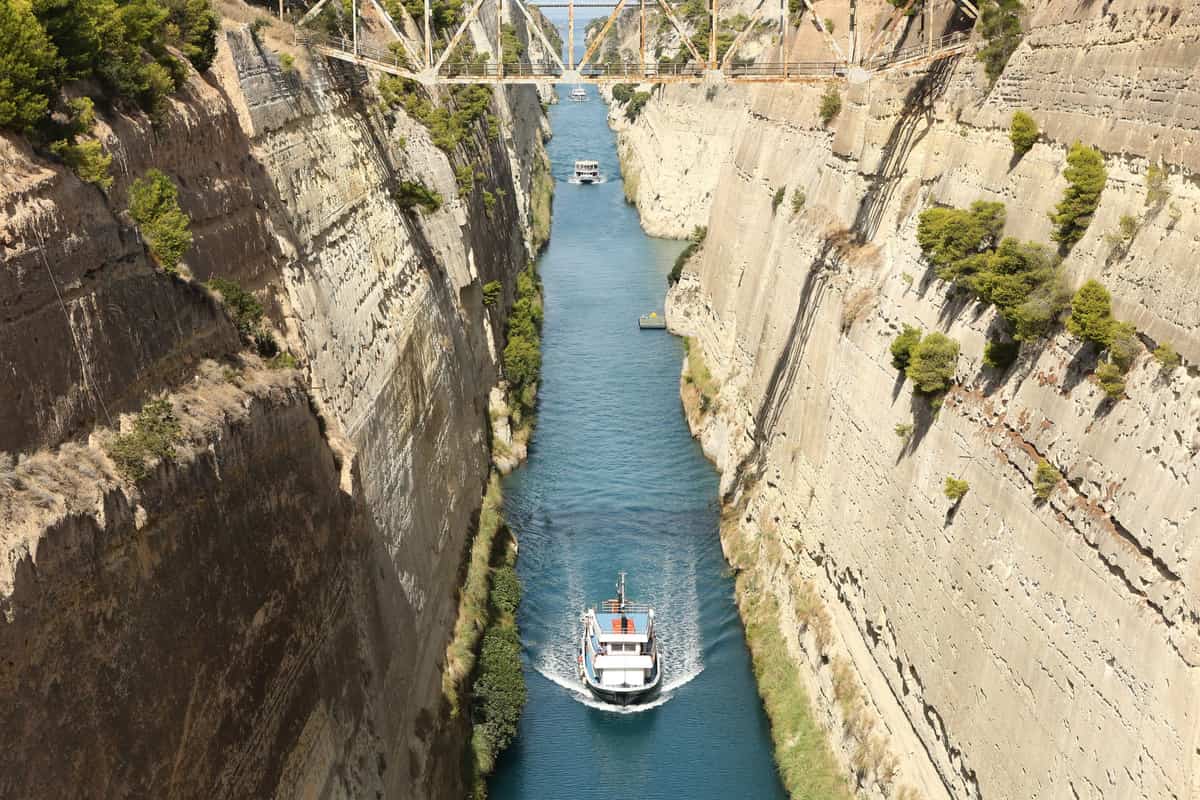
A Corinth canal tour sails or walks along the Corinth Canal, the deep cut through the isthmus that links the Gulf of Corinth with the Saronic Gulf. The tour is one of the Greece Tours on Greece Ville, listed with the other day trips from Athens and Peloponnese tours.
This post covers what the tour is, how the canal was built, the ancient Diolkos, the bridges, the rocks and faults in the walls and the ships that pass.
The two ends of the canal, the best months and common questions come last. The sections include Corinth canal tours that can be booked online.
What is a Corinth canal tour?
A Corinth canal tour sails or walks along a deep cutting, about 75 m wide at the top. It cut the sea route from Piraeus to Patras to about a third. That is around 200 km instead of 600 km.
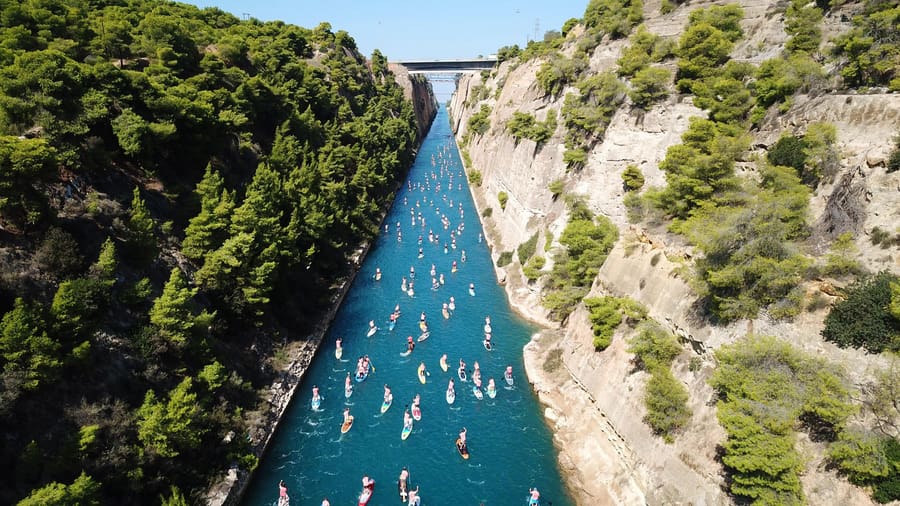
Corinth Canal SA, known in Greek as AEDIK, runs the waterway. Its walls cut through the Corinth Marl, which built up in a shallow, low-salt lagoon.
Tiny fossils date one marl section to the Early Pleistocene. Another, across a fault, dates to the Middle Pleistocene. A top bed of shells and corals shows the lagoon later opened to the sea.
On a Corinth canal tour, a motorbike jump is part of the story. On 8 April 2010, Robbie Maddison jumped the canal on a Honda CR 500.
He took off from a ramp 80 m above the water. He landed on a hill 85 m away.
- Nobel: Alfred Nobel’s dynamite of 1866 and blasting gelatine of 1876 made the cut possible.
- Pausanias: He wrote that earlier diggers gave up before they reached the solid rock.
- Nero: His digging stopped after three months, because the emperor died.
- Marl: Carbonate cement makes the canal’s bluish grey marl brittle and stiff.


How was the canal built on a Corinth canal tour?
A Corinth canal tour follows a dig that began on 29 March 1882, weeks before the official launch. István Türr founded the canal company that year with the French banker Jacques de Reinach. Work was planned to take five years.
The government first chose the French builders Piat and Chollet, but their plan stayed on paper. In 1880, Türr met the governor of the National Bank of Greece to study the canal.
Béla Gerster tested the plan, starting from the earlier design of the engineer Virlet d’Aoust.
After the Panama canal company failed on 4 February 1889, Paris money for Corinth dried up. The Corinth company went bankrupt that July.
By then, 8,200,000 cubic metres had been dug and 2,600,000 remained.
- Opening: King George and Queen Olga opened the canal on 6 August 1893.
- First ship: The French Notre Dame du Salut, 110 m long and 13 m wide, went through first.
- Shares: The Comptoir national d’escompte sold the first shares in spring 1882.
- Ends: The first French company deepened both ends before it went bankrupt.
What was the Diolkos on a Corinth canal tour?
A Corinth canal tour passes the Diolkos, a paved trackway for hauling ships across the isthmus. Letters cut into its stones date it to the late 7th or early 6th century BC. Thucydides already saw it as old.
Its steepest stretches climbed at 1 in 16.5, a 6% grade. Studies show a 25-tonne trireme, 35 m long and 5 m wide, can cross it with difficulty.
Getting a loaded trolley moving needed up to an estimated 180 men. Tolley argued against oxen, since three pairs pull only twice as hard as one.
On a Corinth canal tour, the eastern grooves were cut on purpose to steer cart wheels. Philip V of Macedon sent 38 ships across, while his larger warships sailed around Cape Malea.
The 19th-century canal destroyed parts of the Diolkos.
- Frazer: James George Frazer reported traces of the trackway in 1913.
- Fowler: Harold North Fowler found part of its western quay in 1932.
- Verdelis: The archaeologist died early, so his excavation was never fully published.
- Repairs: Stone edging, gravel paths and streetlights now keep walkers off the old paving.
Which bridges cross the canal on a Corinth canal tour?
A Corinth canal tour passes under the A8 motorway, which crosses on twin box-girder bridges of prestressed concrete. The motorway bridge opened in 1997. It is 190 m long, with a main span of 110 m.
The Athens Airport–Patras railway crosses on its own concrete box-girder bridge, opened in 2005. It is 230 m long, with spans of 60, 110 and 60 m.
The Poseidonia submersible bridge, at the Gulf of Corinth end, was built in 1985. The Isthmia one, at the Saronic Gulf end, followed in 1987.
On a Corinth canal tour, a motor-driven system of rods lowers each submersible bridge as a ship approaches. The bridges can also sink by gravity alone if a blackout cuts power.
In April 1941, German troops piled removed demolition charges mid-bridge, and a stray round set them off.
- Gefyra Isthmou: The small village beside the high bridge had 361 residents in 2011.
- Rebuild: Italian railway engineers then built a combined rail and road bridge in 25 days.
- 1944: German blasts buried the canal under more than 645,000 cubic metres of soil and wreckage.
- 1949: A new railway bridge permanently replaced the one lost in the war.
Which rocks and faults show on a Corinth canal tour?
A Corinth canal tour shows classic normal faults on the north wall. Rock layers turn up or down beside each fault plane. Near-vertical faults near the canal run east-north-east and are considered active. It sits at the eastern edge of a fast-opening rift.
Records of 2,500 years show earthquakes around the gulf rising sharply in the last 250 years. In early 1981, three quakes above magnitude 6 struck within 11 days.
In the second half of the 20th century, 16 slope failures were reported along the canal.
Cracks up to 10 cm wide appeared while the post-war bridge supports were built. Glass telltales and displacement sensors track them.
- 1984 study: It judged rainwater widening the cracks the only real risk to the bridge’s northern support.
- Lab tests: Engineers tested the marls with boreholes, X-ray diffraction and electron microscopes.
- 2020: The canal was also closed for days in November 2020.
- 2023: After safety works, it reopened to ships on 1 June 2023.
On a Corinth canal tour, the soft walls still need stabilising. The Saronic Gulf entrance needs urgent repair.
What ship traffic passes on a Corinth canal tour?
A Corinth canal tour shares the water with small and medium ships of up to about 10,000 tonnes. From 1990 to 2000, ships crossing it carried an average of 4.75 million tons a year. Ships must not exceed 6 knots inside.
The builders expected just under 4 million net tons a year. By 1906, traffic reached only half a million. In 1913, 4,069 vessels passed; in 1915, only 3,587.
Today transit fees follow the net tonnage on each ship’s International Tonnage Certificate. Tugs pay on 70% of gross tonnage, and Greek Navy ships pass free.
On a Corinth canal tour, each ship keeps about one nautical mile behind the one ahead. No international treaty governs the canal, so it stays fully under Greek sovereignty.
- Signals: Two long blasts and one short call a pilot; four long blasts call a tug.
- 2020 limit: In November 2020, only ships up to 17 m wide were allowed through.
- Braemar: The record ship drew 5.41 m after a 2008 refit added a 31 m hull section.
- 1948: United States Army engineers reopened the canal to shallow-draft ships by 7 July 1948.
What lies at each end of a Corinth canal tour?
A Corinth canal tour ends near Isthmia, where legend says Sisyphus began the Isthmian Games. They were funeral games for Melicertes, also called Palaemon. Athens paid 100 drachmas to each citizen who won there.
In 390 BC the Spartan king Agesilaus camped at the sanctuary, and the archaic Temple of Poseidon burned.
The Roman baths keep a mosaic of Tritons carrying Nereids on their backs. Kechries village stands on ancient Kenchreai, 4 km south-west of Isthmia.
In 1907, Clearchos Karantanis opened Greece’s first natural mineral water bottling factory in Loutraki. The town’s first bath building, a wooden house with 10 baths, dates from 1855.
- Starting gate: The Early Stadium had a gate worked with strings from a triangular pavement.
- Kechries coast: It marks the eastern tip of the Corinth Fault.
- Spring water: Loutraki’s thermal water is weakly alkaline, with a pH of 7.2 to 7.3.
- Mosaics: Stefanos Xenopoulos made the Nereid, Dryad and Helios mosaics in the round spring building.
Which months suit a Corinth canal tour?
A Corinth canal tour suits the dry months. At the Velo station near Corinth, July is the driest month. It gets 5.0 mm of rain on about 1.1 days. June gets 6.4 mm on 2.0 days. The station stands 19 m above sea level.
July has the hottest afternoons, with an average high of 33.2 °C, and August follows at 32.9 °C. August also has the warmest nights, at 19.8 °C.
On a Corinth canal tour in April, highs average 20.3 °C. Rain totals 26.7 mm. September keeps a high of 28.4 °C.
- December: It is the wettest month, with 78.6 mm on 10.3 days.
- February: It has the coldest nights, with an average low of 5.0 °C.
- Humidity: The air is driest in July, at 53.3%, and dampest in December, at 77.0%.
- Wind: It blows from the east in eleven months and peaks at 7.3 knots in February.
What do visitors ask about a Corinth canal tour?
A Corinth canal tour raises questions about the war, the walls, swimmers, pilots, signal flags and bungee jumps. Allied commanders estimated that 90% of German sea reinforcements for North Africa passed through the canal. That made it a sabotage target.
How did the war reach a Corinth canal tour?
In April 1941, SOE officer Mike Cumberlege sailed a caique through the canal. He laid a delayed mine and depth charges, but they failed to explode. In 1943, his Operation Locksmith team placed explosives that floated and stayed silent.
How are the walls watched on a Corinth canal tour?
Stability studies show the walls fail chiefly along cracks and faults, not as curved slides through the marl. After rockfalls, engineers flew a drone to build three-dimensional models of the failed slopes.
Has anyone swum the length of a Corinth canal tour?
Television journalist Deena Clark swam the Corinth Canal at age 58. She was the first woman on record to do so. Her swim covered nearly four miles between the Ionian and Aegean seas.
Who steers ships through on a Corinth canal tour?
A maritime pilot is a licensed mariner who knows a waterway’s depths, currents and hazards. Pilots board ships to steer them through. The master stays legally responsible with a pilot aboard, except in the Panama Canal.
Which flags do ships fly on a Corinth canal tour?
A ship flies signal flag H to show a pilot is on board. It flies flag G to ask for one.
How safe is bungee jumping on a Corinth canal tour?
The first modern bungee jumps were made on 1 April 1979 from the Clifton Suspension Bridge in Bristol. In 1986, a man died rehearsing a BBC stunt when the cord came loose from a clip. New Zealand first published a bungy code of practice in 1990.