

A Thermopylae tour visits the narrow pass in central Greece where Leonidas and his Greek allies held back the army of Xerxes in 480 BC. The tour is one of the Greece Tours on Greece Ville.
This post covers what the pass is, the old Amphictyony that met there, the Greek cities that sent men, the Persian army, hoplite arms and the sea battle fought on the same days.
The finds of archaeologists, Spartan training, modern roads and rail, books and films, the best months and common questions come last. The sections include Thermopylae tours that can be booked online.
What is a Thermopylae tour?
A Thermopylae tour visits the narrow pass between Mount Kallidromo and the sea in Phthiotis, central Greece. Ancient writers also called it simply Pylae, which means the Gates. It does not mean gates of fire; that phrase in Greek is pyropylai.
In modern Greek, the word Thermopylae also stands for loyalty to one’s principles and values. The meaning comes from a line by the poet Cavafy.
On a Thermopylae tour, Herodotus is the first map. He says the road was only one cart wide at Alpeni, behind the pass. It was just as narrow at the Phoenix stream near Anthela, in front of it.
Herodotus describes the road as running north to south, though it really runs west to east. Between the western and eastern openings lay a plain a little more than a mile long. It was about half a mile wide.
The Phocians built their wall out of fear of the Thessalians, who had come from Thesprotia. The Greeks planned to get their food at Alpeni, a village very near the road.
Kallidromo spreads over south-eastern Phthiotis and north-eastern Phocis, east of Mount Oeta. The village of Drymaia sits on the mountain. Mendenitsa lies to its north-east, and Amfikleia to its south.
On a Thermopylae tour, the modern village is small. The Thermopylae community counted 482 people in the 2021 census. Of these, 279 lived in the village and 203 at Loutra Thermopylon. The village had 273 residents in 2001 and 295 in 2011.
- Old name: In 1835 the village, then called Drakospilia, joined the municipality of Oites.
- Community: In 1919 it became the seat of its own community.
- Molos: This town lies 10 km east of the village of Thermopylae.
- Wall gate: Herodotus says the Phocian wall across the pass once had a gate built into it.
On Kastraki hill, at Chalkomata, stand the remains of a Hellenistic fort. They are linked to Rhodountia, an Aetolian stronghold built against Roman attacks.


Why did the Amphictyony meet on a Thermopylae tour?
A Thermopylae tour passes Anthela, where an old league of Greek tribes met. The assembly was called the Pylaia, because members met at Pylai, another name for Thermopylae. Legend says the league was founded partly to protect the temple of Demeter there.
Herodotus places Anthela between the Phoenix river and Thermopylae, where the Asopus flows into the sea. He describes a wide space there. It held a temple of Demeter Amphictyonis, seats for the Amphictyons and a temple of Amphictyon himself.
On a Thermopylae tour, the founding myth explains the name. Amphictyon, the league’s founder, was a brother of Hellen, the ancestor of all Greeks. Strabo writes that the delegates, the Pylagorai, sacrificed to Demeter at every Pylaian assembly. He also mentions a large harbour at Thermopylae, beside the temple.
The orator Aeschines lists members such as the Malians, Dolopes, Perrhaebians and Magnesians. The Pythians of Delphi belonged too. League rules said no member was to be wiped out in war or have its water supply cut.
After the battle, the Amphictyons set up the inscriptions and pillars that honoured the dead at Thermopylae. Philip II of Macedon took control of the league in 339 BC.
On a Thermopylae tour, the ruins are modest but real. Excavations date the sanctuary buildings at Anthela to the 5th century BC. The remains include a trapezoid enclosure, identified as a large stoa and a stadium.
- Size: The enclosure measures 66.30 m on the north side and 65.30 m on the south.
- Coin: A coin of 335 BC shows a veiled Demeter with a wreath of grain.
- Reverse: Its other side shows a seated Apollo and reads Of the Amphictyons, not Delphi.
- Old names: Hesiod called the town Anthe, and Stephanus of Byzantium called it Anthene.
Anthili, the modern village identified with ancient Anthela, had 1,233 residents in the 2021 census.
Which Greek cities sent men on a Thermopylae tour?
A Thermopylae tour honours far more men than the Spartans. Herodotus counts 500 Tegeans and 500 Mantineans at the pass. Arcadian Orchomenos sent 120 men, and the rest of Arcadia sent 1,000. Corinth sent 400, Phlius 200 and Mycenae 80.
Herodotus tallies 3,100 Peloponnesians, yet he also quotes an inscription that gives 4,000. It reads: Here four thousand from the Peloponnese once fought three million.
On a Thermopylae tour, the Locrians are the puzzle. The Opuntian Locrians sent all their fighting men, but Herodotus gave no number. Pausanias puts them at 6,000, which raises the Greek force to 11,200.
Leonidas brought the Thebans, under Leontiades son of Eurymachus, because Thebes stood accused of siding with Persia. Herodotus says Leonidas kept them at the pass against their will, as hostages.
The Thespians stayed by choice. Their general Demophilus was the son of Diadromes. Herodotus names Dithyrambus, son of Harmatides, as the bravest Thespian.
On a Thermopylae tour, the fate of Thespiae is worth a pause. Xerxes’ army burned the city, whose people had already left for the Peloponnese. Its remaining citizens later sent 1,800 men to fight at Plataea.
- Malians: Diodorus also lists 1,000 Malians on the Greek side.
- Defections: Herodotus says the Locrians, and all Boeotians but the Thespians and Plataeans, later joined Xerxes.
- Phocians: They fought at Thermopylae but stood on the Persian side at Plataea.
- Thespies: A monument to Demophilus stands in the modern village of Thespies.
Thebans were killed as they came forward to surrender, and the Thessalians backed their plea.
Who marched with Xerxes on a Thermopylae tour?
A Thermopylae tour faces the story of a huge army. Herodotus named 46 nations that sent troops to Xerxes. He put the army at 2.6 million fighting men, with an equal number of support staff. Modern historians give far lower figures.
Armies from the eastern provinces gathered at Kritala in Cappadocia. Xerxes then led them to Sardis for the winter. Five food depots lined the route ahead. They included Doriskos on the Evros estuary, Eion on the Strymon and Therme, today Thessaloniki.
On a Thermopylae tour, the march sets the scale. The army took roughly three months to cover about 600 km unopposed, from the Hellespont to Therme. Herodotus says the soldiers drank the Echeidorus River dry.
Ancient counts swung widely. Ctesias used Persian records and gave 800,000 men. The poet Simonides spoke of four million. The historian J. B. Bury called the numbers of Herodotus wholly fabulous. He suggested about 180,000 land troops.
A British transport officer, Sir Frederick Maurice, took a practical view. He argued that local rivers watered only about 200,000 men and 70,000 animals.
On a Thermopylae tour, the Immortals are the name to know. Herodotus says every dead, badly wounded or sick man was replaced at once. They were chiefly Persians, with Medes and Elamites in their ranks.
- Spears: Ordinary Immortals had silver counterweights on their spears, while officers had golden butt-spikes.
- Saka: These famous axemen joined Persians, Medes and Cissians as the elite of the Persian infantry.
- Brothers: Abrocomes and Hyperanthes, two brothers of Xerxes, died fighting over the body of Leonidas.
- Hydarnes: After Salamis, the commander of the Immortals led the army back across the Hellespont.
The bridges of boats over the Hellespont used 360 ships on one span and 314 on the other.
What did hoplites carry on a Thermopylae tour?
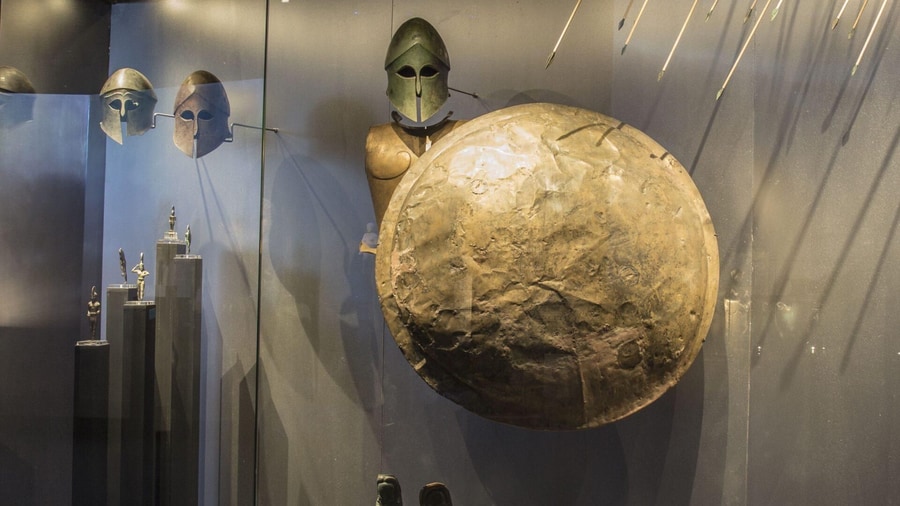
A Thermopylae tour shows the gear of the Greek hoplite, the heavy infantryman of the phalanx. Each hoplite paid for his own equipment. Only men with the money fought in the line. A full bronze panoply weighed nearly 32 kg.
The aspis shield weighed between 6.5 and 8 kg. Its Argive grip put a handle at the rim and a forearm strap, the porpax, at the centre. Only one aspis survives in good enough shape to study.
On a Thermopylae tour, the spear comes next. The dory shaft was made of cornel or ash wood and weighed 0.91 to 1.81 kg. Its butt-spike, the sauroter or lizard-killer, stood the spear in the ground.
The xiphos sword weighed 450 to 900 g and hung from a strap under the left arm. A Spartan once explained the short blade. He said it let Spartans get close to the enemy.
Richer hoplites wore a bronze cuirass of the bell or muscled type. Others wore the linothorax, a breastplate of linen, shown in Greek art from 575 BC onwards.
On a Thermopylae tour, the helmet tells a story of change. The Corinthian helmet blocked sight and hearing. In time, the more open Chalcidian and Thracian helmets replaced it.
- Bomarzo: The one well-kept aspis was found in Lazio in 1830 and is kept in the Vatican.
- Kopis: Its single-edged, forward-curving blade struck with the force of an axe and reached 65 cm.
- Drift: Each man edged toward his neighbour’s shield, so the phalanx drifted right and veterans stood there.
- Lambda: The famous lambda on shields appeared by the end of the Peloponnesian War.
What happened at sea during a Thermopylae tour?
A Thermopylae tour story has a twin at sea. While Leonidas held the pass, the Greek fleet fought the Persians off Artemisium in northern Euboea. Herodotus lists 127 ships from Athens, 40 from Corinth, 18 from Aegina and 10 from Sparta.
The Allies first sent three ships to Skiathos as scouts. Ten Sidonian triremes caught them and captured two. Three of the Sidonian ships then struck the Myrmex, or Ant, reef, now identified as the Lefkari reef.
On a Thermopylae tour, the weather plays its part. Near the Gap of Skiathos, a summer gale called a Hellesponter drove the Persian fleet ashore. The storm lasted two days and wrecked about one third of the Persian ships.
The worst wreck came at Cape Sepias, today’s Cape St. George in Magnesia. The Persian fleet then moored at Aphetae, opposite Artemisium. Fifteen of its ships blundered into the Allied lines and were captured.
Eurybiades, son of Eurycleides, led the Greek fleet, because the other cities refused Athenian command. The Euboeans bribed Themistocles to keep the fleet there. He in turn bribed Eurybiades and Adeimantus of Corinth to stay.
On a Thermopylae tour, the diver Scyllias is a favourite tale. He had worked for the Persians, raising treasure sunk in the storm. Then he swam into the Allied camp with news of 200 Persian ships sailing around Euboea.
- Hydna: Pausanias says Scyllias and his daughter Hydna of Scione cut Persian moorings off Mount Pelion.
- First evening: The Allies drew their sterns together, bows facing out, then rowed out at a signal.
- Result: They captured or sank 30 Persian ships, and Antidorus of Lemnos defected with his ship.
- Third day: Half the Athenian ships were damaged or lost.
The sea off Artemisium later gave up the Artemision Bronze. Work on its wreck stopped when a diver died in 1928 and never started again.
What have diggers found on a Thermopylae tour?
A Thermopylae tour walks ground that Spyridon Marinatos dug in the late spring of 1939. His benefactor Elizabeth Humlin Hunt funded and helped the work. Greek and foreign newspapers reported the dig widely. It also served the nationalist government of Ioannis Metaxas.
The historian Susan Heuck Allen called the excavation propaganda fodder for Metaxas. Marinatos published a German report, Forschungen in Thermopylae, in 1940. It appeared in the volume of an archaeology congress held in Berlin.
George B. Grundy was the first modern historian to make a thorough topographical survey of the pass. His survey led writers such as Liddell Hart to change their views on parts of the battle.
Herodotus says the old Phocian wall lay chiefly in ruins. The Greeks rebuilt it to bar the invaders. He also wrote that he had found out the names of all three hundred Spartans.
Simonides had the epitaph of the seer Megistias inscribed, because the two men were guest-friends. It says Megistias was killed by the Medes who crossed the Spercheios river.
On a Thermopylae tour, the arrowheads have travelled. The National Archaeological Museum in Athens showed them in its exhibition Glorious Victories: Between Myth and History. It opened on 20 October 2020, for the anniversary of Thermopylae and Salamis.
- Exhibition: It gathered 105 ancient works, among them the helmet of Miltiades.
- Lamia museum: It fills old army barracks, taken over by the Ministry of Culture in 1973.
- Rooms: The museum’s first floor holds 27 rooms, arranged around twelve themes.
- Kalapodi: Much of its Archaic display comes from the Oracle of Apollo at Kalapodi, including the temple roof.
How did Sparta train men for a Thermopylae tour?
A Thermopylae tour story starts with the agoge, the Spartan training system. A magistrate called the paidonomos, or boy-herder, oversaw it. Boys slept in packs called agelai, each led by an older youth called the eiren. Boys trained barefoot.
From the age of 12, each boy got only one cloak a year. They slept on beds of reeds pulled by hand from the Eurotas River. Three commanders, the hippagretai, each picked 100 young men for the 300-strong hippeis.
On a Thermopylae tour, the calendar matters. Sparta held the Carneia every year from the 7th to the 15th of the month Carneus, in August. Leonidas marched out in August 480 BC with 1,200 men: 900 helots and 300 Spartan hoplites.
Leonidas had an unusual family. Herodotus says his mother was also his father’s niece. The ephors forced King Anaxandridas II to take a second wife.
The second wife bore Cleomenes, and the first wife then bore Dorieus, Leonidas and Cleombrotus. Dorieus, angry that Cleomenes got the throne, failed to found a colony in Africa. He was killed in Sicily.
On a Thermopylae tour, Queen Gorgo deserves a place. Aged eight or nine, she told her father to leave as Aristagoras raised his bribe to 50 talents. Later she told the Spartans to clear the wax off a blank tablet from Demaratus. It hid his warning of Xerxes’ invasion.
- Farewell: Plutarch says Leonidas told Gorgo to marry a good man and bear his children.
- Eurytus: Blinded by eye disease, he had his helot lead him back into the fight, and died.
- Aristodemus: Back in Sparta, no one gave him fire, and he was mocked as the Trembler.
- Pantites: Sent to Thessaly as a messenger, he returned to dishonour and hanged himself.
In Sparta, Pausanias saw a slab listing the men who fought at Thermopylae, with their fathers’ names.
How do road and rail cross a Thermopylae tour?
A Thermopylae tour from Athens arrives by the A1 motorway. The A1 carries European route E65 between Thermopylae and Roditsa. The high-speed railway passes through Mount Kallidromo in a tunnel. The classic line runs south and west of the mountain.
The Kallidromo rail tunnel has two single-track tubes, with 18 km of tube in total. Services on the new Tithorea–Lianokladi high-speed line began in February 2018. Double track from Leianokladi to Domokos was completed in January 2019 and electrified that April.
On a Thermopylae tour, the old line is worth knowing. It was known for its mountain scenery between Bralos and Domokos. In 1917, Allied supplies went by boat from Taranto to Itea. They went on by road to Bralos, then by train to Salonica.
The SOE office in Cairo considered three viaducts in the Brallos area as targets: Gorgopotamos, Asopos and Papadia. The Asopos viaduct was the preferred target, because it took longer to rebuild.
On a Thermopylae tour, the Asopos story is a wartime epic. SOE saboteurs blew up the viaduct on 21 June 1943. A German attempt to rebuild it collapsed, killing the engineer and a number of his workers.
From 1955 to 1963, the road from Athens to Lamia was numbered EO2. A 1963 ministerial decision then set the EO1 national road through Atalanti, Kamena Vourla, Thermopylae, Lamia and Stylida.
- Old EO1: From 1955 to 1963, EO1 meant the Elefsina–Larissa road through Bralos, today’s EO3.
- Width: The old national road was 13 to 14 m wide, with no median strip.
- 2005: By then the A1 was finished, except the Maliakos horseshoe and Tempi.
- 2007: The Agios Konstantinos and Kamena Vourla bypasses opened, with the first Maliakos sections.
The EO3 belongs to European route E65, except its southern end between Eleusis and Bralos.
How did books and films retell a Thermopylae tour?
A Thermopylae tour story has been retold for centuries in poems, paintings, films and ships’ names. Richard Glover’s poem Leonidas appeared in 1737. Willem van Haren’s Leonidas followed in 1742, and both revived European interest in the battle.
Jacques-Louis David worked on Leonidas at Thermopylae from 1799 to 1803. He took it up again in 1813 and 1814, and the painting hangs in the Louvre.
In The Isles of Greece, Byron asks the earth to give back three of the three hundred. He wants them to make a new Thermopylae.
On a Thermopylae tour, Cavafy’s poem Thermopylae is a fitting text. Dated 1901 and 1903, it honours people who define and guard a Thermopylae in their lives. It ends with Ephialtes appearing and the Medes passing through at last.
The 1836 Battle of the Alamo was compared to Thermopylae within weeks. An 1843 battle memorial in Austin, Texas, mentions Thermopylae.
On a Thermopylae tour, the film The 300 Spartans is a good starting point. Rudolph Maté shot it in 1962 in the village of Perachora. Manos Hadjidakis wrote the music, and Richard Egan played Leonidas.
Frank Miller watched that film as a young boy, and it inspired his comic 300. The comic came out in five monthly issues in 1998 and won three Eisner Awards in 1999.
Zack Snyder shot the film 300 in Montreal over sixty days, in front of bluescreens. Only one scene was filmed outdoors. The film opened in Sparta on 7 March 2007, two days before its North American release.
- Gates of Fire: Steven Pressfield’s 1998 novel is told by Xeones, a squire who survives the battle.
- Sequel: 300: Rise of an Empire, released on 7 March 2014, centres on the Athenian admiral Themistocles.
- Clipper: The tea clipper Thermopylae, built in Aberdeen in 1868, reached Melbourne in a record 63 days.
- Submarine: HMS Thermopylae, launched on 27 June 1945, is the only Royal Navy ship of that name.
In 1872 the clipper beat Cutty Sark from Shanghai to London by seven days.
Which months suit a Thermopylae tour?
A Thermopylae tour suits spring and early autumn, before and after the summer heat. At Lamia airport, near the pass, the last spring month averages 20.1 °C and 238.2 hours of sunshine. Its rain drops to 33.3 mm over 8.7 days.
March at Lamia airport averages a high of 16.9 °C, with 175.9 hours of sunshine. It still brings 59.7 mm of rain over 12.2 rain days. April collects 185.8 hours of sunshine and 42.3 mm of rain.
On a Thermopylae tour in summer, heat is the main concern. June brings 277.9 hours of sunshine but only 19.3 mm of rain over 5.3 days. July has a mean of 26.4 °C, and its nights average 19.2 °C.
August logs 278.3 hours of sunshine and only 3.9 rain days. Lamia airport has recorded 45.4 °C in August and 44.6 °C in June.
On a Thermopylae tour in autumn, September is a strong choice. It averages a low of 15.5 °C, with 203.5 hours of sunshine and 23.7 mm of rain. October has reached 37.3 °C, yet its sunshine falls to 147.8 hours.
November averages a high of 17.9 °C and a low of 7.9 °C, with 11.0 rain days. December brings 72.5 mm of rain and the year’s highest humidity, 78.0%.
- January: It brings 63.8 mm of rain over 13.0 days and 114.7 hours of sunshine.
- Winds: East winds prevail at Lamia from April to September, and west winds from October to March.
- Agia Triada: This Phthiotis village reached 46.1 °C on 26 July 2023.
- Makrakomi: This Central Greece town hit 46.3 °C on 2 August 2021.
Storm Diomedes dropped up to 56 cm of snow on the mountains near Lamia in January 2022.
What do visitors ask about a Thermopylae tour?
A Thermopylae tour raises questions about Spartan hair and cloaks and the bravest fighter. Others ask about the hot springs, the summer festival and how the war ended. A Persian scout once saw Spartans combing their long hair before the fight.
What did long hair mean on a Thermopylae tour?
The exiled Spartan king Demaratus explained the combing to Xerxes. Spartans did this before risking their lives. To them, long hair kept its old meaning as the mark of a free man.
What colour did Spartans wear on a Thermopylae tour?
The Greek word halourga means sea-purple. It covered girdles, undergarments and the Laconian cloaks.
Who was the bravest man on a Thermopylae tour?
Herodotus judged the Spartan Dienekes the bravest of all the Greeks at the pass. Told that Persian arrows hid the sun, he replied they then fought in the shade. Plutarch later credited the remark to Leonidas, and Cicero repeated it in Latin.
What are the springs used for on a Thermopylae tour?
Greek sources say the water at Loutra Thermopylon helps treat rheumatic, gynaecological and peripheral nerve conditions. The Kallidromo baths at Psoroneria are said to help skin diseases, arthritis and sciatica. The Athenian Herodes Atticus, who lived from AD 101 to 177, paid for baths at Thermopylae.
Which festival runs on a Thermopylae tour?
The Municipality of Lamia runs the Thermopyleia festival. In 2023 it lasted from 31 August to 10 September. Plays and concerts start on Kolonos Hill at 21.00, such as Sophocles’ Electra on 3 September 2023. In 2021, a light show lit the Leonidas monument to music by Vangelis.
Which battles came next in the Thermopylae tour story?
The sea battle of Salamis was fought on 26 or 27 September 480 BC. At Plataea in 479 BC, a stalemate lasted eleven days before the armies fought. Aristodemus, sent home from Thermopylae with an eye disease, fought with fury and died there.