
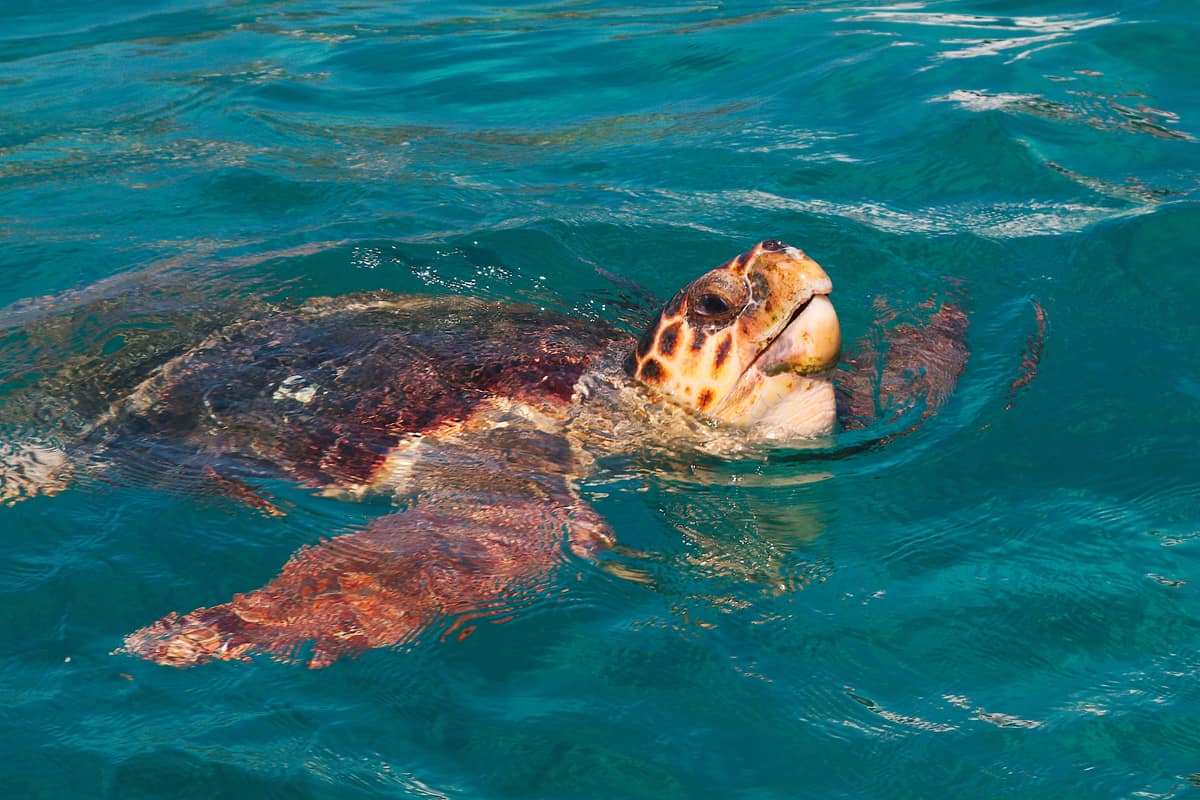
A Zakynthos turtle boat tour crosses Laganas Bay in the south of the island to watch loggerhead sea turtles at the surface. The trip is one of the Greece Tours on Greece Ville, listed with the other Ionian Islands tours and Greece boat tours.
This post covers how a loggerhead grows up, how it dives and feeds, how scientists track it, and how males and females meet.
The warm sand, the threats, the rescuers, the law, the other sea turtles, the best months and common questions come last. The sections include turtle tours that can be booked online.
What is a Zakynthos turtle boat tour?
A Zakynthos turtle boat tour is a boat trip in Laganas Bay to watch wild loggerhead sea turtles. The bay lies on the south coast of Zakynthos and faces southeast. Its mouth opens about 12 km wide. Sand covers its floor.
Carl Linnaeus gave the loggerhead its first scientific name, Testudo caretta, in 1758. Thirty-five other names followed over the next two centuries. Leonhard Stejneger first used the pair Caretta caretta in 1873.
The loggerhead nests over a broader geographic range than any other sea turtle. In the Atlantic, loggerheads range from Newfoundland, Canada, to Argentina. In the eastern Pacific, records stretch from Alaska to Chile.
Loggerheads on a Zakynthos turtle boat tour belong to one of 10 regional management units. Each unit is a population block drawn from nesting, DNA and movement data. The IUCN treats each unit as a subpopulation.
The Mediterranean subpopulation was assessed in its own right in 2015 and listed as Least Concern. Its population trend is increasing. The IUCN calls this status entirely conservation-dependent, built by decades of work at nesting sites.
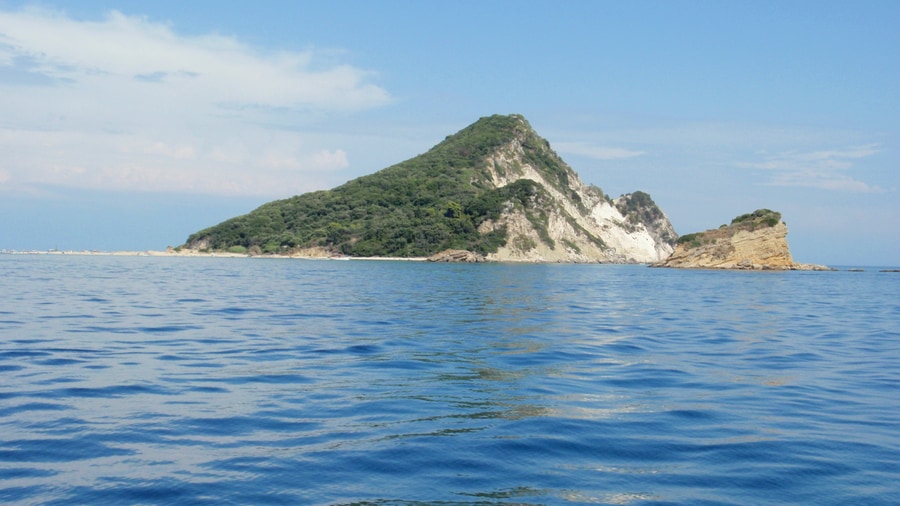
Submerged rocks sit along the sides of the bay and around its islets. In the centre, the 50 m depth line lies about 6.0 km from the coast. A Zakynthos turtle boat tour crosses this sloping floor.
- Genus: Constantine Rafinesque named the genus Caretta in 1814.
- Ancestry: North Atlantic and Mediterranean loggerheads descend from colonists from Tongaland, South Africa.
- Adults: The IUCN estimates 21,414 mature loggerheads in the Mediterranean subpopulation.
Posidonia seagrass grows from the shallows at the edges of the bay. In the centre, wave action keeps the meadows deeper, reaching 40 m. The bay’s surface water measures 15 °C in March.


How does a loggerhead grow up before a Zakynthos turtle boat tour?
A Zakynthos turtle boat tour shows loggerheads that grew up in three stages. Young loggerheads live in the open ocean for 4-19 years. They then move to coastal, or neritic, feeding grounds. Maturity finally comes at 10-39 years of age.
Hatchlings ride the undertow, the seaward pull of waves, away from the beach. They swim for about 20 hours and travel far offshore. This hard first swim, the frenzy, cuts their exposure to coastal predators.
Each loggerhead on a Zakynthos turtle boat tour first swam into waves to leave land. Hatchlings sense wave direction from circular water motion below the surface. Surface currents carry them at up to 60 m a minute.
A study in Italian waters shows fast early growth. Young turtles there grow at 11.8 cm a year during their first six months. The rate falls to 3.6 cm a year at 2.5 to 3.5 years old.
In the Mediterranean, the move to seabed feeding comes early. Turtles with shells as short as 26 cm already eat bottom prey. Researchers propose a short, fixed surface stage, because young turtles dive poorly.
Adults seen on a Zakynthos turtle boat tour grew slowly. Mediterranean loggerheads take 23.5 to 29.3 years to reach 80 cm of curved shell, about adult size. Their yearly growth ranges from 0.37 to 6.5 cm.
- Predators: At sea, swimming crabs, parrotfishes and moray eels eat young loggerheads.
- Bone rings: Growth rings in 55 turtles’ flipper bones give 14.9 to 28.5 years to maturity.
- Survival: Data from 3,254 Mediterranean tag records give a yearly survival rate of 0.73.
One study of a declining population found that 0.0009 to 0.0018 of eggs reach adulthood. For a stable population, the figure rises to 0.0025. The author judged that earlier studies overstated survival.
How does a loggerhead dive and feed on a Zakynthos turtle boat tour?
A Zakynthos turtle boat tour watches an animal built for long breath-holds and hard food. Loggerheads can dive deeper than 140 m. Their lungs store oxygen and control buoyancy, or how well they float. Powerful jaws crush their prey.
Satellite tags logged dives of up to 7 hours by a loggerhead wintering in Greek waters. It surfaced briefly, before its oxygen stores ran out. So the dives were aerobic, meaning fuelled by stored oxygen.
A Zakynthos turtle boat tour crosses water where loggerheads rest on the seabed. Females never rest within sight of one another. A resting or sleeping sea turtle can stay under for 4-7 hours.
Loggerhead lungs hold 50-150 ml of air per kilogram. That air lets them hover without swimming, a state called neutral buoyancy. The heart beats 12.8 times a minute in dives, against 20.9 at the surface.
Loggerheads on a Zakynthos turtle boat tour are broad feeders. Their food runs from sea pens and sea cucumbers to squid and flying fish. A Mediterranean study of 95 turtles found 63 prey species never listed before.
In Laganas Bay, males dig in the sand for bivalves, or two-shelled molluscs. They dig with the beak and push with the flippers. They try about twice a minute and succeed 45% of the time.
- Breath-hold: Loggerheads can stay under for over ten hours, a record among air-breathing sea animals with backbones.
- Bite: Adult and subadult loggerheads bite with 382 to 1,221 newtons of force.
- Menu: No other sea turtle has a longer list of known prey.
Loggerhead blood holds oxygen less tightly than green turtle blood. Its P50 value, the oxygen pressure that half loads the blood, is 47 Torr. Green turtle blood measures 29 Torr.
How do scientists track the turtles of a Zakynthos turtle boat tour?
A Zakynthos turtle boat tour crosses water where scientists study turtles closely. They photograph face scales, fit flipper tags and attach satellite transmitters. Drones count turtles from above. These tools reveal where each turtle travels after the breeding season.
Photo-identification means recognising a turtle from the scale pattern behind its eye. An experienced observer matched known turtles with a mean 99% success. The test photo catalogue held over 400 turtles.
Photo records of 947 loggerheads, gathered over 18 years, cover the waters of a Zakynthos turtle boat tour. They show yearly survival of 0.89 for females but only 0.73 for males.
Satellite transmitters are tags that send a turtle’s position to satellites. Researchers tracked 75 adults, 38 males and 37 females, from Zakynthos. About 25% of the males stayed within 100 km.
Seven females tracked after nesting in the bay of a Zakynthos turtle boat tour revealed feeding grounds. Three settled in the north Adriatic, one in the south Adriatic and two in the Gulf of Gabès.
Drones flying at 60 m film a wide strip of sea. Across Greek breeding sites, 69 drone surveys logged 10,075 turtle records. On Zakynthos, over 70% of recorded turtles were within 200 m of shore.
- Diet traces: Chemical markers in tissue placed 22 of 47 untracked turtles in northern feeding areas.
- Flipper tags: Tags recovered across more than 40 years show wider spread than satellite tracks.
- Males: Photo-identification suits males, which do not come ashore for flipper tags.
Tracking also shows which feeding areas need protection. Researchers found ten core feeding sites near existing protected areas. Their protection is estimated to cover 64% of the turtles breeding on Zakynthos.
How do males and females meet on a Zakynthos turtle boat tour?
A Zakynthos turtle boat tour visits a bay where adult males and females meet to mate. Males search actively along the shore, while females rest. Females take more than one partner, so a single nest can hold eggs from different fathers.
Males return to breed at least twice as frequently as females. A model put the figure at 2.6 times. Males tracked for 10 to 12 months all travelled back to the breeding grounds.
Males are loyal to the bay of a Zakynthos turtle boat tour. All 26 males tracked across multiple seasons came back to the same breeding site. They breed roughly every year.
Photo surveys over a single season logged 460 turtle sightings. Females outnumbered males by 3.3 to one. The balance swung from 2 males per female in April to 9 females per male late in spring.
Drones tell males apart by their longer tails. They saw up to three times more females than males in the bay. Yet females still willing to mate and breeding males stayed close to 1:1 before nesting.
Males leave once females stop accepting partners. Females store sperm, so their later eggs still get fertilised. In the bay of a Zakynthos turtle boat tour, peak male drone counts fell from 81 to 32.
- Mixed fathers: Nests of 14 out of 15 females had more than one father.
- Rivals: Other males bite a mating male’s flippers and tail, and wounds can take weeks to heal.
- Female refusal: A female resists when a male first tries to mount her.
Photo records showed a female mating with two different males within 5.5 hours on the same day. Polyandry means a female mating with more than one male. This was its first direct proof in sea turtles.
How does warm sand shape the turtles of a Zakynthos turtle boat tour?
A Zakynthos turtle boat tour passes beaches that produce more female than male hatchlings. The key heat window is the middle third of egg development. Warming threatens future male output. Shade, rain and the spot a mother picks all change nest heat.
The pivotal temperature is the steady heat that gives half males and half females. Lab tests on Greek eggs put it at 29.3 °C. The matching time from laying to hatching was 52.6 days.
Two seasons of estimates for the beaches of a Zakynthos turtle boat tour found 68% and 75% females. Egg development time differed sharply between beaches. The authors urged protection for beaches with cooler sand.
A later study found every nesting beach on Zakynthos produced males. Males made up 23% of hatchlings from 2007 to 2009. A model of past air and sand heat over 135 years put the male share at 50%.
Warming forecasts for the beaches of a Zakynthos turtle boat tour range widely. One predicts a 7.6% fall in male output by 2100. The harshest predicts no male hatchlings at all by 2038.
Temperatures at key sites for Greek loggerheads are projected to rise 3–5 °C this century. Nesting on Zakynthos is projected to start up to 74 days earlier. That shift brings only minor relief for nests.
- Shade: In beach tests, shading lowered sand temperature more than watering or depth did.
- Rain: In wet years, loggerhead nests in Florida ran cooler and hatched significantly more males.
- Nest choice: Over 24 years of records, the mother herself best predicted each nest’s male-female mix.
Under a 0.9 m sea-level rise, models show about 4 km of Zakynthos nesting beach lost. That stretch holds 85% of nesting activity. Cliffs behind it stop the sand from moving inland.
What harms turtles on the route of a Zakynthos turtle boat tour?
A Zakynthos turtle boat tour crosses water where boats, fishing gear, plastic and seals harm loggerheads. Propellers scar the turtles living in Laganas Bay. Nets and hooked lines catch turtles across the Mediterranean. Shore lights also reach turtle nests.
A study identified single turtles in social media posts from Laganas Bay. Residents, which stay to feed, were under one third of them. Yet they filled 81.9% and 87.9% of posts over two seasons.
The same study rated the boat and propeller strike risk for residents at 30%. Later surveys found collision scars on 80% of the longest-known residents. A Zakynthos turtle boat tour shares the bay with them.
Coast Guard data counted 463 vessels in the bay’s protected waters in one season. In 2022, monitors logged over 109 cases of boats crowding one turtle. These averaged 8.5 boats, ranging from 3 to 28.
Fishing reaches far beyond the bay of a Zakynthos turtle boat tour. A review estimated over 132,000 turtle captures a year in Mediterranean fisheries. It also estimated over 44,000 accidental deaths a year.
Plastic also reaches the turtles of a Zakynthos turtle boat tour. It turned up in 26 of 36 dead loggerheads found on Greek coasts. Those turtles held an average of 7.94 plastic items each.
- Monk seals: In 2010, monk seal attacks marked 21 large loggerheads around Laganas Bay.
- Beach lights: Artificial light affected 77.9% of East Laganas nests in one season.
- Feeding: Fishermen at Agios Sostis harbour fed turtles for tourist tips more than 22 times.
A Greek rescue centre logged 1,539 turtle admissions over three decades. Vet checks found the cause for 87% of them. Fishing explained 87.3% of those, including 595 turtles hurt on purpose after capture.
Who rescues the turtles of a Zakynthos turtle boat tour?
A Zakynthos turtle boat tour runs in a bay guarded by state wardens and charities. MEDASSET carries the bay’s problems to European bodies. WWF Greece works beside the nesting beaches. A Mediterranean action plan ties the wider work together.
Lily Venizelos first visited Laganas Bay in 1974. She founded MEDASSET, the Mediterranean Association to Save the Sea Turtles, in the United Kingdom in 1988. It was set up in Greece in 1993.
MEDASSET filed a formal EU complaint over the bay of a Zakynthos turtle boat tour in 1994. It renewed the complaint each year until 1998. These yearly complaints pushed the European Commission to act against Greece.
The board of the Management Agency, the body running the park, began work on 30 July 2000. Its 10 members included two charities: the Sea Turtle Protection Society of Greece and WWF Greece.
By 18 December 2000, that board had met seven times. It had passed over 130 decisions, all without a vote against. Law 5037 later gave the state nature agency powers to investigate environmental offences.
Nine warden huts stand along the nesting beaches of a Zakynthos turtle boat tour. Outside the summer field season, park wardens register turtle strandings. A stranding is a turtle found dead or hurt on shore.
- WWF Greece: The charity ran a wildfire lookout in the area behind Sekania beach.
- Releases: Over 71% of turtles in Greek rescue care beyond five days returned to the wild.
- Petition: MEDASSET and EuroNature gave the Greek Prime Minister a 17,000-signature petition in 2005.
The Barcelona Convention is a treaty for the Mediterranean’s sea and coast. Its parties adopted an Action Plan for the Conservation of Mediterranean Marine Turtles in 1989. They have revised it three times since.
How did European law reach the bay of a Zakynthos turtle boat tour?
A Zakynthos turtle boat tour sails in a bay covered by Greek and European law. A Council of Europe committee took up the bay in the 1980s. The EU Court of Justice later found Greece in breach of nature law.
The Bern Convention is a Council of Europe wildlife treaty from 19 September 1979. It strictly protects the loggerhead under Appendix II. Its committee took up the bay of a Zakynthos turtle boat tour in 1986.
In 1987 the committee adopted Recommendation No. 9 for the bay of a Zakynthos turtle boat tour. Its first measure asked Greece to remove prefabricated houses at Dafni. Those houses are now permanent buildings.
Greece brought in specific rules for the nesting beaches in 1984. They also limited building on the coast. A minister’s order and a 1990 Presidential Decree, signed by the President, then strengthened them.
The EU Habitats Directive of 1992 strictly protects the loggerhead under Annex IV. On 30 January 2002, the EU Court of Justice ruled on case C-103/00. It found Greece had broken Article 12 of that directive.
The court said mopeds on the beach east of Laganas disturbed breeding turtles. Pedalos and small boats near Gerakas and Dafni did the same. Buildings on Dafni beach were liable to damage that breeding site.
- Frozen funds: The European Commission froze funds earmarked for infrastructure in the protected area.
- Reopened file: In 2020, 13 parties backed reopening the Bern file, 2 opposed and 8 abstained.
- Closed case: The EU court case on the turtles closed on 27 June 2007.
On 16 November 2023, the European Commission referred Greece again to the EU Court of Justice. It concerns a landfill, or rubbish dump, on Zakynthos. Greece failed to restore it inside a protected area.
Which other sea turtles reach the waters of a Zakynthos turtle boat tour?
A Zakynthos turtle boat tour sails the Mediterranean, home to five of seven sea turtle species. Only the loggerhead and the green turtle still breed there. Leatherbacks visit from the Atlantic, while Kemp’s ridley and hawksbill records stay rare.
Green turtles nest in the eastern Mediterranean, far from a Zakynthos turtle boat tour. Their 13 major rookeries, or regular nesting beaches, lie in Turkey, Cyprus and Syria. Smaller groups nest in Egypt, Lebanon and Israel.
Akyatan beach in Turkey is the largest rookery. It holds about 20% of all recorded clutches, or egg batches. Recent counts average 2204 nests a year. A 2007 nesting record at Rethymno, Crete, is the westernmost known.
Scales tell a green from the loggerhead of a Zakynthos turtle boat tour. A green has one pair of scales between the eyes, a loggerhead two. Per shell side, a green has four plates, a loggerhead five.
The leatherback is the largest living turtle. It reaches up to 2.7 metres and 500 kg. Thick, leathery skin covers its back instead of a bony shell. Seven ridges run along that back from front to rear.
Mediterranean leatherbacks come mainly from nesting beaches in French Guiana and Suriname. Greece logged 14 records up to 1984 and 43 more in the next 40 years. The majority came from the northern Aegean Sea.
- Green diet: Mediterranean greens graze mainly Cymodocea nodosa, a seagrass of shallow, sheltered bays.
- Kemp’s ridley: The smallest sea turtle has a Mediterranean record from Malta.
- Hawksbill: This tropical species enters the Mediterranean only very rarely.
The IUCN, a global conservation body, rates Mediterranean green turtles as Near Threatened. It lists the leatherback as Vulnerable worldwide. Kemp’s ridley and the hawksbill both rank as Critically Endangered.
Which months suit a Zakynthos turtle boat tour?
A Zakynthos turtle boat tour suits midsummer best, when nesting peaks in the bay. In late spring, females rest in warm shallows near shore. Resident turtles stay in the bay into autumn as well. Winter is the island’s wettest season.
A Zakynthos turtle boat tour in late spring meets a sea still too cool for the best breeding. Researchers logged the bay with sensors 1 m below the surface, over a 3 m seabed. They ran these loggers in 2018, 2019 and 2020.
Early in the season, females rest in small patches of warm water. Water close to shore can be 3-5 °C warmer than the open sea. That warmth speeds up egg development.
A Zakynthos turtle boat tour in midsummer comes at the height of nesting. July held 50.5% of all nests laid from 1984 to 2002. That share comes from 19 seasons of nest counts.
June held 34.6% of those nests, while August held 13.9%. September held just 0.1%. As summer warms the sea, females stop seeking out warm patches.
A Zakynthos turtle boat tour can also meet resident turtles. The bay holds both migrating breeders and resident feeders. A small group of under 10 residents, chiefly males, appeared in two straight years of photo records.
- Wind: In November and December, the main winds over the island turn to southerlies.
- Rain: About 75% of the yearly rain at Zakynthos town falls between October and February.
- Warming: Sea temperature around Zakynthos and Kyparissia Bay rose 1.0 °C from 1982 to 2012.
Over 38 years, the first hatched nest of each season came earlier in the year. Yearly nest numbers in the bay ranged from 667 to 2,018 a season. They showed no significant long-term trend.
What do visitors ask about a Zakynthos turtle boat tour?
A Zakynthos turtle boat tour prompts questions about turtle numbers, beaches, islanders, tourist photos, flights and emergencies. Laganas village, on the bay, grew from 233 residents in 1991 to 766 in 2021. That is more than three times its earlier size.
How large is the female population near a Zakynthos turtle boat tour?
A 20-year photo-identification database, combined with drone records, estimates that 250 to 400 females use the breeding area. Drones are small aircraft flown without a pilot on board. From 1984 to 2002, the bay averaged 1293.7 nests a season.
Do sunbathers and nests share the beaches of a Zakynthos turtle boat tour?
A study set the possible overlap of natural nest sites and tourist beach use at up to 36%. Thanks to beach management rules, the recorded overlap was just 7%. Zakynthos also counts as a predator-free rookery. In Kyparissia, predators destroyed over half the nests each year in the 1980s.
Who lives on the island of a Zakynthos turtle boat tour?
The 2021 census counted 20,625 women and 20,555 men on Zakynthos. Women therefore slightly outnumber men on the island. The total grew by 1.0% compared with the 2011 census. ELSTAT, the Hellenic Statistical Authority, ran that count.
How do tourist photos help the turtles of a Zakynthos turtle boat tour?
Researchers searched social media photos posted from the bay between April and November. The photos identified 139 individual turtles in 2018 and 122 in 2019. Beginners learn the matching method fast. A 20-minute training session clearly improved their results.
Which airport do visitors use for a Zakynthos turtle boat tour?
The island’s airport is run jointly by Fraport AG and the Copelouzos Group. Their concession deal was signed in December 2015. A concession is a long lease to run a public asset. In 2019, the airport handled 1,810,427 passengers.
Which emergency numbers matter on a Zakynthos turtle boat tour?
The Hellenic Coast Guard answers on 108. Europe’s emergency line is 112. Police answer on 100. Firefighters answer on 199. EKAV, the national emergency medical centre, answers on 166. The coast guard runs 240 vessels, seven airplanes and six helicopters.