

A Heraklion tour crosses the capital of Crete, from its old harbour to its fountains, and climbs to Mount Juktas above it. The tour is one of the Greece Tours on Greece Ville, listed with the other Crete tours and Greece shore excursions.
This post covers the city’s Arab and Byzantine past, the Great Siege, its writers and painters and the Battle of Crete.
The fountains, the harbour, the ruins under the streets, Mount Juktas, the best months and common questions come last. The sections include Heraklion tours that can be booked online.
What is a Heraklion tour?
A Heraklion tour explores the capital of Crete and the countryside around the city. The city proper had 145,440 residents in the 2021 census. The city also hosts the Decentralized Administration of Crete, a regional arm of the Greek government.
The municipal unit of Heraklion, the area of the former city municipality, counted 156,842 people. It covers 109.026 square kilometres. The wider urban area, which adds the suburb of Gazi, held 205,036 residents.
A Heraklion tour visits a city ranked in 2017 by Euromonitor, a market research firm. The firm placed it 2nd among Greek regions for visits. It ranked 20th in Europe and 66th worldwide, with 3.2 million visitors.
Greece set up its 13 regions under Law 1622/1986. Manolis Loukakis became the first head of the Region of Crete in 1987.
A Heraklion tour also crosses the Heraklion regional unit, which covers 2,641 square kilometres. It had 305,017 residents and holds 8 municipalities. The unit began as a prefecture, a Greek county, created in 1915.
The 2011 Kallikratis reform, a redraw of local government, merged 5 former municipalities. The new Municipality of Heraklion holds 20 communities besides the city itself.
A Heraklion tour also uncovers older names for the city. Under early Byzantine rule, from 330 to 824, it was called Kastro. Its people were later called Kastrinoi, or castle-dwellers.
- Mayor: Alexis Kalokairinos won the October 2023 vote for mayor of Heraklion.
- Leadership: A general secretary picked by the national government heads each decentralized administration.
- Nea Alikarnassos: Refugees from Asia Minor, now in Turkey, founded this district after 1922.
Michail Afentouliev, commissioner of Crete during the Greek revolution, renamed the city Herakleia in 1822. European languages turned Candia into Candie in French and Candy in English. Spanish speakers wrote Candía.


How did Arabs and Byzantines shape a Heraklion tour?
A Heraklion tour enters a city once ruled by an Arab emirate. An emirate is a state led by an emir, a Muslim ruler. That emirate lasted about 135 years. It counted among the main foes of Byzantium, which later won the island back.
The founders are traditionally called survivors of a failed revolt in 818. It broke out in Córdoba, a city in Muslim Spain, against emir al-Hakam. Afterwards, the people of its suburb al-Rabad were exiled together.
A Heraklion tour recalls their long road to Crete. The exiles turned to piracy and seized Alexandria in Egypt. The general Abdullah ibn Tahir, who served the Abbasid caliphs, then forced them out.
They sailed away with their families in 40 ships. Historian Warren Treadgold estimates about 3,000 fighting men among the group. Muslim sources date their landing on Crete to 827 or 828.
A Heraklion tour starts with the Arabic word khandaq, which means trench. It reached Arabic via Aramaic from the Middle Iranian Pahlavi word kandak. The Arab trench at Heraklion ran from sea to sea.
Crete became a forward base for corsairs, Muslim sea raiders. They ravaged Aegean shores under Byzantine control. After a Syrian fleet sacked Thessalonica in 904, captives from that city were sold as slaves on Crete.
A Heraklion tour also covers the Byzantine counterstroke. In 960, 27,000 oarsmen and marines manned a fleet of 308 ships carrying 50,000 troops. Its dromons, or war galleys, carried Greek fire, a flame weapon.
- Landing: The Byzantine army came ashore at Ellinoperamata, 3 km west of the city.
- Breach: Miners dug under the walls while a battering ram drew the defenders’ eyes.
- Captives: The last emir, Abd al-Aziz ibn Shu’ayb, and his son went to Constantinople as prisoners.
After the fall, the Byzantines moved the capital to Temenos, a fortified twin-peaked hill. That site did not suit a city. Crete became a theme, or military province, under a general based at Chandax.
What did the Great Siege leave on a Heraklion tour?
A Heraklion tour stands where the Cretan War between Venice and the Ottoman Empire was decided. Lord Byron called the siege of the city “Troy’s rival”. The war, also called the fifth Ottoman–Venetian war, cost Venice its largest and richest overseas holding.
A Heraklion tour faces the size of the armies. The Ottoman side brought 60,000 soldiers and 20,000 workers and miners. The defence held 10,000 European allies and 12,000 Cretan and Venetian citizens.
Venice planned to starve the Ottoman army on Crete by sea. In 1645 Venice and its allies had about 36 galleons, which were sailing warships. Their fleet also held 4 galleasses, large warships with oars and sails.
A Heraklion tour also covers the war fought underground. In 1649 the Ottomans set off over 70 mines, or explosive tunnels, under the defences. They lost over 1,000 men, and the defenders held firm.
In 1656 the Ottomans lost a sea battle at the Dardanelles, the strait to their capital. A Venetian and Maltese fleet of 67 ships beat 108 Ottoman ships. Sixty were destroyed, and 5,000 enslaved Christian rowers went free.
A Heraklion tour recalls the French effort of 1669. About 6,000 French soldiers and 31 ships sailed under the Duke of Beaufort. Their first sally, or raid, cost about 800 dead, the Duke among them.
Francesco Morosini first took acting command of the fleet in 1654, after Alvise Mocenigo died at Candia. In the final summer, on 27 August, a council of war chose surrender. It acted without first consulting Venice.
- Terms: Under the peace, Venice kept the islands of Tinos and Kythera.
- Cost: Venice spent about 4,253,000 ducats, Venetian gold coins, on defending the city alone.
- Trial: Back in Venice in 1670, Morosini faced charges of disobedience and treason but was cleared.
Venetian reports put the dead at 118,754 Ottoman soldiers and 30,985 Venetian soldiers. Among the fallen were 280 Venetian noblemen. That equalled roughly a quarter of the Grand Council, the ruling assembly of Venice.
Which writers came from the city of a Heraklion tour?
A Heraklion tour crosses the city where poet Odysseas Elytis was born. The writers Galateia and Elli Alexiou were born here too. Galateia married the novelist Nikos Kazantzakis, and they divorced in 1926. Earlier, the poet Vitsentzos Kornaros settled in Venetian Candia.
Elytis was the pen name of Odysseas Alepoudelis, born on 2 November 1911. His family came from Lesbos. By 1895 it was well established in the soap and olive oil trade in the city.
A Heraklion tour recalls that the Alepoudelis family moved to Athens in 1914. In 1979 Elytis won the Nobel Prize in Literature. The prize praised his poems about modern man’s struggle for freedom and creativeness.
Nikos Kazantzakis studied law at the University of Athens from 1902 to 1906. In 1907 he went to the Sorbonne in Paris to study philosophy. There he fell under the spell of the thinker Henri Bergson.
A Heraklion tour brings up The Odyssey: A Modern Sequel, his epic or long story poem. He wrote it between 1924 and 1938. It has 24 books, called rhapsodies, and exactly 33,333 lines.
Galateia Kazantzaki, a novelist and playwright, was born Galateia Alexiou in 1884. Her father, Stylianos Alexiou, was a publisher and author. Her collected plays, 17 in total, were published in 1957.
A Heraklion tour honours the poet Vitsentzos Kornaros, born in 1553. He moved to the city, then called Candia, and married Marietta Zeno there. He also joined a literary club, the Accademia degli Stravaganti.
- Axion Esti: Elytis published this poem, whose title means It Is Worthy, in 1959.
- Pen names: Galateia wrote as Lalo de Castro and Petroula Psiloriti.
- Novel: Kazantzakis set his 1953 novel Captain Michalis in the city during the Cretan revolt of 1889.
Elli Alexiou joined the Communist Party of Greece in 1928. In 1950 she was stripped of her Greek citizenship. She lived in exile, partly in Hungary and Romania, until it was restored in 1965.
Which painters came from the city of a Heraklion tour?
A Heraklion tour enters old Candia, the centre of the Cretan school of icon painting. El Greco trained as an icon painter in this city. Michael Damaskinos, Theophanes the Cretan and Georgios Klontzas also worked here. Their art mixed Byzantine and Western traditions.
Between 1453 and 1526, about 120 painters worked in Candia. They formed a guild, the Schuola di San Luca, on the Italian model. A guild is a trade body for one craft.
A Heraklion tour meets two painting styles in Candia. The maniera greca, or Greek manner, followed Byzantine models. The maniera latina, or Latin manner, used Western methods. Both sometimes appear side by side in one icon.
El Greco was born in 1541, when Crete belonged to the Republic of Venice. His father, Georgios, was a merchant and a tax collector. By 1563, aged twenty-two, the young painter was already a guild master.
A Heraklion tour marks the city El Greco left for Venice around 1567, at age 26. In 1570 he moved to Rome, and later to Toledo in Spain. He died there in 1614.
Michael Damaskinos has 100 known works. From 1577 to 1582 he belonged to the Greek Brotherhood of Venice. He painted icons for its church, San Giorgio dei Greci, and returned to Candia around 1583.
A Heraklion tour recalls Theophanes the Cretan, another master of the Cretan school. After his wife died, he and his sons became monks on Mount Athos. There he painted frescoes, or wall paintings, in the Great Lavra monastery.
- Signature: El Greco signed in Greek letters, at times adding Κρής, meaning Cretan.
- Paler skin: Damaskinos was the first to bring paler flesh tones into post-Byzantine painting.
- Manuscript: Georgios Klontzas filled one book of the 1590s with over 400 miniature drawings.
In 1566 Klontzas was one of two artists who valued an El Greco icon. It showed the Passion of Christ on a gold background. Klontzas lived from 1535 to 1608, and 54 of his works survive today.
What did the Battle of Crete leave on a Heraklion tour?
A Heraklion tour crosses ground where German paratroopers landed in late spring 1941. British, Australian and Greek troops held the town and its airfield. The battle left a monument in the city and war graves at Suda Bay.
Brigadier Brian Chappel led the defence with the 14th Infantry Brigade. Just over 7,000 men defended the area, and about 2,700 of them were Greek. The 2nd Black Watch, a Highland battalion, counted 867 men.
A Heraklion tour recalls the airfield, the best equipped of the seven on Crete. It was the only one with a concrete runway. Colonel Bruno Bräuer led about 3,000 men against it.
At around 17:30 the Ju 52 transport planes began their drop runs. They flew straight and low, so they made easy targets. Australians on two hills called the Charlies fired directly into the aircraft doors.
A Heraklion tour honours the armed Cretan civilians who fought beside the soldiers. Their attacks caused about 200 casualties in one German battalion. Confused German pilots dropped two motorcycles with sidecars into Allied lines.
The Greeks were not told of the sea evacuation, so only one Greek soldier left with the British. German troops entered Heraklion at the close of the battle. There a Greek officer, Linardakis, signed a surrender with Bräuer.
A Heraklion tour recalls how the old town walls slowed the first German attack. The paratroopers had no heavy guns or explosives to break through them. The 14th Brigade lost 195 men killed on Crete.
- Losses: More than 440 Allied servicemen died on the voyage back to Alexandria.
- Monument: A marble and brass monument of 1991 stands in Georgiadis Park.
- Surrender: In 1945, the German garrison signed the surrender of Crete in Heraklion.
The 21st and 22nd Australian War Graves Units moved the graves to Suda Bay after the war. They took them from four burial grounds the Germans had made, one of them at Heraklion.
Which fountains does a Heraklion tour pass?
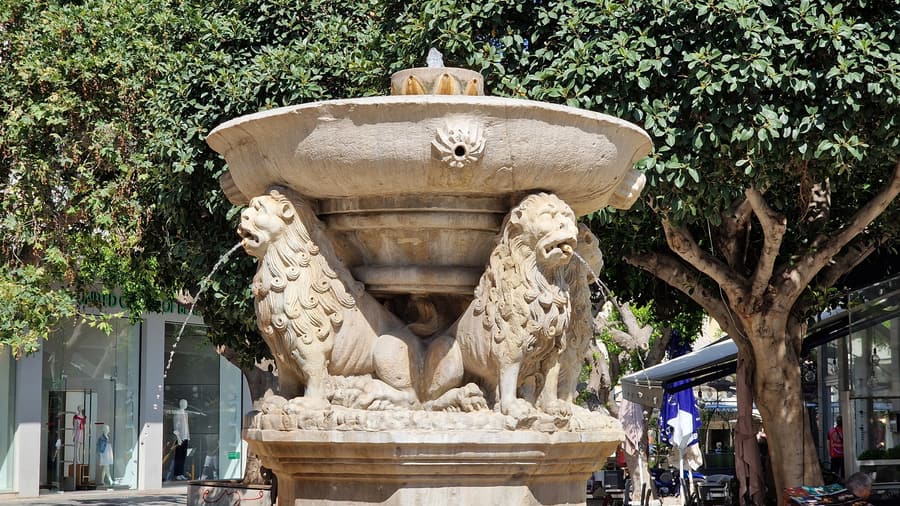
A Heraklion tour passes Venetian fountains in the old town, each named after the official who built it. An Ottoman sebil, a domed kiosk fountain, survives from a later age. Each one recalls the city’s constant lack of water.
The fountains on a Heraklion tour answered a lasting water shortage. A 1639 report by the Venetian governor Isepo Civran listed 1,270 wells and 273 cisterns. Cisterns were underground tanks that stored mainly rainwater.
Giovanni Matteo Bembo, the Venetian captain-general, built the Bembo fountain between 1552 and 1554. Its marble front, shaped like an ancient temple, measures 5.7 by 2.35 metres. Only that front survives today.
A Heraklion tour finds the Bembo fountain south of the old church precinct of San Salvatore. The water tank behind its front was pulled down in the 1930s. Water ran from a spout into an ancient stone coffin, or sarcophagus.
A Heraklion tour meets the sebil, an Ottoman kiosk fountain from 1776. Its builder gave almost all his property to keep it running. Each half-round window has its own tap and stone basin.
Duke Giovanni Sagredo built a fountain in 1603 at the Loggia, a Venetian public hall. It sits on the northwest corner. Clay pipes brought water from a spring found near the city.
Antonio Priuli, a Venetian governor-general, built the last Venetian water works in 1666. It ended at a fountain whose front copies a Renaissance temple. A triangular top rests on four ornate Corinthian columns.
- Sagredo relief: A carved woman in an arched niche stands for Crete itself.
- Turkish inscription: A text on the Priuli fountain names the Ottoman pasha who restored its water.
- Orsini fountain: Engineer Latino Orsini built a fountain on Ruga Panigra, today Kalokairinou Avenue, in 1583-1584.
The Morosini fountain drew water through a 15.5-kilometre aqueduct from a site called Pelekita, or Grammata. Engineers Zorzi Corner, Raffaele Monani and Francesco Basilicata built that aqueduct in only 15 months.
What does the harbour show on a Heraklion tour?
A Heraklion tour sees two harbours side by side. The old Venetian basin sits next to the Koules fortress. It keeps the remains of arsenals, vaulted sheds for building warships. The modern port beyond it handles cargo and cruise ships.
The Venetians shaped the harbour between the 13th and 16th centuries. They extended natural rock ridges into breakwaters, walls against waves. Much later, the British firm Sir Robert McAlpine built the modern port beside the old basin.
On a Heraklion tour, the harbour shows a long fight with nature. Fierce north winds and earthquakes filled the basin with silt and toppled the shipsheds. Venice had to repair the damage again and again.
The first group of arsenals, the Arsenali Antichi or Old Arsenals, was finished in 1507. Its vaulted bays stood where the Region of Crete building stands now. The earthquake of 1856 brought it down.
A Heraklion tour then looks east. There the New and Newest Arsenals, Nuovi and Nuovissimi in Italian, rose between 1556 and 1609. Their double vaulted bays had room for ten galleys, long oared warships.
A Heraklion tour sees only a fragment of that eastern group. The middle part of its two southern double bays survives. Earthquakes and demolitions in the 1930s destroyed all the rest.
The modern port splits into four zones: passenger, commercial and military, shipyard, and the old harbour. Its depth runs from 3.5 metres to 19 metres. Its old breakwater uses large stones; the newer one uses concrete.
- Water store: A cistern finished in 1615 held 20,000 barrels of fresh water for ships.
- Salt store: A warehouse east of the arsenals kept salt from the pans of Elounda and Souda.
- Cargo piers: Piers III and IV handle general cargo, bulk cargo and containers.
Port authority figures show 242,951 cruise passengers in 2014 and 219,805 in 2015. The count rose to 238,780 in 2016, then fell to 181,693 in 2017.
What lies beneath the streets on a Heraklion tour?
A Heraklion tour walks over buried layers from the Stone Age to Ottoman times. Excavations in the old town keep finding Arab, Byzantine and Venetian remains. East of the centre lie two Minoan towns, at Poros-Katsambas and at Amnisos.
A Heraklion tour crosses streets that hide ancient Greek remains, such as Daidalou, Idomeneos and Epimenidou. They surface mainly during earthworks before new buildings. The state Archaeological Service supervises that work.
On a Heraklion tour, the old Kastella site sits east of the church of Saint Peter. Its dig showed how Arab settlers built and lived. Graves from the later Byzantine age lay there too.
Works in 1991-1993 uncovered a Roman house with mosaics. Inside Saint Peter’s church, a trench 5 metres deep held a Roman coin from AD 169. The same trench gave pottery from the 10th-9th centuries BC.
Two large Byzantine public baths came to light on Koronaiou and Chortatson streets. Cisterns and graves of the same age surfaced too. Earthworks across the city have yielded coins and fine glazed pottery.
A Heraklion tour also passes over hidden cisterns. One with five vaulted rooms survives intact north of the church of Agios Titos. Another, declared a protected monument, now lies under multi-storey buildings on Dikaiosynis Street.
The Minoan town at Poros-Katsambas lay between Trypiti rock and the small Mantraki peninsula. Its earliest finds show workers shaping obsidian, a volcanic glass, and casting copper. Cycladic-style pottery shows links with the Cyclades.
- Stone Age site: A rock shelter at Mesa Katsambas yielded finds from the mid-6th millennium BC.
- Honey offering: A Linear B tablet in early Greek lists honey at Amnisos for the goddess Eleuthia.
- Ottoman drains: The Ottomans built two closed, stone-lined sewers at key points of the city.
At Amnisos, a sanctuary of Zeus Thenatas kept an enclosure with a round fire altar. The Karteros river there was called the Amnisos in the Bronze Age. A tiny island of that name lies off its mouth.
What does Mount Juktas add to a Heraklion tour?
A Heraklion tour that adds Mount Juktas gains a mountain of myth, Minoan worship and living faith. Birds of prey breed on its wild slopes. Two Minoan shrines stood on the mountain. A church with a yearly summer feast crowns the top.
The mountain’s Greek name, Giouchtas, possibly grew from a corrupted form of the Latin Jupiter. Its highest point is called Psili Korfi, which means High Peak in Greek. The main Minoan shrine of the mountain stood on that summit.
A Heraklion tour reaches what is thought to be the earliest Minoan peak sanctuary, a summit shrine. The Juktas shrine had roofed and open-air spaces for living, storage and religious rites.
Stone types foreign to the mountain show that people hauled rock up to the shrine. The oldest pottery there dates to Middle Minoan IA, an early phase of the Minoan timeline.
A Heraklion tour on Juktas also crosses a wildlife refuge. The area matters for the breeding of birds of prey.
A Heraklion tour also meets Anemospilia, a Minoan temple whose name means “caves of the wind”. The site was found by chance on 28 March 1979. Earthquake and fire destroyed the temple around 1700 BC. Modern Heraklion can be seen from the site.
An 18-year-old man lay on a platform with a 40 cm knife among his bones. The dig leader, Yannis Sakellarakis, saw signs of human sacrifice. Dennis Hughes argued the “knife” was a spearhead that fell from a shelf.
- Rooms: The Anemospilia temple had three chambers and one annex that led into them.
- Plants: Low scrub called phrygana and maquis covers the slopes, with small planted pine and cypress groves.
- Protection: The Agia Irini gorge is Natura 2000 site GR4310002, within an EU network of protected areas.
Founded in 1443, the church has one aisle for the Transfiguration of Christ. A Heraklion tour on 6 August meets its yearly feast, which draws large crowds. Afendis Christos, meaning Lord Christ, belongs to the monastery of Christ the Saviour.
Which months suit a Heraklion tour?
A Heraklion tour suits late spring and September best, with warm air, warm sea and little rain. High summer brings the strongest sun. Winter brings the heaviest rain. A city holiday for Saint Minas falls in late autumn.
A Heraklion tour in late spring meets only 12.8 mm of rain at the airport station. The daily mean temperature is 20.3 °C. Daylight lasts 14.2 hours on average. Air humidity sits at 62%.
The sea off Heraklion warms as summer nears. It averages 19.5 °C in late spring and 23.0 °C in June. It holds 25.4 °C in both July and September, then 23.3 °C in October.
A Heraklion tour in high summer meets warm nights by the sea. At the port, July lows average 24.9 °C and August lows 25.1 °C. The city station once hit 43.6 °C in July.
September keeps a mean daily high of 27.5 °C. It gets 17.5 mm of rain, spread over 2.4 rain days. Daylight shrinks from 12.4 hours in September to 11.2 hours in October.
On 11 November, the feast of Saint Minas brings a public holiday to Heraklion. Tradition credits him with stopping a planned massacre of Christians at Easter 1826. Since then he is shown on horseback as a Roman general.
A Heraklion tour in autumn meets rising rain: 43.1 mm in October, then 56.4 mm in November. December brings rain on 13.0 days. Its 4.4 days with thunder top every other month.
- Driest air: Humidity falls to 58% in June and July.
- August sun: The month logs 365.8 hours of sunshine.
- Port winter: January lows at the port station average a mild 10.5 °C.
Winter keeps the sea mild, at 18.4 °C in December and 17.1 °C in January. In December, sunshine drops to only 105.4 hours.
What do visitors ask about a Heraklion tour?
A Heraklion tour raises practical questions about flights, study, football and the city’s partners abroad. The city hosts a university campus and two well-known football clubs. An Olympic stadium stands near the sea. Eight cities abroad are twinned with Heraklion.
Which airport serves a Heraklion tour?
A Heraklion tour is served by an airport that first opened in March 1939. Allied special forces raided it in June 1942, during the German occupation. Its code from the International Civil Aviation Organization is LGIR. A new airport at Kastelli, 39 km southeast, began construction in February 2020.
Does the city of a Heraklion tour have a university?
A Heraklion tour visits a campus city of the University of Crete. The university was established in 1973 and started work in the 1977–78 academic year. Its official seat is in Rethymno. Its emblem shows Europa, a princess of Greek myth, taken from a coin found at Gortyn.
Which football clubs play in the city of a Heraklion tour?
A Heraklion tour crosses the home city of OFI, founded in 1925, and Ergotelis, founded in 1929. Both clubs have played in the Super League, the top tier of Greek football. OFI won the Greek Cup in 1987. It finished second in the league in 1986.
Where is the Pancretan Stadium on a Heraklion tour?
A Heraklion tour finds the Pancretan Stadium, Pankritio in Greek, in the Lido district west of the centre. It stands about 50 metres from the coast. It opened on 31 March 2004 and seats 26,240 people. It hosted Olympic football matches that year.
Which towns are twinned with the city of a Heraklion tour?
A Heraklion tour explores a city twinned with Limassol in Cyprus. Its ties with Constanța in Romania and Odesa in Ukraine date from 1992. Toledo in Spain joined in 2017, Nizhny Novgorod in Russia in 2018. Tampa in the USA, Čukarica in Serbia and Ningbo in China followed in 2019.
Which research centre works in the city of a Heraklion tour?
A Heraklion tour passes the home of FORTH, the Foundation for Research and Technology – Hellas. Founded in 1983, it is the largest research centre in Greece. It runs nine research institutes. Five Greek scientists who had worked abroad, among them Fotis Kafatos, first proposed it.