

A Corfu tour crosses the island of Corfu by road, from its highest mountain to its hill villages and olive groves. The tour is one of the Greece Tours on Greece Ville.
This post covers Corfu’s land, Mount Pantokrator, the hill villages, the olive groves, the music and the museums.
Famous Corfiots, the best months and common questions come last. The sections include Corfu tours that can be booked online.
What is a Corfu tour?
A Corfu tour is a day trip by road around Corfu. Its long axis runs from the north-west to the south-east. Much of it is lowland, with a handful of mountain blocks. The route climbs from stream-side meadows to limestone hills.
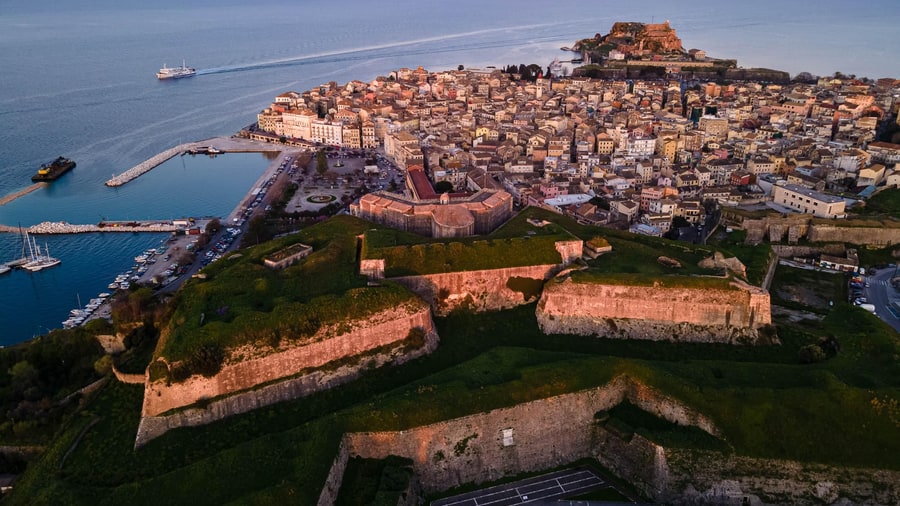
Corfu lies about 75 km south-east of the Strait of Otranto. Neanderthals, an early human species, visited when the island lay no more than 12 km offshore. Rising seas cut it off between 10,000 and 8000 BC.
A Corfu tour crosses rock laid down in an ancient sea. Until the early Jurassic, the region formed a fault-cut basin beside the vanished Pindos Ocean. Limy sediment piled up there through the Mesozoic, the dinosaur age.
- Springs: The south Corfu karst aquifer, groundwater in dissolved limestone, feeds springs of 1–3 cubic metres a second.
- Woods: Oak woods survive only in fragments, chiefly in the north near Tritsi, Portais and Acharavi.
- Plants: A 1995 field study counted 134 wild tree and shrub species on the island.
Corfu is a continental island, once part of the mainland. Its wildlife is therefore similar to that of mainland Greece. Mount Aghii Deka, the main peak of central Corfu, rises to 576 m.


What does Mount Pantokrator show on a Corfu tour?
A Corfu tour on Mount Pantokrator shows a summit monastery, a transmitter tower and rare mountain plants. Bracken, a tall fern, now spreads over abandoned farm fields on its slopes. Lower down lies a deserted village built of stone.
The mountain’s Greek name, Pantokrator, means “the Almighty”. Villagers of Perithia helped build the first monastery with local wood and limestone. Large-leaved lime trees that look truly wild grow on north-facing rubble below the top.
The summit monastery is lived in during the summer months. It keeps a collection of icons, painted holy images. Near it, a Corfu tour meets a free-standing transmitter tower, a lattice of criss-crossed steel.
Black pine grows on Corfu only at this summit, as one group of trees. The trees are possibly wild. Bladder senna, a rare shrub, grows on the island only in this mountain block.
Corfu has 36 orchid species. The University of Vienna herbarium holds a pyramidal orchid collected on the mountain. A collector took it at 800 m on 15 June 1970.
- Buckthorn: A rock buckthorn new to Corfu’s flora was found on limestone below the summit.
- Orchids: The Natural History Museum Vienna holds a Provence orchid collected at 600 m near abandoned Sinies.
- Maple: Early records placed field maple on Corfu only among the ruins of Palio Chorio, “Old Village”.
Old Perithia counted 1,052 residents in 1907. Its population fell to 72 by 1951 and 27 by 1961. Its stone houses mainly follow Venetian design. Its kalderimia, or cobbled mule paths, are stone too.
Which hill villages does a Corfu tour pass?
A Corfu tour passes hill villages, among them settlements protected by Greek law for their architecture. Sinarades and Kynopiastes both hold this traditional-settlement status. Strinylas, at about 680 m, is the island’s highest inhabited village. Only abandoned Perama, at 700 m, lies higher.
Doukades stands at 170 m, inland from the Bay of Liapades. Its community also includes the nearby village of Papathanatika. Its late-19th-century primary school is a listed monument with neoclassical, temple-style façades.
A Corfu tour reaches Sinarades 13 km from Corfu town, at 163 m. It sits on hillsides near the sea, yet stays hidden from the water. Fear of corsairs, or sea pirates, packed its houses tightly together.
Its houses have arched ground-floor doors and ochre Byzantine-style tiles. Carved marble frames the doorways. Outside stone stairs climb to a “bontzo”, a veranda. The leading theory links the village name to the Sinaras, a vanished Byzantine family.
- Museum: Teacher Nikolaos Paktitis created the folklore museum in Sinarades, opened in August 1982.
- Kynopiastes: Its main church, the Virgin Eleousa, meaning “the Merciful”, has three aisles and 18th-century icons.
- Strinylas: The name is thought to come from “strinaria”, the local word for its hard building stones.
Spartylas had 658 residents in 1991, 575 in 2001 and 504 in 2011. Pelekas village had 637 residents in 1981. Back in 1565, Sinarades had 234 residents; by 1879 it had 1,545.
What do the olive groves show on a Corfu tour?
A Corfu tour shows olive groves spread over more than 300,000 stremmata of the island’s regional unit. A stremma equals 1,000 square metres. Holdings are small, with 20 to 50 olive trees each. Nets under the trees catch the falling fruit.
Contracts from the 1500s show olives and citrus around Afra, in Middle Corfu. In 1623 Venice urged islanders to dig up wild olives and plant new roots. It paid farmers for each new tree.
A Corfu tour north of Corfu town crosses villages with long oil records. Archives for 1766–1770 count 13,670 olive trees in Evropouli. Neighbouring Potamos had 63,765 trees and 16 oil presses.
Corfu’s old oil mills crushed olives with stone. The monolithi, a single-stone mill, turned one round vertical stone on a wooden axle. It rolled over a massive horizontal stone. The alestiki mill used two or three smaller vertical wheels instead.
The harvest starts in late autumn. On a Corfu tour, plastic nets lie under the trees. Ripe olives fall naturally onto the nets. Growers collect them every two to three weeks. Collection can last into late spring.
- Tree height: A Greek farm ministry file says olive trees reach 15 to 20 metres.
- Variety: Lianolia, the local small-fruited olive, has the botanical name Olea europaea var. craneorpha.
- Land use: At the end of the Second World War, olives covered 52.3% of Corfu’s farmland.
A 1983 study found that healthy olives left on the ground over a fortnight gave more acidic oil. The same study counted 56,910 olives per fruiting tree at a Ropa valley site.
What music does a Corfu tour hear?
A Corfu tour hears brass from the philharmonics, the island’s marching wind bands. The tour also hears the kantada, a love song a man sings to a woman. String instruments such as guitar and mandolin accompany it.
These songs took shape during Venetian rule. They blend local Greek elements with Italian musicality. Male choirs sing them at night in the streets, in three or four vocal parts.
A Corfu tour hears the “Old Philharmonic”, the Philharmonic Society of Corfu. Its band first appeared in August 1841. It was the Ionian Islands’ fourth civilian band. Earlier bands began in Zakynthos, Argostoli and Lixouri.
Foreigners called it “La Banda Grecca”, Italian for “the Greek Band”. This band gave the first performance of the Greek national anthem in 1864. Each town band has up to 200 marching musicians.
- Composer: Corfu-born Spyridon Samaras saw his opera Flora mirabilis open at La Scala in 1886.
- Bandina: Each town philharmonic also trains a 60-strong student band called the bandina.
- Botides: These clay pots, smashed on Holy Saturday, recall Psalm 2:9 on a potter’s vessel.
Nikolaos Mantzaros wrote the “Aria Greca” in 1827. It was the first concert aria, a solo song, in Greek. He came from a noble Corfiot family. He taught local youth music without pay.
Which museums does a Corfu tour pass?
A Corfu tour passes museums of ancient sculpture, Asian art, banknotes and icons in Corfu town. A poet’s house museum stands in the old town too. A country estate outside town holds a museum to a Greek statesman.
The Archaeological Museum rose between 1962 and 1965 on city-donated land. It holds the Gorgon pediment, a triangular gable from the Temple of Artemis. French soldiers under General Donzelot found the temple ruins while digging trenches.
A Corfu tour visitor meets Medusa, who wears a belt of intertwined snakes, a fertility symbol. Her children Pegasus and Chrysaor stand on either side of her. In myth, both were born after her death.
The Museum of Asian Art holds over ten thousand objects from China and Japan. Diplomat N. Chatzivasileiou gave 450 objects, mainly Korean and Japanese screens. Merchant Ch. Chiotakis gave 341 pieces of Chinese porcelain made for export.
- Banknotes: The museum’s 1944 note of 100 billion drachmas, the old Greek money, is the country’s highest-value note.
- Icons: Melina Merkouri opened the Antivouniotissa Museum, whose name means “facing the mountain”, in 1984.
- Poet: The Solomos Museum fills scholar Flaminio Lolli’s former house, where the poet settled in 1832.
The museum on the Koukouritsa estate is Greece’s only museum devoted solely to Ioannis Kapodistrias. The state declared the estate a historical monument in 1995. The renovated museum reopened in October 2017.
Which famous Corfiots does a Corfu tour recall?
A Corfu tour recalls a statesman, a novelist, poets and a historian. It also recalls a painter, a sculptor and prime ministers. Each was born on Corfu or grew up there. Their lives span the 18th to 20th centuries.
A Corfu tour passes a plaque on the house where Ioannis Kapodistrias was born. At 25, he became a minister of the Septinsular Republic, a free state of seven islands. He is buried at the Platytera Monastery.
Novelist Albert Cohen was born on Corfu on 16 August 1895 to Greek Jewish parents. The family owned a soap factory. They moved to Marseille, France, when he was a child. He wrote his novels in French.
A Corfu tour also recalls Lorentzos Mavilis, born on Ithaca in 1860 to a Corfu-based family. He is seen as Greece’s greatest sonnet writer. Iakovos Polylas, born on Corfu, published the poems of Dionysios Solomos in 1859.
- Historian: In October 1829, Corfu-born Andreas Moustoxydis became director of Greece’s first national archaeological museum, on Aegina.
- Watercolours: The National Gallery of Greece showed the life’s work of Corfu-born painter Angelos Giallinas in 1974.
- Sculptor: Pavlos Prosalentis, born on Corfu in 1784, became modern Greece’s first professional sculptor.
Two prime ministers of Greece were also born on Corfu. Historian Spyridon Lambros led the government from 27 September 1916 to 21 April 1917. Georgios Theotokis was elected mayor of Corfu in 1879 with 65% of the vote.
Which months suit a Corfu tour?
A Corfu tour suits the carnival weeks and Holy Week, when Corfu town keeps old customs. Late spring brings a regional public holiday. Mid-summer is kumquat flowering time. Late summer and autumn bring wild flowers to coasts and woods.
A Corfu tour at carnival time meets petegoletsa, street sketches named after the local word for gossip. The form resembles commedia dell’arte, an Italian comedy of stock characters. The sketches play on Tsiknopempti evening, carnival’s meat-eating Thursday.
Corfu homes mark Easter with special breads. On Holy Monday, housewives bake fogatses, sweet breads of Venetian origin with liqueur and kumquat. Colombines are braided breads topped with a red egg and a feather.
A Corfu tour on Holy Saturday meets the procession of Saint Spyridon’s relics. Tradition links it to an escape from famine. Since 1574, the custom has followed a Venetian security ban on Orthodox processions on Good Friday.
- Holy Thursday: In village churches, women weave a silk cord, adding to it at each Gospel reading.
- Easter Tuesday: The saint’s relic goes back into its casket in a rite called the Mpasmatha.
- Autumn flowers: Queen Olga’s snowdrop, recorded on Corfu, has a form that blooms from September to December.
Union Day marks the union of the Ionian Islands with Greece. On that day, the Metropolitan, Corfu’s senior bishop, leads a thanksgiving service. Schools, scouts and soldiers then march. Fighter-jet displays over Garitsa Bay can follow the parades.
What do visitors ask about a Corfu tour?
A Corfu tour raises questions about two books, cricket, the Liston and the kumquat. One cricket club, GSK Vyron, dates from 1925. The Liston runs for about 150 m. The word kumquat comes from Cantonese words meaning golden mandarin orange.
Which books tie into a Corfu tour?
Albert Cohen, born on Corfu, wrote the novel Belle du Seigneur. It won the French Academy’s grand prize for the novel in 1968. Corfu-born Iakovos Polylas published a Greek version of Shakespeare’s The Tempest in 1855. It was the first standalone Shakespeare translation printed in Greece.
Why does cricket feature on a Corfu tour?
The first Corfiot cricket teams formed shortly after 1864, once the British had left. Kerkyraikos Gymnastikos Syllogos, the Corfu Athletic Club, was founded in 1893 and still runs a cricket section. Greece won the 2009 European Cricket Championship Division Five on Corfu without losing a game.
What is the Liston on a Corfu tour?
The Liston is a pedestrian street in Corfu town. In Venetian usage, liston means the long marble slabs used to pave streets. Its main street regularly hosts parades and mass gatherings. On Holy Wednesday, its street lanterns glow purple.
What kind of fruit is the kumquat on a Corfu tour?
The kumquat tree is native to southern China. Chinese writings mention it from at least the 12th century. Corfu grows the oval kumquat, known to botanists as Citrus margarita. The tree has glossy leaves and small white flowers. Each tree pollinates itself. A 100 g serving holds about 44 mg of vitamin C.