
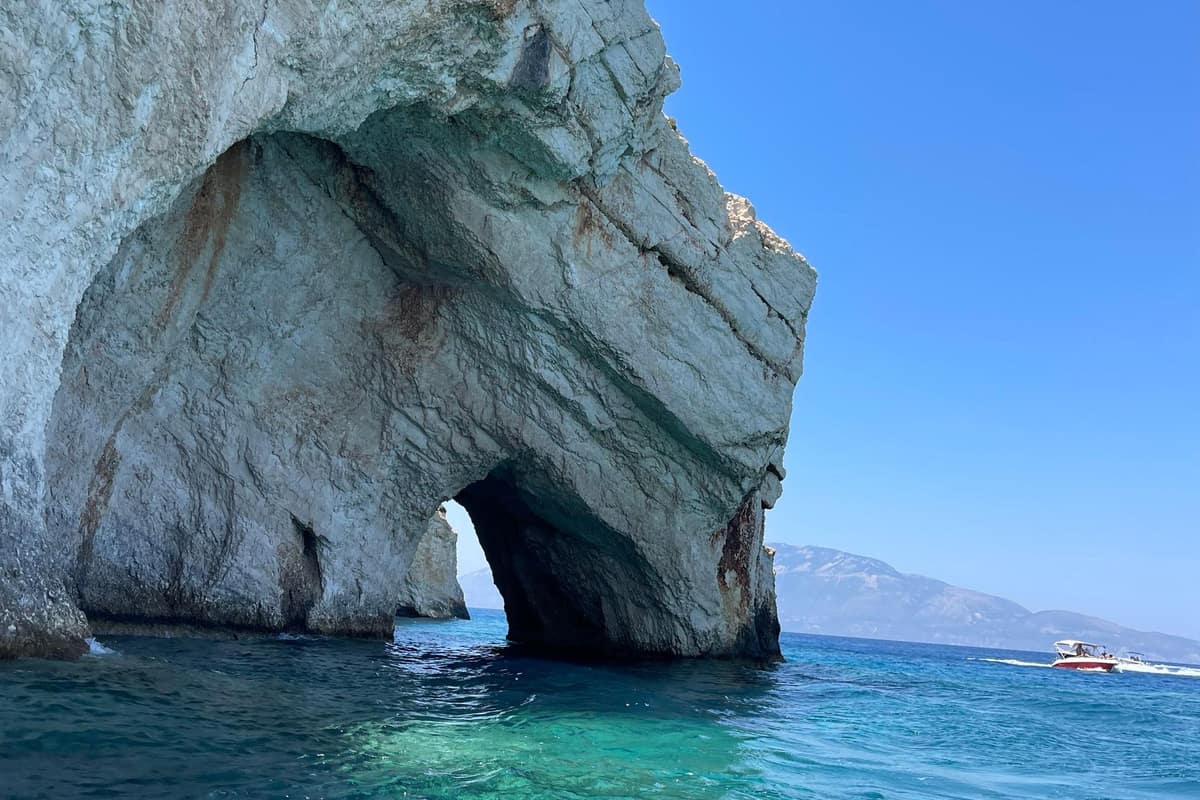
The Zakynthos blue caves are sea caves and arches at Cape Skinari, the northern tip of Zakynthos in the Ionian Sea. Small boats reach them from the harbours of the north and the east coast. The trip is one of the Greece Tours on Greece Ville, listed with the other Ionian Islands tours and Greece boat tours.
This post covers where the Zakynthos blue caves lie, how the sea carved them and why the water glows inside. It also covers the caves and arches, the sea life around them and Cape Skinari. The north coast, the best months and common questions come last.
The sections include Zakynthos blue caves trips and related Zakynthos boat tours that can be booked online.
What are the Zakynthos blue caves?
Zakynthos blue caves are sea caves at Cape Skinari, the northern end of Zakynthos. The island lies in the Ionian Sea. The caves lie south-east of the cape. The west coast of the island is rocky and steep, and it forms caves and small coves.
Cape Skinari, the cape of the Zakynthos blue caves, lies at 37°56′02″ north and 20°41′57″ east. The west coast of Zakynthos is about 34 kilometres long. The nearest village to the cape is Korithi, which lies to the south of it.
Korithi stands at an altitude of 169 metres. It lies 2 kilometres north of Agios Nikolaos. The census counted 72 residents in Korithi in 1991, 122 in 2001 and 47 in 2011.
The village of Skinaria nearly shares its name with Cape Skinari. It lies much farther away from the Zakynthos blue caves. It stands at an altitude of 188 metres. It had 97 residents in 1991, 68 in 2001 and 63 in 2011.
The hamlet of Agios Nikolaos stands at the head of a small bay. It was recognised as a settlement in 1991 and joined the community of Volimes. It belongs to the Elatia municipal unit, which was once a municipality of its own.
- Height: Agios Nikolaos has a mean altitude of 20 metres.
- People: The hamlet had 31 residents in 1991 and 30 in 2011.
- Crowding: Elatia was the least crowded municipality of the Zakynthos area.
- Skinaria: The village lies at 37°52′56″ north and 20°42′13″ east.
The east coast of Zakynthos faces the Peloponnese. It is 37 kilometres long and sandy. The Zakynthos blue caves sit around Cape Skinari instead, at the northern end of the island.


How did the sea carve the Zakynthos blue caves?
Zakynthos blue caves are sea caves cut into a coast of limestone. Both waves and water can wear this rock away. Waves break the rock, and water slowly dissolves it. Caves shaped both ways are called hybrid caves. The Hellenic arc keeps lifting and shaking this coast.
In Halong Bay in Vietnam, caves first formed by dissolving are now enlarged by the sea. Phang Nga Bay in Thailand shows another mix. Caves dissolved in limestone were flooded by the rising sea and are now worn by waves. Sea caves such as the Zakynthos blue caves can have more than one origin.
Karst, a landscape of dissolved rock, grows best in dense, thin-layered limestone full of cracks. Chalk is porous and not dense, so karst is poorly developed there. Karst also grows best where the water table is low and the rainfall is moderate to heavy.
Water that stands still fills with carbonate minerals and stops dissolving rock. In a cave, the lower carbon dioxide level makes acid water drop calcium carbonate. These mineral deposits, called speleothems, take forms such as stalactites, stalagmites and flowstones.
The Hellenic arc is a mountain chain along the southern edge of the Aegean Sea plate. Two places where plates dive under the land lie about 100 kilometres apart. The Kephallenia Fault Zone fills the gap between them.
- Norway: Halvikshulen is 340 metres long and took at least a million years to form.
- Largest volume: Rikoriko Cave in New Zealand holds 221,494 cubic metres.
- Surveyed caves: Of the sea caves surveyed, 3 are over 1000 metres long.
The island of the Zakynthos blue caves has highlands. These are left over from squeezing that started 30 million years ago or earlier. Sea caves such as the Zakynthos blue caves are mainly small next to caves formed by dissolving rock.
Why does the water glow inside the Zakynthos blue caves?
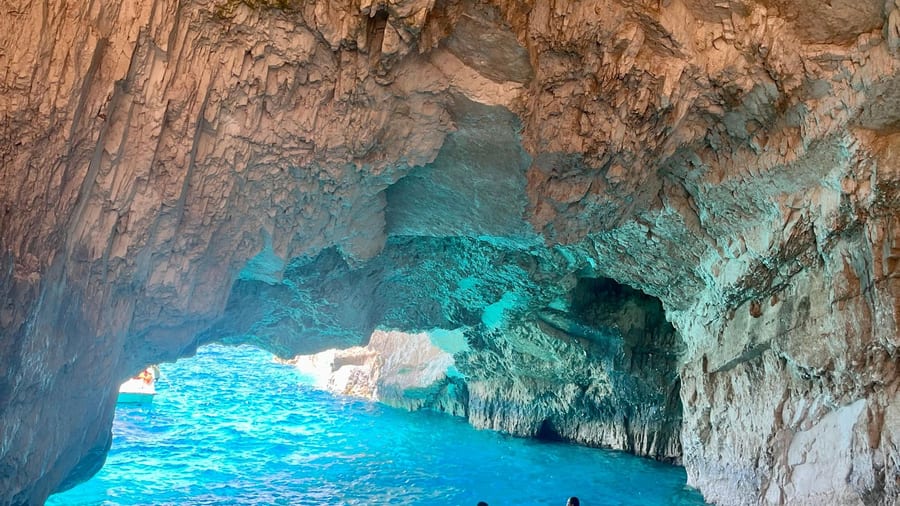
Zakynthos blue caves glow with the colour that water itself has. Water carries a faint blue tint of its own, and a thicker layer looks bluer. Scattered light sends the blue back up to the surface, where it can be seen.
The water in the Zakynthos blue caves is made of molecules that vibrate in three basic ways. Water absorbs visible light mainly through a harmonic, or overtone, of those vibrations. Each overtone absorbs far less than the last.
In the pipe test, white light passes through a long pipe of purified water. Clear windows close both ends. The light looks pale sky blue. The absorption is weak, so the pipe must be a metre or more long.
The electrons of water absorb light only in the ultraviolet, outside visible light. So they do not colour the water. Tens of metres of water absorb all the light. Without scattering, every body of water looks black, even the water of the Zakynthos blue caves.
Like the Zakynthos blue caves, the Blue Cave on the Croatian island of Biševo is a sea cave. It was carved in limestone by the sea. In 1884 local fishermen showed it to the explorer Eugen von Ransonnet-Villez. He wrote that its beauty beat even the Blue Grotto of Capri.
- Biševo light: In summer, from 10 am to 1 pm, sunbeams bounce off the white floor.
- Capri boats: Visitors lie flat on the bottom of a small four-person rowboat.
- Emperor: Tiberius moved to Capri in 27 AD and used the grotto as his personal swimming hole.
In 1826 the fisherman Angelo Ferraro took two men to the Capri grotto. They were the German writer August Kopisch and the painter Ernst Fries. Blue sea caves such as the Zakynthos blue caves also exist on Biševo, on Capri and in Malta.
Which caves and arches form the Zakynthos blue caves?
Zakynthos blue caves are a row of sea caves. The row starts just after Agios Nikolaos and ends near Cape Skinari. The biggest is the Kyano Spilio, or Blue Cave. The caves rank among the noteworthy sights of all the Ionian Islands.
A different kind of sight lies between Cape Skinari, near the Zakynthos blue caves, and Cape Mounta. The wreck of the British submarine HMS Perseus rests almost exactly on the line joining the two capes. It lies only 2.3 nautical miles from Mounta.
HMS Perseus was a British Parthian-class submarine. She was built at Barrow in Furness and launched in late spring 1929. On 26 November 1941 she sailed from Malta for Alexandria, ordered to patrol the waters east of Greece.
She sat on the surface about 3 km off the Kefalonia coast, charging her batteries. Then the mine exploded. John Capes, a 31-year-old stoker, lay in a bunk made from a spare torpedo tube. Four men left through the escape hatch, but only Capes reached the surface.
Divers later found the anchor of an Italian mine close to the wreck. This fits the belief that a mine sank her. Her gun and steering wheel are still in place on the seabed.
- Gauge: The gauge read just over 270 ft, but the escape gear was tested only to 100 ft.
- Tilt: The wreck lies with a list to starboard.
- Damage: A crack on the port side near the bow is the only big damage.
- Compasses: They still work and show her last course.
Kostas Thoctarides found Capes’s empty bunk, the hatch and a rum bottle, as Capes had described. Memorial ceremonies took place on Kefalonia in late spring 2000. The wreck lies in the same sea as the Zakynthos blue caves.
What lives in the sea around the Zakynthos blue caves?
Zakynthos blue caves sit in Ionian water full of life. A Greek nature database calls the sea off west and north-east Zakynthos an important monk seal shelter. Caves in the Mediterranean also hold fish, sponges and tiny colony animals.
A monk seal in the sea around the Zakynthos blue caves is diurnal, so it feeds by day. It has eight pairs of teeth. In 2008, nursing was reported on an open beach at Cabo Blanco, the first such record since 1945.
Seal pups need a safe cave. Such a cave has a barrier against waves, a long entrance corridor and a sheltered shallow pool. It also has a beach above the high-tide line. Italian caves such as Grotta delle Sirene, the Mermaids Cave, are named after monk seals. The seals once lived there.
The same database records a beaked whale, the common dolphin and the killer whale in the area. Off the Inner Ionian islands, researchers photographed about 120 bottlenose dolphins. About one quarter stay in the area, and the rest pass through. Groups of striped dolphins sometimes enter these waters.
The Mediterranean holds more than 3000 marine caves, like the Zakynthos blue caves. Of these, 307 are recorded in the Ionian Sea. The cardinal fish is the cave fish reported more than any other. Its daily trips in and out help bring food in.
- Rockfish: A diver photographed the deep-water Messina rockfish in a Zakynthos cave, 26 to 31 m down.
- Microbes: Caves in the Zakynthos marine park were thick with microbes and smelled of hydrogen sulphide gas.
- Sponges: Without light or algae, one cave can hold up to 86 kinds of sponge.
- Bryozoans: These tiny colony animals have 228 species in caves.
On the sea floor, Posidonia spreads by stolons, creeping stems that grow about 7 centimetres per year. In autumn it loses its outer adult leaves, and new leaves grow in winter.
What does Cape Skinari show near the Zakynthos blue caves?
Zakynthos blue caves lie near Cape Skinari, which carries a stone lighthouse. The lamp was destroyed in 1941 and shone again in 1945. It marks the northernmost point of Zakynthos. Across the channel lies Cape Mounta, the south-east tip of Kefalonia.
Cape Mounta lies across the channel from the Zakynthos blue caves. It is 32.4 km (17.5 nautical miles) from Cape Kyllini on the Peloponnese. It is also 41.6 km (22.5 nautical miles) from the south-west tip of mainland Greece. The nearest village to Mounta is Skala, and the bay of Katelios opens to its west.
The Kefalonia village of Pessada lies across the channel from the Zakynthos blue caves. The monastery of the Crucified there was founded in 1602. It stands about 14 km south-west of Argostoli. Pessada itself had 233 residents in 2011.
A Greek nature database says the sea cliffs of Zakynthos host rare plants. Its record covers a Natura site that runs from Agios Nikolaos Bay to Marathias Cape. That site has a perimeter of 116.1 km and a highest point of 463 m.
- Tower: The stone tower stands in the middle of the north side of the keepers’ house.
- Light: A lighthouse database lists a white flash every 5 seconds.
- Lantern: It is white, with a black roof.
- Manager: The same database names the Hydrographic Office of the Hellenic Navy.
The cape shows a lighthouse, a channel and the far shore of Kefalonia. Mounta and Pessada lie on that shore. The Zakynthos blue caves lie close by, on the Zakynthos side. Mantrakia beach lies south of the Agios Nikolaos settlement.
What lies along the north coast near the Zakynthos blue caves?
Zakynthos blue caves sit near small hill villages in the north-west of the island. Maries stands 390 metres above sea level on the western edge of Mount Vrachionas. Orthonies stands 454 metres above sea level on the north-west part of the same mountain.
Volimes is one of the villages near the Zakynthos blue caves. It had 392 residents in 2021, down from 702 in 1981. The 1953 Ionian earthquake did great damage there.
The village of Anafonitria stands 340 metres above sea level. Its community covers 10.168 square kilometres. The village had 211 residents in 1991, 224 in 2001 and 248 in 2011.
A government gazette of 28 January 1866 lists Maries under its old name, Margiais. At that time it was part of the Volimes municipality. In 1912 Maries became the seat of its own newly founded community.
On 30 July 1866 the municipality of Volimes, which held Orthonies, was renamed the municipality of Elatia. Koroni, a hamlet of 10 residents, lies north-east of Orthonies, about 6 kilometres by road.
- Volimes name: The old official name, Volimai Mesou, was corrected in 1940.
- Askos: This village at 160 metres has a nature park with plants, animals, stone stables and cisterns.
- Elatia: This municipality had six sub-districts and 2,503 residents at the 2001 census.
The Volimes community, with its other villages, had 956 residents in 2001 and 534 in 2021. Orthonies is about 25 kilometres by road from Zakynthos town. Those figures show how small the villages near the Zakynthos blue caves are.
Which months suit the Zakynthos blue caves?
Zakynthos blue caves suit late spring and summer best, on the evidence of airport traffic and wind records. August 2023 was the busiest month at the island’s airport, with 485,242 passengers. The airport counted only 3,353 passengers in January and 3,669 in December.
The airport on the island of the Zakynthos blue caves counted 26,226 passengers in April 2023. In late spring the count rose to 190,962. June brought 369,133 passengers and July brought 481,599.
Each 24 August the island marks the 1717 move of Saint Dionysios’ relics from the Strofades monastery. In the August feast, the relics leave the church and go along Alexandrou Roma Street to Solomos Square. They return via Lombardou Street.
Zakynthos carnival has an old horseback contest, the Giostra di Zante, where first prize was a silver sword. The Orthodox carnival, Apokreo, falls inside the Triodion. That church period starts in the tenth week before Easter.
A two-year buoy record off Zakynthos gave a mean wind speed of 5.7 metres per second. The monthly mean ranged from 4.3 metres per second in late spring to 7.5 in December.
- Flights: The airport had 3,129 flights in August 2023 and only 106 in January.
- Clean Monday: This first day of Great Lent falls 48 days before Easter Sunday.
- Daily wind: At that buoy the wind speed hardly changed through the hours of the day.
Forecasts for 18 September 2020 gave maximum waves of 4.5 metres on the southern coast of Zakynthos. Wave and wind records like these show why the month matters for the Zakynthos blue caves.
What do travelers want to know about the Zakynthos blue caves?
Zakynthos blue caves prompt questions about the island’s music, saint and wartime past. The island has the oldest philharmonic band in Greece, founded in 1816. Saint Dionysios asked to be buried on Stamfani island. The 275 Jews of Zakynthos were not deported in the Holocaust.
Which region and municipality hold the Zakynthos blue caves?
The Ionian Islands region is the smallest by area of the 13 regions of Greece. It has five regional units, Corfu, Ithaca, Kefalonia, Lefkada and Zakynthos, and its capital is Corfu. Zakynthos is a regional unit and also the only municipality of that unit.
What is the population of the island of the Zakynthos blue caves?
In 1940 the island of Zakynthos had 42,148 residents. By 1981 it had 30,011 residents. It had 32,556 in 1991 and 38,596 in 2001. The 2011 reform joined six older municipalities into one: Zakynthos, Alykes, Arkadioi, Artemisia, Elatia and Laganas.
Which museum stands on the island of the Zakynthos blue caves?
The Museum of Solomos and Eminent Zakynthians began in 1959 as a literary and social association. It was built after the 1953 earthquakes in St Mark’s Square, on land given by the Metropolitan Church. It has been open since 24 August 1966.
What music belongs to the island of the Zakynthos blue caves?
After Corfu, Zakynthos has the second-largest philharmonic tradition among the Ionian islands. Since 2009 the island has had its own jazz festival, and it also hosts a classical music festival. A traditional song names Zakynthos, Kefalonia, Corfu and Lefkada as the four islands that decorate Greece.
What happened to the relic of Saint Dionysios on the Zakynthos blue caves island?
Three years after burial, the body of Saint Dionysios was dug up and found uncorrupted. In an 18th-century Ottoman attack on the Strofades, attackers cut off the hands of the relic. It is one of three uncorrupted relics in the Ionian. The others are Saint Spyridon on Corfu and Saint Gerasimos on Kefalonia.
What happened to the Jews of the Zakynthos blue caves island?
Mayor Loukas Karrer and Bishop Chrysostomos hid the Jews in rural villages. They gave the Germans a list with only their own two names. Statues of the bishop and the mayor stand on the site of the old synagogue. In 1978 Yad Vashem honoured both men as Righteous Among the Nations.