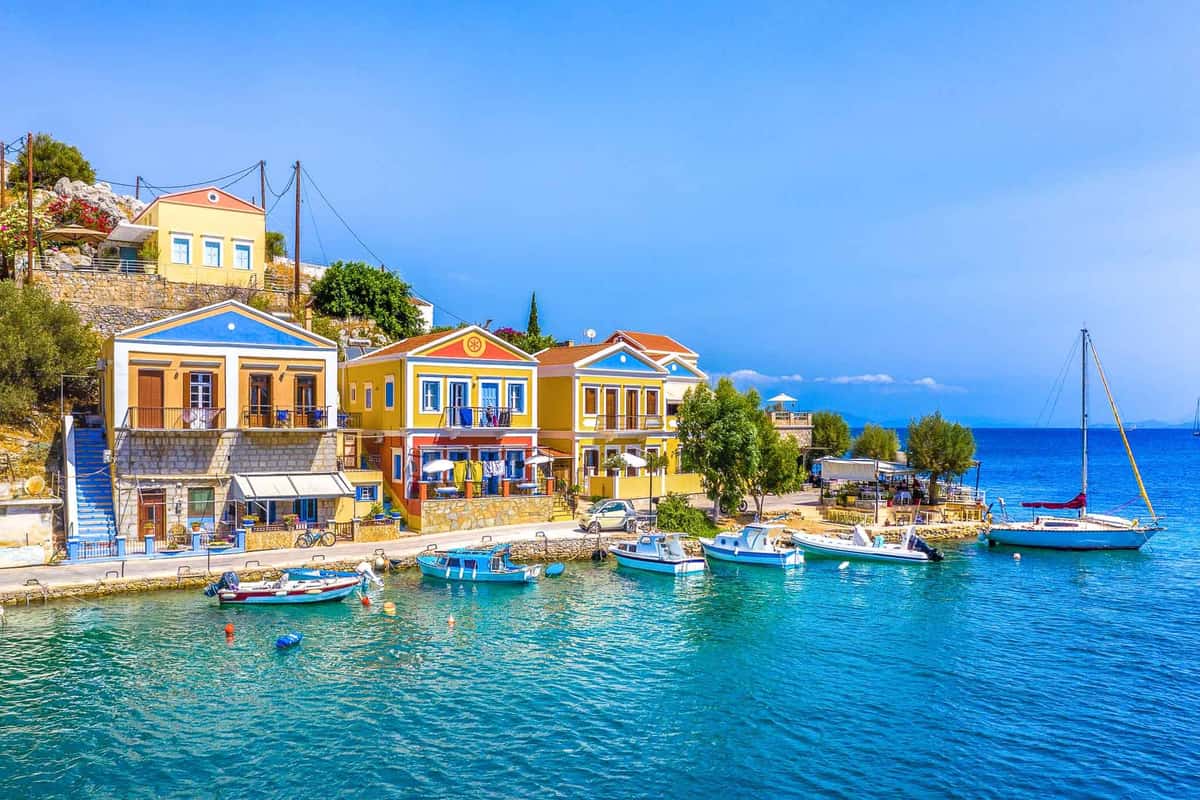
A Symi day trip from Rhodes crosses the sea to Symi, a small island of the Dodecanese. The trip reaches a harbour of coloured mansions and a famous monastery. It is one of the island day trips in Greece on Greece Ville.
This post covers what a Symi day trip from Rhodes is, how the sea crossing works and Gialos harbour. It also covers Panormitis monastery, the sponge and shipbuilding trades and the bays. The landscape, the best season and common questions come last.
The sections include Symi day trips and related boat cruises that can be booked online.
What is a Symi day trip from Rhodes?
A Symi day trip from Rhodes is a short sea journey to a small Dodecanese island. Symi is the eighth largest island of that group. Visitors explore its harbour town and then sail back to Rhodes. The island keeps a small, close community.
Symi ranks 42nd among the islands of Greece by area. It lies at about 36°35′ north and 27°50′ east. Its highest mountain, Vigla, almost splits it in two. The northern half is lower and easier to farm. Cape Patos is the southernmost point.
The 2021 census counted 2,603 permanent residents. Symi town held 2,322 of them. Pedi had 101, Roukouniotis 85 and Xisos 29. The island has about 45 people for every square kilometre. A Symi day trip from Rhodes centres on the town, where almost everyone lives.
Chorio is the oldest part of Symi town. It grew up around the castle, mainly for defence. Gialos is now the administrative and tourist centre. It holds almost all public services and banks. A desalination plant, which turns sea water into fresh water, has made drinking water since 2009.
- Ancient past: Symi belonged to the Rhodians in ancient times, except for a short period under Athens.
- Local government: The Municipality of Symi was formed on 28 September 1948, seated in Symi town.
- Film history: Pascali’s Island was filmed mostly on Symi and in Rhodes in late summer 1987.
Foreign visitors come especially from Britain, France and Italy. About 120 people from outside Greece live on Symi all year. Around 50 of them are British. A Symi day trip from Rhodes shows why they stayed.



How does the sea crossing work on a Symi day trip from Rhodes?
A Symi day trip from Rhodes depends on the sea, because Symi has no airport. Air travellers first fly to Rhodes, Kos or Athens. Then they reach the island by boat. Almost all tourists who visit Symi travel through Rhodes.
Ferries link Symi with Rhodes, Kalymnos, Kos, Leros, Leipsoi, Nisyros, Patmos and Tilos. Ships from Piraeus also sail to Symi. They stop at other islands on the way. Symi lies 255 miles from Piraeus. It also lies about 27 miles east of Nisyros.
On a Symi day trip from Rhodes, the Turkish coast stays close. The nearest Turkish shore is only 3.7 miles away. Symi sits in front of a gulf on the Asia Minor coast. That gulf is called the Gulf of Symi.
The Bozburun Peninsula in Turkey has Symi to its west. The Datça Peninsula lies to its north. Bozburun’s coast is cut into smaller peninsulas, bays and islets. In ancient times, the cape at its tip was called Aphrodisias.
- Old Rhodian lands: From the 5th to the 1st century BC, Rhodes ruled the facing coast of Caria.
- Marmaris: This Turkish coastal town was the ancient town of Physkos.
- Harbour light: The Agios Nikolaos Lighthouse in Rhodes town was built in 1863.
Every boat entering the port of Symi must call on VHF channel 12, a ship radio line. Day tourism from Rhodes helped the economy recover during the Greek dictatorship. The Symi day trip from Rhodes still supports the island.
What does Gialos harbour show on a Symi day trip from Rhodes?
A Symi day trip from Rhodes ends its crossing at Gialos, the main harbour. Symi town rises like an amphitheatre around this natural harbour. The name comes from the older Greek word Aigialos. The harbour has an excellent anchorage.
When the fear of pirates faded, the old village spread down to the sea. It formed Gialos, the safe harbour. Sea captains and merchants had their homes there. The lower town grew in the 15th and 16th centuries. Its buildings stand tightly packed, with vaulted passages.
Craftsmen from Karpathos built the houses of Gialos. Marble from Paros and Penteli formed stairs and balconies. Roof tiles came from Marseille. Wood for doors and windows came from Trieste. On 19th-century buildings, a round gable opening helps protect the roof from strong winds.
A Symi day trip from Rhodes reveals bold house colours. Ochre, salmon, red, light blue and white cover the restored neoclassical houses. Symmetrical windows, doors and balconies make the buildings look like human faces.
- Clock tower: The stone municipal clock of 1881 is the first sight visitors see.
- Harbour buildings: The cathedral of Saint John the Baptist from 1838 stands near the fish market.
- Fisherman statue: The statue “Michalaki” is the work of Symi sculptor Costas Valsamis.
Ministerial decision No. 24908 of 23 October 1971 protected the settlement as a historic site. Gialos and the Chora are on the official list of traditional settlements. In August 1988, a harbour photo appeared on the cover of Condé Nast Traveler.
What is Panormitis monastery on a Symi day trip from Rhodes?
A Symi day trip from Rhodes can include Panormitis monastery in the south-southwest of the island. It stands at the head of a bay called Panormos. Together with Patmos, it is one of the two greatest Dodecanese pilgrim sites.
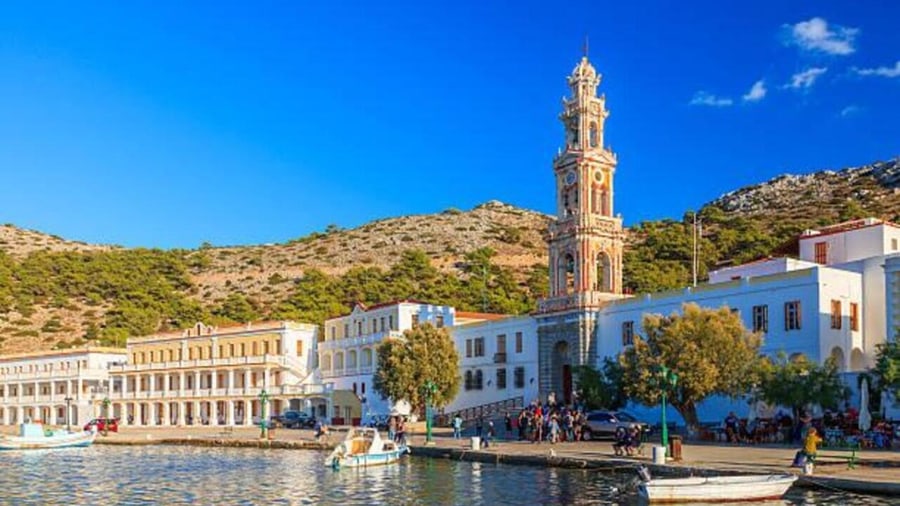
There are signs that the first monastery rose around 450 AD. It was built on the site of an ancient temple of the god Apollo. The main church took its present form in the 18th century. The baroque bell tower came later, in 1911.
On a Symi day trip from Rhodes, the bell tower catches the eye first. It looks very much like the bell tower of the Zagorsk Monastery near Moscow. The building follows a Venetian style. Its main entrance faces the beach of Panormitis.
The courtyard is paved with pebbles laid in geometric patterns. Its church is a single-aisled basilica, meaning one long hall. Frescoes, or wall paintings, cover the inside walls from top to bottom.
- The icon: It is two metres tall, and sheets of silver cover the figure of the saint.
- The maker: An inscription says the craftsman Ioannis of the Peloponnese made it in 1724.
- The museums: One shows church art, and one shows folk life about fishing, farming and herding.
A memorial honours a former abbot, two monks and two teachers. They were executed in 1944 for secret radio contact with British officers. The sacristy, a room for holy objects, keeps offerings sealed in bottles by believers. The sea is said to have washed them up.
How did sponge diving and shipbuilding shape a Symi day trip from Rhodes?
A Symi day trip from Rhodes shows an island shaped by sponges and ships. Symi people taught other islanders how to fish, process and trade sponges. The harbour houses kept sponge rooms on their ground floors. The old shipyard still stands in the Charani district.
Under Ottoman rule, only Symi paid the Sultan a sponge tax. It was twelve thousand coarse and three thousand fine sponges. Before 1863, Symi had 250 kagkaves. These were sponge-fishing boats that worked mainly in winter.
In 1840, the Symi diver Michael Karanikis tried a new method. He was the first to dive holding a flat stone tied by rope to the boat. Locals called this stone the kambanellopetra. In 1863, Fotis Mastoridis brought the diving suit from the Indies.
To prove the suit was safe, his wife Eugenia wore it into the harbour. A Symi day trip from Rhodes still arrives at that same harbour. In 1865, Symi earned 21,186 pounds sterling from sponges. Kalymnos earned 16,949.
- The fleet: In different years, the fleet reached 400 kagkaves, 210 naked-diver boats and 54 diving suits.
- The clash: In 1884, naked divers destroyed 45 diving suits in the island’s warehouses.
- The wreck: Around Easter 1900, Captain Dimitrios Kondos and his Symi crew found the ancient Antikythera shipwreck.
Shipbuilding on Symi has deep roots. In myth, Glaucus, the first settler, taught islanders to swim and build ships. A shipyard worked at Charani under the master known as Kellis until the 1960s.
Which bays and beaches does a Symi day trip from Rhodes pass?
A Symi day trip from Rhodes passes bays where cliffs drop into clear water. Pedi sits in a bay at the northeast tip. Panormitis bay forms a safe, round harbour in the south-southwest. Its slopes are thick with plants.
Agios Georgios Dysalonas is the largest beach on Symi. A sheer cliff rises above it. Only boats can reach it. It lies on the east side, between Pedi and Marathounta.
Nanou is rated the best pebble beach on Symi. It also has no road access. A sheer cliff on one side drops into deep-green water. Marathounta is one of the rare beaches that a car can reach. It lies about 18 km south-southwest of Symi town.
On a Symi day trip from Rhodes, Pedi shows layers of history. Ruins of an early Christian basilica lie on its beach. Pedi has lots of small beaches. Walkers and water taxis start there for other beaches.
- Agia Marina: This rocky islet guards the north side of Pedi Bay’s entrance, with water safe for children.
- Nimborio: This beach village lies about 4 km west of Symi town.
- Maroni: Pine forest meets this pebble beach northwest of Gialos, near a tiny islet chapel.
- Agios Vasilios: Also called Lapathos, this pebble cove is framed by mountains with wild cypress trees.
Agios Nikolaos offers sand and shallow, clear water. It has sun loungers and a tavern. A narrow strip of land joins the islet of Agios Aimilianos to Symi. A church stands on that islet.
What landscape and nature meet a Symi day trip from Rhodes?
A Symi day trip from Rhodes meets a rocky island of Mesozoic limestone, an ancient rock. High cliffs and deep inlets shape its 85 km coastline. The island has no rivers or streams. Its water comes only from wells and cisterns.
Symi was joined by land to Anatolia, the Asian mainland of Turkey. That link lasted until the upper Pleistocene, a late ice age period. Now the water between Symi and Turkey is more than 200 m deep.
The north is covered with phrygana, a low dry scrub. It holds thyme, oregano, thorny burnet and Greek sage. The south keeps an old wild cypress woodland with Turkish pine. Botanists value it because it grew before people changed the land.
On a Symi day trip from Rhodes, plant lovers find 679 recorded kinds of plants. Three grow nowhere else on Earth. They are two wild onions, Allium symiacum and Allium panormitisi, and a wild oregano, Origanum symes.
- Protected area: Natura 2000 site GR4210025 covers 9,874.98 hectares, and 76.86% of it is sea.
- Seabirds: The site holds the third largest Audouin’s gull colony in Greece.
- Sea life: Dolphins and the Mediterranean monk seal feed between Symi’s islets.
Eleonora’s falcon and the Alpine swift breed in the protected area too. In 1420, the priest Cristoforo Buondelmonti wrote about goats on Symi’s high rocks. He also praised the island’s excellent wine.
When is the best season for a Symi day trip from Rhodes?
A Symi day trip from Rhodes works best in June or September. Symi has a semi-arid Mediterranean climate, which means dry and warm. Summers are long, hot and dry. Its winters are short, mild and wet, with rain.
June has only 1.2 rain days on average at Rhodes airport. The sea at Rhodes averages 23.4 °C in June. Nights at the Paradeisi airport station average a low of 22.1 °C that month.
On Symi, tourist traffic is heaviest from July to September. The sea at Rhodes averages 25.9 °C in July. In September it reaches 26.7 °C. Evenings stay warm, with an average low of 23.0 °C at Paradeisi.
A Symi day trip from Rhodes in autumn has a botanical bonus. Symi’s two native wild onions flower in this season. At Rhodes port, the average low falls from 24.4 °C in September to 21.3 °C in October.
- Heat records: Paradeisi has recorded 35.0 °C in September and 33.0 °C in October.
- Humidity: Rhodes airport averages 59.9% in August, 61.4% in September and 67.5% in October.
- Warm nights: The coldest August night on record at Paradeisi still stayed at 21.0 °C.
Water is scarce on Symi in the dry months. For that reason, Symi houses keep a cistern, a tank for rainwater. It sits at the back of the ground floor or under the upper floor.
What do travelers ask about a Symi day trip from Rhodes?
A Symi day trip from Rhodes raises common questions about the island’s long past. Travelers ask about its name and first settlers. They ask about the wars of the 1940s. They also ask about Italian rule and the island’s churches.
What name story is told on a Symi day trip from Rhodes?
The historian Diodorus wrote that Chthonius, son of Poseidon and Syme, led the first settlers. The island took its name from his mother, Syme. Another ancient account calls Syme the daughter of Ialysos and Dotis. Buondelmonti linked the name to a king called Simen.
Who lived on the island seen on a Symi day trip from Rhodes?
Diodorus says the Carians seized Symi after the Trojan War. At that time they ruled the sea. When droughts came, they left for a place called Uranium. Later Nausus, a companion of Hippotes, settled the island again with Cnidians and Rhodians.
What 1944 raid is remembered on a Symi day trip from Rhodes?
Operation Tenement took place from 13 to 15 July 1944. The British Special Boat Service sent 100 men under Major Ian Lapraik. The Greek Sacred Band sent 224 men. The German and Italian garrison lost 21 killed and 151 captured.
What surrender links to a Symi day trip from Rhodes?
In 1945, Otto Wagener, the German military commander of the Dodecanese, signed the surrender to the Allies. British Brigadier Moffat and Sacred Band commander Tsigantes were present. The Germans wanted to give the islands to the Greeks. The British did not accept this.
How did Italian rule shape the island of a Symi day trip from Rhodes?
The Italian occupation was very harsh, with years of great poverty. From 1912, people emigrated to Egypt, Marseille and the United States. Later they also left for Australia. The 1936 Italian census counted 6,195 people on 63.6 km² of Symi and its islets.
What churches meet a Symi day trip from Rhodes?
Symi reputedly has over 300 monasteries, churches and chapels. Panormitis, Roukouniotis and 7 small monasteries honour the Archangel Michael. That makes 9, like the orders of angels. Roukouniotis is a 15th-century monastery built like a fortress. It holds 14th-century frescoes and an icon by the Cretan painter Stylianos Genis.