
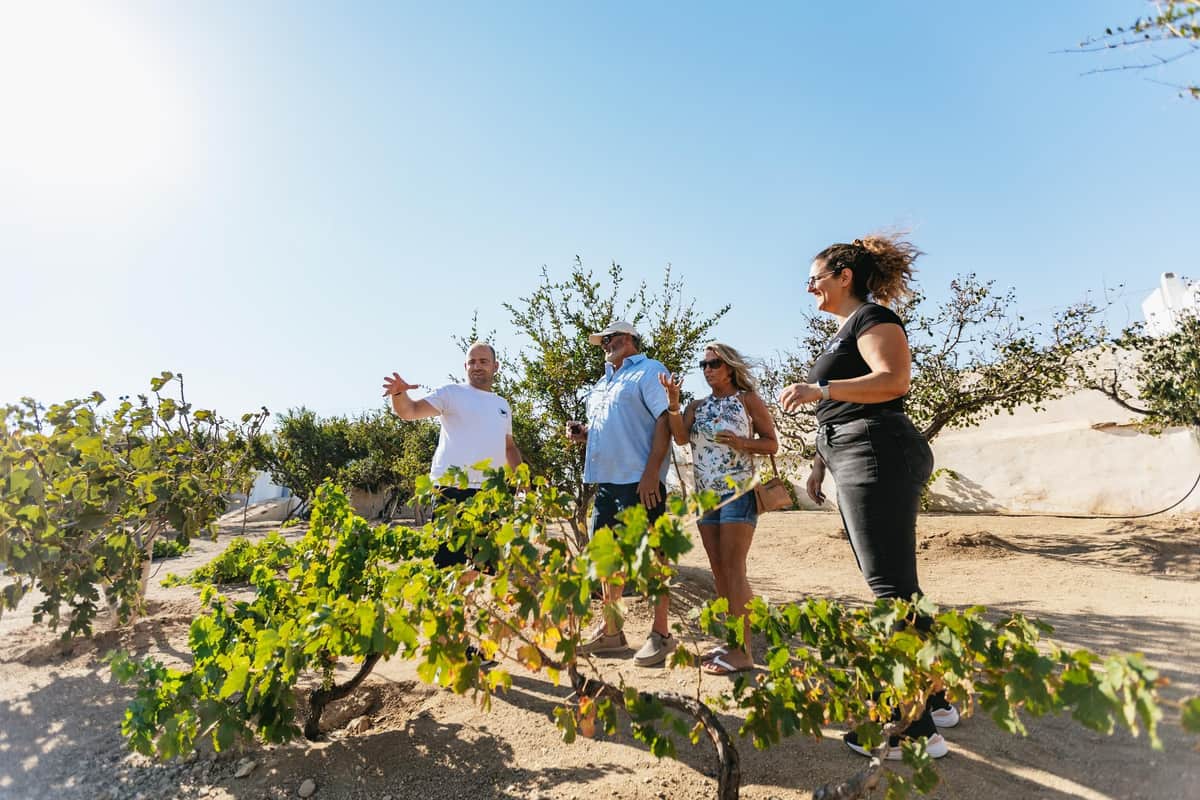
A Mykonos wine tour visits island farms and vineyards to taste wines from Mykonos and the other Cyclades. The tour is one of the Greece Tours on Greece Ville, listed with the other Mykonos tours and Greece food tours.
This post covers the wine rules of the Cyclades, rare island grapes, winemaking, tasting words, old customs and vine pests.
Glasses and serving, the best months and common questions come last. The sections include Mykonos wine tours that can be booked online.
What is a Mykonos wine tour?
A Mykonos wine tour pours wines under the PGI Cyclades label, one of Greece’s 37 PGI District Wines. A ministerial decision of 5 June 2008 drew its borders. The rules cap yields at 10,000 kg of grapes per hectare.

The file names Assyrtiko and Savatiano as its main grapes. Twelve applicants from Santorini, Paros, Syros and Sikinos signed it.
On a Mykonos wine tour, the region’s vineyards are small. In 2020, the South Aegean had 3,931 hectares of vines on 8,218 holdings. Of these, 2,335 hectares grew grapes for PDO wines and 769 for PGI wines.
The vine area was 3,957 hectares in 2015, so it shrank only slightly. Only 760 hectares grew wine grapes for neither label.
- Syros: The island has its own narrower label, PGI Syros, among the PGI Area Wines.
- Ionian gap: Only the Ionian Islands lack a PGI Regional Wine among Greece’s nine regions.
- Abroad: Agreements protect the Cyclades name in 13 countries outside the EU, from Norway to New Zealand.
- Switzerland: It has protected the older name Regional wine of Cyclades since 30 April 2002.


Which Cyclades grapes reach a Mykonos wine tour?
A Mykonos wine tour meets Aidani, a grape of eastern origin from Ionia. It has great economic importance for the Cyclades. Its vines have medium vigour and yield, and they are sensitive to powdery and downy mildew.
Athiri counts among the best Greek white grapes, and its vines grow strongly and yield well. Beyond the islands, it also grows in Chalkidiki, Lakonia, Boeotia and Evia.
On a Mykonos wine tour, red Mandilaria shows the island trade-off. Its vines resist drought but are very sensitive to downy mildew and sour rot.
Mavrotragano buds in late March, flowers in late spring and ripens at the end of August. Its vines are vigorous, moderately productive and sensitive to a dry climate.
- Malvasia: Known abroad since the 14th century, this wine seems to have blended Monemvasia, Athiri and Aidani.
- Monemvasia: Greece has only one grape of this name, while western Europe records a long list called Malvasia.
- Fokiano: A study of 91 Greek samples found Fokiano and Armeletousa closely related.
- Rozaki: Rozaki is listed among the white table grapes of Vitis vinifera.
How is wine made on a Mykonos wine tour?
A Mykonos wine tour can end with sun-dried sweet wine. For PGI Cyclades, fresh grapes need at least 230 grams of sugar per litre of must. After drying, they must reach at least 315 grams.
By the 7th century BC, vine growing had spread across Greece. Sun-drying grapes and adding herbs, honey or resin spread with it. Today the sun-dried wine ages in oak at least 12 months if white, 18 if red.
On a Mykonos wine tour, colour comes from the skins. Red wine keeps the skins in the juice for one week to one month. The OIV sets a minimum of 1 month of skin contact for orange wine.
Winemakers remove stems before red fermentation, because stems add tannin and a green pepper smell. Saignée, French for bleeding, draws pink juice off a red tank early for rosé.
- Orange wine: The British importer David A. Harvey coined the term in 2004.
- Must: Freshly crushed grape juice holds between 10 and 15% glucose.
- Oak: After 3 to 5 vintages, an oak barrel gives little or no oak flavour.
Which wine words help on a Mykonos wine tour?
A Mykonos wine tour goes easier with tasting words. Chewy describes tannins felt in the mouth that do not overwhelm the wine. A hard wine is overly tannic. Tasters call a wine hot when it carries too much alcohol.
A flabby wine lacks acidity, and in still wines flat means the same. A strong tannic backbone can help a red wine last 40 years or more.
On a Mykonos wine tour, acidity can trick the palate. A sweet Vouvray can taste dry because its acidity is so high. Tasters notice too much acetic acid, the acid of vinegar, at around 600 mg/L.
The modern Greek word krasi comes from krasis, the mixing of wine and water in kraters. At each symposium, an elected symposiarch decided how much water went into the wine.
- Crystals: Tartrate crystals in a bottle can look like broken glass, but they are harmless.
- Retsina: The Roman writer Columella first recorded resin in wine amphorae, in the first century.
- Undrinkable: In 968, the envoy Liutprand of Cremona called the resinated wine of Constantinople undrinkable.
- Vix krater: Found in a French Celtic tomb, it stands 1.63 m tall.
Which old wine customs survive on a Mykonos wine tour?
A Mykonos wine tour recalls ancient treading, when workers gripped a rope above the vat for balance. Flute music sometimes played as they trod. One of the earliest Greek wine presses, at Palekastro on Crete, was a stone treading basin.
Ancient Greeks picked grapes early to keep their acidity. They then sun-dried them to concentrate the sugar.
On a Mykonos wine tour, the Anthesteria comes to mind. It ran from the 11th to the 13th of Anthesterion, near the January or February full moon. Its days were Pithoigia, the jar-opening, Choes, the pouring, and Chytroi, the pots.
On Choes, drinking clubs raced to drain their cups in silence. The Lenaia of Athens seems to take its name from lenos, a wine-press.
- 6 August: The grape blessing on the Transfiguration opens the Orthodox Blessing of First Fruits.
- Moustalevria: It is kefteria on Crete, kourkouta on Samos and palouzes on Cyprus.
- Petimezi: The word comes from the Persian petmez, a name for grape syrup.
- Hepsema: Ancient Greeks called grape syrup hepsema, meaning boiled, and Hippocrates mentions it.
Which vine pests threaten a Mykonos wine tour?
A Mykonos wine tour meets vines that faced phylloxera. A 2021 study says the pest first appeared in Thessaloniki in 1910. In France, wine output fell from 84.5 million hectolitres in 1875 to 23.4 million in 1889.
Desperate French growers buried a live toad under each vine to draw out the poison.
On a Mykonos wine tour, mildew is the other enemy. Downy mildew survives winter as oospores in dead leaves for 3 to 5 years, possibly up to 10. Powdery mildew infection begins after 2.5 mm of spring rain at about 15 °C or more.
Greek harvests came five days earlier for each 1 °C of warming. Models project harvests up to 40 days earlier later this century.
- Lime and sulfur: In the 1850s epidemic, dusting vines with lime and sulfur controlled powdery mildew.
- Grapevine moth: Native to southern Italy, it has two or three generations a year in Europe.
- Higher ground: Greek vineyards can be pushed to higher elevations as the climate warms.
- Rooster: Ancient growers carried halves of a torn white rooster around vineyards against disease.
Which glasses and temperatures suit a Mykonos wine tour?
A Mykonos wine tour serves each wine at its own temperature. Medium-bodied whites such as Chablis are served at 10 to 12 °C. Provence rosé is served at the same 10 to 12 °C. Medium reds like Sangiovese are served at 14 to 17 °C.
Dessert wines like Oloroso sherry and Madeira are served at 8 to 12 °C. Red ones are served at room temperature or slightly chilled.
On a Mykonos wine tour, the glass shapes the aroma. A Bordeaux glass is tall with a broad bowl, for full-bodied reds like Syrah. A Burgundy glass has a bigger bowl that gathers the aromas of delicate reds.
- Decanters: Renaissance Venetian makers gave them a long neck over a wide body. More wine then meets the air.
- Stoppers: British makers added stoppers in the 1730s to limit air contact.
- Decanting: Karen MacNeil backs decanting tannic Barolo, but warns it can harm delicate Pinot noir.
- Heat: Wine left in extreme heat expands and can push up past the cork.
Which months suit a Mykonos wine tour?
A Mykonos wine tour in summer meets harvest time in the Cyclades. On Santorini, the grape harvest starts at the end of July or in early August. In summer, the basket-trained vines of Santorini stand green with new shoots.
The lowest August temperature on record at the Mykonos station is 19.3 °C. October’s record low is 11.2 °C, and November’s is 9.3 °C.
On a Mykonos wine tour, old harvest tools tell a story. Santorini pickers sharpened their knives, called ferentinia, on red volcanic stones called poria. Grapes went into kofinia, baskets woven from lygaria branches.
During the harvest, Santorini families ate manestra tis ventemas, a thick soup, with fava and tomato fritters.
- Song: Pickers on Santorini sang “Ventema came, lads, take notice” as they worked.
- Linos: On old treading floors, the must ran through a hole called afla into a tank called linos.
- Baskets: Wineries no longer use kofinia, because the baskets make moving grapes harder.
- Vintage: The word dates from the early 15th century and comes from Old French vendange.
What do visitors ask about a Mykonos wine tour?
A Mykonos wine tour raises questions about age, driving, carrying wine home, flights, strength and glass sizes. Wine holds 5.5% to 16% alcohol, chiefly 12.5% to 14.5%. A large 250 ml glass of 12% wine holds about 3 UK units.
What drinking age applies on a Mykonos wine tour?
The minimum age to buy alcohol is 18 across the bulk of Europe. Germany allows beer and wine from 16, or from 14 with a parent.
Can a driver taste on a Mykonos wine tour?
The body takes about one hour to break down one UK unit. That is 10 ml or 8 g of alcohol. The Czech Republic, Hungary and Romania allow drivers zero alcohol.
How much wine can travel home from a Mykonos wine tour?
EU indicative levels set what counts as own use between member states, such as 110 litres of beer.
How does wine fly home from a Mykonos wine tour?
Airliners pressurise the cargo hold, so pressure-sensitive goods do not burst. Checked bags have an advised maximum of 23 kg and an upper limit of 32 kg.
How strong is the wine on a Mykonos wine tour?
American rules define table wine as grape wine of up to 14% alcohol. Greek table wine, epitrapezios oinos, is the lowest level of Greece’s wine classification.
How much alcohol does a glass hold on a Mykonos wine tour?
A medium 175 ml glass of 12% wine holds about 2.1 UK units. In Australia, a 100 ml glass of 13.5% wine is one standard drink.