
Greece food tours are tastings, market walks, cooking classes and winery visits that show how Greeks eat and drink, from the street food of Athens and Thessaloniki to the olive oil of Crete and the wines of Santorini and Nemea. The page is part of the Greece Tours on Greece Ville.
This page covers what Greece food tours are, the city food walks, olive oil, cheese and street food, then wine, island food, spirits and sweets. Common questions come last. Each section links to the Greece Ville posts on single tours.
What are Greece food tours and what do they cover?
Greece food tours explain Greek cuisine through tastings of cheeses, pies, olives, pastries and grilled meats, and they show how geography, trade and history shaped the dishes that Greek households cook and share across the mainland and the islands.

Climate and terrain favoured goats and sheep over cattle, so beef dishes are uncommon, while lamb, goat and cheese dominate the traditional table. Home meals add lathera, vegetables stewed with olive oil, herbs and tomato sauce.
Greek cooks name regional styles for the Aegean islands, the Peloponnese, the Ionian islands, Epirus, Crete, Macedonia and Thrace. Greece food tours build each route around one or two of these styles.
Loukaniko, a pork or lamb sausage, takes its name from the Roman lucanica, and Greece has used the word since the 4th century. Cooks flavour it with orange peel, fennel seed and dried herbs.
The Greek Food and Beverages Code regulates all foods and beverages in Greece. Greece food tours therefore treat names such as feta and Kalamata as legal terms, and not only as menu words.
- Avgotaracho: Mullet roe from the Messolonghi lagoons is salted, dried under the sun and sealed in beeswax.
- Pitarakia: These mini half-moon pies of mizithra cheese come from the island of Milos.
- Sfougato: This oven-baked omelette of eggs, grated courgette, spring onions, dill and feta also appears at breakfast.
- Church bread: Prosphora and fanouropita belong to the food tradition of the Greek Orthodox Church.
The sections below follow the main routes of Greece food tours, from Athens and Thessaloniki to Crete, Kalamata, the cheese counters and street food stalls.
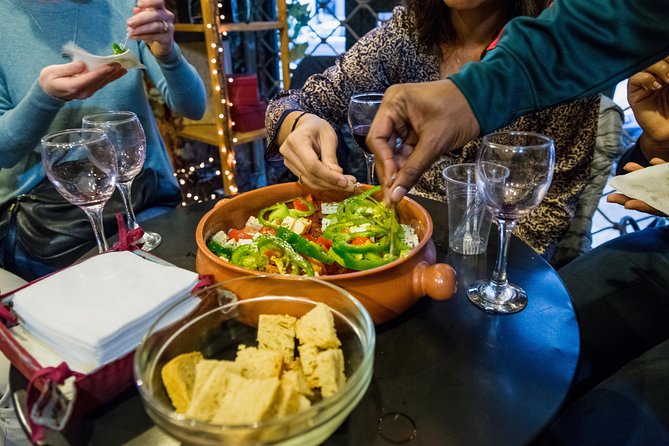


How do Greece food tours work in Athens?
Greece food tours in Athens move between markets, bakeries and tavern tables, and they sample spreads, grilled meat and custard pastries that reflect the Byzantine, Ottoman and Asia Minor cooking absorbed into the everyday menu of the Greek capital.
The Athens food tour post covers a tasting walk through the capital, with the stops, the dishes and the questions that visitors ask, so this section stays on the wider story of Greece food tours.
The vertical rotisserie behind gyros was developed in Bursa in the 19th century, and Greeks from Asia Minor carried the method west in the population exchange of 1922–23. Greece food tours trace that route.
Taramasalata is a meze of cured fish roe blended with olive oil, lemon juice and a base of bread or potato. High-quality versions are beige, while the pink colour of commercial tubs comes from dye.
Galaktoboureko pairs semolina custard with filo and syrup, and its best-known versions belong to Athens and Thessaloniki. The custard bakes inside the pastry instead of being spooned in afterwards.
- Monastiraki: Pandrossou Street and Adrianou Street are the main streets of this flea market district.
- Fast food: By 1970 gyros wraps were a popular fast food in Athens.
- Layers: A pan of galaktoboureko holds 20 sheets of filo in total.
- Lent: Greek tables serve taramasalata with onions and lemon on Clean Monday.
An Athens route works as a short history of the empires behind the city’s kitchens, and Greece food tours in the capital read each dish as a record of movement.
Why do Greece food tours include cooking in Athens?
Greece food tours add cooking in Athens because hands-on lessons show how dips, layered bakes and pies are assembled, and because the names on a Greek menu trace back through Ottoman and Byzantine cookbooks that explain where each dish came from.
The Athens cooking class post covers lessons in home cooking in the capital, with the dishes, the kitchen techniques and the practical questions, while this section follows the history of the dishes themselves.
Tzatziki gives Greece food tours a long paper trail. A 10th-century Baghdad cookbook by Ibn Sayyar al-Warraq holds a yogurt and cucumber recipe that a food historian calls the precursor of modern tzatziki.
The word cacık reached print in 1844 in the first Ottoman cookbook, by Hoca Kâmil Pasha. The Greek name tzatziki came from the Turkish word and entered English in the middle of the 20th century.
Moussaka entered English in 1862 through a translation of that Ottoman cookbook. The word comes from the Arabic for pounded or cold, and similar aubergine dishes appear in a 13th-century Arabic cookbook.
- Mamluk record: A 14th-century Egyptian cookbook holds the earliest jajaq made with strained yogurt.
- Cyprus: Cypriot talattouri adds mint and lemon juice to a similar base.
- Turkey: Turkish mussaka is fried aubergine in a tomato-based meat sauce.
- Egypt: Egyptian mesaqa’ah can be vegan, vegetarian or meat-based, and always features fried aubergine.
Cooking classes turn Greece food tours from tasting into practice, because the order of layers, the dip ratios and the choice of herbs explain each dish more clearly than a menu. The Greece cooking classes page sorts the classes from Athens to the islands.
What do Greece food tours taste in Thessaloniki?
Greece food tours in Thessaloniki taste a Macedonian cuisine shaped by Asia Minor Greek, Aromanian, Pontic Greek, Slavic, Armenian and Sephardi Jewish communities, with savoury pies, cheeses, cured meats and sweet pastries that differ from the cooking of Athens.
The Thessaloniki food tour post covers a tasting walk through the northern port city, with the markets, the pastries and the practical questions, while this section places Macedonian cooking inside Greece food tours.
Modern recipes from Kavala to Kastoria and Kozani offer lamb with quince and pork with celery or leeks, and they continue ancient dishes of lamb cooked with vegetables and goat cooked in olive oil.
Imathia gives Greece food tours gavopsara, aubergine roasted in salted water with mustard, and Kastoria gives makalo, meatballs with garlic sauce. Both appear on the list of Macedonian appetisers and main courses.
The pita for souvlaki in the north is fried on a griddle instead of being toasted on a grill. The city holds more cafes and bars per capita than any other European city.
- Cheese word: Thessaloniki residents call feta tyri, the general word for cheese in the south.
- Trahanas: A local speciality pairs the grain product trahanas with pork cracklings.
- Athos bread: Pinakoti is a bread from Mount Athos in Chalkidiki.
- Saffron: Saffron from Kozani appears on the list of Macedonian local products.
The city’s mixed past explains why Greece food tours here taste different from tours in the south of the country, because each community left a dish on the table.
How do Greece food tours explain olive oil?
Greece food tours explain olive oil through its long record in Greek soil, since evidence suggests olives were grown on Crete as long ago as 2500 BC, and through the modern groves and harvests that still supply kitchens across the whole country.
The Crete olive oil tour post covers groves, mills and tastings on the largest Greek island, with the varieties, the protected names and the practical questions, while this section places oil inside Greece food tours.
The FAO puts Greece second for olive oil use per person in 2023, at 8.8 kilograms, behind Spain and ahead of Italy. The European Union supplies nearly 60% of the world’s olive oil.
About 80% of harvested olives become oil, and the rest are cured as table olives. In Greece, steep ground sometimes forces hand harvesting, which avoids bruising and gives a better finished product.
Koroneiki olives cover 50% to 60% of the acreage in Greece. The fruit is small, but the oil yield is of high quality, and the cultivar goes by local names such as Ladolia and Psilolia.
- Amphorae: The earliest surviving oil amphorae date to 3500 BC, in Early Minoan times.
- Mycenaeans: Olive oil was a major export of Mycenaean Greece.
- Naxos: Jugs over 4,000 years old in a tomb on Naxos held remains of olive oil.
- Egypt: Egyptians imported oil from Crete, Syria and Canaan before 2000 BC.
Greece food tours that begin with olive oil set the tone for every later stop, because the same oil dresses the salad, softens the rusk and binds the pie. The Corfu food tour post covers the olive oil, kumquat and dishes of Corfu.
What do Greece food tours teach about Cretan cooking?
Greece food tours teach Cretan cooking as a seasonal tradition of local produce with little or no processing, in which dairy, poultry and fish appeared weekly, red meat was rare, and olive oil and red wine ran through every meal.
The Crete cooking class post covers lessons in Cretan food, with the farms, the cooking science and the questions cooks ask, while this section covers the traditional pattern of the Cretan table.
Cretans ate dairy products daily in low to moderate quantities. Olive oil was the main fat for salads and cooking, unlike in northern Europe, where cooks relied on animal fat.
Red wine, drunk in moderation, accompanied meals. Dessert was commonly yogurt with fresh fruit, and pastry made with honey appeared during the week, so Greece food tours treat sweets as a modest part of the diet.
Dakos is a salad built on a slice of barley rusk, soaked in water or olive oil, and topped with chopped tomatoes and crumbled feta or mizithra. TasteAtlas ranked it the best salad in the world.
- Staka: This buttery cream, mixed with flour, makes a roux and tops poached eggs.
- Pasta: Cretan pasta includes skioufichta, chilofta and triftoudia, a type of orzo.
- Pies: Sarikopita twists cheese pie into the shape of a traditional Cretan head covering.
- Snails: Cretan cooks fry snails with rosemary and vinegar, or cook them with tomato.
Greece food tours in Crete therefore read the island’s table as a largely vegetable cuisine, and lessons start with the herbs, the rusks and the oil. The Heraklion food tour post covers the market street and the Cretan dishes of Heraklion.
What do Greece food tours find in Chania?
Greece food tours in Chania find a western Cretan table of olive groves, citrus orchards, dairy and honey, with pies, pastries and local cheeses that tie the harbour town to the farms and villages of the surrounding regional unit.
The Chania food tour post covers a tasting walk in the city and the farms of western Crete, with the dishes, the church fasts and the questions that visitors ask.
Olive trees and citrus are the common crops on the land that Chania residents own, and wine, avocados, dairy and honey follow. The prefecture has run an Agricultural August event since 1999 to promote local products.
In the Chania region, salty kalitsounia are stuffed with mizithra or with Cretan herbs and no cheese, while sweet kalitsounia carry honey on top. Cooks bake the dough versions and fry the filo versions.
Anthony Bourdain filmed the making of bougatsa from hand-made filo in Chania for an episode of his television series. Greece food tours here link such scenes to the pastry shops of the old town.
- Rainfall: The Chania regional unit receives more precipitation than any other part of Crete.
- Sfakia: The far south west reaches Sfakia, home of the lamb and goat dish tsigariasto.
- Lake: Lake Kournas, the only freshwater lake on Crete, lies 47 kilometres from Chania.
- Zoumero: This chocolate cake originated in Chania and is baked with flour, eggs, vanilla and cocoa.
Chania links the harbour, the market and the farms, which suits Greece food tours that want to cover a whole food chain.
Why are Kalamata and its olives part of Greece food tours?
Greece food tours visit Kalamata because the Messenian port is a trading centre for olives, olive oil and raisins, and because its hinterland grows the large dark olive that carries the name of the city around the world.
The Kalamata food tour post covers tasting walks and grove visits around the city, with the olives, the sweets and the practical questions, while this section places the city inside Greece food tours.
The Chamber of Commerce of Kalamata is the second oldest in the Mediterranean, after Marseille. Local raisins, olives and olive oil rank among the important exports of the city.
Koroni, 56 kilometres by road from Kalamata, kept exporting silk and olive oil in the 18th century, and four French merchant houses worked there until the 1770s. The trade ran through the Gulf of Messenia.
Maniots made sea salt in the 19th and early 20th centuries, and traded it for barley, wheat, maize, cheese and dried figs. Exports from the Mani also included honey, beeswax, quails and olive oil.
- Oitylo: Early in the 19th century, olive oil was produced in large quantities north of Oitylo in the Mani.
- Maniot cooking: Its ingredients include olive oil, oranges, wild greens, lupins, broad beans and lentils.
- Pylos: Arcaded galleries around the central square of Pylos house markets, bakeries, shops and cafes.
- Gialova: This lagoon, one of 10 major lagoons in Greece, has the alternative name Vivari, from Latin for fishponds.
Kalamata shows how one crop can turn a port into a food destination, and Greece food tours here pair the city market with the groves.
Which cheeses do Greece food tours taste?
Greece food tours taste cheeses made from sheep and goat milk, from creamy whey cheeses to hard grating wheels, because the terrain favoured small flocks, and a single route can move from fresh anthotyros to aged graviera and salty kefalotyri.
On Greece food tours, graviera ranks second among Greek cheeses by popularity, after feta. Its rind carries the crisscross pattern of the draining cloth, and its name comes from the Swiss gruyère, which it resembles.
Graviera of Crete is made from sheep milk and ripened for at least five months, giving a slightly sweet, burnt caramel flavour. Naxos graviera is made largely from cow milk, between 80% and 100%.
Ladotyri Mytilinis is a hard cheese from Lesbos, preserved in olive oil, and the name means oil cheese. The pressed wheels ripen for not less than three months, and it has held protected status since 1996.
Kefalograviera is a hard table cheese of sheep milk or mixed sheep and goat milk, made in Western Macedonia, Epirus, Aetolia-Acarnania and Evrytania. It has a salty flavour and a rich aroma.
- Saganaki: The name belongs to the small two-handled frying pan, not to a single cheese.
- Anthotyros: This flowery cheese is made with milk and whey in a ratio of about 9 to 1.
- Kefalotyri: Young wheels need two to three months to ripen, while a year-old wheel is drier and stronger.
- Protected names: Graviera Kritis, Graviera Agrafon and Graviera Naxou are registered in the EU and the UK.
Greece food tours serve these cheeses from fresh and sweet to hard and salty, so each one sets up the next.
What street food and bakery stops do Greece food tours include?
Greece food tours include street food and bakery stops where skewers, pies, rusks and flatbreads show the oldest everyday cooking in the country, from spit-roasted meat that dates to the Bronze Age to cheese pies baked in the oven.
Excavations on Santorini unearthed stone cooking supports with paired indentations for skewers, used before the Thera eruption of the 17th century BC. Mycenaean sites at Gla, Mycenae and Pylos yielded rectangular ceramic trays.
Homer mentions meat roasted on spits in the Iliad. Gustave Flaubert saw Greeks grilling meat on a bamboo stick in Boeotia in 1850, and modern souvlaki spread from there after the Second World War.
Greece food tours meet souvlaki skewers, which became a fast food in the 1960s after vendors from Boeotia introduced them. A full plate of souvlaki with potatoes and pita is called merida, meaning portion.
Paximathia are hard rusks of whole wheat, chickpea or barley flour. Farmers baked the bread in outdoor ovens every ten to fifteen days, then sliced it thickly and dried it again to preserve it.
- Piroski: These fried pies hold feta, kasseri, minced meat or mashed potato, and specialist shops still sell them.
- Corfu: Souvlaki on Corfu comes with a tomato sauce called plainly red sauce.
- Kokoretsi: Lamb or goat intestines wrapped around seasoned offal appear first in Byzantine cooking.
- Soaking: Farmers softened paximathia in water and olive oil and ate them with homemade cheese.
Street food and bakery stops give Greece food tours a quick lesson in cooking methods, because fire, flour and cheese lie behind the dishes at each counter.
How do Greece food tours explain Greek wine as a whole?
Greece food tours explain Greek wine through native grapes, each tied to a region and a story. Malagousia, Rhoditis, Negoska, Lagorthi, Debina, Vertzami and Mavrodafni show how soil, altitude and rescue work shaped the national list of wines.
Malagousia was virtually extinct until Vassilis Logothetis, a professor of oenology, rediscovered it in Nafpaktia. He gave it to a student, Vangelis Gerovassiliou, in the 1970s. The grape is highly aromatic and makes soft, elegant white wine.
Rhoditis is a pink-skinned grape of the Peloponnese. Before phylloxera struck, growers valued it because it ripens late and keeps its acidity in hot climates. In Patras, it is the principal grape behind the delicately perfumed wines named after the city.
Negoska comes from Northern Greece and gives pink and red wines by carbonic maceration. It is blended into the PDO Goumenissa wine. Vertzami is a thick, dark-skinned grape, best known for single-grape wines from the island of Lefkada.
Lagorthi grows on high Peloponnese slopes at 850 metres and gives a fruity wine with a malic edge. Debina grows mainly around Zitsa in Epirus, where its high acidity suits sparkling wine. Greece food tours pour both styles.
- Name: Mavrodafni means black laurel, a name Gustav Clauss chose for berries that resemble laurel fruit.
- First wine: The sweet fortified style of Mavrodafni was first produced around 1850.
- Method: Makers stop fermentation by adding a distillate prepared from earlier vintages.
- Aromas: The dark, almost opaque wine shows caramel, chocolate, coffee, raisins and plums.
Greece food tours treat these grapes as a map of the country. A single tasting can cross Northern Greece, Epirus, the Peloponnese and Lefkada without leaving the table. The Kefalonia wine tour post covers Robola and the vineyards of Kefalonia.
What do Greece food tours taste in Santorini wine?
Greece food tours taste Santorini wine as a volcanic, windswept style built on Assyrtiko and low-trained vines. The island gets little rain, its white wines carry iodide and salt aromas, and its sweet wines once reached the altar of a church.
Santorini has a Mediterranean climate with warm temperatures, low rainfall and high humidity during the growing season. Strong winds off the sea can damage vines and grapes, so growers train them low to the ground for protection.
White wines from the island are extremely dry, with a strong citrus scent and mineral and iodide salt aromas that come from the ashy volcanic soil. Barrel ageing gives certain white wines a slight frankincense aroma, much like Vinsanto.
In the early nineteenth century the island made a red called Santorin, or Vino di Baccho, a dry claret with an approach to port. Its white Nykteri, the night wine, came in two kinds, Kalliste and Elia. Greece food tours recall both names.
The Russian Orthodox Church adopted Santorini wine as its official Eucharistic wine. Because of that, the Ottomans let island producers trade freely with Russia, even during the frequent wars between the two empires.
- Assyrtiko: This grape is similar in character to Riesling and is mostly island-based.
- Athiri: This lower-acid grape is among the oldest, and it began on Santorini.
- Mavrotragano: This red survived for centuries in harsh land and almost became extinct.
- Yield: Output per hectare is only 10 to 20 percent of common French or Californian yields.
The Santorini wine tour post covers wine visits on the island. Greece food tours add this volcanic style to the wider map of Greek wine.
What do Greece food tours show in the wine valley of Nemea?
Greece food tours show Nemea as a wine valley beside an ancient sanctuary. The basin has limestone soil that suits vines, and its red grape, Agiorgitiko, comes wrapped in legends of kings and monks, with a ruined temple close by.
The soil of the valley holds weathered limestone, and both basins empty through their own valley into the Gulf of Corinth. Agriculture is the primary industry of Nemea town, which serves as the hub for the small villages around it.
One legend says Agamemnon, who led the Greek forces in the Trojan War, favoured Nemean wine at his palace. Another tale credits the monks of a Saint George monastery at Feneos, who tended the vineyards and made communion wine.
The name Agiorgitiko means St George’s grape. It can refer to the chapel of Saint George in Nemea or to Saint George’s Day, which certain Orthodox churches keep in November, around harvest time. Greece food tours cite both ideas.
Another theory names one of the Greek towns that carry the name of the saint. The vine responds badly to water stress, so irrigation can be needed where the practice is permitted. In Nemea, it is the only variety allowed in the appellation.
- Site: Nemea lay on neutral ground between Archaia, Arcadia, Argolis and Corinth.
- Museum: An on-site museum holds finds from the University of California excavations.
- Stadium: The original stadium stood near the temple, and a new one rose farther away in 330 BC.
- Damage: Farming and the robbing of building materials left only the foundations of the oikoi.
The Nemea wine tour post covers the valley and its cellars. Greece food tours use that same valley to explain the red wines of the Peloponnese.
How do Greece food tours present Cretan wine?
Greece food tours present Cretan wine as a story of limestone soil, sea breezes and native grapes. Kotsifali, Liatiko, Mandilaria, Vidiano and Romeiko carry the character of the island, from sweet red wines to peach-scented white wines.
Cretan terroir rests on calcisol soils in the mountain ranges. Summers are hot and sunny, and winters are mild and rainy. Wines from Crete are not listed among those specially prized in classical Greece.
Kotsifali is a red grape grown mainly in the Heraklion regional unit. Blended with Mandilaria, it gives a ruby-coloured dry wine that needs minimal ageing. Mandilaria, also called amorgiano, grows on Rhodes and Crete and is tannic.
Liatiko is an old red grape, pale in colour, moderate in acidity and rich in aromas and sugars. It matures in July, and one explanation links its name to a word meaning of July. Greece food tours taste it in sweet styles.
Romeiko is a red grape found on Crete, particularly in the Chania region. Vidiano is a white grape native to Crete, and it is genetically close to Thrapsathiri and Vilana.
- Aromas: Vidiano shows complex notes of peach, apricot, melon, honey and herbs.
- Difficulty: The grape is hard to cultivate and grows on a small scale around Rethymno and Heraklion.
- Soil: It thrives in dry, calcareous, well-drained soil of modest fertility.
- Ripening: The berries ripen early and have thick skin.
The Crete wine tour post and the Chania wine tour post cover cellar visits on the island. Greece food tours link both to the grapes above.
What do Greece food tours reveal about Mykonos wine and farms?
Greece food tours reveal Mykonos wine and farms through the wider Aegean, where island wine began early. Lemnos, another Aegean island, shows how Limnio and Muscat of Alexandria define local vineyards, and its tastings frame the Mykonos route.
In Greek myth, Euneus, a king of Lemnos, sent wine and provisions to the Achaeans at Troy. His mother was Hypsipyle, and his father was Jason. Greece food tours tell this tale before the first glass.
Muscat of Alexandria is grown very heavily on Lemnos, and it is said that Cleopatra drank muscat wine from there. The grape thrives in hot climates and is sensitive to cold during its flowering season.
Limnio is a red grape native to Lemnos. Wine historians widely believe it was the Lemnia that Aristotle described as producing the famous red Lemnian wine. Hesiod and Polydeuctes also mention a Limnia grape.
On Lemnos, the only appellation wine comes from Muscat of Alexandria. The island union of cooperatives recorded 2,449 tonnes of that grape against 86 tonnes of Limnio. Muscat of Alexandria ranks among the oldest vines still in existence.
- Hardiness: Limnio vines survive harsh droughts.
- Ripening: The grapes ripen late, so an early harvest avoids herbaceous tones.
- Style: The wine is full bodied, with moderate tannins and acidity and a mineral aroma.
- Pairing: Limnio wines go with aged cheeses, game meat and roasted dishes.
The Mykonos wine tour post covers wine on the island itself. Greece food tours set that visit beside the wider Aegean vineyard story.
How do Greece food tours treat Santorini food?
Greece food tours treat Santorini food as produce shaped by volcanic ash, dew and little rain. The island tomato, the oven omelette called sfougato and a sweet cheese pastry all grew from dry soil, scarce water and old farming habits.
The Santorini tomato is a small cherry variety with deep red colour and firm flesh with a high seed content. A fruit weighs 15 to 27 grams, and the plant ripens its crop in 80 to 90 days.
The island receives less than 370 millimetres of rain a year, so crops rely on dew and humidity of 71 percent. The soil holds no natural nitrogen, and growers rarely add fertiliser.
The soil contains sodium, which is hygroscopic and absorbs moisture from the air. Water stress and limey, alkaline soil largely account for the selective breeding that produced this tomato. Greece food tours taste it fresh.
Tradition holds that an abbot of the Capuchin monastery in Ano Syros brought the first cherry tomatoes to Greece in 1818. Regular cultivation began in 1875, and by the 1900s growers harvested 20,000 acres.
- Taste: The fruit is sweet and strongly acidic, with a high carbohydrate content.
- Shape: It is round and slightly flattened, and the lowest fruits show pronounced flutes.
- Sfougato: This baked omelette of eggs, courgette, scallions, dill and cheese is served as breakfast on Santorini.
- Melitinia: This Santorini dessert uses sweet cheese, sugar, eggs and a hint of mastic.
The Santorini food tour post covers tastings on the island, and the Santorini cooking class post covers lessons in the kitchen. Greece food tours join both through the tomato.
What Mykonos dishes do Greece food tours taste?
Greece food tours taste Mykonos food through kopanisti, a salty, spicy cheese with protected designation of origin. Cooks beat the cheese by hand, let microbes ripen it and serve it as a meze. The island has made it for more than 300 years.
In Turkey a similar cheese is called kopanisti peyniri, or bitter cheese. It is made in the Cesme and Karaburun districts of Izmir Province, normally from goat milk. Greece food tours taste the Greek version on bread.
Cooks heat the milk to 28 to 30 degrees Celsius with yeast until it thickens, which takes 20 to 24 hours. Red chilli peppers and salt then go in, and the maker works the mixture by hand once every hour for the first day.
The mass is wrapped in cotton cloth and placed in a pot with a stone on top, which squeezes out extra liquid. It stays in the cloth for a week while the fungus grows.
Makers use a portion of earlier batches as inoculum for new batches, so the microbial culture passes from batch to batch. The cheese is also made on Tinos, Andros, Syros and Naxos.
- Milk: The cheese uses cow, sheep or goat milk, or a mixture of the three.
- Containers: The cheese finishes its ageing in containers that are traditionally earthenware.
- Ageing: Ageing can take between one and two months.
- Meze: Mykoniotes also use the cheese as a meze to accompany ouzo.
The Mykonos food tour post covers tastings on the island, and the Mykonos cooking class post covers lessons in the kitchen. Greece food tours connect both to kopanisti.
Which Naxos produce do Greece food tours feature?
Greece food tours feature Naxos produce shaped by an old farming record, a citron liqueur called kitron and a graviera cheese with protected status. The island has been praised for its agriculture and animal husbandry since early antiquity.
Naxos was celebrated in antiquity and in Byzantine times for agriculture and animal husbandry. The 12th-century geographer al-Idrisi recorded extensive cattle raising on the island. Greece food tours begin with that record. In Greek myth, Dionysus, god of wine, protected the island.
Kitron has a citrusy aroma and flavour, and it is traditionally drunk as a digestif. It comes in three colours: green, yellow and colourless. Greece food tours serve the glass at the end of a meal.
The first kitron distillery opened in 1896 in the village of Halki. The drink was briefly fashionable in the early 1980s, and a shortage of citron trees keeps it hard to find outside Naxos.
Citron trees still grow on Corfu and Naxos. On Naxos the fruit is distilled into kitron, while growers on Crete sell citron for the candied peel called succade.
- Graviera: The Naxos version is mostly cow’s milk, from 80 to 100 percent.
- Protection: Graviera Naxou is registered as a protected designation of origin product.
- Honey: Naxos honey comes largely from the nectar of thyme.
- Potatoes: Naxos is well known within Greece for its potatoes.
The Naxos cooking class post covers lessons with island produce. Greece food tours use that produce to explain why Naxos feeds itself.
How do Greece food tours explain ouzo, tsipouro and raki?
Greece food tours explain ouzo, tsipouro and raki as three grape-spirit traditions. Ouzo is anise-flavoured, tsipouro is a pomace brandy from the mainland, and raki is the eastern Cretan name for tsikoudia, a spirit made from grape pomace.
Distillers remove the spirit at the beginning and end of the run, called heads and tails, to avoid light and heavy alcohols and aromatics. They mix the heads and tails and distil them again to make a different quality of ouzo.
The origin of the name is disputed. One story links it to silkworm cocoons exported from Tyrnavos to Marseille and stamped uso Marsiglia, meaning for use in Marseille. The major Greek dictionaries instead derive it from the Turkish word for grape.
Ouzo turns milky white when water or ice is added. Anethole, the essential oil of anise, dissolves in alcohol at about 38% and above but not in water, so dilution forms an emulsion. This is called louching.
Tsikoudia is a Cretan pomace brandy of 40% to 65% alcohol by volume, and its name literally means terebinth. The pomace ferments for about six weeks in a sealed barrel before distilling. In eastern Crete it is informally called raki, from the Arabic arak, meaning distilled.
- Ouzeries: These cafe-like places serve ouzo with meze, sipped slowly in the early evening.
- Village stills: Each Cretan village has one or two residents licensed to distill.
- Family: Tsikoudia belongs to a group with grappa, orujo and chacha.
- Tsipouro: An aged version is a newer drink that can be compared to whisky.
Greece food tours treat these three drinks as one family with different recipes. Each tasting starts with the grape pomace or the rectified spirit that sets the style.
Which honey, sweets and coffee do Greece food tours include?
Greece food tours include honey sweets, spoon preserves and coffee in a range of forms, from galaktoboureko to melomakarona and the frappe. Each item carries a name that records Byzantine, Ottoman or modern history, and each is tasted slowly.
Galaktoboureko is a Greek dessert of semolina custard baked between layers of filo and covered in syrup. A pan version has 20 layers in total. Athens and Thessaloniki both have notable versions.
Melomakarono is an egg-shaped Christmas sweet made from flour, olive oil and honey. It is also called finikia. The name joins meli, meaning honey, with makaria, an old bread eaten during funerals.
The Greek spoon sweet called vanillia contains no vanilla. It is a thick white paste of mastic resin beaten with table sugar, served on a spoon dropped into ice-cold water. It is regarded as the official sweet of the Patriarchate of Constantinople.
The word frappe is French and means punched or shaken. Frappes first became broadly known outside Greece during the 2004 Summer Olympics in Athens, when tourists grew fond of them and the Los Angeles Times published an article. Greece food tours order one at the table.
- Greek coffee: Political tension with Turkey in the 1950s turned the name Turkish into Greek coffee.
- Mastiha: Chios Mastiha liqueur is clear with a sweet aroma and is traditionally served cold.
- Fire: Wildfires in August 2012 scorched 12,740 hectares on Chios and destroyed more than half of the mastic orchards.
- Freddo: The freddo espresso was first made in Athens in 1991.
Greece food tours finish on these sweet and bitter notes. The mastic, honey and coffee tastings close a route that began with the grapes. The Rhodes food tour post covers the honey, sweets, meze and wine of Rhodes.
What do travellers ask about Greece food tours?
Greece food tours bring together wine, spirits, sweets, coffee and island produce. Travellers ask about drinks, desserts, coffee orders and island products, and the answers below draw on Greek wine, spirit and food traditions across the whole country.
How do Greece food tours treat tsipouro?
Greece food tours treat tsipouro as a drink for company. Depending on the season, it serves as a refreshment or as a hot beverage, and depending on the time of day it replaces coffee or wine. Like all alcoholic drinks in Greece, it is consumed at social gatherings.
How do Greece food tours treat halva?
Halva is served as a dessert and at paniyiria, the village festivals. It is made of sesame or semolina throughout Greece, while the Thessaly town of Farsala makes a regional version from cornflour. Greece food tours taste the sesame form beside coffee.
How do Greece food tours order a frappe?
Orders state sweetness and milk. For two spoonfuls of coffee, glykos means four spoonfuls of sugar, metrios means two and sketos means none. Milk is added only when requested with me gala. Spoon-stirred versions are called koutalatos or karavisios, a word linked to sailors.
Which island foods do Greece food tours link with Lemnos?
Lemnos is famous for Kalathaki Limnou, a PDO cheese of sheep and goat milk, and for Melichloro cheese and yogurt. Its main crops are wheat, barley and sesame, and it also produces honey from thyme-fed bees. Greece food tours connect these products to its Limnio wine.