
A Corfu food tour is a tasting walk or drive through the dishes of Corfu, an island whose kitchen mixes Greek and Venetian roots with kumquat, olive oil and local cheeses. The tour is one of the Greece Tours on Greece Ville, listed with the other Ionian Islands tours and Greece food tours.
This post covers the dishes, produce and drinks that a Corfu food tour tastes, then the formats on sale. Common questions come last.
What is a Corfu food tour?
A Corfu food tour is a walk through Corfu Town, and sometimes a short drive across the island, that stops to taste local dishes, sweets, cheeses, oil and wine while a local explains which recipes came from Venice and which grew on the island.
A Corfu food tour follows the cooking of one island in the Ionian Sea. Corfu is mostly planted with olive groves and vineyards, and the island has produced olive oil and wine since antiquity.
Venetian rule left the clearest mark on the plate. Corfiot cooking today includes Venetian delicacies and recipes, and the names of dishes come straight from the Venetian language of the old republic.
Pastitsada is the best known of them. It is a traditional Sunday dinner on Corfu, and a Corfu food tour treats it as the anchor of the table before the lighter plates and the sweets follow.
The tastings sit inside the streets where the recipes grew up. A Corfu food tour therefore doubles as a short history of the Old Town, told through meals, preserves, drinks and the farms behind them.
- Pasta: Bucatini carries the diced veal of pastitsada on Corfu.
- Fish: Bourdeto is a fish dish from Corfu, cooked with onion and red sweet and hot pepper.
- Eggs: Strapatsada joins fresh tomatoes, eggs and olive oil, and the Ionian Islands cook it because the ingredients are cheap.
- Sweets: Mandoles are caramelised almonds, one of the local sweets.
The sections below follow the order of the stops: the food streets, the Venetian recipes, the kumquat, the ginger beer, the oil, the wine, the formats on sale and the questions travellers ask.



Which food streets and markets does a Corfu food tour cover in Corfu Town?
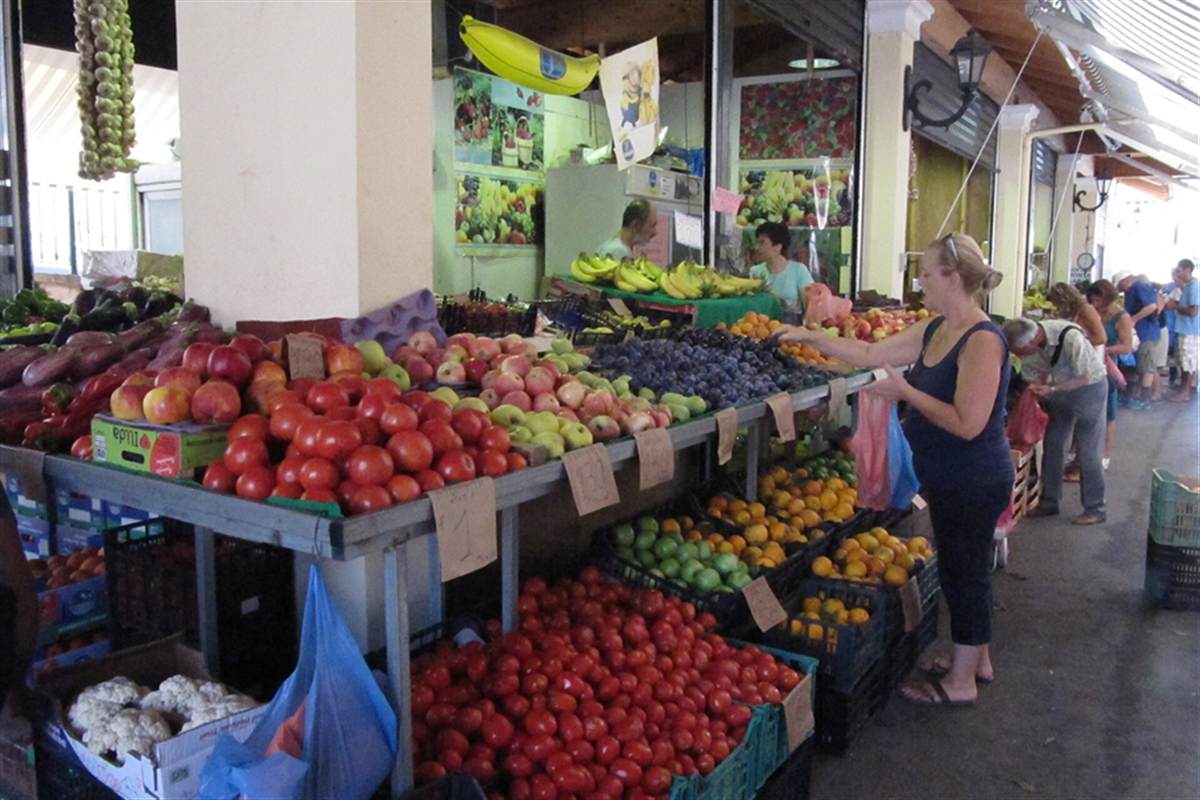
A Corfu food tour in Corfu Town works through the old streets around the Liston and the Spianada, where cafes, shops and stalls sell local cheese, butter and cured meat, and each stop links one product to the farms of the island.
The Liston is a building with an arched colonnade at ground level. Cafes and restaurants line its east side, and restaurants and stores line its west side, so a Corfu food tour starts there.
The Liston stands on the edge of the Spianada, the vast main plaza and park. A street divides the Spianada into the Ano Plateia, meaning upper square, and the Kato Plateia, meaning lower square.
Cheese is the first product on the tasting plan. Corfiote graviera is a variant of gruyere, and the island also makes a Corfu cheese that is a variant of Grana, the hard Italian cheese.
Butter and cured meat follow. Corfu butter is an intensely flavoured cooking and baking butter made of ewe’s milk. Noumboulo is a salami made of pork and lard, flavoured with orange peel, oregano and thyme.
- Smoke: Aromatic herbs are burned to smoke the noumboulo salami.
- Pavilion: An ornate music pavilion stands on the Spianada, where the local Philharmonic orchestras mount performances.
- Palaces: The Old Palaces, north of the Kato Plateia, once housed the Kings of Greece and the British governors.
- Style: The Old Palaces are a large complex of buildings in Roman architectural style.
The Corfu tour post covers the island by road and the sights beyond the town. A Corfu food tour keeps to the food streets and their tastings.
Which Venetian dishes does a Corfu food tour serve?
A Corfu food tour serves dishes that arrived with Venice and stayed in the island kitchen, among them pastitsada, sofrito, bourdeto and strapatsada, and each name carries a Venetian or Italian word that shows where the recipe began.
The name pastitsada comes from the Venetian pastizzada, which means something messed up. In Italy the word covers a large variety of braised meat dishes, served with polenta, mashed potatoes or pasta.
The Corfu version uses veal, beef or poultry cooked with tomato, olive oil, onion, garlic, white wine, vinegar, cloves, bay leaf and cinnamon. Cooks serve it over pasta, topped with grated kefalotyri or Parmesan.
Sofrito is a veal rump roast of Venetian origin. A Corfu food tour sets it beside pastitsada, because both are meat dishes that Corfiot cooks took from Venetian recipes.
Two more names show the link. Bourdeto comes from the Venetian word brodetto, which means broth. Strapatsada takes its name from the Italian strapazzare, which describes breaking an egg and mixing it while cooking.
- Fish: Scorpion fish is the best fish for bourdeto, though a larger fish fillet also appears in the dish.
- West: Patras and Western Greece call the same dish bourgeto or bourjeto.
- Method: Cooks fry tomatoes in olive oil with pepper until a thick sauce forms, then add the beaten eggs for strapatsada.
- Season: Strapatsada is especially popular in the summer, when fresh tomatoes abound.
The Greek food to try post covers dishes from across the country beyond Corfu. A Corfu food tour stays with the Venetian recipes of the island.
Where does the kumquat fit into a Corfu food tour?
A Corfu food tour meets the kumquat as a small citrus fruit that growers on Corfu turn into spoon sweets and liqueurs, so the fruit reaches the tasting table both as a preserve in a spoon and as a drink in a glass.
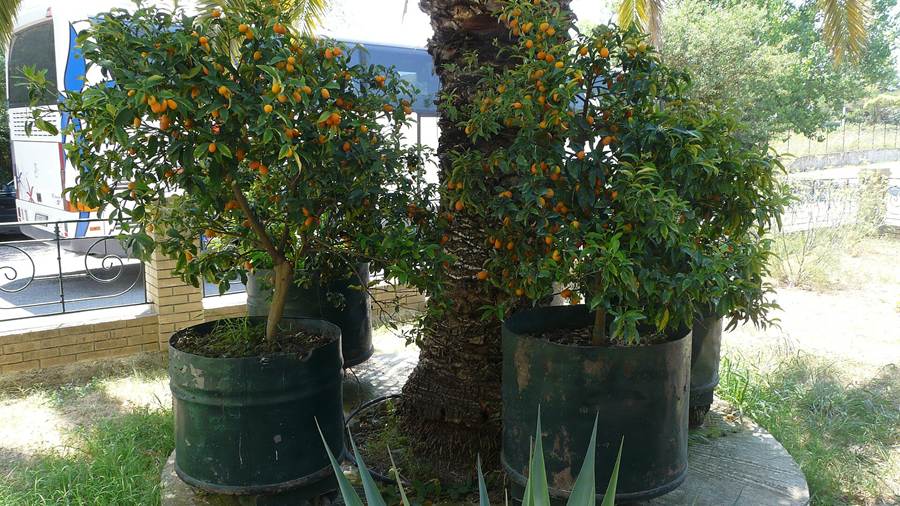
Modern times brought specialist cultivation to Corfu, supported by the mild climate. The kumquat and the bergamot orange are the two crops, and both go extensively into spoon sweets and liqueurs.
Kumquat plants carry extremely glossy leaves and white flowers that grow in clusters or singly. The fruit is yellowish-orange, oval or round, and close to the size of a large olive.
The fruit tastes sweet and somewhat sour. It has a sweet, pulpy skin and a slightly acidic inner pulp, and people eat it whole, which suits a quick tasting stop.
Spoon sweets suit the fruit well. A well-made spoon sweet keeps the shape, colour, aroma and taste of the fruit, and cooks boil the fruit slowly in water and sugar until the syrup sets.
- Size: The fruits measure between 2.5 and 5 centimetres across.
- Tree: The plants reach a height of 2.5 to 4.5 metres, with dense branches.
- Flowers: Kumquat trees pollinate themselves.
- Cousin: Calamansi is a cross between the mandarin orange and the kumquat.
The kumquat gives a Corfu food tour a local citrus flavour in the preserve and in the glass. The next section turns to the other drink of the island, which links the table to British rule.
What is the ginger beer on a Corfu food tour?
A Corfu food tour includes tzitzibira, the local ginger beer, which the island keeps as a remnant of the British era, and the drink links a soft drink of Yorkshire origin to the years when the British ruled Corfu.
Tzitzibira is the ginger beer of Corfu, a remnant of the British era. British rule of the island ran from 1815 to 1863, and the drink outlasted it.
Ginger beer began as a brewed drink. Brewed ginger beer originated in Yorkshire in England in the mid-18th century, and it appeared in Canada and the United States around 1790.
Early ginger beers held alcohol, at about 11 per cent, until the mid-19th century. In 1855 English law limited the strength to 2 per cent, and the drink moved toward the soft drink of today.
Home brewers made it with a ginger beer plant, a mixed colony of yeast and bacteria. Harry Marshall Ward described that plant in 1892, from samples that he received in 1887.
- Breweries: Corfu has three breweries.
- Taste: Ginger beer is more strongly flavoured with ginger and less sweet than ginger ale.
- Starter: A ginger bug starter comes from fermenting ginger, sugar and water.
- Shandy: Mixed with a British ale, ginger beer makes one type of shandy.
The Ionian Islands tours post covers the wider island group and its other tastes. A Corfu food tour keeps to the local bottle and the story behind it, from the north of England to the Ionian Sea.
How does a Corfu food tour show olive oil?
A Corfu food tour shows olive oil through the grove and the mill, where olives become paste, the paste is stirred and pressed, and the oil is separated from the water, so each tasting links a step in the mill to the finished oil.
Homer names six plants in the garden of Alcinous: wild olive, pear, pomegranate, apple, fig and grape vine. On Corfu the apple and the pear are very inferior, while the others thrive.
Olive oil starts as a paste. Mills grind the olives, traditionally with large millstones and now with hammer, blade or disk mills, and the grinding step shapes the taste of the oil.
After grinding, the paste is stirred in a container in a step called malaxation. The microscopic oil drops gather into larger drops there, and that makes mechanical extraction easier.
Pressing follows. The paste is spread on fibre disks stacked in a column, and the press squeezes out oil and water. Centrifuges now separate them, with one exit for each.
- Virgin: Oil produced by mechanical means only is called virgin oil.
- Weather: A drought during flowering can leave an extra virgin oil at the lower virgin grade.
- Cycle: Olive trees produce well every couple of years, so the larger harvests come in alternate years.
- Water: Olive oil holds no significant traces of vegetal water when well made, because water speeds up organic degeneration.
The Greece food tours post covers tastings across the whole country, oil included. A Corfu food tour ties the Corfu mill to the tasting spoon.
Which wines does a Corfu food tour pour?
A Corfu food tour pours wines from grapes that grow on the island and nearby, among them the indigenous white Kakotrygis, the red Petrokoritho, the white muscat and Mavrodaphne, which together show how Corfu has made wine since antiquity.
The main wine grapes on Corfu are the indigenous white Kakotrygis and the red Petrokoritho. The list also holds the Cefalonian white Robola, the Aegean white muscat and the Achaean Mavrodaphne.
Mavrodaphne grows in the Peloponnese and the Ionian Islands. Winemakers blend it with the Black Corinth currant grape to make a fortified dessert wine, and the wine has a dark, almost opaque colour.
Fermentation of the fortified style stops when distillate prepared from earlier vintages goes into the wine, which still holds residual sugar. That leaves the sweetness that a Corfu food tour pairs with dessert.
Tasting notes for Mavrodaphne list caramel, chocolate, coffee, raisins and plums. The first production of this style by Gustav Clauss dates to around 1850, and the wine carries a Port-like richness.
- White: Kakotrygis is a white grape that is indigenous to Corfu.
- Red: Petrokoritho is a red grape that is indigenous to Corfu.
- Neighbour: Robola comes from Cefalonia, the next large island to the south, and it is a white wine grape.
- Dry: Modern production also includes dry red wines made from Mavrodaphne.
The wine stop closes the tastings of a Corfu food tour, and the next section lists the formats on sale, from short town walks to longer days that cross the island.
Which formats of Corfu food tour are on sale?
A Corfu food tour is on sale as walking tours of Corfu Town with tastings, a food walk that ends in a full meal, shared and private departures, product tastings, a wine tasting in the Old Town and shore excursions that add island sights.
The core format is a walking tour of Corfu Town with local food tastings. Titles describe it as a gastronomy walk, an Old Town food and culture walk and a culinary and cultural tour.
Variants change the meal. One walking food tour includes a full meal, another is a bites-and-tastings walk, and a third lets travellers choose between a shared group and a private departure.
Other titles centre on products and drink. A local products tasting tour and a boutique wine tasting in the Old Town sit beside an eat-and-drink walking tour led by a local.
Further titles pair the food walk with the island. A cruise-port tour visits the Old Town, and half-day and day trips add Paleokastritsa and Kassiopi to a Corfu food tour.
- Walking: Small-group walks through the Old Town combine food and culture.
- Meal: One food walk ends with a full meal.
- Tasting: A wine tasting in the Old Town and a local products tasting cover the drink and the shelf.
- Shore: A bus shore excursion pairs Paleokastritsa beach with the Old Town.
The tour cards and availability boxes on the page list live dates for each Corfu food tour format, so dates, group sizes and departures sit there and not in this text.
What do travellers ask about Corfu food tour?
A Corfu food tour raises questions about dishes, drinks and local products, and the answers below cover the savoury plates, the drinks, the Venetian names and the sweets that appear on the tasting plan across Corfu Town and the wider island.
What dishes does a Corfu food tour taste first?
A Corfu food tour starts the savoury tastings with pastitsada, bucatini pasta served with diced veal cooked in a tomato sauce. Bourdeto, a fish dish, and sofrito, a veal rump roast, follow, and strapatsada adds a light plate of tomatoes and eggs, which cooks make quickly in a pan with olive oil.
Which drinks does a Corfu food tour include?
A Corfu food tour includes tzitzibira, the local ginger beer, and liqueurs made from the kumquat and the bergamot orange. The wine list adds the white Kakotrygis, the red Petrokoritho and the sweet Mavrodaphne, a fortified dessert wine from nearby growing areas.
Why does a Corfu food tour use Venetian names?
A Corfu food tour uses Venetian names because Venetian-speaking families settled on Corfu, and the Corfiot Italians spoke Veneto da mar until the second half of the 20th century. The local Greek language also took in a large number of Italian and Venetian words.
What sweets does a Corfu food tour taste?
A Corfu food tour tastes mandoles, which are caramelised almonds, and mandolato, a pasteli of crushed almonds, sugar, honey and vanilla. Spoon sweets made from the kumquat complete the sweet side, served by the spoon as a preserve, and hosts offer them with coffee or tea and cold water.
Featured photo: Poiesia, CC BY-SA 4.0, via Wikimedia Commons.