
A Heraklion food tour is a tasting walk through the centre of Heraklion, the capital of Crete, from the market street to Lions Square, with Cretan cheeses, olive oil, pies and raki. The tour is one of the Greece Tours on Greece Ville, listed with the other Crete tours and Greece food tours.
This post covers the market, the squares, the dishes and the drinks a Heraklion food tour tastes, then the formats on sale. Common questions come last.
Each section ends with tours that can be booked online. The linked Greece Ville posts cover the Heraklion city tour, the Knossos palace and the cooking classes of Crete in depth, with the departure points, the meeting places and the formats on sale. A food tour in Heraklion fits into a free morning or evening in the city, and the same streets lead on to the old harbour, the Venetian walls and the Heraklion Archaeological Museum.
What is a Heraklion food tour?
A Heraklion food tour is a tasting walk through the capital of Crete that follows the traditional Cretan diet, with plant-based dishes, local cheeses, pastry and village spirits tied to the island’s seasons and to the city’s own history.
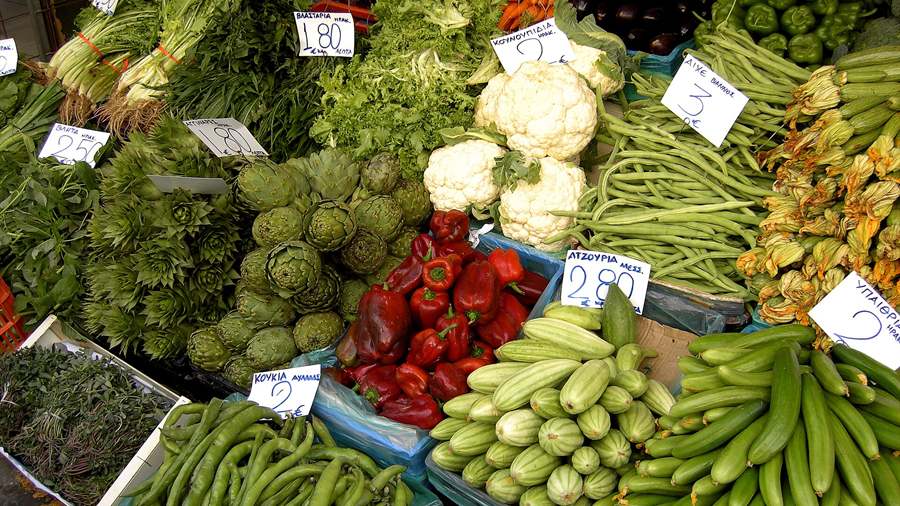
The core of Cretan cooking comes from plants, while food of animal origin played a smaller part. People ate seasonal products from the wider local area, and those products went through little processing or none.
Wine was drunk in moderation, mainly red wine with meals, and yogurt with fresh fruit made the everyday dessert. A Heraklion food tour keeps that restraint, with small tastes at each stop.
Heraklion airport carries the name of the writer Nikos Kazantzakis and handled 8,066,000 passengers in 2022, so a Heraklion food tour serves visitors arriving through a major holiday gateway.
The Crete tours post covers the wider island beyond the capital, including the other cities of Crete and the routes that start from Heraklion. A Heraklion food tour is one stop among them.
- Pikti: This pork charcuterie, also called tsiladia, belongs to the traditional Cretan starters of the island.
- Apaki: Smoked pork or chicken meat is another traditional starter in the Cretan kitchen.
- Askordoulakoi: These starters are pickled bulbs of the tassel hyacinth, a plant of the island.
- Stafidota: These cookies carry a stuffing based on raisins and sit among the starters.
These plates show that a Heraklion food tour is built on preserved and plant-based food rather than on large meat courses, which fits the older Cretan pattern of eating.



How does the 1866 revolt shape a Heraklion food tour?
A Heraklion food tour passes through a walled city that stayed in Ottoman hands during the Cretan revolt of 1866 to 1869, while the rebels initially gained control of the hinterland, the villages and farmland beyond the city walls.
At the start of the revolt, four fortified towns on the north coast stayed under Ottoman control: Chania, Rethymno, Irakleio and Agios Nikolaos. Irakleio is the Greek name of Heraklion.
The southern town of Ierapetra also stayed in Ottoman hands. Walled coast and rebel hinterland were thus divided, and a Heraklion food tour stands on the walled side of that old divide.
On 12 October 1856 an earthquake off the north coast of Crete flattened the greater part of the city’s 3,600 or more homes. Only 18 homes stood intact, and 538 people died in Heraklion.
German bombing in the fifth month of 1941, during the invasion of Crete, damaged Heraklion severely, and the city stayed under German rule until 1945. Occupation forces held the harbour city for the rest of the war.
- 1841: An unsuccessful uprising that year backed union with independent Greece, long before the revolt of 1866.
- Rule: The Ottomans had ruled Crete for more than 220 years when the revolt began.
- Ottoman name: The Ottoman name for the city was Kandiye, from the older Candia.
- Tourism: Crete became a major tourist destination from the 1980s onwards.
These dates place the old streets in a recent past, and a Heraklion food tour moves through a city hit by the earthquake and again by the war.
What is bougatsa on a Heraklion food tour?
A Heraklion food tour serves bougatsa as a hot traditional phyllo pie cut into small pieces, filled with sweet semolina custard or with cheese, and eaten as a breakfast food, a mid-morning snack or a midday snack.
Bougatsa layers about five sheets of buttered phyllo in a baking dish around its filling. Cooks cut the baked pie while it is still hot and serve it in small portions.
Machine-made phyllo covers modern production, but cafes and bakeries in smaller towns and villages still sell hand-made bougatsa. That contrast can be tasted on a Heraklion food tour.
The savoury fillings include feta, mizithra and spinach, alone or mixed with feta. A potato purée filling is also made, so the name covers very different pies from one shop to the next.
Banitsa, a similar pie, comes from Bulgaria, and tyropita is a pie made with cheese. Bougatsa therefore belongs to a family of filled pastries, which a Heraklion food tour samples in its local form.
- Chocolate: A chocolate cream filling gives a sweet version of the pie.
- Apple: Apple is another filling in the sweet range of bougatsa.
- Meat: Minced meat in the pie is a mix of beef and pork or of beef and lamb.
- Potato: A potato purée filling suits the savoury side of the pastry.
Orders are simple: a plate of hot pie in small pieces, sweet or savoury. A Heraklion food tour treats it as a snack to share between stops, at any point of the route.
Why does Lions Square matter on a Heraklion food tour?
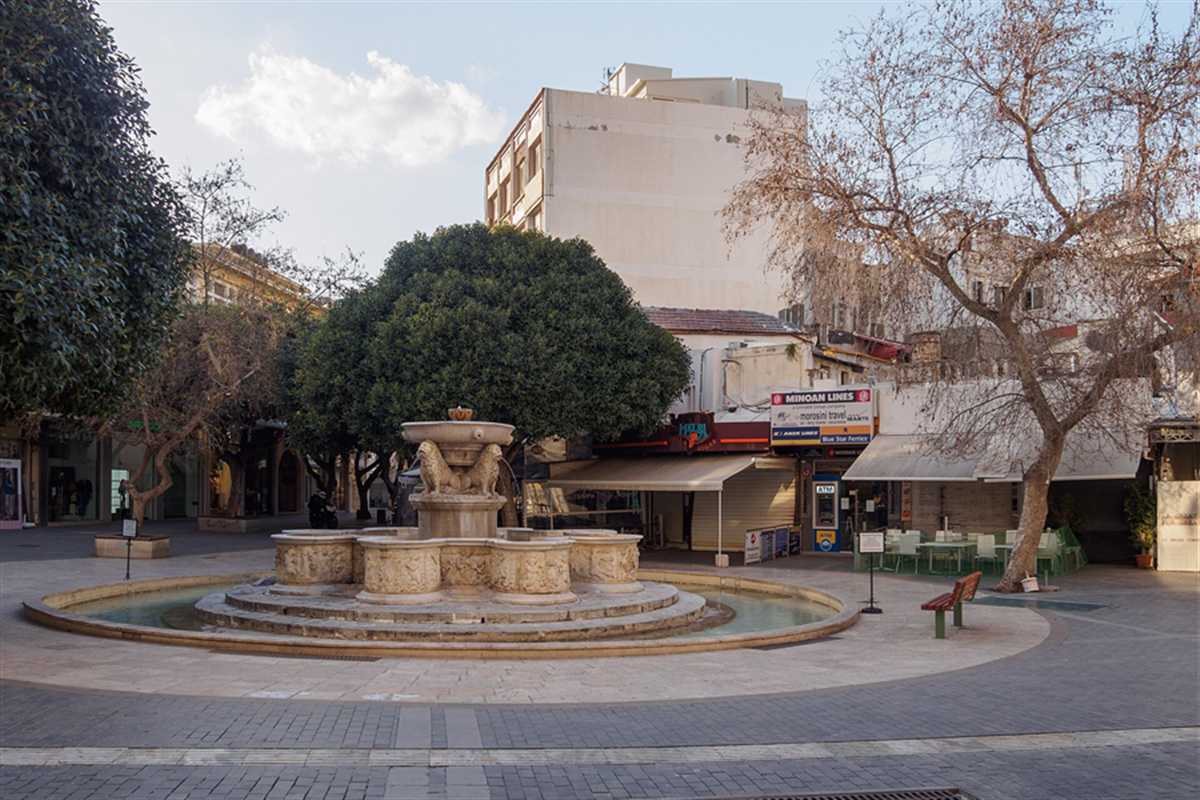
A Heraklion food tour passes Lions Square, a Venetian-era square named officially after the Cretan statesman Eleftherios Venizelos and known popularly as the Lions after the Morosini fountain in its middle, where four lions support the fountain’s main basin.
The Morosini fountain dates from 1628, and its popular nickname, the Lions, gave the square its common name. The genitive form, Leonton Square, comes from the same fountain, and a Heraklion food tour meets both names.
Saint Mark’s Basilica also dates from Venetian times and is listed among the monuments of that era. A Heraklion food tour thus passes through the Venetian layer of the city.
Fountains from the Venetian era survive in the city, among them the Palmeti fountain, together with the Bembo, Priuli and Sagredo fountains. The Morosini fountain is the one in this square.
The Heraklion tour post covers the sights of the city beyond the food stops, including the fountains, the harbour and the museums. A Heraklion food tour is the tasting version of that visit.
- Official name: Eleftheriou Venizelou Square honours a Cretan statesman of that name.
- Nickname: The fountain in the middle is popularly called simply the Lions.
- Fountain: Four lions support its main basin, which gives the nickname its meaning.
- Era: The square dates back to the Venetian era, long before the modern street plan.
A square of this age gives the route a fixed point: the fountain, the basilica and the old fountains are all Venetian work, and each is a landmark between tastings.
Which Cretan cheeses does a Heraklion food tour taste?
A Heraklion food tour tastes Cretan cheeses built on sheep and goat milk and on whey, from fresh mizithra and its salted, sour form xynomizithra to ripened graviera, anthotyros and the other local table cheeses of the island.
Mizithra is a Greek whey cheese or mixed milk-whey cheese from sheep or goats, produced primarily on Crete. Fresh, it is soft, snow-white and creamy, with an almost sweet, milky taste because no salt is added.
Cheesemakers bring raw ewe’s or goat’s milk to a slow boil and curdle it with rennet, whey from an earlier batch, lemon juice, vinegar or even a broken fig-tree sprig.
Salted and aged mizithra turns drier, denser, saltier and more sour. Cooks grate this xynomizithra over hot pasta, and a Heraklion food tour tastes the fresh and the aged forms side by side.
Fresh mizithra is eaten as a dessert with honey or as a meze with olives and tomato. Cretan bakers also use it in small cheese pies and in Sfakiani pita, a pie from the Sfakia region.
- Amarino: This cheese is named in the list of Cretan cheeses beside graviera and xynomizithra.
- Seliano: This cheese appears in the same list of Cretan cheeses as amarino.
- Xygalo: This cheese belongs to the Cretan list too, with pichtogalo next to it.
- Anthotyros: The fresh form is eaten for breakfast with honey and fruit, or in savoury dishes.
The cheeses show how a Heraklion food tour moves from fresh and sweet to aged and salty without leaving one milk tradition.
What is raki on a Heraklion food tour?
A Heraklion food tour closes with a glass of raki, the grape-pomace brandy of Cretan origin that restaurants on the island hand out as a complimentary digestif after the meal, with fruit and sweets served beside it.
Pomace is what remains of grapes after they are pressed for wine, and tsikoudia is the Cretan spirit made from it. Relatives of the spirit include marc in France and bagaceira in Portugal.
Rakomelo adds honey and spices such as cinnamon and cardamom to raki. Producers in Crete and on other Aegean islands make it, and drinkers take it chiefly in winter as a warm drink.
Baked raki, known as psimeni, comes from Amorgos and is made from raki, sugar and spices. It is served at room temperature and holds more spices than rakomelo.
Restaurants in Crete bring the glass at the end of the meal, together with fruit and sweets. A Heraklion food tour follows the same order of the table, and the spirit comes last.
- Serbo-Croatian: The name of the relative grape spirit in that language is rakija.
- Bulgarian: The name of the relative grape spirit in Bulgarian is rakiya.
- Albanian: The name of the relative grape spirit in Albanian is rakia.
- Macedonian: The name of the relative grape spirit in Macedonian is also rakija.
Raki ends the route in the same way the meal ends in a Cretan restaurant, with a small glass and a plate of sweets, before the tastings give way to the city.
What does a Heraklion food tour show about Cretan olive oil?
A Heraklion food tour treats olive oil as the base of Cretan cooking, a product with Bronze Age roots, a pressing method that stayed stable for centuries and a crop whose harvest follows the weather of each season.
Olive oil was a major export of Mycenaean Greece, in the period from about 1450 to 1150 BC. A Heraklion food tour places each tasting inside that long record of trade across the Mediterranean.
Scholars believe early producers placed olives in woven mats and squeezed them. The oil ran into vats. The same process was known from the Bronze Age and lasted through the Hellenistic period.
Olive trees crop well every second year, so heavier harvests fall in alternate years. Weather still decides quality, and a drought during flowering can lower the grade of an oil. Each tasting reflects those seasons.
About 80% of all harvested olives are processed into oil, and the rest are cured and fermented as table olives. Across the Mediterranean, pickers start the harvest in the autumn, from October onwards.
The Greece food tours post covers olive oil, wine, cheese and street food across the whole country, beyond the island of Crete, and gives the wider national background for the Cretan table.
- Export: Mycenaean Greece shipped oil abroad between about 1450 and 1150 BC.
- Method: Woven mats held the olives while pressing, and vats collected the oil.
- Alternate years: Trees give a heavier crop in one year and a lighter crop in the next.
- Per person: FAO figures list Greece at 8.8 kg of oil a year, against 9 kg for Spain.
These records explain why the tasting starts with oil. The same ingredient later dresses salads, enriches stews and softens bread, so each dish that follows carries its flavour.
Which wine does a Heraklion food tour taste near Heraklion?
A Heraklion food tour tastes wine from an island that makes about a fifth of Greek wine, mostly in the region of Peza, using red grapes such as Kotsifali, Mandilaria and Liatiko and the white grape Vidiano, all grown on the island.
Crete produces 20% of Greek wine, mostly in the region of Peza. Tasters therefore sample wine from one of the largest growing areas in the country, not from a small corner.
Kotsifali alone gives a moderately red wine with high alcohol content and rich flavour. It is grown mainly in the Heraklion regional unit, and growers also plant it sparingly on the Cyclades.
Liatiko, Mandilaria and Kotsifali were once blended into Malvasia, a very alcoholic, sweet red wine. Venetian traders exported it widely in the Middle Ages, and western Europe held it in high regard.
Vidiano is a white grape native to Crete, with aromas of peach, apricot, melon, honey and herbs. Growers plant it mainly in Rethymno and secondarily around Heraklion, so it counts as a local rarity.
- Mandilaria: This red grape grows across the Greek islands and serves mainly as a blending partner.
- Early ripening: Vidiano berries have thick skins and ripen early in the season.
- Small scale: The vine is hard to cultivate, so growers farm it in small plots.
- Soil: It thrives in dry, limestone, well-drained ground of modest fertility.
Each glass links a grape to a dish, and the notes above give a reader the background to follow those pairings.
Which Cretan dishes besides dakos does a Heraklion food tour serve?
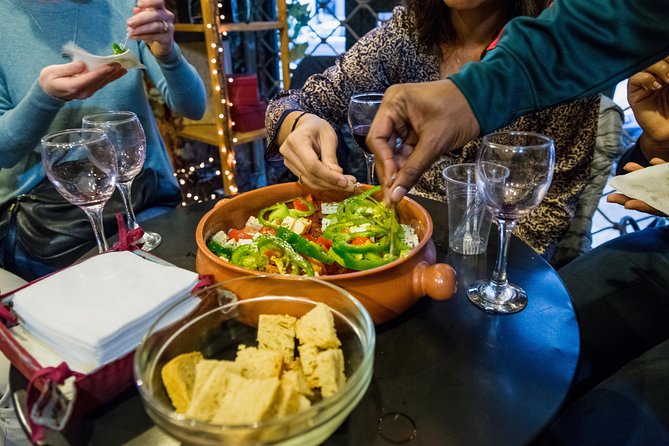
A Heraklion food tour serves dakos, a Cretan salad of soaked barley rusk topped with tomato and cheese, beside traditional pies, stews and pilafs that Cretan kitchens built from seasonal plants, wild herbs, cheese, olive oil and local meat.
Cooks rubbed garlic and sea salt onto the rusk before the tomato and crumbled cheese went on top. Peppers, olives, capers and caper berries also join the salad.
Traditional Cretan cooking drew on seasonal products from the wider local area, with minimal processing or none at all. Menus follow that habit, so each plate tastes of its own season.
Pies fill a large part of the menu. Kreatotourta is a meat pie from western Crete, while tzoulamas is a traditional meat pie from the Messara. The Crete cooking class post covers how home cooks make Cretan dishes.
Gamopilafo is rice cooked in goat and rooster broth. Sofegada is a vegetable stew, and soupies me maratho pairs cuttlefish with fennel. A tasting can offer a small taste of each.
- Stamnagathi: This salad uses a wild chicory plant from the Cichorium genus.
- Liver: Sykoti savore is liver cooked in vinegar.
- Pickles: Askordoulakoi are pickled bulbs of the tassel hyacinth.
- Sweets: Patouda pairs flaky dough with a sweet nut filling.
These dishes show that the menu covers far more than one salad. Plant-based cooking, preserved foods and slow stews all sit on the same island table.
Why does a Heraklion food tour include snails?
A Heraklion food tour includes snails because edible snails are widespread on Crete, and the written record of Cretan cuisine lists them among its specialities, beside lamb, goat, pork, grouper and cuttlefish dishes made from local ingredients and seasonal produce.
Edible snails are widespread on Crete. They cluster in the hundreds while waiting for rainfall to reinvigorate them, which ties the dish to the weather of the island.
Cooks in Greece also add snails to stifado, a casserole built on black pepper, bay leaf, olive oil, baby onions, tomatoes and wine or vinegar. Pork, goat, rabbit, beef, tripe or octopus can replace them.
The list of Cretan specialities places snails beside arni me askolibrous, a lamb stew with golden thistle and avgolemono. The menu introduces that stew as a companion to the snail course.
Katsikaki me stamnagathi is another listed dish, with goat or lamb cooked with avgolemono and a local plant of the Cichorium genus. The plate links meat to wild greens.
- Habitat: Snails are widespread across the island.
- Rain: Wet weather brings them out of waiting.
- Stifado: The Greek casserole lists snails among its possible meats.
- Lamb stew: Arni me askolibrous uses golden thistle.
Snails remain a plain country dish, and menus serve them as part of the wider table of meat, greens and olive oil, so the course sits naturally beside the other Cretan plates.
Which Heraklion food tour formats are on sale?
A Heraklion food tour is on sale as a walking tasting, a private outing with Cretan food, an ecobike ride, a cooking lesson with lunch, or a city tour that adds Knossos, the old market or the archaeological museum.
Four listings sell a Heraklion food tour as a walking tasting. One tastes Greek food around the city, another discovers Cretan flavours, and a third joins history and culture with food tastings.
Other listings change the mode of travel. An ecobike tour adds food tasting, a hop-on hop-off bus tour covers the city sights, and a sailing cruise with a small group sails out to Dia island.
A private tour pairs a local expert with Cretan food. A cooking lesson with lunch moves the meal to a village kitchen. A day trip links the city centre, the market and CretAquarium.
Sightseeing listings combine the food with Knossos. The Knossos tickets post covers entry to the palace site, and one listing adds the archaeological museum with an audio tour.
- Walking tastings: Four listings tour the old city on foot and stop for local food.
- Ecobike: One listing covers the city by bike with tasting stops.
- Cooking lesson: One listing teaches Cretan cooking and serves lunch.
- Combined tours: Four listings pair Knossos and Heraklion with the old market.
The tour cards and availability boxes on this page list live dates, so a reader can check each Heraklion food tour format for the day wanted.
What do travellers ask about a Heraklion food tour?
A Heraklion food tour raises questions about olive oil, wine, dakos, snails and formats. The answers below rest on records of Cretan cuisine, notes on Greek wine grapes and the tour formats currently on sale for the city.
Does a Heraklion food tour cover olive oil?
A Heraklion food tour treats olive oil as the base of Cretan cooking. Records place oil among the exports of Mycenaean Greece, and Cretan cuisine used it for salads and for cooking, unlike northern European kitchens, which relied on animal fat.
Which grapes does a Heraklion food tour pour?
A Heraklion food tour pours Cretan grapes. Kotsifali, Mandilaria and Liatiko are the red grapes, and Vidiano is the white grape native to the island. Mandilaria mainly serves as a blending grape. Crete makes 20% of Greek wine, mostly in the region of Peza.
Is dakos part of a Heraklion food tour?
Dakos belongs to the Cretan table that a Heraklion food tour samples. A slice of barley rusk is soaked in either olive oil or water, with chopped tomatoes on top and crumbled mizithra or feta cheese. The salad is seasoned with herbs such as dried oregano.
Does a Heraklion food tour include a cooking lesson?
One listing on sale sells a Cretan cooking lesson with lunch. Other listings sell a Heraklion food tour as a walking tasting, an ecobike ride with tasting, or a private outing with Cretan food, and the page lists live dates.
Featured photo: C messier, CC BY-SA 4.0, via Wikimedia Commons.