

A Chania wine tour visits vineyards and wineries in the hills around Chania, in western Crete, to taste local wine. The trip is one of the Greece Tours on Greece Ville, listed with the other Crete tours and Greece food tours.
This post covers wine output in Greece, how vines grow through the year, the pests that attack them, how yeasts make wine, oak barrels and how tasters judge wine.
The old wine trade of the harbour, the best months and common questions come last. The sections include Chania wine tours that can be booked online.
What is a Chania wine tour?
A Chania wine tour visits PGI Chania, the westernmost wine zone on Crete. PGI is an appellation, a legally protected name that shows where the grapes were grown. PGI Chania rules also allow white semi-sparkling wines, from dry to semi-sweet.

Appellation rules can also fix the grapes, the maximum yield and the alcohol level. Chianti in Italy became the world’s first protected vineyard zone in 1716.
Greek vineyard holdings averaged only about 0.5 to 0.6 hectares in 2020, among the smallest in the EU. In 1988 Crete held 50,000 hectares of vineyards and was the main sultanina raisin region.
A Chania wine tour sits west of PGI Rethimno. Its vineyards lie between Psiloritis and the Lefka Ori, the White Mountains. The highest climb to 900 metres.
- Output: FAO data credit Greece with 290,000 tonnes of wine in 2021.
- Heights: Under PGI Crete, vineyards can reach or pass 1,000 metres above sea level.
- Sales: At wineries, bottles bought by visitors on site can make up 33% of yearly sales.
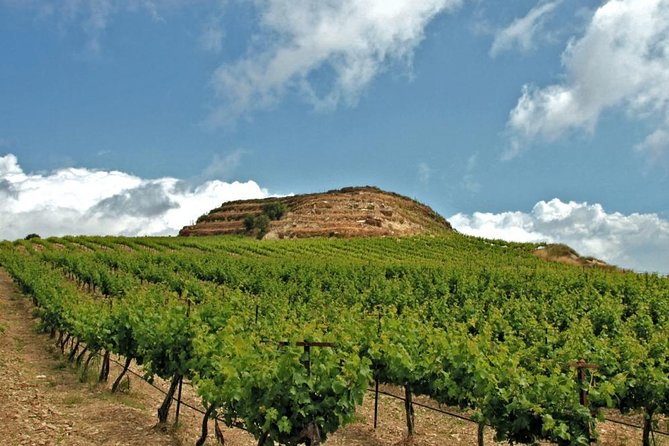


How do the vines of a Chania wine tour grow through the year?
A Chania wine tour follows the vine year from bud break to winter rest. Bud break begins once daytime temperatures stay at about 10 °C. Flowering, veraison and harvest follow. In winter, the vine rests in dormancy.
Frost kills young shoots easily, so growers can set up heaters or wind fans. Each grape flower opens when its calyptra, a cap of fused petals, falls off and frees the pollen.
A Chania wine tour in summer meets veraison, the change of colour. Berries are then about half their final size. In very hot climates grapes can ripen 30 days after veraison starts.
A typical vine needs 635 to 890 mm of water a year, in spring and summer. When water runs short, a vine leaf can heat up to nearly 10 °C above the air.
- Pigment: Heat of 35 °C or more stalls red pigment in the grape skins.
- Harvest: Heat waves close to harvest make grape sugar jump while acids drop sharply.
- Winter: Cane-pruned vines are cut back to one strong cane for next year’s crop.
What pests and diseases threaten the vines of a Chania wine tour?
A Chania wine tour passes vines threatened by phylloxera, mildew and the grapevine moth. Phylloxera, a tiny insect, has no chemical cure. Growers fight it by grafting vines onto resistant American rootstocks. Copper sprays fight downy mildew.
The name phylloxera joins the Greek words for “leaf” and “dry”. Greece’s first outbreak struck Pylaea, near Thessaloniki, around 1898. Resistant rootstocks are mainly hybrids of Vitis berlandieri, V. riparia and V. rupestris.
A Chania wine tour also meets downy mildew, first recorded in 1834 on a wild American vine. Its spores survive in dead leaves for 3 to 5 years, possibly 10.
In 1885 Millardet set the Bordeaux mixture: 8 parts copper sulfate, 15 parts lime, 100 parts water. The OIV blamed Greece’s small 2023 harvest on spring rains that spread downy mildew.
- Powdery mildew: Its spores sprout between 7 and 31 °C, and growth stops above 33 °C.
- Moth: Larvae of the European grapevine moth hollow out grapes and develop in 20 to 30 days.
- Virus: In Heraklion, fanleaf virus and its nematode spreader did not decline over 23 years of control.
How do yeasts turn grape juice into wine on a Chania wine tour?
A Chania wine tour shows how yeast turns grape sugar into wine. Yeast splits each six-carbon sugar into three-carbon pieces. These pieces turn into acetaldehyde and then into ethanol, the alcohol in wine. Pasteur proved that yeast, not decay, drives this change.
The name Saccharomyces means “sugar-mold” or “sugar-fungus”, and cerevisiae is Latin for “of beer”. Its cells are round to oval and 5–10 micrometres across.
A Chania wine tour meets yeast that thrives at the normal pH of wine, between 2.8 and 4. Wild Kloeckera and Candida yeasts can start fermenting when grapes crush in harvest bins.
Glycerol forms early in fermentation. It gives wine more body and a slightly sweet taste without adding alcohol. More than 700 strains of Saccharomyces cerevisiae were identified during the 20th century.
- Air: In 1861 Pasteur found that yeast ferments less sugar when exposed to air.
- Nitrogen: Yeast releases hydrogen sulfide when the must lacks nitrogen.
- Bacteria: Oenococcus oeni drives malolactic fermentation, a second change that softens acid.
Why do oak barrels matter on a Chania wine tour?
A Chania wine tour shows that oak barrels change how wine smells and tastes. Toasting the inside of a barrel raises vanillin and eugenol, which give smoky, spicy notes. Wine aged in oak takes more oak flavour than wine fermented in oak.
Herodotus wrote that ancient Mesopotamians shipped wine along the Euphrates in palm-wood barrels. Strabo recorded wooden casks lined with pitch to stop leaks.
A Chania wine tour can meet barrels of American white oak, Quercus alba. This oak grows fast, with wider grain and lower wood tannins. Its tyloses seal the wood cells, so the barrels resist leaking.
French barrel oak comes from the Allier, Limousin, Nevers, Tronçais and Vosges forests. Its staves season outdoors for 24 to 36 months to leach out bitter tannins. Only 20 to 25% of each tree becomes barrel wood.
- Capacity: The Bordeaux barrel holds 225 litres, while the Burgundy barrel holds 228 litres.
- Lactones: American oak holds two to four times the lactones of French oak, for sweeter vanilla notes.
- Evaporation: The wine lost from barrels through evaporation is called the “angels’ share”.
How do tasters judge the colour, smell and taste of wine on a Chania wine tour?
A Chania wine tour teaches tasters to judge colour, then smell, then taste. Colour can hint at the grape variety and at ageing in wood. In Burgundy, tasters sort aromas as primary from the grape, secondary from fermentation and tertiary from ageing.
Red wines with low pH show more bright red pigment. Higher-pH wines hold more blue and colourless pigments. Red wine averages 216 mg of polyphenols per 100 ml, against 32 mg in white wine.
A Chania wine tour taster meets tannins called proanthocyanidins, which release red pigments when heated in acid. Catechins from grape seeds add to the bitter taste. Methoxypyrazine gives a grassy smell to Cabernet Sauvignon and Sauvignon blanc.
Aroma compounds sit bound to sugars as odourless glycosides until enzymes or acids free them. Malic acid, from the Latin malum for “apple”, can reach 20 g/L before veraison, when grapes change colour.
- Nose: Humans have about 10 cm² of olfactory epithelium, the smell-sensing lining inside the nose.
- Receptors: Linda Buck and Richard Axel won the 2004 Nobel Prize for cloning the smell receptor proteins.
- Wheel: Ann C. Noble’s Aroma Wheel has no texture words; Australia’s “Mouthfeel Wheel” has them.
What wine trade passed through the harbour of a Chania wine tour?
A Chania wine tour recalls the Venetian wine trade of Crete. Crete was a key stop on the Levant trade of Venice. From 1147, Byzantine charters let Venetian merchants trade tax-free on the island. By the 15th century, Crete exported 200,000 butts of malmsey a year.
Malmsey was the name for sweet, rich Greek wine, above all from Crete. Its higher sugar made it much stronger than the native wines of northern Europe. In England, a malmsey butt was fixed at 126 wine gallons, about 477 litres.
A Chania wine tour also recalls a trade war. In the 1490s, Venice charged four extra ducats on every butt shipped to England. Henry VII hit back with an import duty on each Venetian butt that lasted until 1512.
- Ottoman period: Under Ottoman rule, Cretan vineyards and wine making carried on, though on a limited scale.
- Harbour: Silt cut the depth at the old mole of Chania from 24 feet to 10 or 8.
- Exports: In 1904, wines and liquors made up £48,544 of Crete’s £419,642 in exports.
Which months suit a Chania wine tour?
A Chania wine tour suits September and October. August averages 25.9 °C at Souda, near Chania. September cools to 23.2 °C, with nights at 19.1 °C. October averages 19.4 °C, with mean lows of 15.9 °C.
In late spring, Souda counts only 3.9 rain days. November brings 86.7 mm of rain over 10.8 rain days.
A Chania wine tour in October meets Ai-Dimitriatis, the folk name for the month. It honours Saint Demetrius, whose feast falls on 26 October.
Records of 11 to 44 years show the Mandilaria harvest on Crete coming later. Projections move all eight Greek varieties one to two months earlier.
- White grapes: Vilana and Vidiano held about 23 °Brix of sugar at harvest near Heraklion.
- Sampling: There, weekly sampling took three rounds for white grapes and four for reds.
- Mandilari: High yields can stop Mandilari from ripening fully, above all in high vineyards.
What do visitors ask about a Chania wine tour?
A Chania wine tour raises questions on drink-driving, labels, flying home with bottles and duty-free limits. Greek penalties start at 0.5 mg/ml of blood alcohol. EU labels give alcohol as % vol. A sealed duty-free bag stays shut until the final destination.
What drink-driving penalties follow a Chania wine tour?
From 0.5 mg/ml, drivers outside the novice and professional groups get 5 penalty points. They also lose their licence for 30 days. From 1.1 mg/ml, any driver faces at least 2 months in prison. A second offence within 5 years brings a 7-year licence withdrawal.
What does a Chania wine tour bottle label show?
EU wine labels show the compulsory details in one field of vision, readable without turning the bottle. The words “actual alcohol” or “alc” can stand before the “% vol” figure. Greek labels can write sulphites as διοξείδιο του θείου, sulphur dioxide.
How do bottles from a Chania wine tour fly home?
EU airport security can treat corkscrews as sharp objects, so they belong in hold luggage. A duty-free security bag stays sealed until the final destination. If staff open it before a connecting flight, they can reseal the bottles in a new bag.
How much wine from a Chania wine tour can cross a border without duty?
EU indicative levels between member states start at 10 litres of spirits and 20 litres of fortified wine. Travellers who cross Switzerland between two EU countries fall under Swiss rules. These allow 5 litres up to 18% alcohol a day, tax-free, from age 17.