
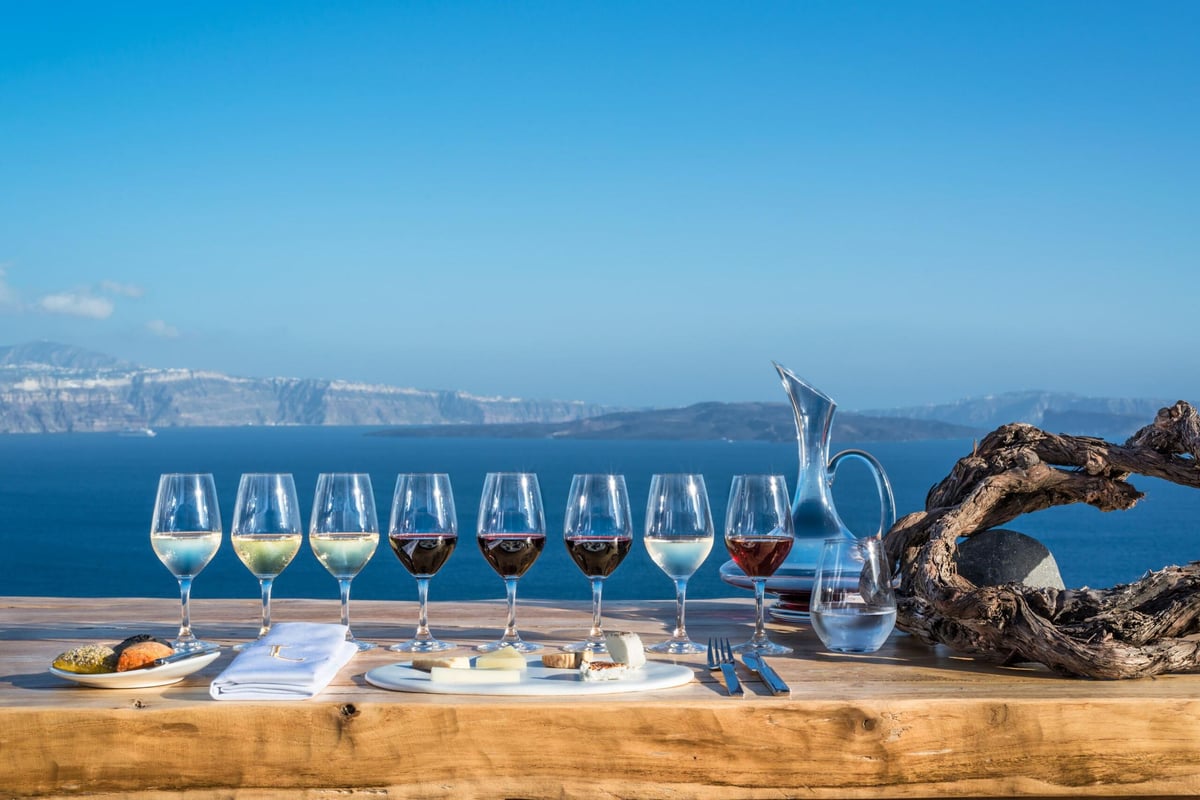
A Santorini wine tour visits the vineyards and wineries of Santorini, where vines grow in volcanic soil above the caldera. The tour is one of the Greece Tours on Greece Ville.
This post covers the protected wine zone, how wine began on the island, its rare grapes, Assyrtiko, why phylloxera never came, the age of the vines and the wineries old and new.
The wine trade, island output, climate change, soil science, tasting notes, museums, label rules, sun-dried sweet wine, wine tourism, the winds, the best months and common questions come last. The sections include Santorini wine tours that can be booked online.
What is a Santorini wine tour?
A Santorini wine tour is a visit to the vineyards, cellars and wineries of a protected wine zone. The Santorini appellation covers dry white wines and sweet wines, both with and without added alcohol. Vines grow across the whole island and on Thirasia.

Apart from the steep coast, farmland takes up about 80% of the island’s surface. The bulk of that farmland is vineyard, on wide terraces held by dry-stone walls. The best vine sites lie in eastern and central Santorini.
In January 1884, the traveller Theodore Bent described the vineyards. He wrote that they looked as if hampers stood in rows every two yards. Those hampers were the low basket vines still seen on the island today.
On a Santorini wine tour, Assyrtiko fills the bulk of the rows. Athiri and Aidani together cover about 10% of the vineyard area. Besides these white grapes, notable areas of the island grow the red Mandilaria.
The EU register records the name in Greek script, Σαντορίνη, with Santorini as its Latin form. Island families still make their own wine in the cellars of their homes.
- Kiklades: The wider Cyclades label, PGI Kiklades, has had EU protection since August 2009.
- Aigaio Pelagos: A broader label, Greek for Aegean Sea, gained EU protection that same month.
- File numbers: The EU lists the two labels as PGI-GR-A1343 and PGI-GR-A1602.
- Wire frames: Attempts to train the island’s vines on wire frames have failed.
A Santorini wine tour therefore meets three layers of protected names: island, Cyclades and Aegean.


How did wine begin on the island of a Santorini wine tour?
A Santorini wine tour follows a wine story that reaches back to Bronze Age Akrotiri. Grapes appear on Akrotiri jars from the 17th century BCE, both painted and embossed. Imprints of large baskets that carried grapes to the press also survive there.
A number of Akrotiri jars have a tap just above a narrow base, which points to stored wine. Above each tap runs a line of circles in nine different designs. Archaeologists suppose these marked nine varieties or qualities of one product, thought to be wine.
A cylinder of chaste-tree wood was filled with lime and shut with a woven lid. It possibly served in the Akrotiri wine press. Side-mouthed jars carried wine and oil. Akrotiri has given at least half of all known early examples in the Aegean.
On a Santorini wine tour, Akrotiri shows what Bronze Age islanders ate and drank. Figs and grapes were favourite fruits there, and pistachios were known too. A 1987 thesis on the West House lists the grapevine among the important crops, with fig and olive.
Plant remains in the West House survived charred, silicified or mineralised under the volcanic ash. Bronze Age Akrotiri covered about 20 hectares and grew into one of the main ports of the Aegean. Finds show contact with Crete, the mainland, the Dodecanese, Cyprus, Syria and Egypt.
After Minoan Crete, intensive trade soon brought wine and vine growing to Santorini. From the Cyclades, vine growing then reached the Greek mainland. Vinsanto is seen as heir to the passoi, the ancient sun-dried wines of the Aegean islands.
- Will of Epikteta: Carved about 210-195 BC on Thera, it is catalogued as inscription IG XII.3 330.
- Imported wine: Its rules name oinos xenikos, imported wine, among the things officials had to provide.
- Three cups: Each official gave enough for three cups per person. The cups marked the crowning, the music and the perfume.
- Penalty: An official who failed to serve paid a hundred drachmas to the association.
The family association met for three days each year at a sanctuary of the Muses. They gathered in the month of Delphinios. Its 288-line text is cut on a grey volcanic pedestal about 3 m long. The stone reached Verona in 1586, by way of Crete and Venice. It stands in the Maffeiano Museum.
Which rare grapes grow on a Santorini wine tour?
A Santorini wine tour can meet forty-nine minor grape varieties scattered among the main vines. Locals call them Xenoloa. These minor grapes mostly give simple house wines and are rarely bottled. An international grape catalogue records their other names.
Voudomato is catalogued as Voidomatis, a black-skinned Greek grape, number 5008. The catalogue lists 16 other names for it, among them Voupthalmos and Vouvalas Mati. It serves both as a wine grape and as a table grape.
Mavrathiro appears as Athiri Mavro, a black-skinned Greek variety, number 745. Its 5 synonyms include Mavratheri and Athiri Noir. Catalogue literature notes a distinctive aroma for it.
Aidani Mavro is a black-skinned grape, and one of its 7 synonyms is simply Santorin. A DNA study found very high genetic similarity between it and white Aidani. Both are thought to share one stock. A mutation possibly explains its black-reddish berries. Berry colour mutations are common in Greek vines.
On a Santorini wine tour, Platani appears in the catalogue as Platania, a white Greek wine grape. It is also called Platanos. Potamisi comes in a white form with 13 synonyms, such as Aspropotamisio and Pontamissi. Its black form, Potamissi Mavro, is held by only one gene bank, coded GRC010.
Mandilaria shoots are too fragile to twist. Growers prune them to short canes with three to five buds. The vines form a low gobelet with three to five small arms, tied to no support.
- Asprouda: The white Asprouda of Santorini is catalogue number 4989 and has 8 synonyms.
- Collections: Fifteen institutions keep Mandilaria, from Austria and Spain to Mexico and South Africa.
- Black sweet wine: Island growers also make a black sweet wine from Mandilaria grapes.
- Mavrotragano: Even on Santorini, it covers a very small share of the vineyard, scattered among other vines.
Mavrotragano is now planted more and more, above all on Thirasia. Its bunches are medium to large and tightly packed, with thick-skinned, round berries.
What makes Assyrtiko stand out on a Santorini wine tour?
A Santorini wine tour tastes Assyrtiko, a grape with very high acid. In one lab study, Santorini Assyrtiko juice had pH 3.08 and 8.5 grams of acid per litre. Assyrtiko covers about 75% of the island’s cultivated vineyard area.
That same juice held 229 grams of sugar per litre. In another study, the juice had a pH of 3.1. The finished wines measured pH 2.9 to 3.0. In Assyrtiko, malic acid drives changes in juice pH through ripening.
Wild yeasts from Santorini Assyrtiko grapes raised wine acidity during fermentation in lab tests. In a Bordeaux trial, Assyrtiko was the only warm-region grape prone to losing tartaric acid. With its very low pH, researchers did not see that loss as a major issue.
Under drought, Assyrtiko leaves seem to store carbon in calcium oxalate crystals while their pores stay shut. In drought-adapted Assyrtiko leaves, more than half the morning’s crystal clusters had gone by the afternoon.
In heat tests at 35 and 40 °C, Assyrtiko and Muscat adapted better than other white grapes. A two-year Greek study found that water shortage gave Assyrtiko smaller berries with more sugar and phenols.
On Santorini, Assyrtiko is pruned to long canes. The buds at the base of its canes are mostly infertile. Its shoots can be twisted without breaking, which suits the island’s woven baskets.
- Area: Greece grew 1,128 hectares of Assyrtiko in 1989 and about 1,106 in 1999.
- Offspring: Hrisi Irini is a grape bred by crossing Assyrtiko with Sémillon.
- USA: Harold Olmo brought the first Assyrtiko cuttings to the USA in 1948.
- Australia: The first Australian Assyrtiko came from the Clare Valley in 2016.
Among grapes tracked across Greece, Assyrtiko showed the biggest year-to-year change in ripening warmth, 153 heat units. The international grape catalogue lists Atzala as another name for Assyrtiko. Beyond Greece, Assyrtiko also grows in Italy, Australia and the USA. Gene tests show a parent-offspring link to another grape, but its full family tree is unconfirmed.
Why did phylloxera spare the vines of a Santorini wine tour?
A Santorini wine tour walks on aspa, hard volcanic ground of ash, lava, pumice and scoria. Research links phylloxera, a root-eating insect, mainly to sand content. It thrives in soils with less than 65% sand. Soils above 80% sand rate as low risk.
Sandy soils have no lasting structure, which researchers think stops the insect from moving through the ground. Coarse sand grains can also collapse into the spaces between them and kill insects.
High silicon levels in soil have also been reported to lower phylloxera numbers. The insect survives and breeds best at soil temperatures of 18 to 27 °C. In Canada and California, it was common in clay and loam but not in sand.
American vine roots ooze a sticky sap that clogs the young insect’s mouth when it feeds. Washington State, long seen as phylloxera-free, found established populations of the insect in 2019.
On Mount Etna, volcanic soils with less than 3% clay have kept large vineyards free of phylloxera. There, heavy rain seals the sandy soil and drowns the insects.
The insect’s life cycle can pass through up to 18 stages. Each summer, the root-feeding form can produce up to seven more generations. Portugal’s Colares vines grow in 3 to 4 metres of sand, so phylloxera leaves them alone.
- Provence: Vines have grown on sandy beaches in Bouches-du-Rhône since 1979 to escape phylloxera.
- Chile: The Atacama, the Pacific and the Andes have kept it mostly phylloxera-free.
- Australia: Phylloxera has never been found in Tasmania, Western Australia or South Australia.
- Mosel: Riesling vines there were spared because the insect cannot survive in slate.
Cyprus was also spared, so its vines were never grafted against phylloxera. Spain’s Juan García grape survived ungrafted on Douro canyon terraces near Fermoselle. Vine scientists suggest that even Santorini’s traditional vineyards can gain resilience by grafting onto suitable rootstock.
How old are the vines of a Santorini wine tour?
A Santorini wine tour meets vines that growers keep alive for generations. Greece added Santorini’s wine heritage to its National Inventory of Intangible Cultural Heritage in 2018. A 2021 review states that individual vines on the island are more than 100 years old.
A grower begins shaping the basket once the young vine has a sturdy trunk. At the first pruning, the grower keeps only the strongest cane. It is cut to 6 to 8 buds and bent into a ring.
The next autumn, the grower keeps three evenly spaced canes and winds each one around the ring. New canes are woven on every year, so the basket grows each season. A basket keeps 3 to 5 canes, each with 5 to 8 buds.
On a Santorini wine tour, today’s baskets are smaller, because growers renew them more than in the past. Renewal is done by layering or by planting cuttings.
Old-style baskets, called Koulouba or Niabelo, were built by wrapping each year’s canes over the last year’s. They took years to build, and only small numbers survive. Greece’s agriculture ministry pays subsidies that support traditional pruning.
Older growers teach younger growers right in the vineyard. Once a year, winemakers and schools run seminars for children. The children watch an agronomist form a kouloura, a basket vine, then try it themselves.
- Lifespan: Grape vines can live for more than 120 years.
- Old vines: In long-established regions, the term means vines thirty to forty years old.
- Slovenia: The oldest known grape-bearing vine, in Maribor, was alive in the 17th century.
- Barossa: Shiraz vines planted in 1847 at Turkey Flat still produce grapes.
After about 20 years, vines start giving smaller crops, which makes their wines more concentrated. Individual ungrafted vines on Mount Etna are more than 150 years old. They predate its 1879–1880 phylloxera outbreak. The ungrafted Ramisco vines of Colares are among the oldest in Portugal.
Which old family wineries does a Santorini wine tour visit?
A Santorini wine tour visits family wineries that grew from old canava cellars. A canava was the island’s traditional family winery. Greece’s culture ministry names Roussos, Argyros, Gavalas, Sigalas and Hatzidakis among them. Canava Roussos traces its history back to 1836.
The Argyros family began making Vinsanto for the Catholic Church in the 1850s. In 1903 the church granted the family land, which gave their Monsignori vineyard its name. Argyros wine went to France and Russia in exchange for barrel wood.
The old Argyros cellars hold 600 barrels of Vinsanto dating back to 1947. Matthew Argyros, a fourth-generation winemaker, runs the estate from a modern winery built in 2014 in Episkopi.
On a Santorini wine tour, an Argyros basket vineyard in Episkopi is thought to date from about 1800. It is the oldest of 16 Greek entries in the Old Vine Registry. The fourth generation has grown the vineyards to 1,200 stremmata.
Gavalas Winery is a small family winery run by Vagelis Gavalas, the fifth generation, with his father Giorgos. Giorgos replaced the old methods with new equipment. The first vinification in the new winery took place in 1998.
Gavalas ages its Vinsanto for six years in 100-year-old oak barrels brought from Russia. Its oldest Vinsanto is from 1967 and was first bottled in 2012. Tastings take place beside the old patitiri, where grapes were once stomped.
- Size: Estate Argyros is the biggest wine producer on Santorini after the cooperative.
- Laboratory: Argyros set up its own lab, so it no longer waits weeks for results from Athens.
- Late Release: The Argyros Late Release Vinsanto spends at least 16 years in oak before sale.
- Old barrels: A number of barrels made from that traded wood still survive.
The Argiros family ran a winery at Exo Gonia from 1861 until it was abandoned in 1952. Its cellars lie 12 m deep, and they now hold the Art Space gallery.
What is the island cooperative on a Santorini wine tour?
A Santorini wine tour can visit Santo Wines, the island cooperative. It was first set up in 1911 as the Santorini Wine and Vine Protection Fund. Today it has about 1,200 member growers and makes about 500,000 bottles a year.
The Union of Santorini Cooperatives did not build its winery until 1951. In 1992 the winery moved into the building it uses today. Its winery can take in every grape grown on the island if needed.
About 40% of the island’s small growers sell their whole crop to the co-op each year. Growers have no contracts and choose each year which winery gets their grapes. When grapes find no other buyer, the co-op acts as the growers’ safety net.
On a Santorini wine tour, the co-op makes roughly 25% to 30% of all the island’s wine. Its bottle count is by far the highest of any producer on Santorini. It welcomes more than 900,000 visitors a year.
Chief oenologist Nikos Varvarigos has worked at Santo Wines for more than three decades. The co-op’s own organic vineyard supplies its single-grape Aidani, Athiri and Mavrotragano wines. Its label Thira Kori uses only grapes from Therasia.
Santo Wines made the island’s first traditional-method sparkling wine, from Assyrtiko grapes only. It ages for 16 months on its lees before release. The cellar also experiments with concrete eggs, amphorae and single-vineyard wines.
- Two arms: The cooperative is being rebranded and split into Santo Wines and Santo Taste.
- Santo Taste: It handles protected farm products such as cherry tomatoes, fava and capers.
- President: Agronomist Markos Kafouros has led the Union of Santorini Cooperatives since 2007.
- Protected names: Kafouros helped draft the protected-origin files for fava, cherry tomatoes and Vinsanto.
The co-op’s gravity-flow winery is one of the largest in Greece. A Santorini wine tour reaches it on the caldera edge at Pyrgos.
Which wineries opened in the modern era on a Santorini wine tour?
A Santorini wine tour also visits wineries founded since the late 1980s. Boutari’s Santorini winery made its first harvest in 1989. After 35 years, it closed on 31 August, and its buildings were sold. Two of its staff went on to found Gaia Wines and Hatzidakis Winery.
In the late 1980s, Boutari picked Assyrtiko earlier to avoid high alcohol. It used tightly controlled fermentations instead of spontaneous ones. Yiannis Paraskevopoulos and Haridimos Hatzidakis both worked there first.
On a Santorini wine tour, Venetsanos Winery stands out as the first industrial winery, built in 1947. Chemist Georgios Venetsanos created it with his brother Zannos, a wine merchant. It stands on four cliff levels, so gravity moved grapes and wine. The island then had no electricity.
At Venetsanos, finished wine was once piped down to the harbour 230 m below. The winery closed in 1979 and reopened in 2014 as a visitor centre. Its wine is now made in a new facility nearby.
Paris Sigalas, who founded Domaine Sigalas, applied mathematical formulas to winemaking and vine growing. Domaine Sigalas makes about 250,000 bottles a year, and its blue-label Santorini is half of them. Kir-Yianni began backing it in 2009 and later bought all of it.
In 1997 Haridimos Hatzidakis restored an abandoned vineyard in Pyrgos. He was the first on the island to farm organically and to ferment with native yeasts. That year he and Paris Sigalas made the first red wines from rare Mavrotragano.
- Gaia: Gaia set up its seashore winery in 1994 at Exo Gonia, in an early 20th-century tomato factory.
- Under the sea: Gaia first aged Assyrtiko bottles in the sea and released Thalassitis Submerged in 2014.
- Karamolegos: Artemis Karamolegos founded his winery in 2004.
- Vassaltis: Yannis Valambous left economics in London to start Vassaltis, with a first harvest in 2015.
Gaia’s founders, Leon Karatsalos and Yiannis Paraskevopoulos, have handed over to Leto Paraskevopoulou and Sofia Karatsalou. His 2016 Mystirio, the island’s first orange wine, came from 150-year-old Karamolegos vines.
How did traders carry the wine of a Santorini wine tour abroad?
A Santorini wine tour retraces a wine trade that reached Venice, Russia and even America. Under Venice, the island became a major stop for pilgrim ships heading to the Holy Land. Santorini wine was exported to Russia from at least 1786.
Ships bound for Crete and the Middle East also called at Santorini. Long voyages needed wine, because clean water was hard to carry. Vinsanto was a favourite of the Venetian nobility and of crusaders sailing home.
In the 17th century, Santorini wine sold at a higher price than the wine of Naxos or Paros. Merchants sold it directly to Constantinople, Candia, Smyrna and Chios. The French traveller François Richard called wine the island’s only saleable product.
A Santorini wine tour passes a trade that stayed in local hands under Ottoman rule. By the mid-17th century, about 7,000 people lived on the island. Newcomers moved there to enter the wine trade.
After the 1774 treaty opened Black Sea trade to Russia, shipping wine paid well. Every stremma, a tenth of a hectare, was terraced for vines. France, Sweden and Russia opened consulates on the island to join the trade.
In the late 18th century, the French consulate reported wine exports of 1,300 tons. Alexandria, Taganrog and Constantinople took large amounts. Santorini merchant boats sailed as far as America, where three wine shipments were recorded.
- Tax: Santorini paid 43% of the tax the Cyclades owed on wine and alcoholic drinks.
- Fleet: In 1842 the island had 40 brigs and 7 to 8 schooners, crewed from Oia.
- Sekio: This wooden bucket for dry wine held exactly 8 okades and was sealed by police.
- Phylloxera years: European merchants hunted for grapes and raisins until their own vines recovered.
After the 1840s, European buyers turned to lighter, fruitier and less sweet wines, and Vinsanto lost favour. Shippers then found Santorini wine far too costly for buyers from Marseille to the Americas.
How much wine does the island of a Santorini wine tour make?
A Santorini wine tour visits an island that makes nearly 1.1 thousand tonnes of wine a year. That is only about 0.5% of all the wine made in Greece. A 2021 study counted 942 hectares of cultivated vineyards.
The vineyards run from sea level up to terraces at 150 to 350 metres. Basket-trained Assyrtiko gave a mean yield of about 2,080 kg of grapes per hectare from 2017 to 2020. The island’s yield fell from 2.9 to 1.5 tonnes per hectare between 2005 and 2019.
About 160 kg of grapes are needed for 100 litres of white wine. Around 50 hectolitres of wine per hectare is a typical yield in wine countries. In 2007, France averaged 52, Italy 55 and Germany 103.
On a Santorini wine tour, grape production has fallen almost 50% in 20 years. That is an average drop of 2.7% a year. Island winemakers warn that output can fall to zero by 2041 without action.
Historic estimates put the island’s vineyards at 3,000 to 4,000 hectares, and about 1,000 hectares remain. The remaining vineyard is split into small family holdings. Former vineyards have been sold and paved over for hotels and villas.
Vineyards grew from 6,000 stremmas in 1731 to 48,000 stremmas in 1874. The grape crop rose from about 600,000 kilos in 1731 to 2,160,000 kilos in 1835. In an average 19th-century year, the island made about 7,000 tons of wine.
- 1874: The grape crop reached 4,800,000 kilos, eight times the total of 1731.
- Before 1956: Farms covered 55,000 of the island’s 75,000 stremmas before the earthquake.
- 2004: A count of the island’s farmland found only 22,000 stremmas.
- 2010 decree: It bars building on vineyard plots smaller than 10 stremmata.
On a vineyard of 10 stremmata, the 2010 decree allows up to 300 square metres of building. High rainfall in 2019 lifted the 2020 crop above the four years before it.
How has climate change hit the vines of a Santorini wine tour?
A Santorini wine tour meets vines hit hard by heat and drought. From 1974 to 2019, the March-to-August average temperature rose by about 3.8 °C. Summer days above 30 °C rose from 9 to 48 over the same years.
That warming is a steady rise of about 0.06 °C each year. Spring rain dropped from an average of 100 mm in 1974-1999 to 75 mm in 2000-2019. Summer rain dropped from 30 mm to 8 mm.
The Huglin heat index for a Santorini wine tour moved from temperate before 1981 to warm from 2008. On the Winkler heat scale, the island moved from Region III, warm, to Region IV, hot.
Assyrtiko sugar rose by about 2 °Brix, a measure of sugar in grape juice, between 1987 and 2019. It went from about 21 to about 23. August nights now fall in the warm night class, the highest of the cool night index.
Over 1920-2019, the start of the harvest moved from the end of August to early August. Heat in late spring and early June, when next year’s buds form, cuts the following year’s crop.
On a Santorini wine tour in 2021, heat and drought damaged the vines. During that harvest, open-air temperatures in one vineyard reached about 42 °C at midday. Vine function slows or stops when shade temperatures pass 35 °C.
- Hot days: Extreme summer heat came on five days in 2000, 2007, 2012 and 2014.
- 2017: Extreme summer heat came on seven days that year.
- 2022: Santorini growers harvested 2,500 tonnes of Assyrtiko grapes.
- Drought: Growers reported three straight years with less than 200 mm of rain.
A viticulture professor said 2023 brought the hottest temperatures in 60 years. Yields in old-vine parcels fell by as much as 60 to 80%. A 90-year-old basket vine finally died from heat and drought. A pilot project aims to water vines with wastewater from homes and hotels.
What have scientists learned about the soil of a Santorini wine tour?
A Santorini wine tour crosses soils formed mainly on rhyodacitic pumice from the volcano. Scientists found them low in organic matter and poor at holding moisture. Unlike typical volcanic soils worldwide, they show no andic properties and cannot be classed as Andisols.
Winds that blow almost all year carry droplets of seawater onto the island’s soils. Sea spray, porous rock, sodium in the pumice and low rain keep the soils poorly developed. The same forces also raise the soil pH.
The soils lack allophane, imogolite and ferrihydrite, the noncrystalline minerals of volcanic soils elsewhere. The only noncrystalline mineral present is amorphous silica, and it occurs in great quantities.
On a Santorini wine tour, a large part of the island shows light grey soil. It formed from the thick tephra below. A soil map by G. R. Stogiannis shows a xeroandept as the main soil type. That is an ash soil that stays dry for much of the year.
The loose soils erode in the wind, which strips away fine particles. The wind piles soil against walls, and samples banked there were 69.8% medium sand. Growers plant vines in small hollows, so rain from short showers soaks in around each plant.
A cultivated field near Akrotiri held only 0.13% organic matter. A topsoil near Fira held 0.28%. Their cation exchange capacity measured just 9.0 and 3.4 m.e. per 100 g, a sign of poor fertility.
- Bronze Age: Below the Minoan pumice lies buried ground of coarse sand with virtually no organic matter.
- Minoan farmers: They faced the same moisture shortage and low organic matter as growers today.
- Pollution: Soil tests linked copper, chromium and lead pollution on the island to tourism.
- Airport: Airport traffic proved a key source of cobalt, chromium and zinc in nearby soils.
The island’s soils still hold less heavy metal than other volcanic islands. The parent rock explains the gap. The researchers warned that growing tourism can degrade the soils and lower wine quality.
How do tasters describe the wine of a Santorini wine tour?
A Santorini wine tour pours Assyrtiko that scientists describe as lean, highly acidic and less aromatic. It is also mineral and very concentrated. On Santorini, the grape mostly makes dry whites of complex texture, body and structure rather than aromatic styles.
Assyrtiko grown in other regions tends to make wines less dense in structure or minerality.
A trained panel smelled earthy, mushroom and nutty notes in Assyrtiko wines. Lemon and honey showed up in certain wines. Earlier tasting notes list lime, passion fruit, beeswax, flint and salty aromas.
On a Santorini wine tour, the acidity felt in the glass is not simple chemistry. Two expert panels judged the wines: oenologists from Bordeaux and 11 trained judges living on Santorini. The island panel rated wines with less malic and more lactic acid as less acidic. About 1 g/L of extra lactic acid went unnoticed by both panels.
The study concluded that sensing acidity goes beyond the amount of acid. Stronger aromas can make a wine seem sharper. Native island yeasts are well adapted to the acidic, low-pH Assyrtiko juice.
Sniffing tests with gas chromatography showed that the strongest odorants in Assyrtiko form during fermentation. Wine from pressed, clarified juice held more ethyl esters and acetates. A Torulaspora yeast from island vineyards can highlight the mineral notes and saltiness typical of Assyrtiko.
- 1717: The botanist Joseph Pitton de Tournefort published the first description of the wine’s character.
- Colour: Tournefort wrote it had the colour of Rhine wine but was strong and full of spirit.
- Liqueur: He called it a liqueur and linked it to the sun-dried wines of ancient Greece.
- 19th century: Vino Santo came in two kinds, dark red and amber, with a strong aroma.
For a long period, Santorini wine sold mainly to strengthen weaker wines from other regions. Its high alcohol made it useful for that job. Today a Santorini wine tour tastes it as a wine in its own right.
Which wine museums tell the story on a Santorini wine tour?
A Santorini wine tour can stop at the Koutsogiannopoulos Wine Museum in Vothonas. The village sits in the middle of the island. The museum lies 8 metres underground in an old cave cellar. Its route runs 300 metres in a labyrinth shape.
The route traces the history of wine from 1660 to 1970. It also follows the life of the island vine grower. Moving and still figures act out scenes of old island winemaking. Displays cover pruning, ploughing, harvest, weighing and pressing grapes, and barrel making.
Wooden presses and tools from the 17th century are the oldest objects on show. Earlier generations of the Koutsogiannopoulos family used much of the machinery. The cellar keeps a temperature of 17 °C.
On a Santorini wine tour, the Lignos Folklore Museum sits in Kontochori, 1 km from Fira. It includes an old kánava winery. Emmanuel Lignos, a lawyer, journalist and newspaper editor, founded it in a building from 1861.
The Santorini Traditional Museum in Pyrgos Kallistis sits inside a canava built in 1895. Its visit starts with winemaking and moves through tomato and fava processing. Each old canava had at least two treading floors and two tanks. One set served red grapes and one white.
Argyros Mansion in Messaria was built in 1888 for George Argyros, a landowner and wine merchant. The mansion won a Europa Nostra Award in 1997.
- Megalochori: The Symposion Cultural Center occupies a restored turn-of-the-century winery.
- Exo Gonia: Art Space has used a historic winery for painting and sculpture shows since 1999.
- Old canavas: Only a small number survive as winery museum spaces; others became houses or shops.
- Pumice mine: The Lignos museum also shows a cave from an old pumice mine.
Wine-history finds are kept at Akrotiri and Mesa Vouno, and at the archaeological museums of Thera and Athens. Others sit in the Gyzi Megaron.
What rules protect the wine names of a Santorini wine tour?
A Santorini wine tour pours wines whose name the EU has protected since 11 June 1981. PDO means Protected Designation of Origin. The eAmbrosia register lists PDO Santorini under file number PDO-GR-A1065. Its legal basis is Article 107 of EU Regulation No 1308/2013.
The PDO covers three products: wine, liqueur wine and wine from raisined grapes. A change sent to the EU on 31 January 2021 raised the Assyrtiko minimum. Dry Santorini now needs 85% Assyrtiko instead of 75%.
The EU published the approved change in its Official Journal on 31 March 2022. In the bulk of dry Santorini wines, Assyrtiko already makes up more than 90% of the grapes. Newly planted or rebuilt vineyards grow one variety, nearly always Assyrtiko.
A Santorini wine tour tastes dry whites that ferment at no more than 20 °C. Before the 2022 change, the yield cap stood at eight thousand kilograms of grapes per hectare. Santorini wines can have an exceptionally low pH, which can make a dry wine taste unbalanced.
A dry Santorini labelled Réserve needs at least 1 year of ageing. That includes 6 months in oak and 3 months in bottle. Grande Réserve needs at least 2 years, with 12 months in oak and 6 in bottle.
A Vinsanto label shows a vintage only if all its grapes come from that year. The wine must also have aged 2 years. Age statements on Vinsanto rise in steps of 4 years: 4, 8, 12, 16 and so on.
- Liqueur Vinsanto: Its spirit must be added by the end of late spring after the harvest.
- Spirit: It can be neutral grape alcohol of at least 96% strength.
- Strength: Liqueur Vinsanto ends at an actual alcohol level of 15% to 22%.
- Sulphur: Raisin wines above 45 g/l of sugar can hold 400 mg/l of sulphur dioxide.
The Latin spelling of the Greek term Νυχτέρι was changed to Nykteri to match Greek law. Greek Ministerial Decision No 235309 sets the conditions for using that name. Labels can also carry terms such as Blanc de blancs.
How is sweet wine made from sun-dried grapes on a Santorini wine tour?
A Santorini wine tour shows how sweet wine comes from grapes cut and dried in the sun. On the island, grapes were spread to dry in a place called the liastra. Bunches stayed in the sun for days, until the grapes turned mela, meaning half-baked.
A true straw wine uses grapes cut from the vine before they dry. Grapes left to shrivel on the vine, even into raisins, make a late harvest wine instead. Drying mats were once straw, but olive-harvest nets are now used.
On the island of a Santorini wine tour, people mainly sun-dried white Assyrtiko, Athiri and Aidani. Red Mandilaria, Mavrotragano and Voudomato were dried more rarely.
Wax in the grape skin blocks water from leaving, so berries dry slowly. An old Mediterranean dip of potassium carbonate made grapes lose water two to three times faster. Grapes in one test lost about 50% of their weight after 12 days at 28 °C.
Before drying, Vinsanto grape juice must hold at least 260 grams of sugar per litre. Drying must raise the grapes’ natural alcohol strength from at least 15% to at least 21%. One litre of Vinsanto takes about 6 kilos of grapes, and up to 10 after long ageing.
A Santorini wine tour tastes a wine where so much sugar remains that fermentation stops early. The result is a naturally sweet wine. The well-drained island soil helps protect the drying grapes from rot.
- Commandaria: In Cyprus, these grapes dry in the sun for 7 to 10 days.
- Sugar: That drying lifts Commandaria juice to 390 to 450 grams of sugar per litre.
- Amarone: Corvina grapes dry for about 120 days and lose 35 to 45% of their weight.
- Jura: Vin de paille grapes rest on straw mats indoors for up to three months.
Pliny the Elder described sun-dried grapes kept seven days on raised hurdles, away from dew. They were trodden on the eighth day. A study of 24 Italian passito wines linked ethyl acetate and furfural to sun-dried grapes.
How does wine tourism shape a Santorini wine tour?
A Santorini wine tour visits wineries that open their doors to visitors. Greece’s first modern wine tourism centre opened on Santorini in 1989. In 2000, 8 of 11 wineries were open to visitors. Today all fifteen welcome visitors almost all year.
Greece’s culture ministry says vine growing has given a big boost to wine tourism on Santorini. It calls the meeting of wine and tourism there a model of fertile interaction. It compares it with French wine networks.
Santorini hosted the 11th World’s Best Sommelier contest from 6 to 13 October 2004. An International Congress of Wine Lawyers met there from 2 to 4 October 2015. The first IMIC Wine Tourism Conference followed from 14 to 16 October 2016.
A Santorini wine tour reaches the host of the Ampelos vine symposia. The first met from 5 to 7 June 2003. In the north of Greece, the Wine Roads of Northern Greece draw about ninety thousand visitors a year.
That association counts 26 members, plus hotels and restaurants as associates. In its network, 25 wineries keep an open door all year. Signs along the Wine Roads point travellers to vineyards, wineries and other sights.
- UNWTO: Its first Global Conference on Wine Tourism met in Kakheti, Georgia, in September 2016.
- Attendance: That conference drew over 200 people from nearly 50 countries.
- Iter Vitis: This wine route has been a Council of Europe Cultural Route since 2009.
- Survey: The typical visitor to Northern Greek wineries was male, aged 36 to 45 and married.
A census of all 39 wineries in Eastern Macedonia and Thrace got answers from 28. It found wine tourism rising around Drama and Kavala, helped by cruise tourism. UNWTO calls wine tourism a key part of gastronomy tourism.
How do the winds shape the vines of a Santorini wine tour?
A Santorini wine tour shows vines shaped by wind. Strong winds do the worst harm in the vines’ first growing stages and cut the yield. On hot days, though, the island’s sea breeze stops fungal diseases from spreading on the vines.
Inside a kouloura basket, the berries ripen shielded from sun and occasional strong winds. The basket also blocks the sand those winds blast. In 2020, researchers at Oia measured the vine damage caused by a strong wind at flowering.
Kladeftiko vines grow only where strong winds are rare, because they are more sensitive than kouloura. Their grapes hang higher with better airflow but face more sun and wind. Growers prune and wrap them late to delay bud break.
On a Santorini wine tour, the vines drink from anedossa, a floating sea fog. It appears at night and lasts until early morning. During the dry summer, anedossa is the only form of humidity the vines receive.
On 2021 mornings, air under kouloura canopies held about 66% humidity, against about 55% under trellised vines. At midday, the basket canopy kept about 56%, while trellised vines dropped to 46%.
In a 2021 harvest heatwave, air inside the basket stayed near 37 °C. Under trellised vines it reached 38.5 °C. The heatwave damaged 19% of basket-vine grapes but 32% of trellised grapes.
- Leaf area: Each basket vine spread 2.86 m² of leaf canopy, twice a trellised vine’s 1.43 m².
- Heatwave hours: From 11:00 to 15:00, the basket held 47% humidity, against about 32% under the trellis.
- Dew: A calm night forms more dew than a windy one, since wind brings down warmer air.
- Fog drip: Fog droplets stick to leaves, merge into larger drops and fall to the ground.
Wind also blows away the moist air next to a leaf, so the leaf loses water faster. Plants shaken by wind grow shorter shoots, thicker stems and stronger roots. Measured dew rarely passes 0.5 mm a night, though theory allows about 0.8 mm.
Which months suit a Santorini wine tour?
A Santorini wine tour fits the Assyrtiko growing season, which runs from March to August on the island. A sea breeze blows from spring until the end of summer. Near harvest, from late July to late August, heat and long droughts hit.
At the island’s weather station, March has a mean temperature of 13.7 °C. March has a record low of 2.1 °C and a record high of 23.8 °C. In Greek grapes, next year’s buds start forming 5 to 6 weeks after bud burst.
Researchers put the bud-forming temperature of European grapes at about 24 to 28 °C. Warmth up to about 30 °C raises the number of future flower clusters in each bud. Hotter weather has the reverse effect.
On a Santorini wine tour in spring, the vines start flowering on their top shoots. Full bloom takes 7 to 10 days. Pollination and fertilisation follow over the next 2 to 3 days. A drop below 10 °C then can damage the flowers.
During flowering, vines need dry, sunny weather and air near 15 °C for smooth pollination. Cold, rainy weather at flowering can cause millerandage, called hens and chicks. Bunches then carry uneven berries and a smaller crop.
From 2009 to 2019, island summers averaged 3 days above 35 °C. Over the same years, March-to-August air averaged 22.01 °C. In August 2021, the mean maximum reached 33.5 °C, against 30.0 °C in 2020.
- Winter rain: From 2000 to 2019, winter brought 177 mm, or 54% of the yearly total.
- Autumn rain: Autumn added 60 mm, or 19% of the year’s rain, over the same years.
- Earlier winters: In 1974-1999, winter brought 140 mm, or 44% of the yearly rain.
- Dry year: October-to-April rain totalled 328 mm in 2019-2020 but only 178 mm in 2020-2021.
Coulure, when young grapes fail after flowering and fall off, shows up in spring above all. On a Santorini wine tour, late summer brings the harvest itself.
What do visitors ask about a Santorini wine tour?
A Santorini wine tour raises questions about flying home with wine, headaches, sulfites, storage, glasses and serving heat. The 100 ml cabin limit on liquids dates from 2006. Lower serving temperatures stress acidity and tannins while muting aromas.
Why is wine limited in hand luggage after a Santorini wine tour?
The 100 ml rule followed a foiled 2006 plot using liquid explosives disguised as soft drinks. After the arrests, flights between the UK and the USA banned all liquids except baby milk. The rules eased on 6 November 2006. As airports install CT scanners, the limits are gradually being relaxed.
Does white wine from a Santorini wine tour cause headaches?
Headaches after white wine are reported less frequently than headaches after red wine. Dried fruit and processed foods such as lunch meat hold more sulfites than red wine. Sulfite reactions strike people with asthma more, as breathing or skin problems rather than headache.
Why do wine labels from a Santorini wine tour mention sulfites?
In the USA, wines bottled after mid-1987 must state they hold sulfites above 10 parts per million. Unsulfurated wine can still hold up to 10 mg/L of sulfur dioxide. The Romans first used it, burning sulfur candles inside empty vessels. On dried fruit such as apricots and figs, sulfur dioxide carries the European code E220.
How are bottles from a Santorini wine tour best stored at home?
Climate-controlled wine storage keeps humidity between 55% and 75%. Jancis Robinson notes that 75% is widely cited as ideal, though little research fixes the best range. A slight angle beats lying flat, according to late-1990s research. Frozen wine can crack the bottle.
Does the glass shape change the wine on a Santorini wine tour?
A 2003 Dresden study found that glass shape changes how wine odours are perceived. A 2023 study found aroma quality rose with a lower cup and a bowl wider than its opening. No study has decisively shown that glass shape changes taste itself.
At what temperature is the wine of a Santorini wine tour served?
Aromatic, light-bodied whites such as Sauvignon blanc are served at 8-12 °C. Full-bodied whites such as oaked Chardonnay are served at 12-16 °C. A 2015 Tokyo study found temperature and glass shape changed the same wine’s bouquet.