
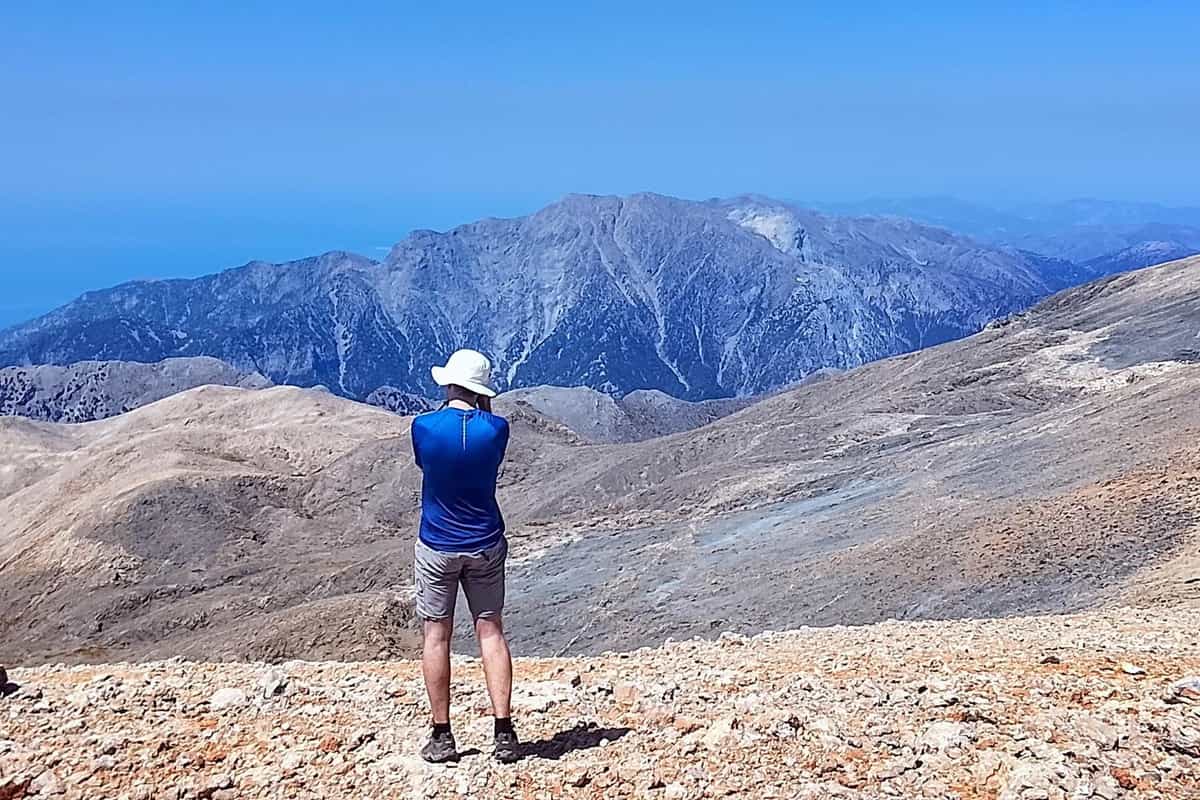
A Chania hiking tour walks the mountains, gorges and old paths of west Crete, above all the Lefka Ori, the White Mountains. The tour is one of the Greece Tours on Greece Ville, listed with the other Crete tours and Greece hiking tours.
This post covers the rocks and caves of the trails, the paths of the shepherds, the trees, the birds of prey, and the revolts and wars of the mountains.
What the body needs on a hike, the best months and common questions come last. The sections include Chania hiking tours that can be booked online.
What is a Chania hiking tour?
A Chania hiking tour is a walk on the Lefka Ori trails. Wikipedia calls the central and southern Lefka Ori a high desert with no match in the northern hemisphere. Pachnes, the top summit, is named after the Greek word for morning dew.

In Cretan speech, that word can also mean fog. No smooth path crosses the high Lefka Ori. The Chania club describes treeless ground of sharp stones and huge gravel fields.
The Chania mountaineering club was founded on 28 September 1930. It began as a branch of the Hellenic Mountaineering Association. Ten branches, including Chania, formed the Greek mountaineering federation in late 1931. The Austrian alpine school of Innsbruck helps keep Kallergi refuge in top shape.
The Chania club grades its routes on a seven-step scale. For a Chania hiking tour, grade 1 means up to 500 m of climb. Grade 4 routes climb more than 1,000 m.
- Plus sign: It marks routes with snow and ice slopes of 40° or more.
- Volika refuge: This mountain hut for walkers can host up to 30 people.
- Federation today: The Greek federation now counts about 80 clubs across Greece.


Which rocks form the trails of a Chania hiking tour?
A Chania hiking tour crosses Plattenkalk, a marble that splits into thin plates. This rock holds lumps or layers of chert, a hard flint-like stone. On Crete, Phyllite-Quartzite rocks, including the Trypali unit, lie on top of the Plattenkalk.
The Lefka Ori forms a broad upward fold running roughly east to west. Plattenkalk is the lowest, outermost rock sheet of the Hellenides, the Greek mountain belt. Its base is nowhere exposed.
The lower rock sheets were squeezed under high pressure as one crust plate sank below another. This happened in the Late Oligocene to Miocene, and the rocks were then raised quickly.
The Pachnes Thrust, a fault under the Chania hiking tour trails, moved rock about 12 km sideways. Cavers traced this fault inside Gourgouthakas cave, 700 m below the surface. Tzani cave on the Omalos plateau runs about 3 km long and 281 m deep.
- Phyllite: This silky rock takes its name from the Greek word phyllon, meaning leaf.
- Deep cave: The Cave of the Lion reached 1,110 m deep in 2008.
- Mavro Skiadi: Found in 1974, it drops 342 m, one of the world’s biggest vertical descents.
How did shepherds shape the paths of a Chania hiking tour?
A Chania hiking tour follows kalderimia, paved mule roads that linked villages and even sheepfolds. Crete alone had thousands of kilometres of these roads. Mitata, the stone huts of shepherds, stand in the Lefka Ori and on Psiloritis.
The kalderimia of a Chania hiking tour climb on upright stone steps, with retaining walls holding their slopes. On steep climbs, they zigzag, with low walls beside drops and paved stream crossings.
The name kalderimi comes from Turkish kaldirim, meaning pavement. A folk story reads it as Greek kalos dromos, good road. The old mule roads ran up and down mountainsides to villagers’ fields.
The domed mitata of a Chania hiking tour, built of stone alone, still stand after about 300 years. Their roof slabs sit one above another, tilted outward so rainwater runs off.
- Thyrides: These small stone cupboards in hut walls held weapons, tools and food.
- Antonis Plymakis: His 630-page book on shepherds and their huts appeared in Chania in 2008.
- Cheese trade: Writers named the White Mountains the main source of Crete’s cheese exports.
Which trees shade the trails of a Chania hiking tour?
A Chania hiking tour in the White Mountains, the Lefka Ori, passes zelkova, maple and kermes oak. Cretan zelkova, Zelkova abelicea, is a tree of the elm family, Ulmaceae. Cretan maple, Acer sempervirens, is one of the rare maples that stay green all year.
Cretan zelkova grows in four mountain areas of Crete: the Lefka Ori, Psiloritis, Dikti and Thrypti. A Chania hiking tour meets it at the upper timberline, where forest ends, mainly on north-facing slopes.
Cretan maple grows up to 10 metres tall, with a trunk up to 50 centimetres across. It lives in the mountains from 300 to 1,700 metres above sea level.
Mediterranean cypress holds little resin, so it does not easily catch or spread fire. Near Theriso village, a Chania hiking tour finds a small cypress forest in Natura site GR4340007.
- Zelkova roots: Cretan zelkova spreads by suckers, new shoots that rise from its roots.
- Maple leaves: Cretan maple leaves are hard and leathery, 1 to 4 centimetres long.
- Thergi gorge: Oriental planes and oleanders line its seasonal stream in west Crete.
Which birds fly over a Chania hiking tour?
A Chania hiking tour passes under bearded and griffon vultures, golden eagles and Alpine choughs. Natura site GR4340016 covers 6875.01 hectares of Agios Dikaios, Tsounaras and the Vitsilia of the Lefka Ori. Golden eagles, griffon vultures and bearded vultures breed on its Mount Koutroulis.
Bearded vultures over a Chania hiking tour have a rusty orange colour. They get it by dust-bathing or rubbing iron-rich mud on their feathers. Wild bearded vultures live 21.4 years on average.
Female bearded vultures lay one or two eggs in mid-winter. The eggs are kept warm for 53 to 60 days. Chicks then spend 100 to 130 days in the nest.
Greece has nearly 1000 Eurasian griffon vultures in all. On Crete, they live in mountain areas, at times in groups of up to 20. They lay a single egg.
- Bone diet: A bearded vulture’s stomach acid digests large bones in about 24 hours.
- Homeyeri: Crete’s golden eagles are this Iberian form, missing from the rest of continental Europe.
- Alpine choughs: These mountain crows have nested at 6,500 metres, higher than any other bird.
How did revolts and war mark the mountains of a Chania hiking tour?
A Chania hiking tour crosses mountains marked by revolts in 1770 and 1905 and war in 1941. The Sfakia revolt began on 25 March 1770, when rebels attacked Kydonia, Apokoronas and Agios Vasilios. In February 1905, Venizelos met seventeen other Cretan leaders at Theriso.
A Chania hiking tour reaches Theriso through narrow gorges that guard the way in. Venizelos chose it for this reason, and the gorge caves gave the rebels natural shelter.
From Theriso, the rebels ran a temporary government that printed its own postage stamps and newspaper. When the revolt ended, the rebels handed over 800 guns.
In the war, British agents formed small resistance groups across the mountains, linked by local message runners. George Psychoundakis, a shepherd from Asi Gonia, was one of these runners.
- After Theriso: Fame led Greece to call Venizelos in 1909, and he became Prime Minister.
- Layforce: Only 179 of about 800 Layforce commandos who landed at Souda got off Crete.
- Night run: Psychoundakis ran from Kastelli-Kissamou to Paleochora in one night, 45 km by today’s road.
What does the body need on a Chania hiking tour?
A Chania hiking tour calls for water, salt and shade. In hot weather, WHO advises a cup of water hourly. It also advises at least 2 to 3 litres a day. Sweat carries about 0.9 grams of sodium per litre.
On a Chania hiking tour, an adult can sweat 2 to 4 litres an hour at peak. Moving to a hot climate raises peak sweating and lowers the salt in sweat.
Drinking more water than the kidneys can pass during long exercise dilutes blood sodium. This low sodium is called exercise-associated hyponatremia. Exercise over four hours and unusual heat raise the risk.
On a Chania hiking tour, shade can lower how hot a person feels by more than 10 °C. In exertional heatstroke, caused by hard effort, the person can still sweat.
- Sun: WHO says the sun can make it feel 10 to 15 °C hotter.
- Dehydration: Losing 5 to 8% of body water can cause tiredness and dizziness.
- Feet: Damp skin blisters more easily than dry or soaked skin.
Which months suit a Chania hiking tour?
A Chania hiking tour suits April and late spring for wildflowers. Cretan sowbread, Cyclamen creticum, flowers then in shady rocky places and gullies. Autumn suits it too, when the smooth crocus, Crocus laevigatus, opens pale lilac or white petals.
On a Chania hiking tour, dry air that rises cools 9.8 °C per kilometre of height. Rising moist air cools more slowly, at about 5 °C per kilometre.
Melted White Mountains snow yields about 25 to 27 million cubic metres of water. That is about 1.5% of Chania’s water resources. Satellite maps show the peak snow date changing yearly.
Cretan ebony, Ebenus cretica, flowers bright pink on rocky hillsides from late March to June. The Cretan rock lettuce, Petromarula pinnata, flowers pale blue in April and late spring.
- Winter: The crown anemone flowers from winter into early spring in the Mediterranean.
- April to October: Oleander blooms in Mediterranean climates, peaking in late spring and June.
- Autumn: Sea squill raises a tall autumn flower spike after its spring leaves die.
What do visitors ask about a Chania hiking tour?
A Chania hiking tour prompts questions on plants, scorpions, snakes and fire risk. All wild orchids in Greece are protected under Presidential Decree 67/1981. Crete’s cat snakes are a pale subspecies, Telescopus fallax pallidus, also found on Gavdos.
Can hikers pick wild orchids on a Chania hiking tour?
No. Presidential Decree 67/1981 bans collecting, uprooting or destroying wild orchids. The yellow bee orchid, Ophrys lutea, is one protected example. Goulimy’s tulip grows at Falasarna in western Crete. The Bern Convention and the decree protect it.
Are scorpions a danger on a Chania hiking tour?
Crete’s scorpions include Euscorpius carpathicus, whose common form has venom no stronger than a mosquito bite. Smaller Euscorpius scorpions cannot always pierce human skin. Scorpions are active at night, shelter under rocks and in caves, and sting when disturbed.
What do fire risk colours mean for a Chania hiking tour?
The daily Greek fire risk map uses green, blue, yellow, orange and red. Category 2 means typical summer risk, manageable by emergency services. Category 3 warns of wildfires that strong winds or rough terrain can make hard to control.
Who handles fires and rescues near a Chania hiking tour?
The Hellenic Fire Corps has fought forest fires since 1998, taking over from the Forestry Service. Its EMAK unit, built for catastrophes, does heavy search-and-rescue and technical rescue work. The Fire Corps operates 20 helicopters and 44 firefighting aircraft.