
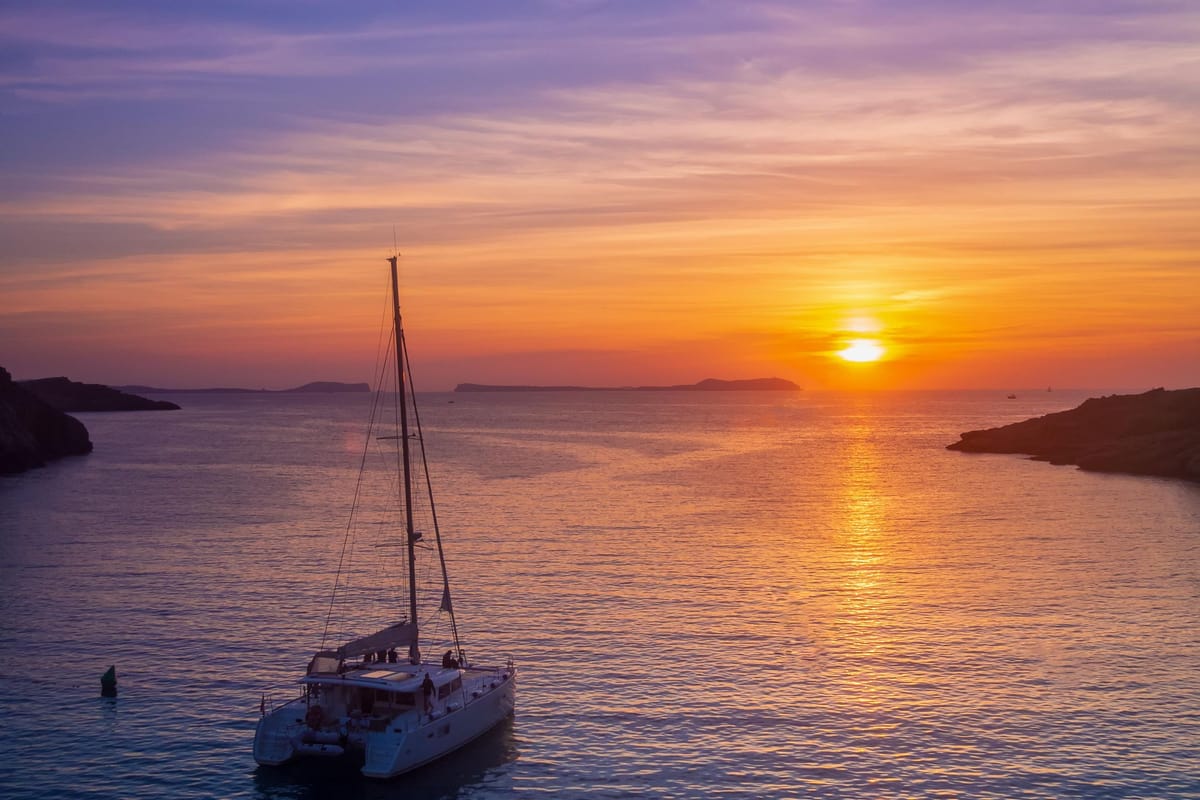
A Santorini sunset tour watches the sun go down over the caldera of Santorini, by boat or from the cliff villages such as Oia. The tour is one of the Greece Tours on Greece Ville, listed with the other Santorini tours.
This post covers when and where the sun sets, why the sky turns red, the green flash, the stars and planets that follow, the colours of the cliffs and the earthquake of 1956.
How Oia became the sunset village, crowds and cruise ships, winds and waves, the wrecks of the caldera, the best months and common questions come last. The sections include Santorini sunset tours that can be booked online.
What is a Santorini sunset tour?
A Santorini sunset tour is an evening trip to watch the sun set. The island’s latest sunsets come every evening from 21 June to 5 July. Its earliest come from 30 November to 12 December, before the winter solstice.

At noon on the June solstice, the sun stands about 77 degrees above Santorini’s horizon, close to overhead. At noon on the December solstice, it climbs only about 30 degrees.
Santorini’s longest days run from 18 to 24 June, each with 14 hours 39 minutes of daylight. Its shortest days, 21 and 22 December, bring 9 hours 40 minutes of daylight.
On Santorini, the latest sunrises come at 07:30 local time, from 31 December to 13 January. The earliest come at 06:00 summer time, from 7 to 20 June.
At the June solstice, nautical twilight, the middle stage of dusk, ends at 21:48 summer time. On a Santorini sunset tour that evening, astronomical twilight ends at 22:31, when full night begins.
- Winter dusk: On the December solstice, civil twilight, the first stage of dusk, ends at 17:35.
- Nautical twilight: On that date, nautical twilight over Santorini ends at 18:08.
- True night: December solstice astronomical twilight ends at 18:39, and true night follows.
Places within about 48°34′ of the Equator, Santorini included, see twilight every morning and evening. Daily weather changes how much air bends sunlight, so sunset times mean little beyond the nearest minute.



Why does the sky turn red on a Santorini sunset tour?
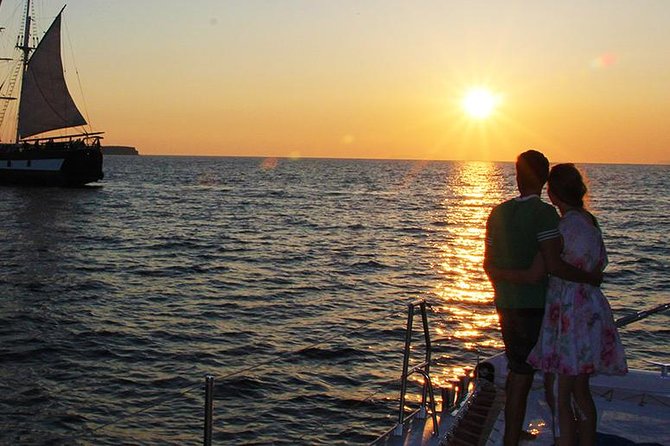
A Santorini sunset tour shows a red sky because air scatters blue light far more than red. The strength of this Rayleigh scattering is inversely proportional to the fourth power of the light’s wavelength. Dust clouds make sunsets more colourful.
Around 1506–1510, Leonardo da Vinci suggested that small particles scattering sunlight made the sky blue. In 1869, John Tyndall found that light scattered by tiny particles took a faint blue tint.
The Sahara is the world’s largest source of wind-blown dust, at roughly 400-700 million tons a year. Intense desert dust episodes reach the Mediterranean Basin up to 11.4 times a year.
Saharan dust grains from one storm measured 100 nanometres to 50 micrometres across. Rayleigh’s model stops working once particles grow past about 10% of the wavelength. Larger ones follow Gustav Mie’s theory.
On a Santorini sunset tour, purple light belongs to the afterglow, the glow after the sun sets. It shows mainly when the sun is 2 to 6 degrees below the horizon.
- Krakatoa: After its 1883 eruption, vivid red sunsets brought fire engines out in New York.
- Munch’s The Scream: In 2004, an astronomer proposed its 1893 red sky shows Norway after Krakatoa.
- Pinatubo: Its June 1991 eruption sent about 17 million tonnes of sulfur dioxide skyward.
Greek researchers compared red-to-green colour ratios in sunsets painted from 1500 to 1900 with volcanic dust records. They found a 0.8 correlation, a measure of how closely the two match.
What is the green flash on a Santorini sunset tour?
A Santorini sunset tour can show the green flash, a green light atop the setting sun. Air bends each colour of sunlight by a slightly different amount, like a prism. It scatters blue out of view, so green is the last colour seen.
On every Santorini sunset tour, a green rim sits on the sun’s upper edge. This rim is too thin for the naked eye. The sun’s lower rim is always red.
A mirage, a trick of light in layered air, magnifies the rim. It stretches the flash from a split second to a couple of seconds. It shows up more in stable, clear air.
A Santorini sunset tour close to sea level can catch an inferior-mirage flash, lasting 1 or 2 seconds. It needs the surface to be warmer than the air above it.
A mock-mirage flash favours high viewpoints over a surface colder than the air. A sub-duct flash gives the sun an hourglass shape. Its upper part can stay green for up to 15 seconds.
- Antarctica, 1934: Byrd’s party at Little America saw a green spot on and off for 35 minutes.
- Vatican, 1960: D. J. K. O’Connell took the first colour photograph of a sunset green flash.
- Jules Verne: His 1882 novel The Green Ray helped make the green flash famous.
The best time to look for the green rim is about 10 minutes before the sun sets. Even then, the search is never made through binoculars or a telescope.
Which stars and planets follow a Santorini sunset tour?
A Santorini sunset tour is followed by Venus, which shows up near sunset or sunrise. That is because it always stays within about 47° of the Sun in the sky. The ancient Greeks called Jupiter Phaethon, meaning “shining one”.
Venus is the Evening Star seen after a Santorini sunset tour. Every 584 days, Venus overtakes Earth and becomes the Morning Star. The ancient Greeks took them for two stars, Phosphorus and Hesperus.
Venus has a greatest elongation, or widest gap from the Sun, of 45° to 47°. Mercury’s gap is only 18° to 28°. At its brightest, Venus reaches magnitude −4.92 on the brightness scale.
Hesperus means “evening” in ancient Greek, and myth made him a son of Eos. Pliny the Elder credited Pythagoras with seeing that the two were one object. Diogenes Laërtius named Parmenides instead.
Modern Greek names Jupiter Dias, after Zeus. Jupiter, also in a Santorini sunset tour sky, circles the Sun in 11.86 years. The Babylonians used its roughly 12-year path to set out their zodiac.
- Arcturus: The name comes from the Greek Arktouros, meaning “Guardian of the Bear”.
- Antares: Its name means “rival to Ares”, since its reddish colour looks like Mars.
- Canopus: The second-brightest night star can in theory be seen only south of 37°18′ north.
The word galaxy comes from the Greek galaxías kýklos, “milky circle”. In myth, milk from Hera’s breast, spilled as she pushed away the infant Heracles, formed the Milky Way.
Why do the caldera cliffs change colour on a Santorini sunset tour?
A Santorini sunset tour reveals cliffs that change colour because the eye changes at dusk. As light fades, the colour the eye sees best shifts toward blue, so reds look darker. This is the Purkinje effect, after the Czech anatomist Jan Evangelista Purkyně.
On a Santorini sunset tour, red petals can look dark red or black at dusk. Green leaves look bright at the same hour, which is the reverse of the daytime view.
Hematite, an iron oxide, is rust-red in its common form. Its name comes from the Greek haima, meaning blood. Whatever its outer colour, hematite always leaves a rust-red streak, or powder mark.
Ochre is clay coloured by 20 to 70% hematite. Red ochre holds unhydrated hematite, and yellow ochre holds hydrated, or water-bound, hematite. Goethite, the main part of rust, ranges from yellowish to dark brown.
Near Oia, a red agglomerate, a rock of volcanic chunks, caps the northern caldera wall. This layer, seen on a Santorini sunset tour, is called the Upper Scoriae 2 unit.
- Pumice: This pale rock was once called spuma maris, “froth of the sea”.
- Scoria: It has larger gas holes, thicker walls and a darker colour than pumice.
- Minoan blocks: Black, glassy andesite blocks in the Minoan deposits are fragments of older Santorini.
Mafic rocks, rich in iron and magnesium, tend to be dark. Felsic rocks, rich in silicon and aluminium, tend to be light. Rhyolite, a lava rich in silica, is light in colour.
How did the 1956 earthquake reshape the villages of a Santorini sunset tour?
A Santorini sunset tour passes villages that the 1956 earthquake damaged and a rebuilding programme renewed. It brought repairs, new houses and renovated churches, schools, museums and community centres. The quake reached intensity IX on the Mercalli scale of shaking.
Oia, a village of a Santorini sunset tour, stands on the cliff’s youngest layer, made of pumice. This poorly consolidated, or loosely packed, pumice makes weak foundations for cliff-top homes.
The newly built Hotel Atlantis came through unharmed. It served as a temporary hospital and a home for public services. Greece turned down a British offer of warships from Cyprus.
Before 1956, Fira’s archaeological museum used a building raised in 1902 through the efforts of Hiller von Gaertringen. The 1956 quake destroyed it. Fira’s old cathedral, Panagia tou Belonia, collapsed in 1956.
New building then spread across the villages of a Santorini sunset tour. Its neo-vernacular style, a revival of local forms, was at times overdone. Vaults added to every hotel room were one example.
- Episkopi Gonias: The quake almost entirely destroyed this village in 1956.
- Other islands: Astypalaia, Anafi, Kalymnos, Leros, Amorgos and Patmos also suffered wide damage.
- Amorgos: The sea drew back so far that people crossed Katapola Bay on foot.
The 1956 wave was the largest tsunami in the Mediterranean in the past two centuries. It reached Crete, the Peloponnese and western Turkey. A tide gauge in Israel recorded it.
How did Oia turn into the sunset village of a Santorini sunset tour?
A Santorini sunset tour can end at Oia, whose castle is recorded as early as 1480. Oia became the seat of its own municipality on 10 March 1835. Tourism on Santorini began to grow in the 1960s and peaked in the mid-1980s.
In the mid-17th century, the French traveller Jean de Thévenot called the village Castelli San Nicolas. On 16 October 1940, the official register changed its name from Oia (Epano Meria) to plain Oia.
In 1852, Santorini’s merchant fleet had 200 ships of 14,755 tonnes in all. Big ships carried grain from Russia, unloaded part at home, then sailed on to France, Italy and England.
A Santorini sunset tour passes an island where wine once made up 85% of exports. On Paros, wine stood at 60%. Greek sailing ships held strong until the 1880s, but steamships gained ground quickly from 1875.
Oia’s economy declined in the early 20th century because of wars, economic depression and overfishing. At the 1928 census, the Oia area counted 1,416 inhabitants.
- 1807: The Ottoman government made Santorini send 50 sailors to its naval base, like Mykonos.
- 1821: In late April, Santorini sent 71 sailors, a priest and Nikolaos Dekazas to Spetses ships.
- 1986: Work by the Greek tourism body in Oia won a prize at the Sofia Architecture Biennale.
The actress Olivia de Havilland visited Santorini in September 1955, at the invitation of Petros Nomikos. Today, Oia’s community works with geologists from the Universities of Athens and Thessaloniki to test the ground.
How do crowds and cruise ships affect a Santorini sunset tour?
A Santorini sunset tour shares the caldera with cruise ships. In 2019, Santorini’s port logged 592 cruise ship arrivals and 980,771 cruise passengers. A European Parliament transport committee report warned that unregulated tourist flows can harm the island.
In 2020, only 3 cruise ships called at Santorini, carrying 131 passengers. In 2021, 191 arrivals brought 104,074 passengers. In 2022, 686 arrivals brought 826,602 passengers.
August is the busiest month for the port of a Santorini sunset tour. The port fund’s chart gives it 116 ship arrivals and 162,019 passengers. Those ships arrived 73.22% full. January and February each saw just one cruise ship.
The European Parliament report counted 5.5 million overnight stays on Santorini in 2017. That was up from 3.3 million in 2012. It blamed weak enforcement and caps that failed to keep numbers at an acceptable level.
- Fee law: Greece’s cruise passenger fee rests on Article 27 of Law 5162.
- Peak season: The fee’s top rate runs from 1 June to 30 September.
- Payment: The fee is paid only through an electronic slip with an RF payment code.
The cruise fee applies to every passenger who lands, whatever their age, on transit and home-port calls. The money funds the municipalities of the landing ports and adds to the state budget.
Which winds and waves meet a Santorini sunset tour?
A Santorini sunset tour meets the meltemi, the Etesian north wind of the Aegean summer. Santorini is the southernmost island of the Cyclades, yet it is the coldest. North-east winds are the main reason. Etesian summer waves are as steep as winter waves.
In late spring and early June, light north winds called forerunners blow for 2-3 weeks. A fresh Etesian spell, called an outbreak, starts when high pressure reaches the Balkans behind a cold front.
During an outbreak, the wind blows hard day and night for one to seven days in a row. As it fades, the wind settles into a daily cycle. It runs about 7.5 m/s at noon and under 5 m/s at midnight.
Over the central and eastern Aegean, the daytime sea breeze blows the same way as the Etesians. It adds to their strength. At a central Aegean point, two datasets put median July and August speeds at 6.8 and 7.1 m/s.
A Santorini sunset tour sails below Oia, where people dug cave houses into the soft caldera slopes. They did so partly to shelter the village from strong winds.
- Etesian day: It needs a 315 to 45 degree wind above median speed, two days running.
- Volcanoes: Model studies show strong eruptions cut Etesian wind speed and days in July and August.
- Islands: In the Aegean, the islands shadow the waves as they travel across the sea.
Observed Etesian winds have weakened in recent decades. Climate models project more Etesian days in a warmer climate. In summer, the Aegean and Levantine basins get the Mediterranean’s highest waves, close to winter levels.
Which wrecks lie in the caldera of a Santorini sunset tour?
A Santorini sunset tour crosses the caldera where the Sea Diamond wreck lies. It went down beside Cape Alonaki, at the northern end of Athinios bay. The hull hangs from a rock by its propeller, on an underwater cliff edge.
Valmet built the Sea Diamond under the name Birka Princess at the Vuosaari shipyard in Helsinki, Finland. From 1992 to 2002, the ship’s outside played MS Freja in the Swedish TV soap opera Rederiet.
Beneath a Santorini sunset tour lies a ship 142.95 m long and 24.70 m wide. A later survey put the reef 131 m from shore, not 57 m as the official chart said.
That chart showed water 18 to 22 m deep at the reef, but the survey found 5 m. The ship’s 19 watertight doors stayed open all voyage, against its own safety management system.
Floating booms ring the site, so rising oil and chemicals cannot spread. The wreck in a Santorini sunset tour’s caldera holds mercury from 5,610 fluorescent lamps. It also holds radioactive parts in 1,050 smoke detectors.
- Waste: The European Commission declared the sunken Sea Diamond waste on 24 June 2008.
- Removal: A 2011 study by the Technical University of Crete called for the wreck’s removal.
- Greek waters: Survey and photography dives on shipwrecks need permission from the Ephorate of Underwater Antiquities.
Two French passengers, a 45-year-old father and his 16-year-old daughter, were never found. At the first trial, the captain got 12 years and 2 months in prison. A later retrial set 36 months.
Which months suit a Santorini sunset tour?
A Santorini sunset tour suits June to September, with hardly more than one rain day a month. June days at Santorini’s HNMS weather station have logged up to 13.6 hours of sunshine. From December to February, Santorini averages up to nine rain days a month.
On 15 January, the sun sets at Oia at 17:26. Civil twilight, the bright sky after sunset, ends at 17:54. On 15 February, the sun sets at Oia at 17:59, with twilight ending at 18:25.
For a Santorini sunset tour on 15 March, the sun sets at Oia at 18:25. On the last day of winter time in late March, the sun sets there at 18:34.
On the first day of summer time in late March, sunset at Oia jumps to 19:35. Summer time ends in late October, and on its last day the sun sets at 18:27.
Once the clocks go back at the end of October, sunset at Oia falls to 17:26. On 15 November, the sun sets at Oia at 17:10, and civil twilight ends at 17:38.
- February: Days at the HNMS Santorini station average 5.6 hours of sunshine.
- March: The same station averages 6.8 hours of sunshine a day.
- November: The station records 6 hours of sunshine a day on average.
Relative humidity, the dampness of the air, averages 71.6% in November, the dampest month. A Santorini sunset tour in early December catches the sun going down at Oia at 17:03.
What do visitors ask about a Santorini sunset tour?
A Santorini sunset tour raises questions about the sky, drones, eyes, emergency calls and ship safety. EU open-category rules forbid flying any drone over assemblies of people. A UV index of 0 means zero UV radiation, as at night.
What appears in the sky after the sun sets on a Santorini sunset tour?
Earth’s shadow, the dark band opposite the sunset, shows best over a low horizon like the sea. It looks sharper the higher the viewer stands. The pink Belt of Venus looks more vivid in winter, as colder air holds less moisture.
Can drones fly near the crowds on a Santorini sunset tour?
A C2-class drone under 4 kg must keep 30 m from uninvolved people. In low-speed mode, that gap shrinks to 5 m. Drones labelled C3 and C4 must keep 150 m from uninvolved people and urban areas.
How does the sun harm the eyes on a Santorini sunset tour?
Photic retinopathy is damage to the retina, mainly the macula at its centre. It comes from long exposure to sunlight or other bright light. The WHO warns that more UV radiation can reach and damage the retina of children.
Which emergency number works on a Santorini sunset tour?
CEPT, the body of European postal and telecom administrations, recommended 112 as the pan-European emergency number in 1976. The number 112 uses two different digits. This cuts accidental calls compared with numbers that repeat one digit.
What Greek ship safety rules matter for a Santorini sunset tour?
After the Express Samina disaster, Greece cut the ferry retirement age from 35 to 30. Greek ships over 30 years old face strict safety standards and regular inspections. Passenger ferries in Greece must now carry voyage recorders, a ship’s black box.