
Olympia tickets open the ancient sanctuary of Zeus in the Peloponnese, with the Temple of Zeus, the Heraion, the Philippeion, the stadium, the workshop of Pheidias and the Archaeological Museum of Olympia. The post is one of the Greece Tours on Greece Ville, listed with the other Greek archaeological site tickets and Peloponnese tours.
This post covers what the tickets include and how a visit works, the temples, the Philippeion and Prytaneion, the stadium and Krypte, the palaestra and gymnasium, the museum and the formats on sale. Common questions come last.
What do Olympia tickets cover, and how does a visit work?
Olympia tickets open the archaeological site of Olympia in Elis, where the ancient Olympic Games took place, together with the museums that hold its finds. A visit starts at the main gate and continues on foot along the paths between the ruins.
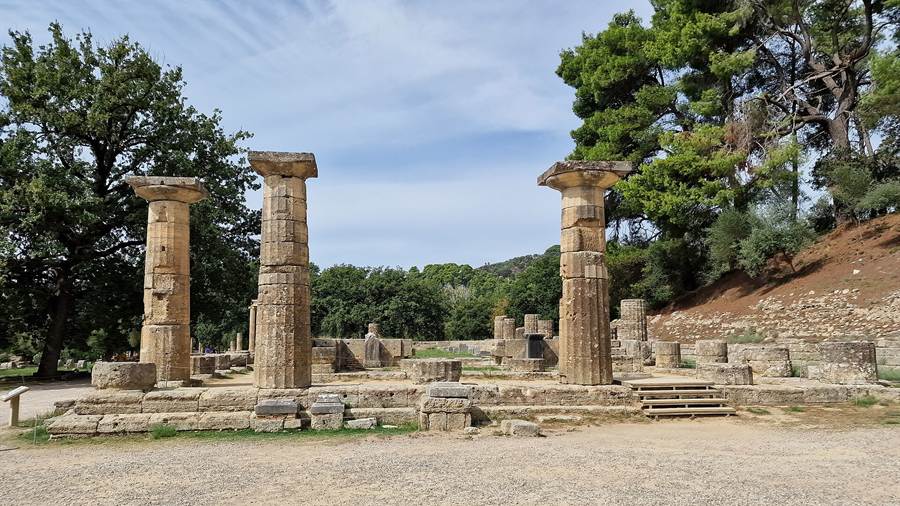
The small town of Olympia lies in Elis on the Peloponnese peninsula. The village services the adjacent archaeological site, which lies to its southeast, and the village appears to have been inhabited continuously since ancient times.
The Kladeos River forms the western border of the site. Visitors walk over the bridge across the river and then stand in front of the main gate, where the walk through the ruins begins.
Seeing the full site requires extensive walking. Excavations also run at the site from time to time, so archaeologists work beside the paths that Olympia tickets open to visitors, and the ground changes as they dig.
Moveable artifacts from the site are mostly housed in its three museums. Olympia tickets therefore lead to two kinds of sight, the open ruins in the valley and the finds on display under cover.
- Town: The village next to the ruins appears to have been inhabited without a break since ancient times.
- Border: The Kladeos River marks the western edge of the archaeological site.
- Gate: A bridge leads visitors across the river to the main gate.
- Digs: Excavations frequently continue in parts of the site.
These points set out what Olympia tickets give access to and how a visit proceeds. The Ancient Olympia tour post covers a walk through the same sanctuary, building by building.
What do Olympia tickets show of the Temple of Zeus and the Heraion?
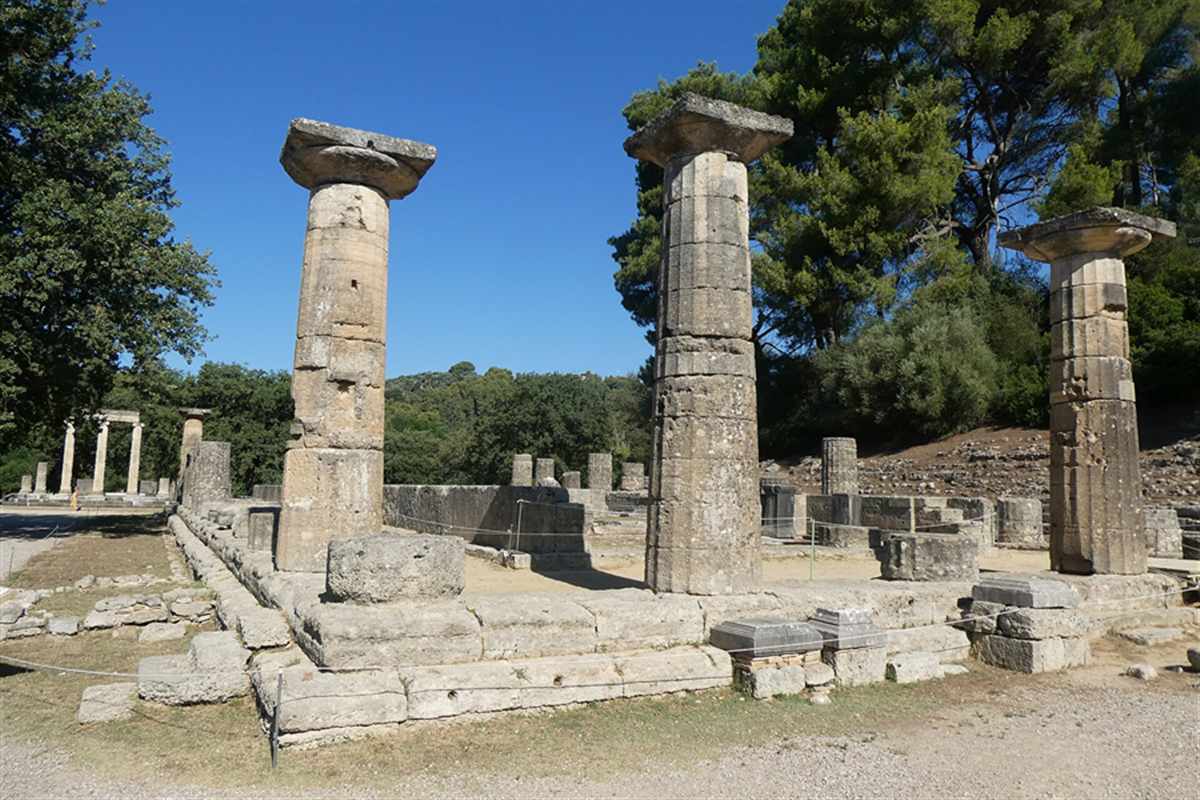
Olympia tickets lead to the ruins of the Temple of Zeus and the Temple of Hera, called the Heraion. Both are Doric buildings in the sacred precinct, and they differ in age, in size and in the stone, wood and clay of their parts.
The Temple of Zeus stood on a platform of three unequal steps, and a ramp on the east side led up to it. Two rows of seven columns divided the inner chamber into three aisles.
The sculpture of the temple used imported Parian marble and the Severe style, now attributed to the Olympia Master and his studio. French archaeologists took fragments of the metopes to the Louvre in 1829.
The Elean account says the people of Skillous in Triphylia built the Heraion. Its walls had a bottom course of stone under a mudbrick superstructure, and its roof followed the Laconian style.
Pausanias saw an oak column still standing in the rear chamber of the Heraion in 173 AD. Its capitals differ from one another, and one shaft has a different number of flutes.
- Platform: The Temple of Zeus rose from three steps of unequal height.
- Marble: The sculpture of the Temple of Zeus came from the island of Paros.
- Size: The Heraion measures 19 by 50 metres at platform level.
- Roof: Disk acroteria 2.5 metres across crowned the pediments of the Heraion, and one is in the museum.
Olympia tickets thus reach two temples with very different histories, one built on timber and the other on a grand stone plan. The two buildings frame the sacred precinct of the sanctuary.
What do Olympia tickets show of the Philippeion and the Prytaneion?
Olympia tickets lead to the Philippeion and the Prytaneion in the north of the sacred precinct. The Philippeion was a round memorial to the royal house of Macedon, and the Prytaneion was the hall where the winners of the games feasted.
The Philippeion was a tholos of limestone and marble. The Athenian sculptor Leochares made it as a memorial to the victory of Philip II at the battle of Chaeronea in 338 BC.
Its outer colonnade had 18 Ionic columns, and nine engaged columns of the Corinthian order stood inside. The building had a diameter of 15 metres, and its marble roof tiles carried a bronze poppy.
Work began under Philip and ended under Alexander the Great. Alexander ordered gold and ivory statues of Philip, Alexander, Olympias, Amyntas III and Eurydice I. It was the only structure in the precinct for humans.
The Prytaneion was built in 470 BC at the northwest of the site. It housed the Altar of Hestia, where the original Olympic flame once burned, and the winners held celebrations and feasts there.
- Shape: The Philippeion was a circular building with a diameter of 15 metres.
- Columns: Eighteen Ionic columns stood outside and nine Corinthian columns inside.
- Dig: Alfred Mallwitz found the location of the Prytaneion between 1972 and 1984.
- Hearth: The Altar of Hestia stood in the Prytaneion.
Olympia tickets therefore connect royal politics with the rituals of victory. The round Macedonian memorial and the hall of the winners stand close together in the north of the precinct.
What do Olympia tickets show of the stadium and the Krypte?
Olympia tickets lead to the ancient stadium east of the sanctuary of Zeus and to the Krypte, the vaulted passage beside it. The track is 212.54 metres long, and the field hosted the running races of the ancient games.
The field of the stadium is 30 to 34 metres wide. Its track was made of hard-packed clay, and the clay gave the runners grip in every running event.
A white block lay at one end of the track. The athletes lined up their feet against it, so that all of them ran exactly the same distance.
The original stadium extended well within the later east wall of the precinct, so the precinct varied in size. Between 1952 and 1966 Emil Kunze and Alfred Mallwitz excavated the north wall of the stadium.
The Krypte is a long and narrow vaulted passage. The athletes and the judges entered the stadium through it, which marked the opening of the games, and a commemorative coin of 2003 shows it.
The stadium returned to use at the 2004 Summer Olympics, when the shot put events took place there. The sport needed the least disruption at a sensitive archaeological site.
- Length: The track measures 212.54 metres.
- Width: The field is 30 to 34 metres wide.
- Surface: Hard-packed clay formed the running surface.
- Block: A white block marked the starting line for the feet.
Olympia tickets thus end the walk at the place where the athletes competed. The field, the block and the passage show how a race began.
What do Olympia tickets show of the palaestra, gymnasium, Leonidaion and workshop of Pheidias?
Olympia tickets lead to the buildings for training and lodging at Olympia, among them the palaestra, the gymnasium and the Leonidaion, and to the workshop where Pheidias made the statue of Zeus. Each building served the athletes or the sculptor.
The palaestra of Olympia dates to the third century BC. A palaestra was a school for wrestling, with a rectangular court inside colonnades, and boxing and wrestling took place there.
The gymnasium followed in the second century BC. The excavation of the gymnasium, the South Stoa and the bath complex began in 1936 under Emil Kunze and Hans Schleif.
The Leonidaion was built around 330 BCE and was the largest building on the site. It lodged athletes, and the architect Leonidas of Naxos funded it, designed it and gave it his name.
The Leonidaion had four Ionic colonnades with 138 columns, and its sides measured about 80 metres. Inside stood a Doric peristyle of 44 columns. An earthquake in the late third century AD destroyed it.
The workshop of Pheidias yielded tools for working gold and ivory, ivory chippings, precious stones and terracotta moulds. The moulds shaped glass plaques that formed the robe of the statue.
- Palaestra: The building dates to the third century BC.
- Gymnasium: The building dates to the second century BC.
- Leonidaion: Its wreckage went into a late wall built against the Herules.
- Cup: A cup inscribed as belonging to Phidias came from the workshop, though scholars dispute it.
Olympia tickets thus show where athletes trained, where they slept and where the great statue took shape. The plans explain daily life at the games.
What do Olympia tickets show of the Archaeological Museum of Olympia?
Olympia tickets lead to the Archaeological Museum of Olympia, one of the principal museums of Greece. The Ministry of Culture and Sports oversees it, and its main building shows finds from the prehistoric period to the time of Roman rule.
The museum stands in two buildings. The principal building holds the exhibition rooms, and the other building holds the museum store and stands apart on the path to the archaeological site.
The collection falls into four groups: terracottas of the prehistoric, Archaic and Classical periods, bronzes, sculptures from the Archaic period up to the Roman, and a collection from the Olympic Games.
Notable holdings include the Winged Gorgoneion and the group of Zeus carrying Ganymedes. The pediments of the Temple of Zeus also belong to the display, beside a miniature bronze statue of a horse.
The museum also keeps an oenochoe that belonged to Phidias. The extent of the bronze collection makes the museum one of the world’s important holders of ancient bronzes.
The first major dig of 1875 recorded 14,000 objects, and the finds went on display in a museum on the site. Olympia tickets therefore lead to a collection that grew with every season of work.
- Terracottas: The group spans the prehistoric, Archaic and Classical periods.
- Bronzes: The bronze holdings rank among the important collections of the world.
- Sculptures: Works range from the Archaic period to Roman times.
- Games: A separate collection holds objects from the Olympic Games.
Olympia tickets that include the museum complete the visit to the ruins. The Ancient Messene tour post covers another ancient city of the Peloponnese.
Which formats of Olympia tickets are on sale?
Olympia tickets are on sale as plain entry to the site and museum, as entry with an audio tour or virtual reality, and as outings from Athens and from the cruise port of Katakolo, with tastings and lunches added.
The simplest format is an e-ticket for the archaeological site and the museum with an audio tour. A second entry ticket pairs the site and the museum, and a third adds a virtual reality audio tour.
A further format uses virtual reality glasses with an audio tour. Another is a walk titled around the birth of the Olympic flame, and a third is led by an archaeologist through the site and museum.
Cruise passengers at Katakolo find the largest set. The formats include a roundtrip transfer, a transfer with virtual reality, a bus tour with free time, a shared minibus and a private transfer with a local host.
Other formats add food. They include an olive mill with an oil tasting, a group tour with a tasting, an olive grove with a family lunch, a beach stop at Kourouta, and a boutique outing with wine.
- Entry: Tickets for the site and the museum, with an audio tour or virtual reality.
- Port: Transfers, bus tours and minibus outings from Katakolo.
- Athens: A tour to Olympia that leaves from Athens.
- Tasting: Olive oil, wine and lunch formats beside the ruins.
The tour cards and availability boxes on this page list live dates for each of these formats of Olympia tickets, so the current choices appear there rather than in the text above.
What do travellers ask about Olympia tickets?
Travellers ask what Olympia tickets show besides the main temples, which periods the buildings come from, and who dug the site. The answers range from the earliest offerings of the tenth century BC to the Roman baths and the German excavation team.
What do Olympia tickets show from the Roman period?
Olympia tickets lead to buildings from the Roman period, when the games opened to all citizens of the Roman Empire. The Nympheum rose in 150 AD, new baths replaced the Greek baths in 100 AD, and an aqueduct followed in 160 AD.
Do Olympia tickets reach the earliest layers of the sanctuary?
Olympia tickets lead to a site where remains of food and burnt offerings reach back to the tenth century BC. No buildings survive from that earliest period of use, and others believe the sanctuary began only in the ninth or eighth century BC.
What do Olympia tickets show of the South Stoa and the baths?
Olympia tickets lead to the South Stoa, which stood at the southern edge of the sanctuary around 350 BC, and to bath houses that date to about 300 BC. The excavation of the South Stoa and the bath complex began in 1936.
Who excavated the ruins that Olympia tickets open?
The first major excavation of the ruins that Olympia tickets open began in 1875 and was funded by the German government. The team included Gustav Hirschfeld, George Treu, Adolf Furtwängler, Wilhelm Dörpfeld and Richard Borrmann, and it dug the Temple of Zeus and the Temple of Hera.
Featured photo: Asier Barre, CC BY-SA 4.0, via Wikimedia Commons.