
Greek archaeological site tickets open the ancient sites and museums of Greece, from the Acropolis and the National Archaeological Museum in Athens to Delphi, Olympia, Knossos and Delos. The page is part of the Greece Tours on Greece Ville.
This page covers how Greek archaeological site tickets work, the sites of Athens, the mainland sanctuaries, Crete, the islands and the north. Common questions come last. Each section links to the Greece Ville posts on single tours.
What are Greek archaeological site tickets and who looks after the sites?
Greek archaeological site tickets are entry passes to monuments and museums that the Greek state protects as national heritage. The sites stand under the Ministry of Culture, and independent learned societies have supported excavation, restoration and publication at them since the nineteenth century.
The Archaeological Society of Athens is an independent learned society that Konstantinos Bellios founded in 1837. Its aim was to encourage excavation, maintenance, care and exhibition of antiquities in the young Greek state.
Stefanos Koumanoudis served as secretary of the society from 1859 to 1894. He began large-scale digs around Athens and later excavated in the Peloponnese and the Cyclades, so the society shaped the sites visitors enter today.
Greece ratified the UNESCO World Heritage Convention on 17 July 1981. That step made its natural and cultural sites eligible for inclusion on the World Heritage List, which gives Greek archaeological site tickets an international frame.
The Ministry of Culture opened on 26 August 1971 as the Ministry of Culture and Sciences. It became the Ministry of Culture on 26 July 1985 and joined tourism on 7 October 2009.
- Eleusis: The society helped find epigraphic evidence tied to the sanctuary of the goddess Demeter at Eleusis.
- Thorikos: The society supplied plans of the prehistoric settlement of Thorikos.
- Donations: The society assisted the state by accepting donations of money and archaeological publications.
- Name change: On 27 June 2023 the sports portfolio moved to education, and the culture ministry regained its earlier name.
Greek archaeological site tickets therefore sit inside a system of state ministries, learned societies and international listings. The sections below name the sites one by one.


What do Greek archaeological site tickets open on the Acropolis of Athens?
Greek archaeological site tickets for the Acropolis lead onto a rock above Athens with a monumental gate, three temples and a long record of rebuilding. A Mycenaean megaron palace stood on the hill in the late Bronze Age.
The Acropolis tickets post covers how Greek archaeological site tickets give entry to the rock and its monuments. Soon after the palace went up, builders raised a massive circuit wall whose main gate faced south.
The Clepsydra, the biggest water spring of the hill, lay at the northwestern foot. A protected well inside the rock gave the Mycenaean fortress drinking water during times of siege.
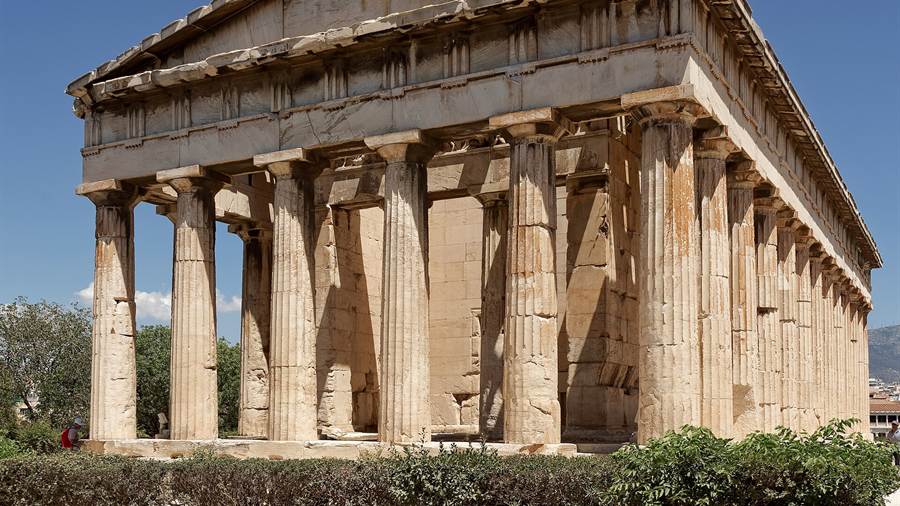
An early Doric limestone temple of Athena carried a pediment with a three-bodied man-serpent whose beards were painted dark blue. That sculpture gave the building the nickname Bluebeard temple. The Ancient Agora tickets post covers the Stoa of Attalos and the Temple of Hephaistos.
After the Persian sack, the Athenians buried broken statues, cult objects and offerings in deep pits on the hill. This Persian debris was the richest archaeological deposit excavated on the Acropolis by 1890.
Mnesicles began the Propylaea in 437 BC, and the small Temple of Athena Nike beside it was finished between 421 BC and 409 BC. The Acropolis tour post covers a walk past these monuments.
- Stones: The Athena Nike restoration reassembled 686 stones from original fragments.
- Patches: A further 905 stones were patched with new marble.
- New parts: 186 parts were made entirely of new marble.
- Weight: The work restored 2,675 tons of architectural members.
Greek archaeological site tickets for the Acropolis therefore admit visitors to a hill built in layers, from a Bronze Age palace to a temple restored in a project that finished in 2010.
What do Greek archaeological site tickets offer at the Acropolis Museum?
Greek archaeological site tickets for the Acropolis Museum lead into a modern building that opened on 20 June 2009 below the rock. More than 4,250 objects stand over 14,000 square metres, and the design by Bernard Tschumi sits above an excavated neighbourhood.
The Acropolis Museum tickets post covers entry to the museum. Its collections stand on three levels, and a fourth middle level holds the shop, the cafe and the offices.
Bernard Tschumi won the fourth design competition with the Greek architect Michael Photiadis. Manfredi Nicoletti and Lucio Passarelli had won the earlier international competition, which was annulled in 1999 after the foundation digs found sensitive remains.
The foundation pillars reach bedrock and float on roller bearings able to withstand a magnitude 10 earthquake. The top level sits askew on the lower ones to match the orientation of the ancient temple.
The Parthenon hall, which Greek archaeological site tickets open at the top level, holds 48 columns marking the outline of the ancient temple. Glass walls on all four sides let natural light reach the marbles.
- Opening crowds: The museum received 523,540 visitors in its first two months.
- Foreign share: Sixty percent of those first visitors came from abroad.
- Glass floors: Parts of the floor use glass so that visitors see the excavations below.
- Open dig: On 21 June 2019 the museum opened the excavation beneath it to visitors.
Greek archaeological site tickets for the Acropolis Museum therefore combine a gallery of finds from the rock with a working dig under glass floors, set 280 metres from the Parthenon.
What do Greek archaeological site tickets show at the National Archaeological Museum?
Greek archaeological site tickets for the National Archaeological Museum open a building in central Athens that holds finds from prehistory to late antiquity. Among them stands a stele of about 510 BC that shows a bearded hoplite named Aristion.
The National Archaeological Museum tickets post covers entry to the halls and the main collections. In 2008 the museum inaugurated the collection of Eleni and Antonis Stathatos, among its newer displays.
The sculptor Aristokles carved the Stele of Aristion, and a horizontal band under the feet names him. Workers found it at Velanideza near Marathon in Attica, and it stands 2.02 metres high.
Traces of red, yellow and blue paint survive on the stele. Greek archaeological site tickets reach a work that once carried meanders, zig-zags and a star on the shoulder of the corselet.
The Hellenistic section features golden jewels from Karpenissi and Thessaly. Named artists whose work stands in the museum include Cimon of Cleonae, Agasias, the Nessos Painter and the Analatos Painter.
- Base: The base of the stele is 0.24 metres high and carries the name of the dead man.
- Damage: The uppermost part of the head and helmet is missing.
- Corridor: The Epigraphical Museum has a large hypostyle corridor shaped like a Pi.
- Laboratory: That museum keeps a laboratory for the conservation of inscribed stone monuments.
Greek archaeological site tickets for this museum therefore reach archaic stone, Hellenistic gold and a collection of named artists, all inside one building in Athens.
What do Greek archaeological site tickets reach at the Panathenaic Stadium?
Greek archaeological site tickets for the Panathenaic Stadium reach a marble arena in central Athens that held ancient games and later modern ones. A river once ran before its entrance, and a spring, a hero’s shrine and a gymnasium stood close by.
The Panathenaic Stadium tickets post covers entry to the arena. The river ran in front of the entrance until the 1950s and now flows beneath Vasileos Konstantinou Avenue.
Greek archaeological site tickets reach a site set in a natural ravine between two hills. The spring of Kallirrhoe, the sanctuary of the local hero Pankrates and the Cynosarges public gymnasium lay near its entrance.
Albert Speer visited Athens in 1935 and drew on the stadium for the Deutsches Stadion in Nuremberg. He designed that arena for 400,000 spectators, and building began in 1937 but was never completed.
Giuseppe Verdi’s Aida was staged at the stadium in April 1916. The Spanish tenor Placido Domingo performed there on 27 June 2007, and a concert for AIDS on 2 October 1988 featured Bonnie Tyler.
- Coin: The stadium is the main motif of a Greek commemorative coin minted in 2003 for the 2004 Olympics.
- Owls: The seats of the cavea carried owls in relief, which symbolise Athena.
- Colonels: The Regime of the Colonels, from 1967 to 1974, held annual events at the stadium.
- Homecoming: The stadium welcomed the Greece national football team after its victory at UEFA Euro 2004 on 5 July 2004.
Greek archaeological site tickets for the Panathenaic Stadium therefore reach a marble arena with a long record of reuse, from ancient games to rock concerts and national celebrations.
What do Greek archaeological site tickets cover at Delphi?
Greek archaeological site tickets for Delphi cover a sacred precinct on the southwestern slope of Mount Parnassus, a museum of its finds and a stadium above the sanctuary of Apollo. Since 1938 the precinct has formed part of Parnassos National Park.
The Delphi day trip from Athens post covers how Greek archaeological site tickets apply to the precinct, the museum and the stadium. The stadium lies on the highest spot of the site.
Its track is 177.55 metres long and 25.50 metres wide. Up to 20 athletes competed at once, but the tracks were soon reduced to 17, and the starting points were made of stone.
A first small museum opened in 1903 to mark the end of the first great French dig. The French architect Albert Tournaire designed it, and a trust of the banker Andreas Syngros paid for it.
The museum now has fourteen rooms on two levels and an exhibition floor of more than 2270 square metres. In 1998 it received more than 300,200 visitors, against 325,000 at the National Archaeological Museum.
- Southeastern Mansion: The building had a 65-metre facade spread over four levels, with four triclinia and private baths.
- Tholos: Vitruvius names Theodorus Phoceus as the architect of the vaulted temple at Delphi.
- Truce: The Sacred Truce, called the Hieromenia, ended all violent conflict so that visitors reached the Games safely.
- Women: Tryphosa, the only recorded female victor at the Pythian Games, won the girl’s stadion running race.
Greek archaeological site tickets for Delphi therefore span a mountain stadium, a French-built museum and a precinct of sacred truce and contests, all within one protected landscape. The Greek mythology sites post covers the oracle of Apollo and other sites of myth. The Meteora monasteries tickets post covers entry to the six active monasteries and their dress rules. The Delphi tickets post covers the Sacred Way, the Temple of Apollo and the museum.
How do Greek archaeological site tickets cover Mycenae and Epidaurus?
Greek archaeological site tickets for Mycenae and Epidaurus cover two sites in the Peloponnese, a Bronze Age citadel with royal tombs and a sanctuary of Asclepius with an ancient theatre. Excavators first opened both places in the nineteenth century.
The Mycenae Epidaurus day trip post covers how Greek archaeological site tickets apply to both sites together.
Claude-Louis Fourmont visited Mycenae in 1729 and 1730 and used the name Tomb of Atreus for the tomb. Later travellers knew it as the Treasury of Atreus and linked it with the tomb of Agamemnon.
Columnar fragments from the tomb facade passed to Howe Browne, the second Marquess of Sligo, who shipped them to Westport House in Ireland. His grandson George Browne found them in a basement in 1904.
The Epidaurus Festival opened on 19 June 1955 with Euripides’ Hecuba, directed by Alexis Minotis. In 1982 the Royal National Theatre staged Aeschylus’ Oresteia under a foreign director, the first to take part.
- Excavation: John Papadimitriou excavated the sanctuary of Asclepius between 1948 and 1951.
- Benefactor: Inscriptions say Euanthes son of Eunomus saved the town from total destruction and received at least six monuments.
- Procession: In the third century BC the poet Isyllus set up a new procession for the birthday of Asclepius.
- Gold: Grave Circle A held a considerable quantity of gold, though far less than the inner coffin of Tutankhamun.
Greek archaeological site tickets for these two places therefore join a fortress of the second millennium BC with a sanctuary whose festival continues to stage ancient drama. The Mycenae tickets post covers the Lion Gate, the grave circles and the tholos tombs. The Epidaurus tickets post covers the theatre, the Tholos and the Temple of Asklepios.
What do Greek archaeological site tickets cover at Olympia and Corinth?
Greek archaeological site tickets for Olympia and Corinth cover two sites in the Peloponnese, a sanctuary of Zeus where the ancient Games were held and a city on the Isthmus. Each site has a museum beside the ruins.
The Ancient Olympia tour post covers how Greek archaeological site tickets reach the sanctuary of Zeus and the museum beside it. The Ancient Corinth tour post covers the ruins of the city on the Isthmus.
The banker Andreas Syggros paid for the museum building at Olympia. The German architects Wilhelm Dorpfeld and Friedrich Adler oversaw its construction on the hill of Drouva near the road to the sanctuary.
An Elean account credits the people of Skillos with the Temple of Hera, built around 600 to 580 BC. Its column shafts differ in diameter, and one has a different number of flutes.
The Archaeological Museum of Ancient Corinth stands inside the site under the 37th Ephoreia of the Greek Archaeological Service. Its first section holds twin Kouroi confiscated from traffickers of antiquities at Klenia in Corinth.
- Founding: Corinthian myth names Corinthos, a descendant of Zeus, as the founder of the city.
- Dispute: Briareus, one of the Hecatonchires, gave the Isthmus to Poseidon and the Acrocorinth to Helios.
- Naukratis: Corinth was one of nine Greek sponsor-cities that founded the colony of Naukratis in Egypt.
- Colonies: In the seventh century BC Corinth sent settlers to found Epidamnus and Anactorium.
Greek archaeological site tickets for Olympia and Corinth therefore join a sanctuary museum funded by a banker with a city museum run by the Greek Archaeological Service. The Olympia tickets post covers the Temple of Zeus, the stadium and the museum.
What do Greek archaeological site tickets include at Knossos?
Greek archaeological site tickets for Knossos give entry to the Minoan palace on Kephala hill, south of Heraklion. The Latinised form Cnossus appears in antiquity and in older scholarship, and the site is widely considered Europe’s oldest city.
Arthur Evans began large-scale digging in 1900 with Duncan Mackenzie, David George Hogarth, Theodore Fyfe and Christian Doll. Together they exposed the palace and a large part of the surrounding settlement.
Like other Minoan palaces, Knossos was arranged around a large rectangular Central Court. The east wing was built into the slope of the hill and held the Hall of the Double Axes and the Queen’s Hall.
Well-known frescoes tied to the site include the Procession Fresco and the Sacred Grove fresco. They show processions, animals, plants, marine life, ritual scenes and human figures, although the originals survive as fragments.
Minoan columns taper downward, unlike later Greek columns. They were made of timber, set on stone bases and finished with rounded capitals. Greek archaeological site tickets admit visitors to reconstructed examples at the palace.
- Writing: UNESCO identifies Cretan Hieroglyphic and Linear A as two of the earliest writing systems in Europe.
- Destructions: Around 1450 BC a wave of violent destructions struck the Minoan palaces and spared only Knossos.
- Philosopher: Aenesidemus, a thinker associated with Pyrrhonist scepticism, is listed among the notable residents of Knossos.
- Architect: Chersiphron, traditionally associated with the Temple of Artemis at Ephesus, is also listed among them.
Knossos itself was destroyed roughly a century after that wave of destructions. Greek archaeological site tickets for Knossos pair with the Knossos tickets post, which covers entry to the palace site.
What do Greek archaeological site tickets show at the Heraklion Archaeological Museum?
Greek archaeological site tickets for the Heraklion Archaeological Museum lead into a two-storeyed building with numbered rooms. Room II covers findings from 2000 to 1700 BCE and shows the glazed plaques of Minoan houses known as the Town Mosaic.
The building has large exhibition spaces, laboratories, a drawing room, a library and offices. A special department, the Scientific Collection, stores finds and studies them away from the public rooms.
Room II holds findings from Knossos, Malia and peak sanctuaries. Peak sanctuary figurines stand there beside the Town Mosaic plaques, and Greek archaeological site tickets open the room to visitors.
Room IX covers findings from 1700 BCE to 1450 BCE in eastern Crete. It holds terracotta figurines from the Pisokephalo peak sanctuary, together with seal stones from the same part of the island.
Room X, the Mycenaean room, covers 1400 BCE to 1100 BCE and shows a clay sculpture of dancers with a lyre player. Room XI, the Dorian room, covers 1100 BCE to 900 BCE.
- Cemeteries: Room VI shows finds from cemeteries at Knossos, Phaistos and Archanes, including gold jewellery and a horse burial from a tholos tomb.
- Egypt: Room V covers 1450 BCE to 1400 BCE and has ancient Egyptian trade objects and a clay model of a house.
- Griffins: Room XII reaches up to 650 BCE with pottery decorated with griffins and objects from Kato Syme.
- Coffins: Room XIII holds Minoan larnakes, the clay coffins of the island.
The weapons and tools in Room XI are mostly of iron. The rooms run in numbered order through the periods, and the Heraklion Archaeological Museum tickets post covers entry to the museum.
What do Greek archaeological site tickets cover at Phaistos?
Greek archaeological site tickets for Phaistos lead to a Bronze Age archaeological site in south central Crete. It is notable for the remains of a Minoan palace and the surrounding town, and the nearby villa of Hagia Triada forms part of the same story.
Antonio Minto excavated the hill of Christos Effendi between 1909 and 1922, especially its fortification walls. The Minoans thoroughly cleaned the older palace ruins before building the later ones, so finds are scarce.
Italian teams dug at nearby Hagia Triada from 1902 to 1908 and again between 1910 and 1914, when Gaetano De Sanctis joined the work. Luisa Banti added limited excavation in 1938 and 1959.
Doro Levi and Clelia Laviosa excavated Hagia Triada from 1970 until 1976. Around 1050 to 900 BC a sanctuary was established in the Regione dei Sacelli area, primarily at the Piazzale dei Sacelli.
The tombs of the rulers lie in a cemetery near the palace. Tholos tombs lie to the southwest and cemeteries to the northwest. A clay model from a larger tomb shows couples at altars.
- Cuny: Albert Cuny read the Phaistos Disc in 1914 as an ancient Egyptian document in syllabic-logographic writing.
- Schwartz: Benjamin Schwartz read it in 1959 as Mycenaean Greek in syllabic writing, with a comparison to Linear B.
- Georgiev: In 1976 Georgiev read the disc as the Hittite language, with the reading running outward.
- Aartun: Kjell Aartun read it in 1992 as a Semitic language in syllabic writing, again reading outward.
In 2004 Winfried Achterberg and others proposed a mapping to Anatolian hieroglyphs. Greek archaeological site tickets for Phaistos pair with the Phaistos tour post, which covers a visit to the palace ruins.
What do Greek archaeological site tickets offer at Akrotiri?
Greek archaeological site tickets for Akrotiri open a Bronze Age town on Santorini that volcanic ash buried and preserved. The date of the eruption is still debated, and the archaeological evidence argues for a date between circa 1550 and 1480 BC.
The Tempest Stele of Egypt has been read as describing the plume and volcanic lightning of the eruption. Carbon dating of early 18th Dynasty artefacts has disputed that reading, and the debate continues.
The Chinese Bamboo Annals report yellow skies and summer frost at the start of the Shang dynasty, a rise dated to about 1618 BC. Writers have set this beside the eruption as a possible volcanic winter.
Estimates of the volume of the eruption range between 13 and 86 cubic kilometres, so uncertainty remains considerable. Greek archaeological site tickets for Akrotiri lead to a town at the centre of that debate.
A stalagmite from Turkey shows bromine peaks at 1621 BC, molybdenum at 1617 BC and sulfur at 1589 BC, each within 25 years. Researchers set these readings beside the other dates for the eruption.
- Sulfur: Petrologic constraints on the magma give a range of 0.3 to 35.9 trillion grams of released sulfur.
- Pyroclastic flows: They account for 5 to 9 cubic kilometres of the dense-rock equivalent.
- Caldera deposits: The deposits inside the caldera account for 5 to 7 cubic kilometres.
- Ash fall: The co-ignimbrite fall accounts for 3 to 4 cubic kilometres.
The eruption left the town under ash, which helped to preserve its fine frescoes. Greek archaeological site tickets for Akrotiri pair with the Akrotiri tickets post, which covers entry to the excavated town. The Lindos Acropolis tickets post covers the Temple of Athena Lindia and the Hellenistic stoa.
What do Greek archaeological site tickets reveal about Delos?
Greek archaeological site tickets for Delos reach a small island near Mykonos where Greek tradition placed the birth of Apollo and Artemis. Stone huts on the island show that it has been inhabited since the third millennium BC.
During the Hellenistic period a well-established Phoenician colony on the island had extensive trade relations. Epigraphic evidence also suggests the presence of a Samaritan community on Delos in the same period.
Two marble stelae from about 250 to 175 BCE and about 150 to 50 BCE record benefactions by Cretan donors to a proseuche, or house of prayer. The community called itself Israelites on Delos.
The Establishment of the Poseidoniasts was the clubhouse of Berytian merchants, shipmasters and warehousemen in the late second century BC. Their protective triad of Baal and Poseidon, Astarte and Aphrodite, and Eshmun and Asklepios gained Roma.
The Stoivadeion is dedicated to Dionysus and bears a statue of the god of wine. Two actors impersonating Paposilenoi once flanked the statue, and the Archaeological Museum of Delos conserves them.
- Historian: Semos of Delos wrote eight books about the history of the island, though the Suda lists him as from Elis.
- Proverb: A Greek proverb said you sing as if sailing into Delos, meaning that someone is happy and light-hearted.
- Mysteries: Iamblichus writes that Delos Mysteries, similar to the Eleusinian Mysteries, were established.
- Supplies: The island had no productive capacity for food, fibre or timber, which were all imported.
Limited water on the island was exploited through an extensive system of cisterns, an aqueduct, wells and sanitary drains. Greek archaeological site tickets for Delos pair with the Delos tour post, which covers the island visit.
What do Greek archaeological site tickets show at Vergina and Pella?
Greek archaeological site tickets for Vergina and Pella lead to two capitals of ancient Macedon. Aigai, the site beside modern Vergina, was the first capital, while Pella replaced it as the new capital at the beginning of the fourth century BC.
Archaeology shows that villages within 7 km of the later city of Aigai formed a population centre by 1000 BC. Aigai never became a large city, because its people lived in the surrounding villages.
Parts of a large building near Palatitsa were taken for a palace of Antigonus III Doson. The 2011 population of the municipality was 2,464, with 1,242 in Vergina proper.
In 1977 Manolis Andronikos began a six-week dig at the Great Tumulus. He found four buried tombs, and two had never been disturbed. The Vergina day trip post covers the royal tombs and the museum.
Pella is first mentioned in connection with the campaign of Xerxes and the war against Sitalces, king of the Thracians. Since 2000 archaeologists have uncovered 1,000 tombs there, an estimated 5% of the total.
- Ionic Tomb: The Ionic Tomb, named after the excavator Konstantinos Rhomaios, has a facade of four engaged columns.
- Architect: A suggestion names Pytheos of Priene, known for the Mausoleum at Halicarnassus, as designer of the Aigai palace.
- Baths: Archaeologists identified a palaestra and baths from the reign of Cassander in the palace of Pella.
- Graves: In 2009 archaeologists found 43 graves at Pella that held rich and elaborate grave goods.
In 2010 archaeologists found 37 tombs dating from 650 to 280 BC, among them a warrior with a gold mouthplate. Greek archaeological site tickets for Pella pair with the Pella archaeological site post, which covers the ruins. The Vergina tickets post covers the royal tombs and the underground museum at Vergina. The Greece historical tours page covers the eras from Minoan to Ottoman, site by site.
What do Greek archaeological site tickets show at Philippi and Messene?
Greek archaeological site tickets for Philippi and Messene lead to a Roman colony in northern Greece and a walled city in the Peloponnese. The site of Philippi was besieged in 473 by Ostrogothic troops, who failed to take it.
Theodoric Strabo led the Ostrogothic troops. They burned down the surrounding villages but left the city standing. The Philippi tour post covers the ruins and the early history of the city.
The name of Philippi survived in a Turkish village on the nearby plain, Philibedjik, which has since disappeared. It then survived in a Greek village in the mountains, long after the city was abandoned.
Philippi began to prosper once more, as the Arab geographer Al Idrisi shows. Greek archaeological site tickets reach a city that he names as a centre of business and wine production around 1150.
+
A Linear B tablet from Pylos records groups of men who each gave one ox to an official named Diwijeus, possibly a priest in the Zeus-sanctuary. The Ancient Messene tour post covers the city.
- Coast-watchers: The men on the tablet belonged to a unit of coast-watchers stationed to guard locations on the coast.
- Olympians: The watchers include Olumpiaioi from Orumanthos, which is Mount Erymanthos.
- Heraclids: The returned exiles were a Doricised population that developed in the seventh century BC under the Heraclid dynasty.
- Franks and Serbs: The Franks held Philippi briefly after the Fourth Crusade, and then the Serbs captured it.
The foundations of a small temple on the shoulder of Mount Ithome are linked to Artemis Laphria. Greek archaeological site tickets for the north and the south of Greece reach Roman, Byzantine and Mycenaean layers.
What do Greek archaeological site tickets show at Mystras?
Greek archaeological site tickets for Mystras open a fortified town on a spur of Mount Taygetos above Sparta. Its church of Hagia Sophia was first dedicated to Jesus Christ the Life Giver, Zoodotes Christos, and served a men’s monastery of that name.
A seal of the Patriarch of Constantinople Philotheus, from 1365, shows that the church was converted into a monastery at the request of the founder himself. The church lies within the archaeological site.
Cleopa Malatesta, wife of the despot Theodore II Palaiologos, was buried at the monastery in 1433. The change of name to Hagia Sophia must have taken place after the Fall of Constantinople.
Hagia Sophia is a two-style cruciform church inscribed with a dome, with three three-sided apses to the east and a narthex to the west. A three-storey bell tower stands to the west.
Fragmentary frescoes dating from 1348 to 1354 are preserved inside, and the enthroned Pantocrator in the alcove is the best preserved. Murals in the northeast chapel date to the end of the fourteenth century.
- Arvanites: Theodore I invited Albanians to settle in the territory, and they developed into the Arvanite community.
- Arbereshe: Albanians left for the Kingdom of Naples in the fifteenth century and formed the Arbëreshë community.
- Monemvasia: A Catalan corsair ruled the rocky peninsula briefly, before the population sought the Pope’s protection.
- Mani: The Mani Peninsula resisted under a loose coalition of local clans and then came under the rule of Venice.
The Despotate of the Morea was ruled by sons or brothers of the Byzantine emperor, who held the title of despotes. Greek archaeological site tickets for Mystras pair with the Mystras tour post, which covers the hill town above Sparta.
What do travellers ask about Greek archaeological site tickets?
Greek archaeological site tickets cover Greek sites from the Minoan palaces of Crete to the Macedonian capitals and Byzantine Mystras. Travellers ask which sites belong together, which museum holds the finds and how the ruins connect with the museum rooms.
Which Greek archaeological site tickets lead to finds from Phaistos and Knossos?
Greek archaeological site tickets for the Heraklion Archaeological Museum lead to Room VI, which shows finds from cemeteries at Knossos, Phaistos and Archanes. The room holds gold jewellery, clay figurines and a horse burial from a tholos tomb at Archanes.
Do Greek archaeological site tickets for Delos and Akrotiri cover the Cyclades?
Greek archaeological site tickets for Akrotiri and Delos both concern the Cyclades. Akrotiri lies on the volcanic island of Santorini, while Delos lies near Mykonos, close to the centre of the archipelago, where stone huts show settlement from the third millennium BC.
Which Greek archaeological site tickets lead to royal Macedonian places?
Greek archaeological site tickets for Vergina and Pella lead to the old and the new capital of Macedon. The municipality of Vergina had 2,464 people in 2011, while Greek archaeological site tickets for Pella reach a site where archaeologists have uncovered 1,000 tombs since 2000.
Which Greek archaeological site tickets lead to Byzantine sites?
Greek archaeological site tickets for Mystras and Philippi lead to Byzantine layers. At Mystras a seal from 1365 records the conversion of Hagia Sophia into a monastery, while Philippi was besieged in 473 by Ostrogothic troops. Mystras was the seat of a despot who ruled the Byzantine Morea.