
Greece historical tours follow the ancient and later past of the country, from the Acropolis, Delphi, Olympia, Mycenae and Epidaurus to Minoan Crete, Akrotiri, Delos, Lindos, Macedonia and Thermopylae. The page is part of the Greece Tours on Greece Ville.
This page covers what Greece historical tours are, the Acropolis and the Athens museums, Sounion and Delphi, Olympia and Corinth, Mycenae, Messenia and Laconia, Minoan Crete, the islands and Macedonia. Common questions come last. Each section links to the Greece Ville posts on single tours.
What are Greece historical tours?
Greece historical tours place each ruin, fortress and museum in its own era, from the Minoan palaces of Bronze Age Crete through Mycenaean citadels and classical sanctuaries to Byzantine towns and Ottoman fortresses, so that one route reads as a timeline.
The Minoan civilization of Crete grew out of a local Neolithic culture around 3100 BC. Its palaces at Knossos and Phaistos open the story that Greece historical tours tell.
The Mycenaean age leaves written traces. Linear B, deciphered in 1952, records early Greek on tablets, and Egyptian records mention a land called Danaya from about 1437 BC.
Ottoman rule began in the mid-15th century and lasted until the Greek War of Independence broke out in 1821. Greeks call that era Turkocracy, which means Turkish rule, and it forms the last layer.
The Greek archaeological site tickets post explains how entry to the state-run sites and museums works for Greece historical tours. The UNESCO World Heritage Sites post sorts the listed monuments by place.
- Minoan: Knossos and Phaistos on Crete mark the oldest stops.
- Mycenaean: Mycenae in the Argolid gave its name to the age.
- Byzantine: Mystras was the capital of the Despotate of the Morea.
- Ottoman: Pylos and its bay served the Ottomans as a naval base.
Later sections sort the sites by region and era, so that each linked post sits beside the places that came before and after it. Greece historical tours work best when the order of eras stays clear.
Why do Greece historical tours begin at the Acropolis of Athens?
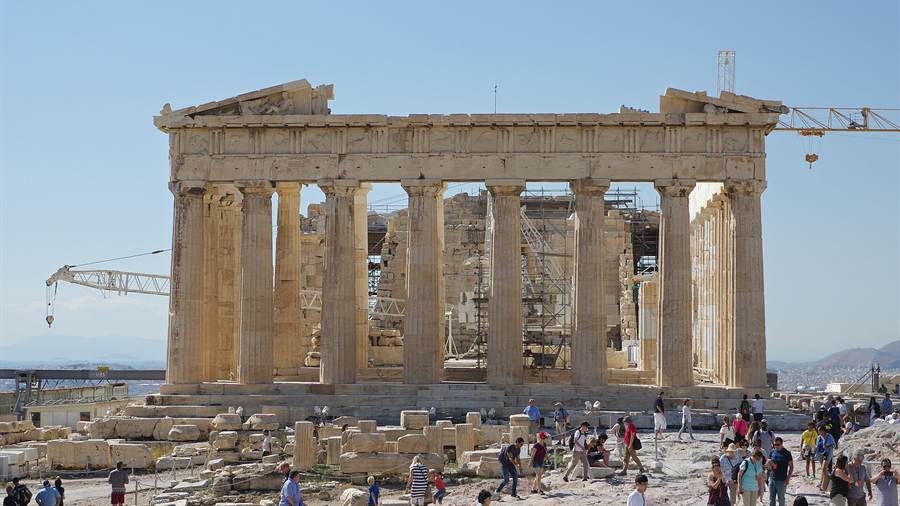
Greece historical tours begin at the Acropolis of Athens because the rock above the city carries layers of history, from a Mycenaean palace of the late Bronze Age to the classical Parthenon, a Christian church and a mosque.
The architects Ictinos and Callicrates began the Parthenon in 447 BC under the general supervision of Phidias. The building was substantially completed by 432 BC, and work on its decoration continued until at least 431 BC.
The Parthenon carries small irregularities. Francis Penrose proposed in 1851 that they were optical corrections, and in 1878 John Pennethorne argued that the curved lines were a deliberate design choice.
Bert Hodge Hill proposed a second Parthenon begun in the period of Kimon after 468 BC, while William Bell Dinsmoor placed the latest possible date for the first temple no earlier than 495 BC.
The Acropolis tickets post covers entry to the rock, and the Acropolis tour post covers the walk across the summit and its monuments. Both posts anchor Greece historical tours in Athens.
- Optical correction: Penrose set out his theory in An Investigation of the Principles of Athenian Architecture.
- Geometry: Pennethorne wrote The Geometry and Optics of Ancient Architecture.
- Architraves: Uneven architrave blocks differ by as much as 18 cm, and interaxial differences reach 4.8 cm.
- Metopes: Experts found metopes while processing 2,250 photos, because the white Pentelic marble differed from the wall stone.
Pericles coordinated the building programme that gave the rock its classical form, and later scholars keep refining its dates. Greece historical tours treat the Acropolis as the fixed point from which other sites are measured.
How do Greece historical tours use the Athens museums and the Panathenaic Stadium?
Greece historical tours pair the Acropolis Museum and the National Archaeological Museum with the Panathenaic Stadium in Athens, because the museums hold finds from Greek sites and the marble stadium recalls the Panathenaic Games held in honour of Athena.
The Acropolis Museum design by Bernard Tschumi rests on three concepts: light, movement, and a tectonic and programmatic element. Three levels hold the collections, while the shop, café and offices occupy a fourth, middle level.
The National Archaeological Museum has a neo-classical design, and a large garden decorated with sculptures lies at the front. During World War II its antiquities were sealed in protective boxes and buried.
After Theodosius I banned bloody spectacles in the late 4th century, the stadium was abandoned, and a field of wheat later covered the site, where the derelict marbles were built into other buildings.
The Acropolis Museum tickets post covers the galleries of the rock’s finds, the National Archaeological Museum tickets post covers the national collection, and the Panathenaic Stadium tickets post covers the marble stadium.
- Order: Visitors to the Acropolis Museum go to the top level first and descend, which keeps the chronological order.
- Rites: European travellers wrote of rites in the ruined passage of the stadium aimed at finding a good husband.
- Site: The Panathenaic Stadium was built in a natural ravine between the hills of Agra and Ardittos.
- Setting: The Acropolis Museum is the largest modern building erected so close to the ancient site.
The two museums and the stadium give Greece historical tours an indoor chapter and an outdoor chapter in one city. The linked posts sort the practical detail, and this page keeps the historical order.
How do Greece historical tours connect Cape Sounion and Delphi?
Greece historical tours connect Cape Sounion and Delphi as two ancient sanctuaries, the Temple of Poseidon on the southern tip of Attica and the precinct of Apollo on Mount Parnassus, which the Greeks regarded as the centre of the world.
The Greeks considered Poseidon the master of the sea, and the temple at Cape Sounion stands where the sea lanes to and from Piraeus gave the first and final view of ships.
An Archaic temple of tufa stood on the cape first, and Persian troops under Xerxes I are held to have destroyed it in 480 BCE, and the Athenians built the new temple on its ruins.
In the founding myth of the oracle, Zeus launched two eagles from the two ends of the world, and they crossed above Delphi, where he placed the omphalos stone.
The Cape Sounion tour post covers the temple on the headland, and the Delphi day trip from Athens post covers the sanctuary of Apollo. Both posts belong to Greece historical tours.
- Wheler: Wheler’s Journey into Greece, published in 1682, sketched the settlement of Kastri and ruins at Delphi.
- Dodwell: Edward Dodwell visited Delphi in 1805 with the painter Simone Pomardi.
- Hesiod: In the Theogony, Hesiod places Pytho in the hollows of Parnassus.
- Graffiti: French sailors cut an inscription of 1816 into the blocks of the Temple of Poseidon.
Sounion shows the sea power of Athens, and Delphi shows the religious centre of the Greek world. Greece historical tours place both on one route when the order of centuries matters more than distance. The Greek mythology sites post covers Delphi, Delos, Cape Sounion and other sites of myth.
What do Greece historical tours show at Olympia and Corinth?
Greece historical tours show at Olympia the sanctuary of Zeus where the ancient Olympic Games were held, and at Corinth a city-state on the isthmus that the Romans demolished and later rebuilt, so the two sites cover athletics and trade.
The roof of the Temple of Zeus at Olympia used 1,000 thin tiles of Pentelic marble, and 102 lion-head waterspouts projected from its edge, of which 39 survive.
In 1210 the fortress of Corinth fell to the Crusaders, and the city became a full part of the Principality of Achaea, which the Villehardouins governed from Andravida in Elis.
Corinth mediated between Syracuse and Gela in Sicily in 491 BC, and in 435 BC it went to war with its colony Corcyra over Epidamnus. Thucydides relates that dispute to the causes of the Peloponnesian War.
The Ancient Olympia tour post covers the sanctuary and its stadium, and the Ancient Corinth tour post covers the city below Acrocorinth. Both posts sit within Greece historical tours.
- Walls: The defence of the hill of Acrocorinth was man-made, in the form of three circuit walls.
- Temple: A temple to Aphrodite on the highest peak was converted to a church, which in turn became a mosque.
- Dispute: In myth, Briareus ruled that the isthmus belonged to Poseidon and the acropolis of Corinth to Helios.
- Games: The ancient Olympic Games were held every four years, and they were restored on a global basis in 1894.
Olympia shows the games and the temple of the god, while Corinth shows the trade city and its fortress. Greece historical tours join the two sites on one route through the Peloponnese.
Which Mycenae and Epidaurus stops belong in Greece historical tours?
Greece historical tours reach Mycenae, a Bronze Age citadel in the north-eastern Peloponnese entered through the Lion Gate, and Epidaurus, the sanctuary of Asclepius with its theatre, which together move from a military stronghold to a stage for drama.
A second destruction struck Mycenae around 1190 BC and ended its role as a major power. The site was reoccupied on a smaller scale, and in 468 BC troops from Argos razed the fortifications.
The auditorium of the theatre at Epidaurus has a lower part of 12 sections and an upper part of 22 sections, divided by a horizontal corridor 1.82 m wide.
The sanctuary of Asclepius at Epidaurus rivalled the cult sites of Zeus at Olympia and Apollo at Delphi. In the Achaean War of 146 BC the Achaians converted it into a stronghold.
The Mycenae Epidaurus day trip post covers both sites together: the citadel, the Lion Gate, the theatre and the sanctuary. It forms the Argolid part of Greece historical tours.
- Tablets: The earliest examples of the Greek language are preserved on Linear B tablets at Mycenae and Tiryns.
- Dedications: After defeating the Achaians, Lucius Mummius visited the sanctuary and left two dedications there.
- Building: In the 4th and 3rd centuries BC the Greeks embarked on an ambitious building programme at the sanctuary.
- Worship: The theatre hosted music, singing and dramatic games that formed part of the worship of Asclepius.
Mycenae and Epidaurus show how Greek history moved from fortified rulers to shared sanctuaries and public theatre. Greece historical tours keep the two sites together so that the sequence stays clear.
Where do Greece historical tours go in Messenia and Laconia?
Greece historical tours go to Ancient Messene, Pylos, Mystras and Monemvasia in the southern Peloponnese, where a Theban-built city, a Mycenaean kingdom, a Byzantine capital and a medieval fortified rock town tell four separate chapters of Greek history.
Tablet PY Cn 3 from Pylos, written in Linear B, names a region called Mezana, which John Bennet read as Messana, a Mycenaean Greek form of the name Messene.
Demosthenes completed the Athenian fort at Pylos in 424 BC, and in the 1280s the Franks built the Old Navarino castle on the site. Nicholas II of Saint Omer, lord of Thebes, received lands in Messenia.
The architecture of Mystras was influenced by the Helladic school of Byzantine architecture, and the churches were covered in elaborate frescoes and were well known for their libraries.
The Latin Empire failed to besiege Monemvasia in 1222, but in 1225, after a three-year siege, William of Villehardouin occupied it. Andronikos III later exempted the town from 28 taxes.
The Ancient Messene tour post, the Pylos tour post, the Mystras tour post and the Monemvasia tour post each cover one of these places, and Greece historical tours use them to sort the southern Peloponnese.
- Venice: Pylos came under the Republic of Venice from 1417 until the Ottoman Empire conquered it in 1500.
- Escape: Theodore escaped from Sultan Bayezid I and recaptured Monemvasia from the Ottomans with Venetian help in July 1394.
- Attempt: Galleys sent to capture Monemvasia in 1564 withdrew because they failed to locate the old, unguarded path to the upper town.
- War: The Second Ottoman-Venetian War of 1499 to 1503 limited the Venetian possessions around Monemvasia.
Greece historical tours use these four places to sort the southern Peloponnese by era, from the Bronze Age tablets of Pylos to the Byzantine and Venetian layers of the rock town. The Mani tour post covers the Mavromichalis family, the tower houses and the blood feuds.
What do Greece historical tours show of Minoan Crete?
Greece historical tours show Minoan Crete through the palaces of Knossos and Phaistos and the finds in the Heraklion Archaeological Museum, which together document a Bronze Age culture that UNESCO lists as a serial property named the Minoan Palatial Centres.
The serial property joins six Minoan sites: Knossos, Phaistos, Malia, Zakros, Zominthos and Kydonia. Early excavators called the buildings palaces, but later research showed that they served religious and economic purposes.
The Minoan past is dated in two systems: Early, Middle and Late Minoan by pottery style, and Prepalatial, Protopalatial, Neopalatial and Postpalatial in a scheme proposed by Nikolaos Platon.
Early Minoan II, from about 2650 to 2200 BC, has been termed an international era, and imported goods became scarce when that trade collapsed in Early Minoan III.
In 1911 George Hempl read the Phaistos Disc as Ionic Greek and Florence Stawell read it as Homeric Greek, both as syllabic writing, while its purpose remains disputed.
After the earthquakes of 1926, 1930 and 1935, Spyridon Marinatos secured a sturdy new building by Patroklos Karantinos, which withstood the bombing that accompanied the German invasion in 1941.
- Knossos: A long wall of Early Minoan III, about 2200 to 2100 BC, lies under the area of the later palace.
- Grain: Later Linear B documents record 960,000 litres of grain from a place called Da-wo.
- Scripts: The Minoans developed two writing systems, Cretan hieroglyphs and Linear A.
- Disc: The Phaistos Disc is covered on each side with a spiral text of 242 occurrences of 45 distinct signs.
The Knossos tickets post, the Phaistos tour post and the Heraklion Archaeological Museum tickets post sort the Minoan stops. Greece historical tours read them from the palace to the museum.
What do Greece historical tours show at Akrotiri, Delos, Lindos and Rhodes?
Greece historical tours show a buried Bronze Age town at Akrotiri on Santorini, the sacred island of Delos, the acropolis of Lindos and the walled Old Town of Rhodes, which together cover the Cyclades and the Dodecanese in the southern Aegean.
Radiocarbon dating places the eruption of Thera between 1620 and 1530 BC, and unusual tree-ring growth in 1597, 1560, 1546 and 1544 BC fits a major volcanic event in any of those years.
The French geologist F. Fouque conducted the earliest excavations on Santorini in 1867, and in 1967 Spyridon Marinatos began the extensive modern dig at Akrotiri, which revealed the full value of the buried town.
Strabo writes that in 166 BC the Romans converted Delos into a free port. Food, fibre and timber were all imported, since Delos had no capacity to produce any of them.
The acropolis of Lindos was fortified in turn by the Greeks, Romans, Byzantines, Knights of St John and Ottomans, which makes the site difficult to excavate and interpret archaeologically.
The Mandraki, the military harbour of Rhodes, was guarded by a tower that Grand Master Zacosta built between 1464 and 1467 at the end of the natural mole.
- Village: Akrotiri started out as a small village of fishermen and farmers in the fifth millennium BCE.
- Evacuation: Only a single gold object has been found at Akrotiri, which indicates an orderly evacuation.
- Torr: Cecil Torr wrote the first modern histories of Rhodes in English in 1885 and 1887.
- Palace: The Palace of the Grand Master was originally built in the late 7th century as a Byzantine citadel.
The Akrotiri tickets post, the Delos tour post, the Lindos tour post and the Rhodes Old Town tour post each cover one stop. Greece historical tours sort them by island group and era.
Which Macedonian sites belong in Greece historical tours?
Greece historical tours in Macedonia reach Vergina, Pella, Dion and Philippi, where the first capital of the Macedonian kings, the city that replaced it, the sanctuary at the foot of Mount Olympus and a Roman city cover four phases of northern Greek history.
The modern town of Vergina was established in 1922 in the aftermath of the population exchanges after the Treaty of Lausanne, and it stands on the site of ancient Aigai.
In the seventh century BC the dominance of the Temenids led the ancient Macedonians to expand and subdue local populations until the end of the sixth century BC, when they established the dynasty at Aigai.
The street plan of Pella dates to the first half of the 4th century BC and stands out for large block size, while Olynthus in Chalcidice had blocks of 86.3 by 35 metres.
William Martin Leake found Dion on 2 December 1806, and the French archaeologist Léon Heuzey confirmed the discovery in 1855. The triumvirs at Philippi had an allied cavalry force of 13,000 horsemen.
The Vergina day trip post, the Pella archaeological site post, the Dion archaeological site post and the Philippi tour post each cover one Macedonian stop, and together they place Greece historical tours in Macedon.
- Dynasty: Herodotus says the Argead dynasty was led by Perdiccas I, who fled from Argos in about 650 BC.
- Villages: Archaeology since 1995 shows that villages near Aigai formed an important population centre by 1000 BC.
- Harbour: The harbour and gulf at Pella have silted up, which leaves the site inland.
- Livy: Livy reported how Pella looked in 167 BC to the Roman general Lucius Aemilius Paulus Macedonicus.
Greece historical tours sort these four stops from the royal capitals to the Roman city, so that each linked post sits in its own phase of Macedonian history.
What do Greece historical tours show at Thermopylae?
Greece historical tours reach Thermopylae, the narrow coastal pass whose name means hot gates, because the pass links the south of Greece with the north and holds the memory of the stand against the Persians in 480 BC.
The pass takes its name from hot sulphur springs, and in Greek myth it was one of the entrances to Hades. The springs still exist close to the foot of the hill.
The land surface of the battle of 480 BC is now buried under 20 metres of soil, and the shoreline advanced by as much as 9 km between 480 BC and the 21st century.
In 491 BC Darius sent emissaries to the Greek city-states asking for earth and water as tokens of submission, and in 486 BC a revolt in his Egyptian province postponed any Greek expedition.
A second battle was fought at Thermopylae in 191 BC, where the army of Glabrio brought the Roman and allied forces in Greece to 36,000 men, outnumbering the Seleucids and their allies.
German documents referred to the sabotage of the Gorgopotamos bridge in 1942 as the recent sabotage near Thermopylae, and the pass is the only land route large enough to bear significant traffic between Lokris and Thessaly.
- Shoreline: The shoreline advanced by up to 2 kilometres between 2500 BC and 480 BC.
- Epitaph: Simonides of Ceos wrote the epitaph that begins Go tell the Spartans, stranger passing by.
- Sacred War: A large fine imposed on the Phocians in 357 BC for cultivating sacred land caused a war.
- Motorway: The A1 motorway linking Athens and Thessaloniki now follows the ancient shoreline and splits the pass.
The Thermopylae tour post covers the pass and the battlefield, and the classical tour of Greece post joins it to Delphi and Olympia. Greece historical tours use the pair to close the classical circuit. The Marathon tour post covers the Battle of Marathon and the run of Pheidippides.
What do travellers ask about Greece historical tours?
Greece historical tours draw questions about which era comes first, how the sites are sorted, what separates a museum day from a site day and how the Athens monuments fit into the story of Greek history from the Bronze Age to the Ottoman period.
Where do Greece historical tours start in the Bronze Age?
Greece historical tours start with the Minoan palaces of Crete and the Mycenaean citadels of the Peloponnese. The Minoans developed two writing systems, Cretan hieroglyphs and Linear A, and a second destruction struck Mycenae around 1190 BC, which ended its role as a major power.
Which Athens monuments appear in Greece historical tours besides the Acropolis?
Greece historical tours add the Theatre of Dionysus on the south slope of the Acropolis, where the first orchestra terrace was built in the mid- to late sixth century BC and hosted the City Dionysia. The theatre reached its fullest extent in the fourth century BC under Lycurgus.
How do Greece historical tours treat the Ottoman period?
Greece historical tours treat the Ottoman period as one layer among the others. The prokritoi, called kocabasis by the Ottomans, were bureaucrats and tax collectors, while the Phanariots became prominent in Constantinople as businessmen and diplomats, and the Ecumenical Patriarch rose to great power under the Sultan.
In what order do Greece historical tours place the sites on this page?
Greece historical tours place the sites in the order of the sections above, from Athens to the Peloponnese, Crete, the islands, Macedonia and Thermopylae. Thessaloniki, the largest city of Ottoman Greece, was part of the Ottoman Empire in two periods, 1387 to 1403 and 1430 to 1912.