
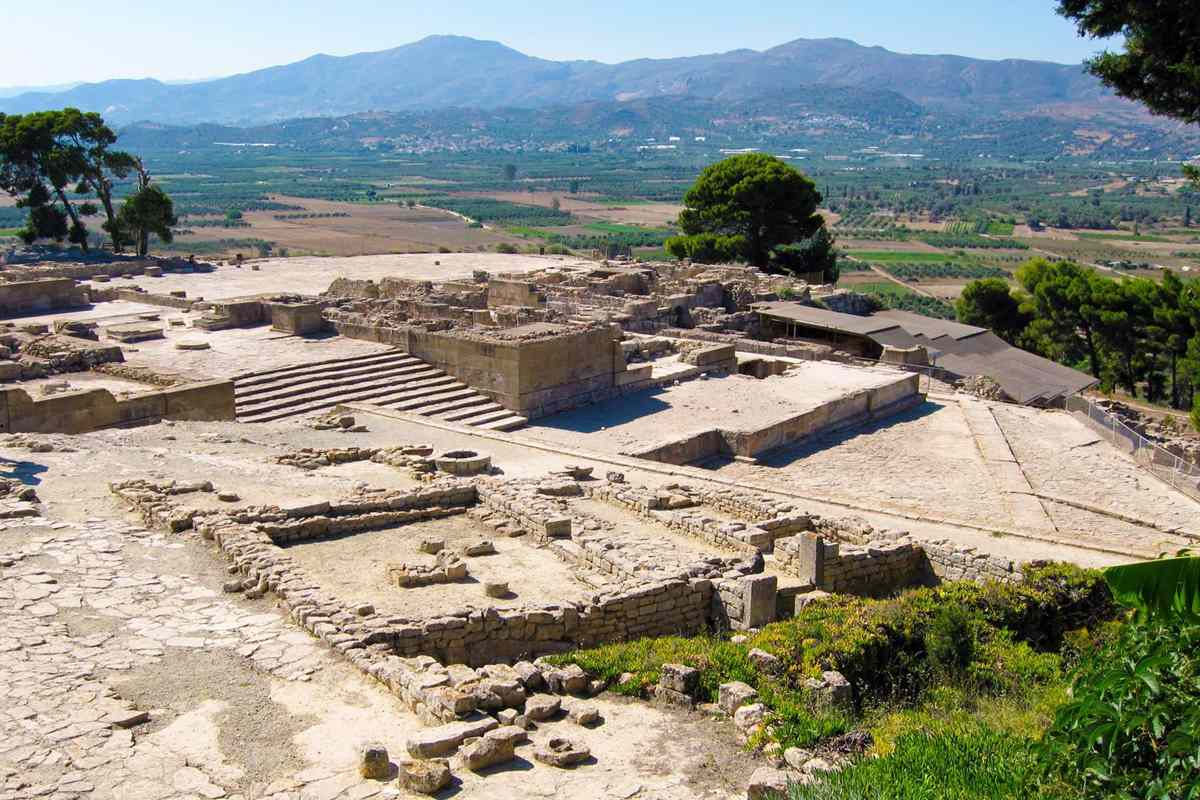
A Phaistos tour visits the Minoan palace of Phaistos on a ridge above the Messara plain in south-central Crete, where the Phaistos Disc was found, with the villa of Hagia Triada nearby. The tour is one of the Greece Tours on Greece Ville, listed with the other Crete tours and Greek archaeological site tickets.
This post covers the formats on sale, the first and second palaces, the palace layout, the excavations, Phaistos in myth, the Phaistos Disc, Hagia Triada, Kommos, the Messara plain and Mount Ida and the questions that come up before booking.
What does a Phaistos tour visit in south-central Crete?
A Phaistos tour visits the remains of a Minoan palace and its surrounding town at modern Faistos, a municipality in south central Crete. The Bronze Age site stands about 62 km south of Heraklion and 5.6 km east of the Mediterranean Sea.
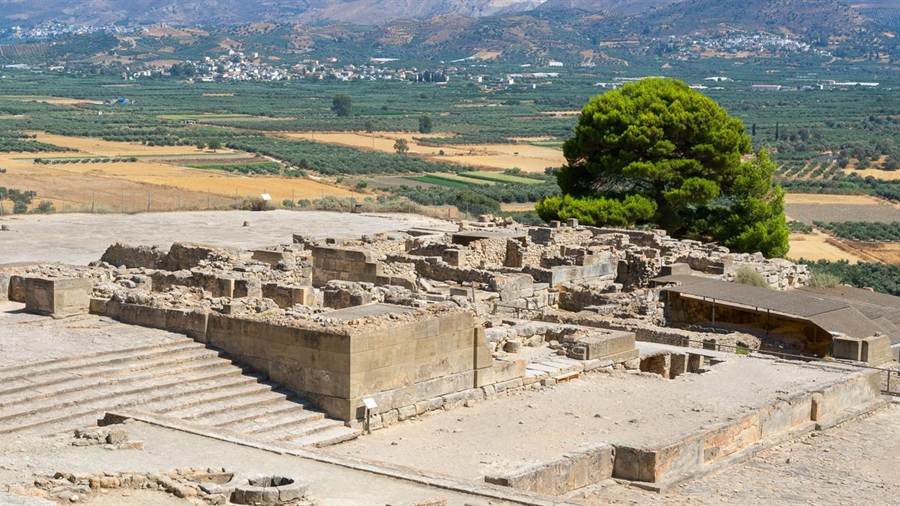
Phaistos was one of the three largest cities of Minoan Crete. The ancient name survives in Greek references to a Cretan city of that name at or near the present ruins.
The ruins sit on a hill at the west end of the Messara, an alluvial plain and the largest in Crete. A Phaistos tour climbs to this ridge above the plain floor.
The word palace is a modern label. Scholars see these Minoan buildings as complexes with multiple uses. At Phaistos the building held religious and political roles, along with storage, housing and a theatre.
Phaistos had links with nearby residences, notably Gortyn. A road system joined the large Minoan cities of the island, and the road network marks Phaistos as an important trade partner.
- Period: Phaistos is a Bronze Age site with the remains of a Minoan palace and town.
- Hills: The palace stands on a hill to the east, and an acropolis occupied a hill to the west.
- Name: The name also appears as Phaestos, Festos and the Latin Phaestus.
- Status: UNESCO lists Phaistos among six Minoan palace sites on its World Heritage list.
A Phaistos tour covers the palace, its courts and its stairs. The sections below set out the formats on sale, the history of the site, its layout, its excavators and its myths.


Which Phaistos tour formats are on sale?
A Phaistos tour on sale here comes as a day trip, a private tour or a wider south Crete tour. The titles pair the palace with Gortyna, Matala, Zaros or the beach caves at Matala, and two formats start from Heraklion.
The Heraklion day trip combines four stops: Gortyna, Phaistos, Matala and Zaros. A second Heraklion format, sold as a private tour, keeps Gortyna, Phaistos and Matala and leaves out the Zaros stop.
Two listings carry Matala, Ancient Phaistos, Gortyn and South Crete in their titles. One of them spells the site Phaistos-Faistos. A Phaistos tour of this type links the palace with Gortyn and Matala.
Another title, Explore the Treasures of Crete, lists Gortyna, Phaistos and Matala as its stops. A private format adds Matala Beach and its caves to Phaistos Palace and the south of the island.
One more format is built around the archaeological and natural sights of south central Crete. It sets the palace inside a wider circuit that mixes ancient sites with landscape stops across the south.
- Gortyna: Gortyna or Gortyn appears in five of the seven titles on sale.
- Matala: Matala appears in six of the seven titles, twice with its beach named.
- Zaros: Only the Heraklion day trip adds Zaros to the route.
- Private: Two of the titles are sold as private tours, both with Matala on the route.
Travellers based in Heraklion can compare these formats with a Heraklion tour. The tour cards and availability boxes on this page list live dates for each Phaistos tour format.
What came before the first palace seen on a Phaistos tour?
A Phaistos tour starts with a long prehistory. People first settled the site around 3600 BCE, and feasting grounds came before any palace. The first palace rose around 2000 BCE, in the Middle Minoan IB phase of the Bronze Age.
Settlement here began slightly later than at other early Cretan sites. At palace sites, feasting in the future court areas goes back to the Neolithic, and the Phaistos palace rose on such ground.
Wider studies date the first palaces of Crete to Middle Minoan IB, around 1925 to 1875 BC. Phaistos gives the clearest evidence for this stage, since later renovations hid the early phases at the other sites.
These first palaces were smaller and less complex than later ones, with a square-within-a-square plan. At Phaistos the first palace was destroyed and rebuilt three times in about three centuries.
A Phaistos tour shows little from inside these early rooms. The Minoans cleaned the ruins of the original palace before building the later versions, which left scant remains for excavators to find.
- Kouloures: Subsurface pits called kouloures survive at Phaistos, read at palace sites as granaries, cisterns or planters for sacred trees.
- Kamares ware: Middle Minoan II examples of this light-on-dark pottery come mainly from the palaces, Phaistos among them.
- Eggshell cups: Potters at Phaistos made cups so thin that they are likened to eggshell.
- Metal look: This thin pottery copied the shapes and embossing of metal vessels.
The record of the first palace ends around 1700 BC. The next part of this Phaistos tour account follows the second palace, its fall and the Greek city on the hill.
What does a Phaistos tour reveal about the second palace and the later city?
A Phaistos tour shows a second palace raised over the first after its fall around 1700 BC. The second palace ended around 1400 BCE, and a Greek city later grew on the hill until the Gortynians destroyed it.
The first palace fell at the end of Middle Minoan IIB, around 1700 BC, through earthquakes or violence. One reading holds that Phaistos then lay empty until Late Minoan IA.
The new palace shifted slightly east of the original and used it as a foundation. It rose on multiple vertical levels, linked by halls and stairs, and expanded on the first build.
The palace was destroyed around 1400 BCE, with a large earthquake as one proposed cause. The ruins on a Phaistos tour stayed visible, and Early Iron Age worship took place in palace ruins.
Phaistos was reinhabited in the Geometric Age, in the 8th century BCE. The city struck its own coin, the stater, and allied with other autonomous Cretan cities and with Eumenes II, king of Pergamon.
- Temple: A temple to Rhea stands in the southern section of the palace and postdates the Geometric Age.
- Ritual: The temple was tied to the ekdysia, a ritual practised at Phaistos.
- Houses: Private houses appear to have been built at Phaistos after the Minoan era.
- Roman era: Small shrines built inside Cretan palace ruins lasted, in certain cases, into the Roman era.
Around the end of the 3rd century BCE, the Gortynians destroyed Phaistos, and the city leaves the history of Crete. A Phaistos tour covers both the Minoan palace and this later city.
How is the palace laid out on a Phaistos tour?
A Phaistos tour crosses a palace set around a rectangular central court of roughly 24 by 52 metres. Two staircases and a theatre area lead to the entrance, while storerooms, shrines and royal apartments fill the levels around the court.
Each Minoan court has 2:1 proportions, with its long side running north to south. On a Phaistos tour, the court lines up with Mount Ida, a sacred mountain of Crete.
The theatre area worked together with two staircases. Its levels gave access through large doors to the main hall of the propylaea. A twin gate then led straight to the central court along a wide street.
The palace rose on four levels. The first held the theatre area and shrines, and the second held servant rooms, guest rooms and the commissariat quarter. Royal apartments and the Hall of the State lay above.
Storage was one role of the building. Finds at Phaistos include tall jars and large pithoi, and grape pips in storage vessels point to wine production at the site.
- Finishes: Plates of sand and white gypsum stone covered the floors and walls of interior rooms.
- West sector: The upper floors of the west sector held spacious ceremonial rooms.
- Lustral basins: Phaistos has four lustral basins, sunken rooms reached by an L-shaped staircase.
- Loom weights: Loom weights from Phaistos are a rare sign of production inside a palace.
A Phaistos tour covers one of five buildings that archaeologists class as Minoan palaces. Visitors planning the other major palace visit on Crete can check Knossos tickets before the trip.
Who excavated the palace seen on a Phaistos tour?
A Phaistos tour walks through ruins cleared by Italian archaeologists. Federico Halbherr and his student Luigi Pernier excavated the palace from 1900 to 1904, after Thomas Spratt had located the site in 1853 on a hill then called Kastri.
The story behind a Phaistos tour starts with Spratt, a ship captain who surveyed Mediterranean sites. He fixed the spot by triangulation from Gortyn, Matala and the coast.
Federico Halbherr, born in Rovereto in 1857, studied in Rome under Domenico Comparetti. In 1910 he founded the Italian Archaeological Mission to Crete and became its first director.
Pernier, born in 1874 into a wealthy Roman family, graduated in Classics from the Sapienza University of Rome in 1897. He trained with Halbherr’s mission in Crete and took his diploma in 1901.
From 1906 to 1909 Pernier led the mission in place of Halbherr, who was held in Italy. Lighter work at Phaistos went on until 1908, while the pair dug at Hagia Triada, about 3 km away.
- Kastri: In 1853 a village of 16 houses stood on the ridge, beside traces of fortification walls.
- First finds: In 1894 Antonio Taramelli dug pottery at Phaistos at the request of Halbherr.
- Linear A: The site has yielded 61 Linear A inscribed items, 26 tablets and 35 sealed documents.
- Later teams: Doro Levi led work from 1950 to 1966, and the Phaistos Project under Fausto Longo began in 2007.
A Phaistos tour covers the results of more than a century of Italian fieldwork. Pernier is best known for the Phaistos Disc, found in a basement room of the palace in 1908.
How do myth and ancient writers describe the city on a Phaistos tour?
A Phaistos tour visits a city that ancient texts mention only rarely. Homer calls Phaistos well populated in the Iliad, and later writers link the city with King Minos, with a founder named Phaestos and with the mythical king Rhadamanthys.
The Homeric epics record the part of Phaistos in the Trojan War. For a Phaistos tour, the written record also includes 62 Linear B tablets that spell the name PA-I-TO.
Diodorus Siculus names Phaistos as one of three towns that King Minos founded on Crete. Pausanias and Stephanus of Byzantium give another founder, Phaestos, a son of Hercules or of Ropalus.
Rhadamanthys, the mythical king linked with Phaistos, was a son of Zeus and Europa and a brother of Minos and Sarpedon. Later legend made him one of the judges of the dead.
Plato’s Laws calls him the justest of men. Homer places him in the Elysian Fields in the Odyssey, and Virgil sets him among the judges of the underworld in the Aeneid.
Epimenides, the Cretan wise man whom the Athenians invited to cleanse their city after the Cylonian affair in the 6th century BCE, is thought to descend from the people of Phaistos.
- Exile: In the myth, Minos drove Rhadamanthys out of Crete, and he fled to Boeotia.
- Marriage: In Boeotia he married Alcmene, the mother of Heracles.
- Sons: Rhadamanthys had two sons, Gortys, linked with Gortyn, and Erythrus.
- Cults: Scotia Aphrodite and the goddess Leto, also called Phytia, received worship at Phaistos.
A Phaistos tour therefore links stone ruins with a long line of stories. Homer, Diodorus, Pausanias and Plato all wrote about the city or its legendary king.
How was the Phaistos Disc found, and why does it matter on a Phaistos tour?
A Phaistos tour leads to the place where the Phaistos Disc came to light. Luigi Pernier found the intact clay disc on 3 July 1908. It is about 16 cm across and now sits in the archaeological museum of Heraklion.
On a Phaistos tour, the find spot lies northeast of the main palace. The disc sat in the basement of room 8 in building 101. Its four rooms served as a formal entry to the palace.
The disc lay in the main cell of an underground temple depository. These basement cells were reached only from above and covered with fine plaster. Their fill held black earth, ashes and burnt bovine bones.
A Linear A tablet, labelled PH-1, came from the same black layer. It lay just south-east of the disc and about 50 cm above the floor. Jan Best uses this tablet to date the disc.
The disc is made of fine-grained clay and was fired on purpose, unlike tablets and seals baked by accident. It is almost 2 cm thick. Side A is slightly concave and side B convex.
- Size: The diameter runs from 15.8 to 16.5 cm, since the outline is slightly egg-shaped.
- Other spellings: The name also appears as Phaestos or Festos.
- Script: A spiral text in an unknown script and language covers each side.
- Dating: Yves Duhoux dates the disc to between 1850 BC and 1600 BC.
The disc stays in Heraklion, so a Phaistos tour covers the ground where it was found, not the object itself. The museum and the site together complete the story.
Can the signs on the disc behind a Phaistos tour be read?
A Phaistos tour brings up a text that nobody has read with certainty. The disc carries 242 stamped signs drawn from 45 distinct types. Scholars have proposed Greek, Luwian, Semitic and other readings, but none so far has external confirmation.
The disc linked to a Phaistos tour stands apart for its method. Each sign was pressed into the soft clay with its own stamp before firing. This makes it an early example of movable-type printing.
Side A holds 123 signs and side B holds 119. Sir Arthur Evans numbered the 45 symbols from 01 to 45. Researchers still use his numbering when they discuss the text.
Sign 02, the plumed head, appears 19 times, more than any other sign, with 14 on side A. Of the 17 shield signs, 13 come straight after a plumed head.
Radial strokes split the spiral into 61 groups, called words, with two to seven signs each. The text runs clockwise from the edge toward the centre. Evans first argued the reverse, then changed his mind.
- Syllabary view: The main linguistic readings assume a syllabary, based on the ratio of symbols to tokens.
- Linear A link: Torsten Timm matches 20 of the 45 characters with Linear A or Linear B signs.
- Other theories: Proposed meanings include prayers, a call to arms, a board game and a geometric theorem.
- Unicode: The signs entered Unicode in April 2008, in version 5.1.
Scholars expect no firm reading until more examples of the signs turn up elsewhere. A Phaistos tour therefore visits the find site of a text that remains unread.
Where does Hagia Triada stand in relation to a Phaistos tour?
A Phaistos tour comes within about three kilometres of Hagia Triada, a Minoan site. The site was an upscale town with a large Royal Villa, not a palace. It appears to have had close political and economic ties with Phaistos.
Hagia Triada lies 30 to 40 metres above sea level in south central Crete. The Minoan harbour of Kommos is nearby, so a Phaistos tour can link all three sites.
The settlement dates back to the Early Minoan period. By Middle Minoan IA it had a cemetery with a large circular tholos tomb. A fire destroyed the site toward the end of LM IB.
About 150 Linear A tablets came from Hagia Triada, the largest cache at any Minoan site. Twenty-three clay roundels also turned up. Every Linear A find dates to LM IB, before the fire.
Luigi Pernier identified the site in June 1900 while digging at Phaistos. An Italian team under Federico Halbherr and Pernier excavated it from 1902 to 1908. Vincenzo La Rosa led work from 1977 to 2012.
- Layout: The site divides into a Villa, the administrative centre, and a Village area.
- Storage: Three large storage magazines point to trade.
- Ancient name: Scholars have proposed da-wo, a place name found on 46 Linear B tablets at Knossos.
- Later use: A Roman villa rose on the site after Rome conquered Crete in 69 BC.
Two chapels stand nearby: Hagia Triada in the deserted village and Hagios Georgios from the Venetian period. A Phaistos tour that adds Hagia Triada sees the palace and its villa neighbour together.
Which Hagia Triada finds complete the story of a Phaistos tour?
A Phaistos tour connects with finds now held in the Heraklion Archaeological Museum. Hagia Triada produced the painted limestone sarcophagus and the Harvester Vase. The sarcophagus is the only one of its era with narrative scenes of Minoan funerary ritual.
Roberto Paribeni found the sarcophagus on 23 June 1903, in a chamber tomb near Hagia Triada. The tomb, known as Tomb 4, measures 3.8 by 4.2 m. It held two skulls.
One long side shows a bull tethered on a table-like altar, with an aulos player behind it. The other shows a man playing a seven-string lyre, the earliest picture of the lyre known in Greece.
The Harvester Vase is a black steatite rhyton from about 1550 to 1500 BC. Its relief shows 27 men in procession. One holds a sistrum, the only known depiction of one in Minoan art.
Two other Minoan stone vases with human figures came from the same site. The Chieftain Cup is a serpentine chalice 11.5 cm high showing five males. The third piece is the Boxer Vase.
- Material: The sarcophagus is a 137 cm limestone chest with fresco painting on all four sides.
- Date: Later excavation narrowed its date to 1370 to 1320 BC.
- Form: The chest has no lid and carries drainage holes.
- Vase repair: Modern plaster replaces the missing lowest part of the Harvester Vase.
Both the sarcophagus and the Harvester Vase sit in Heraklion. A Phaistos tour that passes through the city joins the villa to its finds. Without the museum, a Phaistos tour shows only the ground.
Which Minoan harbour served the palace seen on a Phaistos tour?
A Phaistos tour that continues to the coast comes near Kommos, the Minoan harbour town for Phaistos and Hagia Triada. The site lies 5 km north of Matala, beside Kommos Beach. It is closed to the public but visible from the beach.
Kommos stands on the coast of the Mesara Plain. With Phaistos and Hagia Triada it has been described as a great Minoan triangle. The Papadoplaka reef islet once partly sheltered the town from waves.
A broad road paved with stone slabs divided the Minoan town. The hilly north held homes, and civic buildings rose in the flatter south. In places, remains of different periods lie stacked one on another.
Building T, raised in MMIII, rivalled in size the palace at the heart of a Phaistos tour. Its facade had the largest ashlars the Minoans used. These narrow slabs set on edge are called orthostats.
Building P, from LMIIIA, has six long narrow galleries open on the western side toward the sea. Archaeologists read it as an early ship shed. It is the largest known Minoan building of its era.
- Trade: No other Bronze Age site in the Aegean has yielded more imported ceramics.
- Jars: Kommos is the only Aegean site to yield undecorated Late Bronze Age Egyptian jars.
- Temples: Temple C, built around 400 BC, stayed in use until around 150 AD.
- Excavation: Joseph Shaw of the University of Toronto began work at the site in 1976.
Matala lies 5 km to the south, and the Matala tour page covers that stop. A Phaistos tour that heads for the sea reaches both points on the same stretch of coast.
What landscape frames a Phaistos tour, from the Messara Plain to Mount Ida?
A Phaistos tour crosses the Messara, the largest plain in Crete, about 50 km long and 7 km wide. Phaistos and Hagia Triada stand on a hill at its west end. The Psiloritis massif with Mount Ida rises to the north.
The Messara is an alluvial plain in southern Crete. Since 1500 BC it has grown by up to 6 km through alluvial sediment. A Phaistos tour that adds Gortyna stops near its middle, at ancient Gortys.
Clays from the Messara were the source of significant amounts of Minoan pottery. The Asterousia Mountains rise along its south side. Farmers grow olive trees, vineyards and horticultural crops here.
Mount Ida is the highest mountain on Crete at 2,456 metres. Its massif is called Psiloritis. A natural park that includes the peak belongs to the UNESCO Global Geoparks Network.
Legend places the birth of Zeus in the Idaean Cave on its slopes. Kamares cave, another sanctuary on the mountain, gave its name to the Minoan pottery called Kamares ware.
- Olive oil: A substantial part of the olive oil from the plain goes to European markets.
- Local breed: The plain is home to the indigenous Messara horse.
- Highest villa: The Zominthos plateau, in the northern foothills of Mount Ida, holds the highest altitude Minoan villa ever found.
- Observatory: The Skinakas Observatory of the University of Crete stands at 1750 m on a secondary peak.
A Phaistos tour keeps to the Messara in southern Crete. For an upland trip elsewhere on the island, the Lasithi Plateau tour page sets out a separate route.
What do travellers ask about a Phaistos tour?
A Phaistos tour raises four recurring questions. Listed trips from Heraklion pair Phaistos with Gortyna and Matala. The disc came from a basement room in building 101 at Phaistos, and Hagia Triada is an upscale Minoan town about three kilometres away.
Does a Phaistos tour leave from Heraklion?
Yes. Two listed titles begin with the words From Heraklion, and both combine Gortyna, Phaistos and Matala. One of them also adds Zaros. Heraklion holds the archaeological museum where the Phaistos Disc, the Hagia Triada sarcophagus and the Harvester Vase are kept, so the city links the sites with their finds.
Does a Phaistos tour add Matala or Gortyna?
Yes, listed versions of a Phaistos tour pair the palace with both. Titles name Gortyna, Phaistos and Matala together, and one also names Zaros. Gortys, the ancient city behind the Gortyna stop, lies near the middle of the Messara Plain. Matala lies 5 km south of Kommos, the Minoan harbour of Phaistos.
Where on the site of a Phaistos tour was the disc found?
The disc came from the basement of room 8 in building 101, northeast of the main palace. It rested in the main cell of an underground temple depository, among black earth, ashes and burnt bovine bones. Luigi Pernier recovered it intact on 3 July 1908. A Linear A tablet, PH-1, lay in the same layer.
What is Hagia Triada on a Phaistos tour?
Hagia Triada is a Minoan site in the Mesara Plain about three kilometres from the palace of Phaistos. It was an upscale town with a local administration centre, not a palace. About 150 Linear A tablets came from it, the largest cache at any Minoan site. Its finds include the painted sarcophagus.