
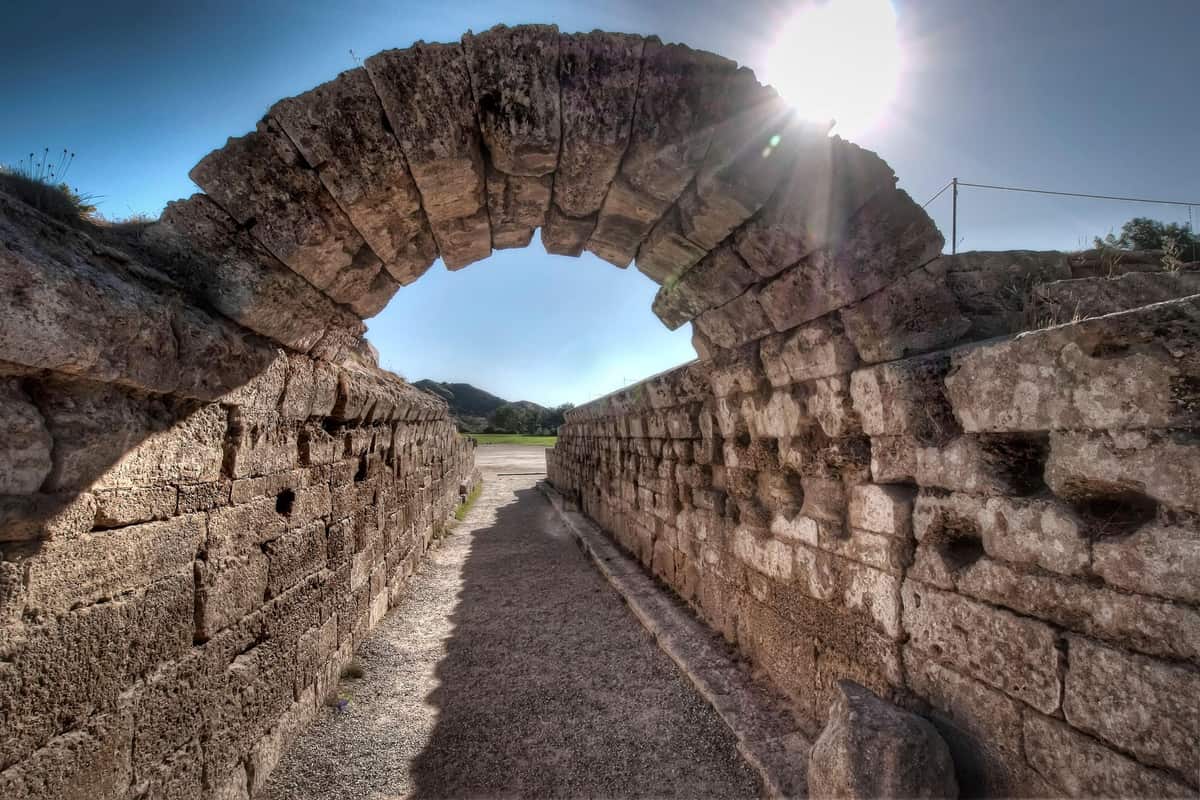
An ancient Olympia tour visits the sanctuary of Zeus in Elis, in the western Peloponnese, where the first Olympic Games took place. The ruins lie in a wooded valley beside two rivers. The tour is one of the Greece Tours on Greece Ville, listed with the other day trips from Athens and Peloponnese tours.
This post covers what an ancient Olympia tour includes, how the sanctuary was laid out and what the Temple of Zeus held. It also covers the athletes, the digs that brought the site back to light and the lighting of the Olympic flame. The land around the site, the best time of year and common questions come last.
The sections include ancient Olympia tours from Athens and from the cruise port of Katakolo that can be booked online.
What is an ancient Olympia tour?
An ancient Olympia tour is a visit to the sanctuary of Olympia in the western Peloponnese. The site hosted the ancient Olympic Games. It lies in Elis, a regional unit of 2,618 square kilometres. Elis is about 100 km long and 55 km wide.
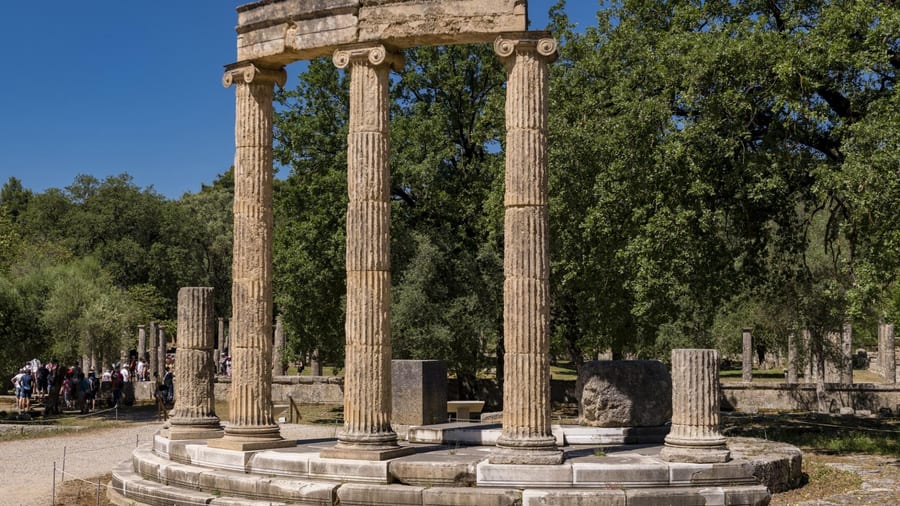
An ancient Olympia tour begins in the municipality of Archaia Olympia. It had 11,153 residents in 2021. The community that holds the village by the ruins had 882.
Greece formed this municipality in 2011 from four older ones: Archaia Olympia, Foloi, Lampeia and Lasiona. It covers 545.1 square kilometres, and the municipal unit covers 178.9.
Rivers matter on an ancient Olympia tour. The Alfeios is the longest river in Elis, and its name means “whitewater”. Only 45 of Greece’s 765 recorded rivers flow all year, and it is one.
The Kladeos river is fed by the Plataneiko, Lagadino, Gani and Liakoto streams. It is named after a river god, a son of Oceanus and Tethys.
- Dam: A dam west of Olympia makes hydroelectric power from the Alfeios.
- Dikes: Dikes south of the sanctuary protect the site from Alfeios floods.
- Road: Limits on vehicles on the Kronion Hill road protect the monuments from vibration, noise and fumes.
On an ancient Olympia tour, the hill above the sanctuary has a name from poetry. The poet Pindar wrote that Heracles gave it the name Hill of Cronus.


How was the sanctuary laid out on an ancient Olympia tour?
An ancient Olympia tour crosses a sanctuary built around a sacred grove, the Altis. The poet Pindar wrote that Heracles marked out the grove with a surveying tool called a stathme. Around it stood treasuries, a council house and a long covered walkway.
An ancient Olympia tour passes the treasuries. The typical treasury was a small temple-shaped building with one room and a front hall with two columns. The treasury of Sicyon is the earliest and the best preserved.
The treasury of Syracuse was built to celebrate a victory over Carthage in 480 BC. The treasury of Sicyon had two rooms lined with bronze.
The Echo Stoa on an ancient Olympia tour was almost 100 metres long. Paintings once lined its hall, so it was also called the Stoa Poikile, or painted stoa.
The Bouleuterion, the council house, stood south of the Temple of Zeus. It was the seat of the Elean Senate, which organized the Games. It had a square hall and an Ionic porch.
- Oath: The Bouleuterion held the altar and statue of Zeus Horkeios, where athletes took their oath.
- Prytaneion: Priests and magistrates lived there, and the high priests lived in the Theokoleon.
- Echo: People said one word spoken in the Echo Stoa echoed seven times.
The Zanes pedestals on an ancient Olympia tour tell a tale of cheating. Fines on rule breakers paid for the Zanes. A name on a pedestal brought shame to the athlete and his home city.
What does the Temple of Zeus show on an ancient Olympia tour?
An ancient Olympia tour shows the ruins of the Temple of Zeus. Its architect, Libon, was a native of Elis. Pausanias, an ancient writer, said the Eleans paid for it with spoils from their victory over the Pisans. Its carvings show scenes from myth.
On an ancient Olympia tour, carved panels called metopes tell tales of Heracles. Six metopes stood at each end of the cella, the inner room of the temple.
One metope shows Heracles capturing the Cretan bull. In another, Atlas fetches the apples of the Hesperides. Meanwhile Heracles, helped by Athena, holds up the sky.
On an ancient Olympia tour, the east pediment, the carved triangle above the front, shows Pelops and Oenomaus. Sterope stands beside her husband Oenomaus, and Hippodamia stands beside Pelops.
Pausanias wrote that Paeonius made the east pediment and Alcamenes made the west one. Scholars have proposed no fewer than 59 ways to rebuild the layout of the figures.
- Order: The Eleans ordered the statue of Zeus for their new temple, hoping to outdo Athens.
- Nike: The seated Zeus held a small statue of Nike, the goddess of victory, in one hand.
- Crown: A wreath of olive sprays crowned Zeus, and his robe was carved with animals and lilies.
The Roman general Aemilius Paullus saw the statue and, as Livy tells it, was moved to his soul. The plan of the workshop of the sculptor Phidias matches the plan of the temple’s inner room.
Who competed at the games seen on an ancient Olympia tour?
An ancient Olympia tour recalls the wrestlers, boxers, runners and chariot owners who competed at the games. Famous names include Milo of Croton, Leonidas of Rhodes and Kyniska of Sparta. The judges and the olive wreath complete the picture.
On an ancient Olympia tour, Milo of Croton stands out as a six-time wrestling winner. One title came in the boys’ event in 540 BC. The other five came in the men’s event.
Leonidas of Rhodes won three foot races at four Olympics in a row, ending in 152 BC. His record of twelve wreaths stood until swimmer Michael Phelps broke it in 2016.
An ancient Olympia tour also tells of Theagenes of Thasos, a boxing winner in 480 BC. Diagoras of Rhodes won the Olympic boxing twice, and his three sons all became Olympic champions.
Kyniska of Sparta was a king’s daughter. In 396 BC she won the four-horse chariot race with horses she trained herself. She won again in 392 BC.
- Pankration: This unarmed fighting sport had only two rules: no biting, no eye gouging.
- Arrhichion: He won a pankration final even though he died in a chokehold.
- Pentathlon: Five events filled one day, from the long jump to wrestling.
The judges, called Hellanodikai, grew to twelve members and settled on ten in 348 BC. The winner’s wreath, called kotinos, came from a wild olive tree. Both are part of an ancient Olympia tour.
How was Olympia rediscovered on an ancient Olympia tour?
An ancient Olympia tour follows a site that travellers, French scientists and German archaeologists brought back to light. Each group added a piece to the story. The travellers came first, then the French team, and then the Germans.
In the 3rd century, a series of earthquakes caused heavy damage to the site. By the year 385, flooding and earthquakes had damaged the buildings, and invaders had reached it.
Travellers such as Fauvel, Pouqueville, Gell, Cockerell and Leake visited the ruins before the first dig. In March 1829, a French commission of nineteen scientists travelled to Greece with the troops.
The French team reached Olympia in 1829 and stayed for six weeks. Only one large piece of a Doric column showed above ground. The French divided the site into squares and dug trenches in straight lines.
An ancient Olympia tour crosses ground that Léon-Jean-Joseph Dubois and Abel Blouet dug. Dubois led the archaeology section. Blouet led architecture and sculpture, and he banned the cutting of pieces from statues.
- Speech: Ernst Curtius spoke about Olympia in Berlin on 10 June 1852.
- Agreement: On 25 April 1874, Curtius agreed in Athens that all finds stay in Greece.
- New find: A 2,500-year-old bronze bull figurine came to light near the temple of Zeus in 2021.
Wilhelm Dörpfeld joined the dig as an assistant in 1877 and later became its technical manager. Within six years of 1875, the German team had uncovered the main buildings of the sanctuary. An ancient Olympia tour stands on that ground.
How is the Olympic flame lit on an ancient Olympia tour?
An ancient Olympia tour reaches Olympia, where the modern Olympic flame is lit every two years. The ceremony opens with the Olympic hymn, then the anthems of the host country and Greece. If clouds hide the sun, a backup flame is used.
Ancient Greeks believed that Prometheus stole fire from the gods. Every four years, extra fires burned at the temple of Zeus and the temple of his wife Hera.
The first flame at a Summer Games burned in Amsterdam in 1928. It stood on top of the Marathon Tower. People for miles around saw where the Games were held.
In 1936, 3,331 runners carried the flame from Olympia to Berlin. The trip covered 3,187 kilometres in twelve days and eleven nights. An ancient Olympia tour begins where that relay began.
The planners built new roads because the path down from Olympia was too hard to use. Each runner was expected to run about a kilometre in five minutes.
- Torch: Each 1936 torch was 27 cm long.
- Morgedal: The 1952 Winter Games relay began in Morgedal, Norway, not at Olympia.
- Innsbruck: The 1964 Winter Games were the first with a flame lit at Olympia.
The first global relay in 2004 lasted 78 days. It covered more than 78,000 km with about 11,300 torchbearers. An ancient Olympia tour stands at the start of such journeys.
What lies around the site on an ancient Olympia tour?
An ancient Olympia tour sits among olive rows and villages. The village of Ancient Pisa, 2.15 km away, holds the International Olympic Academy. An oak forest, thermal springs and the town of Pyrgos lie farther out in the region.
Rows of olive trees are planted on land around the site of an ancient Olympia tour. The new EO74 road that links Olympia opened in the 1980s. Krestena lies 6 km south of Olympia.
In 1949 the International Olympic Committee approved the plan for the academy. It held its first program in 1961 under tents. The academy has a 500-seat auditorium and five classrooms.
Forest fires burned close to the site in 2007, and Olympia was evacuated on 26 August. The fire burned all the trees on the hilltop above the site and the brush by the academy.
- Hill of Kronos: The sacred hill was totally burnt.
- Museum yard: It was scorched, but the statue of Hermes was spared.
- Replanting: The minister promised 3,200 bushes and saplings.
Pyrgos lies 70 km south-west of Patras and 85 km west of Tripoli. The Kaiafas thermal springs lie 30 km south-east of Pyrgos. Agios Andreas lies 13 km north-west of Pyrgos.
When is the best time of year for an ancient Olympia tour?
Spring and autumn bring mild weather to an ancient Olympia tour. In April, September and October, Pyrgos has average highs of 20.0 to 29.0 °C. July and August are hotter, and November and December bring the heaviest rain.
August is the hottest month at Pyrgos, with an average high of 32.2 °C. Ancient visitors suffered from summer heat and flies. Sacrifices were made to Zeus Averter of Flies.
April has an average high of 20.0 °C and 52.9 mm of rain. October has a high of 24.8 °C and 102.1 mm of rain. September has a high of 29.0 °C and 39.4 mm of rain.
Winter on an ancient Olympia tour is cool and wet. January has an average high of 14.7 °C and a low of 5.1 °C. November is the wettest month, with 177.6 mm of rain.
- Driest month: July has 3.6 mm of rain on 0.5 days.
- Sunniest month: July has 360.4 hours of sunshine.
- Dullest month: December has 124.9 hours of sunshine.
Pyrgos figures come from the Hellenic National Meteorological Service and cover 1975 to 2010. Nights at Pyrgos are warmest in August. At Katakolo, the average January low is 8.00 °C.
What do travelers want to know about an ancient Olympia tour?
An ancient Olympia tour raises six common questions. Travelers ask when the games began and ended, and how to reach Olympia from Athens. They also ask about the stadium track and the two statues of Hermes and Nike.
When did the games of an ancient Olympia tour begin?
Legends hide how the games began, so no date is certain. The first Olympiad, a four-year period, is dated 776 to 772 BC. The Pisatans took the sanctuary in 676 BC and ran the games until the late 7th century BC.
When did the games of an ancient Olympia tour end?
A bronze plaque found in 1994 shows the games went on until at least 385. Historians think they came to an end under Theodosius II. The Temple of Zeus was apparently destroyed around 426, after his edict enforced the ban on pagan festivals.
How do travelers reach an ancient Olympia tour from Athens?
Intercity buses link Ancient Olympia with Athens, Patras, Pyrgos and nearby towns. Daily buses from Athens take about 4 to 4.5 hours. Buses from Patras take about 2.5 to 3 hours. The EO74 road runs 142.9 km from Tripoli to Pyrgos, near Olympia.
What does the stadium of an ancient Olympia tour hold?
The stadium was big enough for 20 runners at a time. A trumpet blow started each race. By the fifth century BC a stone starting line, the balbis, marked the track. Historians put one stadion at 150 to 210 m.
What is the Hermes statue on an ancient Olympia tour?
The Hermes statue shows the god Hermes with the baby Dionysus. It is displayed at the Archaeological Museum of Olympia. With its base, the group stands 3.70 m high. The rest of the statue came to light in six later finds.
What is the Nike statue on an ancient Olympia tour?
The Nike of Paionios is a statue of Nike, the Greek goddess of victory. The Messenians and the Naupaktians dedicated it to Zeus. It was a tenth of the spoils taken from their enemies. The statue is made of Parian marble.