Acropolis tickets open the gate to the Acropolis of Athens, the rock above the city with the Parthenon on top. They are one of the tickets and tours in Greece on Greece Ville.
This post covers what Acropolis tickets cover on the rock, at the Parthenon and at the Erechtheion. It also covers the south slope, the ancient sites nearby and the repair work. The climb, the best season and common questions come last.
The sections include Acropolis tickets and related Athens tours that can be booked online.
What do Acropolis tickets cover on the sacred rock?
Acropolis tickets cover the whole summit of the sacred rock in Athens. A buffer zone of 116.71 ha protects the land around it. Visitors enter through the Propylaea gateway. They then walk among temples, shrines and old foundations on the top.
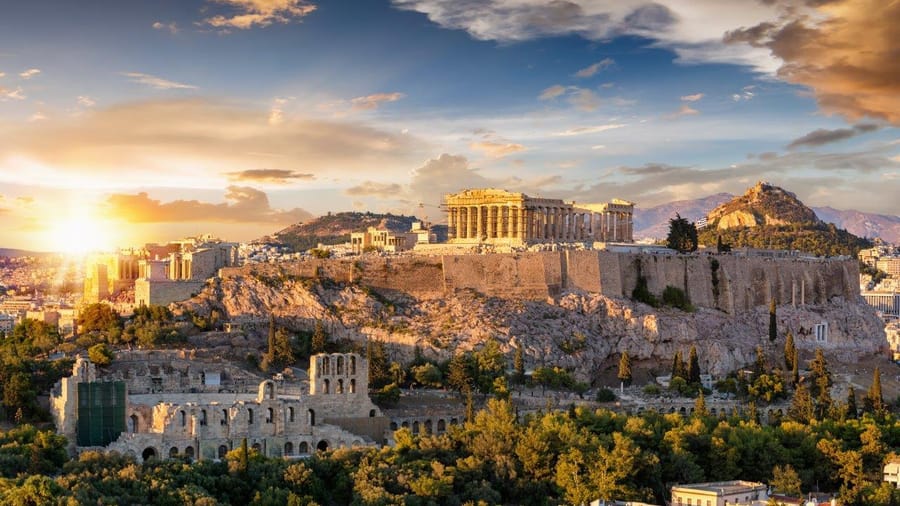
The Mycenaean wall around the summit stood up to 10 m high. It was 3.5 to 6 m thick. Before the 13th century BC, an earthquake split a crack about 35 m deep. A well dug there gave water during sieges.
Acropolis tickets give entry through the Propylaea, where Mnesikles made the central passage wider than the others. The extra width equals one triglyph and one metope. A cross wall inside has five doorways, the gates that name the building. Hoisting knobs still stick out of its unfinished walls.
The Temple of Athena Nike is about 8 m long, 5.5 m wide and 7 m tall. It is the earliest fully Ionic temple on the rock. Its columns are only 7 times as tall as they are wide.
- Agrippa Pedestal: This 8.9 m base stands west of the Propylaea. It first honoured Eumenes II of Pergamon in 178 BC.
- Brauroneion: Seven rock-cut steps still mark this sanctuary of Artemis Brauronia in the south-west corner.
- Chalkotheke: This bronze store south-west of the Parthenon measured about 43 m by 14 m.
Acropolis tickets reach the foundations of the Old Temple of Athena, built between 529 and 520 BC. They lie between the Erechtheion and the Parthenon. At the Sanctuary of Zeus Polieus, a yearly rite put an axe on trial. The axe had killed the sacrificial ox.


What do Acropolis tickets show at the Parthenon?
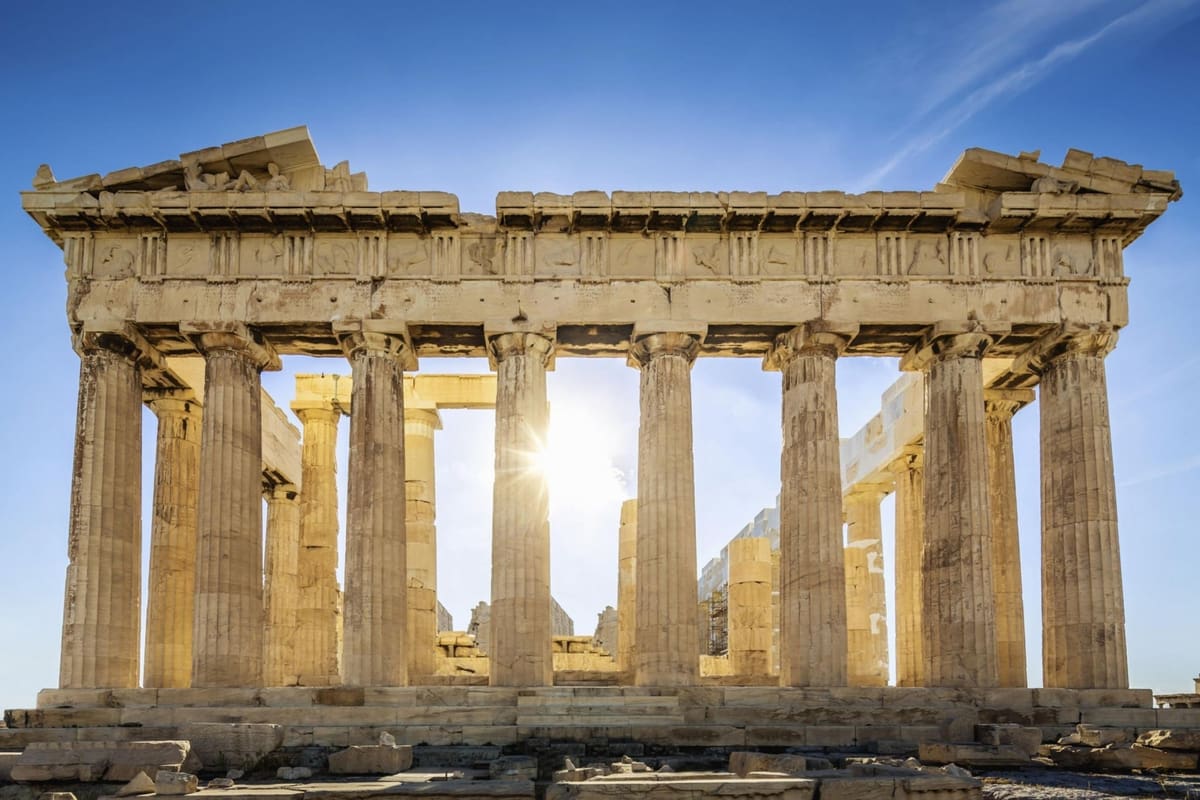
Acropolis tickets show the Parthenon up close, a temple 13.72 m high on the summit. Its platform measures 69.5 m by 30.9 m. Its Pentelic marble is white with a faint yellow tint. The marble shines golden in bright sunlight.
The name Parthenon comes from the Greek word parthénos, meaning maiden or virgin. Yet 5th-century BC building accounts call it simply ho naos, “the temple”. Its columns and inner walls lean slightly inward.
Acropolis tickets reveal the cella, the main inner room. It measures 29.8 m by 19.2 m. The front porch had tall windows about 3 m high and 2.5 m wide. Such windows were rare in Greek buildings. The back room held four columns, thought to be Ionic or Corinthian.
Metopes are carved stone panels above the columns. The temple has 14 on each short end and 32 on each long side. Their widths range from 1.175 m to 1.37 m. That way the carved band ends neatly at each corner. Building records date the carvings to 446–440 BC.
Acropolis tickets also bring visitors under the east pediment, the triangle above the front. It once held 10 to 12 statues. Only its corners keep figures: Helios’s chariot on the left, Selene on the right. River gods Kephisos and Ilissos are thought to fill the west corners.
- Statue height: Pliny the Elder gave the Athena Parthenos a height of 26 cubits, about 11.50 m.
- Gold: The statue used 40 to 50 talents of gold, between 1 and 1.3 tons.
- Floor hole: A hole 75.5 cm by 54 cm and 37 cm deep remains. It once held the statue’s central wooden beam.
The ancient marble road from Mount Pentelicus to the Acropolis ran downhill the whole way. Quarrymen cut the stone with iron picks, chisels and drills. They had to avoid the faults in the marble.
What do Acropolis tickets show at the Erechtheion?
Acropolis tickets show the Erechtheion, also called the Temple of Athena Polias. It once held an ancient statue of Athena made of olive wood. Building accounts from 409–404 BC survive. So the temple is unusually well dated.
Official decrees called it “the temple on the Acropolis within which is the ancient statue”. The accounts name two overseers, Philokles and Archilochos. The architect remains unknown. Six Ionic columns line the east entrance.
Acropolis tickets let visitors see an odd split level. The western floor lies 3 m lower than the eastern floor. Yet both parts share the same ceiling height. The Erechtheion also has no sculpture in its pediments, the triangles at each end.
Under the north porch, a crypt held a pit for snakes. The porch ceiling has an opening. People said one of Poseidon’s thunderbolts came through there. The frieze, a long carved band, used dark limestone. White marble figures were fixed onto it with iron dowels, or metal pins.
Acropolis tickets also show the Porch of the Maidens, with statues of women as columns. The only way in was an L-shaped stair from inside the temple. Certain scholars credit the maidens to Alkamenes and Agorakritos. Both were pupils of Phidias.
- Pandroseion: This walled area to the west held the altar of Zeus Herkeios under Athena’s sacred olive tree.
- Poseidon’s sea: A small opening on the east side of the Pandroseion let people view this “sea”.
- Missing day: Athenians dropped the second day of Boedromion from the calendar. They held it as the day of Athena and Poseidon’s contest.
Acropolis tickets bring old myths to life here. In one, the daughters of Cecrops opened a box holding baby Erichthonius. They saw two serpents inside and fled in terror. In London, St Pancras New Church, finished in 1822, copies the maidens as four terracotta caryatids.
What do Acropolis tickets show on the south slope?
Acropolis tickets cover the south slope below the rock. This slope holds theatres, music halls and a healing shrine. Its finds span from prehistoric graves to Roman times. Each ruin tells a different part of the long story of Athens.
The oldest finds here are very old indeed. A prehistoric burial mound came to light west of the Asklepieion at the end of the 19th century. Wells from 1600-1050 BC were found north of the Stoa of Eumenes. Holders of Acropolis tickets walk over these early layers.
Pericles built an odeon, a roofed music hall, beside the Theatre of Dionysus in 435 BC. It hosted the music contests of the Panathenaea festival. The hall covered about 4,000 square metres. Ninety inner pillars in nine rows of ten held up its roof.
The roof used timber from captured Persian ships. People said it copied the tent of the Persian king Xerxes. The hall burned during Sulla’s siege of Athens in 87–86 BC. King Ariobarzanes II of Cappadocia later rebuilt it. Its remains came to light between 1914 and 1931.
Acropolis tickets also bring visitors close to the Odeon of Herodes Atticus. It was the third odeon of ancient Athens, after those of Pericles and Agrippa. Herodes built it after his wife Regilla died in 160 AD. The traveller Pausanias saw it in 174 AD.
The seating bowl of the Odeon of Herodes Atticus is cut into the rock. It is 76 m across. A corridor 1.20 m wide splits it into two tiers. In 1826 a French general and his soldiers entered the besieged Acropolis through the Odeon. They brought food and gunpowder.
- Asklepieion: This healing shrine began during the Peloponnesian War, possibly because of the plague in Athens.
- Telemachos Monument: This two-sided marble pillar shows the healing god arriving from Epidaurus.
- Stoa of Eumenes: This covered hall, 17.65 m wide, had a second row of 32 Ionic columns inside.
Above the theatre, the Choragic Monument of Thrasyllos fills the mouth of a natural cave. It is a small temple front from 320–319 BC. With Acropolis tickets, visitors see this slope as a record of ancient life.
Which ancient sites near the rock go with Acropolis tickets?
Acropolis tickets open a ring of sites around the rock. The pass covers the Ancient Agora, the Roman Agora and Hadrian’s Library. It also covers Kerameikos, the Olympieio and the Lykeion. Each site shows another chapter of the city.
The Altar of the Twelve Gods in the Ancient Agora dates from 522/1 BC. Distances from Athens were measured from this spot. A marker from 500 BC calls itself the boundary stone of the Agora. It was found by Simon the cobbler’s house, where Socrates met his pupils.
Acropolis tickets also reach the Odeon of Agrippa, built around 15 BC in the middle of the Agora. It first seated about 1,000 people. The late 10th-century Church of the Holy Apostles also sits in the Agora. Only it and the Temple of Hephaestus survive intact there.
The Roman Agora is a courtyard building of 111 x 98 m. Covered walkways called stoas, shops and storerooms lined it. Its east gate had four Ionic columns of grey marble from Mount Hymettus. After the Heruli raid of AD 267, government and trade moved here and to Hadrian’s Library.
With Acropolis tickets, the Tower of the Winds is open too, since entry comes with the Roman Agora. Each of its eight sides is 3.20 m long. In the 18th century it served as a tekke, a meeting house of Dervishes.
- Fethiye Mosque: Built in 1456, it rises over an Early Christian basilica in the Roman Agora.
- Hadrian’s Library: Under Ottoman rule it housed the Voevode, the governor.
At Kerameikos, the small Eridanos river lay under eight or nine metres of earth. Excavators uncovered it in the 1960s. A jug from a Kerameikos grave, the Dipylon Oinochoe, bears the earliest known inscription in the Greek alphabet.
King Otto’s barracks rose at Hadrian’s Library in 1835. In the eleventh and twelfth centuries, a Byzantine settlement grew over the Olympieion. It had tanneries and an olive press. At the Lykeion, Aristotle founded his school in 335 BC and taught for about twelve years. Acropolis tickets thus link the rock to wider ancient Athens.
What damage and repair work do Acropolis tickets visitors see?
Acropolis tickets reveal a hill marked by war, removals and weather. Explosions, sieges and rusting clamps all left scars on the marble. New marble pieces now show long repair work. Visitors see both the damage and the careful fixes today.
A gunpowder explosion in 1656 badly damaged the Propylaea, the entrance gate. Yet the Ottomans still stored powder in the Parthenon. The Venetian siege lasted from 23 to 29 September 1687. Morosini called the shot that blew up the Parthenon the “miraculous shot”.
Holders of Acropolis tickets see where Elgin’s workers sawed Parthenon frieze blocks to make them lighter. The cut-off back parts still lie on the Acropolis. His team also removed cornice blocks, the top edge stones. This left the Parthenon open to rain.
Nikolaos Balanos made a costly mistake in his repairs. He wrapped iron clamps in concrete instead of lead. Water got in, the iron rusted and swelled, and the marble cracked. He also sawed pieces off two ancient blocks to join them into one.
Acropolis tickets also show newer threats. An earthquake in 1981 damaged the east front of the Parthenon. Rain made acidic by air pollution slowly dissolves the marble crystals. Experts call this decay “sugaring”.
- Rock work: Between 1979 and 1993, workers anchored loose rocks at 22 areas with stainless steel clamps.
- New marble: Restorers cast each gap and copy its points onto new Pentelic marble with a pointing device.
- Protected quarry: The ancient quarry on Mount Pentelicus supplies marble only for the Acropolis restoration.
The Acropolis Restoration Service was set up by a Presidential Edict in 1999. It organises and carries out the conservation work. UNESCO lists the Acropolis under five of its cultural criteria.
What do holders of Acropolis tickets need to know about the climb?
Acropolis tickets lead visitors up a limestone hill. The rock is trapezoid, with a fairly level top that slopes slightly from east to west. Its highest point lies on the east side. There, traces of the shrine of Zeus Polieus are carved into bedrock.
For holders of Acropolis tickets, the rock measures 300 m at its longest. At its widest, it measures about 150 m. Rainwater dissolved the softer parts of the limestone. This formed clefts and small caves. Open cracks on the site have been sealed with cement to reduce erosion from acid rain.
In the archaic period, a ramp replaced the bedrock path up to the gate. Under the emperor Claudius, a straight stairway of Pentelic marble rose to the Propylaea, the gateway. Its best estimated date is 42 AD. A sloping lane in the middle let animals for sacrifice climb too.
Holders of Acropolis tickets walk on paths by architect Dimitris Pikionis. He and his students laid them out from 1954 to 1957. He paved them with marble and clay pieces from demolished nineteenth-century buildings. These pieces sit among new marble and concrete.
- Peripatos: This one-kilometre ancient path circled the rock, linking north slope cave shrines to the south slope.
- Nike bastion: A small dog-leg stair, one with a sharp bend, led to Athena Nike’s temple.
- Lift route: Across the plateau, Athena Promachos’s pedestal and the Propylaea’s east side appear on the right.
The small plant Micromeria acropolitana flowers mainly in late spring and June. Ants carry its seeds into rock cracks. Botanists estimate at least 400 grow on the hill. Trampling by visitors is their biggest threat. Visitors with Acropolis tickets are better off staying on the paths.
Two other high places stand near the city. Lycabettus, at 277 m, is the highest point in central Athens. Hymettus, the mountain range east of the city, rises to 1,026 m at its top, called Evzonas.
When is the best season to use Acropolis tickets?
Acropolis tickets suit the mild months best, such as October. At the Neos Kosmos weather station, October averages a high of 24.1 °C. Its average low is 17.6 °C. Summer brings strong heat, while winter brings more rain days.
The Neos Kosmos station stands in downtown Athens, 85 m above sea level. There, July averages a high of 34.1 °C. In August, even the average daily low is 26.4 °C. On average, the hottest day of June reaches 36.1 °C, and August’s hottest day reaches 38.6 °C.
On 14 July 2023, the Athens suburb of Filothei recorded 43.4 °C. Officials announced a midday closure of the Acropolis. On 26 June 2007, Athens reached 46.2 °C. Holders of Acropolis tickets do well to plan around such heat.
At Elliniko on the coast, April gets 231.0 hours of sunshine. October gets 207.7 hours there. At Neos Kosmos, January averages a high of 14.1 °C and a low of 8.6 °C. At Elliniko, January has 12.9 rain days and 130.2 hours of sunshine.
- Summer sun: At Elliniko, June gets 336.0 hours of sunshine and August gets 341.0 hours.
- Dry months: June has only 3.6 rain days at Elliniko, while August downtown gets 5.4 mm of rain.
- Autumn nights: Downtown lows average 20.4 °C in September and 12.2 °C in November.
The Parthenon’s main entrance faced east. Its east pediment was the triangle above the front. It showed the chariot of Helios, the sun, rising at the left corner. Selene, the moon, sat at the right corner. Together they marked the course of a full day.
What do travelers ask about Acropolis tickets?
Acropolis tickets raise questions that go beyond entry. Travelers ask about other acropolises and the people behind the Parthenon. They ask why the temple lost its roof and how the rock formed. They also ask about the Temple of Athena Nike and the caryatids.
Are there other acropolises beyond the one on Acropolis tickets?
The plural of acropolis is acropolises, also written acropoleis or acropoles. Other well-known Greek examples are the Larisa of Argos and the Cadmea of Thebes. By the 2nd century AD, the Athenian Acropolis was a prime tourist destination. An unknown poet called it “the Greece of Greece.”
Who built the Parthenon seen with Acropolis tickets?
The architect Ictinus wrote a book about the Parthenon with Carpion. An ancient inscription names Callicrates as one architect of the Classical wall around the Acropolis. The sculptor Phidias was accused of stealing gold meant for the Athena statue inside. Plutarch says he died in prison.
Why does the Parthenon seen with Acropolis tickets have no roof?
A major fire in the 3rd century AD destroyed the roof and much inside. In the 4th century AD, a steeper wooden roof with clay tiles went up. After the explosion of 1687, nothing of the roof seems to have stayed. Six columns fell on the south side, eight on the north.
How did the rock behind Acropolis tickets form?
Under the hill lies Athens schist, a soft layered rock. It formed from mud and sand in a river delta about 72 million years ago. The limestone is about 30 million years older. Earth’s crust forces pushed it over the schist. Lykabettos, the Areopagus and Mouseion were shaped from the same rock sheet by wearing away.
What does the Temple of Athena Nike show to holders of Acropolis tickets?
The west frieze of the Temple of Athena Nike is a carved band. It shows Athenians defeating Corinthians, experts think. An older cult image on the bastion showed Athena seated. She held a pomegranate in her right hand and a helmet in her left.
What are the caryatids that holders of Acropolis tickets see?
Caryatids are female statues used as columns. A male statue doing the same job is called an atlas or a telamon. Among the earliest were those on Delphi treasuries, including the treasury of Siphnos from the 6th century BC. A caryatid with a basket on her head is a canephora, meaning basket-bearer.